
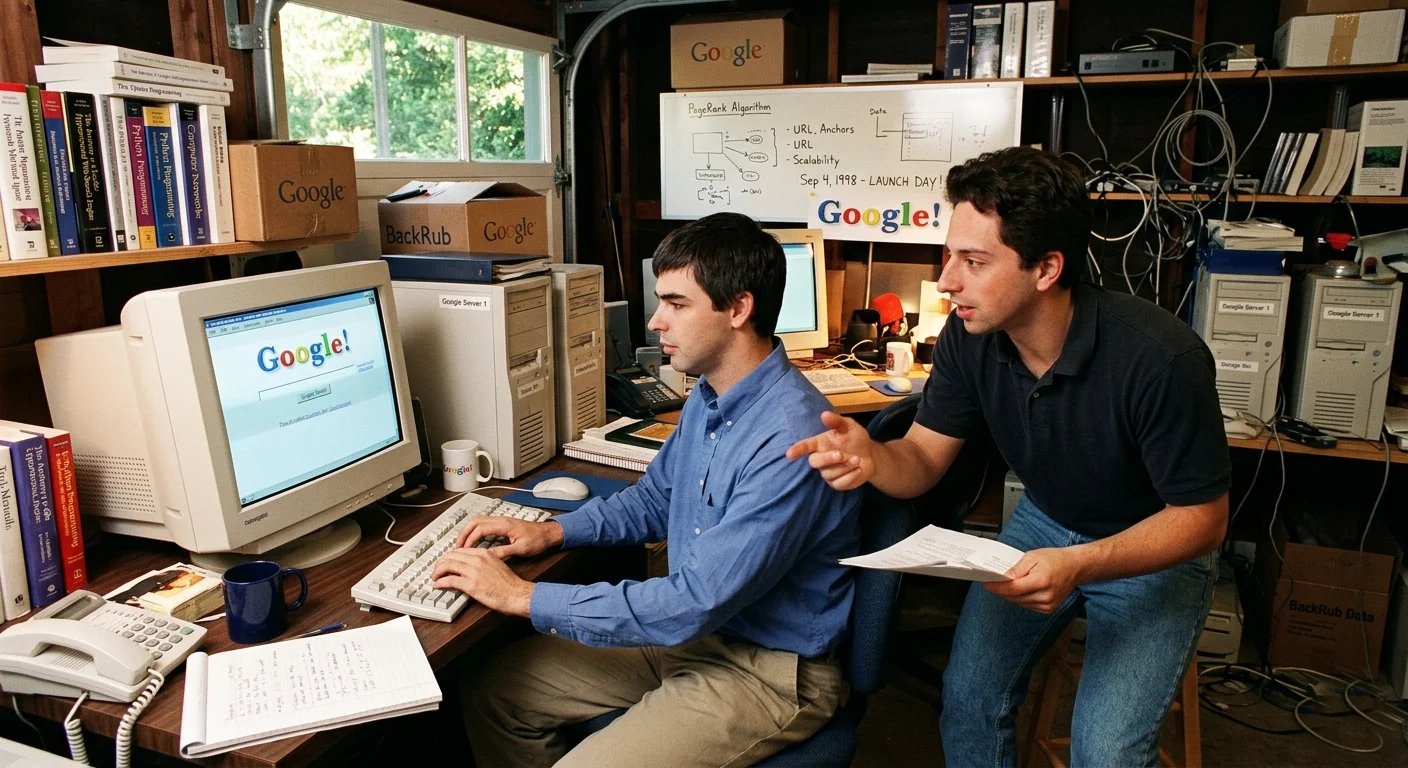
On September 4, 1998, two PhD students from Stanford University formally incorporated a company in a rented garage in Menlo Park, California. The company was called Google Inc., and it had been built on a deceptively simple idea: that the most important measure of a webpage’s value was not how many times a search term appeared in its text, but how many other valuable pages chose to link to it. Larry Page was twenty-five years old. Sergey Brin was also twenty-five. Between them, they had approximately $1 million in seed funding, a search algorithm that outperformed every existing competitor, and a stated mission of breathtaking ambition: to organize the world’s information and make it universally accessible and useful.
That garage on Santa Margarita Avenue in Menlo Park belonged to Susan Wojcicki, a Stanford friend who rented it to Page and Brin for $1,700 a month. The few employees who joined them that first September worked on folding tables and cheap chairs, their computers stacked in makeshift towers, in a space that also contained a washer, a dryer, and a ping-pong table that doubled as a conference room. Within six years they would take the company public in the largest technology IPO in history. Within a decade, Google would be the most visited website on earth. What began in a graduate student’s dormitory room in 1996 became, by almost any measure, the most consequential company of the digital age.
Larry Page, Sergey Brin, and the Academic Environment That Made Google Possible
The two men who founded Google came from remarkably similar backgrounds, a coincidence that may help explain why their intellectual partnership worked so effectively.
Larry Page was born on March 26, 1973, in East Lansing, Michigan, into a family saturated with computing and technology. His father, Carl Page, was a computer science professor at Michigan State University, and his mother, Gloria, taught computer programming at the same institution. Page grew up around computers from childhood, reportedly becoming the first child in his elementary school to submit homework printed from a computer printer. He graduated from the University of Michigan with a bachelor’s degree in computer engineering before enrolling in the doctoral program in computer science at Stanford University in 1995.
Sergey Brin was born on August 21, 1973, in Moscow, then part of the Soviet Union. His father, Michael Brin, was a mathematics professor, and his mother, Eugenia, was a researcher at NASA’s Goddard Space Flight Center. The family emigrated to the United States in 1979 when Sergey was six, fleeing the antisemitism that constrained Jewish academic careers in the Soviet Union. Sergey showed early mathematical aptitude, studied mathematics and computer science at the University of Maryland, and enrolled in Stanford’s computer science doctoral program in 1993, two years before Page arrived.
Their first meeting, in the summer of 1995, has passed into Silicon Valley legend. Brin was volunteering to give orientation tours for incoming students when Page joined one of his groups. By Page’s later account, the two disagreed about almost everything during that first encounter. By the following year, they had formed a research partnership that would change the world.
BackRub, PageRank, and the Algorithm That Transformed Internet Search
In 1995, the World Wide Web was growing at explosive speed, but searching it effectively was genuinely difficult. The existing search engines of the era, including AltaVista, Excite, HotBot, Lycos, and WebCrawler, all operated on essentially the same principle: they indexed webpages and ranked results by how frequently a search term appeared in a page’s text. This approach produced results that were easily manipulated and often deeply irrelevant, with pages stuffed with repeated keywords appearing at the top of results regardless of their actual quality or usefulness.
Larry Page, looking for a doctoral thesis topic, consulted his supervisor Terry Winograd and decided to study the mathematical properties of the World Wide Web by analyzing its link structure. Page later recalled Winograd’s encouragement to pursue this idea as “the best advice I ever got.” Page’s fundamental insight was an analogy to academic publishing: in academic research, the importance of a paper can be measured partly by how many other papers cite it, and the importance of those citing papers adds additional weight to the citation. He theorized that the same principle could be applied to the web. A page that many other pages linked to was likely more important and more relevant than one with few links, and a link from a page that was itself heavily linked carried more value than a link from an obscure page.
Page shared his ideas with Scott Hassan, a fellow Stanford student who began writing the code to implement Page’s crawler. Sergey Brin joined the project, captivated by its mathematical complexity and scale. Together, the three of them built BackRub, a search engine named for its method of tracking backlinks to estimate a site’s importance. The algorithm they developed to implement this approach became known as PageRank, a name that was simultaneously a tribute to Larry Page and a description of its function. PageRank treated every link on the web as a vote of confidence, weighting those votes by the quality of the voter. The result was a search engine that returned results of strikingly better quality than anything else available.
Scott Hassan, who wrote much of the original code and has sometimes been described as Google’s unofficial third founder, left the project before the company was formally incorporated. He later founded the robotics company Willow Garage in 2006. The first academic paper describing PageRank and the Google search engine prototype was co-authored by Page and Brin with their Stanford advisers Rajeev Motwani and Terry Winograd, and published in 1998 as “The Anatomy of a Large-Scale Hypertextual Web Search Engine.” That paper became one of the most downloaded academic documents in the history of computer science. Additional academic contributors to the project included Stanford professors Héctor García-Molina and Jeffrey Ullman.
By 1996, a working version of the BackRub search engine was operating on Stanford’s servers. In August 1996, this early version was made available to users beyond Stanford’s campus, and the response was immediate and enthusiastic. Page and Brin ran the search engine from Page’s dormitory room, using a collection of cheap computers assembled from spare parts. The project consumed so much of Stanford’s network bandwidth that it repeatedly caused the university’s servers to slow down, generating complaints from the university administration.
The Wikipedia article on the history of Google covers the full technical development of BackRub and PageRank at Stanford, the role of Scott Hassan and Alan Steremberg in early development, and the academic papers that laid the theoretical foundation for the world’s dominant search engine.
Renaming to Google, the First Funding, and the $100,000 Check
In 1997, Page and Brin decided to rename the search engine. They wanted a name that conveyed the enormous scale of the information they intended to index. They chose “googol,” the mathematical term for the number 1 followed by one hundred zeros, representing an unimaginably large quantity of data. When they registered the domain name, a misspelling crept in: they typed google.com rather than googol.com, and the misspelling stuck. Google, as a name, had a certain playful energy that suited the project perfectly, and it became one of the most recognizable brand names in the history of commerce.
By 1998, Page and Brin were handling tens of thousands of search queries per day on Stanford’s servers. They recognized that what they had built was commercially significant and began considering how to move beyond the university. They first attempted to sell PageRank and the entire technology to AltaVista for $1 million, hoping to return to their doctoral studies. AltaVista’s parent company, Digital Equipment Corporation, declined the offer, a decision that became one of the most expensive rejections in business history.
Seeking investors, Page and Brin were introduced to Andy Bechtolsheim, a co-founder of Sun Microsystems who was then a vice president at Cisco Systems. The meeting took place at 8:00 in the morning on the front porch of David Cheriton’s home in Palo Alto. Bechtolsheim asked for a quick demonstration of the search engine, watched it perform, and was immediately convinced. He pulled out his checkbook and wrote a check for $100,000 made out to Google Inc., a company that did not yet legally exist. Page and Brin had to open a corporate bank account before they could cash it. Bechtolsheim’s check gave them both the initial capital and the motivation to formally incorporate.
Additional early funding came from David Cheriton himself and from Jeff Bezos, the founder of Amazon. Faculty members at Stanford also invested small amounts. By September 1998, when Page and Brin officially incorporated Google Inc., they had assembled approximately $1 million in seed funding from these early believers.
September 4, 1998: Incorporation in the Garage at Menlo Park
The garage where Google was officially founded belonged to Susan Wojcicki, who was then working in marketing at Intel and who had purchased a house in Menlo Park that she rented out in part to help with the mortgage. Wojcicki later joined Google as an employee in 1999, its sixteenth hire, and went on to become one of the most powerful executives in technology, ultimately serving as the CEO of YouTube from 2014 to 2023.
On September 4, 1998, Google Inc. was officially incorporated in California. The founding team beyond Page and Brin included Craig Silverstein as the first employee, who joined as the director of technology and wrote a substantial portion of Google’s early software infrastructure. The garage office’s initial equipment included desks made from wooden doors balanced on sawhorses, computers stacked on shelving units, and the washer and dryer that continued to belong to Wojcicki. Employees, when they needed to think, would sit outside on the driveway.
The company processed approximately 10,000 search queries per day in September 1998. It moved quickly from the Menlo Park garage to offices in Palo Alto, then to Mountain View in 2003, where it established the Googleplex, the sprawling campus that became famous for its unusual workplace culture of free meals, recreational facilities, and the celebrated “20 percent time” policy that allowed employees to spend a day each week working on personal projects they believed could benefit the company. That policy produced some of Google’s most important products, including Gmail.
The Britannica article on Google’s founding and growth covers the company’s development from the PageRank algorithm through the IPO, the hiring of Eric Schmidt as CEO, and the expansion from a search engine into one of the most diversified technology companies in the world.
The First Years: Exponential Growth, Advertising, and the IPO
In June 1999, Google received $25 million in venture capital investment from two of Silicon Valley’s most prestigious firms, Kleiner Perkins Caufield and Byers, led by John Doerr, and Sequoia Capital, led by Michael Moritz. These firms rarely invested in the same company simultaneously, a fact that underscored the exceptional confidence both had in Google’s potential. By the time of this funding round, Google was already processing 500,000 queries per day, a figure that would grow to 200 million per day within five years.
The advertising model that would make Google one of the most profitable companies in history was developed gradually in the early 2000s. Google AdWords, launched in October 2000, allowed advertisers to bid on keywords and pay only when users clicked on their advertisements. The model, known as pay-per-click advertising, aligned advertisers’ costs directly with results and proved enormously attractive. Google’s advertising revenue grew rapidly, providing the financial foundation for the company’s extraordinary expansion into new products and services.
The extraordinary growth of the company created management challenges that Page and Brin, as academics and engineers rather than business operators, recognized they could not handle alone. In 2001, after considerable negotiation and the intervention of their venture capital backers, they agreed to hire Eric Schmidt as chairman and CEO. Schmidt had previously served as CEO of Novell and held a doctorate in computer science, giving him both executive experience and the technical credibility to work effectively with the founders. The arrangement became known as the “triumvirate,” with Schmidt managing day-to-day operations, Page as president of products, and Brin as president of technology. Schmidt served as CEO until 2011, when Page took over the role.
Google’s initial public offering on August 19, 2004, raised $1.66 billion and valued the company at $23 billion. It was conducted through an unusual Dutch auction format rather than the traditional investment bank-led IPO process, in a deliberate statement about the company’s unconventional nature. Page and Brin each became paper billionaires overnight. After the IPO, all three senior leaders requested that their base salary be reduced to $1 per year, a largely symbolic gesture given their substantial stock holdings but one that fit the company’s cultivated image of prioritizing mission over personal enrichment.
From Search Engine to Digital Empire: Google’s Products and Alphabet
The search engine that Page and Brin launched from a Stanford dormitory room in 1996 became the foundation for an ever-expanding range of products and services. Google News launched in 2002. Gmail, which offered a then-unprecedented one gigabyte of free email storage, launched on April 1, 2004, a date that caused many users to assume it was an April Fool’s joke. Google Maps launched in 2005. Google Chrome became the world’s most widely used web browser after its 2008 launch. YouTube was acquired in 2006 for $1.65 billion, a price that many analysts at the time considered excessive but that proved to be one of the most successful acquisitions in technology history.
In 2015, Page and Brin restructured Google under a new holding company called Alphabet Inc., with Google as its primary subsidiary. Page became CEO of Alphabet and Brin became President. In 2019, both stepped back from their executive roles, though they retained seats on Alphabet’s board and remained its largest individual shareholders. Sundar Pichai, who had joined Google in 2004 and risen through the ranks to become one of its most capable product executives, became CEO of both Google and Alphabet.
The History.com account of Google’s founding by Larry Page and Sergey Brin covers the September 4, 1998 incorporation and the broader story of how two doctoral students built a company that came to define the digital age.
Today, Google handles more than 8.5 billion searches per day, representing over 90 percent of the global search market. It is the world’s most visited website, its advertising business generates revenues exceeding $200 billion per year, and its parent company Alphabet is among the most valuable corporations in the world. The company that Andy Bechtolsheim funded with a handwritten $100,000 check on a Palo Alto porch in 1998 became, within a generation, one of the central institutions of human civilization, the primary interface through which most of the world’s population accesses most of the world’s information. The mission that Page and Brin wrote in their dormitory rooms at Stanford, to organize the world’s information and make it universally accessible and useful, proved not just achievable but transformative beyond any expectation they could have held on the September morning in 1998 when they signed the incorporation papers in a rented garage in Menlo Park.