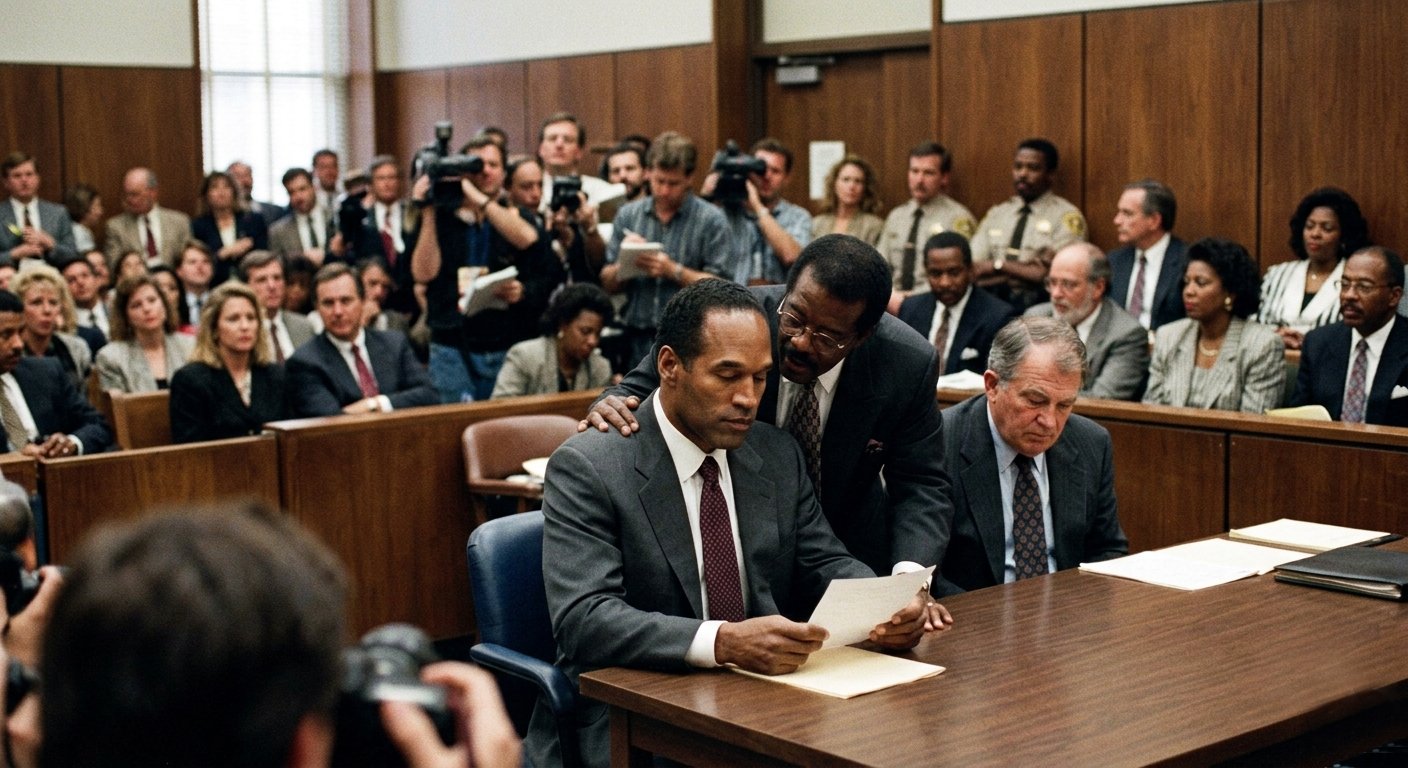
At 10:00 in the morning on October 3, 1995, court clerk Deirdre Robertson stood in Los Angeles Superior Court Courtroom 103 and read the words that brought the most watched criminal trial in American history to its stunning conclusion: “We the jury in the above-entitled action find the defendant, Orenthal James Simpson, not guilty of the crime of murder.” In the courtroom, Simpson exhaled and closed his eyes in relief. His lead attorney Johnnie Cochran Jr. pumped his fist and embraced him. From the gallery came the anguished moans of Kim Goldman, sister of one of the murder victims, and the cry of his mother Patti Goldman. Outside the courthouse, the nation’s reaction followed the same emotional split: millions of African Americans celebrated while millions of white Americans watched in dismay and disbelief.
An estimated 150 million Americans listened on radio or watched on television as the verdict was announced, representing approximately 91 percent of the American television audience at that hour. No single moment in the history of American television had attracted such collective attention since the moon landing. Foreign leaders including Boris Yeltsin of Russia had followed the case closely enough that when he stepped off a plane to meet President Clinton, his first question reportedly was: “Do you think O.J. did it?” The verdict that ended the 252-day trial answered the legal question but left every other question it had raised suspended indefinitely in American public life.
Who Was OJ Simpson and What Was His Background Before the Trial?
Orenthal James Simpson was born on July 9, 1947, in San Francisco, California. He grew up in the Potrero Hill neighborhood in conditions of poverty but demonstrated an exceptional athletic talent that transformed his life. At the University of Southern California, he won the Heisman Trophy in 1968 as the best collegiate football player in the country. He went on to a celebrated professional career as a running back with the Buffalo Bills, where in 1973 he became the first NFL player to rush for over 2,000 yards in a single season, and later with the San Francisco 49ers.
After retiring from football, Simpson had built a second career as a television personality, sports commentator, and actor, appearing in the Naked Gun film series. He was one of the most recognizable and commercially successful Black celebrities in America. In 1985, he married Nicole Brown, a waitress he had met in 1977 when she was eighteen years old. The marriage was troubled from the beginning, marked by documented episodes of domestic violence. In 1989, Simpson pleaded no contest to a charge of spousal battery after Nicole called the police during a violent altercation. The couple divorced in 1992.
What Happened on the Night of June 12, 1994: The Murders at Bundy Drive
On the evening of June 12, 1994, Nicole Brown Simpson and her friend Ronald Lyle Goldman were stabbed to death outside Nicole’s condominium at 875 South Bundy Drive in the Brentwood neighborhood of Los Angeles. Nicole was thirty-five years old. Goldman was twenty-five, a waiter and aspiring actor who worked at the Mezzaluna restaurant in Brentwood, where Nicole had dined that evening with family and friends.
Goldman had volunteered to return Nicole’s mother’s eyeglasses, which she had accidentally left at the restaurant. He drove to Nicole’s address around 10:15 p.m. What happened in the next minutes ended both their lives. Their bodies were discovered by a neighbor shortly after midnight, surrounded by extensive evidence including a bloody glove, a knit cap, and bloody footprints of an unusual shoe size.
Nicole’s two young children, Sydney and Justin Simpson, were found asleep in the house, unharmed. Nicole’s Akita dog was wandering the neighborhood with blood-soaked paws, its agitated behavior having drawn a neighbor’s attention. The murders were brutal: Nicole had suffered multiple stab wounds and a nearly severed neck. Goldman had been stabbed repeatedly, suggesting he had fought his attacker.
Investigators who examined the crime scene quickly identified several pieces of evidence pointing toward a single suspect. A bloody glove matching one found at the crime scene was discovered by LAPD Detective Mark Fuhrman at Simpson’s Rockingham Avenue estate. Drops of blood consistent with Simpson’s DNA were found on the walkway at Bundy Drive. In Simpson’s white Ford Bronco, investigators found blood that matched both victims. Simpson had a cut on his left hand that he could not satisfactorily explain.
The Bronco Chase: How 95 Million Americans Watched OJ Refuse to Surrender
When Los Angeles police issued a warrant for Simpson’s arrest on June 17, 1994, five days after the murders, he was given until 11:00 a.m. to surrender voluntarily. He did not appear. Instead, Robert Kardashian, one of Simpson’s close friends and lawyers, appeared before cameras and read a rambling note that Simpson had left behind, which many interpreted as a suicide message.
Simpson had fled the house of his friend Robert Kardashian in a white Ford Bronco driven by his old friend Al Cowlings, another former NFL player. With Cowlings driving and Simpson lying in the back seat clutching a revolver, the vehicle traveled slowly along the Los Angeles freeway system with a fleet of LAPD police cars following at a distance. The event became one of the strangest spectacles in American media history. Millions of Americans interrupted their daily lives to watch a slow-motion chase broadcast live from news helicopters. Crowds gathered on overpasses to cheer Simpson on. Some held signs reading “Go OJ Go.”
The chase lasted approximately ninety minutes. Cowlings spoke periodically with police negotiators, reporting that Simpson was threatening to kill himself. Just before 8 p.m., the Bronco pulled into the driveway of Simpson’s Rockingham estate. After an hour of tense negotiation, Simpson emerged. In the vehicle, police found $8,750 in cash, a disguise kit with a fake mustache and beard, Simpson’s American passport, and the loaded revolver. Simpson was arrested and charged with two counts of murder with special circumstances.
The Dream Team: Who Were OJ Simpson’s Lawyers?
Simpson’s personal attorney, Robert Shapiro, assembled what became known as the Dream Team, one of the most formidable and expensive criminal defense teams ever assembled in an American courtroom. The full team included Johnnie Cochran Jr., a charismatic and deeply experienced Los Angeles defense attorney who would eventually lead the defense and whose courtroom presence defined the trial’s most dramatic moments. F. Lee Bailey, then widely considered the most famous criminal defense attorney in the United States, joined as a key interrogator. Harvard Law professor Alan Dershowitz served as an appellate strategist. Barry Scheck, co-director of the Innocence Project and a leading expert in DNA evidence, handled the forensic science component. Robert Blasier focused on technical aspects of the evidence. Robert Kardashian, Simpson’s longtime friend, was admitted to the California bar specifically to sit at the defense table as a personal support.
Judge Lance Ito of Los Angeles Superior Court was assigned to preside. Ito was a well-regarded judge but would be widely criticized throughout the trial for his management of the proceedings and his apparent inability to control the courtroom’s theatrical atmosphere. The prosecution team was led by Marcia Clark, a seasoned deputy district attorney, and Christopher Darden, who joined the team partly to provide a Black prosecutorial voice to counter what the defense would argue was the racial dimension of the case.
The Britannica account of the OJ Simpson trial provides the full legal record of the case, the composition of the Dream Team, the prosecution’s case theory, and the jury’s deliberation process that produced the not-guilty verdict.
What Was the Evidence and How Did the Defense Attack It?
The prosecution’s case rested on what Marcia Clark called a “mountain of evidence.” This included Simpson’s blood found at the Bundy Drive crime scene; the blood of both victims found in Simpson’s Bronco and at his home; a bloody glove at Rockingham matching one found at Bundy; rare shoe prints at the crime scene matching a size 12 Bruno Magli shoe that few retailers carried; a knit cap containing fibers consistent with Simpson’s carpet and hair; and Simpson’s documented history of violent abuse against Nicole.
The defense attacked each element of this evidence with coordinated precision. Barry Scheck spent weeks cross-examining prosecution DNA experts, arguing that the testing procedures were riddled with contamination, mislabeling, and improper handling. The LAPD’s crime laboratory, Scheck argued, was a “cesspool of contamination.” The glove became one of the trial’s most theatrical moments when prosecutor Christopher Darden, against the advice of his colleagues, asked Simpson to put on the gloves in front of the jury. Simpson appeared to struggle with the gloves, which had shrunk after being soaked in Nicole’s blood and then improperly preserved. Cochran’s famous line in his closing argument branded the moment in the American consciousness: “If it doesn’t fit, you must acquit.”
The defense’s most powerful weapon was Detective Mark Fuhrman. Fuhrman had testified that he had discovered the bloody glove at Simpson’s estate, but defense investigators found tapes of an interview Fuhrman had given to screenwriter Laura Hart McKinny in which he used the word “nigger” forty-one times and boasted about fabricating evidence and brutalizing suspects. When played in court, the tapes destroyed Fuhrman’s credibility and allowed Cochran to argue that the entire evidence chain was compromised by a racist detective who had planted or tampered with evidence. Fuhrman subsequently invoked the Fifth Amendment when asked if he had planted any evidence, refusing to answer.
Who Were the Jurors and How Long Did They Deliberate?
The jury that decided Simpson’s fate was remarkable for both its composition and the brevity of its deliberations. After months of jury selection and an unusual process that had included numerous changes in juror composition during the trial itself, the final jury consisted of nine African American women, one African American man, one white woman, and one Hispanic woman.
The jury began its deliberations on the morning of October 2, 1995, after 252 days of testimony from 150 witnesses. The trial had produced a transcript of more than 50,000 pages. It had cost approximately $15 million to prosecute. The jury spent less than four hours in deliberation before announcing it had reached a verdict. Judge Ito delayed the announcement until the morning of October 3. The speed of the verdict shocked most legal observers, many of whom had expected the jury to take at least several days given the volume of evidence presented.
October 3, 1995: The Verdict That Divided America
When clerk Deirdre Robertson read the words “not guilty” on October 3, 1995, at 10:00 a.m. Pacific time, the nation split openly along racial lines. Cameras broadcasting from courtrooms, street corners, restaurants, and workplaces across the country captured scenes of jubilation in Black communities and shock and grief in white communities.
At Howard University’s law school in Washington, D.C., Black students erupted in celebration. In offices and living rooms across white America, the response was tears, anger, and incomprehension. Television channels broadcast the simultaneous reactions, and the racial divide was so stark and so visible that commentators described it as a window into two separate Americas that had been looking at the same country from entirely different perspectives. In one widely cited survey, 62 percent of white Americans believed Simpson was guilty while 68 percent of Black Americans believed he was not guilty.
The late Harvard Law Professor Charles Ogletree, who appears in PBS Frontline’s documentary on the verdict, later explained the celebration in terms of its broader symbolic meaning for Black Americans: it was not indifference to the victims, he argued, but recognition that the justice system had consistently failed Black defendants who lacked Simpson’s resources. The acquittal, for many, represented a rare instance in which a Black man with a skilled legal team had received the same aggressive, creative defense that wealthy white defendants took for granted.
The History.com account of OJ Simpson’s acquittal covers the verdict announcement, the immediate public reaction across racial lines, and the subsequent civil trial that produced a very different finding on Simpson’s responsibility for the deaths.
The Civil Trial: How a Second Jury Reached a Different Conclusion
Following his criminal acquittal, OJ Simpson was sued for wrongful death in civil court by the families of both victims. The civil trial began in October 1996 in Santa Monica, with a predominantly white jury. The standard of proof in a civil case is lower than in a criminal case: rather than guilt beyond a reasonable doubt, the plaintiff needs to prove liability by a preponderance of the evidence, meaning it was more likely than not that the defendant caused the deaths.
In February 1997, the civil jury found Simpson liable for the wrongful deaths of Nicole Brown Simpson and Ronald Goldman. The families were awarded a total of $33.5 million in compensatory and punitive damages. Fred Goldman, Ronald’s father who had been a constant presence at both trials, greeted the verdict with both relief and grief. Kim Goldman, Ronald’s sister, continued for decades to pursue the Goldman family’s legal efforts to collect from Simpson.
Simpson had few assets remaining after his criminal defense costs and managed to avoid paying the vast majority of the judgment against him. His NFL pension, which California law protected from civil judgment, provided him a steady income. He moved to Florida, which has strong asset protection laws. He co-wrote a hypothetical account of the murders titled “If I Did It,” which public outrage prevented from being published in 2006, though a bankruptcy court subsequently awarded the rights to the Goldman family, who published it in 2007.
The Legacy of the OJ Simpson Trial: Race, Justice, and American Media
The OJ Simpson trial permanently changed American legal culture, media practice, and public conversation about race and the justice system. It was the first trial to demonstrate the potential reach of gavel-to-gavel courtroom television, transforming legal proceedings into entertainment while simultaneously raising serious questions about whether that transformation corrupted the process itself. Most American jurisdictions subsequently restricted or prohibited cameras in courtrooms, at least in part as a response to the Simpson trial’s carnival atmosphere.
The trial produced a lasting cultural vocabulary. “If it doesn’t fit, you must acquit” entered the language. The Dream Team became the standard by which subsequently assembled celebrity legal teams were measured. Mark Fuhrman became synonymous with police racism. Marcia Clark and Christopher Darden became the public faces of prosecutorial defeat. Judge Ito was parodied on late-night television throughout the trial. Kato Kaelin, the celebrity-seeking houseguest who lived in Simpson’s guesthouse and provided key testimony about Simpson’s movements on the night of the murders, became an exemplary figure of accidental celebrity.
Robert Kardashian, whose reading of Simpson’s apparent farewell note in June 1994 was his first public appearance, had three daughters and a son whose subsequent fame as the Kardashian family transformed American celebrity culture in ways that dwarfed anything connected to the trial itself. Kardashian died of cancer in September 2003, estranged from Simpson, reportedly having privately concluded his former friend was guilty.
The Wikipedia article on the OJ Simpson murder trial provides the complete record of the criminal trial, including the full composition of both legal teams, every major evidentiary controversy, the jury selection process, and the post-verdict civil proceedings.
Simpson himself lived the rest of his life in the shadow of the verdict that had freed him. In September 2007, he led a group of men into a Las Vegas hotel room at gunpoint to recover sports memorabilia he claimed had been stolen from him. He was arrested, charged with multiple felonies including armed robbery and kidnapping, and on October 3, 2008, exactly thirteen years after his murder acquittal, he was found guilty on all twelve counts. He was sentenced to a minimum of nine years in prison and was released on parole on October 1, 2017. He died of prostate cancer on April 11, 2024, in Las Vegas, maintaining his innocence in the murders to the end.
The OJ Simpson verdict of October 3, 1995, stands as one of the defining moments of late twentieth-century American life: a legal event that revealed with uncomfortable clarity how differently Americans experienced their country’s institutions depending on the color of their skin, and how much the truth of what happened on a June night in Brentwood remained permanently, infuriatingly contested.