
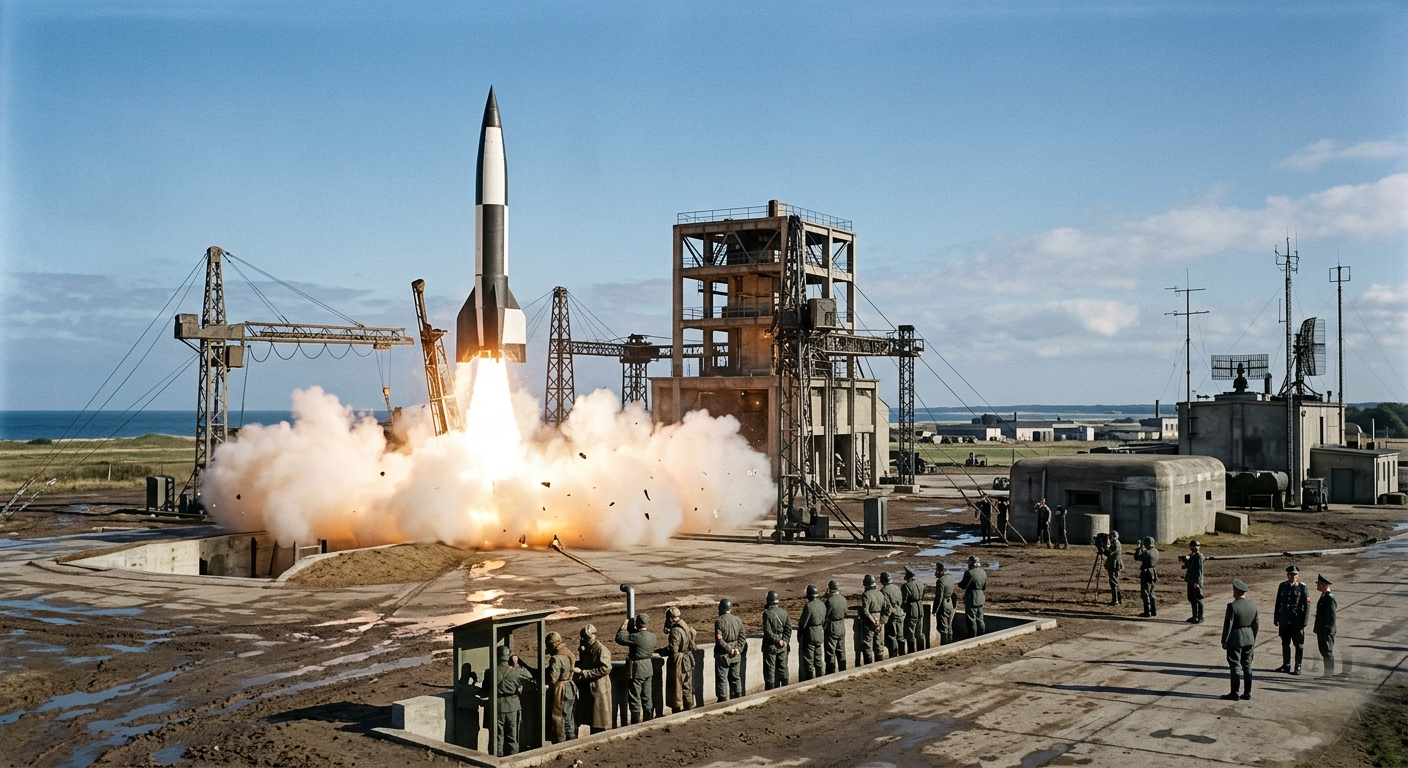
On October 3, 1942, at the Army Research Center on the island of Usedom at Peenemünde on Germany’s Baltic coast, a slim 14-meter rocket designated Aggregat 4, Versuchsmuster 4 (V-4), roared to life on its launch pad. The engine burned for 58 seconds. The rocket climbed to an altitude of approximately 85 to 90 kilometers, crossing to the edge of the upper atmosphere. It then arced downward in a ballistic trajectory, traveling approximately 190 kilometers downrange before impacting the Baltic Sea. The entire flight lasted 296 seconds.
General Walter Dornberger, the military commander of the Peenemünde program, reportedly turned to his chief scientist, a thirty-year-old engineer named Wernher von Braun, and told him: “Do you realize what we accomplished today? Today the spaceship was born.” It was not yet called the V-2. That name, an abbreviation of Vergeltungswaffe Zwei, or “Vengeance Weapon 2,” would come later, assigned by Nazi propaganda. But the technology that lifted off from Prüfstand VII on October 3, 1942, was genuinely revolutionary. It was the world’s first successful flight of a long-range ballistic missile, and the direct ancestor of every rocket that would take human beings to the Moon.
The German Rocket Program: From the VfR to Peenemünde
The path that led to October 3, 1942, began in the 1920s with a community of amateur rocket enthusiasts whose scientific ambitions far exceeded their political circumstances. Germany’s interest in rocketry had been fired largely by the theoretical work of Hermann Oberth, a Romanian-born German physicist whose 1923 book The Rocket into Interplanetary Space argued mathematically that liquid-propellant rockets could achieve orbital and interplanetary flight. Oberth’s work inspired the founding of the German Society for Space Travel, known as the Verein für Raumschiffahrt or VfR, in 1927.
The VfR became a laboratory for practical rocket experimentation. A young aristocrat named Wernher Magnus Maximilian Freiherr von Braun, born in Wirsitz, Prussia, on March 23, 1912, read Oberth’s book as a teenager and was so captivated by its possibilities that he taught himself calculus and trigonometry in order to understand the physics it described. He joined the VfR and quickly established himself as one of its most gifted and energetic members. By the time he was a graduate student at the Technische Hochschule in Charlottenburg, he was assisting Oberth directly in liquid-fueled rocket motor tests.
The German Army’s interest in rockets was not primarily scientific. Artillery was regulated by the Treaty of Versailles, which limited Germany’s conventional military capabilities severely, but rockets were not explicitly covered by the treaty. The Army saw in rocketry a potential loophole: long-range weapons that could deliver warheads to enemy targets while circumventing the treaty’s restrictions. In late 1932, von Braun was recruited by the German Army’s ordnance department under Captain Walter Dornberger to develop liquid-fuel missiles. On July 27, 1934, von Braun received his doctorate in physics from the University of Berlin, having submitted a classified dissertation on liquid-propellant rocket engines.
By the time Adolf Hitler came to power in 1933, von Braun had already committed his career to the Army’s program. In 1937, the rocket research group moved from its initial testing grounds near Berlin to the remote, heavily forested peninsula of Peenemünde on Germany’s Baltic coast, where secrecy could be maintained and long-range test firings could be conducted over the open sea. The new facility, officially the Heeresversuchsanstalt Peenemünde or HVP, was staffed by the best engineers and scientists in Germany, well-funded by the Wehrmacht, and equipped to develop weapons of a scale and sophistication that no other country was attempting.
Wernher von Braun, Walter Dornberger, and the Aggregat Series
The development program that produced the V-2 proceeded through a series of prototype rockets known as the Aggregat series. Each was larger and more technically ambitious than the last, and each built on the lessons of its predecessors. Von Braun was the technical director of the program, responsible for the design and engineering of the rockets. Dornberger, who had been promoted to General by the time of the V-2’s first successful flight, managed the program’s military and administrative dimensions.
The Aggregat 1 and Aggregat 2 rockets of the early 1930s were small experimental vehicles that proved the basic principle of liquid-fueled rocketry. The Aggregat 3 demonstrated the guidance and control systems that would be needed for a useful weapon. The Aggregat 4, the rocket that became the V-2, was the program’s ultimate achievement: a weapon capable of carrying a one-ton warhead to targets 200 miles away at supersonic speed, with no possibility of interception by any existing defense system.
The first prototype Aggregat 4, designated Versuchsmuster 1, was damaged during engine tests on April 18, 1942, before it could be launched. Versuchsmuster 2 was launched on June 13, 1942, reached approximately 4,572 meters, but its guidance system failed and it crashed into the Baltic Sea a short distance from the launch pad. Versuchsmuster 3 suffered a structural failure on August 16, 1942, and destroyed itself shortly after launch. The program’s scientists and engineers analyzed each failure carefully and made the adjustments that eventually produced a working vehicle. That vehicle was Versuchsmuster 4, the fourth prototype, which flew successfully on October 3, 1942.
The Wikipedia article on the V-2 rocket provides the comprehensive technical history of the Aggregat program, the specifications of the weapon, and the full account of its development, deployment, and postwar legacy.
October 3, 1942: The Launch That Changed Everything
The launch on October 3, 1942, took place from Prüfstand VII, the primary test stand at Peenemünde. The rocket’s engine consumed 126 kilograms of a mixture of ethanol and liquid oxygen per second, emitting a distinctive shriek as it ignited. The thrust of the engine accelerated the fully loaded rocket, which weighed approximately 12,700 kilograms, to a speed of approximately 5,760 kilometers per hour. The engine burned for about 58 seconds, during which time the rocket climbed to the edge of space.
The guidance system that steered the rocket combined a gyroscopic inertial guidance system with aerodynamic steering tabs on its four large fins and additional vanes in the engine exhaust plume. An electronic accelerometer measured the rocket’s velocity and shut off the engine at the precise calculated moment to put the rocket on the correct ballistic trajectory. The guidance system was one of the most sophisticated pieces of technology in the world at the time of its development.
When the engine shut off and the rocket crossed into near-space, it became an unpowered projectile following a parabolic arc, falling back to earth under gravity. On impact, it was traveling at approximately 2,880 kilometers per hour, well into the supersonic range. At these speeds, the rocket arrived entirely without audible warning. The sonic boom of its passage arrived after the impact, meaning that people on the ground heard the explosion of the rocket arriving before they heard the sound of it coming. This characteristic made the V-2 fundamentally different from any previous weapon and psychologically devastating to populations under attack.
The success of the October 3 launch validated everything the Peenemünde team had spent a decade building. Dornberger’s statement to von Braun about the spaceship being born was not mere euphoria. The rocket had genuinely crossed into the upper limits of the atmosphere, reaching altitudes that no human-made object had previously reached. On June 20, 1944, a later test of the rocket would officially cross the Kármán line at 100 kilometers altitude, making it technically the first human-made object to reach outer space.
Hitler, the Political Response, and the Decision for Mass Production
Despite the technical triumph of October 3, 1942, the path from a successful test flight to operational deployment was neither immediate nor straightforward. Adolf Hitler had been skeptical of the rocket program throughout its development. He had rejected earlier proposals to prioritize the project and had in some cases actively discouraged the pace of development. A dream he reportedly had about the A-4 not reaching England contributed to his hesitation.
The decisive shift in Hitler’s position came on July 7, 1943, when Dornberger and von Braun traveled to Hitler’s Wolf’s Lair headquarters in East Prussia to brief him personally. The briefing included a color film showing the successful October 3, 1942 launch, along with scale models of proposed launch facilities and supporting vehicles. When Hitler saw the film, his reaction was one of astonishment and sudden enthusiasm. He reportedly said: “Why was it I could not believe in the success of your work? If we had had these rockets in 1939 we should never have had this war.” He immediately gave Peenemünde the highest priority in the German armaments program.
Albert Speer, the Minister of Armaments and War Production, was present at the Wolf’s Lair briefing and supported the program’s acceleration. On December 22, 1942, before the full briefing but after the successful test, Hitler had already signed an order for mass production of the weapon. Karl Saur of Speer’s ministry planned to build 2,000 rockets per month across multiple facilities.
The weapon’s formal name, Vergeltungswaffe Zwei, or V-2, was given to it by Joseph Goebbels’s propaganda ministry as part of a deliberate effort to tie the weapon to the concept of retaliation against Allied bombing campaigns. The naming was politically calculated: by calling it a “vengeance weapon,” the Nazi government was both acknowledging the Allied air campaign and promising German audiences that technological retribution was at hand. The V-1 flying bomb was the Vergeltungswaffe 1 in the same system.
Operation Hydra and the Move Underground
The success of the rocket program made Peenemünde a target. British intelligence, informed by signals intelligence and aerial reconnaissance, had identified the facility as the source of Germany’s secret weapon development. On the night of August 17 to 18, 1943, the Royal Air Force launched Operation Hydra, a massive bombing raid against Peenemünde that sent 596 Lancaster, Halifax, and Stirling bombers against the facility.
The raid caused significant damage and killed 735 people, including Dr. Walter Thiel, the program’s chief propulsion engineer, along with his entire family, and Chief Engineer Walther. These losses were significant setbacks. However, the raid did not destroy the program. Key personnel survived, and the critical manufacturing equipment was relocated to a new underground facility in central Germany.
The new production facility was called the Mittelwerk, located in a network of tunnels in the Kohnstein mountain near Nordhausen in the Harz Mountains. The Mittelwerk was built and operated using forced labor from the Mittelbau-Dora concentration camp, which was established specifically to serve the underground factory. The conditions imposed on the forced laborers were deliberately lethal. Workers were subject to starvation, beatings, and summary execution. Estimates of the death toll among the approximately 60,000 prisoners who passed through Mittelbau-Dora range from 10,000 to 20,000, with some accounts suggesting that 160 workers died each day at the peak of production. The number of people killed building V-2 rockets exceeded the number of people killed by V-2 rockets in combat.
The Britannica article on the V-2 rocket covers the weapon’s technical specifications, its operational deployment against London, Antwerp, and other cities, and the human cost of its production through the forced labor system at the Mittelwerk.
Operational Deployment: The V-2 Campaign Against London and Antwerp
The first operational V-2 launches occurred on September 6, 1944, when two rockets were fired at Paris. On September 8, two V-2s were fired at London, beginning the campaign against Britain. Over the following seven months, more than 1,100 V-2 rockets struck Britain, with the last falling on March 27, 1945. Antwerp, the critical Allied supply port in Belgium, received approximately 1,700 V-2 strikes, making it the most heavily bombarded city by the weapon during the war.
The V-2’s tactical characteristics were unique among World War Two weapons. It traveled at approximately 5,500 kilometers per hour, more than five times the speed of sound. No existing anti-aircraft system could intercept it, and no early warning was possible: the rocket arrived before the sound of its approach. The only countermeasures available to the Allies were attacks on launch sites and production facilities. Allied intelligence worked to identify and bomb these locations throughout the campaign, with limited success.
Despite its terrifying characteristics, the V-2 was less militarily effective than its designers hoped. Its guidance system, while extraordinarily advanced for its time, was not precise enough to consistently strike specific targets. Rockets intended for military or industrial targets frequently missed by several kilometers, reducing their impact on Allied military capability. A V-2 could only hit a general area, not a specific building or facility. Its primary effect was psychological, killing civilians and creating fear without decisively affecting the Allied war effort. The German Army’s own assessment acknowledged that the rockets hit their intended targets only approximately one third of the time.
Total V-2 casualties are estimated at approximately 9,000 civilians and military personnel killed across all the countries attacked. The Belgian city of Antwerp suffered particularly: a V-2 strike on a cinema crowded with Allied servicemen and civilians on December 16, 1944 killed 567 people, the single most lethal V-2 strike of the war.
Von Braun’s Surrender and Operation Paperclip
By early 1945, the military collapse of Germany was evident to everyone at Peenemünde and the Mittelwerk. Wernher von Braun and his senior colleagues spent the final months of the war carefully managing their own futures. Von Braun had concluded that Germany would lose the war and that his knowledge and his team represented resources that any victor would want to acquire.
He was arrested briefly by the SS in March 1944 on charges of making statements suggesting his primary interest was space travel rather than weapons, but was released through the intervention of Dornberger. As Allied forces closed in from east and west in early 1945, von Braun disobeyed a direct SS order to destroy the technical documentation of the rocket program and instead hid it in an abandoned mine shaft in the Harz Mountains.
Von Braun and approximately 500 of his key personnel surrendered to American forces in the Austrian Alps in early May 1945. Shortly before the American forces arrived, von Braun’s brother Magnus had cycled down a mountain road until he found an American soldier, declaring in English: “My name is Magnus von Braun. My brother invented the V-2. We want to surrender.” The Americans accepted with alacrity.
The subsequent transfer of von Braun’s team to the United States was conducted under the classified program Operation Paperclip. Colonel Holger Toftoy and Major James Hamill transported approximately 125 key German scientists and engineers to Fort Bliss, Texas, along with more than 100 complete V-2 rockets and tens of thousands of pages of technical documentation. The program eventually brought approximately 1,600 German scientists, engineers, and technicians to the United States.
The NASA biography of Wernher von Braun covers his postwar career at Fort Bliss, the Redstone Arsenal, and NASA’s Marshall Space Flight Center, where he developed the Saturn V rocket that carried American astronauts to the Moon.
The V-2’s Legacy: ICBMs, the Space Race, and the Road to the Moon
The technology demonstrated in the October 3, 1942 launch proved to be one of the most consequential technical achievements of the twentieth century, not because of what it did to military targets in the Second World War but because of what it made possible afterward. Both the United States and the Soviet Union immediately recognized the V-2 as the foundation for the next generation of long-range weapons and eventually for space exploration.
The Soviet Union also captured significant V-2 technology and German personnel. Sergei Korolev, the chief designer of the Soviet space program, studied captured V-2 documentation extensively, and the Soviet R-1 rocket was a direct copy of the V-2. The R-1 program gave way to a series of increasingly powerful rockets that eventually produced Korolev’s R-7, the rocket that launched Sputnik in 1957 and remains the basis of the Soyuz launch vehicle still in use today. The American and Soviet intercontinental ballistic missiles of the Cold War were both direct technical descendants of the V-2.
Von Braun’s American career took him from Fort Bliss through the Redstone Arsenal in Huntsville, Alabama, to NASA’s Marshall Space Flight Center, which he directed from its founding in 1960. The Redstone rocket that launched Alan Shepard, America’s first astronaut, on his suborbital flight on May 5, 1961, was a direct descendant of the V-2. The Saturn V that carried Apollo 11 to the Moon on July 20, 1969, was the direct culmination of the engineering tradition von Braun had begun on October 3, 1942.
The History.com account of Germany’s first successful V-2 rocket test covers the October 3, 1942 launch and its immediate military significance, placing the event in the broader context of World War Two and the development of modern ballistic missile technology.
The V-2’s story is ultimately one of profound moral ambiguity. The same technology that provided von Braun with an opportunity to reach toward the stars required, in practice, the deaths of tens of thousands of enslaved workers to build, and the deaths of thousands of civilians to deploy. The spaceship and the vengeance weapon were the same object. Understanding October 3, 1942, means holding both dimensions simultaneously: the genuine brilliance of the engineering achievement, and the human suffering that made it possible.