
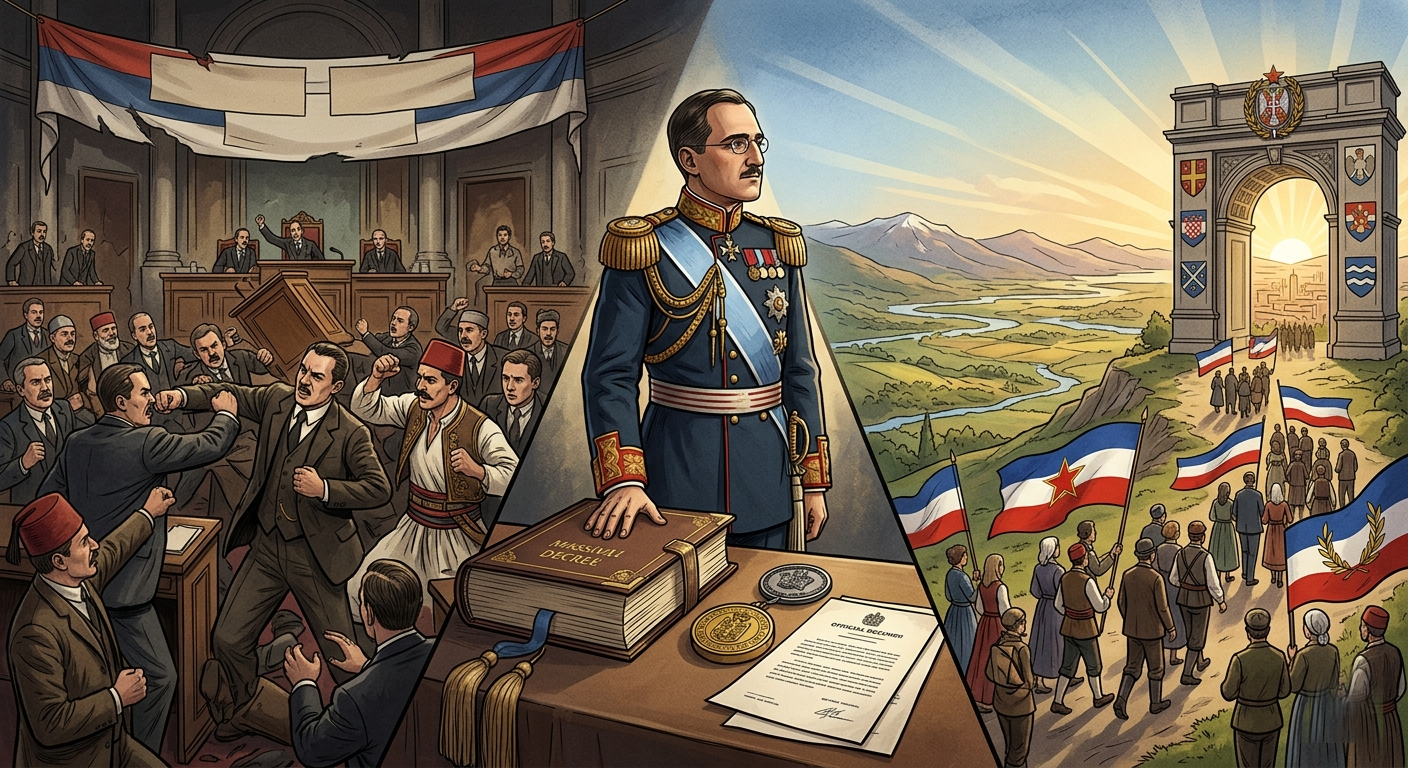
On October 3, 1929, King Alexander I of the Kingdom of Serbs, Croats and Slovenes signed a royal decree that changed the name of his country to the Kingdom of Yugoslavia. The word Yugoslavia derives from the South Slavic words “Jug” (south) and “Slavija” (land of the Slavs), meaning literally the “Land of the South Slavs.” On the same day, the king reorganized the country’s internal administrative divisions from thirty-three oblasts into nine new banovinas, named after rivers rather than historical regions, in a deliberate attempt to erase the boundaries that kept his peoples divided.
The renaming was not a celebration. It was an act of political desperation, the culmination of more than a decade of ethnic tension, constitutional crises, and parliamentary violence that had brought the young South Slavic state to the edge of disintegration. Alexander had suspended the constitution nine months earlier, on January 6, 1929, and imposed a personal dictatorship. The renaming from the Kingdom of Serbs, Croats and Slovenes to Yugoslavia was his attempt to forge by decree the national unity that politics had failed to produce through consent.
The Birth of the Kingdom of Serbs, Croats and Slovenes in 1918
The state that would eventually be renamed Yugoslavia had come into existence in the chaos at the end of the First World War. The Austro-Hungarian Empire, which had controlled much of the Balkans for generations, collapsed completely in the autumn of 1918 as Germany and its allies faced defeat on all fronts.
The South Slavic peoples who had been subjects of the Habsburg monarchy, including the Croats, Slovenes, and Bosnians, formed the provisional State of Slovenes, Croats and Serbs in October 1918. This state had no firm borders, faced territorial claims from Italy and other neighbors, and lacked international recognition. Its leaders quickly determined that union with the Kingdom of Serbia, which had fought on the Allied side and emerged victorious, offered the best prospect for security and stability.
On December 1, 1918, a delegation of the People’s Council of Slovenes, Croats and Serbs arrived at the Serbian royal court in Belgrade and presented a formal request for unification to Prince Regent Alexander Karadjordjevic. Alexander, acting in the name of his ailing father King Peter I, accepted the petition and proclaimed the creation of the Kingdom of Serbs, Croats and Slovenes. It was the first sovereign state uniting South Slavic peoples who had spent centuries under Ottoman and Austro-Hungarian domination.
The Founding Disagreement: Centralism Versus Federalism
The fundamental conflict that would torment the new kingdom and ultimately drive Alexander toward dictatorship was present from the very first day of its existence. The Serbs and the Croats held profoundly different views about what kind of state they had just created.
Serbian leaders, drawing on the memory of Serbian military victories in the Balkan Wars and World War One, argued that Serbia had liberated the South Slavic peoples and that the new kingdom should be organized as a centralized state with power concentrated in Belgrade. The Serbian view was effectively endorsed by the Vidovdan Constitution of June 28, 1921, a centralist document adopted on a day sacred to Serbian national memory but one that the Croat representatives largely refused to vote for. The date, St. Vitus’s Day, the anniversary of the Battle of Kosovo Field in 1389, was chosen with deliberate symbolic weight that Croat and Slovene leaders found deeply alienating.
The Croats, led by Stjepan Radić and his Croatian Peasant Party, demanded a federal structure that would preserve the historical identity of Croatia and guarantee genuine autonomy to the different regions. Radić boycotted the Skupstina, the national parliament, for extended periods, refusing to recognize the legitimacy of decisions taken without the full participation of all the kingdom’s peoples. The Slovenes, led by Anton Korosec, generally favored a more cooperative approach but shared the Croat concern about Serbian dominance of the central state.
King Alexander: From Prince Regent to King to Dictator
Alexander Karadjordjevic had been born on December 16, 1888, in Cetinje, Montenegro, the second son of Prince Peter Karadjordjevic and Princess Zorka of Montenegro. He had grown up in exile with his father, spent years in Russia at the imperial court, and returned to Serbia in 1909 when his brother George renounced his claim to the throne. He commanded Serbian forces in both Balkan Wars of 1912 and 1913 and served as Supreme Commander during the First World War, sharing the famous Serbian retreat through Albania in the winter of 1915 and returning triumphantly to Belgrade in October 1918.
On June 24, 1914, his father’s declining health had led to Alexander’s appointment as Prince Regent of Serbia. He served in this capacity throughout the war and proclaimed the Kingdom of Serbs, Croats and Slovenes on December 1, 1918. When Peter I died on August 16, 1921, Alexander became King, inheriting both a throne and a deeply unstable multinational kingdom.
On June 8, 1922, he married Princess Marie of Romania, daughter of King Ferdinand I of Romania and Princess Marie of Edinburgh, a granddaughter of Queen Victoria. The marriage was intended to cement Yugoslavia’s alliance with Romania against the revisionist powers, Hungary and Bulgaria, which both sought to recover territories lost after the First World War.
The Wikipedia biography of Alexander I of Yugoslavia covers the full arc of his reign from his proclamation of the kingdom in 1918 through his consolidation of power and eventual assassination, with detailed accounts of the parliamentary crises that led to his dictatorship.
The Murder in Parliament and the Collapse of the Constitutional System
The crisis that directly triggered the royal dictatorship came on June 20, 1928, when a Montenegrin Serb deputy named Punisa Racic entered the floor of the Skupstina and opened fire on opposition members of the Croatian Peasant Party. Two deputies died immediately on the floor of the chamber. Stjepan Radic, the most important Croatian political leader since the kingdom’s founding and the man who had represented Croat national aspirations more powerfully than any other figure, was gravely wounded. He died on August 8, 1928, from his wounds.
The murder of Radic was a catastrophe for the kingdom’s political life. The Croatian deputies immediately withdrew from the Skupstina, declaring they would not return to a parliament where their representatives had been shot. They gathered in Zagreb, the Croatian capital, and some leaders began openly discussing separation from the kingdom. Vladko Macek, who succeeded Radic as leader of the Croatian Peasant Party, refused to participate in any parliamentary arrangement without a fundamental restructuring of the state.
Alexander found himself unable to form an effective government without Croatian participation, unable to negotiate a constitutional compromise that satisfied both Serb and Croat demands, and facing the genuine possibility of the kingdom’s dissolution. He appointed Anton Korosec, the Slovene Catholic priest who led the Slovene People’s Party, as prime minister in an attempt to find a neutral figure capable of stabilizing the situation. The effort failed. The political system had broken down entirely.
January 6, 1929: The Royal Dictatorship
On January 6, 1929, King Alexander acted. He abolished the Vidovdan Constitution, prorogued the National Assembly indefinitely, and declared a personal royal dictatorship. In a proclamation to the nation, he stated that parliamentary democracy had failed to serve the interests of national unity and that extraordinary measures were necessary to preserve the state. He banned all political parties organized on ethnic, religious, or regional lines, which in practice meant banning every significant party that existed.
Alexander appointed General Petar Zivkovic as prime minister, a military man whose loyalty was personal rather than political. The country was placed under effectively martial administration. Civil liberties were suspended. Political opponents were arrested, exiled, or simply removed from public life. The Communist Party of Yugoslavia had already been banned in 1921 after an assassination attempt on Alexander’s life, and the political persecution that accompanied the January 6 dictatorship extended this prohibition into a general suppression of organized opposition.
The January 6 dictatorship was not experienced uniformly across the kingdom. For some, particularly those who had grown exhausted by the paralysis of the parliamentary years, Alexander’s decisive action offered hope of stability and effective governance. For Croat nationalists and other regionalists, it was the ultimate confirmation of their fear that the kingdom was in practice a Serbian monarchy imposing Serbian will on unwilling peoples by force.
The Britannica article on the Kingdom of Serbs, Croats and Slovenes provides the full institutional history of the state from its founding through Alexander’s dictatorship and the renaming that transformed it into Yugoslavia.
October 3, 1929: Yugoslavia Is Born
Nine months after suspending the constitution, Alexander completed his reimagining of the state. On October 3, 1929, he signed the law renaming the Kingdom of Serbs, Croats and Slovenes as the Kingdom of Yugoslavia. Simultaneously, he reorganized the country’s internal boundaries, replacing the existing thirty-three administrative units with nine new banovinas. These banovinas were named after rivers: the Drava Banovina, the Sava Banovina, the Vrbas Banovina, the Drina Banovina, the Danube Banovina, the Morava Banovina, the Zeta Banovina, the Vardar Banovina, and the Coastal Banovina, which was named for the Adriatic coast rather than a river.
The choice of river names was deliberate and politically significant. By naming the new administrative units after geographic features rather than historical regions, Alexander was attempting to erase the cultural and historical identities that he believed kept his peoples divided. Croatia as a distinct administrative entity ceased to exist. Bosnia-Herzegovina was split between multiple banovinas. Macedonia, which had been contested territory between Serbia and Bulgaria for decades, was absorbed without acknowledgment of its separate identity. The new map was designed to prevent the banovinas from serving as vehicles for regional nationalism by ensuring that no single ethnic group had a majority in most of them except at the level of the state as a whole.
The new name Yugoslavia conveyed a message of supranational identity. Serbs, Croats, Slovenes, Bosnians, Macedonians, Montenegrins, and others were all, in Alexander’s conception, simply Yugoslavs. The three constituent peoples named in the old title were merged into a single Yugoslav nationality. The three-name formula of the Serbs, Croats and Slovenes, which had been a compromise acknowledging the kingdom’s multinational character, was replaced by a unified label that proclaimed a single national identity even where none yet existed in lived experience.
Administrative Reorganization and the Nine Banovinas
The creation of the nine banovinas was as controversial as the renaming itself. Each banovina was governed by a ban, an appointed administrator directly responsible to the king, with no elected component in the regional government. The banovinas were sized and shaped to prevent any single ethnic group from having a clear majority in more than a few of them.
Only one banovina had a Slovene majority, the Drava Banovina in the northwest. Two had Croat majorities. The remaining six had Serb majorities or mixed populations where Serbs were the largest single group. Bosnian Muslims, who formed a significant community in the central regions, found themselves in a minority in every single banovina, with no administrative unit that reflected their geographic concentration. The resentment this generated among Bosnian Muslims would persist for decades and contribute to the ethnic tensions that would eventually tear a second Yugoslavia apart in the 1990s.
The naming of the banovinas after rivers rather than historical names, and the drawing of the banovina borders specifically to contradict historical regional boundaries, was remembered for generations as a deliberate act of cultural erasure. The historian Misha Glenny later described Alexander’s reorganization as an attempt to “wipe out the memory of ethnic divisions,” though the attempt was far more successful in suppressing the expression of these divisions than in eliminating the divisions themselves.
The 1931 Constitution and the Continuation of Authoritarian Rule
Two years after the renaming, Alexander promulgated a new constitution on September 3, 1931. The constitution gave Yugoslavia a formal legal framework, but it was designed to entrench rather than limit royal power. It established a bicameral legislature with a National Assembly and a Senate, but the electoral rules were manipulated to ensure that a pro-government majority would always be returned. The ballot was not secret, which in practice meant that voters could be pressured by local officials and employers. Only a single “government” party was permitted to contest elections.
International recognition of Alexander’s Kingdom of Yugoslavia had been formally consolidated by the Conference of Ambassadors in Paris on July 13, 1922, which granted the kingdom full diplomatic recognition and international standing. The 1929 renaming required no fresh international recognition since the kingdom remained the same state under a new name, but Alexander worked to reinforce Yugoslavia’s diplomatic position through the Little Entente, the alliance with Czechoslovakia and Romania directed against Hungarian and Bulgarian revisionism, and the Balkan Entente of 1934, which added Greece and Turkey to the alliance network.
King Alexander’s Assassination and Its Aftermath
The authoritarian system Alexander had built depended entirely on his personal authority and could not survive his death. On October 9, 1934, Alexander arrived in Marseille on a state visit to France. As his motorcade moved through the harbor area, a gunman broke through the police cordon and opened fire. King Alexander was shot and killed almost immediately. Louis Barthou, the French Foreign Minister who had been in the car with him, was also mortally wounded and died later the same day.
The assassin was Vlado Chernozemski, a Macedonian revolutionary associated with the Internal Macedonian Revolutionary Organization. The assassination was planned in collaboration with the Ustasha, the Croatian fascist organization founded by Ante Pavelic in 1929, which operated from exile in Hungary and Italy with the direct support of Mussolini’s government. Hungary and Italy’s complicity in the assassination became a major diplomatic scandal, though the League of Nations ultimately took no effective action against them.
Alexander left behind his wife Marie, who had been devoted to his cause of Yugoslav unity, and three sons: Crown Prince Peter, born in 1923; Prince Tomislav, born in 1928; and Prince Andrej, born in 1929. Since Peter was only eleven years old, a regency council was established to govern in his name, headed by Prince Paul Karadjordjevic, Alexander’s first cousin. Paul’s regency continued until 1941, when Yugoslavia was pressured into signing the Tripartite Pact aligning it with the Axis powers, triggering a coup that brought Peter II to power and precipitated the German invasion.
The Britannica biography of King Alexander I provides the comprehensive account of his military career, his fifteen-year struggle to unify Yugoslavia, his assassination, and the historical judgment on his legacy as both a unifier and a dictator.
The Legacy of the Renaming: A Name That Outlasted Three States
The name Yugoslavia, which Alexander decreed on October 3, 1929, outlasted his kingdom, survived a communist revolution, and gave its name to two more successor states before the final dissolution in 1992. When Alexander’s monarchy collapsed under Axis occupation in April 1941, the communists led by Josip Broz Tito rebuilt the state after the Second World War as the Federal People’s Republic of Yugoslavia and later the Socialist Federal Republic of Yugoslavia, retaining the name while transforming the political system entirely. A third, reduced Yugoslavia consisting only of Serbia and Montenegro operated from 1992 to 2003, when the two republics agreed to rename it Serbia and Montenegro. The union dissolved in 2006 when Montenegro declared independence.
The October 3, 1929 renaming thus created a name that endured for seventy-four years through three different political systems and two world wars. Alexander’s vision of a unified South Slavic identity proved impossible to sustain through force, but the geographical and cultural concept embedded in the name Yugoslavia exercised a lasting hold on the region’s political imagination.
The Wikipedia article on the Kingdom of Yugoslavia covers the full institutional history of the state from October 1929 through its dissolution under Axis occupation, including the administrative structure Alexander created, its social and economic conditions, and the Second World War period that ended the first Yugoslav state.
What Alexander renamed on that October morning in 1929 was not merely a country. It was an idea: that the South Slavic peoples, divided by religion, alphabet, history, and political tradition, could be made into a single nation by the act of calling them by a single name. The history of Yugoslavia in the twentieth century is, in one reading, the long argument about whether that idea was right.