
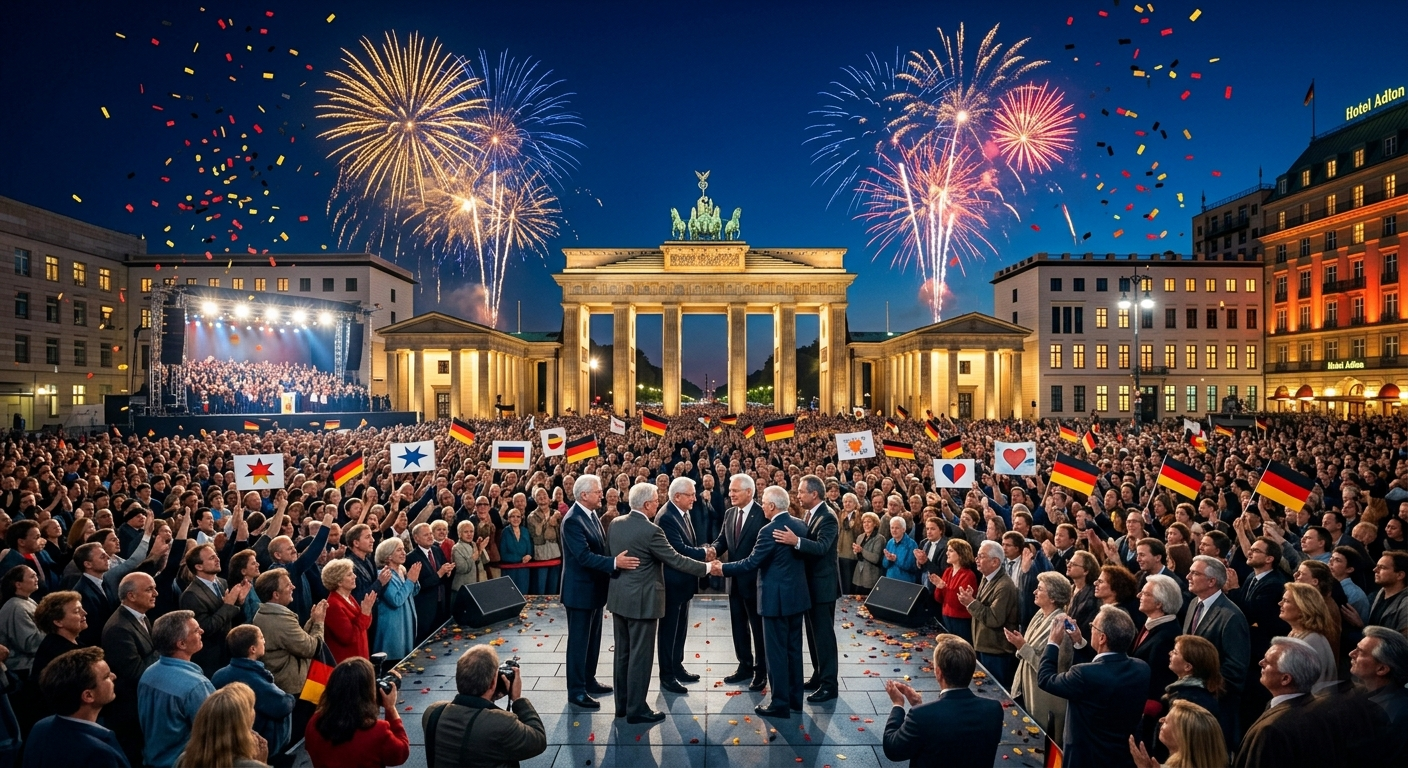
At the stroke of midnight on October 3, 1990, fireworks erupted over the Brandenburg Gate in Berlin. Crowds of hundreds of thousands had gathered in the streets, many weeping openly, others embracing strangers. The black, red, and gold flag of the Federal Republic of Germany was raised before the Reichstag building. In that moment, the German Democratic Republic ceased to exist as a separate state. East and West Germany, divided since 1949 and separated by the most heavily fortified border in the world for most of those forty-one years, were one nation again.
The reunification of Germany was not simply a historic moment for the German people. It marked the effective end of the Cold War that had divided Europe and shaped global politics since the end of the Second World War. It demonstrated that the seemingly permanent division of a continent could be undone in the space of less than a year. And it set in motion a process of social and economic integration whose consequences, both triumphant and challenging, continued to unfold for decades.
The Origins of German Division: How World War Two Split a Nation
To understand the significance of German reunification, it is necessary to understand how the division came about in the first place. Nazi Germany’s total defeat in May 1945 left the country in ruins, its cities bombed into rubble, its infrastructure shattered, and its people facing the combined authority of four victorious Allied powers.
The Yalta and Potsdam Conferences of 1945 divided Germany into four occupation zones: the Soviet zone in the east, and the American, British, and French zones in the west. Berlin, located deep within the Soviet zone, was similarly divided into four sectors. The arrangement was intended as a temporary administrative measure pending a final peace treaty. It became permanent when the Cold War hardened the division between the Western democracies and the Soviet Union into a global confrontation.
In 1949, the division became formal and institutional. The three western zones merged to form the Federal Republic of Germany, known as West Germany, a parliamentary democracy aligned with NATO and the Western alliance. The Soviet zone became the German Democratic Republic, or GDR, known as East Germany, a communist single-party state governed by the Socialist Unity Party, the SED, under Soviet oversight. Berlin remained divided, with West Berlin existing as an enclave of Western democracy surrounded by East German territory.
The German Democratic Republic built the Berlin Wall beginning on August 13, 1961, after the haemorrhage of skilled workers and professionals from East to West threatened the economic viability of the communist state. At least 140 people were killed attempting to cross the Wall during its twenty-eight-year existence. The Wall became the defining physical symbol of the Cold War: the concrete embodiment of a world divided not by geography but by ideology.
Mikhail Gorbachev, Glasnost, and the Beginning of the End
The chain of events that ultimately produced German reunification began not in Germany but in Moscow, when Mikhail Gorbachev became General Secretary of the Communist Party of the Soviet Union in March 1985. Gorbachev recognized that the Soviet system was economically failing and politically stagnating, and he introduced two transformative policies: glasnost, meaning openness, which permitted freer public discussion of Soviet problems, and perestroika, meaning restructuring, which attempted to reform the Soviet economy.
These reforms had consequences far beyond the Soviet Union. They signaled to the satellite states of Eastern Europe that Moscow would no longer necessarily intervene militarily to suppress reform movements, as it had done in Hungary in 1956 and Czechoslovakia in 1968. For the communist regimes that had depended on the implicit Soviet military guarantee to maintain their authority, this signal was potentially fatal.
The East German regime under Erich Honecker was among the most resistant to reform in the Soviet bloc. Honecker had presided over East Germany since 1971 and had built his political position on ideological rigidity and systematic repression through the Stasi, the Ministry for State Security, which employed approximately 91,000 full-time officers and 175,000 unofficial informants to monitor East German society. When Soviet publications in the late 1980s began carrying reform-minded articles, Honecker’s government banned their circulation within East Germany. The regime saw Gorbachev’s reforms as dangerously subversive.
The Peaceful Revolution: Protests, Refugees, and the Fall of the Wall
The year 1989 was the year that changed Europe. In May, a reformist Hungarian government began dismantling its border fence with Austria, creating the first opening in the Iron Curtain. East Germans who had traveled to Hungary for holidays recognized the opportunity immediately. By September, tens of thousands had crossed through Hungary into Austria and onward to West Germany, triggering a refugee crisis that destabilized the GDR.
On August 19, 1989, a peace demonstration called the Pan-European Picnic was held on the Austrian-Hungarian border. When event organizers opened a gate in the border fence as a symbolic gesture, hundreds of East Germans rushed through to the West. The event demonstrated that ordinary East Germans were prepared to take extraordinary risks for freedom.
Inside East Germany, the city of Leipzig became the center of a growing protest movement. Beginning in September 1989, thousands of citizens gathered every Monday evening at the Nikolaikirche, or St. Nicholas Church, for candlelit prayer meetings organized by the pastor Christian Führer, then marched through the city streets demanding democratic reform. The marches grew steadily larger: 70,000 protesters on October 9, 100,000 on October 16, 300,000 on October 23. The Stasi was present in force, and there were genuine fears of violent suppression, but the crowds grew rather than dispersed.
The political consequences were swift. Honecker was deposed by his own Politburo on October 18 and replaced by Egon Krenz, another communist hardliner who attempted to offer modest concessions. On November 9, 1989, an East German government spokesman named Günter Schabowski held a press conference at which he announced a new regulation allowing East Germans to travel freely to West Germany. Asked when the new rules would take effect, Schabowski checked his notes and answered, without any awareness of what he was saying: “Immediately, without delay.” He had not been briefed that the regulation was intended to apply only after administrative procedures were completed the following morning.
The announcement was broadcast live on East German and West German television. Within hours, hundreds of thousands of East Berliners flooded to the Wall’s checkpoints demanding passage. The overwhelmed border guards, who had received no orders from their superiors, eventually stood aside and opened the gates. People climbed atop the Wall, embraced strangers from the other side, and within days began physically demolishing it with hammers and chisels. The Berlin Wall, which had stood for twenty-eight years as the defining symbol of Cold War division, had effectively ceased to exist.
The Wikipedia account of German reunification provides the comprehensive political and diplomatic record of the events from the fall of the Berlin Wall through the formal unification on October 3, 1990, including the text of the key treaties and the full constitutional mechanisms used to accomplish the merger.
Helmut Kohl’s Ten-Point Plan and the Path to Unification
West German Chancellor Helmut Kohl moved with extraordinary speed and political boldness in the weeks following the Wall’s fall. On November 28, 1989, just nineteen days after the opening of the Wall, Kohl presented the West German Bundestag with a Ten-Point Programme for a German Confederation. The plan outlined a pathway toward full German unity through a series of stages, beginning with closer cooperation and gradually moving toward a confederation and eventual full unification. It was a calculated political initiative that shaped the entire subsequent process.
Kohl was aware that the window for action was potentially narrow. The daily hemorrhage of East Germans moving to the West, running at approximately 2,000 people per day, threatened to drain East Germany of its working-age population and collapse whatever economic viability it retained. The Soviet Union’s position on German unification was uncertain. France and Britain had their own reservations about a unified Germany that might dominate European affairs. Acting quickly was both a political opportunity and a strategic necessity.
Kohl flew to Moscow on February 10, 1990, for a critical meeting with Gorbachev. The Soviet leader told Kohl that the Soviet Union was prepared to respect the right of the German people to determine whether they wished to live in a single state, a statement that signaled Moscow’s acceptance of the principle of reunification. In exchange, Kohl agreed to provide substantial financial assistance to the Soviet Union, which was facing severe economic difficulties. The deal cleared the most formidable obstacle to reunification.
The Britannica account of German reunification covers the negotiations between Kohl and Gorbachev, the diplomatic framework of the Two Plus Four process, and the speed at which the legal and constitutional mechanisms for unification were assembled in 1990.
East Germany’s First Free Election and Lothar de Maizière
On March 18, 1990, East Germany held its first and only free parliamentary elections. The result was decisive. The Alliance for Germany, a coalition of three parties that had all pledged rapid reunification and was closely associated with Kohl’s Christian Democratic Union, won 48 percent of the vote. The reformed communist party, now called the Party of Democratic Socialism, won only sixteen percent. East Germans had voted not merely for democratic parties but specifically for the fastest possible route to reunification with the prosperous West.
The election produced a new East German government headed by Lothar de Maizière, the leader of the eastern Christian Democratic Union. De Maizière was a lawyer and a trained classical musician, and he proved to be a capable negotiator in the extraordinarily compressed timeframe he faced. His government’s task was to negotiate the legal and financial terms of East Germany’s accession to the Federal Republic while simultaneously managing the political and economic pressures of a state in rapid collapse.
The Two Plus Four Agreement: International Diplomacy and the Path to Sovereignty
German reunification required not only the agreement of the two German states but also the formal consent of the four powers that had occupied Germany since 1945 and retained residual rights over the country. The diplomatic framework adopted was known as the Two Plus Four talks: the two German states plus the four Allied powers, the United States, the Soviet Union, the United Kingdom, and France.
The key participants in these negotiations included West German Foreign Minister Hans-Dietrich Genscher, who had been a skilled and persistent advocate for German interests throughout the Cold War, and American Secretary of State James Baker, whose strong support for German unity was decisive in aligning Western policy. French Foreign Minister Roland Dumas and British Foreign Secretary Douglas Hurd represented their governments’ more cautious positions. Soviet Foreign Minister Eduard Shevardnadze completed the negotiating table on the Soviet side.
France under President François Mitterrand and the United Kingdom under Prime Minister Margaret Thatcher were both privately concerned about the implications of a reunified Germany that would dominate European politics and economics. Thatcher in particular had deep reservations rooted in historical memory of German power, and reportedly declared that the two World Wars had been fought to prevent German domination of Europe. Ultimately, both countries accepted reunification within the framework of the European Community and NATO, which provided the institutional structure for managing a powerful unified Germany.
The Treaty on the Final Settlement with Respect to Germany, the formal title of the Two Plus Four Agreement, was signed in Moscow on September 12, 1990, by the foreign ministers of all six nations. The treaty confirmed Germany’s borders, including the definitive acceptance of the Oder-Neisse line as the permanent Polish-German border. It limited the size of Germany’s unified armed forces. And it formally ended the residual rights of the four Allied powers in Germany, granting the reunified state full sovereignty. A separate German-Polish Border Treaty was signed on November 14, 1990, giving Poland permanent legal certainty over its western border.
Economic and Monetary Union: The Deutsche Mark Goes East
Among the most consequential decisions of the reunification process was the Economic, Monetary, and Social Union that took effect on July 1, 1990, three months before political reunification. East Germans gained access to the West German Deutsche Mark, with the exchange rate set at one to one for savings up to a certain amount, a generous arrangement that gave East Germans immediate access to hard currency but that economists warned would make East German industry uncompetitive.
West German Chancellor Kohl had overridden the advice of the Bundesbank, West Germany’s central bank, to set the exchange rate at this politically popular level. The Bundesbank had recommended a more economically rational rate that would have provided less spending power to East Germans but better preserved their industries’ ability to compete. Kohl’s decision was driven by political reality: any exchange rate that left East Germans significantly poorer than their western counterparts would fuel continued emigration and political instability.
The economic consequences of monetary union were significant. East German industrial enterprises, which had been operating under the artificial conditions of a planned economy and were often producing goods of inferior quality at uncompetitive prices, were suddenly exposed to market competition. Thousands of factories closed within months. Unemployment in the former East Germany rose dramatically and remained substantially higher than in the West for years and in some regions decades.
October 3, 1990: The Night Germany Became One Again
The Unification Treaty, known in German as the Einigungsvertrag, was signed by representatives of the two German governments on August 31, 1990. It specified that the German Democratic Republic would accede to the Federal Republic under Article 23 of West Germany’s Basic Law, effectively joining the existing state rather than creating an entirely new constitutional framework. The treaty was ratified by both parliaments and came into effect at midnight on October 3, 1990.
At that precise moment, the five new states of the reunified Germany, Brandenburg, Mecklenburg-West Pomerania, Saxony, Saxony-Anhalt, and Thuringia, formally became Länder of the Federal Republic. Berlin, divided since 1945, became a single city and Land. The German Democratic Republic ceased to exist. President Richard von Weizsäcker spoke at the official ceremony, declaring: “In free self-determination, we want to achieve the unity and freedom of Germany. We are aware of our responsibility to peace in the world and ready to serve it.” Two months later, all-German elections on December 2 produced a decisive victory for Kohl’s coalition, and he became the first chancellor of the reunified Germany.
The History.com article on East and West Germany’s reunification covers the October 3, 1990 moment of unification, its immediate political consequences, and its significance as a landmark event in the end of the Cold War era.
The Long Road of Integration: Challenges After Reunification
German reunification on October 3, 1990, was the beginning of a process rather than its conclusion. The formal merger of two states that had been separated for forty-one years and had developed profoundly different economic systems, social cultures, and political traditions required decades of sustained effort and enormous financial resources.
West Germany transferred approximately 1.5 trillion euros to the former East Germany over the first two decades following reunification, the largest internal wealth transfer in modern European history. The funds went toward rebuilding infrastructure, modernizing housing, establishing social welfare systems, and creating economic incentives for new businesses. Despite this investment, structural economic disparities between East and West Germany persisted for decades. Unemployment in the eastern states remained higher than in the West throughout the 1990s and well into the 2000s.
The phenomenon known as Ostalgie, nostalgia for elements of East German life, emerged as a cultural response to the dislocations of reunification. Many former East Germans, particularly those who had built professional careers in the GDR’s institutions, found their qualifications and experience devalued or their careers ended by the transition to the Western system. The psychological adjustment required to shift from a collective, state-directed society to an individualist market economy was genuine and profound.
The Legacy of German Reunification: Europe Transformed
German reunification had consequences that extended far beyond Germany’s borders. The unified Federal Republic, combining the economic strength of West Germany with the territory of East Germany, became a nation of approximately 80 million people, the largest economy in Europe. Kohl’s insistence on embedding German reunification within the framework of deeper European integration directly accelerated the process that produced the Maastricht Treaty of 1992 and the eventual formation of the European Union, in which Germany played a central role.
October 3 became Germany’s national holiday, the Day of German Unity, commemorating the moment at which a nation divided by the most destructive ideological conflict of the twentieth century chose to become one again. The Brandenburg Gate, which had stood for decades in no man’s land between East and West Berlin, became the symbolic heart of the reunified capital and the site of the annual national celebration.
The Britannica article on Germany’s reunification assesses the long-term economic, political, and cultural consequences of the 1990 unification, including the structural differences that persisted between the eastern and western states and Germany’s emergence as the dominant power in the European Union.
For the German people, the events of 1989 and 1990 represented something that many had genuinely ceased to believe possible. A generation had grown up accepting the Wall and the division as permanent features of the world they inhabited. The revolution that ended the Cold War and reunited Germany was, in the end, a largely peaceful one, driven not by military force or political conspiracy but by ordinary people who had decided that the world they had been given was not the world they were willing to accept. They were right, and the midnight fireworks over the Brandenburg Gate were their reward.