
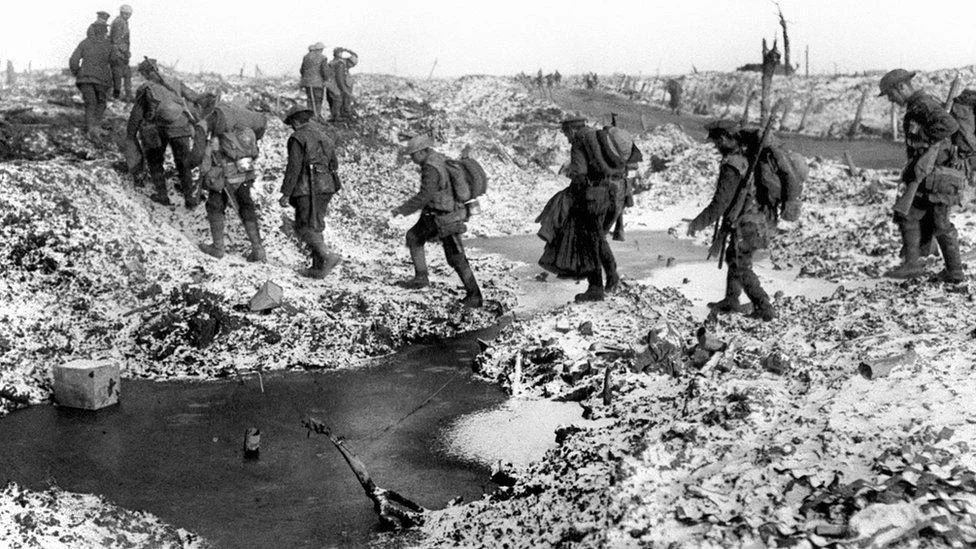
At precisely 7:30 in the morning on July 1, 1916, along a fifteen-mile front of chalky farmland in the Picardy region of northern France, whistles rang out and an estimated 120,000 British and Empire soldiers climbed out of their trenches and began advancing into No Man’s Land toward the German lines. They had been told that the week-long artillery bombardment that preceded them had destroyed the German wire, collapsed the German dugouts, and shattered the German defenders. Many were instructed to walk, not run, toward the enemy positions, because resistance was expected to be minimal. What actually awaited them, in most sectors of the front, was a catastrophe of industrial scale. German machine gunners, who had sheltered safely in dugouts carved fifteen metres into the chalk beneath the bombardment, emerged into the morning air and opened fire on the advancing waves of British infantry. By the end of July 1, 1916, the British Army had suffered 57,470 casualties, including 19,240 men killed outright. It remains the single bloodiest day in the entire history of the British Army.
The Battle of the Somme, which lasted from July 1 to November 18, 1916, was one of the largest and most costly military operations in the history of human conflict. Over its 141 days, more than three million men from all sides fought along the Somme valley and the surrounding ridges and woodlands of Picardy. Combined casualties exceeded one million killed and wounded. The British and Empire forces alone suffered between 419,654 and 432,000 casualties; the French approximately 200,000; and the German Army an estimated 465,000 to 600,000. The battle advanced the Allied lines a maximum of seven miles. It did not break through the German defences or achieve the decisive strategic result its planners had envisioned. Yet its consequences, both in the immediate military sense and in the longer arc of the war and of British national consciousness, were profound and enduring. The Somme remains the prism through which Britain and the Commonwealth have understood, mourned, and debated the First World War for more than a century.
The Western Front in 1916: Trench Warfare, Strategic Deadlock, and the Alliance Imperative
To understand why the Battle of the Somme was fought, it is essential to understand the strategic situation on the Western Front in early 1916. The war had opened in August 1914 with the German Army’s massive offensive through Belgium and northern France in an attempt to defeat France rapidly before turning its full force against Russia. The German offensive was halted at the First Battle of the Marne in September 1914, and in the weeks that followed, both sides raced northward in a series of outflanking movements until the front stabilized in a continuous line of trenches stretching from the English Channel coast to the Swiss border, roughly 450 miles in total length. By the end of 1914, the Western Front had settled into a form of warfare that no military doctrine of the era had anticipated: static, attritional, defensive trench warfare in which enormous quantities of artillery, machine guns, and barbed wire made offensive operations extraordinarily costly and breakthroughs almost impossible.
The years 1914 and 1915 had produced a series of Allied offensives that gained minimal ground at enormous cost: the battles of Artois, Champagne, Loos, and Neuve Chapelle had demonstrated repeatedly that the existing military technology favoured the defender over the attacker. Defenders could shelter in their trenches and dugouts while artillery smashed the attacking infantry in the open; machine guns could sweep No Man’s Land with lethal effectiveness; and the speed of infantry advance on foot was so slow that any initial success could be counter-attacked and erased before it could be exploited. The Allies needed a new approach, but in December 1915, when the Allied commanders in chief met at Chantilly, France, to plan the 1916 campaign, the answer they agreed upon was essentially more of the same: a coordinated series of offensives on the Eastern, Italian, and Western Fronts, planned to strike simultaneously and prevent Germany from shifting forces between theatres. The main Allied effort on the Western Front was to be a joint Anglo-French offensive astride the River Somme in the summer of 1916.
The plan as originally conceived was for the French army to carry the primary burden of the Somme attack, with the British Expeditionary Force supporting on the northern flank. French Commander in Chief Joseph Joffre had selected the Somme specifically because it was the junction between the French and British lines, making coordination natural, and because the ground there offered reasonable prospects for an offensive. British Commander in Chief General Sir Douglas Haig, who had replaced Field Marshal Sir John French in December 1915, would have preferred to attack in Flanders, closer to his supply lines and with objectives that would have directly threatened German control of the Belgian coast. But the French were the senior partner in the alliance, and Haig deferred to Joffre’s judgment. Then, on February 21, 1916, everything changed.
Verdun: The Battle That Made the Somme a British War
The German assault on Verdun, launched on February 21, 1916, was one of the most calculated and brutal operations of the entire war. German Chief of Staff Erich von Falkenhayn had concluded that France could not allow Verdun, the historic fortress city on the Meuse River, to fall without fighting for it to the last, and that if Germany could force France to fight for Verdun at a scale that produced disproportionate French casualties, it could bleed the French Army to the point of collapse. Verdun was, in Falkenhayn’s formulation, a place to which the French would have to commit every last man because of its historical and emotional significance, and Germany intended to exploit that necessity. The battle that resulted from this calculation was one of the most sustained and horrific in military history, lasting from February 21 to December 18, 1916, and ultimately costing both sides approximately 700,000 casualties.
As the French Army was drawn deeper into the Verdun meat grinder through the spring of 1916, the original plan for the Somme became unworkable. The forty-two French divisions that Joffre had planned to commit to the Somme offensive were diverted to Verdun, one after another, until by May 1916 the French contribution to the Somme had shrunk from the primary role to a secondary supporting attack. What had been planned as a French-led offensive with British support became, by the logic of alliance necessity, a predominantly British operation. The British Expeditionary Force, which in 1916 was overwhelmingly composed of the volunteer armies that Field Marshal Lord Kitchener had raised through his famous recruitment campaign in 1914 and 1915, would have to shoulder the main burden of the attack. Haig, who had been preparing for a major offensive later in the summer and who would have preferred to attack in mid-August when his army would be better prepared, was under intense pressure from Joffre to attack as early as possible to relieve the pressure on Verdun. The date was set for July 1.
Kitchener’s Army and the Pals Battalions: The Men Who Would Fight and Die on the Somme
The army that attacked on July 1, 1916 was unlike any army Britain had ever put in the field. At the outbreak of war in August 1914, the British Expeditionary Force was a small but highly professional organization of regular soldiers and reservists, numbering approximately 160,000 men. This professional army was largely destroyed in the fighting of 1914 and 1915, sacrificed in holding actions and counter-attacks that preserved the Allied line but at the cost of irreplaceable trained officers and NCOs. What replaced it was one of the most remarkable exercises in voluntary mass mobilization in human history. Within weeks of the war’s outbreak, Field Marshal Lord Herbert Kitchener, appointed Secretary of State for War, grasped that the conflict would be long and would require an army far larger than Britain had ever possessed. His famous recruitment poster, with its pointing finger and the words ‘Your Country Needs You,’ became one of the most recognizable images of the twentieth century, and the recruitment campaign it represented transformed British society.
In the summer and autumn of 1914, approximately 750,000 men enlisted in a single month. By the end of 1914, more than one million had volunteered. A significant feature of this recruitment was the formation of what became known as Pals battalions: units composed of men who came from the same town, city, neighborhood, trade, or workplace, and who enlisted, trained, and served together. The idea, which was championed by General Henry Rawlinson among others, was that men would be more willing to enlist if they knew they would serve alongside their friends, neighbors, and colleagues. Towns across Britain raised their own battalions: the Accrington Pals from Lancashire, the Sheffield City Battalion, the Grimsby Chums, the Salford Pals, the Leeds Pals, the Bradford Pals, the Barnsley Pals. These formations bound together communities in a way that would make their subsequent losses concentrated and devastating: when a Pals battalion suffered heavy casualties, an entire community lost its men on the same day.
By mid-1916, Kitchener’s New Army of volunteers had been trained and had arrived in France, filling out a British Expeditionary Force that had grown to more than fifty divisions. These men were, on the whole, the best-educated and most enthusiastic recruits Britain had produced. They were genuinely volunteers in every sense, men who had left jobs, families, and comfortable lives in a spirit of patriotic commitment that is almost incomprehensible from the vantage point of a later age. Many had never been in combat. The Somme would be for most of them their first experience of a major offensive, and for tens of thousands of them it would also be their last experience of anything.
Haig, Rawlinson, and the Fundamental Disagreement Over Strategy
The command structure for the Somme offensive was defined by a profound tension between two very different visions of what could be achieved and how. General Sir Douglas Haig, the Commander in Chief of the British Expeditionary Force, was a cavalryman by background who had served in the 7th Queen’s Own Hussars and who retained, despite the evidence of two years of trench warfare, a belief in the possibility of achieving a decisive breakthrough that would restore mobility to the campaign. Haig’s vision for the Somme was ambitious: after the preliminary bombardment had destroyed the German defences, the infantry would break through, and cavalry would pour through the gap to exploit the breach and push far into the German rear, reaching the towns of Bapaume and Cambrai. The image of cavalry galloping through a shattered German line to decisive victory was an article of faith.
General Sir Henry Seymour Rawlinson, who commanded the British Fourth Army and who would direct the assault on July 1, was a more cautious and in many ways more realistic soldier. Rawlinson favoured what he called bite-and-hold tactics: limited advances onto defensible positions, pauses to consolidate, and the exploitation of German counter-attacks to inflict disproportionate casualties on the defenders. He had no confidence that a breakthrough was achievable with the forces and firepower available, and he believed that the artillery could only be effective if it was concentrated on a limited depth of objective rather than spread across the entire German defensive system. Rawlinson’s instincts were sound, but he was subordinate to Haig, and the plan that emerged from their negotiations was an unhappy compromise that attempted to combine Rawlinson’s more modest tactical approach in the south with Haig’s ambitious breakthrough objectives in the north, satisfying neither approach fully.
The French contribution to the Somme assault was commanded by General Ferdinand Foch, commanding the Army Group North, with the actual attack carried out by General Marie-Emile Fayolle’s Sixth Army on the southern flank. Despite the reduction in French forces caused by Verdun, Fayolle’s army retained significant artillery strength, particularly in heavy guns. The French had learned through bitter experience in earlier offensives how to conduct more flexible infantry tactics, advancing in small groups using cover rather than in the rigid extended lines that British doctrine often favoured. The French Sixth Army attacked south of the River Somme with a far more effective tactical approach than most British units employed, and their results on July 1 reflected this.
The Seven-Day Bombardment: The Promise of Destruction That Became a Catastrophic Illusion
The British plan for the Somme relied fundamentally on the preliminary artillery bombardment reducing German defences to the point where infantry could advance almost unopposed. On June 24, 1916, the bombardment began. For seven days, British guns fired an almost continuous torrent of shells into the German lines. By the time the bombardment ended on the morning of July 1, the British had fired approximately 1.5 million shells along the front. The noise could be heard in southern England. The physical destruction appeared total: the landscape before the British trenches was pulverized, the villages and farms behind the German lines reduced to rubble, the air thick with smoke and chalk dust. Officers standing at observation posts watched the enemy lines disappear under the cascading explosions and reported to higher command that the defences must certainly be destroyed.
The appearance was profoundly misleading, and the reasons for this gap between appearance and reality were multiple and interconnected. The first and most fundamental problem was that the British guns were spread too thinly across too wide a front. The French, who had fewer troops but more heavy artillery for a narrower sector, could achieve a far higher density of shells per yard of front. The British bombardment, impressive in its total scale, was inadequate in its local intensity at most points along the line. The second problem was the quality of the shells themselves: post-war investigations revealed that approximately 30 percent of the shells fired in the bombardment were duds that failed to explode. Many of these were manufactured by workers who had no experience in munitions production, filling factories that had been converted to shell production with an urgency that compromised quality control. One and a half million shells fired, but nearly half a million of them never detonated.
The third problem was the German defensive engineering. Since their arrival on the Somme in 1914, the Germans had been building their defences with extraordinary thoroughness. The chalk subsoil of the Picardy region was ideal for tunnelling, and German engineers had carved dugouts as deep as nine metres underground, reinforced with timber and concrete, capable of sheltering entire companies of men in relative safety from even the heaviest bombardment. When the British guns fell silent and the infantry went over the top, the German garrison of these dugouts had to climb a ladder and emerge into the open air, a process that took perhaps one to two minutes. That was enough time to man the parapet, set up their machine guns, and open fire before the British infantry, who had in many cases hundreds of yards to cross, could reach them. The week of apparently devastating bombardment had, in most sectors, left the German defenders essentially intact.
7:30 a.m., July 1, 1916: The Whistles Sound and a Generation Goes Over the Top
The morning of July 1, 1916, was warm and sunny, a perfect summer day in northern France. At 7:28 in the morning, the British detonated a series of massive mines under the German positions, tunnels that had been dug by specialist mining companies over many months, packed with tonnes of high explosive. The largest of these, the Lochnagar mine near the village of La Boisselle, created a crater 91 metres across and 21 metres deep that is still visible today, a vast wound in the earth that has never been filled. The mine explosions were intended to destroy key German strong points and provide the opening shock for the assault that followed two minutes later. At 7:30, the artillery lifted from the German front line positions, the whistles blew along the British trenches, and the assault began.
What happened in the minutes and hours that followed varied enormously across the front, but in most sectors, particularly north of the Albert-Bapaume road, it was a catastrophe. British infantry emerged from their trenches and began crossing No Man’s Land, in many places walking in extended lines as their officers had ordered, the men carrying 60 pounds of equipment each, moving at a pace governed by the assumption that resistance would be minimal. But German machine gunners and riflemen were already at their posts, emerging from the deep dugouts within minutes of the artillery lift, and they opened fire on the advancing lines of British soldiers with a devastating and methodical efficiency. A single German machine gun, firing at a rate of up to 500 rounds per minute, could sweep a broad arc of No Man’s Land. Against lines of closely spaced men walking toward them, German machine gunners were dealing death at an industrial scale.
Individual units experienced losses of terrifying intensity in extraordinarily short periods. The Accrington Pals, officially the 11th Battalion East Lancashire Regiment, suffered 585 casualties, including 235 killed, in less than thirty minutes of fighting near the village of Serre. The entire assault on Serre was a complete failure: not a single objective was taken, and the battalions that attacked there were effectively destroyed as fighting units in the space of an hour. The 1st Newfoundland Regiment, attacking near Beaumont Hamel, lost 710 men out of approximately 780 who went over the top, an almost incomprehensible casualty rate. The 36th Ulster Division managed a notable early success when it captured the Schwaben Redoubt near Thiepval through aggressive and imaginative assault tactics, but was eventually forced to withdraw because units on its flanks had failed to achieve their objectives, leaving its positions untenable. At Gommecourt, a diversionary attack by the Third Army under General Edmund Allenby cost 6,758 casualties while inflicting only 1,212 on the Germans.
The day produced a few genuine bright spots of success, concentrated in the southern sectors where the French Sixth Army’s heavier artillery and more effective infantry tactics had suppressed the German defenders more thoroughly. South of the Albert-Bapaume road, the 30th Division took all its objectives around Montauban, and the 18th Eastern Division also achieved its targets. The 7th Division captured the village of Mametz. These southern successes reflected the proximity to the French sector, whose heavy artillery had helped suppress German batteries, and the use of more sophisticated infantry tactics. But these successes were not exploited: Fourth Army headquarters issued no orders on July 1 to take advantage of the local successes in the south, and the German defenders were able to reinforce their threatened positions during the night. By the evening of July 1, the full scale of the disaster was becoming apparent to higher command, though the true figures were not known for some time. At 10 p.m., Rawlinson merely ordered his corps to continue the attack uniformly, apparently without any clear picture of the catastrophe that had occurred.
The Commanders and the Question of Responsibility: Haig, Rawlinson, and the Weight of Judgment
The question of who bears responsibility for the catastrophe of July 1, 1916, and more broadly for the conduct of the entire Somme campaign, has been debated by historians, soldiers, and the British public for more than a century and remains one of the most contested questions in the military history of the First World War. General Sir Douglas Haig, born June 19, 1861, in Edinburgh, Scotland, into a wealthy family connected to the Haig whisky business, had had a distinguished military career before the war, serving in India and South Africa and at the Staff College. He was a man of formidable administrative ability, deep religious conviction, and genuine personal courage, as well as genuine limitations of imagination, empathy, and tactical flexibility. His diary entries during the Somme campaign reveal a man who maintained extraordinary optimism in the face of evidence that should have provoked more fundamental questioning.
On the eve of the attack, Haig had written that he felt every step in his plan had been taken with divine help. As the catastrophic first day unfolded, the commanders and their staffs simply did not know, for many hours, what was happening at the front. The communication technologies of 1916 — artillery bombardment cut telephone wires, and messages had to be carried by runners through fire-swept ground — meant that information reaching headquarters was fragmentary, delayed, and often unreliable. Rawlinson stated that German army had ‘undoubtedly been severely shaken and he has few reserves in hand,’ even as the Germans were bringing up reserves. The newspapers at home reported ‘Great Day on the Somme’ and ‘Kitchener’s Boys Make Good’ — but the same newspapers began simultaneously publishing their lists of the killed, wounded, and missing, and the communities of Britain began to understand what had happened.
Rawlinson, who was in many ways a more tactically thoughtful commander than Haig, has also received criticism for his handling of the battle, both on July 1 and in the weeks and months that followed. The Fourth Army showed a repeated tendency to attack the same objectives with too light an artillery preparation and too rigid a tactical approach, learning lessons more slowly than the Germans were learning them. At the same time, both men operated within the constraints of a war that no one had anticipated and that offered no easy solutions. The strategic imperative of maintaining pressure on the Germans to relieve Verdun was real. The political pressure from Joffre and from the British government for tangible results was real. And the practical impossibility of simply stopping the offensive without consequences for Allied unity, morale, and the broader conduct of the war was equally real. Haig and Rawlinson were not uniquely incompetent commanders: they were commanders confronting an unprecedented military problem with the tools and doctrines available to them, making decisions under conditions of uncertainty and pressure that would have taxed any commander. The debate about their judgment, and the weight of moral responsibility they bear for the men who died under their command, is one that will never be finally settled.
The Battle Continues: Bazentin Ridge, Delville Wood, and the Grinding Summer of 1916
Despite the disaster of July 1, the Battle of the Somme did not end. The strategic imperatives that had made the offensive necessary in the first place had not changed: Verdun was still consuming French strength, and the Allied high command insisted that the pressure on the Somme must be maintained. Over the following weeks and months, Haig and Rawlinson adjusted their approach, making tactical improvements that gradually increased the effectiveness of British operations even as the human cost continued to mount. Between July 3 and July 13, a series of smaller attacks cost a further 25,000 casualties but achieved limited progress.
On July 14, Rawlinson redeemed his earlier failure with a genuinely imaginative stroke. He planned a night attack along a four-mile front between Longueval and Bazentin-le-Petit, moving troops into position under cover of darkness and following a short but intense artillery barrage at dawn. The plan was opposed by Haig, who doubted whether troops could manage a night approach march, but Rawlinson persisted. The result was one of the most successful tactical operations of the entire Somme campaign: the Germans, taken completely by surprise by the unconventional timing, were swept off Bazentin Ridge, and by mid-morning the British had advanced several thousand yards and broken into the German second line. The village of Longueval was captured. For a brief moment, a gap appeared in the German line that cavalry might have exploited. But the cavalry arrived too late, and by the time they reached the front, German reserves had sealed the breach.
The weeks of late July and August brought fighting of attritional savagery in the woodlands east of Bazentin Ridge, most notably at Delville Wood, known to the South African troops who fought there as Devil’s Wood. The 1st South African Brigade held the wood against repeated German counter-attacks for almost two weeks in late July and early August at a cost of nearly 2,500 men killed or wounded out of an original force of approximately 3,150, one of the highest proportionate casualty rates of the entire battle. The Australian and Canadian divisions that joined the British effort on the Somme in 1916 established their national military reputations in the fighting there, suffering enormous losses in engagements at Pozières, Courcelette, and other bloodily contested positions. The Australian 1st Division at Pozières, fighting from July 23 to August 3, suffered 5,285 casualties in eleven days.
September 15, 1916: The World’s First Tank Battle at Flers-Courcelette
September 15, 1916 marked a pivotal moment not only in the Battle of the Somme but in the entire history of warfare. On that morning, for the first time in military history, tanks appeared on a battlefield. The Mark I tank, a heavy armoured vehicle moving on tracks, capable of crossing trenches and theoretically impervious to machine gun fire, had been developed in secret by the British military establishment over the preceding year, championed by Winston Churchill among others, and produced in small numbers that were now ready for their operational debut. Forty-nine tanks were available for the attack at Flers-Courcelette; thirty-six actually went into action, as mechanical breakdowns took their toll on the primitive and temperamental machines.
The debut of the tank was a mixed result. The machines broke down frequently, moved at a pace barely exceeding walking speed, and suffered from mechanical failures that left many stranded in No Man’s Land. But where they functioned, the psychological effect on the German defenders was enormous. Reports described German soldiers fleeing in terror from the approaching machines, which seemed to embody some nightmare combination of invulnerability and destructive power. A British airman flying overhead reported seeing a tank advancing up the main street of the village of Flers with the British army cheering behind it. The attack at Flers-Courcelette advanced the British line and captured several objectives including High Wood, which had resisted British attacks for months. The total advance was limited, but the tank’s potential was unmistakable. Its early commitment in small numbers before adequate quantities were available was, as Britannica noted, a strategic mistake that sacrificed the element of surprise, but more far-sighted observers recognized that in the tank lay the key that would eventually unlock the trench barrier.
November 18, 1916: The Battle Ends in the Mud
Through October and into November 1916, the Somme fighting ground on, with both sides exhausted and the autumn rains turning the shelled landscape into a morass of mud and shell craters that made operations increasingly difficult. On November 13, the British made their final major effort of the campaign in the Battle of the Ancre, capturing Beaumont Hamel, a village that had been an objective on July 1 and had remained in German hands through all the months of fighting. On November 18, with the weather deteriorating beyond the point where operations could continue, Haig shut down the Somme offensive. The fighting had lasted 141 days.
The territorial result was brutally modest in proportion to the cost. The Allies had advanced at most seven miles along a front of roughly sixteen miles, capturing a strip of the Picardy countryside at a cost of over one million casualties combined. Many of the objectives set for the first day of the battle, July 1, had not been achieved even by November 18. The village of Thiepval, which was supposed to fall on the morning of July 1, was not captured until September 26. Beaumont Hamel, assigned as a first-day objective, was taken on November 13. The city of Bapaume, which Haig’s cavalry was to have reached by the first afternoon, was not captured until the following year. The strategic breakthrough that Haig had envisioned, with cavalry pouring through a broken German line into open country, never materialized at any point during the campaign.
The Human Cost: Casualties, Grief, and the Transformation of British Communities
The casualty figures of the Battle of the Somme are so large that they resist easy comprehension. The 57,470 British casualties on July 1 alone were equivalent to the entire population of a medium-sized English town, killed and wounded in a single morning. Over the course of the battle’s 141 days, the British and Empire forces lost between 419,654 and 432,000 men as casualties, a figure that includes killed, wounded, missing, and captured. The French suffered approximately 200,000, and the Germans between 465,000 and 600,000. Over a million human beings in total, broken or killed in a narrow strip of northern France.
The impact of the Pals battalion system, which had seemed so admirable in conception, was devastating in execution. When a Pals battalion suffered catastrophic losses, the casualties were concentrated in a single community. The Bradford Pals lost 1,770 men in a single day. The Leeds Pals suffered 750 casualties on July 1 alone. The Sheffield City Battalion was reduced to a small fraction of its original strength. Small towns and villages across Britain received their casualty lists on the same day, a collective grief unlike anything the country had experienced. The war continued for another two years after the Somme, with further battles at Arras, Passchendaele, and the Hundred Days Offensive, but the Somme fixed itself in British memory as the defining ordeal, the moment when the full horror of industrial warfare became undeniable and when the gap between the expectations that had sent men to war and the reality they encountered became too vast to be bridged by optimism.
The women and families of Britain received the lists of dead and wounded through the official casualty telegrams and the published rolls in the newspapers. No community was untouched. No village or town that had raised a Pals battalion was spared its share of the grief. The consequences for individual families were permanent and defining: fathers who never came home, brothers lost in the same engagement, entire cohorts of young men removed from communities that would spend decades feeling their absence. The cultural impact of the Somme on Britain was correspondingly deep and lasting, shaping literature, poetry, art, memory, and politics for generations.
The Strategic Argument: Did the Battle of the Somme Achieve Anything?
The question of whether the Battle of the Somme achieved its objectives, or indeed any objectives proportionate to its cost, has been debated without resolution since November 1916. The traditional view, which dominated British memory from the 1920s through the present day, sees the Somme as an exercise in futile slaughter, a campaign of incomprehensible cost that produced trivial territorial gains and demonstrated the failure of the British high command to adapt to the realities of modern industrial warfare. This view found its most eloquent expression in the poetry of the war, in the works of Wilfred Owen, Siegfried Sassoon, and Robert Graves, and in works of popular history and cultural memory that have kept the image of men walking into machine gun fire central to British understanding of the First World War.
A revisionist school of military historians, associated particularly with John Terraine and later with Gary Sheffield and other scholars, has mounted a significant challenge to this orthodoxy. This school argues that the Battle of the Somme, viewed in its full strategic context as part of a coalition war of attrition, achieved results that were real if not immediately visible. The battle forced Germany to end its offensive at Verdun, preserving the French Army from potential collapse. It forced Germany to divert troops and supplies to the Somme front, degrading their capacity in other theatres. And it imposed on the German Army losses that, combined with the losses at Verdun and on the Eastern Front, genuinely exhausted German military power. Erich Ludendorff and Paul von Hindenburg, who replaced Falkenhayn as the senior German commanders after the disasters of 1916, ordered a strategic withdrawal to the Hindenburg Line in early 1917 precisely because the German Army no longer had the strength to hold its existing positions. Their decision to launch unrestricted submarine warfare, which brought the United States into the war in April 1917, was also partly motivated by the calculation that Germany could not survive another year of the attritional warfare that the Somme had demonstrated.
The argument about the Somme’s strategic value does not diminish the scale of the human cost or exonerate the commanders who made the specific tactical decisions that produced July 1’s catastrophic losses. But it does situate the battle within a broader military reality: that by 1916, the war had become a contest of industrial capacity and national endurance in which no single battle could produce the decisive result that earlier generations of commanders had been trained to seek, and in which the destruction of the enemy’s armed forces through sustained attrition was, however appalling in human terms, the only strategy available to the major powers. Winston Churchill’s assessment, delivered in the House of Commons after the war, that the German soldiery was never the same again after the Somme, contains a significant element of historical truth, whatever its adequacy as a moral justification.
The Thiepval Memorial and the Legacy of the Somme in British and World Memory
The Battle of the Somme has left a permanent mark on the landscape of northern France, on the cultural memory of Britain and the Commonwealth nations, and on the way the twentieth century has understood the relationship between war, sacrifice, and national identity. The battlefield itself, preserved in the Somme region of France, contains dozens of military cemeteries maintained by the Commonwealth War Graves Commission, including the vast Thiepval Memorial to the Missing of the Somme. The Thiepval Memorial, designed by the architect Edwin Lutyens and unveiled on August 1, 1932, bears the names of 72,195 British and South African soldiers who died on the Somme between 1915 and 1918 and have no known grave, men whose bodies were never found or could never be identified in the shattered landscape of the battlefield. The memorial is the largest British war memorial in the world, a monument to a scale of loss that required a building of exceptional proportions to contain.
July 1 has been observed as a day of particular commemoration in Britain and across the Commonwealth since the battle’s conclusion. The centenary commemorations of 2016 brought tens of thousands of people to the Somme battlefields for a dawn ceremony at the Thiepval Memorial, recreating in collective memory the moment when the whistles blew and the men went over the top. The Lochnagar crater at La Boisselle, preserved by private initiative since the 1970s, draws visitors year-round who come to stand at its rim and contemplate what happened in the seconds after the mine detonated beneath it. The cemeteries of the Somme, with their rows of identical white headstones, many bearing the inscription known unto God in place of a name, represent one of the most powerful landscapes of memorial in modern history.
The Battle of the Somme also had lasting effects on military doctrine and technology. The tanks that appeared at Flers-Courcelette on September 15, 1916, though used prematurely in insufficient numbers, pointed the way toward the armoured warfare that would eventually break the deadlock of trench warfare at the Battle of Cambrai in November 1917 and that would define mechanized conflict through the twentieth century. The tactical lessons learned by the British Army on the Somme, painful and expensive as the learning process was, contributed to the development of the all-arms doctrine of artillery-infantry cooperation, combined with tanks and aircraft, that produced the Hundred Days Offensive of 1918 and the decisive Allied victory of that autumn. The Battle of the Somme was, as historians have called it, the beginning of modern all-arms warfare, learned at a cost that the men who paid it could not have known they were paying.
Conclusion: July 1, 1916 and the Weight of 57,470 Casualties
The Battle of the Somme began on the morning of July 1, 1916, with one of the greatest military catastrophes in British history. By the time darkness fell, 57,470 men had become casualties, 19,240 of them killed. The communities that had sent their sons, husbands, brothers, and fathers to war in the spirit of 1914’s idealism and determination received the news in the weeks that followed and were never the same again. The names on the Thiepval Memorial, 72,195 of them, represent not merely the dead but a particular kind of loss: men who disappeared so completely in the violence of the battle that no trace of them could ever be identified. They represent the full measure of what industrial war meant for the human body and the human spirit.
The battle’s five months of fighting advanced the Allied lines a maximum of seven miles, destroyed the offensive capacity of the German Army, helped save the French Army from collapse at Verdun, and taught the British Army lessons that it would apply to eventual victory in 1918. Whether the price was proportionate to these results is a question that no calculation can fully answer, because no calculation can put a price on the 57,470 men who became casualties in a single day on a summer morning in Picardy, or on the hundreds of thousands who followed them over the next 141 days. What the Battle of the Somme established beyond any doubt was the nature of the war that the world had entered in 1914: a war of industrial attrition in which the destruction of human life on a scale that previous generations could not have imagined was not an accident or an aberration but the central mechanism by which nations contended for survival and supremacy.
The whistles blew at 7:30 on the morning of July 1, 1916, and the men of Kitchener’s Army walked out into No Man’s Land to meet their fate. Most of them were volunteers who had freely chosen to serve in the belief that the cause they fought for was worth fighting for. The leaders who sent them forward were not uniquely wicked or incompetent men: they were men doing the best they could with the tools and knowledge available to them in an unprecedented situation, failing to prevent a catastrophe that may have been, given the military realities of 1916, impossible to prevent entirely. The Somme stands in human memory not as a simple story of heroism or futility, of competence or incompetence, but as something more complex and more enduring: a testament to the enormous capacity of human beings to endure suffering in the service of one another, and to the enormous capacity of the systems they build to destroy them.