
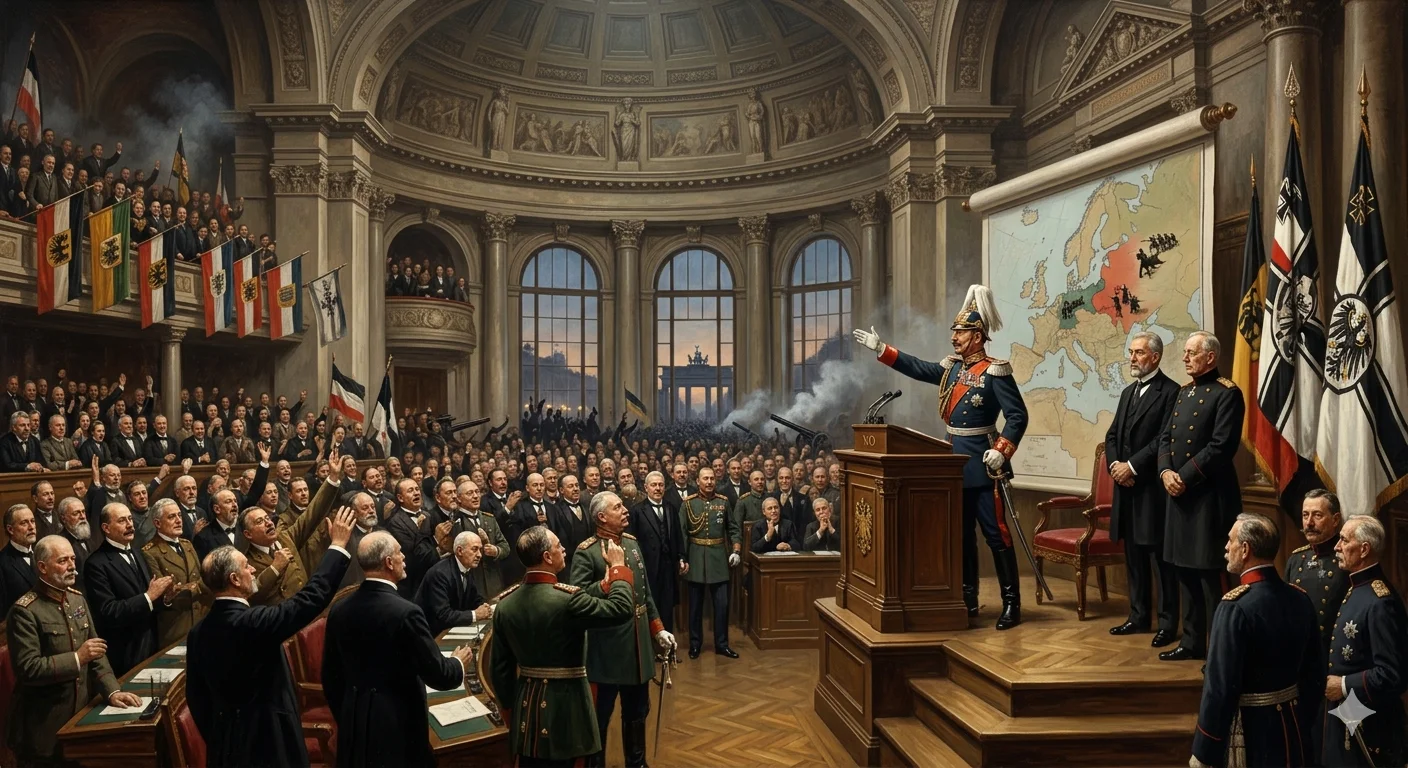
On August 1, 1914, the German Foreign Minister delivered a formal declaration of war to the Russian Imperial court. The message was terse and absolute: “His Majesty the Emperor, my august Sovereign, in the name of the German Empire, accepts the challenge, and considers himself at war with Russia.” With those words, the conflict that had begun thirty-four days earlier with a gunshot in Sarajevo became something qualitatively different. What had been an Austro-Serbian dispute, even an Austro-Russian confrontation, was now a direct war between two of Europe’s great empires, and the alliance systems of the continent were about to drag in France, Belgium, Britain, and ultimately much of the world.
Germany’s declaration of war on Russia on August 1, 1914, was the decisive escalatory moment of the July Crisis, the event that transformed a regional confrontation into what would become the First World War. It did not happen by accident or by the logic of events alone. It was the product of decisions made by identifiable people in identifiable places, under the pressure of competing fears, calculations, and military plans that left less and less room for the diplomacy that might have prevented catastrophe.
The Pre-War World: Alliances, Militarism, and the European Powder Keg
The Europe of 1914 was simultaneously the most prosperous and the most heavily armed continent in human history. A generation of industrialization had transformed the great powers into economic giants capable of equipping and supplying armies of millions. The same generation had produced a system of interlocking alliances designed to provide security but which had instead created a web of mutual obligations that transformed every bilateral quarrel into a potential general war.
The Triple Alliance bound Germany, Austria-Hungary, and Italy into a defensive partnership, though Italy would declare neutrality in 1914 and switch to the Allied side in 1915. Against them stood the Triple Entente, the looser alignment of France, Russia, and Britain. France and Russia were bound by the formal Franco-Russian Alliance of 1894. Britain’s commitment was less formal, resting on entente arrangements rather than binding treaty obligations, but its ties to France were deep and its strategic interests in Belgian neutrality were explicit.
Germany in 1914 was the most powerful military state in Europe, with the largest and best-equipped army on the continent, led by a general staff of formidable professional competence. Kaiser Wilhelm II, who had come to the throne in 1888, was an unstable and emotionally erratic monarch whose impulsiveness combined awkwardly with the structured militarism of the state he led. His Chancellor, Theobald von Bethmann Hollweg, a more subtle thinker, had convinced himself by 1914 that Germany was encircled by hostile powers and that the window for a successful war was narrowing as Russia completed its Great Military Programme of 1913, which would expand the Russian army to over two million men by 1917.
Russia, for its part, had been humiliated in the Russo-Japanese War of 1904-1905 and again in the Balkan crises of 1908 and 1912, each time being forced to back down before Austrian or German pressure. Tsar Nicholas II, a conscientious but often indecisive ruler, and his Foreign Minister Sergei Sazonov had concluded that Russia could not afford another retreat in the Balkans without catastrophic damage to its credibility and its prestige among the Slavic peoples it regarded as its natural constituency. Russia had no formal treaty obligation to defend Serbia, but the political and cultural stakes of standing aside were ones it had decided it could no longer afford.
The Assassination in Sarajevo and the Blank Cheque: June 28 to July 6
On June 28, 1914, Archduke Franz Ferdinand, heir to the throne of Austria-Hungary, and his wife Sophie were shot and killed in Sarajevo, the capital of Bosnia-Herzegovina, during an official visit to inspect Austro-Hungarian imperial forces stationed there. The assassin was Gavrilo Princip, a nineteen-year-old Bosnian Serb who was a member of the Young Bosnia movement and had received training and weapons from members of the Black Hand, a secret Serbian nationalist organization headed by Colonel Dragutin Dimitrijevic, who was also the head of Serbian military intelligence.
Austria-Hungary’s senior leadership, including Emperor Franz Joseph I, Chief of the General Staff Franz Conrad von Hotzendorf, and Foreign Minister Count Leopold von Berchtold, immediately saw the assassination as an opportunity as well as an outrage. Conrad had been arguing for war with Serbia for years. The question was whether Germany would support such a war, knowing that it risked Russian intervention.
Austria-Hungary’s envoy Count Alexander Hoyos traveled to Berlin on July 4 carrying a personal letter from Emperor Franz Joseph to Kaiser Wilhelm II and a memorandum from Berchtold’s office arguing for decisive action in the Balkans. On July 5, 1914, at Potsdam, Kaiser Wilhelm II met with Austria’s ambassador Ladislaus Szogyeny-Marich over lunch and delivered his answer. Despite initially suggesting he needed to consult his chancellor, Wilhelm gave what historians have ever since called the “blank cheque”: an unconditional promise of German support for whatever action Austria-Hungary chose to take against Serbia, even if it risked war with Russia.
That afternoon, Wilhelm assembled a council attended by Chancellor Bethmann Hollweg, Foreign Secretary Arthur Zimmermann, and War Minister Erich von Falkenhayn. All endorsed the position the Kaiser had already taken. Bethmann Hollweg later told his aide Kurt Riezler that “action against Serbia can lead to a world war” and described the decision as “a leap in the dark,” but justified it by arguing that the future belonged to Russia if Germany did not act now, and that such a war could only be welcomed. Hoyos carried the German assurance triumphantly back to Vienna.
The blank cheque was the most consequential single decision of the entire July Crisis. Without German backing, Austria-Hungary would have been unlikely to risk military action against Serbia, knowing that Russia might intervene. With Germany’s unconditional support, the path to war in the Balkans was effectively opened.
The Austrian Ultimatum and Serbia’s Response: July 23 to 28
Austria-Hungary spent the next several weeks drafting an ultimatum to Serbia that, in the deliberate design of its authors, was meant to be rejected. The Council of Ministers met on July 7 and agreed on conditions so intrusive of Serbian sovereignty that acceptance was considered virtually impossible. Berchtold advised Emperor Franz Joseph that the ultimatum “is being composed so that the possibility of its acceptance is practically excluded.”
The delivery of the ultimatum was deliberately delayed until July 23 to allow French President Raymond Poincare and Prime Minister Rene Viviani to complete their state visit to Russia and return to France, reducing the opportunity for France and Russia to coordinate their initial response. The ultimatum demanded that Serbia suppress nationalist groups and anti-Habsburg propaganda, allow Austro-Hungarian officials to operate within Serbia to investigate the assassination, and take numerous other steps that amounted to a significant surrender of sovereign authority. Serbia was given forty-eight hours to respond.
Serbia’s response on July 25 was, in the words of Kaiser Wilhelm II himself when he first read it, so conciliatory that it removed all grounds for war. Serbia accepted most of the demands, including several that its own government had expected to be impossible. Only on the specific question of Austro-Hungarian officials participating in the investigation on Serbian soil did Serbia maintain any reservation, and even that was hedged with offers of compromise. Wilhelm noted on his copy of the Serbian reply: “A great moral success for Vienna, but with it all reason for war is gone.” He then proposed that Austria should occupy Belgrade as a pledge and negotiate the remaining points, the so-called “Halt in Belgrade” proposal.
Austria-Hungary, under pressure from Bethmann Hollweg acting on Germany’s behalf, had already decided it wanted war regardless of Serbia’s response. On July 28, 1914, Austria-Hungary declared war on Serbia and began shelling the Serbian capital of Belgrade the following day. The July Crisis had passed the point of diplomatic rescue.
The Wikipedia article on Germany’s entry into World War I provides a comprehensive scholarly account of the political and military decision-making that led from the assassination in Sarajevo to Germany’s declaration of war on Russia.
Russia Mobilizes and Germany Issues Its Ultimatum: July 29 to 31
Russia’s response to the Austrian declaration of war on Serbia was the key variable that determined whether the conflict would remain a Balkan war or become a general European one. Tsar Nicholas II ordered a partial mobilization of the Russian military on July 25, placing four military districts bordering Austria-Hungary on alert, as a warning signal. The problem was that Russia’s military had no viable contingency plan for a partial mobilization targeting only Austria-Hungary. Any mobilization was effectively the beginning of a general mobilization, given the Russian army’s organizational structure.
Foreign Minister Sazonov and the Russian military leadership argued that a partial mobilization would leave Russia dangerously exposed if Germany entered the war alongside Austria-Hungary, and that the time required to complete a full mobilization meant that any delay now would be paid for in blood later. Tsar Nicholas II, despite his strong personal reluctance and his exchange of telegrams with Kaiser Wilhelm II (the two monarchs, who were cousins, addressed each other as “Nicky” and “Willy” in private communications), authorized a full general mobilization on July 30, 1914. This decision was one of the most consequential acts of the entire crisis. Germany had determined in advance that Russian general mobilization would be treated as an act of war.
On July 31, Germany issued a twelve-hour ultimatum to Russia demanding that it halt all military preparations. No response that could satisfy Germany’s demands was forthcoming. Russia did not stop its mobilization. Germany was not, in any meaningful sense, surprised by this: the German military leadership had been pushing for war for weeks and had regarded Russian mobilization as an opportunity rather than a threat, since it would allow Germany to present a war it had helped to engineer as one that had been forced upon it.
August 1, 1914: The Declaration That Changed the World
At 5:00 in the afternoon on August 1, 1914, Germany declared war on Russia. Germany simultaneously ordered its own general mobilization. In the language of the time, “mobilization means war” was not a figure of speech. The timetables of the Schlieffen Plan, the German strategic blueprint developed by Field Marshal Alfred von Schlieffen and later modified by General Helmuth von Moltke the Younger, meant that once Germany mobilized, it was committed to a sequence of military actions that could not be reversed or substantially altered.
The Schlieffen Plan was Germany’s answer to the problem of fighting a two-front war simultaneously against Russia in the east and France in the west. The Plan called for Germany to deploy the overwhelming majority of its forces in the west first, using a massive sweeping movement through Belgium and northern France to encircle Paris and defeat France within approximately six weeks. German forces would then transfer east by rail to face Russia, which was expected to mobilize slowly due to its vast size and relatively underdeveloped railway network. The Plan assumed that France would honor its alliance with Russia the moment Germany declared war on Russia.
Bethmann Hollweg’s famous instruction to his government’s diplomats captures the calculated nature of German strategy: Germany must appear as though the war had been forced upon it. “We must appear as though the war had been forced on us,” he wrote explicitly. Germany needed domestic and international opinion to believe it was the aggrieved party, not the aggressor. The publication of the German White Book on August 4, containing a selection of diplomatic correspondence designed to support this narrative, was part of the same project.
On August 3, Germany declared war on France. On the night of August 3 to 4, German forces crossed into Belgium, violating the 1839 Treaty of London which had guaranteed Belgian neutrality and which Prussia, along with the other great powers, had signed. Great Britain, whose legal and strategic commitment to Belgian neutrality was explicit, delivered an ultimatum to Germany demanding withdrawal from Belgium. Germany refused, and Britain declared war on Germany on August 4, 1914. Kaiser Wilhelm II, addressing the German nation that day, declared: “I no longer see different parties, all I see is Germans.”
The Chain of Declarations and the Failure of Last-Minute Diplomacy
Between August 1 and August 6, the sequence of war declarations completed the construction of the two opposing camps that would fight for the next four years. Austria-Hungary declared war on Russia on August 6. The Ottoman Empire, though it would not formally enter the war until October 1914 after its warships bombarded Russian Black Sea ports, had already entered into a secret alliance with Germany.
Throughout the crisis, British Foreign Secretary Sir Edward Grey had attempted to organize an international peace conference to prevent escalation. France accepted his proposals. Germany refused, and when Grey requested that Germany simply clarify whether it would remain neutral in an Austro-Russian conflict, Germany declined to commit. When Germany requested British neutrality in the event of a European war on July 29, Grey refused, understanding that German victory in Western Europe would establish German control over the Channel coast and pose an existential threat to British security.
The Imperial War Museums article on how the world went to war in 1914 explains the decision-making processes of each major power during the July Crisis and the reasons why diplomatic solutions failed at each critical juncture.
The Significance of August 1, 1914: Why Germany Declared War on Russia
Historians have debated Germany’s role in the outbreak of World War I since the guns fell silent in 1918. The most significant contribution to this debate came from German historian Fritz Fischer, whose 1960s work argued that Germany had long desired European domination and deliberately seized the opportunity presented by the July Crisis. More recent scholarship has produced more nuanced assessments, acknowledging shared responsibility while maintaining that Germany’s blank cheque to Austria-Hungary was the single most important act of escalation in the entire crisis.
What is clear is that Germany declared war on Russia on August 1, 1914, not because Russian mobilization genuinely threatened German territory, but because the Schlieffen Plan required that Germany attack France before France could mobilize effectively, and any delay jeopardized the plan’s timetable. Germany was not responding defensively to Russian aggression. It was initiating a strategic sequence designed to win a war on two fronts. The Russian mobilization was, for German military planners, a convenient trigger.
Twenty million soldiers and civilians would die in the war that August 1, 1914 helped to begin. Four empires, the Russian, Austro-Hungarian, German, and Ottoman, would cease to exist before the fighting ended. The political map of Europe would be redrawn entirely, and the instability created by those redrawn borders would contribute directly to an even more destructive conflict twenty-one years later.
The History.com article on the first world war’s eruption on August 1, 1914 provides a detailed account of the events of August 1 and the chain of declarations that followed in the days immediately after.
August 1, 1914 was the day a Balkan quarrel became a world war. It was not inevitable. At multiple points in the five weeks between June 28 and August 1, different decisions by different leaders could have contained the crisis. The blank cheque of July 5 could have been withheld. The Austrian ultimatum of July 23 could have been moderated. Germany could have supported Wilhelm’s own “Halt in Belgrade” proposal. Russia could have found a way to signal resolve without ordering a general mobilization. None of these things happened, and the consequences of their not happening would be measured in millions of lives.