
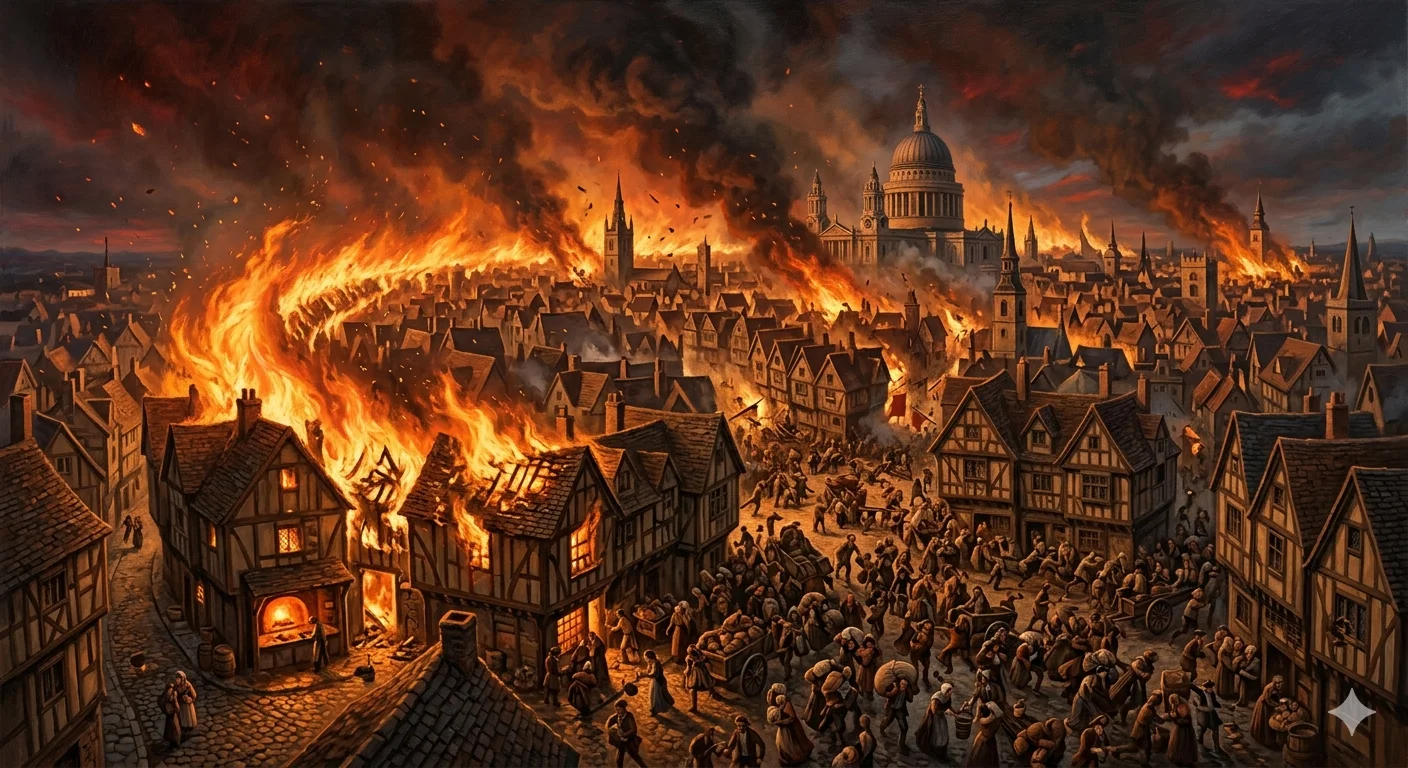
Shortly after midnight on Sunday, September 2, 1666, a fire broke out at the bakery of Thomas Farriner on Pudding Lane in the City of London, near London Bridge. The Farriner family woke to smoke filling their home, escaped through an upstairs window onto the neighboring rooftop, and raised the alarm. Their maidservant, too frightened to attempt the escape, became the fire’s first victim. The parish constables arrived within an hour and judged that the houses adjoining the bakery should be demolished to prevent the fire spreading further. The householders protested, and the Lord Mayor of London, Sir Thomas Bloodworth, was summoned from his bed to give the order. When Bloodworth arrived, he looked at the advancing flames and dismissed them with contempt, reportedly declaring that a woman might put out the fire by relieving herself on it. He refused to authorize the demolitions.
That decision, or rather that failure to act, was among the most consequential moments in the history of London. Within four days, the fire that Bloodworth had dismissed would destroy 13,200 houses, 87 parish churches, the Royal Exchange, Guildhall, and the medieval St. Paul’s Cathedral. Approximately 100,000 Londoners would be left homeless. The City of London that had grown organically since the Roman occupation, a dense maze of timber-framed buildings packed along narrow winding lanes, would cease to exist. A new city would rise from the ashes, built in brick and stone, designed in part by one of the greatest architects in English history.
London in 1666: A City Ready to Burn
To understand how a bakery fire on a single lane could destroy the largest city in England, it is necessary to understand what London was in 1666. It was a city of approximately 350,000 people, one of the largest in Europe, packed into an area of roughly one square mile inside the ancient Roman city wall. Its buildings were almost entirely constructed of oak timber, with walls in the poorer districts covered in pitch or tar that kept out the rain but transformed every wall into a potential fuel source. Roofs were thatched or covered in wood shingles. The upper stories of houses projected out over the narrow streets below, so close to the buildings opposite that neighbors could sometimes shake hands across the lane.
The summer of 1666 had been exceptionally hot and dry, with no significant rainfall for weeks. The timber of every building in the city was as dry as firewood. To compound this, the streets were full of flammable material: hay and straw for the horses that were the city’s only transport, barrels of oil, pitch, tar, tallow, and other combustibles in the riverside warehouses of Thames Street. The warehouses along the Thames waterfront were particularly dangerous, stocked with the provisions and materials of a trading city at the height of its commercial power.
There was no fire brigade in London in 1666. The firefighting available to Londoners consisted of leather buckets filled with water, hand-operated water squirts, and hooked poles for pulling down burning structures to create firebreaks. The entire system depended on the prompt and decisive action of whoever held authority, and on the willingness of property owners to sacrifice their buildings for the common good. Both conditions failed catastrophically on the night of September 2.
The year 1666 was also the second year after the Great Plague of 1665, which had killed approximately 100,000 Londoners, roughly a quarter of the city’s population. London was already traumatized, its population reduced, its social fabric strained. The fire arrived in a city that was still recovering from one of the worst epidemics in English history.
How the Fire Spread: From Pudding Lane to the City’s Heart
When Bloodworth refused to authorize demolitions in the early hours of September 2, the fire had already begun consuming the riverside warehouses on Thames Street. The strong east wind that had been blowing for days was driving the flames westward through the city with increasing force. Within hours of its start, the fire had transformed from a controllable house fire into something far more dangerous. By Sunday morning, more than 300 houses had burned down, and the fire was advancing faster than any bucket brigade could pursue it.
Samuel Pepys, a naval administrator who kept one of the most important diaries in English history, was woken early on Sunday morning and went to a window to observe. What he saw alarmed him enough to go to the Tower of London, from whose height he could see the full extent of the fire sweeping through the city below. He then took a boat on the Thames and observed the scene from the river, later writing that he saw people throwing their possessions into the water to save them, and boats crowded with evacuating Londoners and their goods. Pepys went to the Palace of Whitehall and secured an audience with King Charles II and his brother, the Duke of York James, to report what he had seen. Charles immediately ordered that all houses in the fire’s path should be demolished.
But the orders came too late and were executed too slowly. By the time significant demolition work was underway on Sunday, the wind had fanned the fire into a firestorm that was advancing faster than structures could be cleared. John Evelyn, another diarist who witnessed the fire and left an account of it, described the scene as one of total devastation: a roaring wall of flame consuming everything in its path, driving terrified Londoners ahead of it with their possessions on carts, on their backs, or not at all.
As Sunday became Monday, September 3, the fire continued its westward advance. By Monday night, half of London was in flames. The sky over the city was visible from the countryside for miles around, a vast orange glow that illuminated the horizon as far as forty miles away. Londoners who had fled to the hills of Hampstead and Highgate looked back at their city burning below them. Samuel Pepys buried a wheel of Parmesan cheese in his garden to save it from the advancing flames, alongside his wine and his important papers.
The Role of King Charles II, the Duke of York, and the Gunpowder Decision
When Samuel Pepys delivered his report to King Charles II on Sunday morning, the King responded with the energy and decisiveness that Bloodworth had conspicuously failed to show. Charles II, the restored Stuart monarch who had returned to England from exile in 1660 after the Interregnum, was a man of genuine personal courage, and the fire brought out qualities in him that impressed even his critics. He was seen on multiple occasions during the four days of the fire working alongside firefighters, passing buckets, and directing demolitions, standing for hours with water up to his ankles. His brother James, the Duke of York, who later became King James II, was equally active, commanding teams of firefighters and organizing the defense of key positions in the city.
By Monday and Tuesday, September 3 and 4, the fire had advanced to St. Paul’s Cathedral, the medieval Gothic church that dominated the City of London’s skyline. On the evening of Tuesday, September 4, the Cathedral was surrounded by fire. The lead roof melted, and the great stones cracked in the heat. Londoners had brought their valuables into the Cathedral for safekeeping, believing its stone walls would protect them. Instead, the Cathedral became a furnace. The roof collapsed inward, and one of England’s greatest medieval buildings was destroyed. John Evelyn wrote that the heat from the ruins was so intense that the pavement glowed and stones flew like grenades.
The fire continued advancing westward toward the Palace of Whitehall and the fashionable new developments west of the City. The royal household packed their possessions and prepared to flee. To the east, the fire was threatening the Tower of London, where enormous stores of gunpowder were kept. If the gunpowder stores had ignited, the explosion would have destroyed whatever remained.
As a final measure, Charles II ordered that gunpowder be used to demolish entire blocks of buildings ahead of the fire’s path, creating firebreaks too wide for even the wind-driven flames to leap across. The Navy supplied the gunpowder. The controlled explosions could be heard miles away, and the sounds triggered rumors across the city that the French or the Dutch were launching an invasion, adding panic to the already catastrophic situation. But the strategy worked. Combined with a shift in the wind, which turned southward and died down just before midnight on Tuesday night, the explosions finally created the firebreaks that Bloodworth’s refusal on Sunday morning had made impossible to create in time.
The Wikipedia article on the Great Fire of London provides the comprehensive account of the fire’s progress through the city, the political and social response to it, and the debates about its origins and death toll that have continued among historians.
The Scale of Destruction and the Question of Deaths
By Wednesday, September 5, the fire had been brought under control, though small fires continued to break out for days afterward, and the ground in the burned areas remained too hot to walk on for a week. The final reckoning of the destruction was staggering. An area of approximately 436 acres within the City of London had been reduced to ash and rubble. Of the 80 percent of the City’s buildings that burned, 13,200 houses had been destroyed, along with 87 of the City’s 109 parish churches. The Royal Exchange, the Guildhall, many of the livery company halls, and scores of other civic buildings were gone. The medieval St. Paul’s Cathedral was a ruin.
The official death toll of the Great Fire of London has always been disputed. Contemporary records acknowledged only six confirmed deaths, a number that historians have long regarded as almost certainly a severe undercount. The fire burned the records along with the buildings, cremated remains in the intense heat might never have been found, and the deaths of the poor attracted less official attention than the deaths of the wealthy. Some historians estimate the actual death toll may have been considerably higher, though the exact number remains unknown.
What is beyond dispute is the scale of homelessness the fire created. Approximately 100,000 Londoners were left without shelter. Many camped in open spaces in and around London, in Moorfields, on the hills of Hampstead and Highgate, and in other open areas around the city. Food supplies ran low in the days and weeks following the fire. King Charles II ordered October 10, 1666 to be a day of fasting and public support for fire victims, and he directed the Lord Mayor to support charitable collections.
The fire also provoked an immediate search for scapegoats. Anti-Catholic and anti-foreign sentiment was intense in England in 1666, with England currently at war with both France and the Dutch Republic. Rumors spread that the fire had been deliberately set by French Catholic agents. Foreigners were attacked in the streets, and French and Dutch residents of London were imprisoned for their own protection. A committee was established to investigate the fire’s cause, chaired by Sir Robert Brooke, but it found no evidence of conspiracy. Nevertheless, a French watchmaker named Robert Hubert confessed to having started the fire deliberately, was tried, convicted, and hanged at Tyburn on October 29, 1666. After his death, it emerged that he had been on a ship in the North Sea when the fire started and had not even arrived in London until two days after the blaze began. His conviction stands as one of the most notorious miscarriages of justice in English legal history.
Rebuilding London: Christopher Wren, the Monument, and the New City
Within days of the fire’s end, three ambitious plans for rebuilding London were presented to King Charles II. Christopher Wren, the brilliant young scientist and architect who would become the most important builder in English history, submitted one. John Evelyn, the diarist, submitted another. Robert Hooke, a polymath scientist and architect who had worked with Wren, submitted a third. All three proposed replacing the medieval city’s organic tangle of streets with a rational, planned layout of wider streets and open spaces.
None of the plans was adopted. Rebuilding London rationally would have required resolving impossible disputes over property ownership, and the urgent need to restore the commercial heart of England’s capital economy could not wait for such resolution. Instead, the City was rebuilt largely on its old street plan but with crucial differences in the nature of its buildings. The Rebuilding of London Act 1666 banned wood from building exteriors and required the use of brick and stone. Streets were widened. The riverside wharves were opened up along the full length of the Thames, with no buildings allowed to obstruct access to the river.
Sir Christopher Wren was given the commission to design the new St. Paul’s Cathedral, which he began in 1675 and completed in 1711. The building that replaced the medieval cathedral is one of the greatest works of architecture in the world, its dome visible across London for three centuries. Wren also redesigned 52 of the City’s parish churches, transforming the skyline of London with his characteristic blend of classical grandeur and Protestant restraint. The inscription placed in St. Paul’s in his memory reads: “Si monumentum requiris, circumspice” which translates as “If you seek his monument, look around you.”
The Britannica article on the Great Fire of London covers the fire’s causes, the destruction it wrought, the rebuilding of the city under Wren and other architects, and the lasting changes it made to London’s architectural character and fire safety practices.
In the 1670s, a memorial column was erected near the spot where the fire had begun on Pudding Lane. Designed by Robert Hooke and Christopher Wren together, The Monument stands 202 feet tall and is situated precisely 202 feet west of the bakery on Pudding Lane where the fire started, making its height an exact marker of its distance from the origin point. It remains standing in London today, a permanent memorial to the four days that consumed a medieval city and created the foundations of the modern one.
The History.com article on the Great Fire of London covers the outbreak of the fire, the failure of early firefighting efforts, the personal role of King Charles II in fighting the blaze, and the rebuilding of London under Christopher Wren.
In 1986, exactly three hundred and twenty years after the fire, members of the Worshipful Company of Bakers gathered on Pudding Lane and unveiled a plaque formally apologizing to the Lord Mayor of London for the role of one of their own, Thomas Farriner, in causing the Great Fire of 1666. It was a gesture of historical acknowledgment that arrived more than three centuries late for the 100,000 Londoners who had lost their homes in the flames that had begun in his bakery just after midnight on the second of September 1666.