
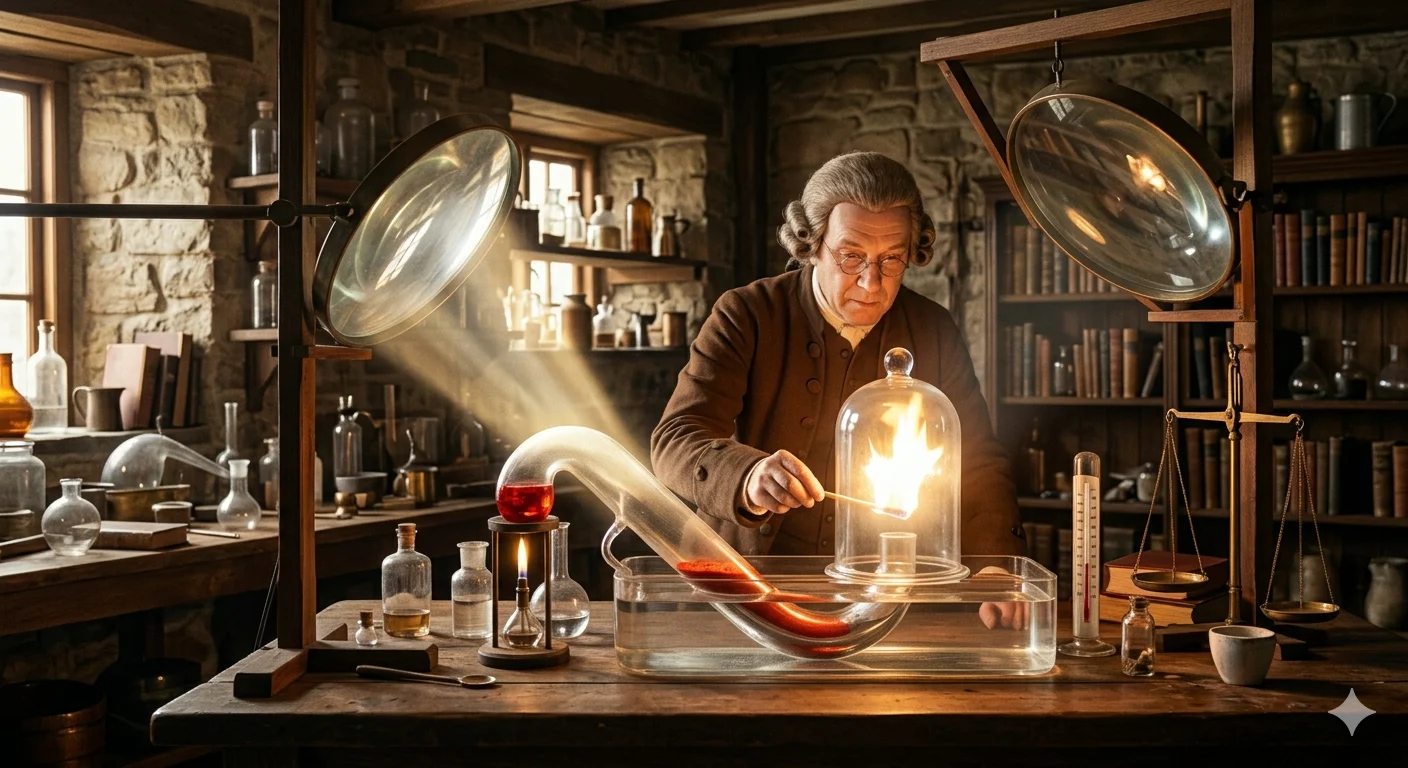
On August 1, 1774, a forty-one-year-old English minister and amateur scientist named Joseph Priestley focused sunlight through a twelve-inch glass burning lens onto a small lump of reddish mercuric oxide contained in an inverted glass vessel sitting in a pool of liquid mercury. The gas that the heated compound released was something he had never encountered before. A candle placed in it burned with a flame that was, as Priestley himself wrote in language that has been quoted ever since, “remarkably vigorous.” A piece of red-hot wood sparkled in it and was consumed very fast. When he breathed it himself, his chest felt “peculiarly light and easy” in a way that ordinary air never produced. He called the substance “dephlogisticated air.” The world would come to know it as oxygen.
The discovery Priestley made at his laboratory at Bowood House in Wiltshire, the estate of his patron William Petty-Fitzmaurice, the second Earl of Shelburne, was one of the most consequential findings in the history of science. It answered questions about combustion and respiration that humanity had been puzzling over for thousands of years. It gave the French chemist Antoine-Laurent Lavoisier the key piece of experimental evidence he needed to demolish the phlogiston theory and build modern chemistry on an entirely new foundation. And it began a controversy about scientific credit and intellectual priority that has never been fully resolved.
Joseph Priestley: Minister, Philosopher, and Accidental Chemist
Joseph Priestley was born on March 24, 1733, in Fieldhead, near Leeds, in Yorkshire, England. His father was a cloth finisher of modest means, and Priestley’s mother died when he was young. He was raised in a strict Calvinist household and educated at dissenting academies rather than the elite universities of Oxford and Cambridge, which at the time required students to subscribe to the doctrines of the Church of England. This background outside the established church shaped everything about Priestley: his religious radicalism, his political views, his refusal to accept received authority in any domain, and his astonishing intellectual breadth.
Priestley became a Unitarian minister, a theologian, a philosopher of education, a political theorist, a grammarian, and a scientist. Over his lifetime he published more than 150 works on subjects ranging from grammar and language theory to the history of Christianity to political philosophy to the nature of electricity and gases. He was a friend of Benjamin Franklin, whose work on electricity had inspired Priestley to take up scientific experimentation in his own right. In 1767, Priestley published The History and Present State of Electricity, which earned him election as a Fellow of the Royal Society the following year.
He came to the study of gases almost by accident. In 1767, he took up a ministerial position in Leeds and temporarily lived near a brewery. Fascinated by the carbon dioxide rising from the fermentation vats, he began experimenting with it and invented a practical method for dissolving the gas in water, creating carbonated water. While others such as Joseph Schweppe would turn carbonation into commercial fortunes, Priestley characteristically gave his discovery away freely. The brewery experiments launched him on what would become his most celebrated line of scientific work: the systematic study of what he called “different kinds of airs,” meaning the various gases that could be produced from chemical reactions.
The Scientific Context: Phlogiston Theory and the World Before Oxygen
To appreciate what Priestley’s discovery meant, it is necessary to understand the theoretical framework in which he and his contemporaries were operating. In the mid-eighteenth century, the dominant explanation for combustion and related phenomena was phlogiston theory, originally developed by the German chemist Georg Ernst Stahl in the early eighteenth century and widely accepted across Europe.
Phlogiston was a hypothetical substance believed to be contained in all combustible materials. When something burned, it was explained, it released its phlogiston into the air. When the surrounding air became saturated with phlogiston, combustion stopped. Metals were believed to be metallic calxes combined with phlogiston, so when a metal was heated and formed a calx (what we now call an oxide), it was thought to be losing its phlogiston. Respiration was explained in similar terms: animals breathed because their bodies needed to expel phlogiston, and when the air they breathed became too saturated with phlogiston, they could no longer survive.
This framework was wrong in fundamental ways, but it was internally consistent and had real explanatory power for many observations. It explained why animals died in enclosed spaces, why candles extinguished, why some substances burned and others did not. Dismantling it required not just a new discovery but a new way of interpreting all the available evidence.
Priestley never abandoned phlogiston theory, even after his most important discovery. The gas he isolated on August 1, 1774, he interpreted entirely through the phlogiston framework. He called it “dephlogisticated air” because he reasoned that it was ordinary air from which all the phlogiston had been removed, leaving it maximally able to absorb more phlogiston from burning substances and from animal respiration. The gas supported combustion so vigorously, in Priestley’s interpretation, not because of anything new it contained but because it was empty of phlogiston and could therefore absorb more.
This interpretation was wrong, but the observation was transformatively correct. Priestley had isolated a real gas with real properties, even if his explanation of those properties was built on a false theoretical foundation.
August 1, 1774: The Experiment at Bowood House
In 1772, Priestley had accepted a position as librarian and scientific companion to William Petty-Fitzmaurice, the second Earl of Shelburne, a wealthy and liberal-minded politician who would later serve briefly as British Prime Minister. Shelburne provided Priestley with an equipped laboratory, financial security, and the intellectual freedom to pursue his experiments at Bowood House in Calne, Wiltshire.
By the summer of 1774, Priestley had already discovered several new gases, including nitric oxide, which he called “nitrous air,” hydrogen chloride or “marine acid air,” ammonia or “alkaline air,” and sulphur dioxide. He had also recently discovered nitrous oxide, which he called “dephlogisticated nitrous air.” His method was systematic: he collected gases produced by heating various substances and tested their properties by observing how they affected the burning of candles and the survival of small animals, particularly mice.
On August 1, 1774, he turned his burning lens on mercuric oxide, a brick-red compound that a colleague had supplied. He later described the event with characteristic candor: the discovery was the result of chance rather than planning. When he heated the compound, it released liquid mercury and a colorless gas. Priestley collected this gas in an inverted vessel over mercury rather than water, because the gas proved to be nearly insoluble in water. He tested it with a candle. The result, as he recorded in his notes, was unlike anything he had seen before: “but what surprized me more than I can well express, was, that a candle burned in this air with a remarkably vigorous flame.” He tested it further with a glowing piece of wood, which burst into bright flame. He found that the gas kept a mouse alive approximately four times as long as an equal volume of ordinary air.
Priestley initially hesitated to draw firm conclusions. He thought the gas might be a variant of nitrous oxide, which he had previously studied. It took him several more months of experimentation, after returning from a European trip, before he became confident that he had identified a genuinely new kind of air. Some historians date his effective discovery to March 1775 rather than August 1774, because it was in March 1775 that he formally recognized the new gas as something far superior to ordinary air and communicated his findings to the Royal Society.
The Wikipedia article on Joseph Priestley covers his full scientific career, his complex relationship with phlogiston theory, and his political and religious life in comprehensive detail.
The Paris Dinner and the Meeting with Lavoisier
The most consequential moment of the entire oxygen story came not in Priestley’s laboratory but over a dinner table in Paris in October 1774. Shortly after his August discovery, Priestley accompanied Lord Shelburne on a tour of the European continent, including Belgium, Holland, Germany, and France. In Paris, Priestley dined with a group of French chemists that included Antoine-Laurent Lavoisier.
Lavoisier was thirty-one years old in 1774, a precise and systematic experimental chemist working at the highest levels of French scientific society, and the son-in-law of a tax farmer who had provided him with excellent laboratory facilities. For two years, Lavoisier had been conducting experiments on combustion and had been puzzled by observations that did not fit neatly within phlogiston theory. He had been heating tin and lead in sealed containers and noting that the metals gained weight when they formed calxes, which was the opposite of what phlogiston theory predicted (if the metals were releasing phlogiston when they formed calxes, they should lose weight).
Over dinner in Paris in October 1774, Priestley described his experiment with mercuric oxide and the extraordinary gas it had produced. Lavoisier listened intently. He rushed to purchase his own sample of mercuric oxide and began his own experiments immediately after Priestley returned to England.
Lavoisier’s subsequent work between 1775 and 1780 was transformative. He repeated Priestley’s experiment, confirmed the properties of the gas, and then went far beyond Priestley’s interpretation. Working from the correct premise that chemical reactions involve the combination and separation of substances rather than the addition or removal of phlogiston, Lavoisier showed that combustion was not a process of releasing phlogiston but a process of combining with the new gas. He showed that the weight gained by metals forming calxes was precisely the weight of the gas absorbed. He named the gas “oxygen” from the Greek words for “acid-maker,” on the mistaken belief that oxygen was a component of all acids, and he made it the cornerstone of a complete reformation of chemistry.
The Britannica biography of Joseph Priestley covers the critical meeting with Lavoisier and the subsequent chemical revolution that Priestley’s discovery enabled but that Priestley himself refused to accept.
Carl Wilhelm Scheele and the Question of Who Really Discovered Oxygen
The credit for discovering oxygen has never been straightforward, because a Swedish apothecary named Carl Wilhelm Scheele almost certainly produced oxygen before Priestley did, and he deserves a central place in this story.
Scheele was born in 1742 in Stralsund, then part of Sweden, and worked as an apothecary’s assistant and later as an apothecary, conducting chemical experiments with limited resources in the back rooms of pharmacies. In 1772, two years before Priestley’s famous experiment, Scheele isolated a gas from a variety of heated metallic compounds including mercuric oxide, which he called “fire air” because of its remarkable ability to support combustion. Scheele recognized that ordinary air was a mixture of his fire air and a second gas, “foul air” (what we now call nitrogen), and he understood the importance of what he had found.
Scheele prepared a manuscript describing his discoveries and submitted it to the printer around 1775, but through a combination of his publisher’s delays and other complications, the book was not actually published until 1777, three years after Priestley’s experiment and two years after Priestley’s formal communication to the Royal Society. Scheele also wrote a letter to Lavoisier in September 1774 describing his findings, but for many years it was believed that Lavoisier had never received it. A copy of the letter was discovered in 1992 in the archives of the French Academie des Sciences, confirming that Lavoisier had in fact received Scheele’s letter in October 1774, just as Priestley was sharing his findings at their Paris dinner.
Whether Lavoisier’s silence on Scheele’s prior claims reflected ignorance, carelessness, or deliberate suppression of a rival’s priority has been debated by historians of science ever since. What is certain is that Scheele received limited credit during his lifetime compared to Priestley and Lavoisier, despite the strength of his claim to have been the first to isolate the gas. Scheele died in 1786 at age forty-four, reportedly from the effects of tasting and inhaling the toxic compounds he worked with throughout his career.
Priestley’s Refusal: Why He Never Accepted Lavoisier’s Oxygen Theory
The central irony of Joseph Priestley’s scientific career, noted by the nineteenth-century French naturalist Georges Cuvier in his eulogy, was that the man who made the discovery that eventually destroyed phlogiston theory was also the discovery’s most tenacious defender throughout the rest of his life. Priestley absorbed Lavoisier’s new chemistry with intense interest and genuine engagement but ultimately rejected its core conclusions until the day he died.
His reasons were partly philosophical, partly religious, and partly political. Priestley saw Lavoisier’s new chemical nomenclature and his systematic theory as a kind of intellectual authoritarianism, analogous to the religious and political establishments that Priestley had spent his life opposing. As a Unitarian dissenter who rejected established religious authority, Priestley was instinctively suspicious of any framework that claimed to have definitively resolved questions he considered still open. He continued to publish defenses of phlogiston theory, including Doctrine of Phlogiston Established in 1800 and an expanded version in 1803, the year before his death.
Political Exile and Priestley’s Final Years in America
Priestley’s scientific work was inseparable from his political and religious radicalism. He was a vocal supporter of both the American and French Revolutions, at a time when these positions made him deeply controversial in Britain. His published works defending the rights of religious dissenters and advocating political reform made him enemies among both the conservative establishment and the Church of England.
In July 1791, while Priestley was attending a dinner with colleagues to celebrate the second anniversary of the French Revolution, a mob attacked and destroyed his home, his laboratory, and his church in Birmingham. The Priestley Riots, as they became known, were orchestrated by royalist and established church elements opposed to his political views. Priestley escaped unharmed but lost his manuscripts, laboratory equipment, books, and years of scientific records. He never returned to Birmingham.
He moved to London and then, in 1794, emigrated to the United States. He settled in Northumberland, Pennsylvania, where he built a new home and laboratory, assembled a library of 1,600 volumes that was among the largest private collections in America, and continued both his scientific work and his theological writing. He became a friend of Thomas Jefferson, and some historians credit his philosophical influence with helping to shape Jefferson’s vision of liberal education. He died in Northumberland on February 6, 1804, at age seventy, still defending phlogiston theory to the end.
The American Chemical Society’s landmark page on Joseph Priestley documents the scientific significance of his oxygen discovery and the way his meeting with Lavoisier in Paris catalyzed the chemical revolution that transformed modern science.
A fitting historical footnote to Priestley’s life is that on August 1, 1874, exactly one hundred years after his discovery of oxygen, a gathering of Priestley’s great-grandson and American chemists at his grave site in Northumberland formed the organization that would become the American Chemical Society. The man who discovered the gas that sustains all life on earth, who never accepted the full implications of what he had found, who was driven from his country for his political beliefs, and who died defending a theory that history had already refuted, gave the world’s chemistry community its oldest and largest professional home.