
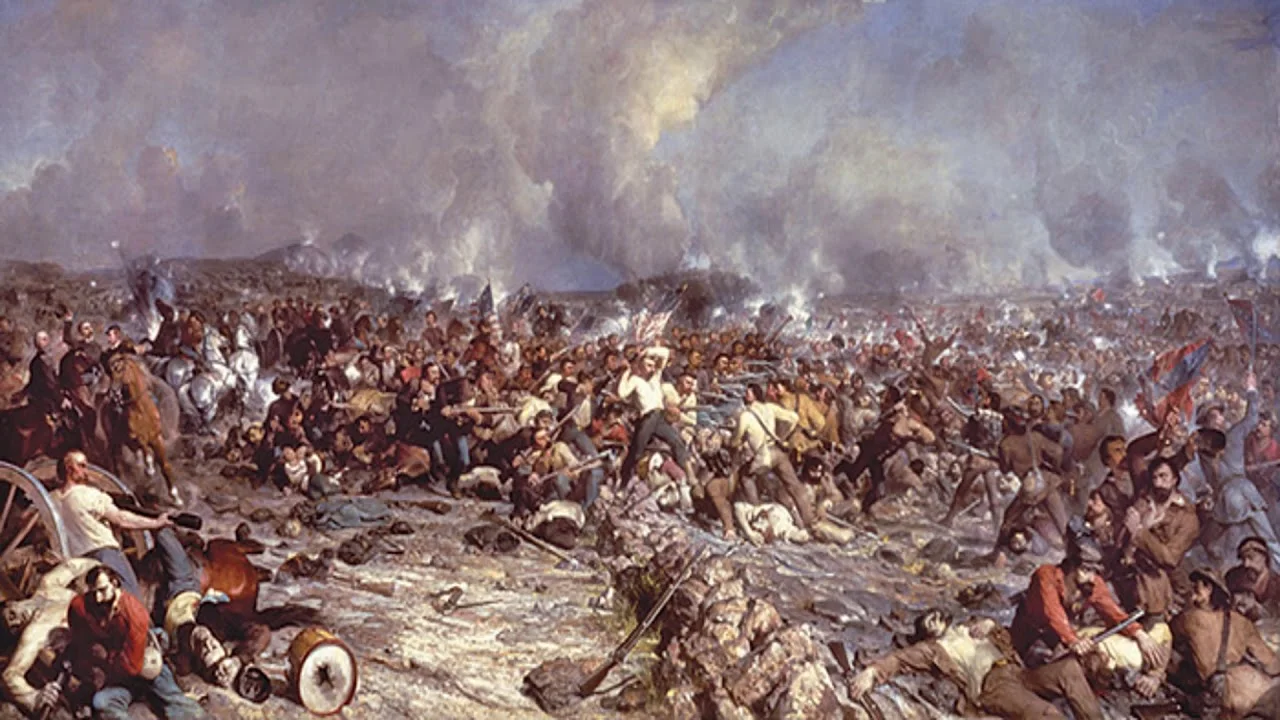
At approximately two o’clock in the afternoon on July 3, 1863, on a broad, sun-scorched Pennsylvania farm field south of the town of Gettysburg, roughly 12,500 Confederate soldiers emerged from the tree line along Seminary Ridge, dressed their ranks, and began to walk eastward across nearly a mile of open ground toward the Union position on Cemetery Ridge. The temperature was 87 degrees. The humidity was stifling. Two hours of the most intense artillery bombardment the American continent had ever witnessed had just fallen silent, leaving the air thick with smoke and the acrid bite of burnt powder. The men who stepped forward into that smoke-hazed open ground were some of the finest infantry soldiers who ever fought under any flag — veterans of campaigns from the Seven Days Battles to Chancellorsville, men who had absorbed punishment that would have broken lesser armies and kept fighting. And they were walking into their own destruction.
What followed in the next fifty minutes is known to history as Pickett’s Charge, though the name is partly a myth that obscures a more complex and tragic reality. General George E. Pickett commanded only one of the three divisions that made the assault; the overall command belonged to Lieutenant General James Longstreet, who had argued against the attack with a vehemence and certainty unusual even among officers who disagreed with their commander. The Virginians under Pickett made up perhaps a third of the attacking force. Yet the charge bears his name, in part because of the Lost Cause mythology that grew up around it after the war, and in part because the image of Pickett — his long dark ringlets oiled and curled, his hat raised as he sent his men forward — captured something essential about the tragedy of what happened that afternoon. More than 6,500 Confederate soldiers became casualties. The charge failed. The Confederacy never mounted a major offensive in the North again. Pickett’s Charge has stood ever since as the high-water mark of the Confederacy, the moment when the tide turned irrevocably against the Southern cause.
Lee’s Second Invasion of the North: Why the Army of Northern Virginia Was at Gettysburg in July 1863
The Army of Northern Virginia arrived at Gettysburg in the first days of July 1863 as the spearhead of Robert E. Lee’s second invasion of the Northern states, a campaign of extraordinary strategic ambition that was driven by the military logic of the Confederate position after more than two years of war. The Confederacy had fought brilliantly on the defensive and had won a string of remarkable victories against the larger and better-equipped Union Army of the Potomac. Lee had crushed the Union army at the Second Battle of Bull Run in August 1862, had fought to an effective draw at Antietam in September 1862 that had blunted his first northern invasion, had destroyed Ambrose Burnside’s massive army with shocking one-sidedness at Fredericksburg in December 1862, and had humiliated Joseph Hooker at Chancellorsville in May 1863, a masterpiece of audacious generalship fought against odds that should have made a Union victory inevitable. But brilliant defensive victories on Virginia soil were not winning the war for the Confederacy, and Lee understood this clearly.
Lee’s strategic calculus for the Pennsylvania campaign was multi-layered. By moving his army north of the Potomac and threatening Washington, Philadelphia, and Baltimore, he hoped to force the Army of the Potomac to fight him on ground of his choosing at a disadvantage, potentially producing the kind of overwhelming victory that would shatter Northern civilian morale and compel the Lincoln administration to negotiate a peace. He also needed to feed his army: Virginia had been stripped of agricultural produce by two years of war, and the rich farms of Pennsylvania could supply his troops with food, fodder, and horses that the Confederacy could not otherwise provide. And he hoped that a decisive victory on Northern soil might finally produce the British and French diplomatic recognition that the Confederacy had been seeking throughout the war, recognition that could transform the conflict from a domestic insurrection into an internationally acknowledged struggle for independence.
The campaign that ended at Gettysburg was thus the Confederacy’s best and perhaps last serious bid for a decisive strategic success. Lee moved the Army of Northern Virginia out of Virginia in early June 1863, crossing the Potomac and advancing through Maryland into southern Pennsylvania, reaching as far as the Susquehanna River before the presence of the pursuing Union Army of the Potomac under its new commander, Major General George Gordon Meade, forced a concentration at Gettysburg. The collision that began on July 1, 1863, when a Confederate infantry division sent to forage for shoes encountered Brigadier General John Buford’s Union cavalry at the crossroads town, was accidental in its initiation but catastrophic in its scale. By the time the first day’s fighting ended on the afternoon of July 1, both armies had committed their full strength to a battle neither had planned to fight at this location, and the Union forces had been driven through the town to take up a defensive line on the high ground to the south — the Cemetery Ridge position that would define the battle and Pickett’s Charge.
Three Days in Pennsylvania: The Battle’s First Two Days and the Strategic Position on July 3 Morning
The first day of the Battle of Gettysburg, July 1, 1863, ended with a Union retreat that looked like a disaster but proved to be the foundation of a strong defensive position. Confederate forces under Lieutenant General A. P. Hill and Lieutenant General Richard Ewell had driven the Union First and Eleventh Corps through the streets of Gettysburg and back to Cemetery Hill, just south of the town. But the retreating Union soldiers had reached defensible ground, and the commanders who arrived to organize the defense — most critically Major General Winfield Scott Hancock, sent by Meade ahead of the main army to assess the situation — made the critical decisions that transformed the retreat into an anchored defensive line. Through the night of July 1 to 2, the Army of the Potomac poured reinforcements into the position along Cemetery Ridge, the low but defensible ridge running roughly north to south just south of town.
The second day of the battle, July 2, saw Lee attempt to break the Union position by attacking both flanks simultaneously. Longstreet’s First Corps attacked the Union left at places that have since become among the most famous terrain features in American military history: the Peach Orchard, the Wheat Field, Devil’s Den, and above all Little Round Top, the rocky height on the southern end of the Union line where Colonel Joshua Lawrence Chamberlain and the 20th Maine Infantry made a desperate bayonet charge that prevented a Confederate envelopment. Simultaneously, Ewell’s Second Corps attacked the Union right at Culp’s Hill and Cemetery Hill. The fighting on July 2 was savage on both sides, with enormous casualties, and ended with the Union lines battered but fundamentally intact. The Confederate attacks had come very close to breaking through in several places, but the Union had held. That night, at a council of war at his headquarters, Meade polled his corps commanders and they agreed to stay and fight.
Lee also chose to continue the battle, and it was in the pre-dawn hours of July 3 that he made the decision that would define his generalship for posterity. Initially, Lee planned to renew the previous day’s attacks on the Union flanks, with Longstreet attacking from the south and Ewell renewing pressure on Culp’s Hill and Cemetery Hill to the north. But before Longstreet was ready to begin his attack, Union artillery on Culp’s Hill opened an intense bombardment in the early morning hours, and the fighting there ran from dawn until approximately 11:00 a.m., ending with the Union line firmly intact and the Confederate forces driven back. With both flanks having failed to produce a breakthrough, Lee reconsidered his options and arrived at the plan that Longstreet would later describe as the greatest mistake of his military career: a massive frontal assault on the center of the Union line on Cemetery Ridge.
Lee’s Fatal Decision: Why He Chose to Attack the Union Center and Why Longstreet Refused to Believe It Could Work
Lee’s reasoning for ordering the frontal assault on Cemetery Ridge has been analyzed, debated, and condemned by historians for more than 160 years. His fundamental premise was a form of tactical logic that was internally coherent but, as Longstreet argued with considerable heat, fatally disconnected from the realities of the terrain, the Union defensive preparations, and the available Confederate forces. Lee believed that his attacks on the Union flanks on July 2 had forced Meade to shift troops from the center of his line to reinforce those threatened flanks, leaving the center weaker and potentially vulnerable. If he struck the center with a powerful, concentrated force at exactly the right point, he might punch through the Union line, split the Army of the Potomac in two, and achieve the decisive victory that would end the campaign.
Longstreet’s counterargument was equally coherent and, as events demonstrated, correct. James Longstreet, born January 8, 1821, in Edgefield District, South Carolina, was Lee’s most experienced corps commander and the officer Lee himself called his Old War Horse. He had been one of the most effective corps commanders in the Confederate army and had a tactical instinct sharpened by years of warfare. He told Lee flatly that morning: No 15,000 men who ever lived could take that position. He wanted instead to execute a wide flanking movement around the Union left, interposing the Confederate army between Meade and Washington and forcing Meade to attack the Confederates on ground of their choosing — a maneuver that would have used the Confederate army’s strength in defensive fighting rather than asking it to perform the most difficult and costly tactical operation in warfare: a frontal assault across open ground against a prepared enemy with superior artillery.
Lee overruled him. He was perhaps emboldened by the memory of Fredericksburg, where Burnside’s massed frontal assaults against his own positions on Marye’s Heights had been slaughtered, and where the attacking Union troops had been broken without serious damage to his own lines. If Burnside’s men had failed at Fredericksburg, couldn’t Pickett’s men succeed at Cemetery Ridge? It was a false analogy: at Fredericksburg, the defenders had had a stone wall to shelter behind, while the attacking infantry had to cross an open field swept by fire from multiple positions. At Cemetery Ridge, the positions were reversed: it was the Union army that had the stone wall, and the Confederate infantry that would have to cross the open field. Longstreet understood this precisely. Lee either did not fully grasp it or chose to proceed in any case. The Confederacy’s hopes rode on the answer.
The Men Who Would March: George Pickett, Johnston Pettigrew, Isaac Trimble, and the Nine Brigades
The force assembled for the assault on the afternoon of July 3 comprised nine brigades drawn from three divisions and two corps. Major General George Edward Pickett commanded the three Virginia brigades that would give the assault its name and its romantic mythology. Pickett was born January 16, 1825, in Richmond, Virginia, and was by any reasonable measure a mediocre general given a role far exceeding his abilities. He had graduated last in his class of 59 at West Point in 1846, a distinction that became famous only in retrospect. He had served with some distinction in the Mexican War, where he had been first to scale the walls at the Battle of Chapultepec, and had been a capable regimental and brigade commander in the early Confederate army. But he had no experience commanding a division in major combat, and his personal characteristics — the oiled ringlets, the foppish romantic persona, the passionate relationship with his young fiancée LaSalle Corbell — suggested a man better suited to cavalry dash than to the sober management of a large-scale infantry assault.
Pickett’s three brigades were commanded by Brigadier General James L. Kemper on the right, Brigadier General Richard B. Garnett in the center-left of the first line, and Brigadier General Lewis A. Armistead in the supporting second line. Kemper was an attorney turned politician turned soldier, a lawyer who had served in the Virginia legislature before the war. Garnett was under a cloud of dishonor: Stonewall Jackson had relieved him of command at the Battle of Kernstown in 1862 for ordering a retreat without authorization, and Garnett was seeking to restore his reputation on this field, which is why, despite a serious leg injury that made walking impossible, he rode his horse into the charge, knowing that conspicuously mounted officers in the line of fire had a near-certainty of being killed or wounded. Armistead would prove the bravest and most consequential of the three, the man who reached the farthest into the Union lines before dying, and whose death would become one of the most poignant and frequently told stories of the entire Civil War.
Brigadier General J. Johnston Pettigrew commanded the division that provided the left wing of the assault, composed primarily of North Carolinians and men from other Southern states. Pettigrew’s division had fought on the first day of the battle under its original commander, Major General Henry Heth, who had been struck in the head by a rifle ball early on July 1 and incapacitated by the wound, though remarkably he survived. Pettigrew’s men were not fresh: they had absorbed significant casualties on the first day’s fighting, and their endurance was already tested. Major General Isaac Ridgeway Trimble, sixty-one years old and the oldest officer in the assault, commanded two North Carolina brigades in support of Pettigrew’s left. Trimble was a former railroader turned soldier of fierce combative spirit who had been fuming for weeks that his rank gave him no command, and he had begged Lee to be allowed to take part in whatever attack was ordered.
The Artillery Duel: One to Two Hours of Thunder That Decided Nothing
The assault was preceded by the largest artillery bombardment in the history of the Western Hemisphere to that point, a cannonade involving approximately 150 Confederate guns firing simultaneously at the Union positions on Cemetery Ridge. At approximately 1:00 in the afternoon of July 3, 1863, the Confederate guns opened along the entire Confederate line from Seminary Ridge, the roar audible across the Pennsylvania countryside for twenty miles in any direction. The Confederate plan was to use the bombardment to destroy the Union artillery batteries on Cemetery Ridge, shatter the Union infantry’s morale, and create the conditions in which Pickett’s infantry could advance across the open ground without being torn apart by cannon fire before even reaching musket range. If the artillery failed to neutralize the Union guns, the infantry assault would be crossing nearly a mile of open ground under fire from the very batteries that the bombardment had been intended to silence.
The artillery duel that followed for the next two hours was spectacular in its violence and largely futile in its effect. The Confederate guns, firing from Seminary Ridge, were aimed high, and a significant proportion of the shells overshot the Union positions on Cemetery Ridge and fell among the troops and headquarters in the rear, forcing even General Meade temporarily to abandon his headquarters. But the Union infantry behind the stone wall on Cemetery Ridge was largely untouched. The Union artillery chief, Brigadier General Henry Hunt, ordered his batteries to reduce their fire as the bombardment progressed, partly to save ammunition for the infantry assault he knew was coming and partly to create the impression that the Confederate fire was having effect — that Union guns were being silenced. The deception worked. Colonel Edward Porter Alexander, twenty-seven years old and the effective Confederate artillery commander on the field, watching the slowing of Union artillery fire, sent a message to Pickett at approximately 1:40 p.m.: For God’s sake, come quick. The eighteen guns have been driven off. Come quick or my ammunition won’t let me support you properly.
But Alexander’s confidence was built on a misreading of what he was seeing. The Union guns had not been destroyed; they had been deliberately husbanded. In an exchange of messages between Longstreet and Alexander just before the assault began, Longstreet asked Alexander directly whether he had enough ammunition and whether the Confederate artillery could suppress the Union guns during the advance. Alexander replied honestly that he did not have full confidence that the Union guns had been silenced and that his ammunition was nearly exhausted. If the infantry did not advance immediately, it would advance without effective artillery support, since replenishing ammunition from the trains in the rear would take over an hour. Longstreet, who did not want to order the charge and who hoped that Alexander’s honest assessment would give him grounds to stop it, found instead that the logic of the artillery situation made stopping the assault even harder: they had fired off most of their shells, and if they did not attack now, they would have no artillery support at all. Longstreet gave the order — or rather, being unable to speak the words, reportedly nodded in response to Pickett’s direct question — and the nine brigades stepped forward.
The Advance Across the Open Ground: Half a Mile of Death and Discipline
At approximately 2:00 in the afternoon, the Confederate lines emerged from the woods along Seminary Ridge and formed for the advance. Pickett’s Virginians deployed on the right, Pettigrew’s division on the left, with Trimble’s two brigades following behind Pettigrew as support. The nine brigades covered a front of roughly a mile, with the open farmland of the Gettysburg valley between them and the stone wall on Cemetery Ridge. The distance to be crossed was approximately three-quarters of a mile to the Emmitsburg Road, with another three hundred to four hundred yards beyond that to the stone wall itself. Every yard of that distance was visible to the Union artillery and infantry on the ridge, and the men would be under fire virtually from the moment they stepped out of the tree line.
The advance began in near-perfect order, the Confederate flags unfurled, the men marching at the deliberate pace of a trained infantry assault, dressing their lines as they moved. The discipline they demonstrated in that advance was remarkable and has been noted by virtually everyone who has written about the battle. Confederate soldiers who survived would later say that the barrage had made them eager to get moving, that the waiting under artillery fire was worse than the marching. As they came into the open, they faced the reality that the Union guns had not been silenced. The batteries on Cemetery Ridge, silent for much of the bombardment, opened fire on the advancing Confederate lines. The batteries on Little Round Top and Cemetery Hill added their fire from the flanks. Lieutenant Colonel Franklin Sawyer of the 8th Ohio Infantry watched from the Union lines and later wrote: They were at once enveloped in a dense cloud of smoke and dust. Arms, heads, blankets, guns and knapsacks were thrown and tossed into the clear air. A moan went up from the field, distinctly to be heard amid the storm of battle.
The Confederate advance did not stop. As men fell on all sides, the brigades closed their ranks and kept moving. But the flanks began to unravel. On the Confederate right, as Pickett’s Virginians crossed the Emmitsburg Road and wheeled partially to their left to align on the Copse of Trees that had been designated as the aiming point for the assault, their right flank was exposed to flanking fire from Union artillery under Lieutenant Colonel Freeman McGilvery and from the Union infantry of Abner Doubleday’s division on the far end of Cemetery Ridge. Then Brigadier General George Stannard’s Vermont Brigade — newly arrived from months of garrison duty, fresh troops not worn down by the previous two days of fighting — marched forward from the Union line, faced north, and delivered devastating flanking fire into the rear of Kemper’s brigade, whose men were now taking fire from both front and flank simultaneously. On the Confederate left, Pettigrew’s brigades had suffered heavily in the artillery fire and the subsequent musket fire, and were beginning to lose cohesion.
The High-Water Mark: Armistead at the Angle and the Final Moments of the Assault
The climax of Pickett’s Charge came at a jog in the stone wall along Cemetery Ridge known as the Angle, where the low wall ran northward for approximately a hundred yards, then turned east for eighty yards, then ran north again toward a grove of trees that soldiers on both sides called the Copse of Trees. Behind this wall, in the most critical sector of the Union line, the Philadelphia Brigade under Brigadier General Alexander Webb — 268 men of the 69th Pennsylvania — defended the portion of the Angle directly in the path of Garnett’s and Armistead’s approaching Confederates. Also present were two three-inch rifled guns of Lieutenant Alonzo Cushing’s Battery A, 4th United States Artillery, Cushing himself mortally wounded by a bullet to the groin and mouth but remaining at his guns to direct his final rounds into the approaching mass.
As the Confederate assault approached the Angle, the 71st Pennsylvania regiment, whose position was at the exact corner of the Angle, broke and retreated when the Confederates came within a few yards, leaving the stone wall momentarily unmanned. It was the gap that the assault needed. Garnett’s and Armistead’s brigades, 2,500 to 3,000 men, began crossing the stone wall. Garnett himself was killed at approximately this moment, shot from his horse, his body falling in the confusion near the wall. Armistead, the last of Pickett’s brigade commanders still alive and able to lead, put his black hat on the tip of his sword and raised it above his head as a rallying point for his men, shouting Come forward, Virginians! Come on, boys, we must give them the cold steel! Who will follow me? And approximately 150 to perhaps 300 men crossed the stone wall with him, pushing into the area behind the Union line, seizing two abandoned cannon, reaching what is now called the high-water mark of the Confederacy.
There was hand-to-hand fighting of ferocious intensity at the Angle. The 69th Pennsylvania stood its ground against the entering Confederates with bayonets and clubbed muskets. Brigadier General Alexander Webb, commander of the Philadelphia Brigade, tried to rally his men and was temporarily blocked when soldiers of the 72nd Pennsylvania — advancing from the rear to reinforce — refused at first to follow him forward into the maelstrom. Colonel Arthur Devereux of the 19th Massachusetts sprinted to General Hancock on horseback, shouting that the Confederate colors were over the stone wall and that the Confederates had broken through. Hancock, who had been conspicuously riding along his line throughout the bombardment and the assault, encouraging his men by the personal example of his physical presence, ordered reinforcements in. He was struck at approximately this moment by a bullet that drove fragments of the pommel of his saddle, a large bent nail, and wood splinters into his thigh — a wound that plagued him for the rest of his life, but he refused to be carried from the field until the battle’s outcome was decided.
Lewis Armistead was shot as he placed his hand on one of Cushing’s cannon, reaching the farthest point of the Confederate advance. He fell mortally wounded, dying two days later in a Union field hospital. By one of the Civil War’s most poignant ironies, the Union troops who killed him were under the command of Winfield Scott Hancock, Armistead’s closest friend from the pre-war army. The two men had been present at the same farewell dinner in Los Angeles in June 1861, when the Southern officers of the garrison were leaving to join the Confederacy, and Armistead had wept openly at the prospect of fighting against his old comrades. He allegedly asked, as he lay dying, to have his personal Bible and other effects delivered to Hancock’s wife Almira — a request that Longstreet later honored. Without Armistead’s personal leadership, the hundred-odd Confederates who had crossed the wall were too few to hold the position against the reinforcements pouring in from both flanks. Every Confederate who did not flee was killed or captured. The high-water mark had been reached and receded.
The Collapse and Retreat: Confederate Survivors Walk Back Across the Field
As Armistead fell and the thin Confederate penetration at the Angle was obliterated, the rest of the assault collapsed simultaneously along the entire line. On the Confederate left, Pettigrew’s division had never been able to reach the stone wall at all, torn apart by artillery and musket fire before it could close with the Union defenses. Trimble’s supporting brigades, following behind Pettigrew, were similarly shattered. On the Confederate right, the flanking fire of Stannard’s Vermonters had broken Kemper’s brigade, and Kemper himself was badly wounded, captured by Union soldiers, briefly rescued by Confederates, and then captured again during the subsequent retreat to Virginia. On both flanks of the Confederate assault, the attacking brigades were being destroyed without having approached the Union line at all.
The survivors began streaming back across the open field toward Seminary Ridge, running individually or in small groups through the same ground they had crossed in perfect order less than an hour before. The field was covered with Confederate dead and wounded in numbers that stunned even hardened veterans. Every regimental commander in Pickett’s division — fifteen in total — was a casualty. Of Pickett’s forty field-grade officers, twenty-six were casualties. All three of his brigade commanders fell: Armistead dead, Garnett dead, Kemper seriously wounded and eventually captured. In Pettigrew’s division, the 26th North Carolina, which had already lost nearly half of its 843 men in the first day’s fighting, ended the battle with 687 total casualties, the highest regimental loss of either side in the entire battle. Trimble lost a leg. Pettigrew was wounded in the hand but survived the battle, only to die of an abdominal wound suffered in a minor skirmish during the retreat to Virginia.
As the survivors straggled back to the Confederate lines, Robert E. Lee rode out alone on his gray horse Traveller to meet them. He told the returning men that the failure was all my fault. He tried personally to rally his troops and his generals for the defense, expecting a Union counteroffensive that never came. When Lee encountered Pickett and ordered him to rally his division to hold against the anticipated Union counterattack, Pickett allegedly replied: General Lee, I have no division. It was not quite true — more of his men survived than Pickett realized in the immediate shock of the aftermath — but the emotional accuracy of the statement captured what had happened. The finest single division of infantry in the Army of Northern Virginia had been gutted in fifty minutes of fighting, leaving Lee with no reserve capable of a major offensive action.
Why Pickett’s Charge Failed: Artillery, Open Ground, a Prepared Defense, and Longstreet Was Right
The failure of Pickett’s Charge was overdetermined — the assault failed not for one reason but for a combination of reasons, any one of which might alone have been sufficient to doom it, and all of which operated simultaneously. The most fundamental problem was the terrain. The attack required approximately 12,500 men to cross nearly a mile of open farmland that provided no cover whatsoever from artillery fire. Every cannon and rifle on Cemetery Ridge, Cemetery Hill, Little Round Top, and the commanding high ground flanking the Confederate advance could fire freely into the advancing lines from the moment they stepped out of the tree line. No flanking maneuver, no use of terrain, no gradual approach under cover was available: the Confederate infantry simply had to walk across the open field and accept whatever casualties the Union defenders chose to inflict.
The artillery bombardment that was supposed to neutralize the Union guns failed comprehensively, for reasons that went beyond bad luck or poor execution. The Confederate guns on Seminary Ridge were firing from a lower elevation than the Union positions on Cemetery Ridge, which meant that accurate ranging was difficult and that shells fired too high would overshoot the Union artillery and fall among the infantry and headquarters in the rear rather than on the gun positions themselves. The Union artillery chief Hunt’s tactical deception — reducing fire to create the appearance that Union guns had been silenced — worked exactly as intended, convincing Alexander that he had achieved suppression when he had not. And Alexander’s own ammunition ran out before the infantry reached the Union lines, meaning that the Confederate advance across the last few hundred yards before the wall occurred with minimal supporting artillery fire, while the Union guns, having husbanded their ammunition, opened at full effect precisely when they were most needed.
The Union defense was also stronger than Lee had calculated. His premise that Meade had weakened the center to reinforce the flanks was incorrect: Meade had in fact predicted at his council of war the previous evening that Lee would attack the center, and had prepared accordingly, ensuring that the II Corps under Hancock was fully manned and positioned behind the stone wall on Cemetery Ridge. The stone wall itself was a significant defensive advantage — it gave the defenders cover while offering none to the attackers. And the flanking fire from Stannard’s Vermonters and from the batteries on Little Round Top struck the Confederate right at precisely the moment when Pickett’s men were most exposed, turning a frontal assault into an attack against three sides simultaneously. The Confederate numerical advantage on the immediate front — 12,500 attackers against perhaps 6,500 defenders — was negated by the ability of the Union defenders to concentrate fire from multiple directions against troops moving in a predictable straight line across open ground.
The Human Toll: Casualties, the Dead, and the Personal Tragedies of a Single Afternoon
The casualties from Pickett’s Charge were enormous by any standard. The most reliable modern estimates suggest that the Confederate forces engaged numbered approximately 12,500 men, of whom approximately 6,000 to 6,500 were killed, wounded, captured, or missing — a casualty rate approaching fifty percent. Pickett’s division alone suffered 2,655 casualties. Pettigrew’s division suffered approximately 2,700 casualties. Trimble’s two brigades added another 885. The aggregate Confederate loss in the charge exceeded the total Union casualties from the entire three days of fighting at Gettysburg in Hancock’s entire Second Corps. These numbers were staggering even by the brutal standards of the Civil War.
Behind the statistics were individual stories of extraordinary courage and extraordinary loss. Richard Garnett had ridden into the assault knowing he would likely be killed, unable to walk on a leg injured in a previous battle, unwilling to be absent from the one engagement where his honor demanded his presence after Jackson’s unjust relief of command. His body was never found — in the confusion of the field, with thousands of dead lying in the summer heat, Garnett simply disappeared, and his fate is one of the small mysteries of the battle. The color-bearer and sergeant of a North Carolina regiment in Pettigrew’s division marched all the way to the stone wall and stood there, flags still flying, while Union defenders who had been shooting men down for fifty minutes could not bring themselves to shoot these two. A Union soldier finally called out, Come over to this side of the Lord, and the two Confederates surrendered, having fulfilled their duty to its uttermost limit.
The Union defenders also paid a price. Alonzo Cushing, twenty-two years old, had been wounded twice before his battery’s final round was fired, holding his intestines in with one hand and directing his last gun with the other until he was killed by a bullet to the head just as Armistead’s men reached the wall. He was awarded the Medal of Honor posthumously, the award delayed by bureaucratic inertia for a hundred and fifty years and not formally bestowed until 2014. General Hancock, whose visible personal leadership throughout the assault had helped steady his corps, carried fragments of a saddle pommel and a bent nail in his thigh for the rest of his life, wounds that prevented him from walking without pain and that may have affected his health for decades.
Lee Retreats, Meade Stays, and Vicksburg Falls: The Day That Turned the Civil War
The aftermath of Pickett’s Charge played out over the remainder of July 3 and through July 4. Lee feared a Union counteroffensive and tried to organize his shattered center for defense, but the Army of the Potomac was exhausted from three days of brutal fighting and Meade was not prepared to risk his hard-won victory with an aggressive pursuit. The two armies faced each other across the devastated field for the remainder of the afternoon, collecting their dead and wounded. On July 4, they observed an informal truce to continue that work. That same July 4, Major General Ulysses S. Grant accepted the surrender of the Confederate garrison at Vicksburg, Mississippi, effectively completing the Union’s control of the Mississippi River and severing the Confederacy east of the river from the Confederate states to the west. Two Union victories of the first magnitude on the same date, the anniversary of American independence.
Lee began his retreat to Virginia on July 4 in a column stretching seventeen miles, his wounded filling an unbroken train of wagons for a hundred miles along the road. The retreat was shadowed by Union cavalry and pressure from Meade’s forces, and when Lee reached the Potomac River at Williamsport, Maryland, he found it flooded and unfordable. The Army of Northern Virginia sat with its back to the river for ten days while Confederate engineers improvised a crossing, offering Lee what seemed to many observers to be a clear opportunity for Meade to strike and destroy the Confederate army. Meade approached cautiously and then found the ford had dried enough for Lee to cross on July 13-14. Abraham Lincoln was furious at what he saw as a lost opportunity to end the war. Meade had saved the Union at Gettysburg, but he had not destroyed the Confederate army.
The High-Water Mark and the Lost Cause: How Pickett’s Charge Was Mythologized
In the decades after the Civil War, Pickett’s Charge acquired a mythology that often obscured the historical reality. The phrase high-water mark of the Confederacy, applied to the farthest advance of Armistead’s men at the Angle, became the central metaphor of the Lost Cause interpretation of the Civil War — the narrative constructed by Confederate veterans and apologists in the post-war years that held that the South had fought nobly and bravely for a just cause against overwhelming odds, and that Gettysburg represented the moment when Providence finally intervened against the gallant but doomed Confederate effort. In this interpretation, the Confederate cause had not been wrong; it had simply been overwhelmed by Northern numbers and industrial power. Pickett’s Charge was evidence not of Confederate failure but of Confederate heroism, the bravery of men who walked into certain death without flinching.
The Lost Cause mythology transformed George Pickett himself into a tragic hero, the embodiment of the Southern soldier at his most gallant. LaSalle Corbell Pickett, his widow, spent decades after her husband’s death in 1875 constructing and promoting this image, writing books and articles that presented Pickett as the central figure of the assault and that included letters and other materials that historians have since largely concluded she largely fabricated. The 1993 film Gettysburg, based on Michael Shaara’s novel The Killer Angels, further solidified the popular image of Pickett’s Charge as primarily a Virginia affair, an impression that historian Gary Gallagher noted left uninformed viewers with the impression that Pickett’s division made up all rather than considerably less than half of the assaulting column.
The historical debates generated by the Lost Cause interpretation proved particularly bitter in the matter of blame for the assault’s failure. Confederate veterans from Virginia blamed the North Carolinians in Pettigrew’s division for retreating too soon, preventing Pickett’s Virginians from breaking through. Confederate veterans from North Carolina and other states rejected this, pointing to the complete failure of Kemper’s and Garnett’s brigades to hold the ground at the Angle even after Armistead had broken through, and arguing that the fault lay with Lee for ordering an impossible assault, or with Longstreet for implementing it with insufficient enthusiasm, or with the Confederate artillery for failing to neutralize the Union batteries. Years after the war, Pickett was asked why the assault had failed. He responded laconically: I’ve always thought the Yankees had something to do with it. The reply was simultaneously dismissive of the acrimonious debate and, in its way, the most honest assessment of all.
The Legacy of Pickett’s Charge: Turning Point, Symbol, and the Weight of What Was Lost
Pickett’s Charge stands in American historical memory as the defining moment of the Civil War’s turning point, the battle within the battle that determined the outcome not only of Gettysburg but, in the longer view, of the entire conflict. Lee retreated to Virginia and never mounted another major offensive into the North. The Army of Northern Virginia continued to fight with extraordinary effectiveness for nearly two more years, but it fought always on the defensive, in an increasingly attritional struggle that the Confederacy could not sustain. The strategic initiative had passed permanently to the Union after Gettysburg, and the subsequent campaigns of Grant and Sherman would exploit that initiative with the relentless efficiency of industrial-age warfare applied against an adversary whose resources were finite.
The Gettysburg Address that President Abraham Lincoln delivered on November 19, 1863, at the dedication of the Soldiers’ National Cemetery at Gettysburg — the cemetery that received the Union dead from the three days of fighting — gave the battle and its casualties a meaning that transcended the immediate military context. Lincoln’s 272 words redefined the purpose of the war: not merely the preservation of the Union as a political entity, but the testing of whether a nation dedicated to the proposition that all men are created equal could endure. The soldiers who had died at Gettysburg, including those who had been killed repelling Pickett’s Charge at the stone wall on Cemetery Ridge, had given the last full measure of devotion to that proposition. Their sacrifice demanded that the living dedicate themselves to finishing the work they had so nobly advanced.
The battlefield at Gettysburg is today one of the most visited and most carefully preserved historic sites in the United States, managed by the National Park Service as Gettysburg National Military Park. The Copse of Trees and the Angle, where Armistead fell and the Confederate advance reached its furthest point, remain essentially as they were on July 3, 1863, marked by monuments that stand across the open ground of the assault. The Virginia Monument, erected in 1917, bears a bronze equestrian figure of Robert E. Lee on Traveller looking across the same field his men crossed in 1863. Walking that ground today, in the quiet summer heat, it is possible to stand where Pickett’s men stood before they stepped out into the open, to look across three-quarters of a mile of gently sloping farmland to the stone wall on the ridge where Hancock’s men were waiting, and to understand in your body as well as your mind what happened here on the afternoon of July 3, 1863, and why it mattered.
Conclusion: The Fifty Minutes That Defined a War and an Era
Pickett’s Charge lasted approximately fifty minutes, from the time the Confederate lines stepped out of the tree line along Seminary Ridge to the moment when the last survivors of Armistead’s penetration at the Angle were killed, captured, or driven back over the stone wall. In those fifty minutes, the Confederacy lost more than 6,000 men and the strategic possibility of winning the war. Robert E. Lee rode out alone to meet his returning soldiers and told them the failure was all my fault, one of the most candid admissions of error by a great general in military history. James Longstreet, who had said that no 15,000 men who ever lived could take that position and been vindicated completely, spent the rest of his life being blamed for the failure by Confederate veterans who could not accept that Lee had made a catastrophic mistake.
George Pickett, the man whose name the charge bears, never forgave Lee for ordering it. He never commanded another division in battle. He went to the grave believing that Lee had wasted his men on an impossible assault, and the bitterness of that conviction colored his memories and his later life. Lewis Armistead, who walked farther into the Union lines than anyone else, died believing, as he told those around him in his final hours, that he had served his conscience and his country, even if he had been obliged to choose a side that conscience later told him was wrong. And the men who walked across that field with him — the Virginians, the North Carolinians, the Tennesseans, the Mississippians, all the men of the nine brigades — showed a courage that has rarely been matched in the history of warfare, marching into certain destruction with a discipline and steadiness that left their enemies, who were trying to kill them, watching in something close to awe.
That courage was in the service of a cause whose moral foundations have been rightly condemned by history: the preservation of slavery and of the social order built upon it. The bravery of individual soldiers does not confer honor on the cause they died for. But the bravery itself was real, and the tragedy of Pickett’s Charge — that so many men of genuine courage and devotion were asked to die for a strategic objective that their own commanding general’s most trusted subordinate had told him was impossible — is a tragedy of the highest order. It is still not quite two o’clock on that July afternoon in 1863, as William Faulkner wrote, before it all begins. And then it begins, and within an hour it is over, and the Confederacy has reached its high-water mark, and the tide is going out, and will not return.