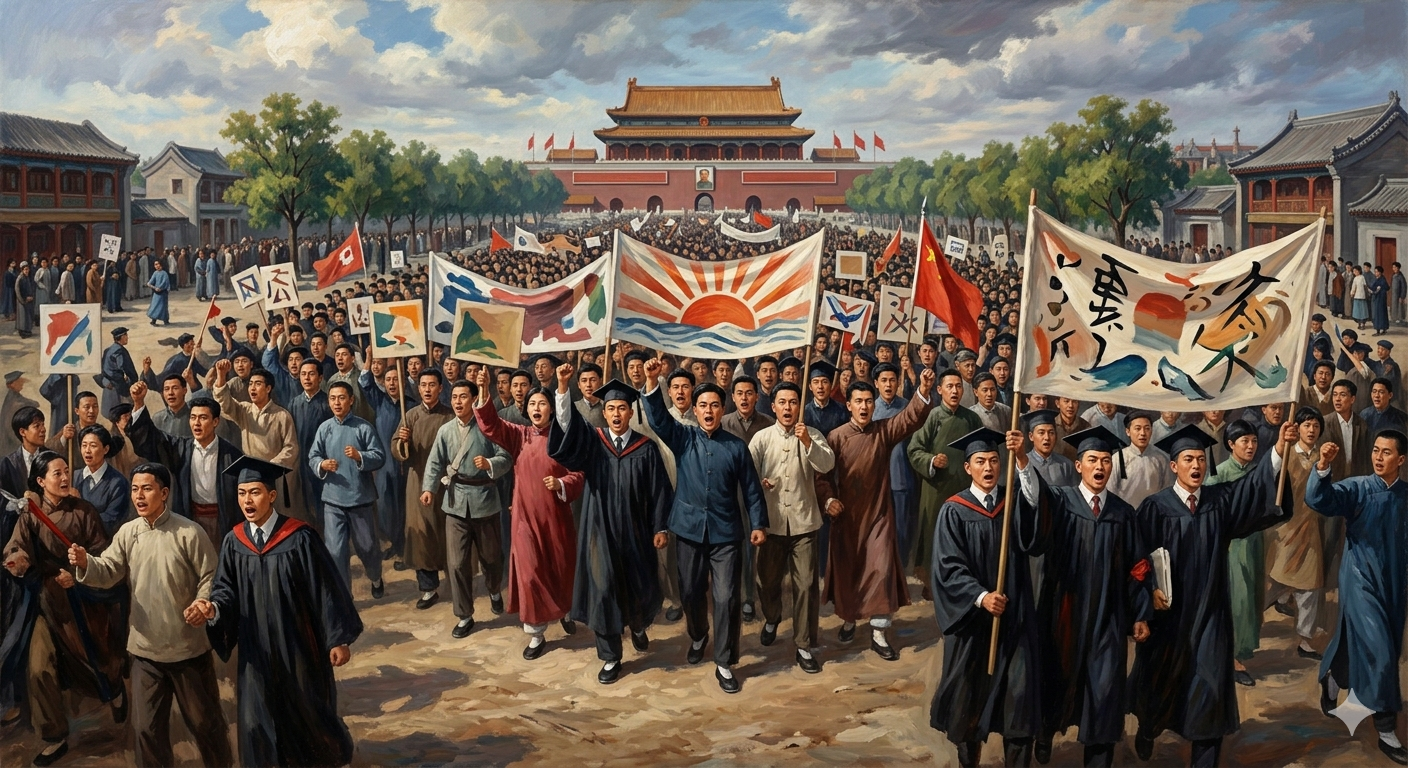
On the morning of May 4, 1919, student representatives from thirteen colleges and universities gathered in Beijing to discuss a catastrophic diplomatic betrayal. By the afternoon, more than 3,000 of them had assembled in Tiananmen Square, the Gate of Heavenly Peace, waving flags and chanting slogans that would resonate through the entire twentieth century: “Struggle for sovereignty externally, get rid of the national traitors at home” and “Give Qingdao back to us!”
What began that day as a protest against a provision of the Treaty of Versailles grew into one of the most consequential movements in modern Chinese history. The May Fourth Movement shook China’s political establishment, transformed its intellectual culture, and set in motion forces that would ultimately produce both the Chinese Communist Party and the reorganized Nationalist Party. The movement is remembered today not only as a turning point in Chinese politics, but as the moment that defined modern Chinese nationalism and gave a generation of young Chinese their political identity.
China Before the Storm: Weakness, Warlords, and the Shandong Question
To understand what drove thousands of Chinese students into the streets in May 1919, it is necessary to understand how far China had fallen from the position of strength it had once occupied. The once-powerful Qing dynasty had collapsed in 1911, replaced by the Republic of China under Sun Yat-sen and then quickly dominated by the military strongman Yuan Shikai. When Yuan died in 1916, China dissolved into a period of warlordism in which competing regional military leaders, rather than any unified national government, controlled most of the country’s territory. The nominal republican government in Beijing, known as the Beiyang government, was weak, corrupt, and deeply indebted to foreign powers.
The Shandong Peninsula, on China’s northeastern coast, was a central grievance. Germany had occupied the port city of Qingdao and secured concession rights in Shandong Province under an 1898 treaty, and had been developing the region’s railroads, mines, and infrastructure ever since. When World War I broke out, Japan, allied with Britain and France, declared war on Germany in August 1914, using the alliance as justification to seize Germany’s Chinese possessions. The Siege of Tsingtao in November 1914 transferred German holdings in Shandong to Japanese control.
In January 1915, Japan presented the Chinese government with the Twenty-One Demands, a sweeping set of requirements that amounted to a near-total assertion of Japanese dominance over China. The demands included territorial concessions, control over railways and mines, and extraterritorial rights for Japanese nationals. The Chinese government, powerless to resist, agreed to most of them. The date of the demands, January 18, 1915, was subsequently marked in China as National Humiliation Day.
China entered World War I on the Allied side in 1917, partly in the hope that supporting the Allies would earn diplomatic support for recovering Shandong Province after the war. More than 140,000 Chinese laborers were sent to the Western Front, digging trenches and performing support work, in what became known as the Chinese Labour Corps. Premier Duan Qirui also signed a secret Sino-Japanese Joint Defence Agreement in 1918, the existence of which enraged the Chinese public when it leaked to the press. When the war ended in November 1918, Chinese cities erupted in celebration. Many Chinese intellectuals had been deeply moved by Woodrow Wilson’s Fourteen Points and his advocacy of national self-determination for oppressed peoples, and they genuinely believed that China’s contribution to the Allied cause, and the principles Wilson had articulated, would result in justice at the peace conference.
The Paris Peace Conference and the Shandong Betrayal
The Paris Peace Conference opened on January 18, 1919, and Chinese delegates arrived with specific demands: the return of Shandong to Chinese sovereignty, the abolition of the unequal treaties and foreign spheres of influence in China, and recognition of China’s equal standing among nations. The lead Chinese delegate was Lou Tseng-Tsiang, the Foreign Minister.
What the Chinese delegation did not know, or perhaps chose to discount, was that during the war Japan had secured secret agreements with Britain, France, Italy, and Russia in 1917 promising Japanese control of the former German concessions in Shandong in exchange for Japan’s military contributions. These secret protocols locked the Allied powers into a position before the conference even began.
Wilson’s advocacy of self-determination was genuinely attractive to Chinese intellectuals, and the American delegation initially showed some sympathy for China’s position. But David Lloyd George of Britain and Georges Clemenceau of France were unwilling to revisit wartime commitments to Japan. Japanese delegates at the conference argued that China had already agreed to Japan’s position in the 1918 secret agreement, and Japan pressed its case with the full weight of its status as one of the five Great Powers represented at the conference.
On May 3, 1919, a telegram from the Chinese delegates in Paris reached Beijing confirming what many had feared: the Great Powers had decided that the German concessions in Shandong would pass to Japan, not China. Article 156 of the Treaty of Versailles formally awarded Japan the right to German holdings in Shandong, including the railways, mines, factories, and infrastructure that Germany had built. German imperialism in Shandong was simply to be replaced by Japanese imperialism.
The telegram’s contents spread through Beijing’s universities within hours. Chen Duxiu, the dean of Peking University and editor of the influential monthly magazine New Youth, which had been at the center of intellectual and cultural debate since 1915, convened emergency meetings with students and faculty. The student organizations that had been planning a demonstration for May 7, the anniversary of the Twenty-One Demands, moved immediately to act.
May 4, 1919: The Day That Changed China
On the morning of May 4, student representatives from all major Beijing universities met at the Peking College of Law and Political Science to coordinate their response. The five resolutions they drafted that morning defined the movement’s immediate agenda: to oppose the granting of Shandong to Japan, to raise public awareness of China’s precarious position, to organize a large gathering in Beijing, to create a unified Beijing student union, and to hold a demonstration that afternoon against the terms of the Versailles Treaty.
Student activist Luo Jialun, a Peking University student who would later become a prominent figure in Chinese intellectual history, drafted and circulated a notice calling on the entire academic community of Beijing to act. The notice’s central slogan became the movement’s rallying cry.
By afternoon, more than 3,000 students had gathered at Tiananmen Gate, students predominantly from Peking University but representing all thirteen participating institutions. They chanted demands for the return of Qingdao and the punishment of three officials they branded as national traitors for their collaboration with Japan: Cao Rulin, the Minister of Transport who had signed the Twenty-One Demands; Lu Zongyu, Director-General of the Chinese Mint who had secured large loans from Japan; and Zhang Zongxiang, China’s ambassador to Japan.
The demonstration then marched toward the Legation Quarter, where students delivered petitions of protest to the American and British diplomatic missions. When the march reached Cao Rulin’s residence in the Zhaojialou neighborhood, students broke down the doors. Cao Rulin had escaped, but Zhang Zongxiang was found inside and was beaten by the crowd. The students set fire to Cao’s residence, and the incident became known as the “burning of Zhaojialou.” Police arrived and arrested approximately 32 students, detaining them in makeshift facilities inside government buildings.
The Beiyang government’s response, arresting students for what most Chinese regarded as a patriotic act, backfired spectacularly. Rather than suppressing the movement, it poured oil on the flames.
The Movement Spreads: Workers, Merchants, and a National Strike
On May 5, the day after the arrests, Beijing students launched a general strike from classes. The strike spread rapidly. Student unions formed in cities across China, from Shanghai and Guangzhou in the south to Tianjin in the north. On May 6, Beijing students established the Student Union of Peking, China’s first unified nationwide student organization, creating an institutional structure that could coordinate action across the country.
As news of the Beijing protests spread through newspapers and telegrams, the movement expanded beyond students to include workers and merchants, transforming what had begun as an educated elite protest into something approaching a genuine popular movement. Businessmen in Shanghai and other cities began boycotting Japanese goods in what became one of the most sustained consumer boycotts in Chinese history. Japanese goods were left on docks, shops refused to stock them, and social pressure ensured compliance across entire commercial districts.
The critical escalation came in early June. On June 3, the Beiyang government launched what it called the “June 3” crackdown, arresting nearly 1,000 students across Beijing in an attempt to finally shut down the protests. The scale of the arrests outraged Chinese society. The center of the movement shifted from Beijing to Shanghai, and workers entered the political arena with a force no one had fully anticipated.
On June 5, workers in Shanghai began a general strike that eventually involved up to 100,000 industrial laborers. Merchants closed shops and joined the work stoppage. For an unprecedented week, Shanghai’s commercial and industrial machinery ground to a halt. The entry of the Chinese working class into political protest on this scale was itself a historic event, marking the beginning of labor’s role as a political force in Chinese life.
Faced with strikes paralyzing its most economically vital city, the Beiyang government capitulated to the movement’s most specific demands. The three officials branded as national traitors, Cao Rulin, Lu Zongyu, and Zhang Zongxiang, were dismissed from their positions. The cabinet resigned. Most significantly, China’s delegation at the Paris Peace Conference was instructed not to sign the Treaty of Versailles. On June 28, 1919, when the treaty was formally signed at Versailles, the Chinese delegation were the only Allied delegates who refused to add their signatures.
The Britannica entry on the May Fourth Movement provides a comprehensive scholarly overview of the movement’s intellectual and political dimensions, available at the Britannica entry on the May Fourth Movement.
The Intellectual Roots: New Culture Movement and the Battle of Ideas
The political protests of May 1919 were inseparable from a broader intellectual and cultural movement that had been building since at least 1915. The New Culture Movement, which historians date approximately from 1915 to 1921, was a sustained critique of the Confucian tradition that had shaped Chinese thought, ethics, family structure, and governance for two thousand years.
Chen Duxiu was the movement’s most prominent voice. As editor of New Youth magazine, which he had founded in Shanghai in 1915, Chen published essays arguing that Confucianism had rendered China passive, hierarchical, and incapable of the dynamism needed to compete in the modern world. He championed “Mr. Democracy” and “Mr. Science” as the twin values China needed to embrace, using these personifications as a rallying call for Western-inspired reform.
Hu Shi, who had studied at Cornell and Columbia under the philosopher John Dewey and returned to China in 1917, brought pragmatism and American progressive thought into the Chinese intellectual debate. Hu Shi argued for the replacement of classical literary Chinese, the wenyan style that required years of specialized study to master, with a vernacular writing style, baihua, based on how people actually spoke. This linguistic reform was more radical than it might appear: it was a proposal to democratize literacy and sever the cultural authority of the classical tradition in a single move.
Li Dazhao, the head librarian at Peking University, had been deeply influenced by the Russian Revolution of 1917 and began introducing Marxist ideas into Beijing’s intellectual circles. A young library assistant named Mao Zedong worked under Li Dazhao at Peking University and participated in reading groups studying socialist and communist thought. This connection between the New Culture Movement, the May Fourth protests, and nascent Marxism in China would prove fateful.
The Legacy: Communist Party, Nationalist Revival, and Enduring Significance
The May Fourth Movement’s most direct political consequences were profound and far-reaching. The movement deeply disillusioned many Chinese intellectuals with the Western liberal model they had admired. Wilson’s failure to follow through on his principles of self-determination at Paris was experienced as a profound betrayal, and it turned many who had looked to the West for models of governance toward the Soviet Union instead.
Chen Duxiu and Li Dazhao formed a Marxist study group in Beijing in 1919. In July 1921, the Chinese Communist Party was formally founded in Shanghai, with Chen Duxiu as its first General Secretary. Mao Zedong was among the attendees at the founding congress. The connections between the May Fourth generation of student activists and the founding membership of the Communist Party were extensive and direct: many of the students who had marched in Beijing in 1919 became the political cadres who would transform China three decades later.
Sun Yat-sen’s Nationalist Party, the Kuomintang, was simultaneously revitalized by the energy the movement released. Sun recognized the students’ organizing capacity and recruited extensively from the May Fourth generation, restructuring the Kuomintang with Soviet organizational assistance into a disciplined political party capable of challenging the warlords who controlled China’s territory.
The movement’s cultural consequences were also permanent. Vernacular Chinese became the standard form of literary and educational writing, replacing classical Chinese in textbooks, newspapers, and literature. A flourishing of vernacular fiction followed, with writers like Lu Xun producing works that used the new literary language to dissect the failures of traditional Chinese society with devastating clarity.
The Wikipedia article on the May Fourth Movement provides an extensive scholarly account of the events, figures, and cultural dimensions of the movement, available at the Wikipedia article on the May Fourth Movement.
The May Fourth Movement’s echoes extended across the entire twentieth century. The student demonstrators of 1989 who gathered in Tiananmen Square during the Democracy Movement explicitly understood themselves as successors to the May Fourth generation, holding marches on the seventy-year anniversary and invoking the movement’s slogans. The People’s Republic of China designated May 4 as Youth Day, while Taiwan observes it as Cultural Renaissance Day, both governments claiming different aspects of the movement’s legacy for their own political purposes.
In 1919, the students who gathered in Tiananmen Square demanded sovereignty, national dignity, and the end of collaboration with foreign powers. China did not sign the Treaty of Versailles. Shandong remained under Japanese control until 1923, when Japan finally returned it under the Washington System of international agreements. But the refusal to sign, the dismissal of the three officials, the paralysis of Shanghai’s commerce, these were not the movement’s real legacy. The real legacy was the generation it created: a generation of Chinese who had learned that organized popular pressure could move governments, that nationalism was a force that could cross class lines and unite students, workers, and merchants, and that China’s future would be shaped by mass politics rather than elite diplomacy.
The National Archives of the United Kingdom provides primary source documentation of the Shandong claim at the Paris Peace Conference that triggered the May Fourth protests, available at the UK National Archives May Fourth Movement resource page.