
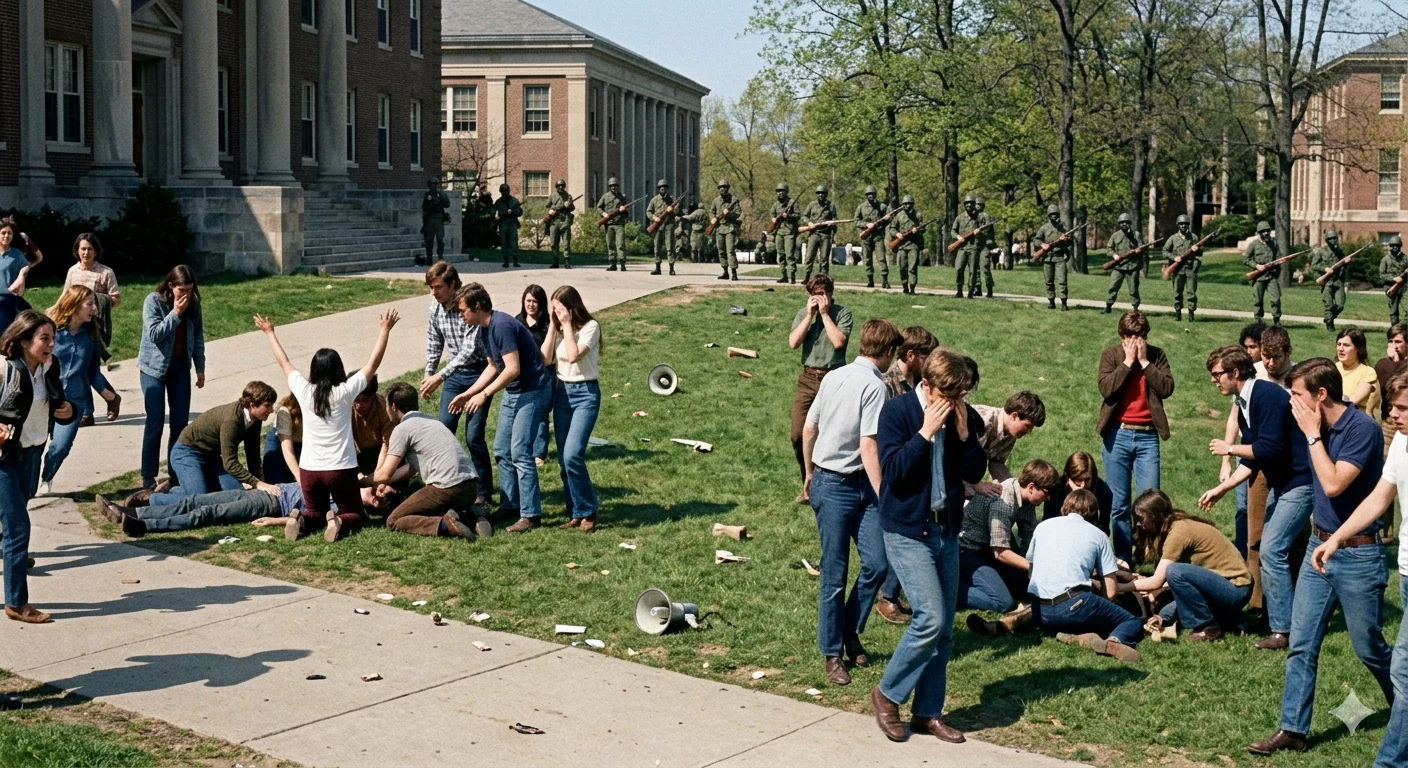
At 12:24 p.m. on May 4, 1970, twenty-eight members of the Ohio National Guard turned and opened fire on a crowd of students at Kent State University in Kent, Ohio. In thirteen seconds they fired between 61 and 67 rounds. Four students died. Nine others were wounded, one of them paralyzed from the waist down for the rest of his life. The nearest victim was approximately 60 feet from the guardsmen. The farthest was nearly 250 yards away.
No warning shots were fired. No order to fire has ever been definitively established. The students who were killed had been doing what students had been doing on college campuses across the country for days: protesting President Richard Nixon’s announcement that American and South Vietnamese forces had invaded Cambodia.
The Kent State shootings became one of the most consequential and divisive events in twentieth-century American history. They triggered the first general student strike in the United States, shuttered hundreds of colleges and universities, accelerated the collapse of public support for the Vietnam War, and produced one of the most iconic photographs in the history of American photojournalism. They remain a symbol of the catastrophic potential of state violence against peaceful dissent.
The Vietnam War and Nixon’s Cambodia Announcement
To understand what happened at Kent State on May 4, 1970, it is necessary to understand the political moment in which it occurred. Richard Nixon had won the presidency in 1968 partly on the promise to end the Vietnam War. The war had divided the country more deeply than any conflict since the Civil War. Opposition was particularly intense on college campuses, where the military draft threatened young men directly.
On April 20, 1970, Nixon appeared on national television to announce that 115,500 American troops had been withdrawn from Vietnam and that another 150,000 were scheduled to leave by the end of 1971. The announcement seemed to confirm that American involvement in Southeast Asia was winding down.
Ten days later, on the evening of April 30, Nixon returned to television with a dramatically different message. He announced that American and South Vietnamese forces were invading Cambodia, a country that had served as a sanctuary for North Vietnamese and Viet Cong forces. Students who had believed the war was ending perceived the Cambodia announcement as a sudden and inexcusable escalation.
On May 1, protests erupted at college campuses across the country. At Kent State University, a public institution in northeastern Ohio founded in 1910 as a teachers college, students gathered on the Commons, the central open area of the campus. Kent State had approximately 20,000 students in 1970, many of them first-generation college students from working-class families in the industrial cities of northeastern Ohio. From 1965 to 1970, more than ten organizations at Kent State had been actively involved in antiwar and civil rights activism.
May 1 to May 3: Four Days of Escalating Tension
The events of May 4 were the culmination of four days of escalating confrontation between students, local authorities, and the National Guard.
On the evening of Friday, May 1, a protest rally on the Kent State Commons turned into a march through the town of Kent, where students broke windows in bars and shops and threw bottles at police cars. The Kent city police department declared a state of emergency and Mayor Leroy Satrom called Ohio Governor James Rhodes requesting National Guard assistance.
On Saturday night, May 2, the most dramatic pre-shooting incident occurred on campus. Students surrounded and set fire to the university’s ROTC building, the Reserve Officers’ Training Corps facility that had become a symbol of the military’s presence on campus. Firefighters were hampered in fighting the blaze. The building burned to the ground. Governor James Rhodes called out the Ohio National Guard, and nearly 1,000 soldiers were deployed to the campus.
Rhodes was in the midst of a hotly contested Republican primary race for a United States Senate seat against Robert Taft Jr., grandson of President William Howard Taft. He was trailing in the polls. His response to the Kent State situation was shaped partly by his political need to project strength.
On Sunday, May 3, the Guard used tear gas to disperse a peaceful demonstration. Guardsmen beat several students with rifle butts and bayoneted others, though no fatalities resulted. At a press conference that day, Governor Rhodes delivered an inflammatory statement, calling the protesters “the worst type of people that we harbor in America” and threatening: “We are going to eradicate the problem, we’re not going to treat the symptoms.” He later failed to follow through on his stated intention to obtain a court order formally declaring a state of emergency, but it was widely assumed that martial law was in effect and that control of the campus rested with the Guard.
Monday, May 4: The Commons, the Hill, and the Thirteen Seconds
Classes resumed at Kent State on Monday, May 4. The university administration had distributed approximately 12,000 leaflets announcing that demonstrations were banned on campus. Many students never received or read them. By noon on what was described as a clear, brisk day, approximately 3,000 people had gathered in and around the Commons area.
Of those present, roughly 500 were actively protesting, gathered around the Victory Bell at the center of the Commons. Another group of approximately 1,000 cheered them on. The remaining 1,500 or so were bystanders, students between classes or students who had simply stopped to watch.
Brigadier General Robert Canterbury, the senior National Guard officer on campus, ordered the students to disperse. The order was delivered by a Kent State police officer riding through the crowd in a military jeep with a bullhorn. The students refused to comply. Some shouted obscenities. Some threw rocks. Guard soldiers fired tear gas canisters into the crowd.
The guardsmen then advanced across the Commons with bayonets fixed on their M-1 rifles, forcing demonstrators back. The larger contingent of guardsmen marched up Blanket Hill, a rise on the west side of Taylor Hall, and descended the other side onto a football practice field enclosed by fencing on three sides. This placed the guardsmen in an uncomfortable position: surrounded by fencing, taunted by students on the surrounding higher ground, with rocks being thrown at them.
The guardsmen then began retracing their steps back up Blanket Hill toward the Pagoda, a concrete umbrella-shaped architectural structure at the crest of the hill. At 12:24 p.m., as they reached the Pagoda, twenty-eight of the guardsmen suddenly turned and faced the crowd below. Over the next thirteen seconds, they fired between 61 and 67 shots. Many fired into the air or at the ground. A number of them fired directly into the crowd of students.
The Four Dead in Ohio: Jeffrey Miller, Allison Krause, Sandra Scheuer, and William Schroeder
The four students killed at Kent State on May 4, 1970, came from different parts of the campus and from different circumstances. Their deaths together represented the terrible randomness of what had happened.
Jeffrey Miller was twenty years old, a student from Plainview, New York. He had been among the more active protesters, standing in the parking lot and engaged in the demonstration when he was shot in the mouth and died immediately at the scene. His body was photographed by a fourteen-year-old student named Mary Ann Vecchio, a runaway from Florida who happened to be on campus that afternoon. The photograph, taken by Kent State photography student John Filo, won the Pulitzer Prize for Spot News Photography and became the defining image of the day and one of the most recognized photographs of the twentieth century.
Allison Krause was nineteen years old, from Pittsburgh, Pennsylvania. She had been participating in the protest. One day earlier, on May 3, she had placed a flower in the barrel of a National Guard soldier’s rifle and told him that flowers were better than bullets. She was shot in her side and died at the scene. Her father, Arthur Krause, later appeared on national television barely controlling his grief. Pointing to President Nixon’s description of student protesters as “bums,” he said: “My daughter was not a bum.”
Sandra Lee Scheuer was twenty years old, from Youngstown, Ohio. She was not protesting at all. She had been walking between classes on her way across campus when she was caught in the crossfire. She was shot in the neck and died at the scene. Her presence among the dead underscored the indiscriminate nature of the shooting.
William Schroeder was nineteen years old, from Lorain, Ohio. He was also not an active protester. He was an ROTC student who had stopped to watch the confrontation. He was shot in the back and was pronounced dead at Robinson Memorial Hospital in nearby Ravenna shortly after the shooting.
Of the nine wounded, Dean Kahler sustained the most serious injury, shot in the spine and permanently paralyzed from the waist down. The nine wounded students were Alan Canfora, John Cleary, Thomas Grace, Dean Kahler, Joseph Lewis, D. Scott MacKenzie, James Russell, Robert Stamps, and Douglas Wrentmore. Those who were shot ranged from approximately 60 feet to 245 yards from the guardsmen who fired.
The Wikipedia article on the Kent State shootings provides a detailed account of all thirteen victims, the sequence of events, and the extensive legal and political aftermath, available at the Wikipedia article on the Kent State shootings.
National Outrage: The Student Strike and the Country’s Response
The immediate aftermath on the Kent State campus was a moment of stunned disbelief. Students gathered on a nearby slope and were again ordered to move by the guardsmen. A confrontation that could have produced another massacre was averted when faculty members formed a human chain between the students and the Guard, persuading the crowd to disperse. Kent State University was immediately ordered closed and remained shut for six weeks.
The effects spread with extraordinary speed. Within days, a student-led strike shut down more than 400 colleges and universities across the country, forcing them to close early or cancel the remainder of their academic years. The spring of 1970 marked the first general student strike in American history. By some estimates, more than 4 million students participated. Protests occurred at high schools as well as universities. Washington, D.C. was flooded with demonstrators.
Despite the widespread student outrage, a significant portion of the American public did not sympathize with the students. Public opinion polls in the immediate aftermath showed that a majority of Americans blamed the students rather than the National Guard for what had happened. The working-class communities surrounding Kent State, whose residents had complicated relationships with the university and its student body, were largely hostile to the protesters. The shootings deepened and exposed the already profound division between those who saw the antiwar movement as patriotic dissent and those who saw it as dangerous radicalism.
Investigations and the Question of Justice
Governor Rhodes commissioned investigations, and a special Ohio grand jury cleared the guardsmen of any criminal charges. In a striking reversal, the same grand jury indicted 25 students and one faculty member on charges connected to the May 4 demonstration or the earlier ROTC building fire. They became known as the Kent 25. The National Guard members who fired the shots faced no legal accountability.
The President’s Commission on Campus Unrest, known as the Scranton Commission after its chairman, former Pennsylvania Governor William Scranton, investigated the shootings and issued its findings in September 1970. The commission’s conclusion was direct and unsparing: the shootings were “unnecessary, unwarranted, and inexcusable.” The report stated that even if the guardsmen had faced some degree of danger, it was not a danger that called for lethal force, and that firing 61 shots could not be justified.
Federal grand jury proceedings were eventually held, and eight guardsmen were indicted on federal civil rights charges. The case went to trial in 1974, but the charges were dismissed by the federal judge before reaching the jury. An appeals court reversed this dismissal, but when the case was retried, the government moved to dismiss the charges in 1979.
The civil lawsuit filed by the wounded students and the families of the dead was resolved through a settlement in January 1979. The State of Ohio agreed to pay $675,000 to the nine wounded students and the families of the four killed. The payment was accompanied by a statement signed by twenty-eight National Guard defendants that read: “In retrospect, the tragedy of May 4, 1970 should not have occurred.” The statement was carefully worded not to constitute an apology or admission of wrongdoing. No member of the Ohio National Guard was ever convicted of any crime in connection with the shootings.
The Britannica entry on the Kent State shootings covers the full sequence of events and the legal proceedings in authoritative detail, available at the Britannica entry on the Kent State shootings.
The Enduring Legacy: “Ohio,” the Photograph, and American Memory
Within weeks of the shootings, Crosby, Stills, Nash and Young recorded the song “Ohio,” written by Neil Young, with the haunting refrain “Four dead in Ohio.” The song was released while the protests were still active and became a defining artifact of the antiwar movement and of the cultural memory of May 1970.
John Filo’s photograph of Mary Ann Vecchio kneeling over Jeffrey Miller’s body won the 1971 Pulitzer Prize and became one of the most recognized images of the twentieth century. The photograph was reproduced in newspapers and magazines around the world, giving the abstract political conflict a single devastating human image.
H.R. Haldeman, one of Nixon’s closest aides, later wrote that the Kent State shootings marked the beginning of the slide that would eventually end in Watergate, setting in motion a crisis of political legitimacy from which the Nixon administration never fully recovered. Nixon resigned the presidency in August 1974. The selective service draft, one of the central grievances driving student antiwar protest, was abolished in 1973. American military involvement in Vietnam ended in 1975.
Two weeks after Kent State, on May 14 and 15, 1970, city and state police fired on students at Jackson State College in Mississippi, killing two Black students and injuring twelve others. The Jackson State killings received far less national attention despite their equally lethal character.
Kent State University established the May 4 Visitors Center, which opened in 2012 at the site of the events. A commemoration is held on the campus every year on May 4. The four places on the Kent State campus where students fell are marked permanently in the landscape.
The History.com article on the Kent State shooting covers the causes, the events of May 4, and the broader political aftermath in detailed narrative form, available at the History.com article on the Kent State shooting.
The thirteen seconds on Blanket Hill at 12:24 p.m. on May 4, 1970, lasted long enough to kill four young Americans and wound nine more. They lasted long enough to shut down hundreds of American universities, to become a defining moment in the political collapse of the Vietnam War, and to enter the permanent memory of a nation’s reckoning with its own capacity for violence against those who dissent.