
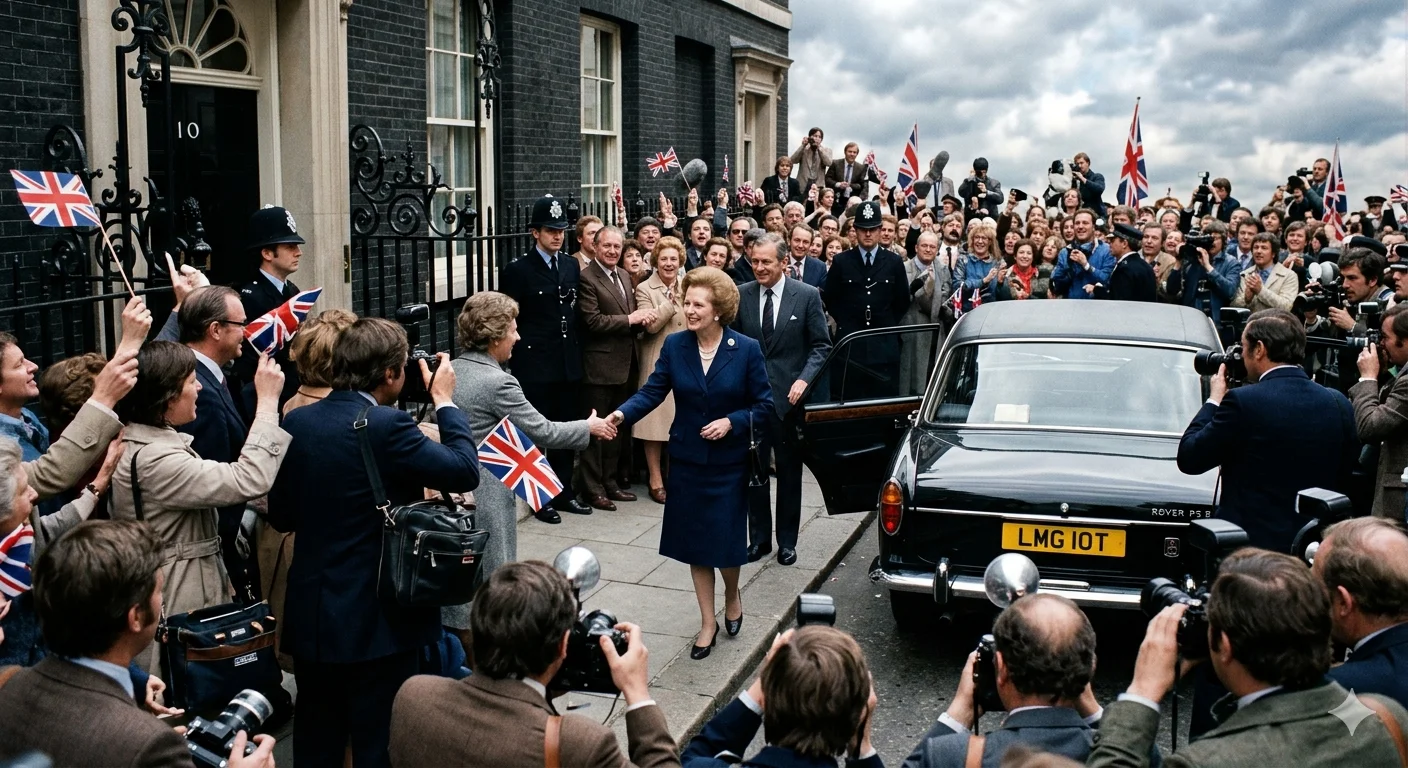
On the afternoon of May 4, 1979, a fifty-three-year-old woman who had once said in a television interview that she did not think there would be a woman prime minister in her political lifetime stood on the steps of 10 Downing Street and delivered a brief statement to the cameras and the gathered crowd. Drawing from the prayer of Saint Francis of Assisi, she said: “Where there is discord, may we bring harmony. Where there is error, may we bring truth. Where there is doubt, may we bring faith. And where there is despair, may we bring hope.”
Margaret Hilda Thatcher had just been summoned to Buckingham Palace by Queen Elizabeth II and asked to form a government. She was the first woman in British history to hold the office of Prime Minister, the first female head of government of any major country in Europe, and the leader who would go on to serve the longest consecutive term of any British Prime Minister in the twentieth century. She would hold the office for eleven years and two hundred and nine days.
Margaret Roberts: From Grantham to Oxford
Margaret Hilda Roberts was born on October 13, 1925, in Grantham, Lincolnshire. Her father, Alfred Roberts, was a grocer and alderman who managed a grocery store on the ground floor of the family’s home above the shop. He was a committed Methodist, a local JP, and a man who held firm views about personal responsibility, self-reliance, and the dangers of excessive government. His daughter absorbed these convictions with her education.
She attended Grantham Girls’ High School on a scholarship and won a place at Somerville College, Oxford, to study chemistry in 1943. At Oxford she became president of the Oxford University Conservative Association, the first woman to hold that position. She graduated with a second-class degree in chemistry in 1947 and took a job as a research chemist, working first in Colchester and then in Dartford, Kent.
Thatcher’s political ambitions were evident from the start. She was selected as the Conservative candidate for Dartford in the 1950 general election, an extremely safe Labour seat, and ran again in 1951. She performed impressively in both contests, substantially reducing the Labour majority in a constituency where no one expected a Conservative to win. During these campaigns she met Denis Thatcher, a successful businessman, who would marry her in December 1951 and prove to be the most consistent support of her entire career.
After marrying Denis and then qualifying as a barrister, she sought a more winnable seat and was elected to Parliament in 1959 as the Conservative Member for Finchley, a constituency in north London that she would represent for the next thirty-three years. She was one of only twenty-five women in the House of Commons at the time.
From Education Secretary to Opposition Leader
Thatcher rose steadily through the Conservative Party during the 1960s, joining the shadow cabinet in 1967. When the Conservatives won the 1970 general election under Edward Heath, she was appointed Secretary of State for Education and Science, becoming only the second woman to hold a cabinet portfolio in a Conservative government.
Her time at the Department of Education was turbulent. She ended the provision of free school milk for children over the age of seven, a decision that became one of the most politically damaging of her career and earned her the epithet “Thatcher the milk snatcher” from Labour opponents and the tabloid press. The personal cost was significant, but she absorbed the criticism and emerged from it, as her allies observed, substantially harder.
She also found her intellectual direction in this period through her relationship with Sir Keith Joseph, a Conservative politician and former cabinet minister who had begun a systematic rethinking of British Conservatism after the Conservatives lost the two 1974 general elections. Joseph was deeply influenced by the free-market economics of Friedrich Hayek and Milton Friedman and spent 1974 and early 1975 giving speeches arguing that the post-war consensus of state intervention, nationalised industries, and corporatist management of the economy had been a catastrophic mistake. Thatcher absorbed these arguments with conviction and they became the intellectual foundation of what would eventually be called Thatcherism.
When Heath lost the October 1974 election, internal Conservative Party pressure built for a leadership challenge. Joseph initially planned to stand but withdrew after a poorly received speech on social policy. With Joseph out of the race, Thatcher made the decision to stand herself. Her campaign was organised with meticulous efficiency by Airey Neave, a highly decorated war hero and Conservative MP who had escaped from Colditz Castle during the Second World War and subsequently become a formidable political organiser. Neave ran a quiet but highly effective whipping operation among Conservative MPs, many of whom wanted to vote against Heath but were not certain who should replace him.
In the first ballot of the Conservative leadership election on February 4, 1975, Thatcher received 130 votes to Heath’s 119, a result that triggered the rules requiring a second ballot and led Heath to resign from the contest. In the second ballot on February 11, 1975, Thatcher received 146 votes, defeating William Whitelaw, Geoffrey Howe, James Prior, and John Peyton. She became the first woman to lead any major British political party, and the first female Leader of the Opposition in the history of Parliament.
The Wikipedia article on Margaret Thatcher covers her full political career in comprehensive detail, from her early life through her election as leader and her eleven-year premiership.
Britain in Crisis: The Winter of Discontent and the Path to the 1979 Election
To understand the scale of the Conservative victory in May 1979, it is necessary to understand the condition of Britain when Thatcher’s party went into that election. The 1970s had been a decade of almost unrelenting economic difficulty. Inflation had reached 26 percent in 1975. Industrial disputes were constant. The three-day working week had been imposed by the Heath government in 1973 to 1974 during the miners’ strike. The International Monetary Fund had been called in to bail out the British economy in 1976, an event of profound national humiliation. The country felt, and in significant ways was, ungovernable.
James Callaghan had become Prime Minister in April 1976, succeeding Harold Wilson. By the summer of 1978, the economy had begun to improve marginally and Labour was recovering in the opinion polls. Most observers expected Callaghan to call an autumn 1978 election, timing it while conditions were still reasonably favourable. Callaghan surprised almost everyone, including his own cabinet ministers, by announcing on September 7, 1978, that he would not call an election and would instead wait until 1979. He had received private polling data suggesting he could improve his position further. The decision proved to be the most consequential political miscalculation of his career.
The winter of 1978 to 1979 became known as the Winter of Discontent. Private sector trade unions had been pushing for wage increases well above the government’s voluntary pay norms. When the government could not hold the line, public sector unions followed. Lorry drivers struck, disrupting food and fuel supplies. Refuse collectors walked out, leaving rubbish piling in the streets of London and other cities. Gravediggers in Liverpool and parts of Yorkshire refused to bury the dead, forcing councils to consider using playing fields as temporary burial grounds. Hospital workers restricted their services. The coldest winter in sixteen years amplified the misery.
The images of uncollected rubbish, food shortages, and the apparent breakdown of essential services became powerful political symbols. They seemed to confirm the Conservative argument that Labour could not govern, that the trade union movement had accumulated too much power, and that something fundamental needed to change. The advertising agency Saatchi and Saatchi had already produced the Conservative campaign’s most effective piece of work in 1978, the poster showing a long queue of unemployed people under the headline “Labour Isn’t Working.” By the winter of 1978 to 1979, the poster had become a prophecy.
Then came the political trigger. Callaghan’s government was a minority administration propped up by support from the Scottish National Party and the Liberal Party under a formal agreement known as the Lib-Lab Pact. When the SNP withdrew its support following the failure of Scottish devolution legislation to reach the required threshold in a referendum, Thatcher tabled a motion of no confidence in the government. On March 28, 1979, the motion passed by 311 votes to 310, the narrowest possible margin, the first government to be defeated on a confidence vote since Ramsay MacDonald’s Labour government in 1924. Callaghan had no choice but to call a general election.
The 1979 General Election Campaign
The election campaign lasted five weeks and was fought on the issues of the economy, trade union power, inflation, and the question of national direction. The Conservatives ran ten points ahead in the polls throughout most of the campaign. Their manifesto promised to cut income tax, reduce public expenditure, make it easier for people to buy their own homes, and curb the power of the trade unions. The key policy innovation was the Right to Buy, a proposal that would allow council house tenants to purchase their homes at substantial discounts, extending property ownership to millions of working-class families.
Thatcher’s campaign was managed by her media adviser Gordon Reece, who had transformed her public presentation with the conscious application of American-style media techniques that were new to British politics. She moderated the high pitch of her voice, wore simpler clothing, and was presented as a practical housewife and mother who understood the economics of a household budget as well as those of a national economy. She cuddled a newborn calf at an East Anglian farm in a photograph that became one of the most recognised images of the campaign, even as Denis, standing behind her, reportedly told her to put the animal down.
The tragic shadow over the campaign was the assassination of Airey Neave on March 30, 1979, two days after the government fell. Neave, by then the shadow Secretary of State for Northern Ireland and one of Thatcher’s closest allies, was killed by a car bomb planted by the Irish National Liberation Army in the car park of the House of Commons. Thatcher was devastated. She referenced Neave in her remarks on the steps of Downing Street after winning the election, the Saint Francis prayer he had intended for her having been passed along as one of his final acts.
Callaghan remained personally more popular than Thatcher throughout the campaign, and Labour campaigned on the slogan “the country needs a Labour government.” The Conservatives countered with the accumulated evidence of Labour’s failures in government. The two leaders agreed in principle to participate in a televised debate, which would have been the first in British general election history, but Thatcher’s advisers ultimately concluded she had more to lose than to gain and she found reasons to decline.
May 3 to May 4, 1979: Victory and the Steps of Downing Street
On May 3, 1979, the British electorate voted in the general election. The Conservatives won 339 seats to Labour’s 269, with the Liberal Party winning 11. The Conservative vote share was 43.9 percent and Labour’s was 36.9 percent, a swing of 5.2 percent from Labour to the Conservatives, the largest swing since the 1945 election. The Conservatives won an overall majority of 43 seats, or by some reckonings 44 seats, in the House of Commons.
On the afternoon of May 4, Margaret Thatcher was summoned to Buckingham Palace, where Queen Elizabeth II asked her to form a government. She accepted, becoming Prime Minister. She drove from Buckingham Palace to 10 Downing Street, where a crowd and the television cameras waited. Standing outside the famous black door, she delivered her paraphrase of the Saint Francis prayer, a statement widely broadcast and remembered as defining the spirit of her arrival in office.
When Thatcher became prime minister, only three other modern nations had had female heads of government: Sri Lanka, India, and Israel. Britain was the most powerful of those, and the manner of her victory, won by democratic election rather than inheritance or dynastic succession, made it a particularly significant milestone for women in politics, however complex her own relationship with feminism may have been.
The Britannica biography of Margaret Thatcher covers her background, her election to office, and the full scope of her transformative and controversial eleven-year premiership.
What Thatcher’s Victory Meant: Thatcherism and the New Political Order
The significance of May 4, 1979, extended far beyond the gender of the new Prime Minister. It marked the decisive end of what historians call the post-war consensus: the shared assumption, dating from the Attlee government of 1945, that the state would maintain high levels of employment, run the nationalised industries, fund a comprehensive welfare state, and negotiate economic management with the trade unions. Both Conservative and Labour governments had operated within this framework for thirty-four years. Thatcher rejected it entirely.
Her government’s economic programme, which became known as Thatcherism, rested on a set of principles derived from her years of intellectual engagement with free-market economics. She would control inflation through strict management of the money supply rather than through prices and incomes policies. She would privatise the nationalised industries. She would restrict the legal powers of the trade unions. She would reduce public expenditure. She would lower direct taxation and increase indirect taxation. The market, rather than the state, would allocate resources.
The immediate economic consequences were painful. Unemployment rose sharply in her first two years, reaching more than three million in 1981. Her poll ratings fell. Her internal party critics, the moderate One-Nation Conservatives she called “Wets,” urged her to change course. Her answer was a passage from her 1980 Conservative Party conference speech: “To those waiting with bated breath for that favourite media catchphrase, the U-turn, I have only one thing to say. You turn if you want to. The lady’s not for turning.”
The History.com article on Margaret Thatcher becoming Britain’s first female prime minister provides a concise account of her path to the premiership and the policies she introduced in office.
She would go on to win landslide re-elections in 1983 and 1987 and to remain in office until November 1990, when she was forced out by her own party over the poll tax and European policy. By the time she left Downing Street, she had privatised British Telecom, British Gas, British Steel, British Airways, British Rail, and dozens of other public enterprises. She had defeated the miners in the year-long strike of 1984 to 1985 and fundamentally altered the legal standing of trade unions. She had fought and won the Falklands War in 1982. She had built a close relationship with Ronald Reagan that shaped the end of the Cold War. Britain’s economic performance had been transformed, though at enormous social cost to the communities that bore the brunt of deindustrialisation.
The woman who had stood at a Dartford polling station as a twenty-four-year-old candidate in 1950 and who had once said she would not see a woman prime minister in her lifetime had not only become that prime minister but had redefined what British Conservatism, British economics, and British political identity meant. She remains, depending entirely on who is asked, either the greatest or the most destructive peacetime prime minister of the twentieth century, a politician who divided opinion in life and continues to do so in death.