
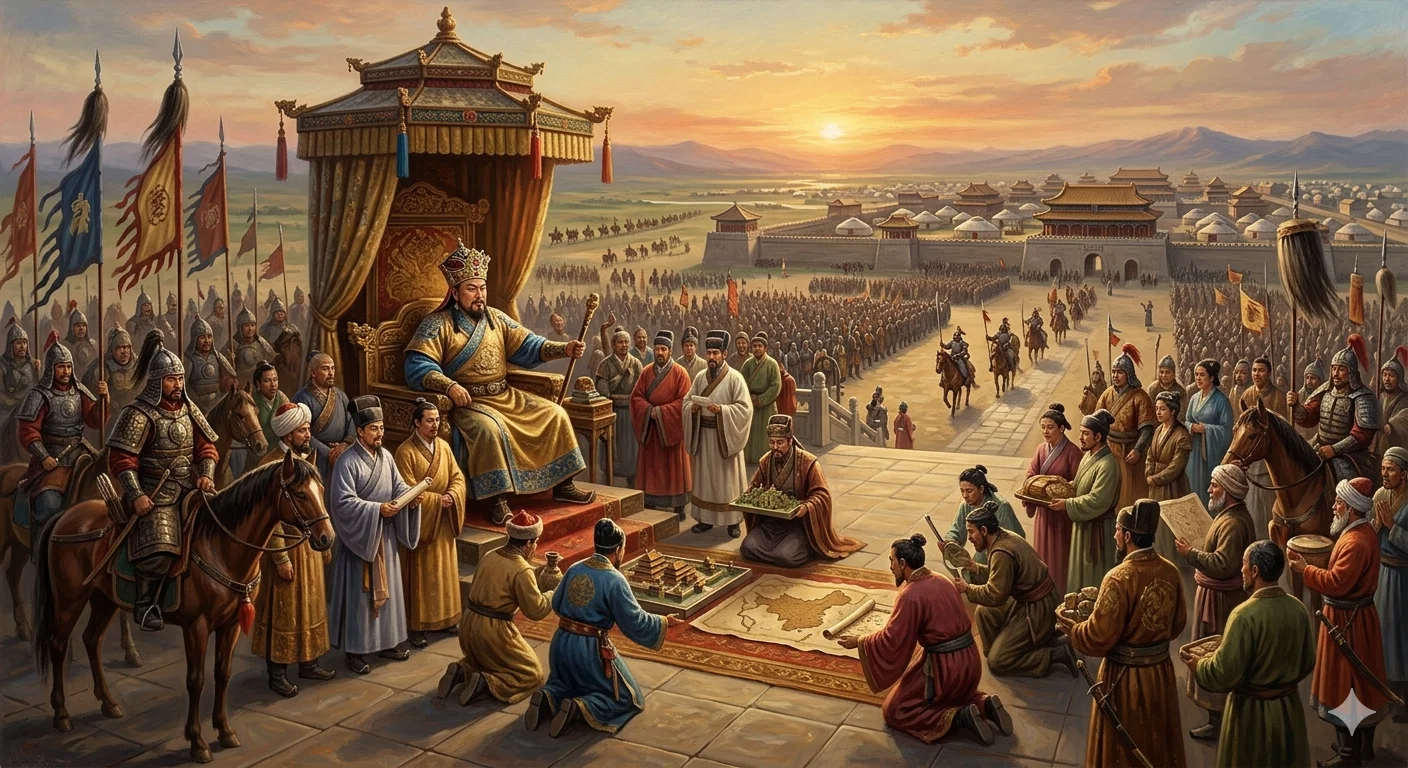
On May 6, 1260, a kurultai, the formal assembly of Mongol tribal chiefs and princes, proclaimed Kublai Khan the Great Khan of the Mongol Empire, the supreme ruler of the largest contiguous land empire the world had ever seen. The proclamation made Kublai the fifth Great Khan of an empire that stretched from the Pacific Ocean to the Caspian Sea, a dominion encompassing perhaps eighty percent of the known world’s territory. He would rule for the next thirty-four years, expand the empire to its greatest extent, become the first non-Chinese ruler of all of China, establish the Yuan Dynasty, and receive the Venetian traveler Marco Polo as a guest at his court. He remains, by any measure, one of the most consequential rulers in the history of the world.
Kublai Khan was born on September 23, 1215, the fourth son of Tolui and Sorghaghtani Beki, and thus the grandson of Genghis Khan, the founder of the Mongol Empire. His birth year was the same year that Genghis Khan conquered Beijing in his campaign against the Jin Dynasty. The empire into which he was born was already the largest in history. By the time Kublai reached adulthood, it would stretch further still.
The Foundations of Greatness: Genghis Khan, the Toluid Line, and Kublai’s Early Life
To understand Kublai’s significance, it is necessary to understand the empire he inherited. Temujin, who took the title Genghis Khan in 1206, was a Mongol warrior who united the scattered and warring tribes of the Mongolian steppe into a single military force of extraordinary cohesion and effectiveness. Under his leadership, the Mongols exploded outward from their heartland, conquering territory on a scale that no army had achieved before. When Genghis Khan died in 1227, the Mongols had conquered vast swaths of Central Asia, destroyed the Jin Dynasty of northern China, and were pressing into Eastern Europe and Persia.
Genghis Khan had four sons by his favorite wife: Jochi, Chagatai, Ogedei, and Tolui, who was Kublai’s father. The empire was divided among these sons and their descendants, with the title of Great Khan passing first to Ogedei and then to his son Guyuk. When Guyuk died in 1248, the title passed to the Toluids, the line of Genghis Khan’s youngest son, and to Kublai’s elder brother Mongke, who became Great Khan in 1251.
Sorghaghtani Beki, Kublai’s mother, was one of the most intelligent and influential women in the history of the Mongol Empire. A Nestorian Christian herself, she was deeply committed to religious tolerance and ensured that her sons were educated in the languages, philosophies, and traditions of the peoples they would one day rule. She hired Chinese tutors for her sons, encouraged their exposure to Buddhism, Taoism, Confucianism, and Islam, and impressed on them the importance of understanding the cultures of the conquered rather than simply imposing Mongol traditions on them. This education would prove decisive in Kublai’s approach to governance.
Kublai grew up mastering the traditional Mongol arts of horsemanship, hunting, and warfare. He was a capable military commander from an early age. But what distinguished him from most Mongol princes was his genuine intellectual curiosity about Chinese civilization and his recognition that governing sedentary agricultural societies required different skills from leading nomadic cavalry armies. He gathered around himself a circle of Chinese Confucian advisors, most notably Liu Bingzhong, who would serve him for decades and help design the administrative structures of his empire.
Viceroy of China: Kublai Under His Brother Mongke
When Mongke became Great Khan in 1251, he placed Kublai in charge of northern China as viceroy, giving him full civil and military responsibility for the region. This appointment was the decisive turning point in Kublai’s political formation. In northern China, Kublai governed a sophisticated, urbanised civilization with millennia of administrative tradition behind it. He deepened his relationship with Chinese scholars and officials, appointed talented administrators regardless of their ethnic background, and established a reputation for relatively humane and effective governance at a time when Mongol rule in other regions was synonymous with devastating destruction.
He established a northern capital at Shangdu, the city that Marco Polo would later call Xanadu and that the English poet Samuel Taylor Coleridge would immortalise in verse. Shangdu was a sophisticated city built on Mongol and Chinese principles, located on the Inner Mongolian steppe, a place where Kublai could be both a nomadic Mongol ruler and an administrator of Chinese subjects.
From 1253 onward, Kublai also participated actively in the military campaigns to extend Mongol control into southern China. In 1253, on orders from Mongke, Kublai led a campaign against the Dali Kingdom in Yunnan province, in what is now southwestern China. He took the capital of Dali and, in a move that reflected his deliberate policy of restraint, spared the inhabitants despite the fact that Dali had earlier killed Mongol envoys. The Dali king Duan Xingzhi submitted to Mongol authority and was allowed to continue governing his territory as a subordinate ruler. Kublai’s willingness to absorb local power structures rather than destroy them entirely was a consistent feature of his approach.
In 1259, Mongke launched a major four-pronged campaign to complete the conquest of the Song Dynasty, which controlled southern China. Kublai was one of the commanders of this operation. The campaign was making progress when Mongke died suddenly of illness on August 11, 1259. The entire military operation stopped immediately as Mongol commanders dispersed to participate in the succession crisis that followed.
The Path to Power: Civil War and the Proclamation of 1260
When Mongke died, two main contenders emerged for the title of Great Khan. Kublai was the elder candidate, with an established record of military and administrative achievement and the support of much of the Chinese-oriented faction of the Mongol leadership. His younger brother Ariq Boke, however, held the traditional Mongol capital of Karakorum and had the support of the more conservative Mongol nobles who mistrusted Kublai’s embrace of Chinese culture and saw him as having been corrupted by his long residence in China.
Both men moved quickly to have themselves proclaimed Khan by their respective supporters. Kublai convened a kurultai of his own supporters in the spring of 1260, and on May 6, 1260, he was officially proclaimed Great Khan. Ariq Boke held a rival kurultai at Karakorum and was proclaimed Khan there. The Mongol Empire suddenly had two men claiming to be its supreme ruler.
The civil war that followed, known as the Toluid Civil War, lasted until 1264. Ariq Boke had the advantage of geography and initial popular support among the Mongol traditionalists. Kublai had the advantage of vastly superior resources: the agricultural wealth and administrative capacity of northern China, the loyalty of key military commanders, and the support of the Ilkhanate of Persia under his brother Hulagu. Kublai blockaded Karakorum, cutting off food supplies to Mongolia. The two sides fought several pitched battles, with Ariq Boke actually recapturing Karakorum at one point in 1261. But Kublai’s superior resources and the withdrawal of support from the Chagatai Khanate under Khan Alghu progressively weakened Ariq Boke’s position.
On August 21, 1264, Ariq Boke rode to Kublai’s camp at Xanadu and surrendered. Kublai was now the undisputed Great Khan of the Mongol Empire. He asked his defeated brother, “Brother, in our struggle was it you or I who was right?” Ariq Boke reportedly answered, “I was then; you are now.” Ariq Boke died in 1266 under Kublai’s custody, the cause of his death unknown but widely suspected to have been on Kublai’s orders or at least with his knowledge.
The Britannica biography of Kublai Khan provides a comprehensive account of his rise to power, his governance of China, and his long and complex reign.
Ruling the World: Administration, the Yuan Dynasty, and Completing the Conquest of China
As Great Khan, Kublai faced the enormous practical challenge of governing a territory that contained dozens of different peoples, languages, religions, and administrative traditions. He approached this challenge with a flexibility that was unusual in the Mongol tradition. Rather than imposing a single system, he maintained different governmental structures in different parts of the empire, preserving local customs and religions while establishing Mongol supremacy at the top.
In 1264, he moved his capital from Karakorum in Mongolia to a new city he was building in northern China, which he called Daidu, meaning Great Capital, on the site of what is now Beijing. Shangdu remained his summer capital, and he divided his time between the two cities according to the seasons. The move of the capital from the Mongolian steppe to China was deeply controversial among traditional Mongols, confirming their suspicion that Kublai was becoming too Chinese in his thinking. But from Kublai’s perspective, China was the richest and most populous part of his empire, and governing it effectively required physical presence.
He completed the conquest of the Song Dynasty in southern China in stages. Military campaigns recommenced in 1267 after a period of consolidation. The key strategic objective was the city of Xiangyang, which protected the approaches to southern China and which the Song had fortified powerfully. The siege of Xiangyang lasted five years, from 1267 to 1273, and was only resolved when Kublai brought in expert siege engineers from the Ilkhanate of Persia, particularly two engineers named Ismail and Ala al-Din, who constructed a new type of trebuchet capable of breaching the city’s defenses. With Xiangyang taken, the road to southern China was open.
In 1271, before the conquest of the south was complete, Kublai made a significant political move: he proclaimed a new dynastic name for his realm. He called it the Yuan Dynasty, meaning “Great Origin” or “Main Pivot,” giving his line of the Mongol empire the legitimacy of a Chinese imperial dynasty. He took for himself the Chinese reign name Shizu, wore the robes of a Chinese emperor, and performed the ceremonial rituals that Chinese subjects expected of their ruler. He was playing the role of Chinese emperor with deliberate intent, seeking to make himself acceptable to the hundreds of millions of Chinese people his forces were conquering.
In 1276, Kublai’s general Bayan captured the child Song emperor. Southern Chinese loyalists continued to resist until 1279, when the last claimant died at sea off Guangdong province. By 1279, for the first time in history, all of China was under non-Chinese rule. Kublai Khan was the first Mongol, and the first non-Chinese person of any kind, to rule the entire Chinese realm. He governed more people than any ruler in human history to that point.
The Wikipedia article on Kublai Khan covers his military campaigns, his relationship with Marco Polo, his administrative reforms, and the later difficulties of his reign in exhaustive detail.
The Court of Kublai Khan: Marco Polo, Trade, and Cultural Exchange
Kublai Khan’s reign represented one of the most extraordinary moments of cultural and commercial exchange in pre-modern history. The Pax Mongolica, the enforced peace that the Mongol Empire imposed across Eurasia, made overland travel from Europe to China safer than it had been in centuries and would not be again for a very long time. Merchants, diplomats, missionaries, and adventurers took advantage of this opening.
The most famous of these travelers was the Venetian merchant Marco Polo, who arrived at Kublai’s court around 1275, accompanied by his father Niccolo and uncle Maffeo, who had previously visited Kublai and carried messages between him and the Pope. Marco Polo remained in China for approximately seventeen years, serving in various administrative capacities under Kublai, and returned to Venice around 1292. His account of what he saw, dictated after his return and known as The Travels of Marco Polo, described the wealth, sophistication, and scale of Kublai’s China to a European audience that could barely credit the details. Whether every particular of Marco Polo’s account is accurate remains debated, but the general picture of a sophisticated, wealthy empire under a powerful and relatively enlightened ruler accords with other contemporary evidence.
Under Kublai’s patronage, the arts flourished in China. He was a generous supporter of religious institutions of all traditions, granting tax exemptions to Buddhist temples, mosques, Christian churches, and Taoist monasteries. He commissioned the Tibetan lama Phags-pa to design a new script for the Mongol language. He extended the Grand Canal between Beijing and Hangzhou, a massive infrastructure project that improved the movement of goods through China. He established a network of post roads with relay stations throughout his empire, allowing messages to travel at remarkable speeds. He introduced paper money as the universal currency of the Mongol Empire, though the mismanagement of this monetary system later contributed to inflation and economic instability.
Failed Ambitions: Japan, Southeast Asia, and the Limits of Power
Kublai Khan’s reign was not without serious and costly failures. His attempts to extend Mongol dominion beyond the borders he had inherited encountered the limits of Mongol military power in environments that were not suited to cavalry warfare.
The most famous failures were the two attempted invasions of Japan. In 1274, a combined Mongol and Korean force of approximately 40,000 men crossed the Korea Strait and landed in northern Kyushu. The Japanese forces, though outmatched in some respects by Mongol military technology and tactics, held the beachhead long enough for a typhoon to destroy a large portion of the invasion fleet. The Mongols withdrew. In 1281, a much larger force of approximately 140,000 men was assembled for a second attempt. The Japanese defenders had built defensive walls along the landing beaches in the intervening years. The invasion force was held at bay for weeks, until a catastrophic typhoon, which the Japanese called kamikaze, meaning “divine wind,” destroyed much of the fleet and forced the survivors to abandon the campaign. The Japanese ascribed their deliverance to divine intervention; the failures cost Kublai enormous resources and military prestige.
Kublai also launched campaigns into Southeast Asia with mixed results. Three expeditions against the Pagan kingdom of Burma in 1277, 1283, and 1287 succeeded in capturing the Pagan capital and establishing nominal Mongol suzerainty, but the costs outweighed the gains. Multiple invasions of Vietnam failed to achieve lasting conquest. An invasion of Java in 1292 was initially successful militarily but the Mongol forces were eventually withdrawn after being lured into difficult jungle terrain.
The End of Kublai’s Reign and His Legacy
In his later years, Kublai Khan suffered a series of devastating personal losses. His favourite wife Chabi, who had been a trusted counsellor and a skilled navigator of Chinese and Mongol cultural expectations, died in 1281. His chosen heir, his son Zhenjin, died in 1285 before his father, depriving Kublai of his expected successor. These losses, combined with the military failures in Japan and Southeast Asia, plunged Kublai into depression. He turned increasingly to food and alcohol for comfort, became grossly overweight, and suffered from gout and diabetes. He tried every available medical treatment, from Korean shamans to Vietnamese physicians, without success.
He designated Zhenjin’s son Temur as his heir before his own death. Kublai Khan died on February 18, 1294, at the age of seventy-nine. His tomb has never been found, in accordance with the Mongol practice of secret burial.
At the time of his death, the Mongol Empire had fractured into four largely independent realms: the Yuan Dynasty in China, the Golden Horde in Russia and Central Asia, the Chagatai Khanate in Central Asia, and the Ilkhanate in Persia. These khanates continued to exist and interact for another century, but the unified empire that Genghis Khan had built and Kublai had briefly held together in its entirety was gone.
The Yuan Dynasty that Kublai established lasted until 1368, when a peasant uprising under Zhu Yuanzhang overthrew Mongol rule and established the Chinese Ming Dynasty. It had lasted less than a century as the ruler of all China, but within that century it had governed the largest and most populous empire in the world, connected Europe to Asia through the Silk Road and Pax Mongolica, and hosted the cultural exchanges that would help transmit knowledge, technology, and disease across Eurasia.
The World History Encyclopedia article on Kublai Khan provides a richly detailed scholarly account of his rise, his achievements, and his eventual decline.
Kublai was called Setsen Khan, the Wise Khan, by the Mongols who admired him. The Chinese regarded him as the ablest and most enlightened of the Yuan emperors. Marco Polo described him as the greatest lord who had ever been born. The English poet Coleridge, reading an account of his palace at Xanadu centuries later, was moved to write one of the most famous poems in the English language. Whatever else may be said about Kublai Khan, his life’s work left a mark on the history of Asia, and of the world, that no subsequent century has entirely erased.