
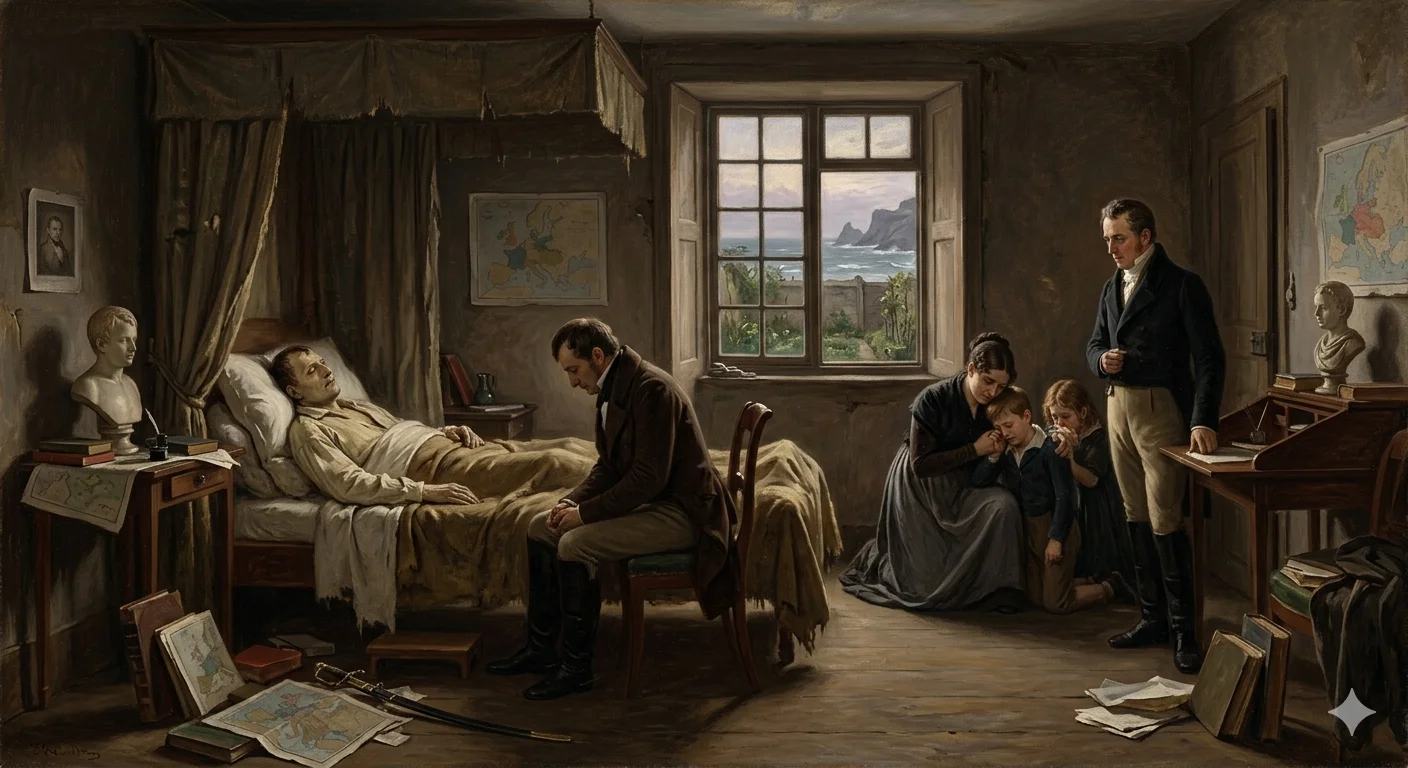
On May 5, 1821, at 5:49 in the evening, Napoleon Bonaparte died in his bedroom at Longwood House on the island of Saint Helena, a British-held territory in the South Atlantic Ocean approximately 1,870 kilometers from the west coast of Africa. He was fifty-one years old. The man who had once commanded the armies of France, conquered most of Europe, rewritten the continent’s legal codes, and crowned himself Emperor in Notre Dame Cathedral died in a damp, rat-infested bungalow on one of the most isolated islands on earth, a prisoner of the British government that had defeated him six years earlier at Waterloo.
His last recorded words, variously transcribed by those present at his bedside, were either “France, the army, head of the army, Josephine” or a single phrase meaning “who retreats.” By nightfall, he was gone. The question of what had actually killed him has never been entirely settled, and the circumstances of his final years and death remain among the most discussed and debated episodes in the history of any individual life.
From Waterloo to the South Atlantic: How Napoleon Came to Saint Helena
The chain of events that ended on May 5, 1821, had begun with Napoleon’s second and final abdication on June 22, 1815, four days after his catastrophic defeat at the Battle of Waterloo by the combined British and Prussian forces under the Duke of Wellington and Field Marshal Gebhard von Blucher.
Napoleon had hoped to escape to the United States. He made his way to the Atlantic coast at Rochefort, but British naval vessels were blockading the French coast and made any departure impossible. On July 15, 1815, Napoleon made a decision that sealed the rest of his life: he surrendered to Captain Frederick Maitland of HMS Bellerophon near the Ile d’Aix, placing himself voluntarily into British custody. He had calculated, apparently, that this surrender would lead to relatively comfortable asylum in Britain, where he imagined being treated as a distinguished private citizen. He was wrong.
The British government and its allied partners had no intention of allowing Napoleon to remain anywhere near Europe or the United States, both of which they judged to be within reach of his influence and the possibility of another return. They chose Saint Helena, a tiny island measuring roughly ten by five miles, governed by the British East India Company, located so far from everywhere that it could be adequately guarded without exceptional effort. The decision was made official while Napoleon was aboard HMS Bellerophon anchored off Plymouth, where crowds of curious British people gathered in small boats for a glimpse of the fallen emperor. He learned on July 31 that Saint Helena would be his destination.
On August 7, Napoleon was transferred to HMS Northumberland and on October 15, 1815, arrived at Saint Helena. He had been accompanied into exile by a group of approximately twenty companions: General Henri-Gratien Bertrand, grand marshal of the palace, with his wife Fanny and their three children; Count Charles de Montholon, aide-de-camp, with his wife Albine and their son; General Gaspard Gourgaud; Emmanuel de Las Cases, the former chamberlain who would later compile the famous Memorial de Sainte-Helene; and various servants.
Longwood House: The Prison Without Walls
Napoleon spent his first two months on Saint Helena at a pavilion called The Briars, on the estate of a local family named Balcombe. He was then moved to his permanent residence, Longwood House, a forty-room wooden bungalow that would be his home until his death. The building was, by all accounts, highly unsuitable. It was damp throughout the year, subject to winds that drove moisture through every wall, infested with rats, and situated in a part of the island where the climate was unhealthy and the air heavy. Napoleon’s attendants consistently complained of colds, respiratory problems, and the general unwholesomeness of the establishment. The Times of London published articles at various points suggesting that the British government was deliberately hastening Napoleon’s death through the choice of his accommodations.
The man responsible for Napoleon’s daily existence on Saint Helena was the island’s governor, Sir Hudson Lowe, who arrived in the role in April 1816. The relationship between Napoleon and Lowe was one of mutual contempt from the beginning. Lowe operated under strict instructions from the British government. He was required to ensure Napoleon could not escape and was not permitted to address him as “Emperor” or even as “Emperor Napoleon.” He was to be addressed as “Napoleon Bonaparte” or “General Bonaparte.” Napoleon refused to accept these terms and the two men clashed repeatedly from their first meeting.
Lowe’s instructions required him to open Napoleon’s correspondence before allowing it to be read, to keep armed soldiers stationed around Longwood at all times, and to confine Napoleon’s freedom of movement to a limited area of the island. Napoleon protested these conditions in letters circulated publicly through intermediaries, hoping to generate enough sympathy in Europe and Britain to pressure the government into revising the arrangements. These efforts largely failed, though they did produce a debate in the British Parliament in March 1817 in which Henry Vassall-Fox, the third Baron Holland, called for a public inquiry into Napoleon’s treatment.
Napoleon occupied his hours at Longwood through a combination of reading, dictating his memoirs, gardening in his restricted outdoor space, and receiving the small circle of people available to him. He read extensively, retaining the voracious intellectual appetite he had shown throughout his life. He also engaged in an extended process of dictating his account of his campaigns and his reign to Las Cases and others, creating what would become the foundation of the Napoleonic legend. Napoleon on Saint Helena was engaged in a sustained effort to control his own historical reputation, presenting himself to posterity as a liberal reformer and defender of the principles of the French Revolution who had been brought down by the jealousy of reactionary European monarchies.
The Britannica article on Napoleon’s exile on Saint Helena provides a comprehensive account of the conditions of his imprisonment and his relationships with those around him.
The Decline: Napoleon’s Health and the Years of Isolation
Napoleon’s health began showing serious deterioration as early as 1817. His physician at that time, Dr. Barry O’Meara, diagnosed him with chronic hepatitis and warned Governor Lowe that the poor climate and insufficient exercise were endangering his life. Lowe dismissed O’Meara’s assessment as exaggeration and ultimately dismissed O’Meara from his post in July 1818.
As the years passed, Napoleon’s companions began to leave. Emmanuel de Las Cases departed in December 1816 after a dispute with Lowe. General Gourgaud left in March 1818. Albine de Montholon, who some historians believe was Napoleon’s mistress during the exile, returned to Europe with her children in July 1819. As the household at Longwood thinned, Napoleon increasingly withdrew into himself, spending more time in his rooms and less in the outdoor exercise that might have sustained his health. He was observed sleeping twelve or more hours a day in his final years.
In November 1818, the allied powers formally announced that Napoleon would remain a prisoner on Saint Helena for the rest of his life. This news struck a final blow to whatever hopes he had retained of ever returning to Europe. His remaining companions observed a marked change in his spirits after this declaration.
The illness that would kill him developed slowly through 1819 and 1820 and then accelerated sharply in 1821. From July 1820, Napoleon suffered frequent bouts of severe stomach pain, nausea, and vomiting. He lost weight rapidly, becoming a shadow of the compact, physically energetic figure he had been in his prime. His legs swelled. His complexion became waxy. By March 1821, he was no longer able to leave his bed.
His physician for the final two years was Dr. Francois Carlo Antommarchi, a young Corsican doctor who had been sent to Saint Helena by the Bonaparte family in September 1819. Napoleon did not have high confidence in Antommarchi’s abilities, reportedly saying of him that “one has the right to be ignorant, but not to lack heart.” Governor Lowe, for his part, dismissed Napoleon’s condition as a “diplomatic illness,” a performance designed to generate sympathy, and declined to accept that the prisoner was genuinely dying.
The Final Weeks: Wills, Last Rites, and Death
As Napoleon entered what he clearly understood to be his final weeks, he dictated two separate wills in April 1821. In these documents, he made his last public statement about his own situation and legacy. He left his fortune to ninety-seven named beneficiaries, including many former soldiers who had served under him. He asked to be buried on the banks of the Seine in Paris, among the French people he had led and loved. And in language that has been quoted and analysed ever since, he declared: “I die before my time, killed by the English oligarchy and its hired assassins.”
Whether this was a literal accusation of murder or a rhetorical flourish expressing his view that the conditions of his imprisonment had shortened his life, these words entered history as Napoleon’s final verdict on those who had held him captive. He also wrote that the Bourbon dynasty that had replaced him would fall and that his son, the young Napoleon II, would one day rule France. Neither prediction proved entirely wrong.
Napoleon reconciled with the Catholic Church in his final days, a significant act given that his relationship with the papacy had been among the most turbulent in modern history, including his arrest and imprisonment of Pope Pius VII. On May 3, 1821, he received the last rites from the Abbe Vignali, the priest who had joined his household in 1819.
On May 4, his English physician Archibald Arnott, who had replaced the dismissed O’Meara in the medical arrangements, administered a high dose of calomel, a mercury chloride compound used as a powerful laxative, over Antommarchi’s objections. A few hours after receiving the calomel, Napoleon vomited blood and his pulse became rapid. He never regained full consciousness.
At 5:49 in the evening of May 5, 1821, Napoleon Bonaparte died. He was dressed for burial in his favourite military uniform, that of the Chasseurs de la Garde, and covered with the grey overcoat he had worn at the Battle of Marengo in 1800.
The Autopsy and the Cause of Death: A Controversy That Has Never Fully Closed
The autopsy was conducted on May 6, 1821, beginning at 2 in the afternoon at Longwood House. It was attended by Napoleon’s French companions including Antommarchi, Count de Montholon, General Bertrand, and various servants, alongside seven British doctors. The formal findings, as summarised in Antommarchi’s report and the British doctors’ records, identified a large ulcer of the stomach, a perforation leading to internal bleeding, and findings consistent with gastric cancer.
These findings have not gone unchallenged. Over the subsequent two centuries, alternative theories about Napoleon’s cause of death have attracted serious historical and scientific attention. The most prominent alternative theory, advanced in the 1960s by Swedish dentist Sten Forshufvud and later developed by other researchers, holds that Napoleon was deliberately poisoned with arsenic, possibly by Count de Montholon, who may have been acting on behalf of parties hostile to Napoleon in France or on behalf of the British government. This theory rests partly on analysis of samples of Napoleon’s hair, which showed elevated arsenic levels in some studies. Critics have countered that arsenic was present in many common materials of the period, including wallpaper dyes, and that the evidence for deliberate poisoning remains inconclusive.
The Wikipedia article on the Death of Napoleon presents the range of medical and historical hypotheses in detail, including the evidence for and against both the cancer and the arsenic poisoning theories.
Most mainstream historians and medical researchers today consider stomach cancer, possibly complicated by a perforated ulcer, to be the most likely cause of death, consistent with Napoleon’s family history and the specific symptoms and progression of his illness. But the controversy has never entirely closed, and Napoleon’s death remains one of those historical events that seems to generate perpetual reexamination.
Burial and the Return to Paris: Napoleon’s Body Across the Decades
Napoleon was buried on May 9 or 10, 1821, in a valley on Saint Helena known as the Valley of the Willows or the Valley of the Geranium, a place where he had sometimes walked during his exile. His body had been placed in a four-layered coffin of remarkable construction: an innermost tin lining, then a mahogany coffin, then a lead coffin, and an outer mahogany shell. Governor Lowe refused to allow the tombstone to bear any inscription with the name “Napoleon” or “Emperor Napoleon.” The stone was inscribed only with the words “Ci-Git,” meaning “Here Lies,” and the epitaph went unfilled. Napoleon had wanted “Napoleon” and nothing more.
The legal, political, and diplomatic dimension of Napoleon’s burial became contentious for years. France under the restored Bourbon monarchy had no interest in commemorating the man who had been their arch-enemy. But popular sentiment in France remained complicated and powerful. Napoleon’s former soldiers remembered him with devotion. His wars had been catastrophic for Europe, but his legal, administrative, and institutional reforms had been transformative, and many in France associated him with national glory.
In 1840, King Louis-Philippe of France negotiated the return of Napoleon’s remains to France. On December 15, 1840, in a ceremony of enormous public spectacle that drew hundreds of thousands of people into the streets of Paris in the cold winter weather, Napoleon’s body was brought up the Seine and interred in the Hotel des Invalides, where it remains today in a massive red porphyry sarcophagus beneath the gilded dome. He was given, in death, the burial on the banks of the Seine that he had requested in his will.
The History.com article on Napoleon’s life and death in exile covers the full arc of his imprisonment on Saint Helena and the mysterious circumstances surrounding his final decline.
Napoleon Bonaparte had lived fifty-one years and nine months. He had risen from the son of a minor Corsican nobleman to command the largest empire Europe had seen since Rome. He had been defeated twice and exiled twice. He had rewritten the laws of France and much of Europe, built cities, reformed bureaucracies, won and lost dozens of battles, married twice, and died in a damp bungalow on an island that barely appeared on most maps of the world.
His grave on Saint Helena had no name. His body now rests under two hundred tons of red porphyry in the greatest ceremonial building in Paris. The distance between those two facts measures something important about what Napoleon Bonaparte meant to the world that outlasted him.