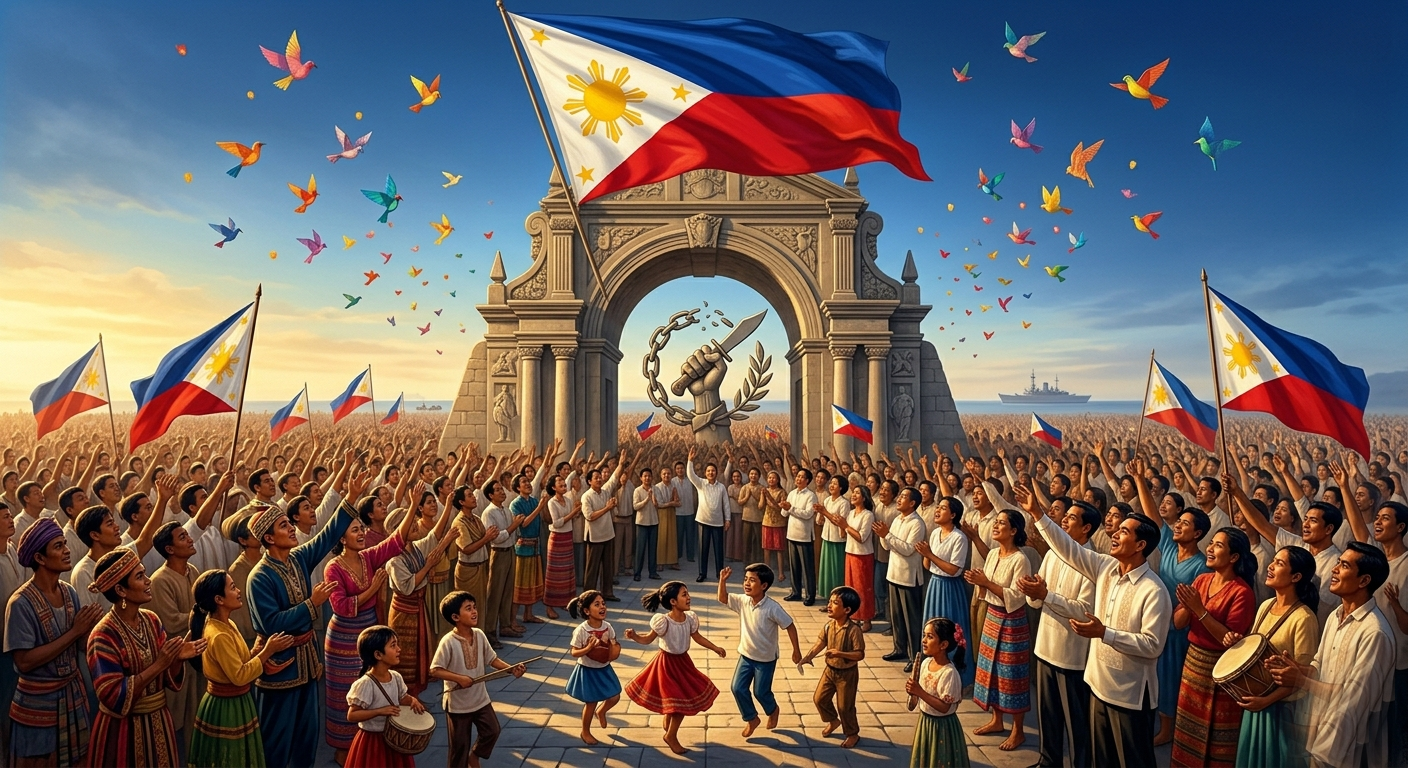
At approximately ten o’clock in the morning on July 4, 1946, a massive crowd gathered at the Luneta grandstand — the great open park in the heart of Manila that Filipinos would later rename Rizal Park in honor of their national martyr — watched in silence as the flag of the United States of America was lowered for the last time as the banner of a colonial power. In the same moment, the flag of the Republic of the Philippines rose to take its place: a banner of blue, red, and white with the golden sun and three stars that Emilio Aguinaldo had first unfurled at Cavite forty-eight years before, a flag that had been raised in independence once already and then suppressed by the same power that was now, finally, acknowledging that it belonged by right to the people who had made it. Sirens wailed across Manila. Church bells rang throughout the archipelago’s more than seven thousand islands. From barrio to barrio, from island to island, cries of ‘Kalayaan’ — freedom — rang out across a nation that had waited for this moment through three and a half centuries of colonial subjugation.
The independence that was formally proclaimed on July 4, 1946, when US High Commissioner Paul V. McNutt read President Harry S. Truman’s proclamation on behalf of the American government and newly-installed Philippine President Manuel A. Roxas accepted it on behalf of the Filipino people, was the product of one of the longest and most painful independence struggles in Asian history. The Philippines had been colonized by Spain since 1565, for a period of 333 years during which the archipelago’s people had resisted, accommodated, and ultimately risen against imperial authority in a revolution that came within reach of establishing an independent republic before being overtaken by the geopolitical machinations of the Spanish-American War of 1898. What followed — an American colonial period that lasted another forty-eight years, that simultaneously built institutions and perpetuated dependence, that promised independence and then delayed it, that was interrupted by the devastating Japanese occupation of World War II — brought the Philippines to July 4, 1946 through a path of such complexity, suffering, and compromise that the independence finally achieved could be celebrated and mourned simultaneously.
The Archipelago at the Crossroads of Asia: The Philippines Before Spanish Colonization
The Philippine archipelago, stretching more than 7,100 islands across the western Pacific Ocean between Taiwan to the north and Borneo to the south, had been home to sophisticated human communities for tens of thousands of years before the arrival of European colonizers. The earliest known human inhabitants, related to the Negrito peoples, were followed over millennia by Austronesian-speaking migrants who spread throughout the islands beginning approximately three thousand years before the common era. By the time the first Europeans arrived, the Philippines was organized into hundreds of independent polities called barangays — basic political units of typically thirty to one hundred households, governed by a datu (chief) in consultation with elders and community leaders. These barangays were neither primitive nor isolated: the Philippine islands sat at the center of an extraordinarily active network of Asian maritime trade, and Filipino merchants and goods were connected to the great commercial civilizations of China, India, and the Islamic world across hundreds of years of exchange.
The largest and most politically organized of the pre-colonial Philippine polities had absorbed significant influences from Hindu-Buddhist civilization through trade with the maritime kingdoms of Java and Sumatra, and from Islam through contact with the sultanates of Brunei and the Malay archipelago. By the time of the Spanish arrival, the Sultanate of Sulu in the southwestern Philippines and the Sultanate of Maguindanao on Mindanao represented the most politically sophisticated Islamic states in the archipelago, with legal systems, diplomatic traditions, and regional influence that would resist Spanish authority for centuries after the northern and central Philippines had been brought under colonial control. This pre-colonial diversity — the patchwork of animist, Hindu-influenced, and Islamic societies speaking hundreds of distinct languages across thousands of islands — would prove both a source of resilience and a source of difficulty for the independence movements that would eventually challenge colonial rule.
Three Hundred and Thirty-Three Years Under the Cross and the Crown: Spanish Colonization from 1565 to 1898
The Spanish presence in the Philippine archipelago began tentatively with Ferdinand Magellan’s arrival in 1521 — the expedition that first demonstrated the insularity of the world by sailing from Europe westward to the East — but ended disastrously when Magellan was killed in the Battle of Mactan by Lapulapu, the chieftain of Mactan island, who refused to submit to Spanish demands for recognition. The permanent Spanish colonial presence began forty-four years later, in 1565, when Miguel López de Legazpi arrived from Mexico with a small fleet and established the first lasting European settlement at Cebu. Legazpi proceeded north to conquer Manila in 1571, establishing the colonial capital that would remain the center of Philippine political life through three colonial regimes and into the twenty-first century. The islands were named las Filipinas in honor of King Philip II of Spain, the naming itself an act of colonial appropriation that transformed a diverse archipelago of independent communities into a single political unit defined by its relation to a distant European monarchy.
Spanish colonial rule rested on three interlocking pillars: the Church, the encomienda system of labor extraction, and the reducción policy of population concentration. The Catholic Church, represented primarily by the great mendicant orders — the Augustinians, Dominicans, Franciscans, and Recollects — was the most important institution of colonial administration, responsible not only for religious conversion but for education, record-keeping, and the day-to-day governance of the colonial population at the parish level. The friars who ran the parishes were often the most powerful Europeans that ordinary Filipinos encountered, and their accumulated wealth, political influence, and sometimes abusive conduct became central grievances in the nationalist movement of the nineteenth century. The encomienda system assigned colonial subjects to encomenderos who collected tribute and extracted labor, creating a system of economic exploitation that, combined with the demographic catastrophe of epidemic diseases introduced by European contact, reduced the indigenous population significantly in the early colonial period before gradual recovery.
Three centuries of Spanish colonial rule produced a deeply Catholic Filipino culture that remains one of the most distinctive features of Philippine identity in Asia — the Philippines is, to this day, the only predominantly Christian nation in Southeast Asia. It also produced the galleon trade between Manila and Acapulco, the longest transoceanic trade route in history, which connected the Philippines to New Spain and through it to the Spanish Atlantic economy and made Manila one of the great commercial cities of Asia. And it produced a colonial social structure that concentrated land and wealth in the hands of the Spanish-born elite, the mestizo community of Chinese and Spanish descent, and the ilustrado class of educated Filipinos who had absorbed European culture while gradually developing a distinctly Filipino national consciousness. The ilustrado class would eventually produce the Propaganda Movement of the 1880s and 1890s, the intellectual and cultural campaign for colonial reform that led directly to the revolution of 1896.
José Rizal, Andrés Bonifacio, and the Birth of Filipino Nationalism in the Nineteenth Century
The emergence of a coherent Filipino nationalist movement in the nineteenth century grew from multiple sources converging in the latter half of that century: the opening of Philippine ports to international trade in the 1830s and 1840s, which connected Filipino elites to the global economy and to European liberal political ideas; the expansion of education, which produced a growing class of Filipinos educated in Manila and Europe; and the increasingly visible abuses of the friar orders, whose vast landholdings and entrenched political power made them the symbol of everything the ilustrado class found objectionable about Spanish colonial administration. The first organized expression of this nationalist consciousness was the Propaganda Movement, a campaign conducted primarily from Europe by exiled Filipino intellectuals calling for colonial reforms: representation in the Spanish Cortes, secularization of the parishes, equality before the law, and the basic civil rights that other Spanish subjects enjoyed.
The towering figure of this movement — and of Filipino nationalism as a whole — was José Protacio Rizal Mercado y Alonso Realonda, born on June 19, 1861, in Calamba, Laguna, into a mestizo family of Chinese and Tagalog descent that had prospered under the Spanish colonial system but whose members had also experienced its arbitrary cruelties. Rizal was educated at the Ateneo de Manila, at the University of Santo Tomas in Manila, and then at universities in Spain and Germany, where he earned degrees in medicine and accumulated a secondary education in philosophy, history, and languages that made him perhaps the most intellectually accomplished Filipino of his generation. His two novels, Noli Me Tángere, published in Berlin in 1887, and El Filibusterismo, published in Ghent in 1891, exposed the corruption of the friar orders and the colonial administration with a realism and literary power that made them immediately incendiary. The novels circulated throughout the Philippines in defiance of colonial censorship, radicalizing a generation of Filipinos who recognized in Rizal’s descriptions of colonial injustice a mirror of their own experience.
Rizal returned to the Philippines in 1892 and founded La Liga Filipina, a civic organization dedicated to peaceful reform, but was arrested almost immediately and exiled to Dapitan in Mindanao. In his absence, more radical voices took the lead. Andrés Bonifacio, a self-educated warehouse clerk and labor organizer from Tondo in Manila who had been radicalized by reading Rizal’s novels and the history of the French and American revolutions, founded the Kataastaasan Kagalanggalang Katipunan ng mga Anak ng Bayan — the Supreme and Venerable Association of the Children of the Nation, known simply as the Katipunan — in July 1892. The Katipunan was not a reform organization but a revolutionary one, dedicated to achieving independence from Spain through armed struggle. Its membership grew through secret recruitment across Manila and the surrounding provinces, reportedly reaching around 100,000 by the time Spanish authorities discovered its existence in August 1896.
The discovery of the Katipunan’s existence triggered the beginning of the Philippine Revolution on August 19 and 23, 1896, when Bonifacio and his followers in Caloocan tore up their colonial identification papers in a collective act of defiance known as the Cry of Pugad Lawin, symbolically renouncing Spanish authority. Revolutionary fighting spread rapidly from Manila to the surrounding provinces. Among the most successful of the early revolutionary commanders was Emilio Aguinaldo, the mayor of Cavite El Viejo (modern Kawit) in Cavite province, whose forces won a series of early victories that gave him disproportionate influence within the revolutionary movement. In March 1897, at the Tejeros Convention, a revolutionary congress elected Aguinaldo as the president of the revolutionary government, effectively displacing Bonifacio from leadership. Two months later, Bonifacio was arrested on charges of sedition and executed — a fratricidal act that darkened the memory of the revolution’s early months and whose justice has been debated by Filipino historians ever since.
José Rizal, who had publicly disapproved of the armed revolution before it broke out, was arrested by Spanish authorities, tried by a military court for rebellion and sedition, and executed by firing squad on December 30, 1896, at the Luneta in Manila — the same Luneta where, fifty years later, the Republic of the Philippines would be proclaimed. He was thirty-five years old. His execution, rather than suppressing the revolutionary movement, transformed it: Rizal became the supreme martyr of Philippine nationalism, a figure of almost sacred significance whose memory was invoked by every subsequent generation of Filipino activists, and whose death demonstrated more clearly than any political argument that Spain was unwilling to respond to Filipino aspirations with anything other than violence. The revolution that Rizal had declined to lead in his lifetime became, in the wake of his death, the revolution that was fought in his name.
The Spanish-American War and the Treaty of Paris: How the Philippines Changed Empires in 1898
The Philippine Revolution had reached a strategic stalemate by late 1897. Aguinaldo’s forces, pushed into the mountainous interior by Spanish military pressure, signed the Pact of Biak-na-Bato in December 1897, agreeing to accept exile in Hong Kong in exchange for 400,000 pesos and Spanish promises of reform. The pact was concluded in bad faith on both sides: Spain did not implement the promised reforms, and Aguinaldo used the money to purchase arms in preparation for renewed resistance. The exile proved brief. On April 25, 1898, the United States declared war on Spain, and the first decisive engagement of that war was fought in Manila Bay.
On the morning of May 1, 1898, Commodore George Dewey, commanding the US Navy’s Asiatic Squadron aboard the USS Olympia, entered Manila Bay and engaged the Spanish naval forces commanded by Rear Admiral Patricio Montojo. The battle was entirely one-sided: in approximately seven hours of fighting, Dewey’s modern steel warships destroyed the entire Spanish squadron, with 381 Spanish sailors killed or wounded and 8 Americans slightly wounded. The Spanish fleet in Manila Bay had been the most powerful Spanish naval force in Asia, and its destruction in a single morning eliminated Spanish ability to defend the Philippines. Dewey then sent the McCulloch, an American revenue cutter, to Hong Kong to bring Aguinaldo back to the Philippines, and Aguinaldo returned on May 19 to resume command of the Philippine revolutionary forces.
What followed was a period of ambiguity and miscalculation whose consequences shaped Philippine history for the next century. Aguinaldo and the Filipino revolutionary leadership understood — or believed — that the United States had come to help them achieve independence, not to establish a new colonial regime. American officials, including Dewey himself, were careful to avoid making explicit commitments either way. At a meeting in Singapore between Aguinaldo and US Consul E. Spencer Pratt before Aguinaldo’s return to the Philippines, the general had asked directly whether the United States intended to hold the Philippines as dependencies. Brigadier General Thomas Anderson deflected the question: In 122 years we have established no colonies. I leave you to draw your own inference. The inference Aguinaldo drew was that American assistance was temporary and that independence would follow Spanish defeat. He was wrong.
While Filipino forces surrounded Manila and won victories across the archipelago, American troops poured into the Philippines and eventually occupied Manila in August 1898 in a somewhat theatrical battle with the Spanish — a battle in which the Spanish and Americans had pre-arranged a formal surrender that excluded Filipino forces from entering the city, a deliberate humiliation of the revolutionary allies. The Treaty of Paris, signed on December 10, 1898, formally ended the Spanish-American War. Under its terms, Spain ceded the Philippines, Guam, and Puerto Rico to the United States, and the United States paid Spain $20 million — not as the purchase price of human beings, which would have been legally and morally outrageous, but technically as compensation for Spanish government property in the ceded territories. Aguinaldo’s government had not been consulted, represented, or acknowledged in these negotiations. The Filipino declaration of independence of June 12, 1898, in which Aguinaldo had proclaimed the Philippines free from Spain at his home in Kawit before a crowd of Filipino citizens, an American officer, and a foreign band playing the newly composed Philippine national anthem, was not recognized by either Spain or the United States.
The Philippine-American War: The Blood Cost of Colonial Acquisition
The First Philippine Republic, formally constituted by the Malolos Constitution promulgated on January 21, 1899, with Aguinaldo as president, was the first constitutional republic established in Asia. It governed — imperfectly, in the conditions of revolutionary war and under blockade — the substantial territories that Filipino forces had liberated from Spanish control. The United States, however, had no intention of recognizing it. When President McKinley’s administration ordered the extension of American military authority beyond Manila, armed confrontation between American and Filipino forces became inevitable. It came on the night of February 4, 1899, when a skirmish between American and Filipino pickets near Manila escalated into the Battle of Manila, beginning what Filipinos call the Philippine-American War and what American sources called, for decades, the Philippine Insurrection.
The Philippine-American War was one of the bloodiest and most brutal conflicts in the history of American overseas engagement. What began as a conventional military contest, in which Filipino forces attempted to hold a defensive perimeter around Manila, quickly became a guerrilla war after November 1899, when Aguinaldo ordered his forces to abandon conventional operations and disperse into the countryside. The American military response included the establishment of concentration camps for civilian populations, destruction of food supplies, and counterinsurgency tactics that resulted in the deaths of enormous numbers of Filipino non-combatants. Estimates of Filipino civilian deaths range from 200,000 to 750,000 from combat, famine, and disease. The war also revealed deep divisions within American political culture: anti-imperialist voices, including Mark Twain, Andrew Carnegie, and former President Grover Cleveland, condemned the war as a betrayal of the principles the American republic had been founded to embody. Aguinaldo was captured on March 23, 1901, by a deception operation led by Brigadier General Frederick Funston, and issued a proclamation accepting American sovereignty on April 1. Armed resistance continued in various forms through 1913 in Mindanao and the Visayas, but the main phase of the war was declared over on July 4, 1902.
The American Colonial Period: Education, Democracy, and the Politics of Promised Independence
American colonial policy in the Philippines differed from Spanish rule in significant respects while reproducing colonial dependency in others. The Americans invested substantially in public education, establishing a system of public schools throughout the archipelago with English as the primary medium of instruction. In 1901, approximately 500 American teachers — known as the Thomasites, after the USAT Thomas, the transport ship that brought the first large contingent — arrived to staff the new schools, which eventually educated millions of Filipinos and created the English-language facility that remains one of the most distinctive features of Philippine society. The establishment of the Philippine Assembly in 1907 — an elected lower house of the legislature, though the appointed Philippine Commission controlled the upper house and an American Governor-General held ultimate executive authority — gave Filipino politicians experience in democratic governance that would be essential for the post-independence period.
The dominant political figure of the American colonial period was Manuel Luis Quezon, born on August 19, 1878, in Baler, Aurora, the son of a village schoolteacher and a mestiza mother. Quezon had served as an aide to Emilio Aguinaldo during the Philippine-American War and had subsequently pursued a legal and political career that brought him to the center of Philippine colonial politics. He became a Resident Commissioner to the United States Congress in 1909 — the non-voting representative that the Philippines was entitled to send to Washington — and used this position to advocate persistently and skillfully for Philippine independence through the machinery of American legislative politics. His political acumen was matched by his personal ambition and his willingness to navigate the complicated compromises that American colonial politics required of Filipino politicians who sought to advance their nation’s interests without provoking a political backlash that would delay independence further.
Throughout the 1920s and early 1930s, the Philippine independence movement made repeated legislative approaches to the United States Congress, each independence mission funded by voluntary contributions from Filipino citizens and each encountering the resistance of American interests — the sugar, coconut, and tobacco industries that competed with Philippine exports, the military establishment that valued Philippine bases, and those in Congress who questioned whether the Philippines was ready for self-governance. The Jones Act of 1916 had promised eventual independence and established an elected Philippine Senate, but the crucial legislation — the Tydings-McDuffie Act of 1934 — set a definite timeline. Authored by Senator Millard Tydings of Maryland and Representative John McDuffie of Alabama, the Philippine Independence Act established a ten-year transition period during which the Philippines would be governed as a Commonwealth, and at the end of which the United States would recognize Philippine independence on July 4 of the year following the completion of the Commonwealth period.
The Commonwealth of the Philippines: Quezon, the 1935 Constitution, and the Path to Sovereignty
The Commonwealth of the Philippines was inaugurated on November 15, 1935, in a ceremony that represented an unprecedented moment in the history of colonial governance: a major imperial power was publicly, legally committing to decolonization and establishing an institutional framework for the transfer of sovereignty. Manuel Quezon was elected as the first president of the Commonwealth, defeating Emilio Aguinaldo in a contest that carried deep symbolism — the man who had declared Philippine independence in 1898 losing the election for the presidency of the transitional government to the man who would govern the Philippines through the next decade. Quezon’s vice president was Sergio Osmeña, a Cebuano politician of Chinese mestizo descent who had been one of the most important advocates of Philippine independence in the American colonial legislative system.
The 1935 Philippine Constitution, drafted by a Constitutional Convention and modeled largely on the American constitution with adaptations for Philippine circumstances, established a presidential republic with a bicameral legislature and an independent judiciary. The document also contained, in its Article XVIII, the remarkable provision that defined the Commonwealth’s transitional character: Upon the final and complete withdrawal of the sovereignty of the United States and the proclamation of Philippine independence, the Commonwealth of the Philippines shall thenceforth be known as the Republic of the Philippines. This sentence — written into the foundational law of the Philippine state — expressed both the aspiration and the conditionality of Filipino sovereignty: it would be real, it would be complete, but it depended on American recognition rather than on Filipino declaration alone. The difference between the American-recognized independence of 1946 and the Filipino-declared independence of 1898 would eventually become a central question in Filipino historical and political consciousness.
The Commonwealth period also saw the appointment of General Douglas MacArthur as Military Advisor to the Philippine Commonwealth government, charged with building a Philippine national defense force capable of defending the islands’ independence after American sovereignty was withdrawn. MacArthur, who had served as the US Army Chief of Staff and who had strong personal and family ties to the Philippines — his father Arthur MacArthur had been the Military Governor-General during the Philippine-American War — threw himself into the task with characteristic energy. But the Philippine Army that he was building from scratch, funded by a Philippine defense budget that was a fraction of what adequate defense required, would be catastrophically tested before the transition to independence was complete.
The Japanese Occupation and World War II: How the War Delayed and Transformed Philippine Independence
On December 8, 1941 — the day after Pearl Harbor, across the International Date Line — Japanese aircraft struck the US Army Air Corps bases at Clark Field and Iba Field in Luzon, destroying most of the American air power in the Philippines in a single morning. Japanese ground forces landed in northern Luzon on December 10 and in larger force on December 22. The combined Filipino-American forces, commanded by General MacArthur and comprising both US Army regular troops and the newly-organized Philippine Army, were outnumbered, underequipped, and unprepared for the Japanese onslaught. The defense of Bataan Peninsula, the most heroic episode of the initial resistance, lasted from January to April 1942, when the exhausted, starving garrison of 76,000 Filipino and American soldiers surrendered to the Japanese in the largest capitulation in American military history. What followed — the Bataan Death March, during which approximately 10,000 Filipino and American prisoners died from execution, starvation, and disease on the sixty-five-mile forced march to Camp O’Donnell — became one of the war’s defining atrocities.
The Japanese occupied the Philippines from 1942 to 1945, establishing a puppet regime under Jose P. Laurel that declared Philippine independence in 1943 — a declaration that Filipinos generally recognized as a Japanese manipulation rather than genuine liberation. Life under Japanese occupation was brutal: Japanese forces engaged in systematic violence against the civilian population, requisitioned food and resources that caused widespread hunger, and conducted sweeping counterinsurgency operations against the Filipino guerrilla forces that resisted occupation across the archipelago. More than one million Filipinos died during the war, making the Philippine experience of World War II proportionally among the most devastating in Asia. President Quezon, who had escaped from Corregidor Island to Australia with MacArthur and then to the United States, established the Commonwealth government in exile in Washington, where he died of tuberculosis on August 1, 1944, before he could see either liberation or independence. He was succeeded by Osmeña as Commonwealth president in exile.
The liberation of the Philippines was as devastating as the occupation. American forces under MacArthur landed at Leyte Gulf in October 1944 — MacArthur wading ashore to fulfill his famous promise I shall return — and fought their way north through the archipelago through early 1945. The Battle of Manila in February 1945 was particularly catastrophic: Japanese forces, refusing to surrender, fought block by block through the historic city in a battle that lasted nearly a month and resulted in the near-total destruction of Intramuros, the ancient walled city of Manila, and the deaths of an estimated 100,000 Filipino civilians. When the fighting ended and MacArthur restored the Commonwealth government in March 1945, he found a capital that was the most devastated city in Asia after Warsaw: infrastructure destroyed, public institutions gutted, economy shattered, and a population traumatized by three years of occupation and a liberation that had cost nearly as much as the conquest.
Manuel Roxas, Sergio Osmeña, and the Politics of Post-War Independence
In the chaos of the immediate post-liberation period, the Commonwealth government had to navigate not only the physical rebuilding of the Philippines but also the political transition to independence, complicated by the deeply contentious question of collaboration with the Japanese occupation. Sergio Osmeña, the Commonwealth president-in-exile who returned with MacArthur to the Philippines in October 1944, was a figure of unimpeachable nationalist credentials who had spent the war in Washington lobbying for Philippine interests. But he faced a significant political challenge from Manuel Roxas, who had remained in the Philippines during the occupation and had served in the Japanese-sponsored Laurel government — though he had also been active in the anti-Japanese guerrilla underground and had protected American prisoners at some personal risk.
Manuel Acuña Roxas y Acuña was born on January 1, 1892, in Capiz, Aklan (now Capiz province), the son of a municipal president. A lawyer and politician who had served in the Philippine Senate and as Speaker of the National Assembly, Roxas had the strong personal support of General MacArthur, who certified his wartime conduct as unimpeachable and blocked the prosecution of Roxas for collaboration while other collaborators were being tried. MacArthur’s intervention in Philippine politics was controversial but decisive: with his backing, Roxas ran for president on an independent Liberal ticket in the elections of April 23, 1946, defeating Osmeña with 54 percent of the vote. When the Philippines gained independence from the United States on July 4, 1946, Manuel Roxas became its first president — a man who had spent the occupation years in Manila rather than in exile, and whose presidency would be defined in large part by the terms of the independence settlement with Washington.
The Bell Trade Act and the Limits of Independence: Economic Sovereignty Constrained
The independence that the Philippines received on July 4, 1946, came with strings attached that made many Filipinos question whether it was genuinely complete. The most contentious of these conditions was the Bell Trade Act — formally the Philippine Trade Act of 1946 — which the United States Congress had passed as a condition for releasing post-war reconstruction funds to the devastated Philippines. The act required the Philippines to accept preferential tariff arrangements that maintained the Philippines as a captive market for American goods; tied the Philippine peso to the US dollar; imposed import quotas on Philippine products competing with American industries; and most controversially, required that the Philippine Constitution be amended to grant American citizens and corporations equal rights with Filipino citizens in the exploitation of Philippine natural resources — the so-called parity rights clause.
The parity rights provision was particularly controversial because it required a constitutional amendment, and amending the 1935 Philippine Constitution required a three-fourths vote of all members of the Philippine Congress. The Roxas administration faced a potential impasse: three elected members of the Democratic Alliance, a left-wing coalition with strong ties to the Hukbalahap guerrilla movement, had been denied their seats by a congressional resolution that their opponents claimed was motivated by political calculation. With these three seats vacant, the Roxas administration was not certain it had the votes to achieve the three-fourths supermajority needed for the constitutional amendment. The seats were excluded, the vote was taken without them, and the amendment passed — though the exclusion of elected members to ensure a constitutional outcome generated lasting controversy about the legitimacy of the process. The Philippine Congress ratified the Bell Trade Act on July 2, 1946, two days before independence, under explicit American pressure that post-war reconstruction funds would be withheld if the act was not accepted.
The independence settlement also preserved an extensive American military presence in the Philippines. The Military Bases Agreement of 1947 granted the United States the right to maintain and operate dozens of military bases in the Philippines for a period of ninety-nine years, including the massive Clark Air Base and Subic Bay Naval Station that would remain among the largest American military installations in Asia until their closure in the early 1990s following the eruption of Mount Pinatubo and the Philippine Senate’s refusal to renew the bases agreement. The critics of the 1946 independence settlement — Filipino nationalists, leftists, and subsequently many historians — have argued that what the Philippines received was not genuine sovereignty but a continuation of subordination in a different formal arrangement: economic dependence maintained by trade legislation, military presence maintained by bases agreements, and political influence maintained by American support for cooperative Filipino politicians.
The Ceremony of July 4, 1946: What Happened When the Philippines Became a Republic
The ceremonies marking Philippine independence on July 4, 1946, were elaborate and deeply symbolic. The principal ceremony took place at the Luneta grandstand in Manila, where the flag of the United States was lowered and the Philippine flag raised in its place at approximately ten in the morning. US High Commissioner Paul V. McNutt, representing the United States government, read Proclamation 2695 issued by President Harry S. Truman, which officially recognized Philippine independence. The proclamation concluded with Truman’s words: A nation is born. Long live the Republic of the Philippines. May God bless and prosper the Philippine people and keep them safe and free! President Manuel Roxas accepted the proclamation on behalf of the Filipino people, and the Treaty of General Relations — the Treaty of Manila of 1946 — was signed by McNutt as representative of the United States and by Roxas as representative of the Philippines, formally relinquishing American sovereignty over the Philippine Islands.
The day’s celebrations were both joyful and freighted with complexity. The choice of July 4 as independence day had been made by the American side, and the coincidence with American Independence Day was explicitly intended by the US government to symbolize what it regarded as the successful conclusion of its civilizing mission — the Philippines, properly instructed in American democratic values, was now ready to govern itself, and the date of its liberation marked the parallel between the American founding and the Filipino founding. Many Filipinos appreciated the symbolic gesture while privately recognizing its condescension: the implicit claim that Philippine independence was a gift from the United States rather than a right that Filipinos had earned through generations of resistance, sacrifice, and political struggle. At four-thirty in the afternoon, a tree symbolizing Philippine independence was planted in front of Manila City Hall. At seven in the evening, President Roxas hosted a formal dinner, reception, and ball at the presidential palace. The celebration concluded with a grand fireworks display at the Sunken Gardens outside Intramuros, as US Navy ships put on a searchlight display in Manila Bay — American military power framing the moment of Filipino sovereignty in a visual metaphor that was either reassuring or ironic depending on one’s perspective.
From July 4 to June 12: How the Philippines Reclaimed Its Own Independence Day
For sixteen years after 1946, the Philippines celebrated its Independence Day on July 4, an arrangement that the original legislation and subsequent custom had established but that many Filipinos found increasingly uncomfortable as the post-independence period produced a more critical assessment of the American colonial legacy. The intellectual context for change was provided by a group of Filipino historians and cultural figures associated with the Philippine Historical Association, who in the late 1950s began publicly articulating the concept of the unfinished revolution — the argument that the true assertion of Filipino national sovereignty had been made not on July 4, 1946, when the Americans recognized independence that Filipinos had claimed for themselves, but on June 12, 1898, when Emilio Aguinaldo had proclaimed independence at Kawit in the first act of Filipino self-determination that America had subsequently suppressed.
The change came under President Diosdado Pangan Macapagal, born on September 28, 1910, in Lubao, Pampanga, a lawyer and politician whose personal and intellectual background gave him a strong sympathy for the historical grievances of Filipino nationalism. On May 12, 1962, Macapagal issued Presidential Proclamation No. 28, declaring June 12, 1962, a special public holiday commemorating the sixty-fourth anniversary of Aguinaldo’s 1898 declaration of independence. He justified the change explicitly: the June 12 declaration represented the authentic Filipino act of national self-determination, while the July 4 independence had been granted by a foreign power according to its own timetable. The practical impact was also noted: attendance at the June 12, 1962 celebrations was estimated at approximately one million people, compared to the two to three hundred thousand who had typically attended July 4 celebrations in Manila. In 1964, the Philippine Congress enacted Republic Act No. 4166, formally changing Independence Day from July 4 to June 12. July 4 was renamed Philippine Republic Day, retaining its status as a national holiday.
Emilio Aguinaldo himself, who was still alive when the change was made — he would die in February 1964 at the remarkable age of ninety-four, the last survivor of the revolutionary generation that had proclaimed independence in 1898 — expressed his satisfaction with the change. The man who had declared Philippine independence at Kawit in 1898 and who had led the Philippine-American War that the United States had won, had lived long enough to see the Philippines reclaim the date that expressed the truth of Filipino national consciousness: that the Philippines had not been made independent by an American proclamation in 1946 but had always been independent in spirit, had claimed that independence in law and deed in 1898, and had been deprived of it by force — first by Spanish resistance, then by American colonial imposition, then by Japanese occupation — before it was finally, formally, and only partially acknowledged on July 4, 1946.
The Significance of July 4, 1946 in the History of Asian Decolonization
The independence of the Philippines on July 4, 1946, held significance that extended far beyond the Philippines itself. It was the first major decolonization of the post-World War II era in Asia, occurring one year before Indian independence in August 1947, and it established a precedent and a model that would be observed carefully by colonial powers and colonized peoples throughout Asia and Africa in the years that followed. The Commonwealth of the Philippines had been, as the WWII Museum’s historian noted, an unprecedented world event in which the United States, a colonial power, was preparing to let go of its colony — a demonstration that the transition from colonial to independent status was possible through institutional preparation rather than only through violent revolution, and that a colonial power could formally commit to and execute a planned decolonization rather than waiting to be driven out.
The American example of a scheduled, institutionally managed decolonization was not without its complications and its critics, and the conditions attached to Philippine independence — the Bell Trade Act, the parity rights amendment, the Military Bases Agreement — meant that the independence was more constrained than it appeared on the surface. But the formal transfer of sovereignty on July 4, 1946, was nonetheless a genuine transfer, and the Republic of the Philippines that emerged from it was genuinely a republic, with its own constitution, its own elected government, its own military, and its own place in the international community. The subsequent decades would test the Filipino republic with extraordinary challenges: the Hukbalahap rebellion, the long Marcos dictatorship, the People Power Revolution of 1986, and the continuing work of building a democratic society in a country whose colonial legacy had left deep structural distortions in its economy and politics.
Conclusion: The Long Road to Luneta — What July 4, 1946 Meant for the Filipino People
When the Philippine flag rose over the Luneta on the morning of July 4, 1946, it completed a journey that had begun in the minds of Filipino reformers three centuries after the Spanish conquest, taken form in the martyrdom of José Rizal and the revolution of Andrés Bonifacio and Emilio Aguinaldo, survived the suppression of the Philippine-American War, navigated the complicated politics of the American colonial period, endured the catastrophe of the Japanese occupation, and arrived at the moment of formal sovereignty through a combination of Filipino determination and American colonial policy.
The independence was imperfect. The economic sovereignty of the new republic was compromised from its first day by the Bell Trade Act’s conditions. The military sovereignty was constrained by American base agreements that would last for decades. The political culture was shaped by forty-eight years of American colonial governance that had simultaneously created democratic institutions and created dependencies. But the flag that rose at the Luneta was real, and the republic it represented was real, and the people who celebrated in the streets of Manila and in the barrios of the archipelago were expressing a joy that four centuries of colonial history had made them earn a hundred times over. Cries of ‘Kalayaan’ rang from island to island. Freedom had come, qualified and constrained but genuinely present, to the 7,100 islands of the Philippine archipelago.
The Philippines today celebrates Independence Day on June 12, acknowledging the deeper truth that Filipino nationhood was not a gift bestowed by the United States in 1946 but a reality asserted by the Filipino people in 1898 and defended through blood and sacrifice in the decades that followed. July 4 remains Republic Day — a holiday that honors the formal establishment of the Third Republic in 1946 and the beginning of the Philippines’ life as a recognized sovereign state in the international community. Both dates matter. Both dates are true. The fullness of the Filipino national story requires both: June 12 for the assertion of sovereignty that was Filipino from the beginning, July 4 for the recognition that made that sovereignty real in international law. Together, they mark the arc of a nation’s liberation — not from one day’s ceremony but from the long, painful, and ultimately triumphant work of becoming free.