
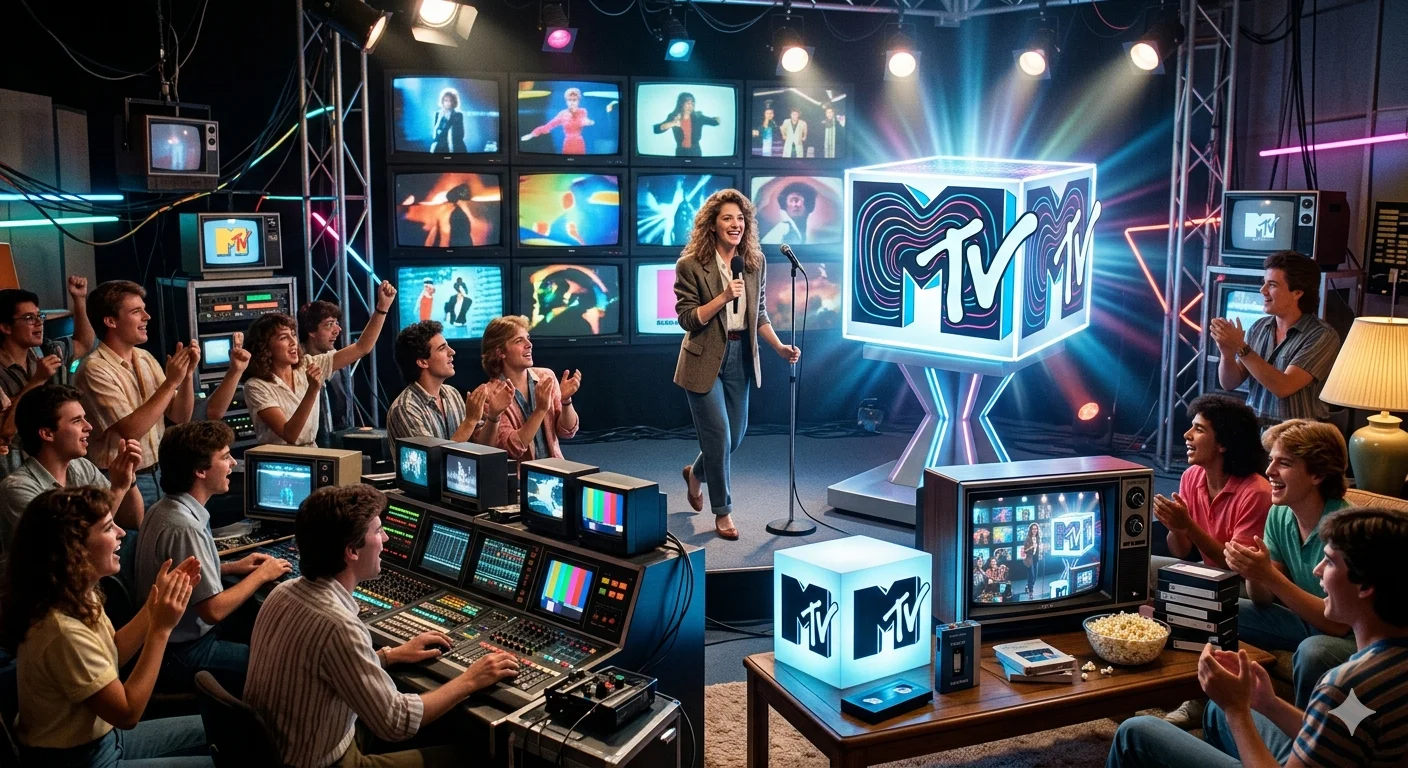
At 12:01 in the morning on August 1, 1981, a new cable television channel flickered to life in homes across parts of New Jersey. The screen filled with footage of a rocket launch countdown, the same countdown from the first Space Shuttle launch that had taken place months earlier. Then, a voice spoke six words that would prove to be one of the great understatements in the history of popular culture: “Ladies and gentlemen, rock and roll.” The voice belonged to John Lack, one of the founding executives of the new channel. The first music video followed immediately. It was “Video Killed the Radio Star” by the British new wave duo The Buggles. The channel was called MTV: Music Television.
In the years that followed, MTV would reshape the music industry more completely than any single force since the invention of rock and roll itself. It created a new form of celebrity, redefined what it meant to be a musician, accelerated the careers of artists who could translate their music into compelling visuals, and effectively ended the careers of others who could not. It generated one of the most recognizable advertising campaigns of the decade, built an entirely new youth culture that crossed national borders, and eventually transformed itself from a music channel into a pop culture institution that reflected and shaped the tastes of an entire generation. Everything it did flowed from that single moment just after midnight on the first day of August 1981.
The Music Industry in 1981: A Business Looking for a New Idea
The world into which MTV launched was a music industry in genuine trouble. The late 1970s had seen the rise and catastrophic commercial collapse of disco, a genre that had briefly dominated sales but whose backlash had left radio formats uncertain and record company executives anxious. Album sales, which had grown steadily through the 1970s, had begun to stagnate. The recording industry was experiencing what many inside it described as a genuine crisis of consumer interest, and no one had a clear answer for how to reverse the trend.
Cable television, meanwhile, was in the early stages of an expansion that was already disrupting the dominance of the three broadcast networks, ABC, NBC, and CBS. The deregulation of the television industry in 1972 had cleared the legal path for cable’s growth, and by the early 1980s cable channels were proliferating. CNN had launched on June 1, 1980, just fourteen months before MTV, demonstrating that specialized 24-hour cable channels could find audiences. ESPN had launched in September 1979. The infrastructure for a new kind of television was being built, and executives at the newly formed Warner-Amex Satellite Entertainment were looking for the next opportunity.
The executives at Warner-Amex recognized in 1979 that teenagers were a largely overlooked and commercially underserved audience, and that connecting music with television in a sustained, dedicated format had never been tried in America. Music television had existed in limited forms in Europe, where promotional films had been sent to television programs for years. The Beatles had made promotional clips for songs as early as the mid-1960s to be broadcast on programs they could not physically attend. Queen had made elaborate promotional films throughout the 1970s. But in the United States, there was no dedicated outlet for music video content, and the genre therefore had no consistent home and no reliable commercial value.
Robert Pittman, John Lack, and the Architecture of MTV
The creative and conceptual architecture of MTV was built primarily by two men: Robert W. Pittman, a radio industry veteran and marketing visionary who became the driving creative force behind the channel’s format, and John Lack, the Warner executive vice president who provided institutional support and whose vision helped bring the project to reality.
Pittman was twenty-seven years old when MTV launched. He had worked in radio since he was a teenager, programming radio stations with a sophisticated understanding of how music connected with youth audiences. He recognized that the format of Top 40 radio, in which a relatively small number of popular songs were played in rotation and introduced by charismatic personalities, could be translated directly into a visual medium. Instead of disc jockeys, MTV would have video jockeys, or VJs, who would introduce music videos and provide the personality and continuity that kept audiences engaged between songs.
Pittman tested his ideas by producing a fifteen-minute television show called Album Tracks on WNBC-TV in New York in the late 1970s. The response confirmed his belief that the format worked. He also developed detailed research into the psychology of the target audience, the post-baby boom teenagers who had grown up with television as a central presence in their lives and who consumed culture in a visual, fast-moving, emotional way that was different from the more deliberate engagement of previous generations.
John Lack had been following a parallel track. He had been involved with PopClips, a television series created by Michael Nesmith, the former member of the Monkees who had become interested in music video as a format in the late 1970s and who produced PopClips for the Nickelodeon cable channel. PopClips demonstrated the commercial viability of a show built entirely around music video clips. When Warner-Amex began seriously developing the concept that would become MTV, Lack was instrumental in bringing it forward through the corporate structure. It was Lack who spoke the first words on MTV’s air on August 1, 1981.
The channel was launched under the corporate umbrella of Warner-Amex Satellite Entertainment. MTV’s on-air programming was originally produced from the Teletronics studio facility on West 33rd Street in Manhattan, with the satellite uplink handled from a facility in Hauppauge, New York. The channel’s logo, an astronaut planting an oversized MTV flag on the surface of the moon, was designed by the Manhattan Design collective, formed by Frank Olinsky, Pat Gorman, and Patty Rogoff, under the guidance of original creative director Fred Seibert. The logo was deliberately bold and irreverent, equating the launch of a music television channel with the moon landing, making a claim about ambition and cultural significance that would have seemed absurd on August 1, 1981 and that turned out to be at least partially justified.
The Wikipedia article on MTV provides a comprehensive account of the channel’s founding, its early years, and its long evolution from music channel to pop culture institution.
The First Five VJs and the First Day of Broadcasting
When MTV launched, it had five video jockeys who introduced videos, provided commentary, and gave the channel its human personality. They were Nina Blackwood, Mark Goodman, Alan Hunter, J.J. Jackson, and Martha Quinn. The five were carefully chosen to represent a range of personalities and backgrounds that would together present a face for the channel that felt accessible, enthusiastic, and authentic to its audience.
Nina Blackwood had a rock sensibility and an edgy visual presence that suited the more underground elements of MTV’s early playlist. Mark Goodman brought a knowledgeable, engaging quality that made him comfortable with a wide range of music. Alan Hunter was personable and charming. J.J. Jackson brought credibility and depth, particularly with rhythm and blues and classic rock. Martha Quinn, with her girl-next-door warmth and genuine enthusiasm for music, quickly became the most beloved of the five and represented for many viewers the accessible, enthusiastic spirit the channel wanted to project.
After The Buggles’ “Video Killed the Radio Star” played, the second video was “You Better Run” by Pat Benatar. On the first day of broadcasting, 116 unique videos were played in total. The playlist was a reflection of the music that record companies were making promotional videos for in 1981, which was heavily weighted toward new wave, pop rock, and the emerging British invasion of the post-punk era. American artists who lacked promotional videos were largely absent, a limitation that would generate significant tension in the channel’s early years.
The channel initially reached only households in parts of New Jersey that had cable service provided by a company called TelePrompTer Cable. The reach was modest, but Lack and Pittman had a marketing strategy. They launched an advertising campaign with a simple and brilliant slogan: “I Want My MTV.” The campaign encouraged viewers to call their local cable companies and demand that MTV be added to their service. Viewers did call, cable operators responded, and MTV’s distribution expanded rapidly throughout 1981 and 1982.
The Early Struggle and the Michael Jackson Turning Point
MTV’s early years were not straightforwardly triumphant. The channel faced two significant and related problems in its first years of operation. The first was a relatively shallow pool of available music videos, particularly from American artists, which led to frequent repetition of the same clips. The second, more serious, was a programming philosophy that effectively excluded Black artists from its rotation.
MTV’s early format was modeled on album-oriented rock radio, a format that catered primarily to white audiences and that systematically underrepresented Black music. The channel refused videos by Black artists including Rick James, whose “Super Freak” was among the more commercial videos available in 1981 and 1982. Rick James became a vocal public critic of MTV’s racial exclusion, and his criticism was shared by many inside the music industry. The channel’s defenders argued that it was simply matching its playlist to a format, but the effect was a systemic exclusion that embarrassed MTV as the decade progressed and became more difficult to defend.
The force that broke this impasse was Michael Jackson. When Jackson’s Thriller album was released in late 1982, his record label CBS Records threatened to pull all its artists’ videos from MTV if the channel refused to play Jackson’s videos. The combination of commercial pressure and the sheer impossibility of arguing that Michael Jackson’s videos should not be on a music video channel made MTV’s position untenable. “Billie Jean” entered MTV’s rotation in 1983, followed by “Beat It,” and the result was transformative for both parties. Michael Jackson’s videos, directed with cinematic ambition and featuring Jackson’s extraordinary physical performance, demonstrated what the music video format could achieve at its highest level. MTV’s ratings surged. The racial exclusion of the channel’s early years was gradually dismantled, though it remained a historical stain on the channel’s record.
The MTV Effect: How Visual Music Changed the Music Industry
The commercial and cultural impact of MTV on the music industry during the 1980s was profound and far-reaching. For artists who could translate their music into compelling visual narratives, MTV was an extraordinarily powerful promotional tool. For artists who could not or would not engage with the visual format, it represented a genuine competitive disadvantage.
The classic example of MTV-powered stardom was Madonna, whose career launched in 1982 and reached superstar status through a combination of musically strong songs and visually provocative videos that made her a constant presence on MTV’s playlist. Her performance at the first MTV Video Music Awards in September 1984, in which she writhed across a stage in a wedding dress while performing “Like a Virgin,” was one of the most talked-about moments in American pop culture that year and demonstrated the degree to which MTV had become the central arena in which pop cultural significance was established.
Duran Duran, the British new wave group, became one of the signature acts of early MTV precisely because they invested in high-production-value videos shot in exotic locations that gave their music a visual glamour perfectly suited to the channel’s aesthetic. Groups like ZZ Top, Tina Turner, and Peter Gabriel, all of whom had been established acts before MTV, used the channel to reach new audiences and scored the biggest commercial hits of their careers in the mid-1980s, precisely because their videos were engaging and well-made.
The channel also profoundly influenced film direction. Directors including Spike Jonze, who would go on to direct Being John Malkovich, and Michel Gondry, who later made Eternal Sunshine of the Spotless Mind, began their careers making music videos for MTV, developing a visual language of fragmented narrative, surreal imagery, and fast cutting that would subsequently influence film, advertising, and television production throughout the 1990s and beyond.
In 1984, MTV launched the MTV Video Music Awards, which immediately became one of the most watched events in American television. The VMA statuette was a replica of the astronaut from the channel’s original logo, the moon man who had planted the MTV flag in 1981. The awards show gave the channel its biggest live programming moment each year and became famous for unpredictable and often controversial performances that drove cultural conversation.
From Music Channel to Pop Culture Institution
By the late 1980s, MTV had begun what would become a gradual but complete transformation of its programming identity. As the cable television landscape expanded and as the music video format became ubiquitous across multiple channels, MTV began moving into non-music programming targeted at teenagers and young adults.
In 1985, the entertainment conglomerate Viacom Inc. purchased MTV Networks from Warner Communications, bringing the channel under new corporate ownership that would over time push its programming increasingly away from music and toward reality television, comedy, and youth-oriented entertainment. Specialty music programs including 120 Minutes, devoted to alternative rock, Headbangers Ball, focused on heavy metal, and Yo! MTV Raps, which gave hip-hop its first major television platform, carved out dedicated spaces for genres that did not fit the channel’s mainstream rotation.
The Real World, which premiered in 1992, pioneered the modern reality television format by placing strangers from different backgrounds together in a house and following their interactions with cameras. It was the template from which a vast proportion of subsequent reality television descended. Jackass, which launched in 2000, was followed by Jersey Shore in 2009. Each of these shows shaped the cultural landscape of their respective eras and demonstrated that MTV’s ability to identify and amplify the preoccupations of youth culture extended far beyond music.
The Britannica article on MTV covers the full arc of the channel’s history, from its origins as a 24-hour music video channel through its transformation into a general entertainment network.
MTV’s cultural influence extended globally. MTV Europe launched on August 1, 1987, exactly six years after the original channel, opening with “Money for Nothing” by Dire Straits. Regional versions of MTV spread to Latin America, Asia, and beyond, making the channel one of the most powerful vehicles for the global spread of American popular culture in the late twentieth century.
What began as six words spoken over a rocket launch countdown just after midnight on August 1, 1981, built over the following decade into something that had fundamentally altered the relationship between music, commerce, celebrity, and visual culture. The Buggles had asked whether video would kill the radio star. What actually happened was more complicated: video and music together created a new kind of star, built on a new kind of relationship between artist and audience, one in which seeing and hearing were inseparable, and in which the image you projected on a television screen was as important as any note you played.