
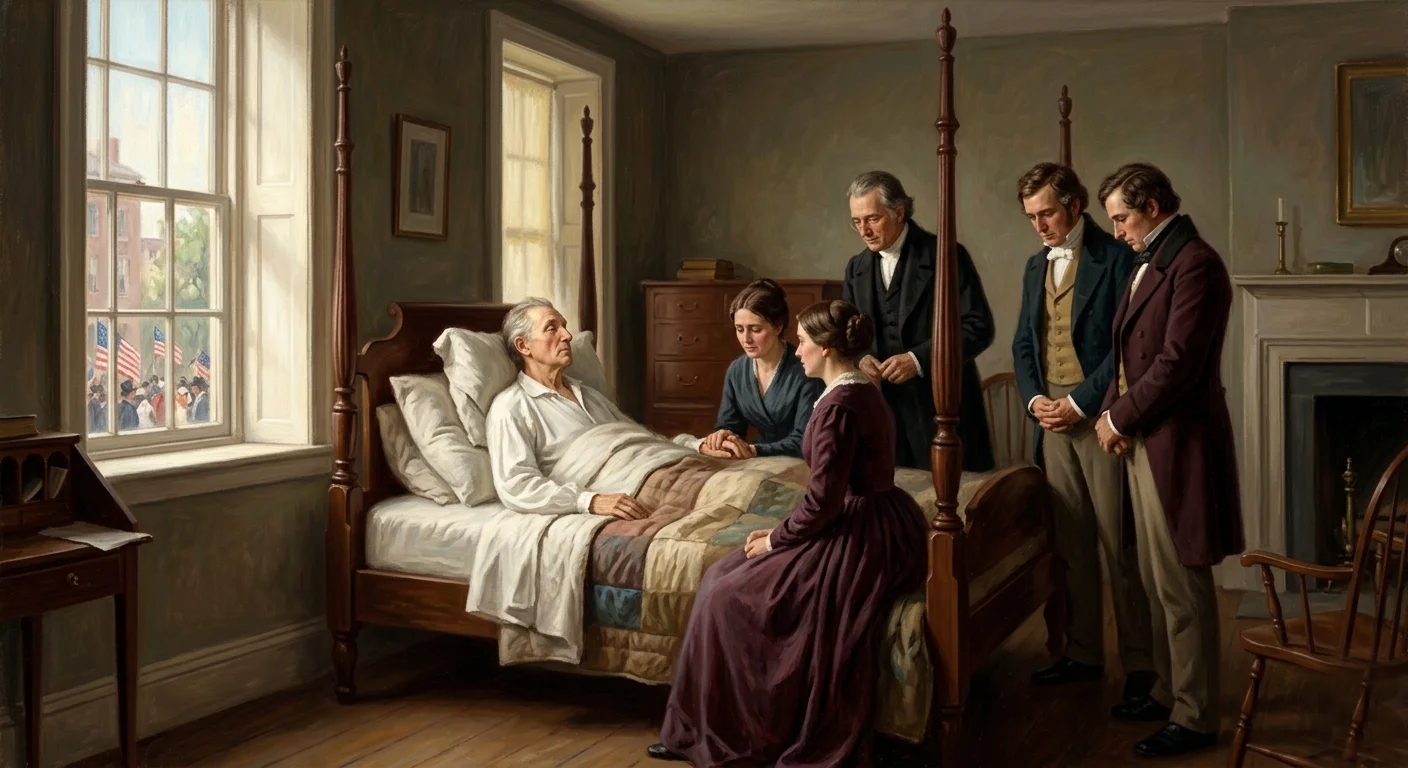
On the morning of July 4, 1831, the United States was celebrating the fifty-fifth anniversary of its independence with the festivities that had become a national tradition — the bells, the cannon fire, the parades, the speeches, and the communal expression of pride in what a young republic had become and what it aspired to be. Somewhere in that celebration, in the New York City home of his youngest daughter Maria Hester Gouverneur and her husband Samuel, a frail seventy-three-year-old man who had crossed the Delaware River with George Washington, studied law under Thomas Jefferson, negotiated the Louisiana Purchase, fought off the British as both Secretary of State and Secretary of War, presided over the Era of Good Feelings as the fifth president of the United States, and declared to the world’s great powers that the Western Hemisphere was no longer open for colonization — that man drew his last breath.
James Monroe died on July 4, 1831, from heart failure and tuberculosis, in circumstances that were financially difficult and personally bereft: his beloved wife Elizabeth had died less than a year before, his estate had been sold to pay debts accumulated over a lifetime of expensive public service, and he was living in his daughter’s home in New York City because he could no longer afford to maintain his own. He had outlasted John Adams and Thomas Jefferson by five years, the two men who had preceded him in the Virginia dynasty of early American presidents and who had themselves died on July 4, 1826, the fiftieth anniversary of the Declaration of Independence. Monroe was the third of the nation’s first five presidents to die on Independence Day — a statistical coincidence so extraordinary that it struck contemporaries with religious awe and has fascinated historians ever since. He was the last Founding Father to serve as president, the last of the Virginia dynasty, and with his death the generation that had created the United States passed from living memory into history.
The Virginia Boy Who Joined a Revolution: Monroe’s Early Life and Military Service
James Monroe was born on April 28, 1758, in Westmoreland County, Virginia, the same county that had produced George Washington two generations before and that embodied the planter culture of the Virginia Tidewater at its most characteristic. His father, Spence Monroe, was a craftsman and modest planter of Scottish descent whose family had emigrated to Virginia in the mid-seventeenth century. His mother, Elizabeth Jones Monroe, was the daughter of a family of Welsh immigrants who had established themselves more securely in the colonial Virginia hierarchy. The family owned approximately 600 acres, enough to be respectable but not wealthy by the standards of the great Virginia planters whose estates ran to tens of thousands of acres and whose social authority shaped colonial Virginia life. Monroe was the eldest of several children, and as the eldest son he carried the family’s hope for advancement.
At the age of eleven, Monroe was enrolled at Campbelltown Academy, considered among the best schools in Virginia, where he excelled in Latin and mathematics and formed one of the most consequential friendships of his life with a fellow student named John Marshall, who would go on to become the fourth Chief Justice of the United States and one of the most influential jurists in American history. Their friendship, formed in a Virginia schoolroom in the 1760s, would persist through decades of political difference — Marshall became a Federalist while Monroe became a Democratic-Republican — and demonstrate the capacity of personal ties to bridge the ideological divisions that the new republic would generate. In 1774, Monroe enrolled at the College of William and Mary in Williamsburg, intending to study law, but the revolution that had been building in the colonies interrupted his academic plans before they could take root.
When the Revolutionary War began in 1775 and the Continental Army was recruiting in Virginia, Monroe — eighteen years old, slightly over six feet tall, broad-shouldered, with a plain face, wide-set blue-gray eyes, and a large, broad forehead that gave him an air of calm solidity — left the College of William and Mary to enlist as a lieutenant in the Third Virginia Infantry Regiment of the Continental Line. He was commissioned in the spring of 1776 and joined Washington’s army in time for the New York and New Jersey campaign of that year, which included some of the most desperate and discouraging engagements of the entire war. Monroe took part in the retreat of Washington’s battered army from New York City southward through New Jersey in the autumn of 1776, a retreat that reduced the Continental Army to a ghost of the force that had started the year with such confidence.
The moment that defined Monroe’s military career came on the night of December 25-26, 1776, when Washington led approximately 2,400 troops across the partially frozen Delaware River in a midnight operation of extraordinary boldness and tactical risk, emerging at dawn on the New Jersey side to launch a surprise attack on the Hessian garrison at Trenton. Monroe was part of the attacking force. As the Americans drove through the town in the chaos of the surprise assault, Monroe led a charge to capture a Hessian artillery battery that was being positioned to sweep the main street. A musket ball struck him in the shoulder, severing an artery. He would have bled to death on the field had not Dr. John Riker, a physician who happened to be present, immediately compressed the wound and tied off the artery. Washington promoted Monroe to captain for his bravery at Trenton — the young lieutenant who would become the fifth president of the United States appears in Emanuel Leutze’s famous 1851 painting of Washington Crossing the Delaware, carrying the flag. Monroe continued to serve through 1777 and 1778, including at the Battle of Brandywine and the winter encampment at Valley Forge, before eventually retiring from the Continental Army in January 1779 to continue his education and begin his political career.
Thomas Jefferson’s Student and Protégé: Monroe’s Political Formation in the Revolutionary Era
The relationship between James Monroe and Thomas Jefferson, which began when Monroe returned to Virginia in 1779 and sought Jefferson’s guidance in the study of law, was one of the defining personal and political relationships of Monroe’s life. Jefferson was then the Governor of Virginia, a position of enormous importance in the early years of the Revolution, and Monroe attached himself to Jefferson as a student and junior colleague with the combination of intellectual deference and personal warmth that Jefferson brought out in many of the young Virginians who entered his orbit. Jefferson recognized in Monroe a reliable ally of genuine ability and directed his legal and political education with the care of a mentor who saw in his student the potential for significant public service.
Monroe studied law under Jefferson from 1780 to 1783 and subsequently embarked on a political career that was shaped in its fundamental orientations by the mentor’s influence. He was elected to the Virginia House of Delegates in 1782, served as a delegate to the Continental Congress under the Articles of Confederation from 1783 to 1786, and married Elizabeth Kortright of New York City on February 16, 1786 — a marriage that would last forty-four years until Elizabeth’s death in 1830 and that provided Monroe with both personal happiness and a connection to the New York commercial establishment that broadened his political horizons beyond the Virginia planter world in which he had grown up. Elizabeth Monroe was described by contemporaries as a woman of great beauty, elegance, and dignity who complemented her husband’s more reserved and unaffected personal style with a social grace that served them well in the diplomatic and political circles they inhabited for decades.
Monroe’s uncle, Joseph Jones, had been a member of the Virginia House of Burgesses and a close friend of Washington, Jefferson, and Madison, and Monroe had absorbed from his uncle’s example the conviction that public service was the highest calling available to a man of ability and republican principles. His political identity formed around the Jeffersonian Democratic-Republican tradition: a belief in limited federal government, states’ rights, the primacy of agriculture as the foundation of republican virtue, and skepticism about the concentrated commercial and financial power that Alexander Hamilton’s Federalists were building through the national bank and allied economic institutions. Like Jefferson, Monroe was profoundly ambivalent about slavery — he owned enslaved people throughout his life, recognized the institution as a moral evil, and yet could not bring himself to take the steps that would have translated that recognition into action on either his own plantation or in the national politics where he wielded influence.
The Ambassador, the Governor, and the Negotiator: Monroe’s Pre-Presidential Career
James Monroe’s path to the presidency was the longest and most varied of any of the early Virginia presidents, encompassing diplomatic assignments on two continents, the governorship of Virginia, and cabinet service in two departments during a major war. President Washington sent him to France in 1794 as the American minister, a posting that reflected Monroe’s known Francophile sympathies and his standing in the Democratic-Republican party during the contentious period of the French Revolutionary Wars. Monroe served as minister through 1796, working to maintain American trade relationships, protect American citizens, and advocate for the Franco-American alliance that had been so critical to the success of the Revolution. He secured the release of Thomas Paine from a French prison — Paine had been imprisoned during the Terror phase of the French Revolution because of suspicions about his loyalty — and secured American navigation rights on the Mississippi River.
His time as minister ended badly, however. Washington recalled Monroe in 1796 in part because Monroe had not been informed of the Jay Treaty, the agreement with Britain that France considered a betrayal of their alliance, and Monroe’s outrage at the treaty’s terms had led him to make statements the Washington administration considered inappropriate for a serving diplomat. Monroe responded with a lengthy pamphlet defending his conduct, which Washington did not forget or forgive. Monroe then served as Governor of Virginia from 1799 to 1802, establishing a capable administrative record in his home state, before Jefferson — now president — sent him on a special mission to France and Spain to assist Robert Livingston in the negotiations that produced the Louisiana Purchase in 1803. The Louisiana Purchase, which doubled the size of the United States at the extraordinarily favorable price of approximately three cents per acre, was the single most important territorial transaction in American history, and Monroe’s role in its final negotiation secured him a claim to a share of one of Jefferson’s greatest diplomatic achievements.
Monroe subsequently served as minister to Britain and then to Spain, with mixed success in both postings, before returning to the United States to serve as Governor of Virginia again briefly and then to be appointed Secretary of State by President James Madison in 1811. As Secretary of State through the War of 1812 and its aftermath, Monroe managed the diplomatic dimensions of the conflict while also, from August 1814 to March 1815, serving simultaneously as Secretary of War after the disastrous fall of Washington, D.C., to British forces burned the Capitol and the White House. Monroe was the last person to hold both cabinet positions simultaneously, and his management of the war’s final phases — including the negotiation of the Treaty of Ghent that ended the conflict in December 1814 — demonstrated the administrative breadth and energy that would characterize his presidency.
Election to the Presidency: The Twilight of Federalism and Monroe’s National Tour
By 1816, the Federalist Party was a shadow of its former self, its national base eroded by two decades of electoral defeat and its reputation damaged by the Hartford Convention of 1814, in which a group of New England Federalists had met to consider secession from the Union in protest of the war — a gathering that most Americans viewed as unpatriotic at best and treasonous at worst. Monroe ran for president against Federalist candidate Rufus King of New York and won decisively, receiving 183 electoral votes to King’s 34. He was inaugurated on March 4, 1817, as the fifth president of the United States, the first president to be inaugurated outdoors, and the only president other than Washington to run essentially unopposed in a presidential election when he was re-elected in 1820.
One of Monroe’s first acts as president was a goodwill tour of the northern states — a gesture of national reconciliation that acknowledged the regional tensions of the preceding decades and sought to present the presidency as an institution that belonged to all Americans, not merely to the Virginia planter class that had supplied the first four presidents. The tour was an enormous success. Everywhere Monroe went — including Boston, the heart of the Federalist tradition that had been his political opposition — he was received with genuine popular enthusiasm. A Boston newspaper, writing about Monroe’s reception in the traditionally Federalist city, coined the phrase that would define his administration in the historical memory: the Era of Good Feelings. The phrase captured something real: the post-war moment of 1817 was characterized by genuine national optimism, the collapse of organized partisan opposition, and a sense that the republic had weathered its early crises and emerged stronger than before.
The Era of Good Feelings was both real and misleading. It was real in the sense that the Federalist Party never recovered from its wartime disgrace and essentially ceased to function as a national political organization during Monroe’s first term, leaving the Democratic-Republicans as the only national party. Monroe himself sought to reduce the salience of party competition, appointing men from across the old partisan divide to his cabinet and administration. But the Era of Good Feelings concealed beneath its surface the sectional tensions that would eventually destroy the democratic-republican consensus: the clash between North and South over the expansion of slavery into the new territories of the West, the economic disruptions of the Panic of 1819, and the personal and factional rivalries within the Democratic-Republican party that would eventually produce the four-candidate election of 1824 and the emergence of the second American party system. Monroe’s good feelings were the calm before a storm he could sense but not prevent.
The Era of Good Feelings: Territorial Expansion, the Panic of 1819, and the Missouri Compromise
Monroe’s presidency produced a record of territorial and diplomatic achievement that ranks among the most substantial of any early American administration. The acquisition of Florida from Spain, formalized in the Adams-Onís Treaty of 1819 — also known as the Transcontinental Treaty — was one of the great diplomatic coups of the early republic. Secretary of State John Quincy Adams negotiated the treaty with extraordinary skill, securing not only East Florida but also a defined boundary between the United States and Spanish territory that ran all the way to the Pacific Coast, establishing for the first time the principle of American continental ambition that would eventually produce the doctrine of Manifest Destiny. Monroe paid Spain five million dollars for Florida, a territory whose acquisition eliminated a persistent source of military threat and diplomatic friction on the southern frontier.
The early years of Monroe’s presidency also saw a rapid expansion of the Union’s membership as new states entered from the territories of the Old Northwest and the Old Southwest. Mississippi became the twentieth state in 1817, Illinois the twenty-first in 1818, and Alabama the twenty-second in 1819. These admissions proceeded relatively smoothly, but they also accelerated the approach of a reckoning that had been deferred since the Constitutional Convention of 1787: the question of whether the new territories created from the Louisiana Purchase would be slave or free. When Missouri applied for admission to the Union in 1819, the debate exploded in Congress with a ferocity that alarmed everyone who observed it. New York Congressman James Tallmadge Jr. introduced an amendment to the Missouri statehood bill that would prohibit the introduction of new enslaved people into Missouri and provide for the gradual emancipation of those already there. The Southern response was furious, and the debate that followed revealed for the first time in the young republic’s history the depth and danger of the sectional division over slavery.
Monroe himself was deeply troubled by the Missouri crisis. He recognized, as he wrote to Jefferson, that the question had the character of a firebell in the night — a phrase Jefferson made famous but that captured the shared anxiety of the surviving Virginia founders about what the slavery debate augured for the republic’s future. Monroe did not think Congress had the constitutional authority to impose conditions on Missouri’s admission regarding slavery, but he also recognized that some compromise was necessary to prevent the crisis from reaching the point of dissolution. Henry Clay of Kentucky, Speaker of the House and known as the Great Pacificator, engineered the compromise that Monroe eventually signed in 1820: Missouri entered the Union as a slave state, Maine — previously part of Massachusetts — entered as a free state to maintain the balance between slave and free states in the Senate, and slavery was prohibited in all remaining territories of the Louisiana Purchase north of the latitude 36 degrees 30 minutes. The Missouri Compromise bought the republic thirty years of avoided confrontation on the slavery question, though both Monroe and Jefferson understood that the compromise had not resolved the underlying tension but merely deferred it.
The Monroe Doctrine: Declaring American Dominance in the Western Hemisphere
The achievement that has most durably defined James Monroe’s place in American history is neither the Era of Good Feelings nor the Missouri Compromise but a statement of foreign policy that occupied three paragraphs in his seventh annual message to Congress, delivered on December 2, 1823. The Monroe Doctrine, as it came to be called from about the 1850s onward, was in its origins a response to specific and immediate concerns: the independence movements that had swept through Spanish America in the preceding years had created a dozen new nations from Mexico to Argentina, and there were serious fears in Washington — and in London — that the continental European powers, grouped in the Holy Alliance, might intervene to restore Spanish colonial rule over these newly independent states.
Secretary of State John Quincy Adams was the principal architect of the doctrine’s intellectual content, though Monroe shaped its ultimate form and tone. British Foreign Minister George Canning had earlier proposed that Britain and the United States issue a joint declaration warning the European powers against intervention in Latin America, but Adams persuaded Monroe that a unilateral American statement would be both more dignified and more clearly expressive of American interests than a joint declaration that would appear to make the United States a junior partner of British foreign policy. The resulting doctrine had three central principles: the Western Hemisphere was closed to new European colonization; any attempt by European powers to extend their political system to the Americas would be considered dangerous to American peace and safety; and the United States would not interfere in European wars or the existing European colonies in the Americas.
When Monroe delivered the doctrine in December 1823, it was received cautiously by the European great powers, who privately dismissed it as presumptuous from a nation that lacked the military force to enforce it. The British Navy, far more powerful than anything the United States could put to sea, was the actual enforcer of the Western Hemisphere’s independence from European intervention in the short term. But the Monroe Doctrine’s importance was not in its immediate practical effect — it was in its articulation of a principle that would grow with American power until it became the foundation of American foreign policy in the Western Hemisphere for the following two centuries. In 1904, Theodore Roosevelt’s Roosevelt Corollary extended the doctrine to justify American intervention in Latin American states that could not manage their own affairs — a significant distortion of Monroe’s original intent, which had been to protect Latin American independence from European interference, not to assert an American right of intervention. But the basic framework of hemispheric sovereignty that Monroe established in 1823 has remained the defining principle of American engagement with the Western Hemisphere ever since.
The Retirement Years: Financial Ruin, Oak Hill, Elizabeth’s Death, and the Move to New York
When Monroe left the presidency in March 1825, handing the office to John Quincy Adams, he faced a personal financial situation that had been deteriorating for years and that his retirement would only worsen. The fundamental problem was one that afflicted several of the Virginia founders: the gap between the aristocratic lifestyle that their position and aspirations required and the actual productive capacity of their plantations. Monroe had accumulated substantial debts over his years of public service, in which he had frequently served at personal expense when government reimbursements were delayed or inadequate. He owned three properties — Highland in Albemarle County, Virginia; Oak Hill in Loudoun County; and a property in Albemarle that he eventually sold — and maintaining them while meeting his debts proved increasingly difficult as agricultural prices declined and the costs of servicing his obligations mounted.
Monroe was forced to sell his Highland estate — the 3,500-acre property in Albemarle County near Monticello that he had bought in 1793 with Jefferson as a neighbor — in 1826, the year Adams and Jefferson died. Highland, now called Ash Lawn-Highland and owned by the College of William and Mary, was the home Monroe had built as a working plantation and the center of his life during his years of legal practice and early political career in Virginia. Its loss was both a practical and a symbolic blow: Monroe had failed to maintain the economic foundation that Virginia plantation culture required of its leading men, and the sale of Highland was a public acknowledgment of that failure. He retained Oak Hill in Loudoun County, to which he and Elizabeth retired after leaving Washington, and the couple spent their final years together at the house he had built on the rolling Piedmont landscape of northern Virginia.
Elizabeth Kortright Monroe had been her husband’s companion through forty-four years of public life on two continents — Europe, where she had accompanied him on his diplomatic postings and where her beauty and grace had made an impression at the courts of both revolutionary France and Napoleonic Paris; Virginia, where she had managed the household and the plantation during his long absences on public business; and Washington, where she had served as First Lady with a formal dignity that some contemporary observers criticized as coldly aristocratic but that reflected her genuine character and her judgment about what the role of the president’s wife should be. She suffered declining health through the early 1820s and died at Oak Hill on September 23, 1830. Monroe was devastated. The couple had burned most of their personal correspondence, a decision that has frustrated historians ever since but that reflected their shared desire for privacy. The loss of Elizabeth left him alone in the house they had built together, in deteriorating health, in impossible financial circumstances, with no realistic prospect of recovery.
After Elizabeth’s death, Monroe sold the remaining furnishings he could part with, made arrangements with his creditors for the management of his remaining debts, and in early 1831 accepted the invitation of his youngest daughter Maria Hester Gouverneur and her husband Samuel to come and live with them in New York City. Maria had been married to Samuel Gouverneur in 1820 in a ceremony at the White House that had been the first presidential wedding in the White House’s history. The young couple had established themselves in comfortable circumstances in New York, and their invitation to Monroe to come and live with them was both a genuine expression of family love and a practical recognition that the aging former president could no longer care for himself alone. Monroe left Virginia in the spring of 1831 and made the journey north to the Gouverneur home in Manhattan, where his health continued to decline through the spring and into early summer.
The Final Day: James Monroe Dies on July 4, 1831
James Monroe’s health through the spring of 1831 was the health of a man who was dying: suffering from tuberculosis and heart failure, weakened by age and grief, sustained only by the care of his daughter’s household and the professional attention of physicians who could alleviate his symptoms but not address their causes. He had been in declining health for years before Elizabeth’s death, and her loss had removed the primary source of personal comfort that had sustained him through the difficulties of his retirement years. He was seventy-three years old, an age that in 1831 was genuinely old, achieved by fewer people and associated with greater physical infirmity than it is in the twenty-first century. The tuberculosis that was consuming his lungs had been weakening him steadily, and by the early summer of 1831 those around him understood that the end was approaching.
On the morning of July 4, 1831, as the nation celebrated its fifty-fifth anniversary of independence, James Monroe lay in the Gouverneur home in New York City. Newspapers across the country had been reporting on his declining health in the weeks preceding the anniversary, and many Americans were aware that the last of the Founding Father presidents was near death. He died that day — accounts are less specific about the precise time than those reporting the deaths of Adams and Jefferson five years earlier, but the death occurred on July 4, 1831, from the combination of heart failure and tuberculosis that had been overtaking him for months. He was surrounded by his daughter Maria and her family. He was the third president to die on Independence Day, the third of the first five presidents to depart on the nation’s birthday, and his death completed a pattern so extraordinary that it seemed to call for explanation beyond the ordinary vocabulary of coincidence.
The news of Monroe’s death traveled through New York and then across the country in the days following July 4, and the reaction was a combination of genuine mourning for the last of the founding generation and renewed astonishment at the extraordinary coincidence of his dying on the same date as Adams and Jefferson. Local newspapers in New York reported the death immediately. National newspapers, receiving the news through the mail systems of the day over the following week, noted what one after another described as a remarkable coincidence — that three of the nation’s first five presidents had all died on Independence Day, and that this pattern seemed too perfectly arranged to be explained by ordinary probability. Monroe had been the fifth president to serve, the third to die on July 4, and in his death the last living link to the generation of men who had fought the Revolution, drafted the Constitution, and created the institutions of the early republic was severed.
The Burial at New York and the Reinterment at Hollywood Cemetery: The Twice-Buried President
James Monroe’s body was first interred in the Gouverneur family vault at the New York City Marble Cemetery, a private burial ground in lower Manhattan established in 1830 that served some of the city’s most prominent families. The New York City Marble Cemetery, located on Second Street between Second Avenue and the Bowery, was one of the first nonsectarian cemeteries in New York, built in response to a city health ordinance restricting burials within Manhattan’s increasingly crowded urban fabric. Monroe’s remains rested there for twenty-seven years, in a city that was his daughter’s home but that was never his own.
In 1858, Virginia sought to reclaim the last of the Founding Father presidents. The Virginia General Assembly, acting in an expression of state pride and historical consciousness, authorized the reinterment of Monroe’s remains at Hollywood Cemetery in Richmond, Virginia. Hollywood Cemetery had been established in 1847 on a hilly site above the James River on the western edge of Richmond, designed by Philadelphia landscape architect John Notman in the rural cemetery style that was transforming American burial practices in the mid-nineteenth century. The cemetery was intended from its founding as the resting place of Virginia’s most distinguished citizens, and the return of Monroe’s remains from New York to Virginia was a gesture of symbolic importance: bringing home the last of the Virginia dynasty to the soil that had produced the first five American presidents.
The reinterment ceremony at Hollywood Cemetery on July 5, 1858, was attended by President James Buchanan, who traveled from Washington to pay his respects, and by dignitaries from across the Commonwealth of Virginia. Monroe’s remains were placed in the Presidents’ Circle at Hollywood Cemetery, a section of the grounds specifically designated for the burial of presidents and significant Virginia statesmen. His tomb — a Gothic-revival cast-iron structure designed by Albert Lybrock and known as the James Monroe Tomb — was designated a National Historic Landmark in 1971, recognizing its significance both as a memorial to Monroe and as an example of nineteenth-century funerary architecture. Monroe’s grave at Hollywood Cemetery lies near the graves of President John Tyler and, later, President Jefferson Davis of the Confederacy, making the Presidents’ Circle at Hollywood one of the most historically dense burial grounds in America.
The Virginia Dynasty and Monroe’s Place in It: Washington, Jefferson, Madison, and the Last of the Virginians
The death of James Monroe in 1831 marked the definitive end of what historians call the Virginia Dynasty — the sequence of four of the first five American presidents who came from Virginia: Washington, Jefferson, Madison, and Monroe. The Virginia dynasty was not merely a geographical coincidence. It reflected the dominant position that Virginia held in the early republic, a position rooted in the state’s size, its wealth, its population, its cultural prestige, and the extraordinary concentration of political talent that it had produced in the revolutionary and founding generation. Virginia had more land, more people, and more of the founding generation’s most capable leaders than any other state, and the dominance of Virginians in the presidency from 1789 to 1825 expressed that dominance at the level of national politics.
Monroe was in some respects the least intellectually brilliant of the four Virginia presidents, and his contemporaries sometimes noted the difference between his solid, reliable competence and the more dazzling intellectual gifts of Washington, Jefferson, and Madison. He was not a great theorist of government like Jefferson or Madison, nor a commanding presence of Washington’s unmatched authority. He was, instead, a man of tenacious public service, careful practical judgment, genuine republican principle, and the kind of patient, persistent career-building that moved him through every major position in the early republic — legislature, governor, senator, diplomat, cabinet officer, and president — over a period of nearly fifty years. His presidency was, by almost every measure, a successful one: he acquired Florida, contained the sectional crisis over Missouri without allowing it to escalate to catastrophe, articulated the Monroe Doctrine that would shape American foreign policy for two centuries, and presided over a period of national expansion and relative domestic calm that earned the name Era of Good Feelings however partially that name applied.
The title of last Founding Father, which Monroe carries in the historical memory, is both accurate and somewhat misleading. He was the last president who had served as an officer in the Continental Army, the last president who had been present at the major events of the Revolutionary era, and the last president whose political consciousness had been formed in direct engagement with the generation that created the republic. But there were other men of his generation — men who had been present at the Continental Congress, who had fought in the Revolution, who had helped draft the Constitution — who outlived Monroe. What made him the last of the founding presidents was the particular combination of military service and presidential office, the link between the creation of the republic in 1776 and its governance through the institutions created in 1787, that had characterized Washington, Adams, Jefferson, Madison, and Monroe in a way that no subsequent president could claim.
Monrovia and the American Colonization Society: Monroe’s Complex Legacy on Slavery
Among the most revealing and morally complex dimensions of James Monroe’s career is his relationship to the question of slavery and his involvement with the American Colonization Society. Monroe owned enslaved people throughout his life — estimates suggest he enslaved as many as two hundred and fifty people at various points, a number that places him firmly in the slaveholding planter class of the Virginia gentry. Like Jefferson and Madison, he acknowledged privately that slavery was a moral evil inconsistent with the principles of the republic he had helped to create. And like Jefferson and Madison, he never took the personal steps that would have brought his conduct into alignment with his principles.
The American Colonization Society, founded in 1816, offered Monroe a path that seemed to reconcile these tensions: the voluntary emigration of free Black Americans and eventually of freed enslaved people to a colony established on the western coast of Africa. Monroe was a prominent member and supporter of the society, which purchased land in West Africa and established what became the colony and eventually the republic of Liberia. In honor of Monroe’s support and of his role as president when the Colonization Society was most active, the capital of the new colony was named Monrovia — the only capital of a foreign country named for an American president. Monroe believed that colonization offered a solution to the problem of slavery that could satisfy both the moral imperative of ending the institution and the racial anxieties of white Americans who could not imagine a biracial democratic republic. He was wrong on both counts: colonization was never practical at a scale that could address the reality of a million enslaved people in the South, and the premise that Black Americans could not be full citizens of the country of their birth was both morally indefensible and historically discredited by the subsequent two centuries of African American history.
The Missouri Compromise of 1820, which Monroe signed despite his constitutional reservations, was his most consequential engagement with the slavery question at the legislative level. The compromise bought time but not resolution: it postponed the confrontation that Monroe and Jefferson both feared and that their generation had refused to bring to a head, leaving to their successors the catastrophic reckoning of the Civil War. Monroe’s personal and political record on slavery reflects the limits of even the most thoughtful members of the founding generation: men who could articulate the principles of human equality and yet could not bring themselves to act on those principles when it would have cost them personally and politically. The contrast between the Monroe Doctrine’s bold assertion of American principles in the international sphere and Monroe’s cautious equivocation on slavery in the domestic sphere is one of the defining contradictions of his career and of the founding era more broadly.
The Third President to Die on Independence Day: Monroe, Adams, Jefferson, and the Coincidence That Defined a Generation
The death of James Monroe on July 4, 1831, five years to the day after the deaths of John Adams and Thomas Jefferson, gave the extraordinary pattern of presidential deaths on Independence Day its final and most astonishing entry. Three of the first five presidents — three men who had all been present at the creation of the republic, who had all played significant roles in the events of 1776, who were all members of the Virginia dynasty (in Monroe’s case the last member), who had all served the republic across multiple decades and in multiple capacities — died on July 4th. The mathematical probability of any three people chosen at random dying on the same calendar day is approximately one in forty-nine thousand, and the probability is not meaningfully reduced by the fact that all three were old men when they died, since the distribution of death across calendar days is roughly uniform.
Contemporary Americans received the news of Monroe’s July 4th death with the same combination of awe and religious conviction that had accompanied the deaths of Adams and Jefferson five years earlier. Newspaper commentators across the country noted the remarkable coincidence and drew from it the same conclusion that Daniel Webster’s eulogy for Adams and Jefferson had articulated: that something more than chance was operating, that the deaths of these men on the anniversary of the day they had made history were evidence of a providential design that confirmed the significance of both the men and the date. Three of the first five presidents could not all have died on Independence Day by pure chance, the argument went; the coincidence was too perfectly suited to the meaning of their lives to be accidental.
Modern scholarship has offered more materialist explanations. The historian Margaret P. Battin and others have noted that all three men were seriously ill for extended periods before their deaths, and that the possibility of their having been sustained past the ordinary limits of their conditions by a determination — personal, medical, or both — to survive until the symbolic date cannot be excluded. All three were aware of the significance of July 4 to their own identities and their country’s history. All three had expressed in various ways the hope of living to witness the anniversaries of 1826 and 1831. And all three died surrounded by family members and attending physicians who were certainly aware of the date’s significance. Whether any of this adds up to a deliberate prolongation of life toward a chosen death-date, or whether it reflects the ordinary variability of the timing of death from chronic illness, or whether it is simply an extraordinary coincidence, is a question that history cannot definitively answer. What it can say is that the pattern added to Monroe’s death a layer of symbolic resonance that made it part of a larger story — the story of the founding generation’s departure from the world — rather than simply the end of an individual biography.
Monroe’s Legacy: The Doctrine, the Era, and the Last Link to the Founders
James Monroe occupies a paradoxical position in American historical memory: important enough to be remembered, yet somehow less vivid in the popular imagination than the more dramatically compelling figures he served alongside. He does not have Jefferson’s philosophical brilliance or Adams’s passionate intensity or Washington’s commanding authority or Madison’s constitutional genius. He has a doctrine named after him, and a capital city in West Africa, and the somewhat vague but honorable distinction of being called the Era of Good Feelings — a description that applies to his time in office even if the feelings were not as universally good as the phrase suggests. His more recent biographers have been inclined to upgrade his reputation from the merely competent to the genuinely effective: political scientist Fred Greenstein has argued that Monroe was a more effective executive than some of his better-known predecessors, including Madison and John Adams, and polls of historians tend to rank him as an above-average president.
The Monroe Doctrine’s legacy has been the most durable and most contested element of Monroe’s contribution to American history. In its original form, the doctrine was a statement of limited but genuine principle: the Western Hemisphere should be free from new European colonization, and the United States would not interfere in European affairs. As interpreted and extended through the nineteenth and twentieth centuries — through the Roosevelt Corollary of 1904, through decades of American interventionism in Latin America, through the Cold War’s application of the doctrine’s logic to Soviet influence in the hemisphere — the doctrine’s original defensive purpose became entangled with the quite different agenda of American imperial power. The Monroe Doctrine as Monroe stated it was about protecting the independence of other nations; the Monroe Doctrine as Theodore Roosevelt and subsequent presidents applied it became about asserting American authority over those nations. Monroe himself, had he lived to see either development, would probably have been troubled by both.
Conclusion: The End of an Era — When Monroe Died, an Age Died With Him
James Monroe’s death on July 4, 1831, was experienced by the Americans of his era as the closing of a door — the end of a passage from one historical epoch to another that could never be reopened. With Monroe gone, there was no longer any living man who had crossed the Delaware River with Washington, studied law under Jefferson, negotiated the Louisiana Purchase, managed the War of 1812, presided over the acquisition of Florida, issued the Monroe Doctrine, or stood in any of the other uniquely privileged positions in American history that Monroe had occupied. The founding generation was over. The republic that had been created by the extraordinary concentration of talent and principle in the men of 1776 now belonged entirely to the generations that followed them, generations that would face challenges — the slavery crisis, the Civil War, industrialization — that the founders had bequeathed them without resolving.
Monroe’s legacy, shorn of the romantic mythology that sometimes attaches to the founding generation, is the legacy of a man who served his country with persistent, unglamorous dedication across five decades of public life, from the frozen Delaware crossing of December 1776 to the last acts of his administration in 1825. He was not the most brilliant of his generation’s leaders, but he was among the most reliable and the most genuinely committed to the principles of republican government that his generation had articulated. The Monroe Doctrine, for all its subsequent distortions, began as a genuine assertion of the principle that people have a right to govern themselves free from imperial interference — a principle as relevant in the twenty-first century as it was in 1823. The Era of Good Feelings, for all its surface falseness, represented a real moment when Americans believed that the republic had survived its founding crises and earned the right to grow.
On July 4, 1831, in a house in New York City that was not his own, without the financial security or the domestic comfort that his lifetime of public service had not managed to secure, James Monroe died on the fifty-fifth anniversary of the nation he had helped to build. He was the last Founding Father to serve as president, the last of the Virginia dynasty, the third president to die on Independence Day, and the man who gave the Western Hemisphere its most enduring statement of the right to self-determination. The nation that mourned him on that July 4th was a nation of thirteen million people, twenty-four states, and an accelerating westward expansion that would define the next generation of American history. The nation that Monroe had fought for as a young lieutenant crossing the frozen Delaware in 1776 had become something larger and more complicated than anyone in that crossing could have imagined — and that transformation, for all its incompleteness and contradictions, was the measure of what his generation had achieved.