
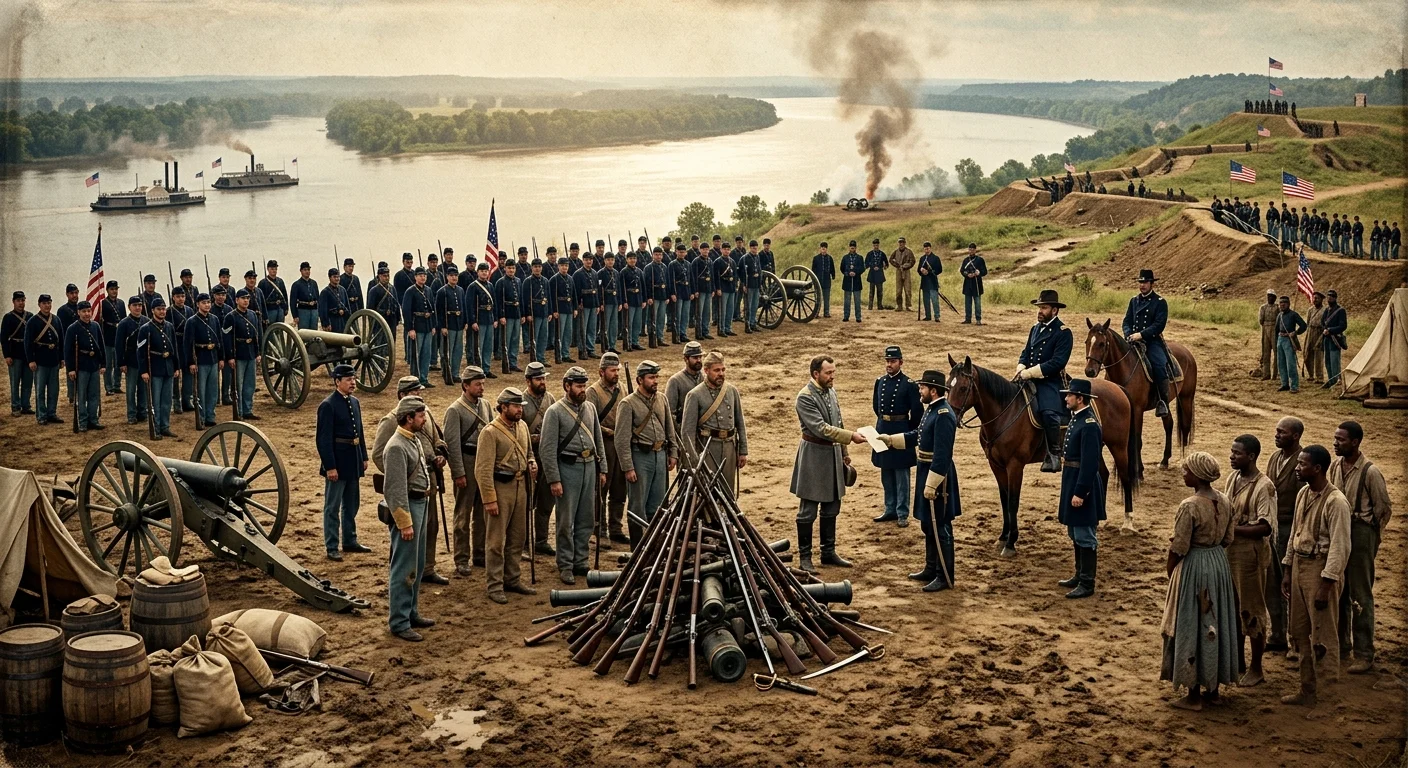
At ten o’clock in the morning on July 4, 1863 — the eighty-seventh anniversary of the Declaration of Independence — approximately 29,000 Confederate soldiers filed out of their fortifications around Vicksburg, Mississippi, stacked their rifles in the mud, furled their battle flags, and formally surrendered to Major General Ulysses S. Grant and the Army of the Tennessee. After forty-seven days of siege, during which the city’s garrison had been pounded daily by artillery from both land and river, its soldiers fed on steadily diminishing rations until they were eating mule meat and shoe leather, and its civilian population had taken to living in caves dug into the yellow clay hillsides to escape the constant bombardment — after all of this, Lieutenant General John C. Pemberton handed over the city, the garrison, 172 cannons, and approximately 50,000 rifles to the Union general who had outmaneuvered, outfought, and outwaited him.
The surrender of Vicksburg on July 4, 1863, was one of the two decisive events of the most decisive week of the American Civil War. The day before, July 3, General Robert E. Lee’s Army of Northern Virginia had made its last great attempt to break through the Union lines at Gettysburg, Pennsylvania, and failed catastrophically at Pickett’s Charge. The simultaneous collapse of Confederate military ambition in both the Eastern and Western theaters in the first days of July 1863 marked the genuine turning point of the war — the moment after which the fundamental trajectory was set, even if two more years of brutal fighting remained before the Confederacy formally accepted defeat. Lincoln had called Vicksburg the key to the war, and Confederate President Jefferson Davis had called it the nailhead that holds the South’s two halves together. When that key fell into Union hands on Independence Day, the Confederacy was split along the Mississippi River, never to be whole again.
Vicksburg’s Strategic Importance: Why the Gibraltar of the South Was Worth the Price of Blood
Vicksburg, Mississippi, occupied one of the most naturally defensible positions in the entire theater of the Civil War. Built on high bluffs rising some two hundred feet above the east bank of the Mississippi River at a bend where the river curved dramatically, the city commanded the waterway from a position that nineteenth-century observers compared to the Rock of Gibraltar — hence its famous sobriquet as the Gibraltar of the South. Confederate artillery batteries on those bluffs could dominate every vessel attempting to pass on the river below, and the terrain around the city was extraordinarily difficult for an attacking army: to the north lay the maze of swamps, bayous, and flooded woodlands of the Yazoo Delta, which rendered conventional overland approach nearly impossible; to the east and south, the high bluffs and ravines of the loess hills of western Mississippi presented obstacles that challenged both movement and supply.
The Mississippi River in 1863 was the most important waterway in North America by almost any measure. It carried the agricultural and commercial produce of the entire interior of the continent to market, served as the primary transportation corridor for both goods and military forces through the heart of the continent, and divided the Confederate states into two geographic blocs: those east of the river, where the main Confederate armies and most of the Confederacy’s population and industrial capacity were concentrated, and those west of the river — Arkansas, Texas, and most of Louisiana — which supplied cattle, foodstuffs, and men that were essential to sustaining the Confederate war effort. As long as the Confederacy held the Mississippi River, these two blocs could reinforce each other and maintain the strategic coherence of the Confederate position. If the Union controlled the river, the Trans-Mississippi Confederacy would be effectively isolated, unable to contribute meaningfully to the defense of Richmond, Atlanta, or any other center of Confederate power.
President Abraham Lincoln had grasped this strategic reality from the earliest days of the war and had articulated it repeatedly and with characteristic conciseness. See what a lot of land these fellows hold, he had said, of which Vicksburg is the key! The war can never be brought to a close until that key is in our pocket. The Union’s overall strategic plan — the Anaconda Plan devised by General-in-Chief Winfield Scott, which called for a naval blockade of Confederate ports combined with control of the Mississippi River to strangle the Confederacy economically and militarily — depended on the capture of Vicksburg as its central continental element. The plan had been partially realized: Union forces had captured New Orleans from the south in April 1862 under Admiral David Farragut, and Memphis from the north in June 1862, leaving Vicksburg as the last major Confederate bastion on the river, the one remaining point from which Confederate artillery could deny Union shipping the freedom of the entire river from St. Louis to the Gulf.
The Commanders: Ulysses S. Grant, John C. Pemberton, and the Officers Who Shaped the Campaign
Ulysses Simpson Grant was born on April 27, 1822, in Point Pleasant, Ohio, the son of a tanner who destined his quiet, somewhat withdrawn boy for a military career through an appointment to West Point. Grant graduated from the Military Academy in 1843, twenty-first in his class of thirty-nine, with no particular distinction but with a natural talent for horsemanship that set him apart from his peers. He served with competence in the Mexican War and was cited for bravery, but his peacetime army career fell apart: he was posted to remote garrisons far from his wife Julia Dent and his young children, turned to drinking to manage the loneliness, and resigned from the army in 1854 under pressure. The years between his resignation and the outbreak of the Civil War were a study in personal failure — failed farming, failed business ventures, a final humiliating stint as a clerk in his younger brothers’ leather goods store in Galena, Illinois, where he was working when the guns opened on Fort Sumter in April 1861.
The Civil War restored Grant. He received a commission as colonel of the 21st Illinois Infantry in June 1861 and quickly demonstrated an administrative competence and a calm, decisive tactical judgment that distinguished him from most of the political generals who had received their ranks through influence rather than ability. His capture of Fort Henry and Fort Donelson in February 1862 — where he demanded unconditional and immediate surrender and was immediately dubbed Unconditional Surrender Grant by a grateful Northern press — established him as the Union’s most effective western commander. His performance at the Battle of Shiloh in April 1862, where he refused to be panicked by a Confederate surprise attack that drove his army nearly into the Tennessee River, and turned the battle the following day into a Union victory, showed the quality that Lincoln most valued: Grant would fight. He took command of operations against Vicksburg in November 1862, and the campaign that unfolded over the following eight months would establish him as the most capable general the Civil War produced.
John Clifford Pemberton was born on August 10, 1814, in Philadelphia, Pennsylvania — a fact that would haunt his command at Vicksburg and define how history remembered him. A Northerner who had chosen to fight for the South, Pemberton had married a Virginia woman, Martha Thompson, who had convinced him to resign his commission in the United States Army in April 1861 and offer his services to the Confederacy. The decision made him a traitor in the eyes of many Unionists, including his own brothers, who served the Union throughout the war. Confederate authorities were also not entirely confident in him: a man who had turned against his native region once might, some feared, turn against his adopted one as well. Pemberton was nonetheless a capable and tenacious defender who had performed adequately in earlier assignments in South Carolina and Georgia, and Confederate President Jefferson Davis — himself a West Point graduate and former Secretary of War who took a close personal interest in the Vicksburg command — appointed him to defend the city in October 1862, reportedly over the recommendation of General Joseph Johnston that a different commander be assigned.
The relationship between Pemberton and Johnston would prove to be one of the most consequential and dysfunctional command relationships of the entire war. Johnston was the commander of the Confederate Department of the West, making him Pemberton’s nominal superior, but he and Pemberton received contradictory orders from President Davis — Davis ordered Pemberton to hold Vicksburg at all costs, while Johnston urged Pemberton to abandon the city and save his army. The two generals never managed to coordinate effectively, and Johnston’s failure to mount a credible relief effort during the siege contributed significantly to Vicksburg’s ultimate fall. Johnston assembled an army of approximately 36,000 men east of Vicksburg during the siege but never delivered the attack that might have forced Grant to divide his forces. His inaction — the result of a combination of inadequate forces, his own strategic caution, and the formidable Union position — condemned Pemberton’s garrison to its fate.
The Anaconda Plan and the Vicksburg Campaign’s Strategic Context: Strangling the Confederacy
General-in-Chief Winfield Scott’s Anaconda Plan had been publicly mocked when it was first proposed in the spring of 1861, dismissed by those who expected a short war as an unnecessarily elaborate strategy for a conflict that the first major battle would decide. Scott, a veteran of the War of 1812 and the Mexican War whose strategic instincts had been sharpened by sixty years of military experience, had seen past the romantic certainty of a quick decisive victory and understood that the South’s geographic extent, its agricultural self-sufficiency, and the genuine military capacity of its population would require a sustained, comprehensive strategy to defeat. The plan called for a naval blockade of all Confederate Atlantic and Gulf ports to strangle the Confederacy’s export economy and cut off imported war materials, combined with Union military control of the Mississippi River to split the Confederacy and prevent the movement of supplies and reinforcements between its eastern and western halves.
By the spring of 1863, the Anaconda Plan’s naval blockade element had been in operation for two years and was progressively tightening, though it remained imperfect. The Mississippi River element had achieved significant progress: the Union controlled the river from its headwaters to Memphis in the north, and from New Orleans to Port Hudson in the south — but the two hundred miles of river between Port Hudson, Louisiana, and Vicksburg remained in Confederate hands, and as long as Vicksburg held, that gap could not be closed. The city had already withstood one Union naval bombardment in June 1862, when Flag Officer David Farragut’s deep-draft ocean-going vessels had run past the Vicksburg batteries without being able to do decisive damage to the fortifications, and had repelled a Union land assault from the north at Chickasaw Bayou in December 1862, when William T. Sherman’s assault force had been cut to pieces in the swampy terrain below the Confederate bluffs. Grant’s appointment to direct operations against Vicksburg in the fall of 1862 brought to the effort the one quality that all previous approaches had lacked: strategic genius combined with the determination to use it.
Grant’s Bold Masterstroke: Running the Batteries, Crossing the River, and Living Off the Land
When Grant assumed command at Vicksburg in the fall of 1862 and surveyed the approaches to the city, he inherited a strategic problem of formidable complexity. Vicksburg sat at the apex of a huge bend in the Mississippi River, with the Delta swamps to its north and the loess hills to its east and south. The city’s batteries commanded the river approaches so completely that a frontal naval assault was essentially suicidal. A land approach from the north required crossing the Yazoo Delta, a maze of swamps and bayous where armies could be swallowed whole and where Confederate defenders had every advantage. Grant spent the winter of 1862-63 attempting five different approaches — bayou operations designed to find a navigable route through the Delta to a point below the city’s guns — and all five failed. Northern newspapers were calling for his removal. Lincoln’s advisers were urging the president to replace him. Grant went on working.
The plan that Grant finally settled on in the spring of 1863 was audacious to the point of recklessness by any conventional strategic standard. He would march his army of approximately 40,000 men down the west bank of the Mississippi through Louisiana, far south of Vicksburg, while Rear Admiral David Dixon Porter’s Mississippi Squadron ran its gunboats and transports past the Vicksburg batteries at night. Grant would then cross the river south of Vicksburg with the navy’s transports, march inland to the northeast, cut the Confederate supply lines to Vicksburg, capture the Mississippi state capital at Jackson, and approach Vicksburg from the east — from the direction that the Confederate defensive works were least prepared to receive. He would do all this while deliberately severing his own supply line and feeding his army off the surrounding countryside, a maneuver so contrary to established military doctrine that his senior subordinate, William T. Sherman, argued strenuously against it. Grant ordered it anyway.
On the night of April 16, 1863, Rear Admiral Porter ordered seven ironclad gunboats, one armed ram, three army transports, and a tug to begin running the Confederate batteries at Vicksburg. The vessels had been modified for the passage: their port sides, which would face the Vicksburg guns as they rounded the bend, were piled high with bales of cotton, hay, and grain to absorb shellfire. Coal barges were lashed alongside as additional protection. As the fleet rounded the De Soto Point bend and the Confederate batteries opened fire, the river was illuminated by the muzzle flashes of Confederate guns and by fire that the Confederates had deliberately set on the Louisiana shore to backlight the Union vessels. Every Union vessel was hit multiple times. Not one was sunk. Porter brought his fleet through successfully, and on April 30, Grant’s army crossed the Mississippi at Bruinsburg, thirty miles south of Vicksburg, meeting virtually no opposition because Pemberton had been deceived by an elaborate series of diversionary raids and demonstrations into believing the main Union effort was coming from a different direction.
What followed over the next seventeen days was one of the most remarkable military campaigns in American history. Grant cut himself loose from his supply line and moved northeast through Mississippi, feeding his troops from the farms and plantations of the surrounding countryside, fighting and winning five separate battles in quick succession. Port Gibson fell on May 2. Raymond fell on May 12. Jackson — the Mississippi state capital and the main Confederate supply and communication hub — fell on May 14, as Grant’s forces scattered General Joseph Johnston’s smaller force and burned the factories and rail facilities that sustained the Vicksburg garrison. By capturing Jackson, Grant severed Pemberton’s supply line and his communications with the Confederate heartland. In three weeks, his men had marched 180 miles, won five battles, and captured 6,000 prisoners. It was the most successful overland campaign any American general had conducted since Winfield Scott’s march from Vera Cruz to Mexico City in 1847.
Champion Hill and Big Black River Bridge: The Last Battles Before the Siege
Pemberton, responding to Johnston’s orders to abandon Vicksburg and link up with the Confederate forces at Jackson, marched his army out of the city on May 15 to attempt the junction — a movement that Grant had anticipated and that brought about exactly the kind of decisive battle in the open field that Grant had been maneuvering to achieve. The two armies collided at Champion Hill, approximately twenty miles east of Vicksburg, on May 16, 1863. The Battle of Champion Hill was the largest and most important engagement of the entire Vicksburg campaign — a hard-fought contest on rolling terrain broken by ravines and timber that lasted for most of the day and ended with Pemberton’s army in disorderly retreat.
The Confederate position at Champion Hill had been strong, and Pemberton’s 22,000 men had initially held their ground against Grant’s 29,000. But Grant’s subordinates — most particularly Major General James B. McPherson, commanding the XVII Corps — pressed the Union attacks with the coordinated aggressiveness that Grant demanded, and eventually broke through the Confederate center. General William W. Loring’s Confederate division, cut off from the rest of the army by the Union breakthrough, failed to reach the retreating Confederate main body and was effectively lost from Pemberton’s command for the rest of the campaign, eventually making its way to Johnston’s forces through the swamps south of the battlefield. Pemberton’s remaining forces retreated westward toward Vicksburg in disorder, making a brief stand along the Big Black River on May 17 before being driven again and fleeing across the river, burning the bridges behind them as they went. By May 18, Grant had arrived in the rear of Vicksburg, and Pemberton’s battered army was sealed inside the city’s defenses with no realistic hope of escape or relief.
The Siege Begins: Grant’s Trenches, the Forty-Seven Days, and the City’s Slow Strangulation
Grant made two direct assaults on the Vicksburg fortifications on May 19 and May 22, hoping that the demoralization of Pemberton’s army from its recent defeats might make a quick capture possible and spare the lengthy process of siege warfare. Both assaults failed with significant casualties. The Confederate fortifications, built on the crests of the loess hills surrounding the city, were formidably strong: earthworks ten to twenty feet high, fronted by ditches eight to ten feet deep, studded with artillery positions, and connected by a system of trenches and covered ways that allowed the defenders to move and reinforce threatened points without exposure to Union fire. The May 22 assault was particularly costly — Grant’s forces suffered approximately 3,200 casualties in a day of fighting that achieved only one temporary break in the Confederate line. He had no choice but to invest the city in a systematic siege.
Grant’s siege works were a marvel of military engineering. Beginning in late May, his army of approximately 70,000 men constructed fifteen miles of approach trenches, parallels, and covered roads that progressively pushed the Union lines closer to the Confederate fortifications. The siege lines completely encircled the city on its landward side, while Admiral Porter’s gunboats and mortar boats controlled the river, denying any possibility of resupply or reinforcement by water. The Union also constructed extensive fortifications facing east, toward the positions where Johnston’s relieving army was assembling — creating in effect a siege within a siege, with Pemberton trapped inside and Johnston unable to break through from without. Inside the shrinking perimeter, conditions for Pemberton’s soldiers deteriorated with relentless daily progression.
The ammunition situation was manageable for most of the siege — the Confederates had stockpiled substantial quantities before the investment was complete — but food was an entirely different matter. The Confederate Army had consumed or requisitioned most of the city’s civilian food supplies early in the siege, and by June the garrison was on severely reduced rations. Fresh meat disappeared first, replaced by salt pork and then by mule meat as the army’s draft animals were slaughtered. By late June, soldiers were eating rats, squirrels, frogs, and whatever they could find. Shoe leather became a protein source for some. Scurvy and dysentery swept through the ranks, and by the end of June approximately half of Pemberton’s remaining soldiers were sick or hospitalized. The capable fighting force that had held its ground at Champion Hill had been reduced to a starving, disease-ridden garrison whose continued resistance was a matter of sheer will rather than military capability.
Prairie Dog Village: How Vicksburg’s Civilians Endured the Siege in Caves
The forty-seven days of siege were not endured by soldiers alone. Vicksburg’s civilian population — several thousand men, women, and children who had not fled before the investment was complete — experienced the siege as an ordeal of bombardment, hunger, and fear that has few equivalents in the history of American city life. From May through July, Union artillery on the surrounding hills and Union gunboats and mortar boats on the Mississippi subjected the city to a daily and nightly rain of shells that made it dangerous to move about the streets or remain in ordinary structures. The shelling was not constant — there were periods of relative quiet — but it was frequent enough and unpredictable enough to require a more secure form of shelter than the frame and brick buildings of antebellum Vicksburg could provide.
The residents’ solution was underground. Over the course of the siege, more than 500 caves were excavated into the yellow clay hillsides that ridged the city between the civilian residential areas and the Confederate defensive lines. These bombproofs — as they were called locally — ranged from simple single-room burrows barely large enough for one family to elaborate multi-room underground homes that could shelter larger groups. Many Vicksburg families made their caves as comfortable as possible, carrying in furniture, rugs, pictures, and books from their houses above — doing their best to maintain a semblance of domestic normality in circumstances that made normalcy impossible. The city’s population of cave-dwellers became so extensive that Union soldiers, observing it from their positions on the surrounding hills, began calling Vicksburg the Prairie Dog Village. The name stuck.
Food for civilians was as scarce as food for soldiers, and perhaps more psychologically difficult to manage. The city’s civilian food supply had been effectively nationalized by Confederate military authorities early in the siege, and by June civilians were subsisting on the same severely reduced rations as the soldiers, supplemented by whatever they could procure through their own ingenuity. Sweet potatoes and other vegetables were brewed as substitutes for coffee. Frogs, mules, and other unconventional meat sources appeared in civilian kitchens. Paper became so scarce that the Vicksburg Daily Citizen — one of the city’s newspapers, which continued to publish throughout the siege in an act of journalistic determination — resorted to printing on wallpaper, producing editions on decorative paper that became among the most prized souvenirs of the campaign. The edition printed on July 2, 1863, exhorted Vicksburg’s citizens to hold on and expressed confidence in Johnston’s relieving army. When Union soldiers entered the city on July 4, they found the type still set for another wallpaper edition. They completed and printed it themselves, as a souvenir.
The Underground War: Mine Explosions and the Psychological Toll of Siege
Beyond the grinding daily misery of hunger, disease, and bombardment, the defenders of Vicksburg faced an additional technological threat in late June: Union mine warfare. Grant’s engineers had identified the Third Louisiana Redan, a Confederate fortification in the center of the defensive line, as a suitable target for an underground mining operation. Union troops dug a tunnel approximately forty feet long beneath no-man’s-land and packed the end chamber with 2,200 pounds of black powder. On June 25, 1863, the powder was detonated, blowing a crater some twelve feet deep and thirty feet across in the Confederate line and killing or burying dozens of Confederate soldiers in the debris. Union infantry immediately charged through the gap, but the Confederates had anticipated the explosion and had prepared a second defensive line behind the forward position. The Union assault was repulsed after fierce fighting in and around the crater, but the explosion demonstrated that the Confederate position could be breached from underground, adding to the psychological pressure on the defenders.
A second mine was detonated on July 1 at the same location, again blowing a large crater in the Confederate line. This time Grant chose not to follow the explosion with an immediate infantry assault, preferring to wait until he could coordinate multiple simultaneous mine explosions along the defensive line — a plan that, if executed, might have broken the Confederate position decisively. But events made the plan unnecessary. By the first days of July, Pemberton’s assessment of his position had become unambiguous: with half his men sick, his rations exhausted, Johnston making no credible move to relieve the city, and his soldiers speaking openly of surrender, there was nothing left to do but ask for terms.
The Surrender Negotiations: Grant and Pemberton Between the Lines on July 3, 1863
On the morning of July 3, 1863 — the same day that Pickett’s Charge was being repulsed at Gettysburg, though neither Grant nor Pemberton yet knew this — white flags appeared on a portion of the Confederate works at Vicksburg. Hostilities along that section of the line ceased immediately. Shortly afterward, two Confederate officers were seen approaching the Union lines carrying a white flag: Brigadier General John Bowen, a division commander in Pemberton’s army, and Colonel L. M. Montgomery, an aide-de-camp. Bowen carried a letter from Pemberton: I have the honor to propose an armistice for hours, with the view to arranging terms for the capitulation of Vicksburg.
Grant’s initial response was characteristic of the man who had been dubbed Unconditional Surrender Grant eighteen months earlier at Fort Donelson. He sent back a written reply declining the proposal for commissioners to negotiate terms and stating bluntly: The effusion of blood you propose stopping by this course, can be ended at any time you may choose, by an unconditional surrender of the city and garrison. Men who have shown so much endurance and courage as those now in Vicksburg will always challenge the respect of an adversary, and I can assure you will be treated with all the respect due them as prisoners of war. I do not favor the proposition of appointing commissioners to arrange terms of capitulation, because I have no other terms than those indicated above. The tone was uncompromising but not contemptuous — Grant acknowledged the fighting quality of the men he was asking to surrender while making clear that no favorable terms were on offer.
Bowen, who was an old neighbor of Grant’s from Missouri before the war, then requested a personal meeting between the two commanding generals between the lines. Grant agreed to meet Pemberton at three o’clock that afternoon, accompanied by Generals Edward O. C. Ord, James B. McPherson, John A. Logan, and A. J. Smith. Pemberton arrived late, escorted by Bowen and Lieutenant Colonel Louis Montgomery. The conference lasted approximately ninety minutes and did not immediately produce agreement. Pemberton asked for terms that would allow his garrison to march out with the honors of war, carrying their small arms and field artillery — terms that Grant later wrote he rejected promptly and unceremoniously. The conference ended without agreement, with Grant promising to send his written final terms by ten o’clock that night.
Grant returned to his headquarters and convened a council of his corps and division commanders, polling them on whether to offer parole rather than demanding that Pemberton’s force be transported north as prisoners. The practical arguments for parole were compelling: shipping approximately 30,000 prisoners north to Cairo, Illinois, and then by rail to Eastern prison camps would have occupied his army for months and consumed enormous logistical resources. Moreover, Grant calculated — correctly, as it turned out, though the calculation would prove more optimistic than the reality — that paroled men who had been through the ordeal of the Vicksburg siege would carry the stigma of defeat home with them and would not be effective soldiers again. The council voted in favor of parole. Grant sent his revised terms that night: the garrison would be paroled rather than transported as prisoners, allowed to march out with the honors of war rather than as unconditional captives. Pemberton accepted.
July 4, 1863: The Flag Falls at Vicksburg as Grant Takes the Nailhead of the Confederacy
At ten o’clock in the morning of July 4, 1863, the Confederate soldiers of Pemberton’s Army of Mississippi filed out of their fortifications for the last time. They stacked their rifles in prescribed formation, furled their battle flags — the flags under which they had fought from Shiloh through Champion Hill, through the assaults of May 19 and 22, through forty-seven days of siege — and became paroled prisoners of war. Union troops behaved with notable restraint and generosity: rather than exulting over their defeated enemies, many Union soldiers broke open their own rations and gave food to the starving Confederate prisoners, a gesture of soldierly humanity that was widely noted in accounts of the day. Speculators who had been hoarding food inside the Confederate lines for higher prices found their stores broken open and the contents thrown on the streets for the starving residents and soldiers. The Union division that had been designated to occupy the city moved in immediately, raising the Stars and Stripes over the courthouse.
The formal surrender occurred at ten in the morning, but the symbolic transfer of the city extended through the day as Union troops occupied the fortifications and the town itself. Pemberton turned over to Grant not only the nearly 30,000 surviving soldiers of his garrison but also the enormous material resources that the Confederate defense had consumed without being able to use effectively in the final weeks of the siege: 172 pieces of artillery and approximately 50,000 small arms, the accumulated armament of one of the Confederacy’s major armies, now in Union hands. Most of the paroled Confederate prisoners were formally exchanged and returned to Confederate service on August 4, 1863, at Mobile Harbor, Alabama — a development that made Grant’s optimism about the demoralization of paroled soldiers look overstated — and by September, former Vicksburg defenders were back at Chattanooga, Tennessee, and some fought against Sherman’s invasion of Georgia in 1864. The army that Pemberton had surrendered was not as definitively destroyed as Grant had hoped.
What was definitively destroyed was the Confederate strategic position on the Mississippi River and the coherence of the Confederate war effort west of that river. Lincoln’s reaction to the news of Vicksburg’s fall was one of profound and unconcealed joy. The president is reported to have said upon hearing the news: The Father of Waters again goes unvexed to the sea — a phrase that crystallized in a single image the entire strategic significance of the campaign. One week after the fall of Vicksburg, an unarmed civilian vessel traveled the entire length of the Mississippi from St. Louis to New Orleans without incident — the first time such a journey had been possible since the war began. The Trans-Mississippi Department of the Confederacy — Texas, Arkansas, and most of Louisiana — was now effectively cut off from the Eastern Confederacy, unable to send its beef, grain, horses, and men across the heavily patrolled river. The nailhead that Davis had said held the South together had been pulled.
Port Hudson and the Complete Control of the Mississippi: Five Days Later
The strategic completion of the Vicksburg victory came five days after Pemberton’s surrender, when the Confederate garrison at Port Hudson, Louisiana, the last remaining Confederate stronghold on the Mississippi River, surrendered to Union Major General Nathaniel P. Banks on July 9, 1863. Port Hudson had been under siege since May 27, 1863, at approximately the same time that Grant was completing the investment of Vicksburg. The Port Hudson garrison, approximately 6,800 men under Major General Franklin Gardner, had held out through two costly Union assaults and the same grinding siege conditions that had worn down the Vicksburg defenders — but with Vicksburg gone and the strategic rationale for further resistance dissolved, Gardner accepted the inevitable and surrendered.
With Port Hudson in Union hands, the Union controlled the entire length of the Mississippi River from its headwaters in Minnesota to its mouth at the Gulf of Mexico for the first time since the outbreak of the war. The Anaconda Plan’s most critical continental element had been completed. The strategic isolation of the Trans-Mississippi Confederacy was total. Grant deployed Sherman and 50,000 troops against Johnston’s remaining forces at Jackson, Mississippi, completing the destruction of Confederate military infrastructure in central Mississippi. Johnston evacuated Jackson again before Sherman could destroy his army, but all of central Mississippi was now effectively under Union control. The campaign that had begun with Grant’s assignment to the Vicksburg theater in November 1862 had in eight months achieved results more decisive than any previous operation of the war.
The Dual Turning Points: Vicksburg and Gettysburg in the Same Week
The coincidence of the Confederate defeats at Vicksburg and Gettysburg in the first four days of July 1863 has been endlessly analyzed by Civil War historians, who have debated which battle was more important, whether either alone would have been decisive, and what the conjunction of the two defeats meant for the Confederacy’s strategic position. The answers to these questions vary depending on the historian’s framework, but on the fundamental significance of the first week of July 1863 as the turning point of the war there is near-universal agreement. Gettysburg ended Lee’s invasion of the North and began the long defensive retreat of the Army of Northern Virginia that would end at Appomattox in April 1865. Vicksburg split the Confederacy, eliminated a major Confederate army, and gave the Union complete control of the river that was the continent’s artery.
From a purely military standpoint, many historians have argued that Vicksburg was actually the more significant of the two July 1863 Confederate defeats. Gettysburg was Lee’s last northern invasion, but the Army of Northern Virginia remained intact and capable of defending Virginia for nearly two more years; the Eastern Theater’s war continued to cost the Union enormous casualties through the Wilderness, Spotsylvania, Cold Harbor, and Petersburg. The surrender of Pemberton’s entire army at Vicksburg, by contrast, represented the destruction of a complete Confederate force — approximately 30,000 men and their equipment — in a way that significantly degraded the Confederacy’s capacity to maintain its war effort. Combined with the fall of Port Hudson and the Union control of the Mississippi, Vicksburg’s military consequences were immediate and permanent in a way that Gettysburg’s were not.
General Grant himself, whose career trajectory the Vicksburg campaign dramatically accelerated, was promoted to major general in the regular United States Army following the campaign and given command in eastern Tennessee, then in March 1864 appointed Lieutenant General and general-in-chief of all Union armies — the position from which he directed the final campaigns of 1864-65 that ended the war. The Vicksburg campaign had demonstrated every quality that Lincoln required in a commanding general: strategic boldness, tactical flexibility, personal courage, the ability to maintain momentum under political pressure, and above all the willingness to engage the enemy and keep fighting through adversity. Grant found the war, as he later wrote with characteristic understatement, a daring one to make in the heart of the enemy’s country with a large river behind us and the enemy holding points strongly fortified above and below. The fact that he made it anyway, and won, was what elevated him from the most successful of the Union’s Western commanders to the general who won the Civil War.
John Pemberton After Vicksburg: Resignation, Disgrace, and the Bitter Legacy of a Traitor to Both Sides
For John Pemberton, the surrender at Vicksburg was the effective end of his military career and the beginning of a peculiar form of dual disgrace that followed him for the rest of his life. In the South, he was blamed for the loss of Vicksburg and widely regarded — not entirely fairly — as a man who had not tried hard enough to save the city that the Confederacy had considered irreplaceable. The fact that he was a Pennsylvania-born Northerner who had adopted the Confederate cause fed persistent whispers that he had not been fully committed, that perhaps he had deliberately surrendered to his fellow Northerner Grant. These suspicions were almost certainly unfounded: Pemberton had defended Vicksburg with genuine determination for forty-seven days against superior forces, had refused to abandon the city when Johnston urged him to save the army, and had held out until the physical condition of his men made further resistance genuinely impossible. But the loss of Vicksburg was so catastrophic in Confederate eyes that someone had to bear the blame, and Pemberton was the obvious target.
Shortly after the surrender, Pemberton resigned his commission as lieutenant general and accepted a demotion to the rank of colonel, serving out the remainder of the war as an ordnance inspector — a role that was important to the Confederate supply effort but that placed him entirely out of the limelight that his rank had previously occupied. He was essentially shunned by Confederate society for the rest of the war, his presence in Richmond a reminder of the loss that the Confederacy could not forget. After Appomattox, Pemberton retired to a farm near Warrenton, Virginia, and then in 1876 returned to Philadelphia — the city of his birth, from which he had departed fifteen years earlier to fight against the country that had produced him. He died on July 13, 1881, in Penllyn, Pennsylvania, having never received the vindication he deserved from either the North, which remembered him as a traitor, or the South, which remembered him as a failure.
Vicksburg’s Long Refusal: Why the City Didn’t Celebrate the Fourth of July for 81 Years
The wound that the Fourth of July surrender inflicted on Vicksburg’s civic identity was deep and lasting. The city that had endured forty-seven days of bombardment, starvation, and underground living, that had watched its garrison march out and surrender their arms to the army that had besieged them, that had passed from Confederate control to Union control on the anniversary of American independence — that city found it impossible to celebrate Independence Day in the years that followed. The Fourth of July was the day of Vicksburg’s defeat, its humiliation, its surrender. To celebrate it as the birth of American liberty felt, to the city’s residents, like celebrating their own subjugation. They refused.
For eighty-one years, Vicksburg did not celebrate the Fourth of July as a community. Individual residents might have marked the date privately, and large Fourth of July celebrations were reportedly held by some community groups as early as 1907, but the city as a whole maintained a collective silence about the anniversary that was as much an act of civic memory as of resentment. It was not until 1944 — during World War II, when Mississippi soldiers were once again fighting under the American flag in a war that had generated a different kind of patriotic solidarity — that Vicksburg finally held a public Fourth of July celebration, eighty-one years after Pemberton had stacked his guns and furled his flags before Grant’s victorious army. The long refusal to celebrate, and its eventual ending, both speak to the depth of the wound and the slow, incomplete healing that followed.
The Lincoln Response and the Anaconda Completed: The Father of Waters Goes Unvexed to the Sea
President Abraham Lincoln’s response to the fall of Vicksburg was among the most eloquent and emotionally honest he ever expressed in public about the progress of the war. He had been anxiously awaiting news of the Vicksburg campaign for months, had expressed confidence in Grant when political pressure was demanding the general’s removal, and had called Vicksburg the key to the war so many times that his confidence in this judgment was now publicly on record. When the news arrived confirming the surrender, Lincoln wrote on July 7, 1863, to General-in-Chief Henry Halleck: We have certain information that Vicksburg surrendered to General Grant on the 4th of July. Now, if Gen. Meade can complete his work so gloriously prosecuted thus far, by the literal or substantial destruction of Lee’s army, the rebellion will be over.
Lincoln’s announcement to the public used the phrase that became the most-quoted summary of the campaign’s significance: The Father of Waters again goes unvexed to the sea. The language was biblical in cadence and poetic in conception, capturing in a single image both the practical strategic result — the Mississippi River was now open to Union commerce from St. Louis to the Gulf — and the larger meaning that the Union placed on the achievement. The Mississippi was not merely a waterway. It was the central artery of the American continent, the river that drained the interior of North America and connected the farms of the Midwest to the markets of the world. Its freedom from Confederate obstruction meant the freedom of the American economic system to function as it was designed to function, without the political division of the Confederacy interrupting the natural flow of commerce and community. Vicksburg’s fall, in Lincoln’s formulation, restored something that was not merely militarily important but naturally and properly American.
Conclusion: The Key in the Pocket and the River That Went Unvexed
The surrender of Confederate forces at Vicksburg on July 4, 1863, was one of the decisive events of the American Civil War and one of the decisive moments in the history of the United States. In a single day, one of the Confederacy’s most important strategic positions passed from Confederate to Union control, approximately 29,000 Confederate soldiers became paroled prisoners of war, 172 cannons and 50,000 rifles changed hands, and the Mississippi River — from the lakes of Minnesota to the Gulf of Mexico — became a Union waterway for the remainder of the conflict. The Confederacy was split along its greatest natural boundary, the Trans-Mississippi states effectively isolated from the Eastern Confederacy, the Anaconda Plan’s central continental element fulfilled.
The campaign that produced this result was one of the great military achievements in American history — a campaign in which Ulysses Grant had outthought, outmaneuvered, and outlasted an enemy that held a naturally formidable defensive position, that had been ordered by its commander-in-chief to hold at all costs, and that had fought with genuine courage and tenacity for seven months from the first tentative Union approaches in 1862 through the forty-seven days of siege in 1863. Grant had demonstrated every quality that military genius requires: the strategic imagination to conceive the plan, the physical and moral courage to execute it against professional advice, the tactical flexibility to adapt as circumstances changed, and the simple human determination to keep going when everything was going wrong. The campaign made him the most important general in the Union Army, and the career that began with his capture of Vicksburg would end two years later at Appomattox.
The town of Vicksburg refused to celebrate the Fourth of July for eighty-one years after the day its garrison laid down its arms. That refusal was, in its way, a testament to the magnitude of what had happened — an acknowledgment that July 4, 1863, was not merely a military defeat but an event of such transforming consequence that the city’s relationship to the national holiday could never again be simple or uncomplicated. Lincoln had put the key in his pocket. The Father of Waters was going unvexed to the sea. And the war, though it would last two more years, had turned.