
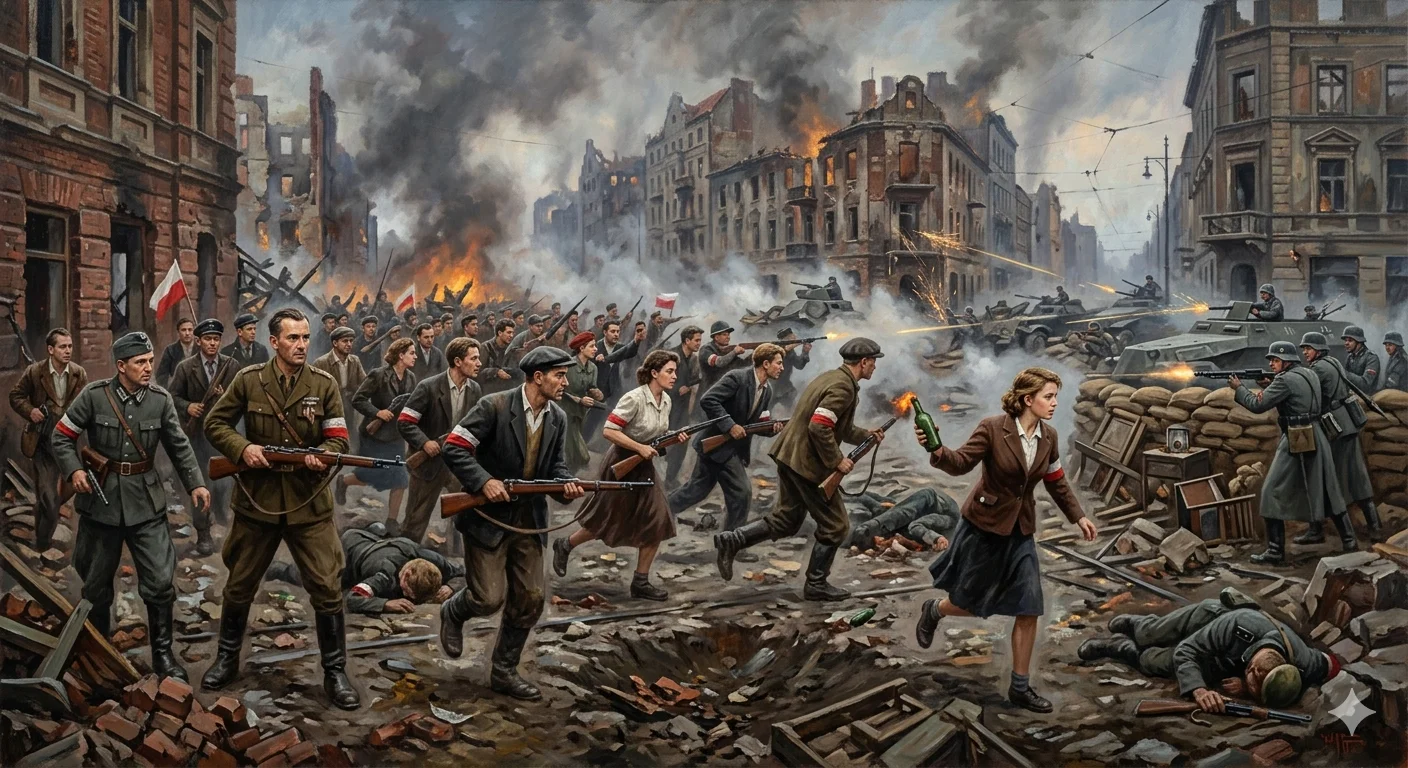
At 5:00 in the afternoon on August 1, 1944, shots rang out across the streets of Warsaw. At precisely that hour, the hour that Poles would come to call “W Hour,” the Polish Home Army launched its uprising against the German occupiers who had held the city in a brutal grip for nearly five years. Approximately 45,000 fighters of the Armia Krajowa, the Polish underground resistance, rose simultaneously across the city’s districts, joined by thousands of civilians who poured out of doorways carrying flags and weapons that had been hidden since September 1939. For the first time in years, the banned Polish national flag flew openly from Warsaw’s buildings.
The Warsaw Uprising, fought over sixty-three days until its defeat on October 2, 1944, was the single largest military operation undertaken by any resistance movement during the entire Second World War. It was an act of extraordinary courage and an act of devastating political miscalculation. The Poles who launched it hoped to liberate their capital in a matter of days. Instead they fought until the city was reduced to rubble, and they did so largely alone, betrayed by geography, politics, and the deliberate inaction of an ally who wanted them to lose.
Poland Under German Occupation: Five Years of Brutality Before the Uprising
To understand what drove 45,000 poorly armed Poles into the streets on August 1, 1944, it is necessary to understand what Nazi Germany had done to Warsaw in the preceding five years.
Germany invaded Poland on September 1, 1939, and Warsaw fell on September 28 after a siege that killed thousands of civilians and destroyed large portions of the city. The Soviet Union, acting under the terms of the Molotov-Ribbentrop Pact, simultaneously invaded from the east on September 17, and Poland was divided between the two totalitarian powers. The Polish government immediately reconstituted itself in exile, first in France and later in London, where it remained throughout the war as the internationally recognized legitimate government of Poland.
Under German occupation, Warsaw became a city of systematic terror. The Nazis killed Polish intellectuals, professors, clergy, and military officers in mass executions. They imposed forced labor, mass deportations, and collective punishments for resistance. The Jewish community of Warsaw, which had been among the largest in the world, was herded into the Warsaw Ghetto in 1940, where approximately 400,000 people were confined in conditions of deliberate starvation. Between July and September 1942, approximately 300,000 Jews from the Warsaw Ghetto were deported to the Treblinka extermination camp and murdered. The Ghetto Uprising of April and May 1943, in which the surviving Jewish fighters of the Ghetto rose against the Germans with virtually no weapons and held out for almost a month, preceded the Warsaw Uprising by more than a year and burned in Polish memory as both an inspiration and a warning.
The Polish underground had been organizing since the first days of the occupation. The Home Army, known by its Polish initials as the AK for Armia Krajowa, was the armed wing of the Polish underground state and was loyal to the Polish government-in-exile in London. At its peak in mid-1944, the AK encompassed more than 300,000 soldiers organized throughout German-occupied Poland. It conducted sabotage operations, gathered and transmitted intelligence that was crucial to the Allied cause, provided critical information on German V-1 and V-2 rocket development, and organized a sophisticated civil administration operating in parallel to the Nazi occupation authorities.
The Decision to Revolt: Operation Tempest and the Strategic Calculation
The Warsaw Uprising was not a spontaneous outburst. It was a carefully considered, if ultimately disastrously miscalculated, military and political operation that grew out of a broader strategic plan.
General Tadeusz Komorowski, the commander of the Home Army, known by his underground name as “Bor” or Bor-Komorowski, had developed Operation Tempest as a plan for the entire AK to rise against the retreating Germans as Soviet forces approached from the east. The concept was to demonstrate Polish military capability, secure Polish territory before Soviet arrival, and establish the authority of the Polish government-in-exile and its armed forces as the legitimate liberating power before the Red Army could present its own political facts on the ground.
The political urgency was acute. The Soviet Union had broken diplomatic relations with the Polish government-in-exile in April 1943, after the London Poles called for an independent investigation into the Katyn massacre, in which Soviet security forces had murdered approximately 22,000 Polish military officers, intellectuals, and professionals in the spring of 1940. Stalin had established his own rival Polish political committee, the Polish Committee of National Liberation, also known by its Polish acronym PKWN, which was a Soviet-backed organization intended to provide political cover for a communist takeover of Poland after the war.
Earlier operations under Operation Tempest in cities like Vilnius and Lwow had produced a deeply ominous pattern. When AK units revealed themselves to cooperate with the advancing Soviet forces, the Soviets accepted their military help in expelling the Germans and then immediately arrested the officers and forcibly conscripted the ordinary soldiers into Soviet-controlled Polish units. The AK had cooperated in good faith and been rewarded with imprisonment and conscription.
In Warsaw, the calculation was different from the calculations in other cities. The AK leadership decided that Warsaw had to be liberated before the Soviets arrived, not in partnership with them. Only by presenting the Soviets with a fait accompli of a self-liberated, Polish-controlled capital city could the London government hope to survive as a political force. The uprising was thus simultaneously a military operation against the German occupiers and a political gambit against the Soviet liberators.
The Soviet Advance and the Timing of W Hour
The immediate trigger for the uprising’s timing was the dramatic advance of Soviet forces in the summer of 1944. Operation Bagration, the massive Soviet offensive launched on June 23, 1944, had annihilated Germany’s Army Group Centre in what was arguably the greatest military disaster in German history. By late July, Soviet forces under Marshal Konstantin Rokossovsky were approaching Warsaw from the east, and on July 29 and 30, Soviet armored columns reached the Vistula River along the eastern suburb of Praga, just across the river from the main city.
On July 29, Moscow Radio broadcast an appeal in Polish calling on the people of Warsaw to rise against the German occupiers. The broadcast was unambiguous: “Warsaw trembles at the cannon’s thunder. The Soviet forces are pushing forward and approaching Praga. They are coming to bring you liberation. Fight the Germans!” For the AK leadership, this Soviet broadcast appeared to be a direct invitation and a promise of imminent support.
On July 31, 1944, General Komorowski announced that W Hour, the moment of the uprising’s launch, would be 5:00 p.m. on August 1. The decision was made with the knowledge that only a fraction of AK fighters had adequate weapons, that ammunition supplies in the Warsaw district were sufficient for approximately three days, and that the uprising was expected to succeed within a week through rapid military action before the Germans could reinforce and before the window of maximum German weakness closed.
The assumption was that Soviet forces would cross the Vistula quickly, that Germany’s clearly demoralized Warsaw garrison would collapse under a combined internal and external assault, and that Warsaw would be Polish and free within days. Every part of this assumption proved wrong.
The Wikipedia article on the Warsaw Uprising provides a comprehensive account of the military operations, political context, and ultimate destruction of Warsaw, including the Soviet role in allowing the uprising to be crushed.
August 1, 1944: The First Hours of the Uprising
When W Hour arrived, the streets of Warsaw filled simultaneously with AK fighters moving to their assigned positions. Civilians who had not been told about the uprising for security reasons came out of their buildings and joined the fighters spontaneously. Rubin Katz, who was living in Warsaw at the time, recalled the atmosphere: “We went into another room and produced a hitherto banned Polish national flag, which had been hidden since the war began, and unfurled it from the balcony railing.” After nearly five years of occupation, the sheer release of open defiance was intoxicating.
General Antoni Chrusiel, known as “Monter,” commanded the Warsaw AK corps of approximately 45,000 fighters. They were supplemented by approximately 2,500 soldiers from other resistance movements, including fighters from the National Armed Forces and from the communist People’s Army. Only about one in four of the fighters had any weapon at all. Many carried pistols, improvised grenades, and incendiary bottles. The AK faced a German garrison of approximately 25,000 soldiers equipped with artillery, tanks, and air support.
In the ruins of the former Jewish Ghetto, a unit of Polish volunteers using a captured German tank broke through the walls of the Gesiowka camp, a concentration camp that had been established in the Ghetto ruins. They freed approximately 400 Jewish prisoners. Among those liberated, former prisoners formed into a volunteer company and joined the fighting. It was, as the Polish officer who led the attack later recalled, one of the extraordinary moments of the uprising.
The initial gains were dramatic. Within three days, the AK had seized control of most of Warsaw’s districts and raised Polish flags over buildings throughout the city. The city centre, much of the Old Town, and large residential districts fell to the insurgents. But the Germans held the key transportation nodes: the main railway stations, the major road junctions, and the bridges over the Vistula. These would prove impossible to take and would ultimately doom the uprising by preventing the Poles from fully controlling the city’s arteries.
Heinrich Himmler, the German Response, and the Massacres
When news of the Warsaw Uprising reached Berlin, Adolf Hitler’s reaction was immediate and furious. He ordered that the uprising be crushed without mercy and that Warsaw itself be destroyed. Reichsführer SS Heinrich Himmler addressed senior SS officers about the uprising on September 21, 1944, articulating what the German response would be with deliberate savagery. He ordered that the city be razed to the ground regardless of the outcome.
The suppression of the uprising was assigned to SS General Erich von dem Bach-Zelewski, a specialist in anti-partisan operations. The German forces assembled to crush the revolt included two particularly brutal units: the Kaminski Brigade of Russian collaborators and the Dirlewanger Brigade, a penal unit composed of convicted criminals, which became notorious for its atrocities against civilians. In the district of Wola in the first days of August, German and collaborationist forces massacred between 40,000 and 50,000 Polish civilians in what became known as the Wola Massacre, one of the largest single mass killings of the entire war. Men, women, and children were shot in the streets, in courtyards, and in hospitals.
The uprising that had been expected to last a week stretched into nine weeks of urban combat of extraordinary intensity and brutality. The AK fighters dug in and refused to surrender, sustained by civilian cooperation that was total and selfless in the early weeks. Civilians built barricades, supplied food and water, carried messages, tended the wounded, and in some cases fought alongside the soldiers. Women constituted approximately one in seven combatants, serving not only as nurses and couriers but in combat roles. The women’s elite Dysk battalion was among the AK’s most effective fighting units.
When street-level communications were severed by German pressure, the AK used Warsaw’s sewer system to move fighters and supplies between districts under the city’s streets, in conditions of utter darkness and suffocation.
The Soviet Halt and the Allied Response
The most agonizing dimension of the Warsaw Uprising was the deliberate inaction of the Soviet Union. Historians agree that Joseph Stalin halted the Soviet advance on the Vistula in order to allow the Germans to crush the Home Army, which represented the military power of the anti-communist Polish government-in-exile. A victory for the AK in Warsaw would have strengthened the London government’s claim to lead post-war Poland. Stalin preferred that the AK be destroyed.
The Red Army under Rokossovsky halted outside Warsaw and remained in position across the Vistula while the uprising bled out over sixty-three days. Soviet aircraft occasionally flew over Warsaw but provided no effective support. When Britain and the United States sought Soviet permission to use Soviet air bases to mount supply drops to the besieged Poles, Stalin initially refused. American and British aircraft flew long-range missions from Italy and Britain, some managing to drop supplies over Warsaw, but the quantities were inadequate and many drops fell into German-held territory.
The United States Holocaust Memorial Museum article on the Warsaw Uprising documents the full course of the sixty-three-day battle, the role of the AK, and the political abandonment of Warsaw by its would-be Soviet allies.
The Fall of Warsaw: Surrender and Destruction
By late September 1944, the uprising’s position was hopeless. The AK had lost control of most of the city. Food, water, medical supplies, and ammunition were exhausted. The civilian population was dying. On October 2, 1944, General Komorowski surrendered to German forces. He and approximately 15,000 surviving Home Army fighters were granted prisoner of war status, which the Germans formally respected.
The civilian population was not so protected. Approximately 550,000 civilians were deported through the transit camp established at Pruszkow, where SS security forces segregated them and decided their fates. Tens of thousands were sent to concentration camps and forced labor facilities across the Reich. Others were dispersed to labor camps and villages throughout German-occupied Poland.
And then the Germans did something without precedent even in the history of the Second World War: they systematically destroyed the empty city. Following Himmler’s orders, specially equipped SS and Wehrmacht demolition units moved through Warsaw street by street, block by block, building by building, using flamethrowers, explosives, and incendiaries to destroy everything. Museums, libraries, churches, palaces, theatres, apartments, and offices were systematically burned or blown up. Between 80 and 90 percent of Warsaw’s buildings were destroyed in this deliberate and calculated act of cultural annihilation. The priceless collections of the Krasinski Library, the Zamoyski Library, and the Central Military Library were incinerated. Warsaw was reduced to ruins.
The Britannica article on the Warsaw Uprising covers the military course of the uprising, the massacres of civilians, and the political consequences that allowed the Soviet-backed communist government to take control of Poland.
In total, the Warsaw Uprising of 1944 cost approximately 200,000 Polish lives, of which the overwhelming majority were civilians. Around 16,000 AK fighters died in combat and approximately 6,000 were seriously wounded. The Germans suffered approximately 10,000 killed, 9,000 wounded, and 7,000 missing.
The Red Army remained on the east bank of the Vistula throughout the autumn and winter. It entered a ruined, nearly deserted Warsaw on January 17, 1945. With the Home Army destroyed and the Polish government-in-exile politically marginalized, Stalin’s Soviet-backed communist administration faced virtually no organized opposition in establishing its control over Poland.
The Warsaw Uprising of 1944 was a failure in every immediate military and political sense. The city was destroyed. The fighters were killed or imprisoned. The government for which they fought was excluded from power. But for the Poles who survived the decades of communist rule that followed, the sixty-three days of the uprising remained a sacred memory, a testament to Polish dignity and resistance that no occupation and no propaganda could erase. That moral legacy found its fullest expression in the Solidarity movement of the 1980s, which drew directly on the uprising’s memory to fuel the peaceful revolution that eventually brought down the communist system.