
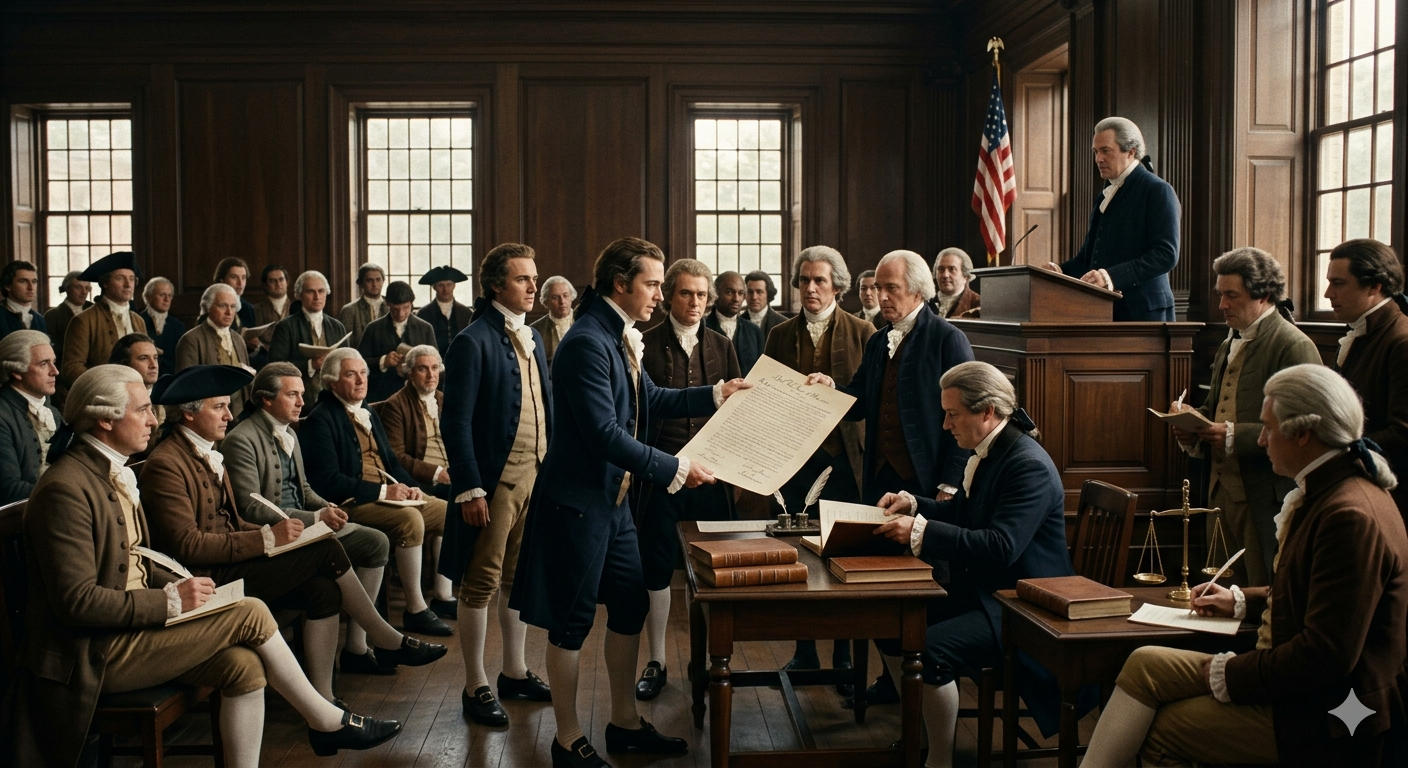
On September 2, 1789, the First Congress of the United States passed an act creating the Department of the Treasury, the third executive department of the new federal government. President George Washington signed the legislation into law the same day. The act was brief and precise, establishing the structure of the new department in straightforward terms: there shall be a Secretary of the Treasury, to be deemed head of the department; a Comptroller, an Auditor, a Treasurer, a Register, and an Assistant to the Secretary. Nine days later, on September 11, 1789, the Senate confirmed Washington’s appointment of Alexander Hamilton as the first Secretary of the Treasury. Hamilton took the oath of office that day and immediately set to work on the most consequential financial challenge in the young nation’s history.
The creation of the Treasury Department was not merely an act of bureaucratic organization. It was the culmination of more than a decade of financial improvisation, catastrophic monetary failure, and hard-won constitutional transformation. The question of how the United States would manage its money had been at the center of American political life since the first shots of the Revolutionary War, and the answer that Congress finally provided on September 2, 1789, would shape the economic character of the nation for centuries.
The Financial Crisis of the Revolution: Continental Currency and the Origins of the Treasury
The history of the Treasury Department begins not in 1789 but in the summer of 1775, when the Continental Congress convened in Philadelphia to deal with the most pressing practical question facing the revolution: how to pay for a war.
The Continental Congress had no power to levy or collect taxes under the Articles of Association that preceded the Constitution. It could not compel the individual colonies to contribute funds in any legally enforceable way. It had no standing in the credit markets of Europe. Faced with the immediate need to pay soldiers, purchase weapons, and supply an army, Congress resolved to issue paper money in the form of bills of credit, promissory notes backed by nothing more tangible than faith in the revolutionary cause.
On June 22, 1775, only days after the Battle of Bunker Hill, Congress issued two million dollars in bills of credit. On July 29, 1775, it assigned responsibility for the administration of the revolutionary government’s finances to joint Continental treasurers George Clymer and Michael Hillegas, a Philadelphia merchant who became the first person formally designated as Treasurer of the United States on May 14, 1777. On February 17, 1776, Congress designated a committee of five to superintend the treasury, settle accounts, and report periodically to Congress. On April 1, 1776, a Treasury Office of Accounts was established, consisting of an auditor general and clerks, to facilitate the settlement of claims and keep the public accounts.
The paper currency issued to fund the war proved disastrously unstable. The $241.5 million in Continental bills printed during the war devalued with catastrophic speed. By May 1781, the dollar had collapsed to a rate of between 500 and 1000 to one against hard currency. Protests against the worthless money swept the colonies, giving rise to the expression “not worth a Continental” that would remain in the American vernacular for generations. The lesson was painful and clear: a nation that could not manage its currency could not survive as a republic.
Robert Morris and the Superintendent of Finance
Congress recognized by 1781 that the informal and fragmented management of revolutionary finances needed to be consolidated. It created the position of Superintendent of Finance and appointed Robert Morris of Pennsylvania, a wealthy Philadelphia merchant who had been a delegate to the Continental Congress and a signer of the Declaration of Independence. Morris was among the most skilled financiers in America and had earned the nickname “the financier” for his remarkable ability to procure funds or goods on a moment’s notice, often from his own personal credit. His staff included a comptroller, a treasurer, a register, and auditors. Morris served as Superintendent of Finance from 1781 until 1784, when he resigned because of ill health. A treasury board of three commissioners continued to oversee the finances of the confederation until September 1789.
The Articles of Confederation, ratified in 1781, had given Congress slightly more formal authority over financial matters, but still no power to tax directly. The result was continued financial weakness, an inability to service the war debt, and a credibility gap with foreign investors that made borrowing expensive and unreliable. It was this continuing financial crisis, as much as any other single factor, that drove the movement to replace the Articles of Confederation with a stronger constitutional framework.
The Constitutional Solution: From Articles of Confederation to the First Congress
The Constitutional Convention of 1787 produced a fundamental restructuring of American government that directly addressed the financial failures of the revolutionary era. The new Constitution gave Congress the power to levy and collect taxes, to borrow money on the credit of the United States, to regulate commerce, and to coin money and regulate its value. These powers, absent under the Articles, created the legal foundation for a genuine national financial system.
The First Congress of the United States convened in New York City on March 4, 1789, the first session of government under the new Constitution. Among its most urgent tasks was the creation of the executive departments that would carry out the new government’s functions. The Department of State was established on July 27, 1789. The Department of War followed on August 7. The Department of the Treasury came third, on September 2, 1789.
Before Congress formally established the Treasury, a preliminary debate had taken place about how the department should be structured. There was a question of whether the Treasury should be controlled by a board of commissioners, as the old treasury board had been, or by a single secretary appointed by the president. Congress determined that a single secretary was more appropriate, giving the president direct accountability over financial management. Even before the act was formally passed, Washington had offered the position to Robert Morris, whose reputation as the financier of the Revolution made him the obvious choice. Morris declined, citing the difficulty of the position, but recommended Alexander Hamilton. Washington hesitated initially because of Hamilton’s polarizing personality and the intense opinions he generated, but ultimately appointed him on the basis of his unquestioned financial expertise.
Alexander Hamilton: The First Secretary and the Architecture of American Finance
Alexander Hamilton was thirty-four years old when he took the oath of office as the first Secretary of the Treasury on September 11, 1789. Born in Charlestown, Nevis, in the West Indies, he had come to America as a young man for his education, served with distinction as George Washington’s aide-de-camp during the Revolutionary War, studied law in New York, and emerged as one of the most brilliant minds of the founding generation. He had been elected to the Continental Congress from New York in 1782. He was the primary author of the majority of the Federalist Papers, the collected essays arguing for ratification of the Constitution that he co-wrote with James Madison and John Jay. He was a man of immense energy, intellectual rigor, and political vision.
Hamilton took office with the Treasury Department beginning as the largest department in the federal government, with thirty-nine full-time employees. His first official act as Secretary was to respond to a congressional request that he prepare a plan for the support of public credit. The House of Representatives had directed him on September 21, 1789, just ten days after he took office, to prepare such a report. He delivered it on January 14, 1790.
The First Report on the Public Credit was a forty-thousand-word masterpiece of fiscal analysis and political argument. Hamilton estimated the total debt of the United States at approximately $77 million: approximately $54 million in federal debt, including $11.7 million owed to foreign governments and investors and $42.1 million owed to domestic creditors, plus an additional $25 million in state debts incurred during the Revolutionary War. He argued that the young republic’s future depended entirely on its willingness to honor these obligations in full. The debt, he wrote, was “the price of liberty,” and the faith of America had been pledged for its repayment. He called for full federal payment at face value to all holders of government securities, and he proposed that the federal government assume responsibility for all state debts, removing them from the books of individual states and placing them on the national ledger.
The US Treasury Department’s own history of its founding provides the official account of the Department’s creation, its revolutionary period origins, and Hamilton’s role in establishing the nation’s early financial infrastructure.
The Great Debate: Hamilton vs. Jefferson and Madison
Hamilton’s plan immediately generated fierce controversy. The debate over assumption of state debts split the new republic along lines that would eventually produce America’s first two-party political system.
James Madison, who had been Hamilton’s co-author on the Federalist Papers and was now the leading voice in the House of Representatives, led the opposition to assumption. Many southern states, particularly Virginia and the Carolinas, had already paid down much of their revolutionary war debt and objected to a plan that would require them to contribute tax revenues toward paying the debts of northern states that had been less diligent. Madison also raised constitutional objections about the scope of federal power. Secretary of State Thomas Jefferson, who had just returned from France, shared Madison’s concerns about the political implications of Hamilton’s economic nationalism, though he recognized the practical necessity of establishing American creditworthiness in European financial markets.
The political deadlock in Congress was broken by the famous Compromise of 1790, negotiated at a dinner hosted by Thomas Jefferson in New York. Hamilton agreed to support the permanent location of the new national capital on the Potomac River, satisfying the southern states’ desire to have the capital closer to their region. In exchange, Jefferson and Madison withdrew their opposition to Hamilton’s assumption plan, allowing the Funding Act to pass in August 1790. The deal shaped American geography as much as American finance: the city that would be built on the Potomac became Washington, District of Columbia.
Hamilton’s Three Reports and the Foundation of American Financial Institutions
Having secured the passage of his funding plan, Hamilton pressed forward with the remaining elements of his financial vision. In December 1790, he submitted his Second Report on Public Credit, also known as the Report on a National Bank. This report called for the establishment of a central bank modeled on the Bank of England, a privately held institution endowed with public funds that would serve to expand the flow of legal tender, process revenue fees, and perform fiscal duties for the federal government. The proposed Bank of the United States would have a mixture of government and private ownership, with the federal government appointing five of the twenty-five directors and holding one quarter of the stock.
Washington was uncertain about the bank’s constitutionality and solicited opinions from his cabinet. Jefferson and Attorney General Edmund Randolph argued that the Constitution granted only enumerated powers and that chartering a bank was not among them. Hamilton’s rebuttal, submitted to Washington on February 23, 1791, introduced what became one of the most consequential doctrines in American constitutional history: the doctrine of implied powers. Hamilton argued that every power vested in a government includes by its nature the right to employ all means reasonably applicable to the attainment of that power’s ends, and that the Necessary and Proper Clause of the Constitution authorized the bank as a legitimate instrument of the government’s financial powers. Washington accepted Hamilton’s argument and signed the bank bill into law. The First Bank of the United States opened in Philadelphia and served as the forerunner of the Federal Reserve System.
Hamilton submitted his third major report, the Report on Manufactures, on December 5, 1791. It proposed protective tariffs and other measures to encourage the development of American industry, arguing that manufacturing was essential to national prosperity and independence. Although Congress did not immediately adopt the report’s recommendations, it established the intellectual framework for American industrial policy that would shape economic development throughout the nineteenth century.
The Wikipedia article on the United States Department of the Treasury covers the full history of the department from its revolutionary origins through Hamilton’s tenure and the subsequent evolution of its functions, institutions, and reach into virtually every aspect of American economic life.
Hamilton’s Legacy and the Treasury’s Enduring Role
By 1792, as the historian John Chester Miller observed, the results of Hamilton’s program were unmistakable. The heavy war debt had been put on a course toward ultimate extinction. The price of government securities had stabilized close to their face value. Hoarded wealth had been brought out of hiding and put to productive use. Foreign capital had begun flowing into the United States. The credit of the federal government had been solidly established with European investors. A financial system had been created from nothing in the space of three years.
Hamilton resigned as Secretary of the Treasury in January 1795, returning to his law practice in New York. He remained an influential figure in American politics until his death in a duel with Vice President Aaron Burr in Weehawken, New Jersey, on July 11, 1804. He died the following day at the age of forty-nine. Hamilton’s portrait appears on the obverse of the ten-dollar bill, and the Treasury Building in Washington, D.C., is depicted on the reverse.
The Treasury Building itself has its own history of construction, destruction, and reconstruction. After the government moved to Washington in 1800, the Treasury Department occupied a porticoed Georgian-style building designed by English architect George Hadfield. The British burned this building in 1814 during the War of 1812. It was rebuilt by James Hoban, the architect who also rebuilt the White House after the British burned it in the same campaign. The current Treasury Building, one of the oldest federal buildings in Washington and the largest stone structure in the city at the time of its construction, was built beginning in 1836 and completed in stages through the 1860s.
The History.com account of the founding of the US Treasury covers the establishment of the Treasury Department on September 2, 1789, the appointment of Hamilton, and the early financial policies that transformed the debt-ridden former colonies into a creditworthy republic.
The Department of the Treasury today comprises twelve bureaus and components with over 100,000 employees. Its responsibilities include the production of currency and coin, the collection of taxes through the Internal Revenue Service, the administration of customs duties through US Customs and Border Protection, and the management of the federal government’s financial accounts, public debt, and the financing of the federal government. Many of the agencies that originated within Treasury have grown into independent departments or major federal agencies: portions of the Departments of Agriculture, Commerce, Homeland Security, the Interior, and Justice, as well as the General Services Administration and the Office of Management and Budget, all trace their institutional lineage to Treasury organizations. The department that Hamilton built from thirty-nine employees in 1789 became one of the central pillars of the American state.