
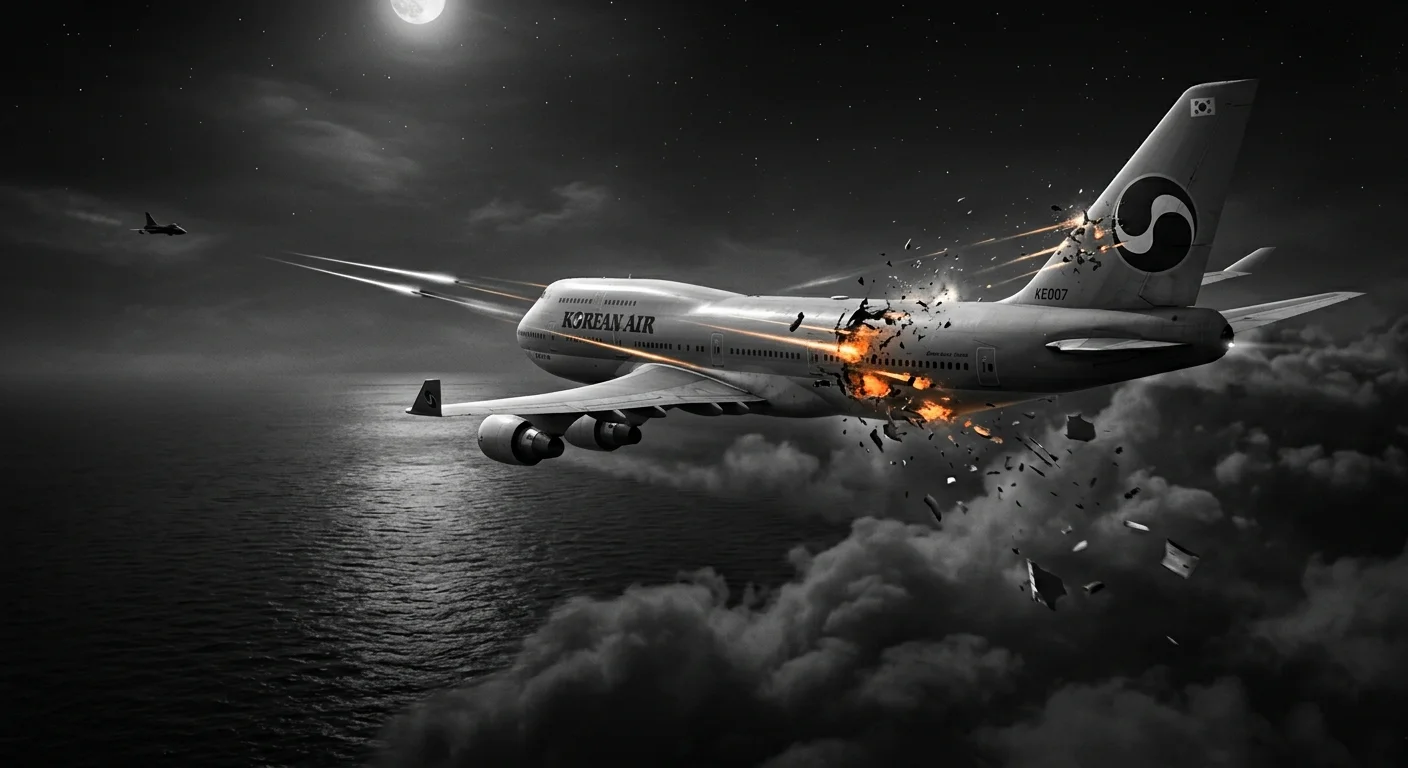
In the freezing darkness high above the Soviet Far East, at approximately 3:26 in the morning local time on September 1, 1983, a Soviet Air Forces pilot named Major Gennadiy Nikolayevich Osipovich pressed a weapons release switch aboard his Sukhoi Su-15 interceptor aircraft and transmitted a curt message to his ground controller: The target is destroyed. Two air-to-air missiles — one radar-guided, one heat-seeking — had been fired at the aircraft he had been tracking for more than two hours. The target Osipovich had just destroyed was not the American spy plane he and his commanders believed it to be. It was Korean Air Lines Flight 007, a Boeing 747 carrying 246 passengers and 23 crew members on a scheduled commercial flight from New York to Seoul. All 269 people aboard were killed when the stricken airliner spiraled down through twelve minutes of controlled and then uncontrolled descent and struck the surface of the Sea of Japan west of Sakhalin Island.
The shootdown of KAL Flight 007 remains one of the most consequential and morally troubling events of the late Cold War — a catastrophe produced by the intersection of human navigational error, institutional military paranoia, the hair-trigger tensions of superpower confrontation, and a fundamental failure by the Soviet military establishment to distinguish between a civilian airliner full of sleeping passengers and an enemy intelligence aircraft. The incident killed members of fourteen nationalities, including 62 Americans and a sitting United States congressman. It plunged already-strained US-Soviet relations to their lowest point in years. It became a central exhibit in the Reagan administration’s argument that the Soviet Union was an evil empire that had demonstrated its contempt for human life. And it produced one lasting positive consequence: President Ronald Reagan’s decision, announced two weeks after the shootdown, to make the United States military’s Global Positioning System freely available to civilian users worldwide — a decision that eventually transformed navigation, commerce, and daily life for billions of people.
The World in 1983: Cold War Tensions at Their Most Dangerous Peak
To understand why Korean Air Lines Flight 007 was shot down, it is essential to understand the atmosphere of mutual fear, suspicion, and military alertness that characterized the relationship between the United States and the Soviet Union in 1983. The years of relative détente that had characterized US-Soviet relations in the 1970s — when arms control negotiations, diplomatic engagement, and the assumption of shared interest in avoiding nuclear war had produced a working relationship despite fundamental ideological conflict — had given way by the early 1980s to a new and in some respects more dangerous phase of Cold War confrontation. President Ronald Reagan had entered office in January 1981 committed to a fundamentally different approach to the Soviet Union, and his administration had pursued that approach with an energy and rhetoric that genuinely alarmed Soviet leadership.
In March 1983 — just six months before KAL 007 was shot down — Reagan had publicly described the Soviet Union as the evil empire, a formulation that Soviet leaders took as evidence that the new American president was not merely using anti-Soviet rhetoric for domestic political purposes but genuinely believed it and was prepared to act on it. Three weeks after the evil empire speech, Reagan announced the Strategic Defense Initiative — the proposal for a space-based missile defense system that the press quickly dubbed Star Wars — which the Soviets interpreted as a potential first-strike enabler: a system that, if it worked, would allow the United States to launch a nuclear attack on the Soviet Union and then intercept the Soviet retaliatory response. In Soviet strategic logic, a first-strike-capable American military was an existential threat that required immediate countermeasures.
The Soviet response included a secret intelligence program called Operation RYAN — the Russian acronym for Raketno-Yadernoye Napadenie, or Nuclear Missile Attack — which was designed to detect indicators of an imminent American first strike. RYAN represented the institutionalization of Soviet paranoia at the highest levels of the intelligence establishment: it directed Soviet assets worldwide to look for signs that the Americans were preparing a surprise nuclear attack, interpreting any unusual activity in military systems, communications, or civilian preparations through this lens of nuclear threat. The program was running in full force in the summer of 1983, and its effect was to prime Soviet military commanders to interpret ambiguous events as potential components of an American strategic move rather than as innocent coincidences or accidents.
The tensions were not merely rhetorical. American military aircraft had been conducting increasingly provocative reconnaissance missions near Soviet territory throughout 1983. Aircraft from the aircraft carriers USS Midway and USS Enterprise had repeatedly overflown Soviet military installations in the Kuril Islands during the FleetEx ’83 naval exercise between March 29 and April 17, 1983 — direct violations of Soviet airspace that had resulted in the dismissal or formal reprimand of Soviet military commanders who had failed to intercept or shoot down the intruding American aircraft. These incidents had created a powerful institutional incentive for Soviet air defense commanders in the Far East: the next time an unidentified aircraft entered Soviet airspace, the price of failure to act would be professional ruin. The atmosphere in Soviet Far Eastern Air Defense Command in the summer of 1983 was one of heightened alertness, recent humiliation, and profound determination not to be caught unprepared again.
The Passengers and Crew of Flight 007: Who Died Over the Sea of Japan
Korean Air Lines Flight 007 departed Gate 15 of John F. Kennedy International Airport in New York City at 12:25 in the early morning of August 31, 1983, thirty-five minutes behind its scheduled departure time of 23:50 on August 30. The flight carried 246 passengers and 23 crew members — 269 people in total — representing the nationalities and lives that routine international air travel brings together in the ordinary course of a modern world. The passengers included 105 Koreans, 62 Americans, 28 Japanese, and individuals from twelve other countries. Among them were 22 children under the age of twelve. The flight was, by the routines of commercial aviation, entirely unremarkable: a scheduled service on one of the busiest air routes in the Pacific, staffed by experienced professionals, carrying the ordinary cross-section of business travelers, tourists, students, families, and diplomats that a New York-Seoul flight would have carried on any given day in 1983.
The most prominent American aboard was Representative Lawrence Patton McDonald of Georgia, a conservative Democrat who served as the second district congressman and who was also the national chairman of the John Birch Society, one of the most aggressively anti-communist organizations in American political life. McDonald was traveling to Seoul with a congressional delegation to participate in ceremonies marking the thirtieth anniversary of the United States-South Korea Mutual Defense Treaty, signed in 1953 in the aftermath of the Korean War. The tragic irony that the most prominent victim of a Soviet military action was simultaneously the most vehemently anti-Soviet member of the United States Congress was not lost on the politicians and media figures who would eventually use the shootdown as a political weapon. McDonald was forty-eight years old at the time of his death.
The flight crew for the Anchorage-to-Seoul leg of the journey — the fatal leg — consisted of Captain Chun Byung-in, aged forty-five, First Officer Son Dong-hui, aged forty-seven, and Flight Engineer Kim Eui-dong, aged thirty-one. Captain Chun was a highly experienced pilot with a total of 10,627 flight hours, including 6,618 hours specifically on the Boeing 747 — one of the highest experience levels possible on that aircraft type. First Officer Son had accumulated 8,917 total flight hours, including 3,411 on the 747. Flight Engineer Kim had 4,012 total hours, including 2,614 on the 747. By every standard measure of aviation experience and qualification, these were not rookies or marginal performers. They were seasoned professionals who had demonstrated their competence repeatedly over careers spanning decades. That the combination of their experience, training, and attention would nonetheless fail to detect a navigational error that placed their aircraft hundreds of miles off course for five and a half hours was the central mystery and the central tragedy of the incident.
The Navigational Error: How a Boeing 747 Strayed 200 Miles Off Course for Five Hours
The navigation system of a Boeing 747-200 in 1983 was among the most sophisticated available for commercial aviation, relying on a technology called the Inertial Navigation System, or INS. Unlike earlier radio-beacon navigation systems that depended on external transmitters, INS was entirely self-contained: it used gyroscopes and accelerometers to track the aircraft’s position continuously by measuring every change in its velocity and direction from a known starting point. The system required no external signals and could function in complete radio silence over the ocean, far from any ground-based navigation aids. A properly programmed and engaged INS would guide the autopilot of a 747 along a precise series of waypoints — geographic coordinates specified in advance by the flight planners — regardless of any external factors. The technology was reliable, sophisticated, and already in widespread use. It was also capable of being misconfigured in ways that were not immediately obvious to a crew that trusted the autopilot to be doing what they believed they had told it to do.
The ICAO investigation that eventually reconstructed the accident in detail concluded that the most likely explanation for the deviation of KAL 007 was that the autopilot had been left in HEADING mode — a simpler mode that maintained a constant magnetic compass heading — rather than being properly engaged in INS mode, which would have navigated the aircraft along the programmed series of waypoints. In HEADING mode, the autopilot simply held the aircraft on whatever compass bearing had been selected; it did not follow waypoints and could not correct for the natural drift of the Earth’s magnetic field, the curvature of the Earth, or any other factor that would cause a constant compass heading to trace a curved arc across the globe rather than a straight line between two points. There had been more than a dozen documented incidents of similar confusion between HEADING mode and INS mode on other flights, none of which had resulted in catastrophe, but all of which demonstrated that the failure mode was neither unique nor unforeseeable.
Approximately ten minutes after taking off from Anchorage, Flight 007 began to deviate to the right — northward of its assigned route toward Bethel, Alaska, the first waypoint on the North Pacific route designated R20. This deviation, slight at first, grew steadily over the following five and a half hours as the aircraft maintained a constant magnetic heading rather than following the programmed great-circle course. By the time the aircraft reached the vicinity of the Kamchatka Peninsula, it had drifted approximately 200 miles north of its assigned track, placing it not in the international waters between Alaska and Japan but in the militarized coastal airspace of the Soviet Union’s most heavily defended Pacific territory. The crew never detected the error. The INS waypoints were presumably displaying reasonable position estimates that were not being cross-checked against other available navigation sources. The autopilot was flying the aircraft on the course its heading mode specified. Captain Chun, First Officer Son, and Flight Engineer Kim had no indication — from their instruments, from air traffic control, or from their own visual observation — that anything was wrong.
The RC-135 Confusion: How an American Spy Plane’s Proximity Sealed the Airliner’s Fate
While KAL 007 was making its inadvertent passage toward Soviet airspace, a completely separate drama was unfolding in the same general area of sky. A United States Air Force Boeing RC-135 Cobra Ball aircraft — a highly specialized intelligence-gathering platform derived from the commercial 707 airframe and loaded with sophisticated electronic collection equipment — was conducting a legal and routine reconnaissance mission in international airspace near the Kamchatka Peninsula. The RC-135’s mission on the night of August 31 was to monitor a Soviet ballistic missile test scheduled to take place at the Kura Missile Test Range on Kamchatka: the aircraft would fly in wide circles in international airspace, its sensors sweeping the peninsula for the electronic signatures of the test launch, tracking the missile’s trajectory with radar, and collecting whatever intelligence the Soviet test might inadvertently reveal about the capabilities of their ballistic missile program.
The RC-135 and KAL 007 were never in the same area simultaneously, but their flight paths in the hours before the shootdown overlapped in the memory and plotting systems of Soviet radar operators who were tracking both. At some point in the sequence of events, Soviet controllers lost track of one aircraft and, when they detected another, assumed they were tracking the same plane. The ICAO investigation later concluded that the Soviet air defense command’s confusion of KAL 007 with the RC-135 — the assumption that the large unidentified aircraft approaching Soviet airspace from the east was the same reconnaissance plane they had been watching for hours — was a central factor in the decision to engage the aircraft. The presence of the American spy plane resulted in confusion and the assumption by Soviet air defense that the aircraft proceeding towards the USSR was an RC-135 reconnaissance aircraft, in the ICAO’s measured formulation. The critical coincidence — a civilian airliner off course and an intelligence aircraft on a legal reconnaissance mission, both operating in the same general region of sky at the same time — gave Soviet commanders a plausible but fatally wrong framework for interpreting what they were seeing on their radar screens.
Soviet air defense commanders along the Kamchatka coast had been monitoring the large unidentified radar return for some time before KAL 007 actually crossed into Soviet airspace. General Valeri Kamenski, the Air Force Commander of the Far Eastern Military District, had personal and professional reasons for not wanting to repeat the recent embarrassment of American aircraft overflying Soviet installations without response. When the unknown aircraft’s track began curving toward Kamchatka, Kamenski ordered intercept aircraft scrambled to investigate. Four MiG-23 fighters were sent up as KAL 007 first approached, but they failed to reach the aircraft before it cleared Kamchatka and flew back into international airspace over the Bering Sea — a near-miss that heightened the alert status for the next phase of the aircraft’s passage, which would take it over the Kuril Islands and Sakhalin.
The Final Hours: Soviet Fighters Track the 747 Over Sakhalin
As KAL 007 continued on its off-course track toward Sakhalin Island, the Soviet air defense network handed off the track from one command to another, with growing alarm about the behavior of the unidentified aircraft. By the time the Boeing 747 was approaching Sakhalin, the alert level in Soviet Far Eastern Air Defense Command was extreme. General Anatoly Kornukov, who commanded Sokol Air Base on Sakhalin, had declared that the aircraft should be destroyed if it crossed the state border — a categorical order issued before the target had been definitively identified as anything other than an unidentified radar return. The pressure of the institutional context — the recent FleetEx humiliations, the RYAN-primed suspicion of American provocations, the personal career stakes of commanders who had been disciplined for inaction — was driving the decision-making toward engagement rather than caution.
Major Gennadiy Osipovich was scrambled in his Sukhoi Su-15 to intercept the aircraft over Sakhalin. He located the target and closed on it from behind, approaching the enormous silhouette of the 747 at altitude in the darkness. His own account of what happened next has been central to the historical debate about the incident. Osipovich later acknowledged that the aircraft he was pursuing had its navigation lights on — blinking steadily in the way that distinguishes a commercial airliner from a military aircraft operating without lights in hostile territory. He also acknowledged that the aircraft looked different from an RC-135: larger, with a distinctive profile that was recognizable as a civil transport. He fired cannon shells as warning shots — a required step under Soviet intercept procedures before lethal force could be authorized — but these shots were fired at an angle and from a distance and speed that made them impossible to see from the cockpit of the 747 ahead, which had no indication that anything unusual was happening.
In the cockpit of KAL 007, Captain Chun had just received permission from Tokyo Air Traffic Control to climb from 33,000 to 35,000 feet, a routine altitude request based on fuel consumption and efficiency. As the 747 slowed slightly to initiate the climb, the aircraft’s airspeed briefly decreased. To Osipovich and to the Soviet ground controllers monitoring his radio transmissions, this deceleration appeared to be a deliberate evasive maneuver — the kind of action that a military reconnaissance aircraft, alerted to the pursuit behind it, might take to stay in international airspace and deny Soviet fighters the opportunity to engage. The passengers in KAL 007’s cabin were unaware of any of this. The in-flight movie had concluded. People were sleeping under blankets, or reading, or eating. Captain Chun’s calm, professional voice had announced shortly before the missile impact that the aircraft would be landing at Seoul Gimpo International Airport in approximately three hours.
At 3:26 local time on September 1, 1983, Osipovich fired two missiles at the aircraft ahead of him. The first, a radar-guided R-60 missile, detonated approximately fifty meters behind the 747, its proximity fuze sending shrapnel forward into the aircraft’s tail section. The detonation severed or damaged the crossover cable of the left inboard elevator, punctured the fuselage and caused rapid decompression of the pressurized cabin, and damaged one of the aircraft’s four hydraulic systems. The damage from the first missile caused the 747 to climb unexpectedly from 35,000 feet to approximately 38,250 feet as a result of the damaged elevator control — a phenomenon that was interpreted by Soviet ground controllers as further evasive maneuvering. The second missile hit shortly after. Co-pilot Son reported to Captain Chun, twice, Engines normal, sir — a measure of how controlled and unaware the crew remained in the first seconds after the strike. Captain Chun’s last transmission to Tokyo Air Traffic Control was recorded forty-eight seconds after the missiles detonated.
The Final Descent: Twelve Minutes Before the Sea
KAL 007 did not fall from the sky immediately after the missile strikes. This fact — that the aircraft remained airborne for somewhere between ninety seconds and twelve minutes after the detonation, depending on the source consulted — became one of the most agonizing details of the incident and one of the most politically charged, because it raised questions about what the passengers aboard experienced during that time. The ICAO investigation, working from the cockpit voice recorder and flight data recorder that were eventually recovered and made available (after years of Soviet concealment), concluded that the aircraft remained in a controlled descent for approximately twelve minutes after the strike, spiraling downward in a steep descending turn before the loss of hydraulic pressure made control impossible and the aircraft entered an uncontrolled final plunge into the sea.
The aircraft crashed into the Sea of Japan approximately forty-eight kilometers southwest of Sakhalin Island, near Moneron Island. The impact with the water at high speed was not survivable, and no passengers or crew survived. Search and rescue operations began within hours of the crash, initially involving both Soviet and Japanese vessels and aircraft, though the Soviet operations were primarily focused on recovering the aircraft’s flight recorders and classified materials before international investigators could obtain them. The debris field scattered across the shallow sea floor included fragments of the aircraft’s structure, personal belongings, and human remains. Some human remains and personal effects were recovered from the surface in the days following the crash, but no bodies were recovered intact. The 269 victims of KAL 007 have no graves.
The Soviet Cover-Up: Denial, Deception, and the Black Boxes Hidden for Decades
The Soviet government’s handling of the KAL 007 shootdown in the hours, days, and weeks after the event was a case study in Cold War information management that ultimately damaged Soviet credibility more severely than a straightforward acknowledgment of the error would have done. The initial Soviet public response was to deny knowledge of the incident entirely — to say, in effect, that an unidentified aircraft had been tracked, had entered Soviet airspace, and had flown away; nothing more. The Soviet news anchor Igor Kirillov later revealed that he had initially been handed a TASS report that contained an open and honest admission that the aircraft had been shot down by mistake, but that this report had been snatched from his hands at the last moment before broadcast and replaced with one that was completely opposite to the first one and to the truth.
The cover-up was systematic and multi-layered. Soviet naval vessels located the wreckage of the aircraft within approximately two weeks of the crash. Civilian Soviet divers who participated in the recovery operations later confirmed that they had viewed the aircraft wreckage on the sea floor by approximately September 15, two weeks after the shootdown. The flight recorders — the cockpit voice recorder and the flight data recorder, whose contents would be essential to any objective investigation — were recovered and transported to Moscow for analysis, where they remained concealed from the ICAO and international investigators for nearly a decade. A classified memo from KGB head Viktor Chebrikov and Defense Minister Dmitry Ustinov to Soviet leader Yuri Andropov in November 1983, released by Boris Yeltsin in 1993, confirmed that the black boxes had been recovered and analyzed in Moscow — directly contradicting the Soviet government’s public position that no wreckage had been found.
When the Soviet denial became unsustainable in the face of the intercepted pilot communications that the United States had released publicly — recordings that proved beyond any doubt that Soviet pilots had tracked, pursued, and destroyed the aircraft — the Soviet government shifted its position to acknowledgment combined with justification. Official Soviet spokesmen claimed that KAL 007 had been on a deliberate intelligence-gathering mission for the United States Central Intelligence Agency, using the cover of a commercial flight to conduct electronic surveillance of Soviet military installations in Kamchatka and Sakhalin. A classified memo to the Politburo from the Soviet military and the KGB asserted that the flight was a major, dual-purpose political provocation carefully organized by the US special services — simultaneously gathering intelligence and setting up the Soviet military to shoot down a civilian aircraft that could then be used for international propaganda. This explanation, believed or at least publicly maintained by the Soviet leadership, was not supported by any evidence and was directly contradicted by the cockpit voice recorder, which revealed the flight crew to be relaxed, professional, and completely unaware of their off-course position until after the missile struck.
The American Response: Reagan’s ‘Massacre’ Speech and the Political Exploitation of Tragedy
President Ronald Reagan was at his ranch in California when the shootdown occurred. The news reached the White House through the intelligence community — the United States had been listening to Soviet air defense communications from a monitoring station at Wakkanai Air Station in Hokkaido, Japan’s northernmost island, and had recordings of the entire Soviet intercept operation, including Osipovich’s communications with his ground controllers and his announcement that the target was destroyed. These recordings were, as of September 1, 1983, highly classified: the existence of the US capability to intercept Soviet military communications in real time was one of the most sensitive secrets in the American intelligence arsenal, and revealing it meant permanently alerting the Soviets to plug the capability gap.
Reagan made the decision to declassify and release the recordings, accepting the intelligence cost in exchange for the propaganda benefit of demonstrating Soviet culpability to an international audience. The recordings, played for the United Nations Security Council by US Ambassador Jeane Kirkpatrick, were powerful evidence that a Soviet military aircraft had tracked and destroyed an aircraft without determining its nature — but they were not evidence, as both Secretary of State George Shultz and Reagan implied in their public statements, that the Soviet Union had knowingly and deliberately destroyed a civilian airliner full of innocent passengers. The intelligence community’s own assessment, developed over the days after the shootdown, concluded that the Soviet military had most likely believed it was engaging an American reconnaissance aircraft rather than a commercial flight. US Air Force intelligence dissented from the rush to judgment at the time, and eventually US intelligence reached a consensus that the Soviets probably did not know they were attacking a civilian airliner — a consensus that the official US public position never reflected.
Reagan’s speech to the American people on September 5, 1983, described the shootdown as a massacre, an act of barbarism born of a society which wantonly disregards individual rights and the value of human life, and a crime against humanity that must never be forgotten. The speech was politically effective domestically and internationally: it rallied anti-Soviet sentiment, strengthened congressional support for Reagan’s defense budget, and put the Soviet Union on the defensive in world opinion. It also, in the judgment of many diplomats and analysts who were present at the time, overclaimed what the evidence actually showed. The deputy chief of mission at the US Embassy in Seoul, Paul Cleveland, who had access to the intelligence community’s analysis of the intercept recordings, later said publicly that he was not at all happy with the Reagan speech because by that time the Americans in Seoul had come to understand the error that the Soviets made. He believed that Washington overreacted to the downing of KAL 007, and that the President was espousing his hard line for political reasons not necessarily supported by the facts.
Secretary of State George Shultz met with Soviet Foreign Minister Andrei Gromyko on September 8 in a meeting that had been scheduled before the KAL incident. The meeting, overshadowed entirely by the shootdown, ended acrimoniously. Shultz publicly stated that Gromyko’s response was even more unsatisfactory than the response he gave in public yesterday and totally unacceptable. Reagan ordered the closure of Aeroflot Soviet Airlines ticket offices in the United States and suspended Soviet passenger air service to American airports. On September 12, the Soviet Union vetoed a United Nations Security Council resolution condemning it for shooting down the aircraft.
The Passengers’ Nationalities and the International Outrage
The death toll of 269 encompassed victims from fourteen nations, making KAL 007 not merely a bilateral US-Soviet diplomatic incident but a genuinely international crime against the community of nations. The 105 Korean dead included many ordinary people whose connection to the political tensions of the Cold War was nonexistent — businesspeople, students, families returning home, individuals with no involvement in the intelligence activities and military confrontations that had ultimately caused their deaths. The 62 American dead were the focus of particular outrage in the United States, especially given the presence of Congressman McDonald among them. The 28 Japanese victims created significant distress in Japan, which was a close American ally but also a country geographically adjacent to the Soviet Union and sensitive to the implications of superpower military confrontation in its immediate neighborhood.
The international reaction was characterized by near-universal condemnation of the Soviet action, even from governments that were broadly sympathetic to Soviet positions on other issues. The argument that KAL 007 might have been on an intelligence mission was not taken seriously outside the Soviet sphere: the ICAO investigation found no evidence to support it, the cockpit voice recorder contradicted it, and the long history of inadvertent airspace violations by commercial aircraft worldwide provided a much more plausible explanation for why a civilian Boeing 747 might be two hundred miles off course than any theory of deliberate espionage. International aviation organizations and governments called urgently for measures to ensure that such a disaster could not happen again — calls that would eventually produce significant changes in international aviation safety protocols and navigation procedures.
Congressman Lawrence McDonald: The Most Prominent American Victim
Congressman Lawrence Patton McDonald of Georgia was, by any measure, the most politically significant of the American victims of KAL 007, and his death generated a particular intensity of reaction in the American political right wing that went beyond ordinary grief. McDonald, who was forty-eight years old when he died, represented Georgia’s seventh congressional district as a Democrat — a conservative Southern Democrat whose politics were defined primarily by his intense, lifelong anti-communism. He was the national chairman of the John Birch Society, the organization founded in 1958 to combat what it saw as communist infiltration of American institutions, and he had spent his entire political career arguing that the Soviet Union represented an existential threat to American freedom that the mainstream of American politics was consistently underestimating. His death at the hands of Soviet missiles gave his warnings a terrible retroactive credibility to many of his supporters and allies.
McDonald had been one of the most outspoken critics of any diplomatic accommodation with the Soviet Union in the Congress, and he had been deeply skeptical of the détente era’s premise that normal relations between the superpowers were possible or desirable. His presence on the same flight as the congressional delegation traveling to Seoul for the anniversary of the US-Korea Mutual Defense Treaty was a coincidence — he had booked his travel separately — but it produced, in his death, a symbol that the political right was not slow to exploit. Senator Jesse Helms of North Carolina, who arrived in Seoul on a different flight and was told of the shootdown at the airport, became briefly convinced that the Soviet military had been trying to assassinate him personally and arranged to leave South Korea immediately on an Air Force aircraft with a fighter escort, so complete was his certainty that he had been the intended target. The paranoia that the KAL incident generated, even in figures who had no direct connection to the flight, illustrates the atmosphere of the period.
The Soviet Pilot Major Gennadiy Osipovich: The Man Who Fired the Missiles
Major Gennadiy Nikolayevich Osipovich was the Soviet Su-15 interceptor pilot who fired the missiles that destroyed KAL 007. In the years and decades after the event, Osipovich gave a number of interviews and public statements about his role that have been both illuminating and contradictory, and whose shifting accounts have contributed to the ongoing historical debate about what he knew and when he knew it. In a 1996 interview, Osipovich stated that he had known the aircraft was a commercial airliner but insisted that it was actually a disguised reconnaissance plane — a position that was consistent with the Soviet military’s official line but that contradicted his earlier accounts of having believed he was pursuing a military intelligence aircraft.
His accounts of the intercept describe the standard features of a professional military intercept operation carried out with considerable pressure from the ground controllers monitoring the engagement. He had fired warning shots, as Soviet intercept procedures required, but had done so in a manner that was not visible to the crew of the aircraft ahead. He had observed that the aircraft’s navigation lights were on and blinking — the characteristic behavior of a civilian airliner rather than a military aircraft attempting to avoid detection. He had communicated these observations to his ground controllers and had received the order to engage regardless. The final decision to authorize lethal force against the unidentified aircraft had been made not by Osipovich himself but by the chain of command above him, including General Kornukov, whose declaration that the aircraft should be destroyed if it crossed the state border had foreclosed the option of allowing it to pass.
The ICAO Investigation and Its Findings: What Actually Happened
The International Civil Aviation Organization launched a comprehensive investigation of the KAL 007 incident that was severely hampered for years by the Soviet Union’s refusal to cooperate and its concealment of the flight recorders. The investigation was ultimately able to produce a definitive report only in 1993, following the dissolution of the Soviet Union and Russia’s release of the flight recorders to international investigators. The ICAO report reached two central conclusions that are now the consensus of the aviation safety and historical communities. First, the flight crew did not implement the proper navigation procedures to ensure the aircraft remained on its assigned track throughout the flight — a finding that attributed the primary cause of the airspace violation to human error in the operation of the autopilot and navigation systems. Second, the Soviet air defense command assumed that KAL 007 was a United States RC-135 reconnaissance aircraft before ordering its destruction — a finding that attributed the decision to shoot to institutional paranoia and misidentification rather than to deliberate knowledge that the target was a civilian aircraft.
The cockpit voice recorder, which captured the conversations on the flight deck from the moment of the missiles’ detonation until the final loss of signal, revealed a crew that was professional, calm, and completely unaware that they were in mortal peril until the instant of the strike. There is no evidence in the recording of any knowledge that Soviet fighters had been pursuing them, no discussion of their off-course position, no indication that anyone on the flight deck understood the situation they were in. The recording also directly contradicted the Soviet claim that the crew had been engaged in intelligence collection activities — there is no discussion of reconnaissance equipment, no communication with military handlers, nothing that was consistent with a spy mission. The crew of KAL 007 were doing exactly what they appeared to be doing: flying passengers from New York to Seoul, completely unaware that they were about to die.
The Legacy That Saved Lives: Reagan Opens GPS to the Civilian World
Among the more remarkable consequences of the shootdown of KAL 007 was the acceleration of a decision that would eventually benefit billions of people worldwide in ways that had nothing to do with Cold War politics or Soviet-American relations. The Global Positioning System — the satellite-based navigation network that the United States Department of Defense had been developing since the 1970s — was, in 1983, entirely a military system. Its satellites were in orbit, its signals were available in principle to any receiver, but the United States had deliberately degraded the signals available to civilian receivers through a technique called Selective Availability, ensuring that only military GPS receivers with access to the encrypted full-precision signal could navigate with high accuracy. The civilian GPS signal that was publicly accessible was intentionally imprecise, accurate to within approximately 100 meters rather than the military’s precise fix.
Within two weeks of the KAL 007 shootdown, President Reagan announced publicly that the United States would, once GPS was sufficiently developed, make the fully accurate GPS signal freely available to civilian users worldwide without restriction. Reagan framed the decision explicitly as a response to the tragedy: if such a navigation aid had been available to the crew of KAL 007 and widely used in commercial aviation, the navigational error that had sent the aircraft off course might never have occurred, or would have been detected far sooner. The directive Reagan issued was not immediately implemented — Selective Availability would not be turned off until President Clinton did so in May 2000, seventeen years later — but it established the policy framework that eventually transformed GPS from a military asset into a universal civilian utility. Today, GPS underpins navigation systems in automobiles, ships, aircraft, smartphones, agricultural equipment, and emergency response operations used by billions of people worldwide, and the policy decision that made this possible was announced in the weeks following the deaths of 269 people over the Sea of Japan.
The Wan-Jan Nuclear False Alarm: The World Nearly Ended That Same Month
The shootdown of KAL 007 contributed to what historians of nuclear security have identified as the most dangerous month in the entire Cold War: September and October 1983. The Soviet military and intelligence establishment, already primed by Operation RYAN to interpret ambiguous events as evidence of an impending American first strike, received confirmation that the American president believed in exactly the kind of aggressive anti-Soviet action that RYAN was designed to detect. On September 26, 1983 — just three weeks after the KAL shootdown — a Soviet early-warning satellite system registered what appeared to be the launch of multiple American Intercontinental Ballistic Missiles aimed at the Soviet Union.
The officer on duty in the Soviet early-warning command center was Lieutenant Colonel Stanislav Petrov. The system was reporting with high confidence that the United States had launched a nuclear strike. Petrov had approximately minutes to decide whether to forward this report through the chain of command, which would have triggered Soviet retaliatory procedures that, in the atmosphere of September 1983, might have been acted upon. He decided to report the alert as a false alarm — a judgment that proved correct when no missiles arrived. The satellite system had been deceived by unusual reflections of sunlight off clouds over Montana, creating a signal that the software had interpreted as missile exhaust. Petrov’s decision not to forward the false alarm to his superiors potentially prevented a nuclear war. The incident has since been described as the closest the world came to nuclear catastrophe since the Cuban Missile Crisis, and it occurred in a context of heightened Soviet alertness that the KAL 007 incident had directly contributed to creating.
The Wreckage, the Recovered Materials, and the Unanswered Questions
The physical recovery of the wreckage of KAL 007 was itself a story of Cold War deception and eventual revelation. Soviet naval vessels found the aircraft wreckage within weeks of the crash, located the flight recorders, and transported them secretly to Moscow. For nearly a decade, the Soviet and then Russian governments maintained that the recorders had never been found. It was only with the dissolution of the Soviet Union and the political transformation of Russia under Boris Yeltsin that the recorders were finally released to the ICAO in 1992 — nine years after the shootdown — allowing the full investigation of the incident to proceed. When Yeltsin released classified Soviet documentation in 1993, including the Chebrikov-Ustinov memo to Andropov confirming that the recorders had been found and analyzed in October 1983, the scale of the Soviet cover-up became definitively documented.
The lack of a complete and transparent investigation in the immediate aftermath of the incident — produced by Soviet obstruction, American political manipulation, and the constraints of Cold War information management — created a vacuum that conspiracy theories rushed to fill. Some theorists claimed that KAL 007 had actually landed in the Soviet Union and that the passengers and crew were imprisoned, alive, in Soviet labor camps — a claim that was emotionally appealing to the families of victims but was directly contradicted by the cockpit voice recorder and the physical evidence of the crash. Others suggested that the United States military had deliberately arranged for KAL 007 to overfly Soviet military installations to trigger Soviet radar activations, sacrificing 269 civilians for intelligence purposes — a theory with no credible evidence but that reflected genuine anger at what many regarded as reckless American military provocation in the Soviet Far East. The conspiracy theories have persisted for decades and speak to the depth of mistrust that the Cold War generated and to the human need to find intentionality behind what was, at its core, a catastrophic convergence of ordinary errors and extraordinary tensions.
Conclusion: 269 Lives and the Cold War’s Human Cost
The shootdown of Korean Air Lines Flight 007 on September 1, 1983, was the product of a system — not a single individual decision, not a single malfunction, but a system: a system of political tension that had made each side in the Cold War genuinely frightened of the other, a system of military preparedness that had trained soldiers to act without hesitation when orders came, a system of navigational technology that could fail in ways that were difficult to detect, and a system of institutional incentives that rewarded aggression and punished caution. None of the individuals involved — not Captain Chun, who died without knowing he was off course; not Major Osipovich, who fired because he was ordered to and because the logic of his situation demanded action; not the Soviet commanders who ordered the engagement, terrified of another FleetEx humiliation; not the American military planners whose RC-135 happened to be in the same airspace — none of them intended the deaths of 269 people. And yet 269 people died.
The investigation, the diplomatic fallout, the Reagan speech, the Soviet cover-up, and the eventual disclosure of the truth all revealed aspects of the Cold War that its most fervent partisans on both sides preferred not to acknowledge: that the system of deterrence and confrontation that defined the superpower relationship was not merely risky in the abstract but concretely dangerous to the lives of ordinary people who had no part in it; that neither superpower’s leadership was as omniscient or as morally reliable as its propaganda suggested; and that the technologies and institutions of modern warfare, operating under the pressures of political paranoia and institutional incentive, could kill hundreds of innocent people as a byproduct of their ordinary functioning.
The 269 men, women, and children who died on KAL 007 — 22 of them children under twelve years old, including infants — are remembered today primarily through the concrete changes their deaths produced: the opening of GPS to civilian use; the improvement of international aviation coordination protocols; the sobering effect that the incident, combined with the Petrov nuclear false alarm of September 26, eventually had on both Soviet and American leaders, contributing to the renewed diplomatic engagement that began in 1985; and the designation of September 1 in South Korea and elsewhere as a day of remembrance for the disaster that demonstrated, more vividly than almost any other single event, what the Cold War’s competitive paranoia could cost the human beings who had the misfortune to find themselves in its path.