
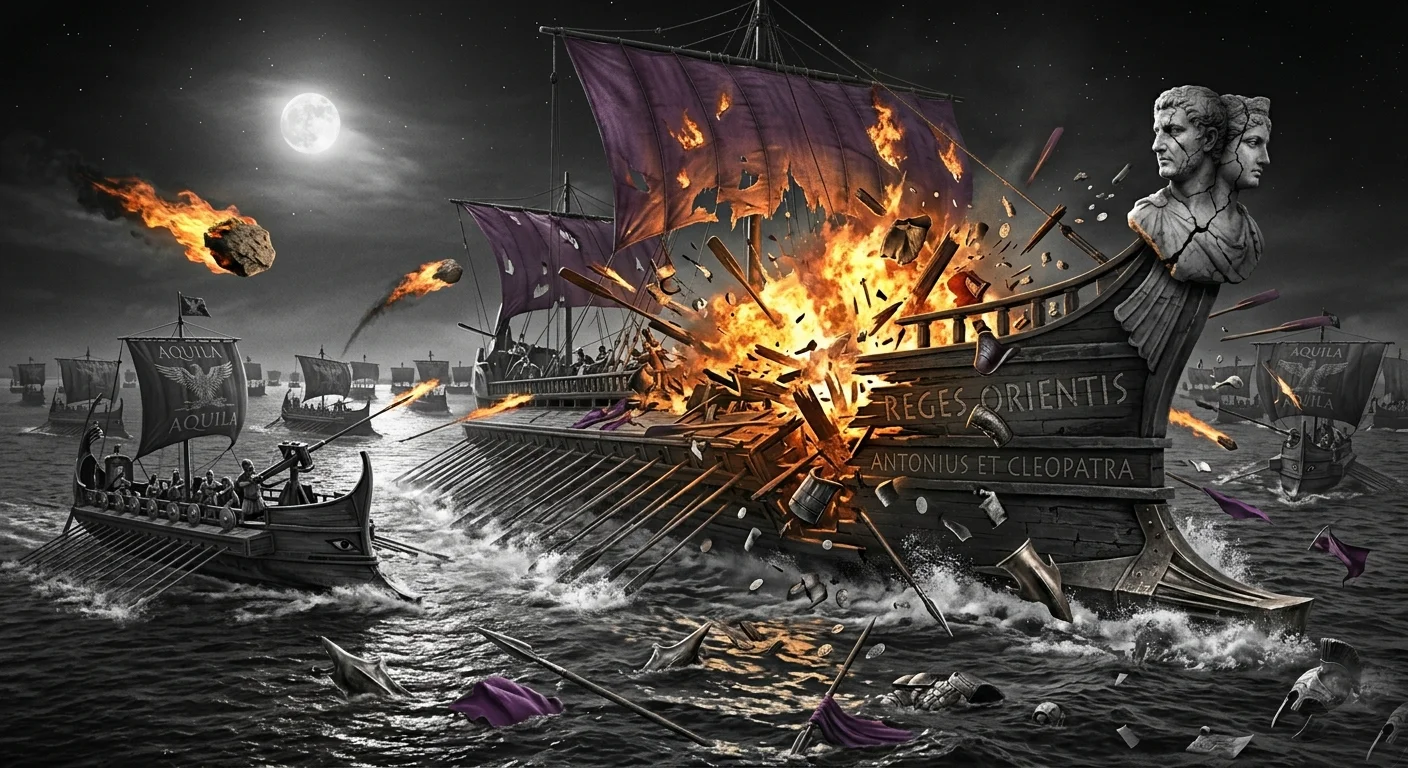
On the morning of September 2, 31 BC, on the sunlit waters of the Ionian Sea off the promontory of Actium on the western coast of Greece, two of the greatest military and naval forces the ancient world had assembled faced each other across the mouth of the Ambracian Gulf. On one side rode the combined fleets of Mark Antony and Cleopatra VII of Egypt — hundreds of enormous warships manned by tens of thousands of sailors, the floating fortresses of two of the most powerful individuals in the Mediterranean world, supported by the wealth of Egypt and the allegiance of Rome’s eastern provinces. On the other side waited the fleet of Gaius Julius Caesar Octavianus — smaller ships, but faster and better handled, commanded by the most gifted naval admiral of his generation, Marcus Vipsanius Agrippa, and backed by the political genius of a man who had been maneuvering for this moment for over a decade.
The battle that unfolded over the course of that September afternoon was not merely a military engagement. It was the final act of a drama that had consumed the Roman world since the assassination of Julius Caesar on the Ides of March in 44 BC — a drama of civil war, political manipulation, romantic passion, military ambition, and propaganda warfare that had torn the Roman Republic apart and concentrated its fate in the hands of a shrinking number of players. By the time the day was over, the combined fleet of Antony and Cleopatra had been broken, burned, and surrendered. The two lovers had fled south toward Egypt, their cause effectively lost. Within a year, both would be dead by their own hands in Alexandria. And Octavian—who had been dismissed by contemporaries as a sickly eighteen-year-old when Caesar’s will named him heir, who had outmaneuvered generals and senators and rival triumvirs through years of ruthless political calculation — would stand alone as the undisputed master of the Roman world, ready to transform the Republic into an Empire that would endure for five hundred years.
The Road to Actium: Julius Caesar’s Assassination and the Birth of the Second Triumvirate
The roots of the Battle of Actium extended back to the Ides of March, 44 BC, when a conspiracy of senators led by Marcus Junius Brutus and Gaius Cassius Longinus struck down Julius Caesar in the Theatre of Pompey in Rome. Caesar’s assassination was intended to restore the Republic by removing the man who had effectively become a dictator for life, but it produced instead a political vacuum that the conspirators — the Liberatores, as they called themselves — were entirely unprepared to fill. Into that vacuum rushed the forces that had sustained Caesar’s power: his legions, his veterans, his personal fortune, and above all the enormous political weight of his name and legacy. The two men best positioned to claim Caesar’s inheritance were Mark Antony, his loyal lieutenant and colleague in the consulship, and Gaius Octavius — Caesar’s great-nephew, whom Caesar had secretly adopted in his will and who was thus suddenly, legally, and provocatively calling himself Gaius Julius Caesar Octavianus.
Mark Antony — Marcus Antonius — was born around 83 BC into a distinguished but often troubled Roman family. He had served under Julius Caesar with conspicuous courage and loyalty throughout the Gallic Wars and the subsequent civil wars against Pompey, earning a reputation as a brilliant cavalry commander and an inspiring leader of men. He was physically imposing, personally charismatic, fond of pleasure and excess in ways that his enemies exploited mercilessly in their propaganda, and genuinely formidable in battle. His identification with Caesar was so complete that the conspirators had considered killing him alongside Caesar but had ultimately decided against it, a decision they would have cause to regret. In the aftermath of the assassination, Antony secured Caesar’s papers and fortune, organized the emotional public funeral that turned popular opinion against the conspirators, and began the process of mobilizing Caesarian forces for the revenge that he and the dead dictator’s veterans demanded.
Octavian was, at the moment of Caesar’s assassination, eighteen years old, studying in Apollonia in Macedonia and recovering from what seems to have been chronic ill health. He was slight, physically unimpressive, and had never held a major military command. His claim on the Caesarian inheritance was legal — Caesar’s will named him adopted son and heir — but most of the experienced politicians and generals of Rome dismissed him as irrelevant. They were wrong in a way that they would spend the next decade discovering. Octavian possessed what his contemporaries initially failed to recognize: an extraordinarily precise political intelligence, an absolute clarity about his own long-term objectives, an ability to present himself as the defender of whatever Roman values the audience required, and a ruthlessness about removing obstacles that he concealed beneath a consistently maintained posture of moderation and republicanism.
The chaos of the period from 44 to 43 BC — during which Antony, Octavian, and the Senate maneuvered against each other and against the Liberatores — was eventually resolved, temporarily and unstably, by the formation of the Second Triumvirate in October 43 BC. The three men who divided the Roman world between them were Octavian, Antony, and Marcus Aemilius Lepidus, an older and experienced general whose role in the arrangement was as much to provide legitimacy as to contribute real power. The triumvirs divided the Roman world among themselves: Antony took the wealthy and culturally prestigious East, including Greece, Asia Minor, Syria, and with it effective authority over Rome’s relationship with Egypt and the other eastern kingdoms; Octavian took the West, including Italy, Gaul, and Hispania, where he faced the grinding and thankless task of managing Italian politics and settling veterans on Italian land; Lepidus received Africa. They sealed the arrangement by proscribing their enemies — drawing up lists of men to be killed and their property confiscated — in a wave of violence that claimed the lives of approximately three hundred senators and two thousand equestrians, including the orator and philosopher Cicero, whose head and hands were nailed to the rostra in the Roman Forum.
Mark Antony and Cleopatra VII: The Eastern Alliance That Alarmed Rome
Cleopatra VII Philopator — the last active ruler of the Ptolemaic dynasty that had governed Egypt since the death of Alexander the Great in 323 BC — was when Antony summoned her to Tarsus in 41 BC already a figure of formidable political sophistication and international experience. Born around 69 BC, she was the daughter of Ptolemy XII Auletes and had spent much of her early reign fighting her own siblings for the Egyptian throne in conflicts that Julius Caesar had personally helped to resolve during his sojourn in Egypt in 48-47 BC. Caesar and Cleopatra had become lovers during that visit, and she had borne him a son, Caesarion — Ptolemy Caesar — whose existence was an implicit challenge to Octavian’s claim to be Caesar’s heir. When Antony summoned her to Tarsus to answer charges that she had aided his enemies during the struggles of the triumviral period, Cleopatra arrived not as a subordinate but as a monarch meeting an equal. According to the tradition preserved by Plutarch, she sailed up the river to Tarsus on a magnificent golden barge, dressed as Aphrodite the goddess of love, attended by boys costumed as Cupids and women as sea-nymphs, with perfumed sails and silver oars. Antony was captivated.
The relationship between Antony and Cleopatra was simultaneously personal, political, and deeply strategic. For Cleopatra, Antony was what Caesar had been before him: the most powerful Roman of his generation, whose protection was essential for Egypt’s independence and whose military power she could leverage to advance Egyptian interests and secure the Ptolemaic dynasty’s survival. For Antony, Cleopatra represented Egypt’s enormous wealth — the most productive agricultural economy in the ancient world, the granary of the Mediterranean — and a royal partner whose connections throughout the eastern kingdoms gave his eastern administration a reach and prestige that no purely Roman arrangement could have provided. The Roman political culture in which Antony had been raised could not accept the idea that he might genuinely prefer the company of an Egyptian queen to the political world of Rome, and so it interpreted his relationship with Cleopatra as a form of enchantment or corruption — as if only witchcraft could explain why a Roman general would choose Alexandria over Rome.
The political damage to Antony’s standing in Rome accumulated steadily through the 30s BC. The Donations of Alexandria in 34 BC — a public ceremony in which Antony and Cleopatra appeared together in full royal regalia and Antony formally distributed Roman-controlled eastern territories to Cleopatra and their three children — was seen in Rome as an outrage against Roman traditions and values. Antony had had three children with Cleopatra: Alexander Helios, Cleopatra Selene, and Ptolemy Philadelphus. At the Donations, he gave Alexander Helios Media and Parthia, Cleopatra Selene Cyrenaica and Libya, and Ptolemy Philadelphus Phoenicia and Syria — territories that Rome considered its own, not gifts for a foreign queen’s children. He also formally recognized Caesarion, Cleopatra’s son by Julius Caesar, as the true and legitimate heir of Caesar — a direct and personal challenge to Octavian’s entire claim to power and identity.
Antony also compounded his political difficulties by neglecting his Roman wife Octavia, Octavian’s own sister, whom he had married in 40 BC in a diplomatic arrangement designed to smooth relations between the triumvirs. His separation from Octavia and effective marriage to Cleopatra in the Roman public’s perception (Roman law did not recognize the union as legal since Romans could not marry foreigners) gave Octavian a personal grievance to add to his political and ideological weapons. When the Second Triumvirate formally expired at the end of 33 BC and Antony refused to participate in its renewal, the confrontation between the two remaining power centers of the Roman world became inevitable.
Octavian’s Political Masterstroke: The War Against Cleopatra
Octavian’s handling of the political situation in 32 BC demonstrated the strategic intelligence that distinguished him from all his rivals. He faced a genuine difficulty: Antony remained a popular figure among a substantial portion of the Roman Senate — approximately forty percent of senators, along with both consuls of 32 BC, had left Rome to join him — and any war against Antony would be a civil war between Roman citizens, a kind of conflict that the Roman world had grown exhausted of and that the tradition of Roman law and religion regarded with particular horror. Octavian’s solution was elegant: he would not declare war on Antony. He would declare war on Cleopatra.
Octavian’s first weapon was Antony’s will, which he had obtained from the Vestal Virgins — the sacrosanct priestesses who traditionally held important documents for safekeeping — through means that were legally dubious but politically devastating. The will reportedly specified that Antony wished to be buried in Alexandria rather than Rome, and that he had left substantial bequests to Cleopatra and their children. Whether the document Octavian revealed was authentic, altered, or entirely fabricated has been debated by historians for two thousand years; its content was what mattered politically. By making the will public, Octavian presented to the Roman public a man who had turned his back on Rome — who preferred an Egyptian tomb to a Roman one, who valued his foreign lover’s children over the Republic’s traditions — and who therefore could not be trusted with Roman power. The reaction was the outrage Octavian had calculated it would produce.
Having poisoned Antony’s reputation sufficiently, Octavian then arranged for the Senate to strip Antony of all his official powers, including the consulship for which he had been designated, and to declare war — not against Antony personally, but against Cleopatra. This legalistic precision was deliberate: Cleopatra was a foreign queen who owed allegiance to Rome, and the declaration of war against her carried none of the religious and political stigma of a formal civil war. Forty percent of the Senate had sided with Antony, but they were now technically supporting a man who was, as a Roman citizen, fighting on the side of a foreign enemy against Rome. Octavian had transformed a rivalry between Roman strongmen into a patriotic war to defend Roman civilization against Eastern corruption and foreign domination. It was a brilliant piece of propaganda, and it worked.
The Protagonists: Octavian, Agrippa, Antony, and the Commanders of Actium
Gaius Julius Caesar Octavianus was thirty-two years old at the time of the Battle of Actium, the same age as his admiral Marcus Agrippa. His full formal name — Imperator Caesar Divi Filius, or Commander Caesar, Son of the Deified One — encapsulated the two most important elements of his political identity: the military authority expressed in the title Imperator and the divine-hereditary legitimacy expressed in the claim to be son of the deified Julius Caesar. Physically he was slight and reportedly suffered from chronic ill health throughout his life, including cold sweats, difficulty tolerating heat, and a weak voice. He was not personally brave in the way that Antony or Caesar had been — he reportedly fainted before the Battle of Philippi in 42 BC and had to be taken away from the field by his physicians. But he was politically almost without equal: extraordinarily patient, absolutely clear about his objectives, willing to wait years to achieve a strategic goal, and capable of presenting himself to every audience as exactly the kind of leader that audience required.
Marcus Vipsanius Agrippa was the instrument through which Octavian’s political genius was translated into military victories. Born around 63 BC in relative obscurity, Agrippa had been a childhood friend and companion of Octavian and had developed, over the course of their shared youth and the subsequent wars, into the most capable military commander that Rome produced in his generation. He was not merely an admiral — though his naval victories at Mylae and Naulochus in 36 BC, where he had defeated Sextus Pompey, had made him the most experienced and successful naval commander in the Roman world — but a multitalented military engineer and administrator of exceptional ability. It was Agrippa who had devised and deployed the harpax at Naulochus: a wooden harpoon encased in iron, attached to a rope and windlass, fired from a ballista into enemy ships, and then cranked tight to draw the enemy vessel alongside for boarding — a weapon that negated the advantage of larger ships by denying them the ability to use their superior size for ramming or missile fire. He would deploy the harpax again to decisive effect at Actium.
Mark Antony was fifty-two years old at Actium, at the height of his physical powers but facing a strategic situation that had been progressively worsening for months. He had originally planned to carry the war to Italy, to invade across the Adriatic and take the fight to Octavian on his own territory — a strategy that might have worked, given that Antony’s land forces were superior to Octavian’s in experience and confidence. But Agrippa’s early seizure of key positions along the western Greek coast had disrupted these plans before they could be executed, and Antony had found himself maneuvered into a defensive position at Actium that became progressively less tenable as the months passed. Antony’s great strength was as a land commander — his cavalry was widely considered the finest in the Roman world — but the strategic situation forced him to contest the sea, which was his greatest weakness. His fleet was composed largely of large, heavily armed quinqueremes and even larger flagships that carried towers full of armed men and multiple ballistae, impressive fighting platforms individually but slow and difficult to maneuver as a fleet.
Cleopatra’s role in the campaign remains one of its most debated aspects. She had accompanied Antony to Greece with her own squadron of sixty ships and the Egyptian treasury — the financial resources that made the entire campaign possible — over the strenuous objections of many of Antony’s Roman officers, who argued that her presence was politically damaging and militarily distracting. They were right on both counts: her presence gave Octavian’s propaganda its most powerful claim, that Antony was fighting not for Rome but for an Eastern queen. But Cleopatra’s financial contribution was indispensable, and her personal relationship with Antony made her removal from the campaign a practical impossibility. Her squadron, positioned at the rear of the battle line with the treasury ships, would become the pivot on which the entire engagement turned.
The Blockade of Actium: How Agrippa Strangled Antony Before the Battle
The Battle of Actium on September 2, 31 BC, was not the beginning of Octavian’s campaign against Antony and Cleopatra—it was the culmination of months of preliminary operations that Agrippa had used to progressively strangle Antony’s strategic position before the decisive engagement ever occurred. Antony had concentrated his enormous fleet inside the Ambracian Gulf on the western coast of Greece, where his camp at Actium controlled the narrow entrance and where his supply lines ran south through the Peloponnese to Egypt. His land forces, approximately nineteen legions with somewhere between 60,000 and 80,000 men, were encamped on the promontory, supplied from Egypt through a carefully guarded transport route running up the Peloponnesian coast.
Agrippa struck before Antony’s forces had fully concentrated from their winter quarters. In early 31 BC, he surprised the defenders at Methone, on the southwestern tip of the Peloponnese, seizing the port and cutting off the southern end of Antony’s supply route. He then swept north along the Greek coast, taking Leucas and seizing more shipping and crews, progressively closing the route through which Egyptian supplies had been reaching Antony’s forces. Simultaneously, Octavian moved his land forces across the Adriatic and established his camp on the northern peninsula of the Ambracian Gulf, directly opposite Antony’s position at Actium on the southern peninsula — a position that controlled Antony’s communications with the interior. With Octavian to the north and Agrippa cutting off supplies from the south and sea, Antony’s enormous force was in a trap.
The months of waiting in the heat of a Greek summer destroyed Antony’s forces more thoroughly than any battle could have. Disease swept through the overcrowded camps; malaria, dysentery, and the intestinal illnesses that follow contaminated water supplies killed thousands. Desertions began as men who had joined Antony’s cause when it seemed stronger than Octavian’s gradually recalculated their allegiances. A remarkable number of Antony’s allied kings switched sides to Octavian during this period: Herod of Judaea, who had been one of Antony’s most important client monarchs in the East, detached himself from the Antonian cause. Others followed. By August of 31 BC, Antony had lost the strategic initiative entirely, and the choice before him was essentially binary: fight his way out or surrender.
The Council of War and the Debate Over Strategy: Sea or Land?
On September 1, 31 BC — the day before the battle — Antony held a council of war at his camp at Actium, and the deliberations revealed the divisions that had weakened his cause throughout the campaign. His Roman officers, led by experienced soldiers like Publius Canidius Crassus, argued passionately for abandoning the ships and fighting on land, where Roman legionary infantry had always excelled and where Antony’s superior cavalry could be decisive. They pointed out that Antony’s fleet was manned largely by inexperienced crews, many of them drafted from the countryside to replace losses, while Octavian’s sailors had been fighting together for years under Agrippa’s training and leadership. On land, the two forces were more evenly matched, and Antony had the advantage of experience and the loyalty of his best veterans.
Cleopatra, supported by those who understood that her treasury was effectively the financial backbone of the campaign, argued for a naval engagement. Her reasoning is reconstructed differently by different ancient sources, but the most coherent interpretation is that she recognized the naval situation as desperate regardless — that waiting longer in their blockaded position would only continue the attrition of disease and desertion — and that a naval action offered at least the possibility of breaking through Octavian’s line and escaping to Egypt, where the campaign could be regrouped and continued from a stronger financial base. The treasury ships, laden with the wealth of Egypt, could not be safely transported overland; they needed to go by sea. The compromise that emerged was essentially Cleopatra’s position: the fleet would sail out, fight if necessary to create an opening, and break through to Egypt with the treasury and as many ships as possible.
The ambiguity of this plan — was it a genuine attempt to win a naval battle, or a breakout disguised as a battle? — has generated historical debate ever since. Ancient sources including Plutarch and Dio Cassius present it differently, and modern historians have come to different conclusions. What is not disputed is that the sails were kept aboard the ships on the morning of the battle, when normal practice for a fleet intending to fight would have been to leave the sails ashore to reduce weight and windage. The presence of the sails aboard Antony’s fleet, observed by Octavian’s scouts and reported to Agrippa, was interpreted as evidence that escape rather than battle was the primary intention — which is why Agrippa arranged his fleet in three formations designed to prevent a breakthrough rather than simply to engage and destroy. He was prepared for either a battle or a pursuit.
September 2, 31 BC: The Battle Itself — From the Gulf of Actium to Open Sea
On the morning of September 2, both fleets moved into position outside the Gulf of Actium. Antony’s fleet deployed from the narrow strait in three divisions plus Cleopatra’s reserve squadron: the right wing under Antony himself and Lucius Gellius Poplicola, the center under Marcus Octavius and Marcus Insteius, and the left wing under Gaius Sosius. Cleopatra’s squadron of sixty Egyptian galleys, carrying the treasury, waited in the rear. Against them, Agrippa deployed Octavian’s fleet in a corresponding three-formation arrangement: his own command on the left wing, Lucius Arruntius in the center, and Marcus Lurius on the right. Titus Statilius Taurus commanded the land forces observing from shore. Octavian himself was present but exercised no direct operational command — the battle was entirely Agrippa’s.
Both fleets held their positions for several hours as the morning wore on, neither side willing to attack into the narrow straits where the confined waters would negate the tactical advantages of the smaller, more maneuverable ships on both wings. The wind was light in the morning, unfavorable for Antony’s larger ships, which needed a good following wind to move efficiently. As the day progressed toward noon and then afternoon, the northerly wind that typically develops on the Ionian Sea in the afternoons began to strengthen — the wind that Antony had been waiting for, which would push his fleet out of the straits and into the open sea with enough momentum to give his heavy ships the initiative. Around midday, the wind came forcefully across, and Antony launched his ships toward Agrippa’s, hoping to turn his left flank and break the line before the wind shifted again.
Gaius Sosius launched the initial attack from the Antonian left wing, pressing toward Agrippa’s position with the fleet’s largest and most heavily armed vessels. The fighting that followed was intense, with both sides’ soldiers raining missiles — arrows, javelins, rocks from catapults — down on the lower decks of enemy ships, and with boarding parties attempting to cross between vessels locked together by grappling hooks. Agrippa’s harpax — the iron-tipped wooden harpoons fired from ballistae and attached to windlasses — proved its value here: when fired into the hulls and superstructure of Antony’s larger ships, the device made escape impossible, drawing the enemy vessel alongside for boarding regardless of how much the larger ship’s crew resisted. In the first hours of fighting, Agrippa’s ships using the harpax sank approximately fifteen of Antony’s vessels, demonstrating that the technological advantage Antony might have expected from his larger, more heavily armed warships had been effectively neutralized.
The battle continued through the afternoon without a decisive result on either wing, as both sides fought to outflank the other without being able to achieve the decisive breakthrough needed to collapse the enemy formation. Antony’s flagship — a massive ten-banked warship — was deeply engaged with multiple Agrippan vessels and held fast by the harpax. The fighting was brutal and the casualties on both sides were severe. But neither side was winning clearly. Then, in the late afternoon, the decisive moment of the engagement arrived — and it came from within Antony’s own fleet.
Cleopatra’s Flight and Antony’s Fatal Decision: The Moment That Decided History
Late in the afternoon of September 2, 31 BC, Cleopatra raised her sails. Her squadron of sixty Egyptian galleys, which had been waiting in the rear behind Antony’s battle line, caught the northerly wind and broke southward through the fighting fleets, passing through whatever gap existed in the battle formation and heading out into the open Ionian Sea toward Egypt. Whether this movement was planned as the breakout they had always intended, or whether it was a spontaneous decision made by Cleopatra when she saw that the battle was going against Antony, is the question that has divided historians for two millennia. The treasure was aboard her ships. The financial resources that made any continuation of the war possible were sailing south. Ancient sources differ on whether Antony had agreed to this breakout in advance or was caught by surprise.
What happened next is not in dispute. Antony saw Cleopatra’s ships leaving. He abandoned his flagship — transferring himself with some difficulty to a lighter vessel while the large warship was still caught by the harpax — and with approximately forty ships managed to break through the battle line and follow her. He came alongside Cleopatra’s flagship, the Antonia, and boarded it. But according to the tradition preserved by Plutarch, he was so broken by the defeat and what the flight might mean that he could not face Cleopatra directly. He sat at the bow of the ship for hours, his head in his hands, neither approaching her nor speaking to her, brooding over the magnitude of what had just happened. He sent orders back to Publius Canidius Crassus, who commanded the land forces, to withdraw and march to Asia, but those orders would ultimately be ignored as the land forces, abandoned by their commander and without supplies, surrendered to Octavian one week later.
The effect on the fleet Antony had abandoned was immediate and catastrophic. Whatever fighting spirit had sustained the soldiers and sailors of the remaining Antonian fleet — and it had been considerable, given the brutal fighting of the afternoon — collapsed when word spread that the commander had gone. Agrippa held his fleet in formation throughout the night of September 2, accepting no surrender, preventing any further escape. On the morning of September 3, most of Antony’s remaining ships, many so badly damaged they could barely float, surrendered to Agrippa. Octavian claimed to have captured approximately three hundred vessels; many were so damaged that they were burned. The sailors and marines were absorbed into Octavian’s forces. The soldiers in Antony’s land camp surrendered a week later. The greatest naval force assembled in the ancient Mediterranean world since the naval battles of the First Punic War had effectively ceased to exist.
The Aftermath: Flight to Egypt, Antony’s Death, and Cleopatra’s End
Antony and Cleopatra arrived in Alexandria with their surviving fleet — perhaps ninety ships — and the treasury intact. They had escaped with the financial resources to continue the war, but the political landscape had changed entirely. The allied kings who had supported Antony began defecting rapidly; the legions and garrisons he had left throughout the East surrendered to Octavian as he marched through Asia and Syria. Antony sent messages to Octavian proposing terms: that he be allowed to live as a private citizen in Athens; that his eldest son Antyllus be spared; that Cleopatra be treated honorably. Octavian ignored the messages or sent back responses that were designed to encourage Cleopatra to betray Antony rather than to negotiate with him. Cleopatra, for her part, made her own approaches to Octavian, at one point sending him a golden crown and throne with an offer to abdicate in favor of her children by Antony. Octavian kept her in hope of better terms while pursuing his military campaign.
In the spring and summer of 30 BC, Octavian advanced from two directions. His trusted commander Cornelius Gallus marched eastward from Cyrene toward Egypt’s western frontier. Octavian himself landed at Pelusium on the eastern frontier of Egypt with the main army. Antony fought bravely in several engagements, winning a minor cavalry victory outside Alexandria on July 31, 30 BC. But more of his forces were deserting with every passing day, and the resources to resist an extended siege did not exist. On August 1, 30 BC, the final collapse came. Antony’s cavalry and fleet surrendered to Octavian without fighting. His remaining infantry disintegrated. Antony, receiving a false report that Cleopatra was already dead, stabbed himself with his sword. The wound was not immediately fatal, and before he died he was carried to Cleopatra’s mausoleum — the tomb she had been constructing — where he died in her arms, as ancient accounts describe it, bidding her to make her peace with Octavian and take care of herself.
Cleopatra did not intend to make her peace with Octavian or to survive as a captive in his Roman triumph. She understood perfectly what Roman tradition demanded of a conquered enemy’s queen: to be displayed in chains in the triumphal procession through Rome, a living trophy of the conqueror’s victories. She had already seen her younger sister Arsinoë displayed in precisely this way in Caesar’s triumph of 46 BC. When Octavian arrived at the mausoleum and attempted to take her prisoner, she tried and failed to seduce him into offering better terms. Finding no escape, she arranged her own death. The method ancient sources most often attribute to her — death by the bite of an asp, the small Egyptian cobra that was simultaneously the symbol of Egyptian royal divinity and one of the most powerful toxins available in the ancient world — has never been definitively established. She died on approximately August 10 or 12, 30 BC, at approximately thirty-nine years of age, the last independent ruler of the Ptolemaic dynasty that had governed Egypt since 305 BC. Octavian, who had wanted to display her in his triumph, had her buried beside Antony in the mausoleum she had built for herself.
Octavian’s Victory and the Death of the Last Ptolemaic Heir
Cleopatra’s death had one immediate consequence for which Octavian had been specifically preparing: the elimination of Caesarion, the son of Julius Caesar and Cleopatra. Caesarion — Ptolemy XV Caesar — was approximately seventeen years old and represented a direct dynastic challenge to Octavian’s claim to be the legitimate heir of Julius Caesar. Octavian had sent Caesarion eastward from Alexandria before the final campaign to protect him, but after Cleopatra’s death, Octavian’s agents tracked him down and killed him. There is a macabre pun attributed to Octavian’s Greek tutor Arius Didymus: that too many Caesars is not a good thing — phrasing the reasoning for murder in a casual literary allusion. Antony and Cleopatra’s children by each other — Alexander Helios, Cleopatra Selene, and Ptolemy Philadelphus — were spared, as Suetonius notes, and were raised in Rome by Octavia, the sister whom Antony had so thoroughly humiliated. Cleopatra Selene later became queen of Mauretania.
Egypt was annexed as a Roman province — but with a uniquely personal status that reflected its uniquely important role. Unlike every other Roman province, Egypt was not administered by a senatorial governor but by a personal representative of Octavian himself, with instructions that no senator was permitted to visit Egypt without explicit permission. The grain of Egypt — the productivity of the Nile Valley that fed Rome and could be used to starve any political rival who lost access to it — was thus directly in Octavian’s personal control, an asset that no future rival could threaten him through. Cleopatra’s treasury, which he had secured intact, provided the financial resources to pay his veterans and reward his allies. The conquest of Egypt, in a very practical sense, made the Roman Empire financially viable.
The Birth of the Roman Empire: Octavian Becomes Augustus in 27 BC
Octavian returned to Rome in 29 BC and celebrated a triple triumph: for his campaigns in Illyricum, for the victory at Actium, and for the conquest of Egypt. The celebrations lasted for three days and displayed the treasures of Egypt, including representatives of the peoples he had conquered, before the Roman population in the traditional form that Roman military culture demanded as the proper culmination of a successful war. Three years later, in January 27 BC, Octavian performed one of the most carefully choreographed political acts of his remarkable career: he appeared before the Senate and offered to return all his extraordinary powers to the Roman state, renouncing the exceptional position he had held since Actium and restoring the Republic.
The Senate refused his offer and instead loaded him with titles, powers, and honors that gave him, in formal legal terms, the control of every significant lever of Roman government while preserving the outward form of the Republican institutions that Romans still revered. He was given the title Princeps — First Citizen — which became the standard designation for the Roman emperor throughout the period of the Principate. He was given the title Augustus — the Revered — which he accepted and used as his personal name for the rest of his life: Octavian henceforth became Augustus, and it is by this name that history has remembered him. He was given command of all the provinces that contained significant military forces, while the Senate nominally administered the others. He controlled the treasury. He controlled the army. He controlled foreign policy. The Republic was over; the Empire had begun. Octavian had achieved, through patience, intelligence, propaganda, and the decisive victory at Actium, precisely what Julius Caesar had attempted through more direct means and had been assassinated for: the concentration of Roman power in a single man’s hands.
The Significance of Actium: The Battle That Shaped Western Civilization
The Battle of Actium is significant not merely as a military engagement but as the hinge on which the history of the ancient world turned. Had Antony and Cleopatra won — had their fleet broken through Agrippa’s formation and taken the campaign to Italy, or had Antony’s naval strategy worked and Octavian’s fleet been destroyed — the subsequent history of the Mediterranean world would have been profoundly different. The eastern empire that Antony and Cleopatra had been building since the Donations of Alexandria would have had a genuinely different character from the one Octavian created: oriented toward the East rather than the West, drawing on the Hellenistic monarchical traditions of Egypt and the eastern kingdoms rather than on the Roman republican traditions that Augustus so carefully preserved even as he subverted them. Cleopatra might well have achieved her ambition of ruling not merely Egypt but the combined Greco-Roman world from Alexandria. The Ptolemaic dynasty, which ended with her death, might have survived for centuries more.
The world Octavian created instead was one in which Rome remained the center of political power, in which Roman republican institutions — the Senate, the traditional magistracies, the legal framework — were preserved as the formal structure within which the new imperial authority operated, and in which the cultural weight of the Latin West ultimately outweighed the Greek East that Antony and Cleopatra had represented. The Pax Romana — the Roman Peace — that Augustus inaugurated and that lasted for approximately two centuries was one of the most extraordinary periods of political stability, economic growth, and cultural achievement in the history of the ancient world. Roman law, Roman engineering, Roman language, Roman administration, and the Christian religion that would spread through the Roman Empire in the centuries after Augustus — all of these were the consequences of the world that the Battle of Actium made possible.
The Roman poets of Augustus’s era understood the battle’s significance and celebrated it accordingly. Virgil devoted some of the most magnificent lines of the Aeneid — his epic poem celebrating Rome’s origins and destiny — to a description of Actium on the Shield of Aeneas, presenting the battle as the fulfillment of Rome’s divine mission to bring peace and order to the world. Propertius, Horace, and other Augustan poets echoed the theme: Actium was not merely Octavian’s victory but Rome’s, the moment when the Western, rational, Latin order had overcome the Eastern, sensual, foreign chaos embodied by Antony’s subjugation to Cleopatra. The propaganda of the Augustan age transformed what had been a civil war between Roman factions into a cosmic confrontation between civilization and barbarism, and the battle that decided it into a founding moment of the Roman Empire.
Nicopolis: The City Built on the Bones of Victory
One of the most striking physical expressions of Octavian’s victory at Actium was the city he founded on the northern promontory of the Ambracian Gulf — the site of his own military camp during the campaign — and named Nicopolis, the City of Victory. The name was directly inspired by Alexandria’s parallel: just as Alexander the Great had founded cities named after himself to mark his conquests, Octavian founded a city named for his victory to mark the decisive moment of his rise to power. Nicopolis was not merely a symbolic gesture; it was a substantial urban center populated by the forced synoikismos — compulsory relocation — of the populations of several surrounding Greek towns, and it remained an important city of the Roman and Byzantine Empires for centuries. The monument Octavian erected at the site of his camp — decorated with the bronze rams taken from the prows of Antony’s captured ships, the traditional Roman practice for commemorating naval victories — proclaimed to all who saw it that this was the place where the old world had ended and the new one had begun.
Conclusion: September 2, 31 BC and the World Made New
The Battle of Actium was fought and decided in a single afternoon, yet its consequences unfolded over centuries. The 269 men and women who died at Actium — the sailors and soldiers of both fleets, burned and drowned and killed in the close fighting of the afternoon — were the immediate human cost of a conflict whose ultimate stakes were the shape of the entire ancient world. The lovers who fled south on Cleopatra’s flagship as the battle collapsed around them — Mark Antony, broken and staring at the wake, and Cleopatra, calculating her next move with the intelligence that had kept her dynasty alive through years of Roman interference — were the last representatives of a world that was already ending: the world of the Hellenistic kingdoms, of Alexander’s divided inheritance, of the competition between Rome and the East that had defined Mediterranean history for three centuries.
The young man who watched from shore as his admiral Agrippa’s fleet completed its work, and who then spent the following year pursuing the defeated lovers to their deaths in Alexandria — Gaius Julius Caesar Octavianus, thirty-two years old, the sickly teenager who had been dismissed when Caesar’s will named him heir and who had outmaneuvered generals, senators, and triumvirs to arrive at this moment — would live for another forty-four years after Actium, ruling an empire that stretched from Britain to Mesopotamia and giving it the administrative, legal, and cultural foundations that endured long after his own death in 14 AD. He would be remembered forever after not by the birth name Octavian but by the title the Senate gave him in 27 BC: Augustus — the Revered. On September 2, 31 BC, at a promontory on the western coast of Greece that few outside the region had previously heard of, the Republic died and the Empire was born, and the history of the western world took the shape it would hold for the next five centuries.