
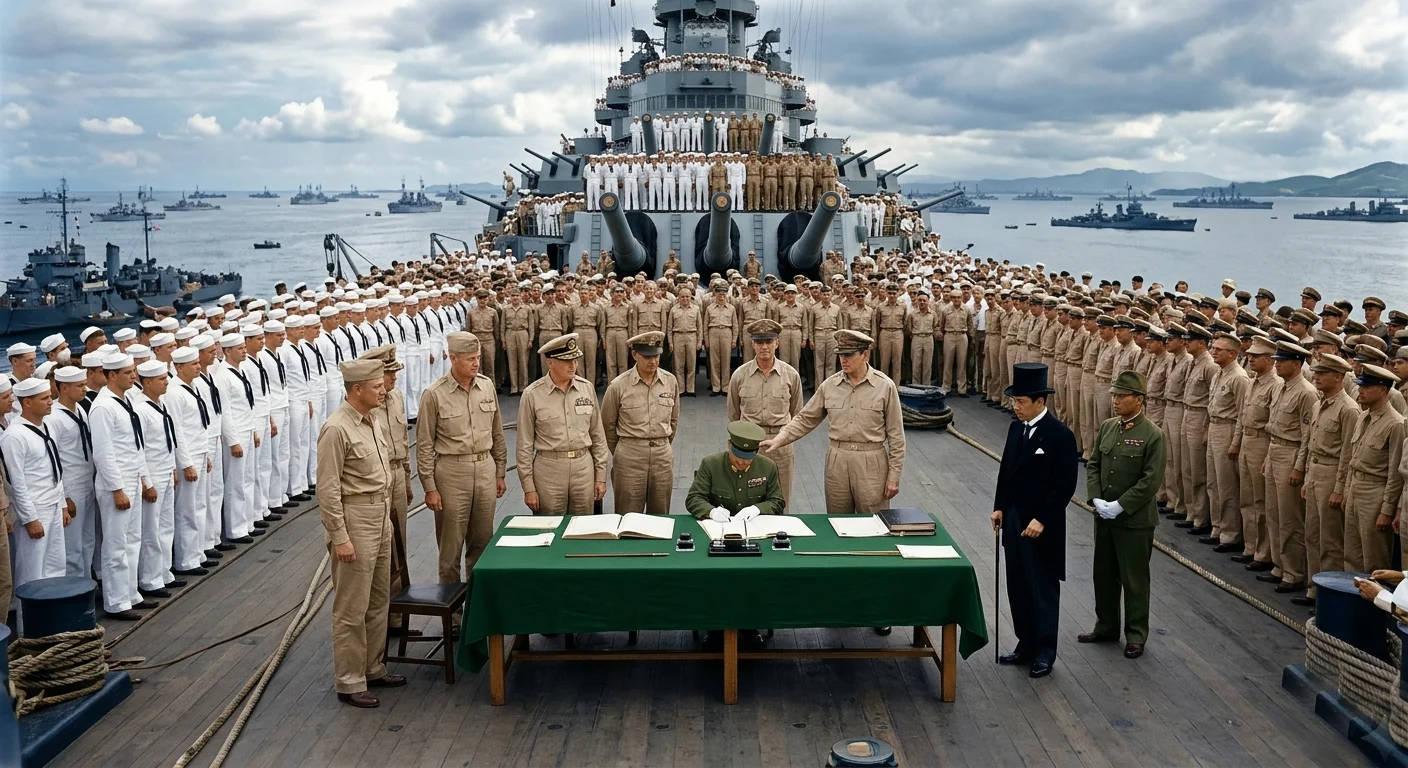
At 9:02 in the morning on Sunday, September 2, 1945, General Douglas MacArthur stepped to the microphone on the teak deck of the United States Navy battleship USS Missouri, anchored in Tokyo Bay with more than 250 Allied warships arrayed around it, and began the brief ceremony that would formally end the most destructive war in human history. His hand trembled slightly as he spoke — a detail noted by LIFE magazine’s correspondent on the deck below — but his voice was steady and his words were chosen with a consciousness that they would be heard by hundreds of millions of people around the world listening on radio, and read by generations not yet born. Around him stood the senior commanders of the Allied powers: admirals and generals in the uniforms of nine nations, gathered to witness the formal capitulation of the Empire of Japan. Before him, in civilian dress and military uniform, stood the eleven delegates of a nation that had fought for nearly four years against the greatest coalition of military and industrial power in history.
Twenty-three minutes later, when MacArthur closed the proceedings with the words ‘These proceedings are closed,’ the Second World War was over. The Instrument of Surrender that had been signed on the gray veranda deck of the Missouri, in a ceremony whose every detail had been carefully choreographed by MacArthur himself, committed Japan to unconditional surrender to the Allied Powers, ordered the cessation of all hostilities by Japanese armed forces everywhere on earth, and subjected the Japanese government and the Emperor’s authority to the supreme command of the Allied Powers. The document was simple: eight short paragraphs, printed in English and Japanese, that formalized the end of six years of global warfare that had claimed the lives of an estimated sixty million human beings and transformed every continent on earth.
The Path to Surrender: Japan’s War and the Question of Unconditional Capitulation
The formal ceremony on September 2, 1945, was the culmination of a process that had begun, in the most fundamental sense, in December 1941 when Japan’s carrier aircraft attacked the United States naval base at Pearl Harbor, Hawaii, killing 2,403 Americans and drawing the United States into the global conflict that had already been consuming Europe and Asia for two years. The Pacific War that followed was one of extraordinary ferocity, fought across millions of square miles of ocean and island and jungle, from the Aleutian Islands in the north to the Solomon Islands in the south, from the coast of China to the approaches of the Japanese home islands themselves. By 1944, Japan’s strategic position was clearly hopeless: its navy had been effectively destroyed at the Battle of Leyte Gulf in October 1944, its air power had been decimated in a series of engagements that killed irreplaceable experienced pilots, and American submarines had strangled its merchant shipping, cutting off the oil and raw materials on which its military machine depended.
Yet Japan did not surrender as its strategic situation became hopeless. The Japanese military culture of the period — shaped by the Bushido code, by the doctrine of absolute loyalty to the Emperor, and by a propaganda apparatus that had told the Japanese people for years that surrender was unthinkable and that any soldier who surrendered was bringing dishonor upon his family and his nation — made the idea of unconditional surrender almost literally inconceivable to the military leaders who controlled Japanese policy in 1944 and 1945. The Supreme Council for the Direction of the War — the group of six senior ministers and military commanders known as the Big Six — was deeply divided between those who recognized that the war was lost and sought to negotiate an end on terms that would preserve some Japanese sovereignty, and those who believed that a final decisive battle on the Japanese home islands, combined with the use of thousands of kamikaze pilots and civilian defenders, could inflict sufficient casualties on any invading Allied force to compel a negotiated peace on acceptable terms.
The Potsdam Declaration of July 26, 1945 — issued jointly by the United States, the United Kingdom, and China, and later endorsed by the Soviet Union — defined the Allied terms for Japanese surrender clearly and without ambiguity. It called for the immediate and unconditional surrender of all Japanese armed forces, promising that failure to comply would result in prompt and utter destruction. It specified that Japan would be occupied, that Japanese sovereignty would be limited to the four main home islands, that Japanese military power would be permanently destroyed, and that war criminals would be brought to justice. But it was deliberately ambiguous about the future of Emperor Hirohito and the imperial institution—a point of critical importance to the Japanese leadership, for whom the preservation of the Emperor was not merely a political question but a theological one, touching the foundations of Japanese national identity and religious belief.
Hiroshima, Nagasaki, and the Soviet Declaration of War: The Three Shocks That Forced Japan’s Hand
The Japanese government’s initial public response to the Potsdam Declaration was mokusatsu — a Japanese term meaning approximately to kill with silence or to treat with contempt — which the Japanese military leadership intended as a tactical non-response that would preserve negotiating room while they continued to seek Soviet mediation for a negotiated peace. It was interpreted by the Allied governments as rejection. On August 6, 1945, at 8:15 in the morning local time, the United States Army Air Forces B-29 Superfortress Enola Gay, piloted by Colonel Paul Tibbets of the 509th Composite Group, dropped the first atomic bomb ever used in warfare on the Japanese city of Hiroshima. The device, code-named Little Boy, was a uranium gun-type weapon with a yield equivalent to approximately fifteen thousand tons of TNT. The explosion immediately killed an estimated 70,000 to 80,000 people. By the end of 1945, the death toll from the Hiroshima bombing — including those who died from acute radiation exposure, burns, and blast injuries in the weeks and months after the detonation — was estimated at between 90,000 and 166,000.
The Japanese leadership’s response to Hiroshima was not immediate capitulation. The Big Six remained divided, with the military members — War Minister Korechika Anami, Army Chief of Staff Yoshijiro Umezu, and Navy Chief of Staff Soemu Toyoda — insisting that Japan could still negotiate favorable terms if it demonstrated the capacity and willingness to resist an Allied invasion. Then, on August 8, 1945 — in fulfillment of the secret commitment made to the United States and United Kingdom at the Yalta Conference — the Soviet Union declared war on Japan and invaded Manchuria in force. The Soviet declaration was a catastrophic blow to Japanese strategic hopes: the plan to seek Soviet mediation had been the primary peace strategy of Foreign Minister Shigenori Togo and Prime Minister Kantaro Suzuki, and it was now destroyed. The Soviet Army poured across the Manchurian border with overwhelming force, collapsing Japanese defenses that had been stripped of their best units to defend the home islands.
Hours after the Soviet declaration of war, on August 9, 1945, a second American B-29, Bockscar, piloted by Major Charles Sweeney of the 509th Composite Group, dropped a second atomic bomb — Fat Man, a plutonium implosion device with a yield equivalent to approximately twenty-one thousand tons of TNT — on the Japanese city of Nagasaki. The weapon killed an estimated 40,000 to 80,000 people. The combination of the two atomic bombings and the Soviet declaration of war in the space of three days broke the deadlock in the Japanese Supreme Council. Even as the news of the Nagasaki bombing reached the Big Six, they remained divided three to three — but the triple shock had created the conditions for the unprecedented intervention that would end the war.
Emperor Hirohito’s Decision: The Imperial Voice Breaks the Deadlock
Prime Minister Kantaro Suzuki, recognizing that the Supreme Council could not agree, took the extraordinary step of convening a late-night meeting with Emperor Hirohito himself and asking the Emperor directly to resolve the deadlock by expressing his imperial will. This was an almost unprecedented act in the modern Japanese constitutional order, which had treated the Emperor as a divine figure above ordinary political decision-making. Emperor Hirohito — the 124th Emperor of Japan, who had reigned since 1926 and was thirty-eight years old in the summer of 1945 — had been monitoring the military situation with growing alarm for months. He had been privately informed that Japanese military planners estimated that the defense of the home islands against an Allied invasion would cost the lives of between twenty and twenty-eight million Japanese civilians and soldiers, in addition to the millions of Allied casualties the military expected to inflict.
Hirohito listened to the arguments of each minister in turn and then, in a scene that would become one of the defining moments of Japanese history, expressed his imperial will clearly and without equivocation: Japan would accept the Potsdam Declaration with a single condition — the preservation of the Emperor’s position. He told his ministers that he could not bear to see his loyal troops disarmed and his devoted subjects punished as aggressors, and that the time had come to bear the unbearable. He directed the government to communicate Japan’s acceptance of the Potsdam Declaration to the Allied powers. The Big Six and the broader cabinet ratified the Emperor’s decision in a formal vote on the morning of August 10, 1945, though War Minister Anami — who had resisted surrender until the end — wept openly as the vote was taken.
The Allied response to Japan’s conditional acceptance was carefully worded: it did not explicitly guarantee the preservation of the Emperor, but stated that the ultimate form of the Japanese government would be established by the freely expressed will of the Japanese people. This ambiguous formulation was sufficient for the Japanese peace faction, who interpreted it as implicit acceptance of the Emperor’s continuation, though the American position had been genuinely divided — with the State Department and British government favoring retention of the Emperor and elements of the American military and public demanding his removal or trial as a war criminal. Secretary of State James Byrnes crafted the compromise language. The Japanese government formally accepted the Allied response on August 14, 1945.
The Jewel Voice Broadcast: Hirohito Speaks to His People for the First Time
On the evening of August 14, 1945, Japan Broadcasting Corporation technicians traveled to the Tokyo Imperial Palace and set up microphones in an underground bunker beneath the Imperial Household Ministry. Emperor Hirohito, dressed in his military uniform, recorded the message that would be broadcast to the Japanese people the following day — the first time in Japanese history that the Emperor had spoken directly to his subjects by radio, and the first time that most Japanese people had ever heard his voice. The recording was made twice — an original and a copy — and both were kept secret in the palace overnight. What happened next illustrated how deeply divided Japan remained even at the moment of surrender.
In the early hours of August 15, approximately one thousand officers and soldiers of the Imperial Japanese Army, convinced that the surrender was an act of treachery against Japan’s honor and determined to prevent it, raided the Imperial Palace in an attempted coup. They were searching for the recordings to destroy them. The rebels were confused by the palace’s layout and failed to find the phonograph records, which had been hidden by palace officials in a pile of documents. The original recording was smuggled out of the palace hidden in a lacquer box, the copy in a lunch bag. Major Kenji Hatanaka, one of the coup leaders, attempted to storm the NHK radio station to prevent the broadcast but was ordered to stand down by the Eastern District Army. The coup collapsed without achieving its objective. Hatanaka shot himself at dawn on August 15.
At precisely noon on August 15, 1945, NHK radio stations throughout Japan broadcast a two-minute recording of Emperor Hirohito’s voice reading what became known as the Gyokuon-hoso — the Jewel Voice Broadcast. The speech was read in formal Classical Japanese so archaic and courtly that many ordinary Japanese listeners could not fully understand it. The word surrender was never used. Hirohito spoke instead of accepting the provisions of the joint declaration of the Allied powers — meaning the Potsdam Declaration — and explained that the war had developed not necessarily to Japan’s advantage. He described the atomic bomb as a new and most cruel bomb of a type previously unknown and stated that if the war continued, it would result not only in the ultimate collapse and obliteration of the Japanese nation but also lead to the total extinction of human civilization. Some who heard the broadcast wept. Some were confused about what had been announced. Some military commanders in remote postings refused to believe it was authentic. But the war was over.
Between Announcement and Ceremony: Preparation for the Surrender
The period between Hirohito’s August 15 broadcast and the formal signing ceremony on September 2 was filled with the complex logistics of arranging the surrender of an empire. General Douglas MacArthur had been appointed Supreme Commander for the Allied Powers by President Harry Truman on August 15, charged with accepting Japan’s surrender and overseeing the subsequent occupation. MacArthur’s first challenge was ensuring that the ceasefire held — a far from guaranteed outcome given the depth of the Japanese military’s resistance to surrender and the scattered nature of Japanese forces across the Pacific and Asia. Both sides were genuinely uncertain whether Japanese soldiers in remote locations would comply with the surrender order or whether rogue military units would continue fighting or attack Allied forces during the transition period.
The selection of the site and the ship for the surrender ceremony was itself a matter of careful deliberation. Truman directed that the ceremony take place aboard a Navy vessel, and the battleship USS Missouri — named for Truman’s home state of Missouri, and currently serving as the flagship of Fleet Admiral William F. Halsey Jr.’s Third Fleet — was chosen. The choice carried layers of significance that MacArthur and the ceremony’s planners understood and exploited. The Missouri was a brand-new ship, having been commissioned only in June 1944, but it represented the vast industrial and military power of the United States that had crushed Japan’s military machine. The ceremony would take place in Tokyo Bay itself — in the sovereign waters of the Japanese home islands, an implicit statement that Allied power had penetrated to the very heart of the Japanese Empire.
Two objects were placed on the bulkhead near the ceremony table that connected the event to its deepest historical resonances. The first was the flag that had flown over the United States Capitol on December 7, 1941 — Pearl Harbor Day — brought aboard the Missouri and displayed as a direct visual link between the moment of Japan’s most devastating attack on the United States and the moment of its complete defeat. The second was even more historically resonant: Commodore Matthew Perry’s flag from his 1853 expedition to Japan, when Perry’s Black Ships had sailed into Tokyo Bay — then called Edo Bay — and compelled Japan to open itself to Western trade, ending more than two centuries of deliberate isolation. Perry’s flag had been preserved in the United States Naval Academy Museum; MacArthur had arranged to have it flown to Tokyo for the ceremony as a statement about the arc of American-Japanese relations from first contact to final reckoning.
The Japanese Delegation: Shigemitsu, Umezu, and the Burden of Representing Defeat
Choosing who would represent Japan at the surrender ceremony was itself a matter of anguished deliberation within the Japanese government. The signed document would carry the names of men who were formally surrendering the Empire of Japan — an act that, within the framework of Japanese military culture, was almost beyond shame. Prime Minister Prince Naruhiko Higashikuni, who had been appointed prime minister on August 17 specifically because his status as a member of the Imperial Family was expected to give his government the authority to enforce the surrender on reluctant military elements, could not attend because his imperial connections made his public participation in a surrender ceremony politically impossible. Prince Fumimaro Konoe, who had served as prime minister before the war, refused the assignment outright.
The burden fell to two men who accepted it on the personal appeal of Emperor Hirohito himself. Foreign Minister Mamoru Shigemitsu represented the Japanese government and signed by command and in behalf of the Emperor of Japan and the Japanese Government. Shigemitsu had served as Japan’s ambassador to China, the Soviet Union, and the United Kingdom before becoming foreign minister, and he walked with a pronounced limp — the result of a 1932 assassination attempt by a Korean independence activist in Shanghai that had cost him his right leg below the knee. He had not been a hawk throughout the war and had privately worked toward a negotiated peace. His presence at the surrender table was in some respects the presence of a man who had tried to prevent what he was now being asked to formalize. General Yoshijiro Umezu signed as Chief of the Imperial General Staff, representing the Japanese Imperial General Headquarters. Umezu had been one of the most determined opponents of surrender within the Big Six — he had argued until very nearly the end for continued resistance — and accepted the assignment to sign only under direct imperial command. He reportedly wept during the ceremony.
Nine additional Japanese delegates completed the delegation, three each from the Army, the Navy, and the Foreign Ministry. For security reasons, only the names of the two signatories — Shigemitsu and Umezu — were revealed to the press on the morning of the ceremony. The full eleven-person delegation left Tokyo by car in the early morning of September 2, boarded the USS Lansdowne at Yokohama, and were transported to the Missouri. When they arrived on deck and walked to their places before the document table, they faced a dense array of Allied officers and officials in the uniforms of nine nations, and behind and above them, the crews of 280 Allied warships crowding the decks and superstructures of their vessels for a view of the historic moment.
The Ceremony: Twenty-Three Minutes That Ended a World War
The ceremony aboard the USS Missouri on September 2, 1945, began at 9:02 in the morning. A naval chaplain offered an invocation. A recorded performance of the United States National Anthem followed. Then MacArthur stepped to the microphone and delivered his opening address, which was broadcast live by radio to the entire world — heard simultaneously in the United States, in Japan, in Europe, in Australia, and across every country that had been touched by the war. MacArthur’s speech was not merely logistical. It was a meditation on the consequences of war and a statement of the principles that he hoped would govern the peace. He called for justice to be administered with tolerance, and said it was my earnest hope, and indeed the hope of all mankind, that from this solemn occasion a better world shall emerge out of the blood and carnage of the past, a world founded upon faith and understanding, a world dedicated to the dignity of man and the fulfillment of his most cherished wish for freedom, tolerance and justice.
After MacArthur’s opening remarks, the signing began. Mamoru Shigemitsu came forward first, limping awkwardly on his prosthetic leg, and struggled briefly with his hat and cane before sitting to sign. The time recorded on the document was 9:04 in the morning. Shigemitsu signed By Command and in behalf of the Emperor of Japan and the Japanese Government. General Umezu signed next, By Command and in behalf of the Japanese Imperial General Headquarters, standing rather than sitting, completing his signature with a barely perceptible expression that photographers captured from multiple angles. The two Japanese signatories returned to their places, and the Allied signing began.
MacArthur then signed as Supreme Commander for the Allied Powers, signing the document with six pens rather than one — a deliberate and significant distribution. The first two pens were black Parker pens that he used to write Dou, then g, then las, then MacAr, then t, then hur — giving one pen after the first segment to General Jonathan M. Wainwright, the American commander who had been forced to surrender the Philippines to Japan at Corregidor in May 1942 and had spent three years as a Japanese prisoner of war, and one to Lieutenant General Arthur E. Percival, the British commander who had surrendered Singapore to Japan in February 1942 in what Winston Churchill called the worst disaster and largest capitulation in British history. Both Wainwright and Percival had been brought to Tokyo specifically to witness the surrender of the nation that had imprisoned them. The remaining signatures on MacArthur’s pen were made with other pens that he also gave away as souvenirs. The red Parker pen that had belonged to MacArthur’s wife was used for one signature and later stolen.
Following MacArthur, the Allied representatives signed in a specified order: Fleet Admiral Chester W. Nimitz for the United States; General Hsu Yung-chang for the Republic of China; Admiral Sir Bruce Fraser for the United Kingdom; Lieutenant General Kuzma Derevyanko for the Soviet Union; General Sir Thomas Blamey for Australia; Colonel Lawrence Moore Cosgrave for Canada; General Philippe Leclerc de Hauteclocque for France; Lieutenant Admiral Conrad Helfrich for the Netherlands; and Air Vice Marshal Leonard Isitt for New Zealand. The British signatory Admiral Fraser, in what became one of the ceremony’s lighter anecdotes, attempted to imitate MacArthur’s gesture of distributing pens to witnesses, giving the two pens he had used to sign to his two witnesses. MacArthur’s aides immediately retrieved the pens from Fraser’s witnesses and returned them to MacArthur. General Jimmy Doolittle — who had led the famous April 1942 bombing raid on Tokyo from the carrier USS Hornet and who was present on the deck — reportedly whispered to those around him: I see the British are still lend-leasing our equipment.
When the last signature had been affixed, MacArthur made his closing remarks, expressing his hope that from this solemn occasion a better world would emerge, and then pronounced the words that ended World War II: These proceedings are closed. The time was 9:25 in the morning. At that moment, a vast formation of American carrier aircraft and land-based planes swept over Tokyo Bay and the Missouri in a thunderous flyover that, to all who witnessed it, seemed to be the voice of the victory itself. Fireworks and signal flares went up from the ships arrayed around the battleship. The sun burst through the clouds that had hung over Tokyo Bay all morning.
The Key Figures: MacArthur, Nimitz, Wainwright, Halsey, and the Architects of Victory
General of the Army Douglas MacArthur was sixty-five years old when he presided over the surrender ceremony on September 2, 1945. He had first come to prominence during World War I, had served as Superintendent of the United States Military Academy at West Point, and had been Chief of Staff of the United States Army from 1930 to 1935. His connection to the Philippines — he had served in various capacities there for much of the 1930s and had commanded the Philippine Army — gave the Pacific War a deeply personal dimension for him: he had been forced to leave the Philippines by order of President Franklin Roosevelt in March 1942 as Japanese forces overwhelmed the American and Filipino defenders, and his famous promise I shall return had defined the strategic and emotional arc of the Pacific campaign from that moment to October 1944, when he literally waded ashore at Leyte Island as promised. He was not merely a military commander but a proconsul, a figure of imperial authority who would reshape Japan more completely in the subsequent years of occupation than any foreign power had ever reshaped any defeated nation.
Fleet Admiral Chester W. Nimitz, who signed the surrender document as the United States representative immediately after MacArthur, had commanded the United States Pacific Fleet since December 31, 1941 — just weeks after Pearl Harbor. Nimitz had overseen the naval campaigns that had progressively destroyed Japanese maritime power, from the crucial early carrier battles of Coral Sea and Midway in 1942, through the island-hopping campaigns that had brought American forces to Iwo Jima and Okinawa, to the final encirclement of the Japanese home islands. He was the architect, more than any other individual, of the naval strategy that had made Japanese surrender inevitable by cutting off Japan’s access to the resources its war machine required. His presence at the signing, paired with MacArthur’s, represented the Army and Navy partnership that had prosecuted the Pacific War.
General Jonathan M. Wainwright and Lieutenant General Arthur E. Percival stood as living symbols of the reversals that the ceremony was formalizing. Wainwright had commanded American and Filipino forces on Luzon and had been forced to surrender at Corregidor on May 6, 1942, after a resistance that had tied down substantial Japanese forces for five months but that had ended in the surrender of approximately 75,000 American and Filipino soldiers — the largest American military surrender since the Civil War. He had been a Japanese prisoner of war for three years and three months, suffering significant mistreatment and witnessing the organized murder of prisoners that characterized Japanese prisoner-of-war policy throughout the war. When MacArthur had Wainwright transported to Tokyo for the ceremony and handed him one of the pens used to sign the Instrument of Surrender, it was simultaneously a vindication, a rehabilitation, and a statement that the defeat at Corregidor had been answered.
President Truman’s Address and the American Home Front
While the ceremony was unfolding in Tokyo Bay, President Harry S. Truman was at the White House in Washington, D.C., listening to the broadcast and preparing to address the American people. Truman had become president just four months earlier, on April 12, 1945, following the sudden death of Franklin Roosevelt — inheriting the war, the decision about the atomic bombs, and the responsibility for the peace simultaneously. He had been one of the least prepared men for the presidency in American history: he had served as vice president for only eighty-two days before Roosevelt’s death, had not been briefed on the Manhattan Project, and had received his first detailed information about the atomic bomb from Secretary of War Henry Stimson only after becoming president. The decisions to use the atomic bombs on Hiroshima and Nagasaki — made after consultation with his senior military and civilian advisers but ultimately his alone — were the most consequential and most morally complex decisions of his presidency.
When the surrender ceremony concluded, Truman addressed the American people on radio, his words carrying the weight of the moment’s meaning: This is the day we have been waiting for since Pearl Harbor. This is the day when Fascism finally dies. The thoughts and hopes of all America — indeed of all the civilized world — are centered tonight on the battleship Missouri. There on that small piece of American soil anchored in Tokyo Harbor, the Japanese have just officially laid down their arms. He declared that V-J Day — Victory over Japan Day — would be officially marked as September 2, the date of the formal signing, rather than August 15, the date of Hirohito’s broadcast. He then proclaimed September 2 as a day of national celebration, asking Americans to give thanks to the Almighty God who has brought us to this glorious day and to pray for the peace He alone can give.
The American celebrations that followed the surrender announcement were extraordinary in their scale and spontaneity. In New York’s Times Square, an estimated two million people filled the streets before and during the announcement, and the scenes of celebration — including the famous photograph by Alfred Eisenstaedt of a sailor kissing a nurse in Times Square — became some of the most iconic images of the twentieth century. In cities across the United States, church bells rang, automobile horns blared, strangers embraced in the streets, and people wept with a mixture of joy and grief for the more than 400,000 Americans who had died in the war and would not be coming home.
The Instrument of Surrender: Eight Paragraphs That Changed the World
The Japanese Instrument of Surrender itself was a concise and carefully drafted legal document prepared by the United States War Department and approved by President Truman. Its eight short paragraphs accomplished several distinct legal and political objectives simultaneously. The first paragraph announced the unconditional surrender of all Japanese armed forces and all forces under Japanese control wherever situated — covering not merely the Japanese home islands but the hundreds of thousands of Japanese soldiers still in China, Southeast Asia, the Pacific Islands, and elsewhere. The second paragraph ordered the Japanese Imperial General Headquarters to issue immediate orders to the commanders of all Japanese forces to surrender unconditionally. The third ordered all civil, military, and naval officials to obey and enforce all proclamations, orders, and directives of the Supreme Commander for the Allied Powers.
The fourth paragraph undertook, on behalf of the Emperor and the Japanese Government, to carry out the provisions of the Potsdam Declaration in good faith. The fifth paragraph stated that the authority of the Emperor and the Japanese Government to rule the state shall be subject to the Supreme Commander for the Allied Powers — a formulation that preserved the formal structure of Japanese government while placing it entirely under Allied authority. This language, and the subsequent Allied decision to retain Hirohito as Emperor rather than try him as a war criminal, was one of the most consequential decisions of the post-war settlement: it gave MacArthur’s occupation of Japan an authority that was channeled through existing Japanese governmental structures rather than imposed over their opposition, facilitating a transformation of Japanese society that would have been far more difficult and costly without the Emperor’s cooperation.
The document was signed in Tokyo Bay, Japan at 0904 I on the SECOND day of SEPTEMBER, 1945, as the official notation recorded, with the Roman numeral I indicating Tokyo Bay time zone. The Allied copy of the Instrument, along with other surrender documents including a copy of Hirohito’s August 15 rescript and the full powers credentials for Shigemitsu and Umezu, was transported to Washington by Colonel Bernard Theilen on September 6 and presented to President Truman in a formal White House ceremony on September 7. The documents were then exhibited at the National Archives after a ceremony led by General Jonathan Wainwright, and formally accessioned into the holdings of the National Archives on October 1, 1945. They remain in the National Archives Building in Washington, D.C.
The Occupation of Japan: MacArthur’s Transformation of a Defeated Nation
The signing of the Instrument of Surrender on September 2, 1945, was the beginning, not the end, of the transformative encounter between the United States and Japan that would reshape the Pacific world for the rest of the twentieth century and beyond. General MacArthur, appointed Supreme Commander for the Allied Powers with essentially proconsular authority over the occupation, identified the two most urgent challenges facing post-war Japan as the threat of famine — with an estimated ten million Japanese people projected to starve if emergency food supplies were not provided — and the political reconstruction of a society that needed to be transformed from a militarist imperial system into a stable democracy. He addressed both simultaneously.
MacArthur’s relationship with Emperor Hirohito became the central political axis of the occupation. Their first meeting, on September 27, 1945 — in which Hirohito came to MacArthur’s headquarters rather than MacArthur coming to the palace, a deliberate reversal of the protocol that would have been observed before the war — produced the famous photograph of the two men standing side by side: Hirohito in formal dress uniform, and MacArthur in casual open-necked uniform without tie or ribbons. The image was itself a statement of the power relationship between the two men, and its distribution throughout Japan sent an unmistakable message about who was now in authority. MacArthur decided, against significant pressure from both the American public and the other Allied governments, not to try Hirohito as a war criminal, concluding that the Emperor’s cooperation was essential for the peaceful reconstruction of Japan and that removing him would require hundreds of thousands of additional Allied troops to maintain order.
Under MacArthur’s direction, the occupation of Japan produced one of the most rapid and comprehensive political transformations in modern history. A new Japanese constitution, drafted largely by MacArthur’s staff and adopted in November 1946 and effective from May 1947, transformed Japan from an imperial system with limited parliamentary democracy into a parliamentary democracy with a constitutional monarch stripped of all political power. Article 9 of the new constitution renounced war permanently as a sovereign right of Japan and prohibited the maintenance of war potential — a provision that, while it was subsequently reinterpreted to allow a Self-Defense Force, fundamentally transformed Japan’s relationship with military power. Land reform eliminated the feudal tenancy system that had concentrated landholdings. Labor unions were legalized. The zaibatsu — the great industrial conglomerates that had powered the war economy — were broken up. Women were given the vote for the first time in Japanese history. War crimes trials prosecuted twenty-five senior Japanese military and civilian leaders at the International Military Tribunal for the Far East, resulting in seven executions including that of former Prime Minister Hideki Tojo.
V-J Day Around the World: How the News of Surrender Was Received
The impact of Japan’s surrender was felt differently in different places, reflecting the vastly different experiences of the war in different theaters. In the United States, V-J Day was a moment of almost delirious relief: the long casualty lists, the anxiety about a planned invasion of Japan that military planners had projected would cost between 250,000 and one million American lives, the years of rationing and sacrifice and uncertainty — all of it was over. Eisenstaedt’s Times Square photograph captured in a single image both the spontaneity and the physicality of the joy. American newspapers printed editions with fonts sized for the first time since Pearl Harbor, in headlines that read WAR ENDS, Japan Surrenders, Peace — simple, enormous, final.
In Australia, which had felt genuinely threatened by Japanese invasion in 1942 and whose soldiers had fought in some of the Pacific War’s most brutal jungle campaigns in New Guinea and Borneo, the relief was compounded by the return of prisoners of war. Approximately 22,000 Australian soldiers had been captured by Japan, of whom approximately 8,000 had died in captivity — a death rate of approximately thirty-six percent that reflected the systematic brutality of Japanese prisoner-of-war policy. For the families of the survivors, Japan’s surrender meant that their loved ones would return. For the families of the dead, it meant only that the killing had stopped. In China, where Japanese forces had been fighting since 1937 and where the war had killed an estimated fifteen to twenty million Chinese civilians and soldiers, the announcement was received with exhaustion as much as celebration.
In Japan itself, the reaction to the formal signing was subdued, complex, and in some respects almost incomprehensible to Western observers. The Japanese public had been told for years that they would fight to the last person rather than surrender; the concept of national defeat had been presented as equivalent to national death. The Emperor’s announcement had not used the word surrender, and many people’s first emotional response was a stunned disbelief rather than either grief or relief. As the reality of the Allied occupation became concrete — as Allied soldiers arrived in Japanese cities, as the physical destruction of the country’s urban centers confronted Japanese civilians with the scale of what the war had cost them — the process of coming to terms with defeat began. It would take decades, and its complications and unresolved tensions still mark Japanese public life and Japanese relationships with its neighbors.
The Cost of the War: Counting the Dead and Measuring the Destruction
The six years of the Second World War, from Germany’s invasion of Poland in September 1939 to Japan’s formal surrender on September 2, 1945, produced casualties on a scale that remains the worst in human history. Total deaths — military and civilian, from combat, bombing, occupation, starvation, and genocide — are estimated at between 70 and 85 million, representing approximately three percent of the world’s total population in 1940. The Soviet Union suffered the largest absolute losses, with an estimated 27 million dead. China lost an estimated 15 to 20 million people. Germany and its occupied territories suffered approximately 8 million military deaths and millions more civilian deaths in the Holocaust and other acts of mass murder. Japan lost approximately 2 to 3 million military personnel and between 500,000 and 800,000 civilians, including those killed by the atomic bombings of Hiroshima and Nagasaki.
American casualties in the Pacific War alone — from Pearl Harbor in December 1941 to the surrender in September 1945 — totaled approximately 106,207 killed in action and 253,142 wounded. For the American families who had waited through those years for news from the Pacific — from Guadalcanal, Tarawa, Saipan, Iwo Jima, and Okinawa — the ceremony on the Missouri was the answer to prayers that had been offered since December 7, 1941. For the men who had fought in the Pacific and who were listening to the broadcast from ships and islands throughout the theater, it was the confirmation of something that had been known for months in a military sense but had not been real until the signatures went down on the document: it was over, they would go home, they would live.
The USS Missouri Today: A Memorial and a Symbol
The USS Missouri herself — Battleship BB-63, named for President Truman’s home state, the site of the ceremony that ended the Second World War — is today a museum ship and memorial in Pearl Harbor, Hawaii, moored within sight of the memorial above the sunken USS Arizona, where 1,177 American sailors and Marines died in the Japanese attack on December 7, 1941. The geographical relationship between the two vessels is deliberately symbolic: the Arizona marks the beginning of America’s war in the Pacific, the Missouri marks its end. Visitors can stand on the teak deck of the Missouri where the surrender ceremony took place, in front of the bronze plaque that marks the exact spot where the document table stood, and look out at Pearl Harbor — the place where the war began for America — and consider the distance, measured in years and lives and sacrifice, between those two dates: December 7, 1941, and September 2, 1945.
The Missouri had a second operational life after the Second World War, serving in the Korean War and in the Gulf War of 1991, where she fired Tomahawk cruise missiles against Iraqi targets before being decommissioned for the final time in 1992. Her preservation as a museum ship and her placement at Pearl Harbor were the result of a sustained campaign by veterans’ groups and historians who recognized that the ship was not merely a piece of military hardware but a physical artifact of one of the most consequential moments in modern history. Every year on September 2, ceremonies are held on the Missouri’s deck to commemorate the anniversary of the surrender — a living connection to the morning that MacArthur declared These proceedings are closed and the world changed.
Conclusion: September 2, 1945 and the World It Made
The twenty-three minutes of the surrender ceremony on September 2, 1945, brought an end to the deadliest conflict in human history and inaugurated an era whose shape was determined by what happened on that teak deck in Tokyo Bay. The United States emerged from the ceremony as the undisputed dominant power in the Pacific, with a military presence and a political authority in Japan that would anchor its strategic position in Asia for the rest of the century. The Soviet Union, which had signed the Instrument of Surrender through its representative Lieutenant General Derevyanko, would spend the subsequent decades competing with the United States for influence in the space left by the collapse of the Japanese Empire. The colonial empires of Europe — Britain, France, the Netherlands — weakened by the war and undermined by Japan’s demonstration that Asian powers could defeat European ones, would begin their disintegration within months and years. The decolonization of Asia was the ultimate geopolitical consequence of Japan’s imperial adventure, and it was ratified in the surrender ceremony that formally ended that adventure.
Japan itself, transformed by MacArthur’s occupation from a militarist empire into a constitutional democracy, became one of the most successful post-war recoveries in history: by the 1960s it had become the world’s second-largest economy, a democratic ally of the United States, and a model for the proposition that nations could rebuild and transform themselves after even the most total of defeats. The instruments of that transformation were set in motion by the ceremony on September 2, 1945, and by the decisions that MacArthur made in the weeks and months that followed. The Japan of today — its constitution, its pacifism, its democratic institutions, its prosperity — is in significant ways the creation of the surrender that was formalized on the Missouri’s deck.
Mamoru Shigemitsu, who had limped to the table at 9:04 on the morning of September 2, 1945, and signed his name to the document that surrendered the Japanese Empire, later became Foreign Minister of Japan again in the 1950s and worked toward Japan’s reintegration into the international community. Yoshijiro Umezu, who had signed as the representative of the Imperial General Headquarters, was tried and convicted as a war criminal at the International Military Tribunal for the Far East and died in prison in 1949. General Douglas MacArthur, who had presided over the ceremony and governed Japan through the occupation, was relieved of command by President Truman in April 1951 for insubordination over the conduct of the Korean War and never held military command again; he died in 1964. Fleet Admiral Nimitz retired from active service in December 1945 and died in 1966. Emperor Hirohito, stripped of his divine status but retained as constitutional monarch, reigned until his death in 1989 — outlasting, in his sixty-three-year reign, virtually every other figure who had been present in Tokyo Bay on September 2, 1945. His nation, once the empire whose surrender he had authorized, became in the decades of his remaining reign a peaceful democracy that renounced war as an instrument of national policy — the most profound transformation that any empire has ever undergone in the aftermath of defeat.