
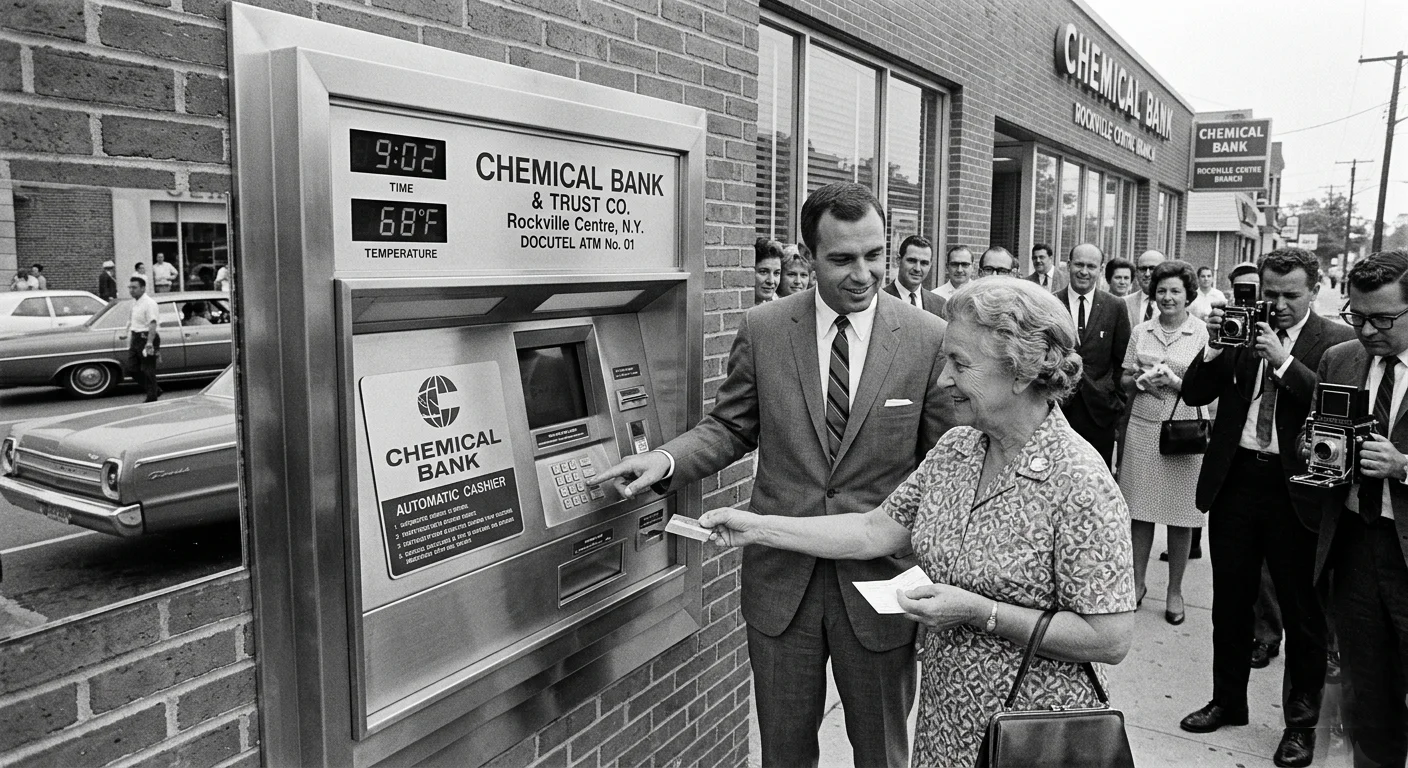
On the morning of September 2, 1969 — the same date that, twenty-four years earlier, Japan had signed its formal surrender aboard the USS Missouri in Tokyo Bay — a very different kind of revolution was quietly beginning on North Village Avenue in Rockville Centre, a small suburban community on Long Island, New York. Outside a branch of Chemical Bank, a boxy machine bolted to the exterior wall waited for its first customer. It was not beautiful by any standard of industrial design. It accepted only a single bank’s specially coded card. It dispensed cash in only one denomination and only up to one hundred dollars per transaction. It could not accept deposits, check balances, or transfer funds. But it was open. It would be open all afternoon, when the bank had closed its doors at three o’clock. It would be open at midnight. It would be open at three in the morning. It would, as Chemical Bank had boldly promised in its advertisements, open at nine o’clock that morning and never close again.
The machine that debuted at Chemical Bank’s Rockville Centre branch on September 2, 1969 — known formally as the Docuteller, named after the Dallas company that built it — was the first automatic teller machine ever deployed for public use in the United States. It was not the first cash-dispensing machine in the world: that distinction belonged to a machine installed at a Barclays Bank branch in Enfield, north London, on June 27, 1967, the invention of Scottish engineer John Shepherd-Barron. But the American ATM, conceived by Donald Wetzel while standing in a frustratingly long bank queue in Dallas, designed with two engineers at a company that normally built automated baggage-handling systems for airports, and deployed through a partnership between Docutel and Chemical Bank, was the seed from which the American ATM industry grew. From that single machine on a wall in Rockville Centre would grow a network of more than 400,000 ATMs across the United States by the turn of the twenty-first century — machines that redefined the relationship between Americans and their banks, transformed the economics of retail banking, and eventually became so embedded in daily life that it became difficult to imagine how commerce had ever functioned without them.
American Banking Before the ATM: The Rigid World of Banker’s Hours
To appreciate the significance of what happened on September 2, 1969, it is necessary to understand the banking world that preceded it — a world of rigid hours, inconvenient geography, and the fundamental assumption that access to one’s own money was a privilege available only during a narrow window of weekday daylight hours. In 1969, American banks typically opened at nine or ten in the morning and closed by three in the afternoon, with Saturday hours limited to a few hours in the morning at most. The phrase “banker’s hours” was already a cliché in American speech, a shorthand for the comfortable and inflexible schedules that the banking industry maintained at the expense of its working-class and middle-class customers, whose own working hours made daytime banking nearly impossible.
For many American workers in the late 1960s, the bank was not a routine convenience but a carefully planned expedition. Withdrawing cash required appearing in person at a branch during business hours, waiting in line — sometimes for as long as twenty or thirty minutes on busy days or near pay periods — presenting identification, completing a withdrawal slip, and waiting for a human teller to count out the bills. If you needed cash on a Friday evening, a Saturday afternoon, or at any point on a Sunday, you were simply out of luck unless you had had the foresight to withdraw it during the preceding business day. Many working-class Americans, consequently, avoided banks almost entirely: they cashed their paychecks at department stores like Sears or J.C. Penney, which offered check-cashing services as a way of drawing customers into their stores. Banks, recognizing this dynamic, hoped that any technology that made banking more convenient might attract these underbanked customers — and then upsell them on loans, credit cards, and savings accounts — without requiring the expense of extending branch hours or hiring additional tellers.
The rigidity of American banking hours in the 1960s was compounded by the geographic restrictions imposed on banking by the patchwork of federal and state banking regulations that had evolved through the twentieth century. In many states, individual banks could operate only a single branch; in others, interstate banking was entirely prohibited. The result was a banking landscape in which customers of one bank had essentially no access to their money if they were away from their home branch, because the network of interbank relationships that would eventually allow ATM customers to withdraw money from any machine anywhere did not yet exist. Banking in 1969 was intensely local, intensely personal in the sense that it required a human teller to process every transaction, and intensely inflexible in ways that a generation raised on twenty-four-hour digital access to financial accounts can barely imagine.
Donald Wetzel: The Man Who Had an Idea in a Bank Line
The story of the first American ATM begins with a moment of personal frustration that its central figure has described with the specificity that marks a memory that changed the course of a career. Donald C. Wetzel — Don Wetzel, as he has been known throughout his professional life — was in the 1960s a man of varied experience and considerable commercial intelligence. He had grown up in New Orleans, begun his professional life as a minor-league baseball player in the New York Giants organization, and eventually concluded that his talents lay elsewhere. He enrolled at Loyola University in New Orleans, earned a degree in foreign trade, and then took a job with IBM selling punch-card computer systems to banks — an experience that gave him an unusually precise understanding of what banks needed from technology and what technology could realistically deliver.
By 1968, Wetzel had left IBM and joined Docutel, a Dallas-based company that had built its business developing automated baggage-handling and transportation systems for airports. Wetzel’s title at Docutel was Vice President of Product Planning — a role that required him to think constantly about what new products the company might develop and what problems those products might solve. He was standing in a bank line in Dallas one day in 1968, waiting to make a cash withdrawal before departing on a business trip, when the idea struck him with the force of an insight that seems obvious only in retrospect. It happened, he later recalled, to be right at noon on payday for a lot of workers. The line was long and it was taking forever to get money out of an account that he knew was there. All they had to do was give it to him. He didn’t want to wait a half hour for them to give it to him. Standing there in the queue, he thought: there ought to be a machine that could do that. Something that didn’t need the bank to be open. Something that could give customers their money twenty-four hours a day, seven days a week.
The insight was not entirely unprecedented — banks had been quietly exploring the idea of automated cash dispensers for several years, and Shepherd-Barron’s machine had already been operating in London for more than a year by the time Wetzel had his epiphany in the Dallas bank line. But Wetzel’s background made him unusually well-positioned to translate the concept into a commercially viable American product. He understood both the technology side, from his IBM years of selling computer systems to banks, and the operational side, from Docutel’s expertise in automated mechanical systems for handling physical objects — in Docutel’s case, baggage, but the principles of moving, reading, and dispensing physical items reliably and at scale were directly applicable to a machine that needed to read a card, verify an account, and dispense specific denominations of banknotes without jamming, miscounting, or malfunctioning.
Building the Docuteller: Wetzel, Barnes, Chastain, and Five Million Dollars
Wetzel brought his ATM concept to Docutel’s leadership and made the case that the company should invest in developing it. His employer provided five million dollars to develop the idea — a significant commitment for a company of Docutel’s size, and a figure that reflects both the genuine technical challenge of building a reliable cash-dispensing machine and the commercial stakes involved. Wetzel assembled a small team whose expertise mapped directly onto the two core engineering challenges of the project: how to build a mechanical system that could reliably dispense banknotes on demand without jamming or misfiring, and how to build an electronic system that could read a coded card, authenticate a user, communicate with a bank’s accounting system, and authorize or deny a transaction in real time.
Tom Barnes, the chief mechanical engineer assigned to the project, was responsible for the physical mechanism of the machine — the systems for detecting, counting, and dispensing banknotes that had to work reliably thousands of times a day under conditions that ranged from the heat of summer afternoons to the cold of winter nights, operated by users of varying levels of dexterity and patience. George Chastain, the electrical engineer, was responsible for the electronic systems: the card reader, the authentication logic, the communication interface with the bank’s back-end systems, and the security mechanisms that would prevent unauthorized access or fraudulent transactions. Wetzel himself served as the project’s conceptual leader and commercial strategist — the person who kept the team focused on what a real bank customer actually needed and what a real bank would actually be willing to pay for.
The development process was not smooth. By the spring of 1969, Docutel had assembled a prototype and Wetzel began inviting bankers from various institutions to Dallas to evaluate it. The demonstrations were frequently fraught with anxiety, because the prototype was not always reliable. On one occasion, five executives from a bank in Atlanta flew to Dallas to examine the Docuteller on a day when the machine had decided not to function. Wetzel managed the situation by keeping the bankers in a conference room discussing the concept and history while engineer George Chastain worked on the machine in the adjacent room, periodically signaling to Wetzel through the partially open door whether the machine was working or not. Only when Chastain’s signal confirmed that the machine was operational did Wetzel bring the Atlanta bankers in for the demonstration. Despite such difficulties, the prototype demonstrated sufficient potential to persuade several banks that the concept was commercially viable.
The reason Chemical Bank became the launch partner for the Docuteller rather than one of the many other banks Wetzel had approached had less to do with Chemical’s specific enthusiasm for ATM technology—Chemical’s executives were initially hesitant about the electronic banking transition, concerned both about the high cost of the early machines and about the possibility that customers would resist having machines handle their money—than it did with an existing business relationship between Docutel’s parent company, Recognition Equipment Incorporated, and Chemical Bank. That prior relationship provided the trust and the communication channel that allowed Wetzel’s team to persuade Chemical that installing the first four production Docuteller machines in a marketing test was worth the financial and reputational risk. Chemical agreed, and Docutel proceeded to manufacture the machines.
September 2, 1969: The Day a Machine Opened and Never Closed
The advertising campaign that Chemical Bank ran to announce the debut of its Docuteller in Rockville Centre on September 2, 1969, was as confident as it was accurate. The bank placed advertisements announcing that on September 2, our bank will open at 9:00 and never close again — a tagline that captured with perfect precision the revolution that the ATM represented. Banking had always been about access constrained by time and geography; the ATM was about access freed from those constraints. The machine that opened on North Village Avenue that morning was literally a bank that never closed, a permanent and always-available interface between the customer and their account that required no human teller, no business hours, and no prior appointment.
The first Docuteller installed at Chemical Bank’s Rockville Centre branch was built into the exterior wall of the building, fully exposed to the weather without any surrounding enclosure — a design choice that reflected both the simplicity of the early ATM and the confidence of Docutel and Chemical Bank that weather exposure would not impair the machine’s reliability. The machine accepted only Chemical Bank’s proprietary MasterCharge card — the precursor to what would eventually become the MasterCard credit card — which customers could obtain at any Chemical Bank branch. A customer inserted the card, the machine read the encoded information on it, verified the account, dispensed the requested amount of cash up to a maximum of one hundred dollars, and returned the card. It printed a receipt recording the transaction. The process was simple, fast, and — for the customers who used it and the bank employees who watched them use it — genuinely astonishing.
Don Wetzel, who was ninety years old when he attended the fiftieth anniversary celebration at the Rockville Centre branch in 2019 — by then a JPMorgan Chase branch, Chemical Bank having been acquired by Chase in 1996 — described the experience of watching customers use the first machine with a mixture of pride and wonder. I never dreamed these machines would be all over the world, with millions being sold, he told a local newspaper at the celebration. That was above our expectations. Nassau County officials honored him at the event by declaring September 6, 2019 Donald Wetzel Day — a recognition, fifty years late but genuine, of the contribution that a man who had stood in an annoying bank line in Dallas had made to the daily lives of everyone who had ever used an ATM anywhere on earth.
The Patent and the Smithsonian: Establishing Who Invented the American ATM
The question of who deserves credit for inventing the ATM is complicated by the fact that multiple teams in multiple countries were working on similar problems in the mid-1960s, and that the evolution from a cash-dispensing machine to what we now think of as a full-function ATM took place over several years and involved contributions from many inventors, engineers, and institutions. In the American context, the formal record of credit has been established through two mechanisms: the patent system and the Smithsonian Institution’s National Museum of American History.
Donald Wetzel, Tom Barnes, and George Chastain applied for a patent for their ATM design in 1970, after the initial Rockville Centre installation had demonstrated the machine’s commercial viability. The patent was granted on June 4, 1973, formally establishing the three Docutel engineers as the inventors of record for the device. The patent covered a machine that dispensed money at the request of a person who had a plastic card with a properly encoded magnetic stripe — a description that captures what would become the standard ATM interaction worldwide, distinguishing the Wetzel-Barnes-Chastain design from the carbon-14 impregnated paper voucher system used in the Barclays-De La Rue machine and from other proprietary approaches developed around the same period.
The Smithsonian’s recognition came in 1995, when the National Museum of American History formally designated Docutel and Don Wetzel as the inventors of the networked ATM. This designation was significant because it acknowledged not just the original cash-dispensing machine of 1969 but the more ambitious follow-on development that Wetzel had pursued after the initial deployment: the networked ATM, which could communicate in real time with a bank’s central computer system, enabling account verification, real-time balance checking, and eventually the interbank connectivity that would allow any ATM to serve any customer of any participating bank. The Smithsonian’s recognition placed Wetzel and Docutel alongside James Watt, the Wright Brothers, and other inventors whose contributions to technology and industry were deemed to have had transformative national and global significance.
The Global Context: Barclays, Shepherd-Barron, and the World Before Wetzel
The world’s first cash-dispensing machine of the modern type was installed not in the United States but in the London suburb of Enfield, at a branch of Barclays Bank, on June 27, 1967 — more than two years before the Chemical Bank Docuteller opened in Rockville Centre. Its inventor was John Shepherd-Barron, a Scottish engineer who served as Managing Director of De La Rue Instruments, the banking technology subsidiary of the De La Rue Company, which was primarily known as a manufacturer of banknotes, passports, and other secure documents. Shepherd-Barron, like Wetzel, had his insight as the result of personal banking inconvenience: he arrived at his bank one Saturday morning to find it already closed, and the frustration of being locked out of his own money sparked the idea that a machine could dispense cash on demand in the way that vending machines dispensed chocolate bars.
Shepherd-Barron described approaching the General Manager of Barclays with the idea and requesting ninety seconds of his time. The reply came after eighty-five seconds: If you can make this device you are speaking about, I will buy it right now. A contract was quickly signed for the development of six machines for trial, followed by fifty more. The first machine, called the De La Rue Automatic Cash System or DACS, was inaugurated at the Enfield branch of Barclays on June 27, 1967, in a ceremony that featured English actor and comedian Reg Varney — best known for the television sitcom On the Buses — making the first cash withdrawal. The machine dispensed a maximum of ten pounds sterling at a time, which Shepherd-Barron described as quite enough for a wild weekend. It used paper cheques impregnated with trace amounts of carbon-14, a mildly radioactive isotope, which the machine’s sensors could detect; the customer entered a Personal Identification Number on a keypad to complete the transaction.
The four-digit PIN that became the global standard for ATM security owes its length to an experiment that Shepherd-Barron conducted with his wife, Caroline. He had initially proposed a six-digit PIN, but when he tested the system at home, he found that the longest string of numbers his wife could reliably remember was four digits. The four-digit standard that he adopted as a result was subsequently adopted worldwide, and it governs the ATM security systems used by billions of people today. Shepherd-Barron notably did not patent his invention, relying instead on trade secrecy to protect it — a decision that, as the ATM proliferated globally, meant that the Barclays-De La Rue design did not generate the patent royalties that Wetzel’s Docutel patent would eventually produce. He was awarded an OBE in the 2005 New Year Honours for services to banking as inventor of the automatic cash dispenser, and died in 2010 at the age of 84.
Several other inventors contributed important elements to what eventually became the modern ATM in the years around 1967 and 1969. Scottish inventor James Goodfellow, working at Smiths Industries and commissioned by Chubb Locks to develop a cash machine, patented in 1966 the concept of a Personal Identification Number stored on a reusable bank card — a crucial security innovation that would eventually be adopted universally. Swedish company Asea Metior installed a cash machine called the Bancomat in Spain in January 1969. A machine appeared in Japan in 1969. West Germany had installed a machine in Tübingen as early as May 1968. The ATM was, in the global sense, an idea whose time had come simultaneously in many places — a product of the convergence of computer technology, mechanical engineering, and the growing recognition by banks worldwide that their business model needed to extend beyond the rigid hours of the traditional branch.
How the Docuteller Worked: Technology, Cards, and the Mechanics of Dispensing Money
The Docuteller that Chemical Bank installed in Rockville Centre in 1969 was, by the standards of subsequent ATM technology, an extremely simple device. It was a cash dispenser only — it could not accept deposits, transfer funds between accounts, or provide account balance information. Its operation was straightforward: a customer inserted a Chemical Bank MasterCharge card, the machine read the encoded information stored on the card’s magnetic stripe, verified that the card was valid, dispensed a fixed amount of cash (up to one hundred dollars per transaction), and printed a receipt. The entire transaction took perhaps a minute from card insertion to cash receipt.
The magnetic stripe technology that the Docuteller used to read customer cards was one of the key innovations that distinguished the American ATM from the Barclays-De La Rue machine, which had used carbon-14 impregnated paper vouchers that were consumed in each transaction and required the bank to issue new vouchers periodically. Magnetic stripes, which could store encoded account information on a reusable plastic card, were far more practical for mass deployment — they allowed each customer to use the same card repeatedly rather than maintaining a supply of single-use vouchers. The magnetic stripe technology that Wetzel, Barnes, and Chastain developed for the Docuteller proved so effective that it became the global standard not just for ATM cards but for credit cards and eventually debit cards: the magnetic stripe that appears on the back of virtually every payment card in use around the world today has its direct lineage in the technology developed at Docutel for the first American ATM.
The cash dispensing mechanism itself was the most technically demanding component of the machine. Banknotes are not uniform objects: they vary in thickness as they wear, they can develop folds or tears, they stick together in ways that can cause miscounts, and they are handled by machines in environments that range from very cold to very hot. Building a mechanism that could reliably count out exactly the right number of notes, detect and reject damaged or stuck bills, and do this thousands of times a day without jamming or miscounting required the kind of precision engineering that Tom Barnes brought to the project from Docutel’s experience with automated baggage-handling systems. The currency dispensing technology developed for the Docuteller established principles that continue to inform the design of ATM cash dispensers to this day.
Chemical Bank’s Gamble: How a Hesitant Bank Became a Pioneer
Chemical Bank’s decision to install the first American ATM was not the product of institutional enthusiasm for new technology. According to the historical record, Chemical’s executives were initially hesitant about the electronic banking transition, concerned about two interrelated risks: the high cost of the early machines, which made the economics of deployment uncertain, and the possibility that customers would resist having machines handle their money. These were not unreasonable concerns. Cash is not merely a financial instrument; it is a physical representation of personal value, and the idea of entrusting the dispensing of cash to an unsupervised machine was, in 1969, genuinely novel. No one knew whether American bank customers would trust a machine to count their money correctly, whether they would feel comfortable inserting their bank card into a device on a public wall, or whether they would find the process less convenient than dealing with a human teller.
Chemical Bank’s approach to managing these risks was characteristically cautious: rather than committing to a broad national rollout, the bank agreed to install four Docuteller machines in a defined marketing test that would determine whether the machines worked reliably in real-world conditions, whether customers would actually use them, and whether customers would even pay a fee for the privilege of using them. The Rockville Centre installation was one of these test machines, chosen in part because of the prior business relationship between Docutel’s parent company and Chemical Bank. By choosing a suburban Long Island community rather than a Manhattan location for the first deployment, Chemical was both limiting the visibility of a potential failure and testing the technology in conditions — a quiet neighborhood bank branch rather than a high-volume urban location — where any problems with the machines could be managed without catastrophic reputational consequences.
The test proved convincingly positive. Customers used the machines in numbers that exceeded Chemical’s expectations. The machines worked reliably with only minor issues. And customers were willing to pay a fee for access — a finding of considerable commercial importance, because it suggested that the convenience of twenty-four-hour access was valued highly enough that customers would pay for it rather than simply using the ATM as a free substitute for a human teller. This last finding was perhaps the most significant for the future economics of the ATM industry: the willingness of customers to pay fees for ATM transactions would eventually, in the 1990s, become one of the most significant revenue streams in retail banking.
The Total Teller and Networked ATMs: Docutel’s Second Act
The 1969 Docuteller was, as Don Wetzel always acknowledged, merely a first step toward the machine he truly envisioned. The cash-only dispenser that opened in Rockville Centre on September 2, 1969 was useful and transformative in its way, but it could do only the single most basic thing that bank customers needed from their bank: give them cash on demand. The fuller vision — a machine that could handle the complete range of everyday banking transactions, including deposits, fund transfers, and balance inquiries — required two years of additional development.
In 1971, Docutel introduced what it called the Total ATM — a second-generation machine that could not only dispense cash but also accept deposits, transfer funds between accounts, send money to credit card accounts, and perform the range of functions that had previously required a human teller. This 1971 machine is in many respects the direct ancestor of the modern ATM: it is the point at which the automatic teller machine became truly automatic, capable of handling the full range of teller functions rather than merely the most mechanically straightforward one. The Total ATM, combined with the magnetic stripe card technology that Docutel had pioneered, created the basic architecture of the ATM system that would be deployed globally over the following decades.
The second major innovation that Wetzel and Docutel pursued after the initial deployment was the development of networked ATMs — machines that could communicate in real time with a bank’s central computer system, enabling transactions that required current account information rather than simply acting on the encoded data stored on the card. Networking the ATM was the technological development that eventually made interbank ATM transactions possible: once ATMs could communicate with central computer systems, it became possible to build the interbank networks — NYCE, PLUS, Cirrus, STAR, and others — that allowed customers of one bank to use the ATMs of another. This transformation of the ATM from a single-bank, single-branch convenience to a universal financial access point is what the Smithsonian recognized in 1995 when it designated Docutel and Wetzel as the inventors of the networked ATM.
The Spread of ATMs Across America and the World: 1970s Through 1990s
Following Chemical Bank’s lead, American banks began installing ATMs through the early 1970s in a pattern that reflected both the genuine enthusiasm of early adopters and the cautious hesitation of institutions waiting to see whether the technology would prove reliable and cost-effective. City National Bank and Trust Company introduced its own Cash ‘n Carry machine in Ohio in 1970. Chase Manhattan Bank installed its first cash machine at its Grand Central Station location in 1973 — a high-traffic urban deployment that tested the ATM’s capacity to handle volume very different from the Rockville Centre suburban test. By the mid-1970s, major banks across the United States were deploying ATMs as both a customer service amenity and a cost-reduction strategy, recognizing that a machine that could handle a cash withdrawal at a cost of a fraction of what a human teller transaction cost represented a significant long-term financial advantage.
The expansion of ATMs from individual bank machines to shared interbank networks was the development that truly transformed the technology from a banking convenience to a universal financial infrastructure. In the early years, each bank’s ATMs could only be used by that bank’s own customers with that bank’s own proprietary card. The introduction of shared ATM networks — beginning with small regional networks and eventually expanding to national and international systems — required banks that were ordinarily competitors to cooperate on the technical and operational standards that would allow their systems to interoperate. The regulatory environment also played a role: the same patchwork of federal and state banking regulations that had made American banking so geographically limited also created barriers to ATM network development, and the gradual loosening of those regulations through the 1980s and 1990s accelerated the growth of shared networks.
By the 1980s, ATMs had become not merely a convenience but a competitive necessity for American banks: customers who had experienced the ability to access their money at any time from multiple locations were increasingly unwilling to accept the limitations of banks that had not installed ATM networks. The number of ATMs in the United States grew from a few hundred in the early 1970s to approximately 100,000 by 1984 and to several hundred thousand by the early 1990s. Each major bank worked to expand its ATM network faster than its competitors, and the race to provide the most convenient access became one of the defining competitive dynamics of American retail banking. Drive-up ATMs appeared, with the first drive-through cash machine reportedly installed in Baton Rouge, Louisiana, in 1980. ATMs appeared in shopping malls, grocery stores, airports, university campuses, and eventually in corner stores and gas stations as the technology miniaturized and cheapened.
ATM Fees, Security Challenges, and Consumer Backlash in the 1990s
The 1990s brought the ATM industry to a new phase of its development, characterized by the introduction of fees and the emergence of security threats that would require both technological innovation and legislative response. The practice of charging fees to use ATMs — particularly fees charged to non-customers using another bank’s machine — began to spread through the American banking industry in the 1990s and quickly became one of the most contested issues in retail banking. Banks argued that the fees were necessary to recover the costs of building and maintaining ATM networks. Consumers argued that being charged to access their own money was an outrage, particularly when the ATM was simultaneously saving the bank the cost of a human teller transaction.
The anger generated by ATM fees — particularly the double fee charged when a customer used another bank’s ATM, paying a fee to both their own bank and the machine’s owner — produced a sustained consumer backlash and eventually drew the attention of legislators and regulators. New York State passed the ATM Safety Act in 1996, requiring banks to install surveillance cameras, reflective mirrors, and locked entryways for their ATMs — a response not to fees but to the second major challenge of the 1990s ATM landscape, which was crime. As ATMs became ubiquitous, they became targets: both for straightforward robbery of people using poorly lit or isolated machines and for increasingly sophisticated electronic fraud schemes that targeted the personal identification numbers and account information that the machines processed.
Criminal organizations developed techniques for attaching skimming devices to ATM card readers that could capture the magnetic stripe data from cards inserted into the machine, combined with tiny cameras that recorded customers entering their PINs. These captured data sets could then be used to create counterfeit cards and access the victims’ accounts. The arms race between ATM security engineers and criminals who found ways to defeat new security measures became one of the defining technical challenges of the ATM industry from the 1990s onward, driving the eventual transition from magnetic stripe technology to chip-and-PIN systems in Europe and, eventually, the United States.
The ATM’s Legacy: How One Machine Reshaped Banking, Commerce, and Daily Life
The long-term impact of the ATM on American banking and daily life has been profound in ways that go well beyond the obvious convenience of twenty-four-hour cash access. The ATM fundamentally altered the economics of retail banking by enabling banks to handle millions of routine transactions — cash withdrawals, balance inquiries, transfers between accounts — at a tiny fraction of the cost of equivalent human teller transactions. The cost efficiency of ATM transactions, compared to branch teller transactions, created both an economic incentive for banks to expand ATM networks aggressively and a pressure on the traditional bank branch model: if customers could handle their everyday banking at an ATM, the number of branches and tellers a bank needed could be substantially reduced.
The ATM also changed the geography of cash in American daily life in ways that reshaped commerce broadly. Before the ATM, cash was a scarce resource that required advance planning: you had to visit a bank during business hours to obtain it, and if you ran out on a weekend or evening, you faced the choice of finding a check-cashing service, borrowing from a friend, or doing without. The ATM abolished cash scarcity as a practical reality for anyone with a bank account, making cash as accessible as any vending machine product. This transformation had significant effects on consumer spending patterns, on the business models of cash-intensive industries like restaurants, entertainment, and retail, and on the broader relationship between Americans and their personal finances.
The magnetic stripe technology developed for the Docuteller had an impact that extended far beyond the ATM industry. The decision by Wetzel, Barnes, and Chastain to encode account information on a magnetic stripe attached to a plastic card established the technical architecture for the payment card industry as a whole. Credit cards, debit cards, and eventually the electronic payment systems that now handle trillions of dollars in transactions annually all built on the foundation of magnetic stripe card technology. When the Smithsonian recognized Wetzel as the inventor of the networked ATM in 1995, it was acknowledging not just the machine that had opened in Rockville Centre in 1969 but the entire infrastructure of electronic payments that had grown from it.
From Rockville Centre to the World: The ATM as Global Infrastructure
By the turn of the twenty-first century, the ATM had become one of the most widely distributed pieces of financial infrastructure on earth. The roughly 2.2 million ATMs estimated to be in service globally in the early 2000s represented a network of financial access points that touched virtually every country and served users in hundreds of languages. The interbank networks that connected these machines — Cirrus, PLUS, STAR, LINK, and their regional equivalents — had made it possible for a traveler with a bank card from a small community bank in rural Iowa to withdraw local currency from an ATM in Tokyo, London, or Buenos Aires. The vision that Don Wetzel had described as above our expectations when he stood in Rockville Centre for the fiftieth anniversary had been fulfilled and exceeded in ways that would have been genuinely difficult to imagine on the morning of September 2, 1969.
The globalization of the ATM was also a story of cultural adaptation and localization. Different countries adopted ATMs at different rates and in different ways: Japan developed some of the most sophisticated ATM functionality in the world, with machines that could handle bill payments, mobile phone top-ups, and a wide range of financial services far beyond simple cash withdrawal. European countries, which generally moved to chip-and-PIN card technology earlier than the United States, developed ATM security standards that became models for global best practice. Developing countries found in the ATM a way to extend financial services to populations that had previously been entirely unserved by formal banking, with mobile ATMs and ATMs in remote rural areas bringing access to accounts for the first time to people who had no realistic way to visit a traditional bank branch.
Conclusion: The Machine That Opened at Nine and Never Closed Again
In 2019, when Don Wetzel traveled from his Dallas home to Rockville Centre for the fiftieth anniversary celebration of the first American ATM, he was ninety years old and had lived long enough to see the machine he had conceived in a bank line become one of the most ubiquitous pieces of infrastructure in human daily life. The branch of JPMorgan Chase on North Village Avenue — the successor institution to Chemical Bank, which had been acquired by Chase in 1996 — hosted a celebration attended by local officials, community members, and the inventor himself, who was honored by Nassau County’s declaration of Donald Wetzel Day. The original machine, of course, was long gone: the Docuteller that had dispensed cash from that exterior wall in September 1969 had been replaced by successive generations of increasingly capable machines, each more connected, more secure, and more functional than the last.
What remained, and what the celebration honored, was not the machine itself but the idea it had embodied — the idea that access to one’s own money should not be constrained by the hours of a bank’s staffing schedule, that the relationship between a person and their financial institution should be available on demand rather than at the institution’s convenience, and that a machine could be trusted to perform accurately and reliably the simple but essential function of dispensing the cash that daily life requires. That idea, which Wetzel had had while standing in an annoying line in Dallas in 1968, which Barnes and Chastain had turned into working machinery over eighteen months of engineering work, and which Chemical Bank had been bold enough to deploy on a wall in Rockville Centre on September 2, 1969, had spread to more than three million machines in every country on earth and had become so completely integrated into the infrastructure of daily life that it had ceased to be remarkable.
That, ultimately, is the measure of the ATM’s success: not that anyone celebrates it, but that no one thinks about it anymore. The machine that opened at nine on September 2, 1969, and never closed again has become as invisible as running water and electric light — one of the taken-for-granted conveniences that defines modern life precisely because it is always there, always working, asking nothing of us except a four-digit number that a Scottish engineer chose because his wife could not remember more than four digits at a time.