
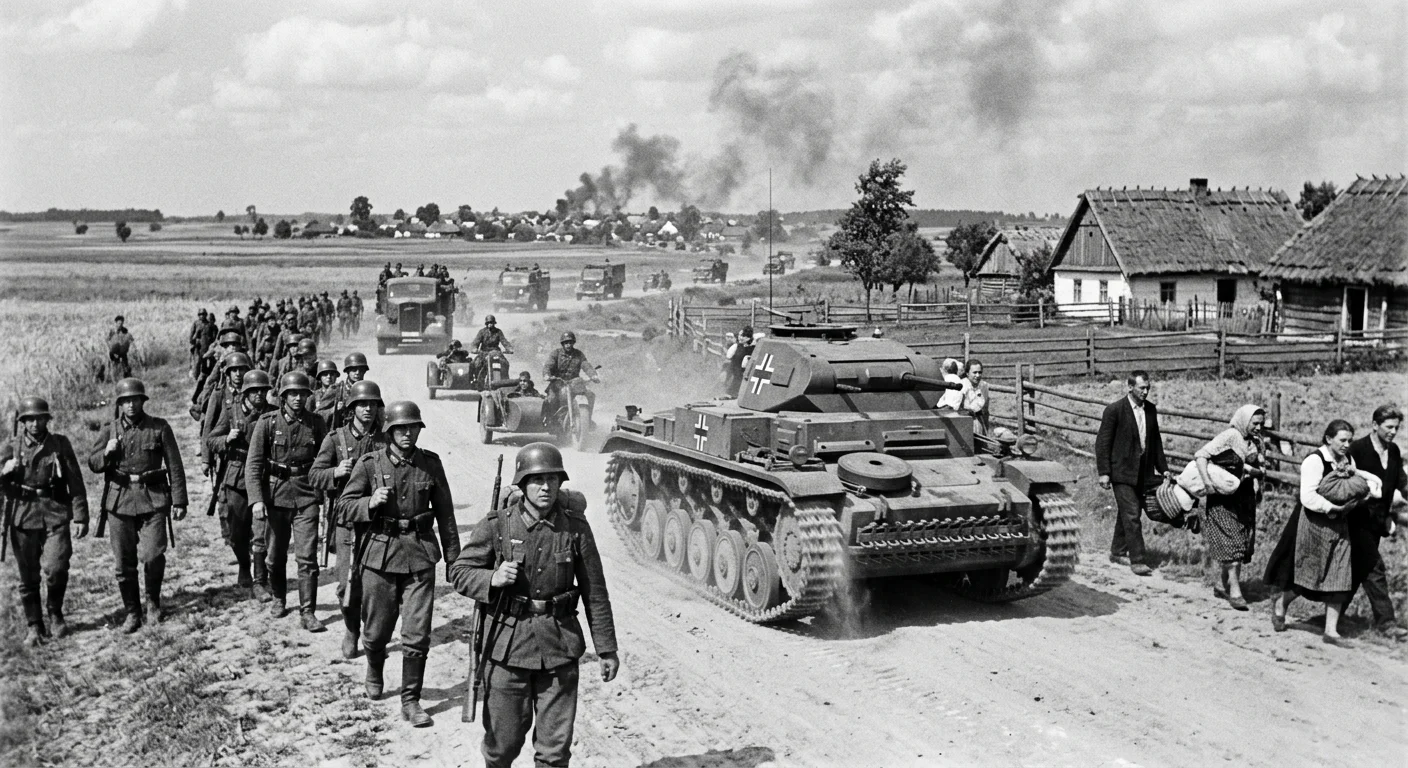
In the gray pre-dawn darkness of September 1, 1939, at precisely 4:45 in the morning, the German battleship Schleswig-Holstein opened fire on the Polish military transit depot at Westerplatte, in the harbor of the Free City of Danzig. Within the same hour, 62 German divisions comprising approximately 1.5 million men, supported by more than 1,300 aircraft of the Luftwaffe, crossed the Polish border simultaneously from the north, west, and south in the most powerful coordinated military assault that Europe had ever seen. The German artillery, the Stuka dive bombers, the Panzer tank columns, and the motorized infantry poured into Poland with a speed and ferocity that the Polish defenders, outnumbered and outgunned in almost every category of modern weapons, were wholly unprepared to resist. World War II — the most destructive conflict in human history, which would ultimately kill between 70 and 85 million human beings over six years — had begun.
Adolf Hitler had ordered the commencement of hostilities against Poland the previous day, at 12:40 in the afternoon of August 31, 1939, with the command that operations were to begin at 4:45 the following morning. The order was the culmination of years of ideological preparation, months of diplomatic maneuvering, and weeks of military planning that had positioned Germany for what Hitler called Fall Weiss — Case White — the operational plan for the conquest and destruction of the Polish state. Justifying the attack to his generals and to the German public, Hitler claimed that Poland had provoked the invasion, that Germans living in Poland had been subjected to systematic persecution, and that Germany had no choice but to defend itself. Every element of this justification was a deliberate lie, constructed by the Nazi propaganda machine under Joseph Goebbels with the express purpose of obscuring the aggressive and predatory nature of an invasion whose true goals — the destruction of Poland as a state, the elimination of its educated classes, the enslavement of its population, and the annexation of its territory as Lebensraum for German colonization — had been stated with remarkable candor in Hitler’s private conversations with his military commanders.
The Treaty of Versailles, Hitler’s Rise to Power, and the Road to War
The origins of the German invasion of Poland reach back twenty years before September 1, 1939, to the settlement that ended the First World War and the grievances that settlement embedded in German national consciousness. The Treaty of Versailles, signed in June 1919, imposed on Germany the guilt of causing the war, required the payment of enormous reparations, limited the German army to 100,000 men, stripped Germany of its overseas colonies, and — most consequentially for the events of 1939 — transferred substantial German-inhabited territory to neighboring states. Poland, reconstituted as an independent state after more than a century of partition, received the province of Posen (Poznań), portions of West Prussia, and the contentious Polish Corridor — a strip of land connecting Poland to the Baltic Sea and separating the main body of Germany from its eastern province of East Prussia. The port city of Danzig, with its overwhelmingly German population, was designated the Free City of Danzig under the protection of the League of Nations, nominally independent but economically integrated with Poland and deeply resented by German nationalists who considered it as much a German city as Hamburg or Cologne.
The resentments generated by the Versailles settlement, combined with the catastrophic economic devastation of the Great Depression after 1929, created the political conditions in which Adolf Hitler’s National Socialist German Workers’ Party rose from a fringe movement to the dominant political force in Germany. Hitler was born on April 20, 1889, in Braunau am Inn, Austria, the son of a minor customs official. He had failed in his ambitions as an artist, served as an undistinguished corporal in the First World War, and developed in the years after Germany’s defeat a ferocious racial ideology that attributed Germany’s defeat to betrayal by Jews and communists — the stab-in-the-back legend that provided a psychologically satisfying but factually baseless explanation for the humiliation of German military failure. His 1925 memoir and ideological manifesto Mein Kampf set out his worldview with unusual clarity: Germany’s destiny lay in territorial expansion to the east, to acquire the Lebensraum — living space — that he believed the German master race required, at the expense of the Slavic peoples whom he regarded as racially inferior and suitable for either enslavement or extermination.
Hitler was appointed Chancellor of Germany on January 30, 1933, by President Paul von Hindenburg, who hoped to use him as a tool to restore political stability while believing that the constitutional machinery of the Weimar Republic would constrain his most extreme ambitions. This calculation proved catastrophically wrong. Within months, Hitler had used the Reichstag fire of February 1933 and the subsequent Enabling Act to transform Germany into a totalitarian one-party state. By 1935 he had openly repudiated the Versailles armament restrictions and begun the rearmament of Germany on a massive scale. In 1936 he remilitarized the Rhineland. In March 1938 he annexed Austria in the Anschluss. In September 1938 he obtained the Sudetenland — the German-speaking borderlands of Czechoslovakia — through the Munich Agreement, in which British Prime Minister Neville Chamberlain and French Prime Minister Édouard Daladier, desperate to avoid another war and believing Hitler’s claim that the Sudetenland was his final territorial demand, agreed to the transfer. Chamberlain returned to Britain waving the agreement and declaring he had achieved peace for our time. In March 1939, Hitler dismantled what remained of Czechoslovakia entirely, occupying Bohemia and Moravia and establishing a puppet state in Slovakia. Poland was next.
The Molotov-Ribbentrop Pact: The Secret Agreement That Made War Possible
The greatest strategic obstacle to a German attack on Poland was the possibility that the Soviet Union — Poland’s eastern neighbor and, potentially, Germany’s most dangerous adversary — might intervene to prevent German dominance of Eastern Europe. Hitler’s public ideology had been ferociously anti-communist and anti-Soviet, and the ideological gulf between National Socialism and Soviet Communism seemed to make any diplomatic arrangement between the two regimes essentially inconceivable. Yet it was precisely this inconceivability that made the agreement Hitler sought so diplomatically powerful when it was achieved: nothing would shock the Western democracies more deeply than discovering that the two ideological enemies of European civilization had reached an accommodation.
Secret negotiations between Berlin and Moscow accelerated through the summer of 1939 as Hitler pressed for an agreement that would free him to attack Poland without risk of Soviet opposition. Stalin had been attempting to negotiate a collective security arrangement with Britain and France that might deter Hitler, but the British and French response was halfhearted at best — they sent a delegation to Moscow by slow passenger ship rather than by aircraft, communicating their lack of urgency — and Stalin ultimately concluded that his interests were better served by an accommodation with Germany than by alliance with Western powers who seemed unwilling to fight. On August 23, 1939, German Foreign Minister Joachim von Ribbentrop flew to Moscow and signed, in the presence of Soviet leader Joseph Stalin, the Treaty of Non-Aggression between Germany and the Soviet Union — the Molotov-Ribbentrop Pact, named for the Soviet Foreign Minister Vyacheslav Molotov and Ribbentrop.
The public text of the Molotov-Ribbentrop Pact was a ten-year non-aggression agreement between two powers that pledged not to attack each other or support any third party that attacked the other. This alone shocked Europe, but the more consequential element was the secret additional protocol that was appended to the public agreement and kept hidden from the world until the Nuremberg trials revealed its existence in 1945 — a revelation that the Soviet Union denied until 1989, when Mikhail Gorbachev finally acknowledged its authenticity. The secret protocol divided Eastern Europe into German and Soviet spheres of influence. Finland, Estonia, Latvia, and Bessarabia (eastern Romania) fell into the Soviet sphere. Lithuania fell into the German sphere, though a subsequent amendment in September 1939 transferred Lithuania to the Soviets in exchange for expanded German control over central Poland. Most critically for the immediate events of September 1939, Poland was to be divided between the two powers: Germany would receive the western portion and the Soviet Union the eastern portion, with the dividing line approximately along the rivers Narew, Vistula, and San.
The practical effect of the Molotov-Ribbentrop Pact was to guarantee that Germany could attack Poland without facing a Soviet military response, and that after Poland’s defeat the two powers would share the spoils. Hitler, who had been willing to accept almost any terms to secure this agreement before his planned invasion, had gotten exactly what he needed. The news of the pact’s signing, announced on August 24, 1939, produced the stunned consternation in London, Paris, and Warsaw that Hitler had anticipated. The British response was to accelerate their military commitments to Poland: on August 25, Britain and Poland formalized their existing military guarantee into a full Treaty of Mutual Assistance, which temporarily caused Hitler to postpone the invasion that had originally been scheduled to begin on August 26. But Hitler’s determination was unshakeable. On August 31, 1939, at 12:40 in the afternoon, he signed the order for the commencement of hostilities. Operation Fall Weiss would begin the following morning.
Operation Himmler and the Gleiwitz Incident: The Lie That Started a World War
Hitler and his propaganda apparatus had long understood that the German public, while supportive of German expansion in principle, might have reservations about a war that was plainly aggressive and unprovoked. They had also calculated that if Germany could be presented as the victim of Polish aggression rather than the perpetrator of German aggression, the moral standing of the war would be improved both domestically and internationally. This calculation produced one of the most cynical and historically significant false-flag operations ever conducted: Operation Himmler, a series of staged incidents along the German-Polish border that were designed to give Hitler the pretext he needed to claim that Poland had attacked Germany first.
The most infamous of these staged provocations was the Gleiwitz incident, which occurred on the night of August 31, 1939 — the night before the invasion. A group of SS operatives under the command of Sturmbannführer Alfred Naujocks, acting under orders from SS-Obergruppenführer Reinhard Heydrich and the head of the Gestapo Heinrich Müller, dressed themselves in Polish uniforms, seized the Gleiwitz radio station near the German-Polish border, and broadcast a short anti-German message in Polish before abandoning the station. To provide a convincing body as evidence of a Polish attack, the Gestapo had previously arrested Franciszek Honiok, a local Silesian German farmer known to be sympathetic to Poland, who was drugged and then shot at the radio station. His corpse was left as what the Germans called Konserve — canned goods, the operational term for murdered concentration camp prisoners brought to staged incidents to serve as prop victims. The body was presented to journalists and investigators the following morning as evidence of a Polish attack on a German radio station.
Hitler made use of the Gleiwitz incident immediately. In his broadcast to the German nation on the morning of September 1, 1939, announcing the commencement of hostilities, he claimed that since 5:45 in the morning Poland had been returning fire — a reference to the staged provocations — and declared that Germany had no choice but to respond to Polish aggression. The propaganda machine of Joseph Goebbels amplified these lies across German and international media. The cynicism of the operation was revealed in full at the Nuremberg trials, when Naujocks testified under oath about the planning and execution of the false-flag attack. The Gleiwitz incident stands as one of the clearest documented examples in history of a government deliberately manufacturing a pretext for a war it had already decided to fight, using the deaths of its own citizens as stagecraft.
The Military Balance: Blitzkrieg Against a Valiant but Overwhelmed Defense
The military disparity between Germany and Poland in September 1939 was stark, though the invasion was by no means the walkover that German propaganda portrayed or that some subsequent historical accounts have implied. Germany deployed approximately 1.5 million troops in two Army Groups: Army Group North under Colonel-General Fedor von Bock, attacking from Pomerania and East Prussia toward Warsaw and the river crossings, and Army Group South under Colonel-General Gerd von Rundstedt, attacking from Silesia and Slovakia toward Warsaw from the southwest. The Wehrmacht committed 62 divisions, including 6 Panzer divisions with approximately 2,500 tanks, and the Luftwaffe provided 1,300 to 1,600 aircraft in support. The operational plan, developed by Colonel-General Franz Halder, the Chief of the General Staff, and Walter von Brauchitsch, the Commander-in-Chief of the Army, called for a rapid encirclement of the main Polish forces west of the Vistula River before they could withdraw to defensible positions in the east.
Poland mobilized approximately 950,000 troops organized into about 39 divisions and 11 cavalry brigades. The Polish military had significant disadvantages in armor, aircraft, and motorized transport, though Polish soldiers were well-trained and fought with extraordinary courage throughout the campaign. Poland had approximately 600 aircraft at the beginning of the campaign, many of them obsolescent, and roughly 600 tanks and tankettes, most of which were inferior to German Panzers. The Polish strategic plan called for forward defense of the western provinces — abandoning them immediately would have surrendered Polish industrial capacity and population centers — followed by a withdrawal to the Vistula line and a defensive posture in the southeast pending the anticipated relief offensive from Britain and France in the west. The problem with this plan was that it depended on France and Britain launching a major offensive against Germany’s weakly defended western frontier within weeks of the invasion’s commencement — an offensive that never materialized.
What foreign observers later called Blitzkrieg — lightning war — was not a formally codified German military doctrine in September 1939 but rather an approach to combined-arms warfare that German military theorists had been developing through the 1930s, drawing on lessons from the First World War and the thinking of innovators like Heinz Guderian, who had championed the concentrated use of armored forces as the primary striking element rather than as infantry support. The essence of the approach was speed and penetration: use air power to destroy the enemy’s air force on the ground and then provide tactical support for ground forces, use Panzer columns to punch through weak points in the enemy’s line and drive deep into the rear, disrupting communications and supply rather than destroying every defended position in sequence, and follow with motorized infantry to exploit the breaches and encircle the disrupted enemy formations. Against Poland, this approach worked with devastating effectiveness.
The Stuka dive bombers — the Junkers Ju 87, with its distinctive inverted gull wings and fixed undercarriage — became the symbol of the German onslaught, screaming down on Polish columns, bridges, railways, and supply depots with a terrifying accuracy and an equally terrifying psychological effect produced by the air-actuated sirens the Germans had fitted to the Stukas’ undercarriage legs. The first Polish city to be bombed was Wieluń, struck on September 1 at 4:40 in the morning — five minutes before the scheduled commencement of hostilities, when the Luftwaffe began its attack even before the ground invasion was officially underway. More than 1,200 civilians died in Wieluń on that first morning, many of them in the town’s hospital, which was destroyed despite bearing visible Red Cross markings. This opening atrocity set the character of the entire campaign: from the beginning, Hitler had instructed his commanders to wage the war with the greatest brutality and without mercy, and the German military executed this instruction thoroughly.
The Battle of Westerplatte and the Polish Resistance: Seven Days Against Three Thousand
The German attack at Westerplatte — the small Polish military transit depot at the entrance to the harbor of Danzig — became one of the most celebrated episodes of Polish military resistance in the entire war, a symbol of the courage with which Polish soldiers fought against overwhelming odds throughout the campaign. The depot was garrisoned by a mere 209 Polish soldiers under Major Henryk Sucharski, and subsequently under his deputy Captain Franciszek Dąbrowski after Sucharski suffered a nervous breakdown under the stress of the opening bombardment. Against this tiny garrison, the Germans deployed approximately 3,500 soldiers, naval support from the Schleswig-Holstein’s 28-centimeter guns and other vessels, and Luftwaffe bombing raids that continued throughout the siege.
The German military had expected to take Westerplatte within a matter of hours on September 1 — the standard assumption was that the depot would fall in twelve hours at most. The Polish garrison held out for seven days, repeatedly repulsing German infantry assaults, enduring constant naval bombardment and aerial attack, and maintaining resistance against a force more than fifteen times their own size until September 7, when their ammunition was nearly exhausted, their casualties were mounting, and further resistance served no military purpose. The defense of Westerplatte was not strategically decisive — the campaign’s outcome was never in doubt — but it demonstrated that Polish soldiers could fight with extraordinary effectiveness against superior forces and became, in subsequent Polish historical memory, one of the foundational myths of national resistance. The German command treated Sucharski’s garrison with the honors of war upon their surrender, recognizing the exceptional character of their defense.
The Battle of the Bzura: Poland’s Greatest Counterattack
The Polish military campaign was not a passive collapse before the German onslaught. The Battle of the Bzura, fought from September 9 to September 22, 1939, was the largest single engagement of the entire Polish campaign and one of the largest battles in the opening phase of the Second World War, representing a major Polish counterattack that temporarily halted the German advance and threatened to disrupt the entire German operational plan. Polish Army Poznań, under General Tadeusz Kutrzeba, and elements of Army Pomerania, recognizing that the German advance was leaving their flank exposed as it drove on Warsaw, launched a coordinated attack southward across the Bzura River toward the rear of the German units pressing on Warsaw. The initial Polish attacks achieved significant local successes, capturing German positions and prisoners and momentarily destabilizing the German 8th Army.
The German response was rapid and overwhelming, committing forces from multiple directions including Panzer units that were redeployed from other sectors of the front. The Luftwaffe was particularly devastating in the battle, with German aircraft conducting continuous close air support operations against Polish columns caught in the open terrain along the Bzura. Despite these pressures, the Polish forces fought with remarkable tenacity for two weeks before the Germans finally broke through and surrounded the Polish armies in what became one of the war’s most dramatic encirclements. Over 100,000 Polish soldiers were captured in the Battle of the Bzura. A portion of the trapped forces managed to break through the German encirclement and fight their way to Warsaw, continuing to resist there until the capital’s surrender. The Battle of the Bzura demonstrated both the fighting quality of the Polish military and the ultimately insuperable combination of German advantages in firepower, air power, and operational mobility.
The Siege of Warsaw: Bombing a City Into Submission
Warsaw, the Polish capital and a city of approximately 1.3 million people, became the symbol of Polish resistance when General Juliusz Rómmel declared it a fortress on September 8, 1939, as German armored units reached its outskirts. The defense of Warsaw was conducted by approximately 140,000 Polish soldiers, supplemented by a civilian militia of tens of thousands of Warsaw residents who took up arms to defend their city. Against them, the Germans deployed approximately 175,000 soldiers, 1,000 artillery pieces, and 1,000 aircraft. Despite this enormous disparity, the Warsaw garrison repelled three major German assaults between September 8 and September 15, with Polish defenders showing extraordinary resourcefulness — improvising anti-tank weapons from Molotov cocktails, using knowledge of the city’s streets and buildings to compensate for their material inferiority.
Hitler, frustrated by Warsaw’s continued resistance, ordered on September 25, 1939, that the city be subjected to maximum bombardment. The Luftwaffe dropped approximately 560 tons of high-explosive bombs and 72 tons of incendiary firebombs on Warsaw that day alone, reducing much of the city to rubble and killing thousands of civilians in one of the most intensive aerial attacks on a civilian population that had yet occurred in European history. Polish composer Władysław Szpilman, who would later write the memoir that became the basis for Roman Polanski’s film The Pianist, survived the bombing and recorded the terror of the raids — the noise of explosions merging with the constant thunder of guns, the destruction of buildings that had stood for centuries. The city’s water supplies were cut, its food stores depleted, its hospital overwhelmed with casualties. Warsaw surrendered on September 27, 1939, after a siege of more than three weeks, with a final death toll among civilians of over 20,000.
September 3, 1939: Britain and France Declare War on Germany
The German invasion of Poland on September 1, 1939, triggered the diplomatic responses that transformed a German-Polish conflict into a world war. Britain and France had issued formal guarantees to Poland on March 31, 1939, in the aftermath of Germany’s absorption of Czechoslovakia, pledging to support Poland if its independence were threatened. These guarantees had been transformed into a formal Anglo-Polish Mutual Assistance Treaty, signed on August 25, 1939. When the invasion began on September 1, both governments faced the choice of honoring their commitments to Poland or accepting yet another humiliating capitulation to Nazi aggression.
Prime Minister Neville Chamberlain, the architect of the Munich Agreement and the policy of appeasement, delivered the British ultimatum to Germany on September 3, 1939: unless Germany withdrew its forces from Poland by 11:00 in the morning, Britain would consider itself at war. No response came. At 11:15 in the morning on September 3, Chamberlain broadcast to the British nation by BBC radio: This morning the British Ambassador in Berlin handed the German Government a final note stating that unless we heard from them by 11 o’clock that they were prepared at once to withdraw their troops from Poland, a state of war would exist between us. I have to tell you now that no such undertaking has been received and that consequently this country is at war with Germany. France followed with its own declaration of war at 5:00 in the afternoon of the same day. The war that almost every adult in Europe had feared since 1933 had finally come.
The declarations of war by Britain and France did not translate into immediate military action to relieve Poland. The French army, with approximately 40 divisions on the Franco-German border facing a German force of perhaps 25 divisions (the bulk of the Wehrmacht being committed in Poland), could have launched a potentially war-winning offensive into Germany’s poorly defended Saar region in the first weeks of September 1939, when the German command itself feared that such an attack might succeed. Instead, the French launched only a minor probing operation — the Saar Offensive, involving perhaps 11 divisions — that advanced a few kilometers into German territory, encountered token resistance, and was halted before any significant engagement. By mid-October 1939, the French had withdrawn even this limited advance. The reasons for this failure of nerve — French military doctrine, the defensive mindset induced by the Maginot Line, political timidity, the residual hope for a negotiated settlement — are complex, but their consequence was that Poland was abandoned to fight its two-front war alone.
The Soviet Stab in the Back: Stalin’s Invasion on September 17, 1939
On September 17, 1939, as the Polish military was still fighting on multiple fronts but its strategic position was clearly desperate, the Soviet Red Army crossed Poland’s eastern border with a force of over 800,000 troops, approximately 4,700 tanks, and 3,300 aircraft. Soviet Foreign Minister Molotov provided a diplomatic pretext that was only marginally less cynical than Hitler’s Gleiwitz fabrication: he claimed that the Polish state had ceased to exist as a result of the German invasion, and that the Soviet Union was therefore obligated to protect the Ukrainian and Belarusian minorities in eastern Poland who were now left without a state to defend their rights. The claim that the Soviet Union was acting as a protector of minorities rather than as an aggressor was, of course, transparently false: the Soviet invasion was the direct fulfillment of the secret protocol of the Molotov-Ribbentrop Pact, executed as planned in the agreement reached with Hitler’s government six weeks earlier.
The Polish government, which had been attempting to organize a last-ditch defense in the southeastern corner of the country — the so-called Romanian Bridgehead strategy, which would have allowed continued resistance from Romanian territory until the anticipated Anglo-French offensive from the west — recognized that the Soviet invasion rendered this plan impossible. President Ignacy Mościcki and Marshal Edward Rydz-Śmigły, Poland’s Commander-in-Chief, ordered the evacuation of the government across the Romanian border on the night of September 17, intending to reach France and continue the fight from Allied territory. The government-in-exile that was eventually established would fight throughout the war, contributing Polish forces to the Allied campaigns in France, North Africa, Italy, and Western Europe, and Polish airmen who escaped to Britain played a significant role in the Battle of Britain in the summer of 1940.
The Soviet and German forces met near Brest-Litovsk, deep in central Poland, on September 17, 1939, and conducted a joint military parade that the German and Soviet commanders reviewed together — a ceremony of unprecedented collaboration between the two totalitarian empires that were carving a sovereign European state between them. Polish resistance on multiple fronts continued until October 6, when the last major Polish military unit surrendered after the Battle of Kock. Poland had never formally surrendered as a state — the Polish government was now in exile and continued to exercise legal sovereignty — but the military campaign that had begun on September 1 was over. The entire campaign, from the first shots at Westerplatte to the last resistance at Kock, had lasted 35 days.
The Partition of Poland: Division and Annihilation Under Two Occupations
On September 29, 1939, Germany and the Soviet Union signed the German-Soviet Frontier Treaty, finalizing the partition of Poland between them. The dividing line was set along the Bug River, somewhat further east than the original Molotov-Ribbentrop protocol had specified — in exchange for this adjustment, Germany transferred Lithuania to the Soviet sphere of influence. Germany annexed western Poland directly into the Reich, incorporating the provinces of West Prussia, Poznań (renamed Warthegau), Upper Silesia, and Danzig and subjecting their populations immediately to the full apparatus of Nazi racial law. The remaining German-occupied territory — the center of Poland, including Warsaw, Kraków, Radom, and Lublin — was organized as the Generalgouvernement, or General Government, a colonial-style administration headed by Hans Frank, who ruled from Kraków with the explicit goal of exploiting Polish territory and labor for German war purposes while reducing the Polish population to a state of servitude.
The German occupation of Poland was characterized from its beginning by extraordinary violence against the civilian population — violence that was not merely a side effect of military operations but an explicit and planned policy element. Hitler had told his military commanders before the invasion: Men, women, and children of Polish descent or language are to be killed without pity. The campaign was to be carried out with the greatest brutality and without mercy. The Einsatzgruppen — SS death squads — followed the Wehrmacht into Poland and immediately began the systematic execution of Polish political leaders, Catholic clergy, professionals, academics, and intellectuals in an operation known as the Intelligenzaktion. During 1939 and 1940, over 60,000 members of the Polish intelligentsia were executed. The logic of Nazi racial ideology held that eliminating Poland’s educated elite would prevent organized resistance and reduce the Polish population to the useful but politically inert workforce that German colonization plans envisioned.
Poland’s 3.3 million Jews — the largest Jewish population in Europe, approximately ten percent of Poland’s total population and nearly one-third of the world’s Jewish population at the time — were subjected from the first day of the occupation to systematic discrimination, expropriation, physical violence, and ultimately the most systematic genocide in human history. The German occupation of Poland became the primary theater of the Holocaust: the death camps of Auschwitz-Birkenau, Treblinka, Sobibor, Bełżec, Chelmno, and Majdanek were all located on Polish soil, and the overwhelming majority of the six million Jews murdered by the Nazi state were killed in Poland or were transported to Polish death camps from across occupied Europe. The Soviet occupation of eastern Poland, while less exterminatory in its immediate methods, subjected the populations under Soviet control to deportations, mass arrests, and the Katyn massacre of April-May 1940, in which Soviet NKVD forces executed approximately 22,000 Polish military officers, police, and intellectuals in the Katyn forest and other locations.
The Military and Political Lessons of the Polish Campaign: Blitzkrieg Changes Warfare
The German conquest of Poland in September 1939 was studied with varying degrees of comprehension and appropriate alarm by every military in the world. The speed of the German victory — a country of 35 million people and a military of nearly a million men defeated in five weeks — demonstrated capabilities that most military establishments had not anticipated and that revealed the extent to which the First World War’s model of static, attritional warfare had been superseded by a new approach to mobile, combined-arms combat. The coordinated use of armored units, motorized infantry, and close air support to achieve rapid penetrations and encirclements rather than sustained frontal engagements was the defining operational characteristic of the German campaign, and it set the template for the war that followed in Western Europe in 1940, in North Africa, and in the Soviet Union.
The German military itself drew lessons from the Polish campaign that were applied in subsequent operations. The Panzers had performed better than many conservative German generals had expected, validating the doctrine of concentrated armored warfare that Guderian and others had championed. The Luftwaffe’s tactical bombing had been devastatingly effective against Polish communications, supply lines, and troop concentrations. But the campaign had also revealed vulnerabilities: the German army’s logistical systems had been strained by the pace of the advance; the infantry had sometimes fallen behind the armor, creating dangerous gaps; and the Polish Army, though defeated, had fought considerably harder than Germany’s earlier bloodless conquests of Austria and Czechoslovakia had suggested it might. The Polish campaign was a proof of concept for Blitzkrieg warfare, but it was also a reminder that warfare against a determined and armed opponent was categorically different from the diplomatic conquests that had preceded it.
The Polish Government-in-Exile and the Continuation of Polish Resistance
The defeat of Poland in September 1939 did not end Polish participation in the Second World War — it transformed it. The government-in-exile, initially established in Paris under Prime Minister Felicjan Sławoj Składkowski and then under Władysław Sikorski after the fall of France in 1940, eventually relocated to London, where it maintained the legal continuity of the Polish state and organized Polish military forces that fought alongside the Allies for the remainder of the war. The Polish armed forces-in-exile contributed approximately 200,000 soldiers to the Allied war effort, fighting in the Battle of Britain (where Polish pilots were credited with shooting down more German aircraft per capita than any other national group in the Royal Air Force), in the North African campaign, in the Italian campaign including the famous assault on Monte Cassino in May 1944, and in Normandy and subsequent operations in Western Europe.
Within occupied Poland itself, the resistance movement — the Polish Underground State — was the most extensive and sophisticated clandestine resistance organization in any German-occupied country. The Armia Krajowa (Home Army), at its peak numbering perhaps 400,000 members, conducted sabotage, intelligence collection, and eventually armed operations against the German occupation, culminating in the Warsaw Uprising of August to October 1944, in which approximately 150,000 Poles died fighting the Germans and the city was systematically destroyed on Hitler’s orders after the uprising’s suppression. The contribution of Polish military intelligence to the Allied war effort was also extraordinary: it was Polish cryptanalysts who first broke the German Enigma cipher before the war, providing the foundation on which British codebreakers at Bletchley Park built the ultra intelligence program that was arguably the single most important Allied intelligence advantage of the war.
The Human Cost of Germany’s Invasion: Millions Dead and a Nation Destroyed
The ultimate human cost of Germany’s invasion of Poland was staggering beyond any historical precedent. Over the course of the German and Soviet occupations, approximately six million Polish citizens died — approximately 20 percent of Poland’s entire pre-war population of 35 million, the highest proportionate loss of any country involved in the Second World War. Of these six million, approximately three million were Polish Jews murdered in the Holocaust — representing roughly 90 percent of Poland’s pre-war Jewish population — and approximately three million were ethnic Polish Christians killed by German and Soviet occupation policies, executions, deportations, forced labor, starvation, and the direct violence of military operations. Warsaw was 85 percent destroyed by the end of the war. Hundreds of thousands of Poles were deported to German forced labor camps and to the Siberian gulag. Poland’s educated class, its cultural leadership, its professional communities, its religious hierarchy were systematically targeted for elimination.
Poland’s territorial integrity was not restored until 1945, and even then, the post-war settlement at Yalta and Potsdam transferred Poland’s eastern territories to the Soviet Union (which had already incorporated them in 1939-40) while compensating Poland with former German territories in the west — a massive population transfer that expelled millions of Germans from Silesia, Pomerania, and East Prussia and replaced them with Polish settlers transferred from the eastern provinces. The Poland that emerged from the Second World War was geographically displaced westward, demographically transformed, its Jewish population effectively eliminated, its prewar social structures destroyed, and its sovereignty subjected to the Soviet domination that lasted until 1989. Spain’s recognition of Polish independence on September 1, 1945 — the sixth anniversary of the invasion — was, in a meaningful sense, the recognition of a country that had paid the highest possible price for a freedom it would not fully enjoy for another four decades.
Conclusion: September 1, 1939 and the Day the World Changed
The German invasion of Poland on September 1, 1939, was the event that transformed a European crisis into a world war, that demonstrated the bankruptcy of the appeasement policy that had allowed Nazi Germany to grow from a revisionist regional power to an existential threat to the entire civilized order, and that unleashed the systematic violence that would define the character of the twentieth century’s central catastrophe. Hitler’s attack on Poland was not an accident of diplomacy or an unwanted escalation of a manageable dispute. It was the deliberate fulfillment of an ideological program that had been publicly stated since 1925, methodically prepared through the rearmament of the 1930s, and diplomatically enabled by the Molotov-Ribbentrop Pact that removed the Soviet obstacle to German eastward expansion. Every decision in the chain of events leading to September 1, 1939, was a human choice — by Hitler, by Ribbentrop and Molotov, by Chamberlain and Daladier at Munich, by the German generals who executed their orders, and by the ordinary German soldiers who crossed the Polish border at 4:45 in the morning.
The war that began on September 1, 1939, would last six years and reach every inhabited continent. It would kill between 70 and 85 million human beings — more than any previous conflict in history. It would produce the Holocaust, the systematic murder of six million Jews and millions of others. It would culminate in the atomic destruction of Hiroshima and Nagasaki. It would redraw the map of the world, end European colonial empires, divide the continent between communist and capitalist blocs, and create the international institutions — the United Nations, NATO, the forerunner of the European Union — that shaped the subsequent decades of human history. The first shots of this war were fired at 4:40 in the morning on September 1, 1939, when German aircraft bombed the Polish city of Wieluń. The first naval bombardment began five minutes later, when the Schleswig-Holstein opened fire on Westerplatte. From those beginnings, the largest and most destructive conflict in human history unfolded — and understanding how and why it began is essential to understanding why it must never be allowed to begin again.