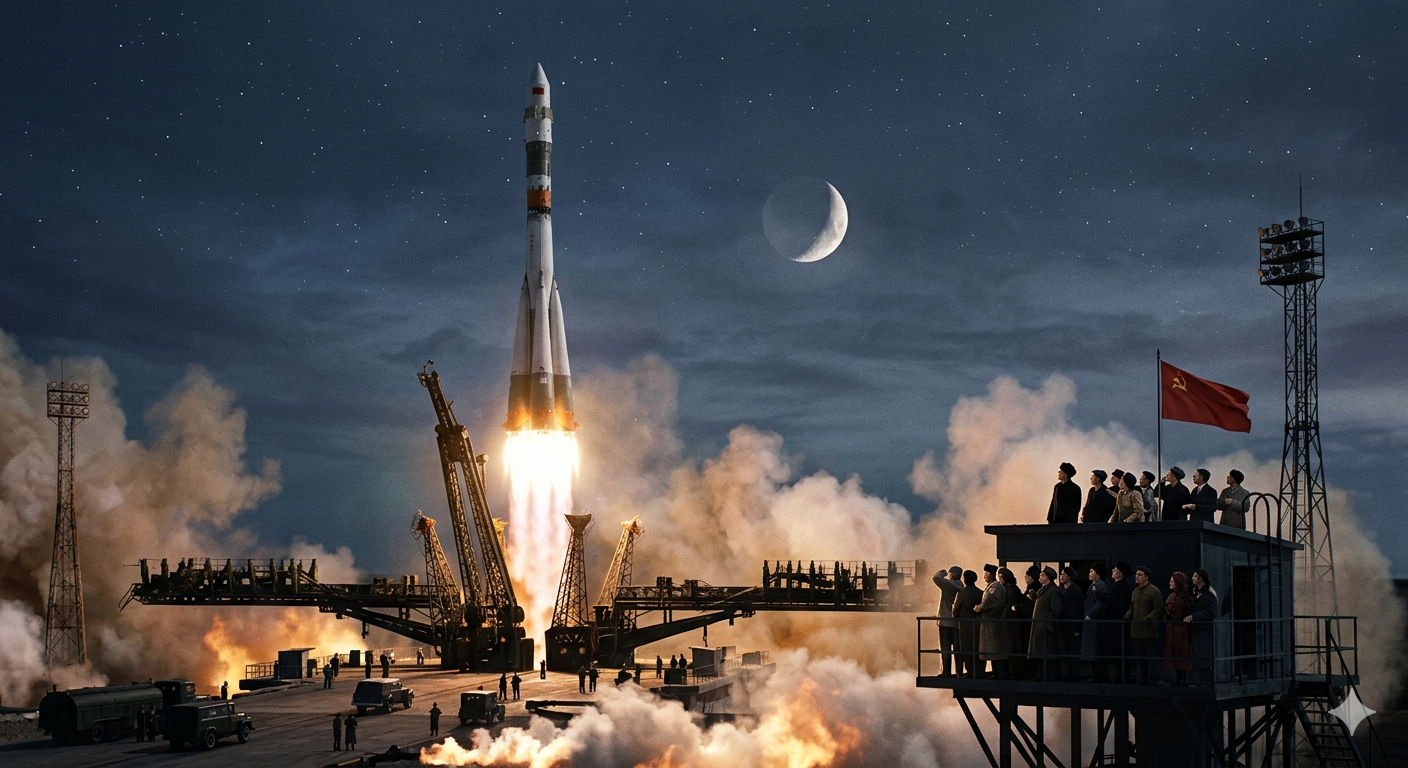
At 16:41 Greenwich Mean Time on January 2, 1959, a rocket lifted off from Site 1/5 at the Baikonur Cosmodrome in the vast steppe of Kazakhstan. The rocket was a Luna 8K72, a modified version of the R-7 Semyorka intercontinental ballistic missile that had already given the world Sputnik 1 fifteen months earlier. Strapped to its upper stage was a spherical spacecraft weighing 361 kilograms, carrying six scientific instruments and two metallic pennants bearing the Soviet coat of arms. Its official designation was E-1 No. 4. Its creators called it Mechta, the Russian word for Dream. The world would come to know it as Luna 1.
The spacecraft that launched on January 2, 1959, was designed to crash into the surface of the Moon, becoming the first human-made object to reach another celestial body. It did not achieve that goal. A malfunction in the ground-based control system caused the upper stage engine to fire for slightly too long, adding an extra 175 meters per second to the spacecraft’s velocity and pushing it off course. On January 4, 1959, Luna 1 passed within 5,995 kilometers of the Moon’s surface, missed it entirely, and continued out into the solar system. But in failing to hit the Moon, Luna 1 accomplished something even more remarkable: it became the first spacecraft in history to escape Earth’s gravitational field, the first to reach the vicinity of the Moon, and the first human-made object to orbit the Sun. It was also, almost incidentally, the first spacecraft to detect the solar wind.
The Space Race and the Soviet Drive to Reach the Moon
To understand why the Soviet Union launched a spacecraft at the Moon in January 1959, it is necessary to understand the extraordinary pace and intensity of the Space Race that had begun just fifteen months earlier.
On October 4, 1957, the Soviet Union launched Sputnik 1, the world’s first artificial satellite, from the same Baikonur Cosmodrome that would send Luna 1 into history. The simple polished metal sphere, no bigger than a beach ball, carrying nothing more than batteries and a radio transmitter emitting a rhythmic beep, shook the world. In the United States, Sputnik triggered panic, congressional hearings, and a fundamental reassessment of American scientific and educational priorities. In the Soviet Union, it transformed the space program from an ambitious engineering project into a national ideological weapon of the highest order.
The man behind Sputnik, and behind everything that followed, was Sergei Pavlovich Korolev. Born on January 12, 1907, in Zhitomir, Ukraine, Korolev had been fascinated by flight since childhood, designed his first glider at seventeen, and spent the 1930s building the first Soviet liquid-fueled rockets through the rocketry organization he co-founded, GIRD. His reward for this pioneering work was arrest in 1938 on false charges during Stalin’s Great Terror, imprisonment in a Siberian labor camp at Kolyma, and years of forced scientific labor in the Gulag’s prison design bureaus, the sharashkas. He survived where many did not, and by the 1950s he was the chief designer of OKB-1, the Soviet rocket design bureau that would define the early space age. For security reasons, Korolev’s name was classified as a state secret throughout his lifetime. He was known to the world only as “the Chief Designer,” a figure whose identity Soviet authorities feared Western intelligence services might target.
It was Korolev’s R-7 rocket, designed originally as the Soviet Union’s first intercontinental ballistic missile, that launched Sputnik. The same rocket, in modified form, launched Sputnik 2 just a month later on November 3, 1957, this time carrying the dog Laika into orbit as the world’s first space traveler. Soviet General Secretary Nikita Khrushchev, who had initially expressed little enthusiasm about Sputnik before recognizing its propaganda value, was now demanding ever more spectacular achievements from Korolev’s team to press the Soviet advantage in the Space Race.
In March 1958, the Soviet Union formally approved the development of two series of spacecraft for lunar exploration: one designed to impact the Moon’s surface and another to photograph its hidden far side during a flyby. The United States was simultaneously developing its Pioneer series of spacecraft with similar objectives. Both nations understood that reaching the Moon, even with an unmanned probe, would be a symbolic triumph of immense political significance. The Moon was not merely a scientific target. It was a propaganda objective, a demonstration of technological power, and a measure of which system, Soviet communism or American capitalism, was more capable of advancing human knowledge.
The Failed Attempts Before Luna 1 and the Engineering Challenges
The spacecraft that would become Luna 1 was the fourth Soviet attempt to reach the Moon, not the first. The Soviet practice of the time was to publicly acknowledge only missions that succeeded and to simply not mention the failures, a policy that Western observers noted allowed the Soviets to present an apparently unbroken string of space triumphs while concealing the full extent of their difficulties.
The first three Soviet attempts to send a spacecraft to the Moon in 1958 all ended in launch failures caused by anomalies with the R-7 rocket. The new upper stage required for lunar missions, which needed to provide the additional velocity to push a spacecraft beyond Earth’s gravitational pull, proved difficult to perfect. The engineering problem was precise and demanding: to achieve escape velocity, the spacecraft needed to reach a speed of approximately 11.2 kilometers per second, slightly faster than the 7.9 kilometers per second needed to achieve Earth orbit. Any error in the upper stage burn time, pointing, or thrust would send the spacecraft on a trajectory that either failed to leave Earth orbit or missed the intended target by a distance too large to achieve the mission’s goals.
Korolev and his engineers at OKB-1 worked through each failure, analyzing what had gone wrong and refining the design. By January 1959, they had a spacecraft ready for the fourth attempt. Luna 1 was a sphere 58 centimeters in diameter, powered by mercury-oxide batteries and silver-zinc accumulators. Five antennas extended from one hemisphere for communications. Its scientific payload included a triaxial flux-gate magnetometer to measure magnetic fields, two micrometeorite detectors developed by Tatiana Nazarova of the Vernadsky Institute, instruments for studying cosmic radiation, and equipment for measuring the gas components of interplanetary space and corpuscular radiation from the Sun.
The spacecraft also carried two metallic pennants bearing the Soviet coat of arms. Their presence in the payload made clear the original intention: Luna 1 was supposed to impact the Moon and deliver the symbols of Soviet achievement to its surface.
January 2, 1959: The Launch, the Error, and the Escape from Earth’s Gravity
The launch on January 2, 1959, proceeded smoothly through its first three stages, all of which operated nominally. The problem occurred in the guidance of the final stage. Soviet engineers of the time did not trust automated systems to control engine burns with the precision required for lunar trajectories. Instead, they communicated with the rocket via radio, sending signals from the ground to command the upper stage engine to stop firing. The signal to stop was delayed. The engine burned for slightly longer than planned, imparting an extra 175 meters per second to the spacecraft’s velocity. This relatively small error in velocity, compounded across the 400,000-kilometer distance to the Moon, translated into a miss of nearly 6,000 kilometers.
Luna 1 passed the Moon on January 4, 1959, at approximately 16:40 Greenwich Mean Time, coming within 5,995 to 6,400 kilometers of the lunar surface after 34 hours of flight. This was close enough to achieve the mission’s designation as the first spacecraft to reach the vicinity of the Moon, but far too distant to accomplish the intended impact.
Along the way, at 00:57 GMT on January 3, when the spacecraft was 113,000 kilometers from Earth, controllers released one kilogram of sodium gas from the spacecraft. The sodium cloud formed a glowing orange artificial comet visible over the Indian Ocean with the brightness of a sixth-magnitude star for a few minutes. It served two purposes: to allow visual tracking of the spacecraft’s trajectory from Earth, and to study the behavior of gas in the near-vacuum of deep space. The cloud was photographed by Mstislav Gnevyshev at the Mountain Station of the Main Astronomical Observatory near Kislovodsk in the northern Caucasus.
After passing the Moon, Luna 1 continued outward. On January 5, the spacecraft’s batteries ran out when it was approximately 597,000 kilometers from Earth, ending radio contact. By January 6, it had become the first human-made object to leave Earth’s orbit entirely, entering a heliocentric orbit, an orbit around the Sun, between Earth and Mars. There it remains today, circling the Sun approximately once every 450 days, the first of humanity’s artifacts to become a permanent resident of the wider solar system.
The Wikipedia article on Luna 1 provides the complete technical specifications of the spacecraft, the detailed account of its flight, and the scientific discoveries it made during its journey through space.
Scientific Discoveries: Solar Wind, Radiation Belts, and the Moon Without a Magnetic Field
Although Luna 1 failed to hit the Moon, its scientific return was genuinely significant and produced at least two discoveries of lasting importance to the understanding of space.
The most consequential discovery was the detection of the solar wind. Luna 1’s instruments registered a continuous stream of charged ionized plasma flowing outward from the Sun in all directions through interplanetary space. The existence of this solar wind had been theorized by astrophysicists, but Luna 1 provided the first direct measurement of it, confirming that the Sun was continuously shedding energetic particles that filled the space between the planets. This understanding of the solar wind became fundamental to subsequent planetary science, explaining phenomena ranging from auroras on Earth to the shaping of cometary tails to the gradual atmospheric stripping of planets without protective magnetic fields.
While traveling through the outer Van Allen radiation belt, Luna 1’s scintillator made observations indicating that a relatively small number of high-energy particles existed in the outer belt, adding to the data on Earth’s radiation environment that had begun to accumulate since the discovery of the Van Allen belts by the American Explorer 1 satellite in February 1958.
Perhaps most importantly from the perspective of the mission’s original objective, Luna 1’s magnetometer found no evidence of a significant magnetic field around the Moon. The Moon, unlike Earth, apparently lacked a substantial magnetosphere. This finding had implications for understanding the Moon’s internal structure and formation, and it guided later mission planning by confirming that the Moon’s environment was quite different from Earth’s in ways that would affect both robotic and eventual human exploration.
Western Skepticism, Soviet Triumph, and the Path to Luna 2
In the West, there was initial skepticism about Soviet claims of success for the Luna 1 mission. Some Western observers and commentators, including Lloyd Mallan who wrote about it in a book called The Big Red Lie, doubted the Soviets’ accounts. Many Western scientists and radio operators had not received transmissions from the spacecraft themselves, partly because by the time Earth’s rotation had moved the United States into a position where its stations could pick up Luna 1’s signals, the spacecraft was already 171,000 kilometers away and its transmissions were difficult to detect with Western equipment calibrated for shorter distances.
The skepticism was eventually laid to rest. In May 1959, several hearings on Soviet Space Technology before the Committee on Science and Astronautics and a Special Subcommittee on the Lunik Probe of the United States House of Representatives attested to the achievements of the Soviet mission and its sophisticated guidance technology. The Soviet Union issued commemorative stamps celebrating the mission. The spacecraft received the retrospective official designation Luna 1 in 1963, when the Soviet Union retroactively named its entire series of lunar probes, and it was given the additional designations Mechta, Artificial Planet 1, and First Cosmic Ship.
The NASA National Space Science Data Center’s Luna 1 mission page provides the official scientific record of the mission, including its instrument package, objectives, and the measurements obtained during its flight.
The United States responded to Luna 1 with its Pioneer 4 mission, which was launched on March 3, 1959. Pioneer 4 passed within 60,000 kilometers of the Moon’s surface, a much greater miss distance than Luna 1’s near approach, but it did confirm the existence of the solar wind and became the first American spacecraft to escape Earth’s gravity. The gap between Soviet and American lunar capabilities in early 1959 was nonetheless real and embarrassing for the Americans.
Luna 1’s original mission was completed, in spirit if not in precise execution, on September 12, 1959, when Luna 2 was launched and successfully impacted the Moon’s surface in Mare Imbrium after 34 hours of flight. It was the first human-made object to reach another celestial body. Luna 3 followed on October 4, 1959, rounding the Moon and returning the first photographs ever taken of the Moon’s far side, images that revealed a landscape dramatically different from the Earth-facing hemisphere, with far fewer of the dark volcanic plains called mare that dominate the near side.
The Legacy of Luna 1 in the History of Space Exploration
Luna 1 holds a unique position in the history of human space exploration. It was the first spacecraft to escape Earth’s gravitational influence, establishing that human technology was capable of interplanetary travel. It was the first to approach the Moon. It was the first to enter heliocentric orbit and join the solar system’s family of natural orbiting bodies as an artificial one. It was the first to detect the solar wind, one of the most important discoveries in the history of space science.
The Britannica article on the Luna space probes places Luna 1 in the context of the entire Soviet Luna programme, from the first attempts in 1958 through the sophisticated robotic exploration missions of the 1970s, showing how each mission built on the discoveries and failures of those that came before.
The man who built Luna 1, Sergei Korolev, would not live to see the American astronauts walk on the Moon in July 1969. He died on the operating table during routine colon surgery on January 14, 1966, less than two weeks after Luna 9 became the first spacecraft to achieve a soft landing on the Moon, the last great Soviet first in space that Korolev would live to celebrate. His identity as the Chief Designer was revealed to the world only after his death. Until that moment, the most important figure in the Soviet space program had been known to history only by a title, not a name.
Luna 1 still orbits the Sun today, a silent artifact of humanity’s first tentative reach toward the Moon, the Dream that missed its target and found something more.