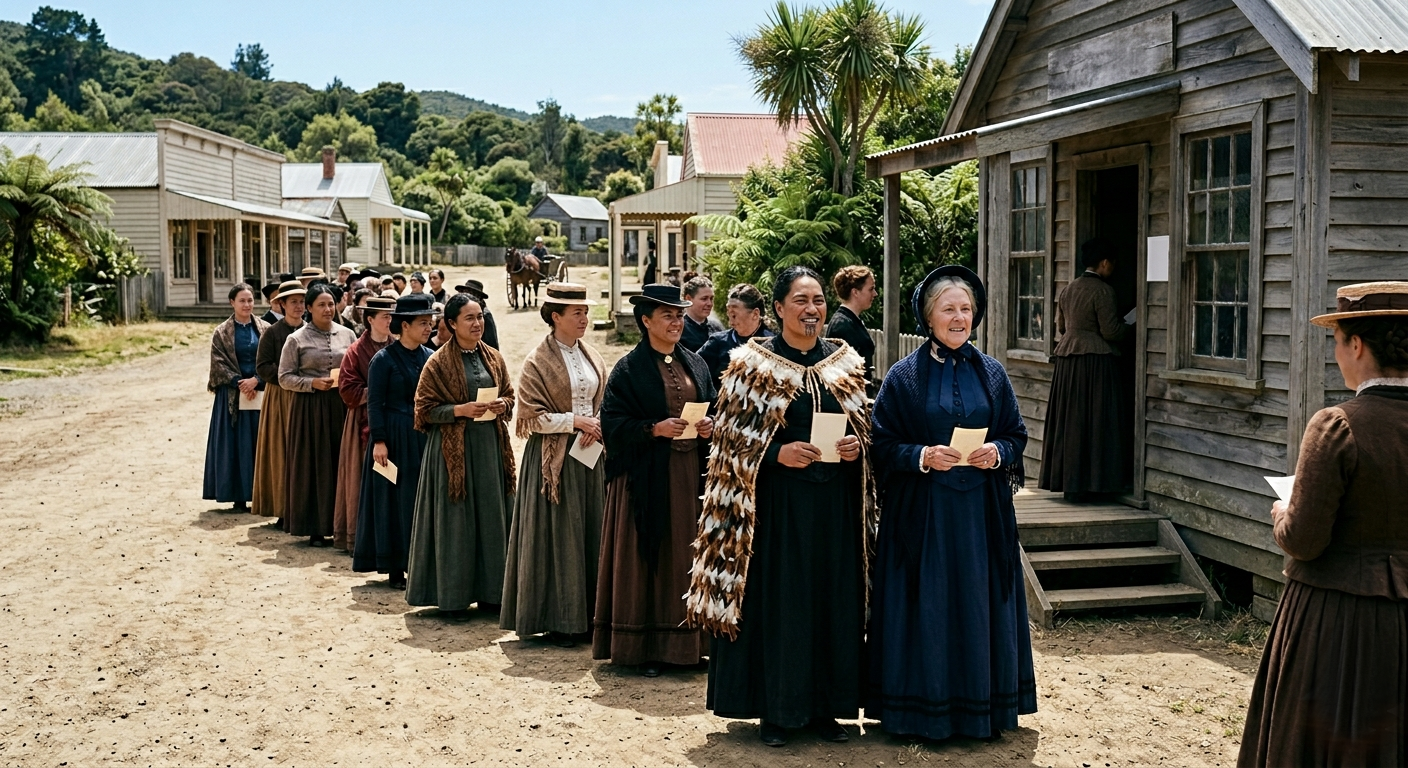
On November 28, 1893, New Zealand women walked into polling booths across the country for the first time in history. They had won the right to vote just ten weeks earlier, when Governor Lord Glasgow signed the Electoral Act 1893 into law on September 19. Now, in a general election that had been described by fearful opponents as a recipe for chaos, the women of New Zealand cast their ballots with such composure and in such numbers that the occasion became a rebuttal to every argument that had been made against them. According to a Christchurch newspaper, the streets near polling booths “resembled a gay garden party,” with the “pretty dresses of the ladies and their smiling faces” lighting up the booths “most wonderfully.” Far from the disorder that opponents had predicted, the 1893 election was described as the “best-conducted and most orderly” ever held in New Zealand.
Approximately 65 percent of eligible New Zealand women, or 109,461 women, had enrolled to vote before the election. New Zealand had not merely extended a right to women in theory. The women of New Zealand had turned out in enormous numbers and exercised that right in practice, demonstrating in the most direct way possible that the critics who doubted women’s interest in political participation had been profoundly wrong. The country that had become, on September 19, 1893, the first self-governing nation in the world to grant women the right to vote in parliamentary elections had also, on November 28, held the first national election in world history in which women could vote.
New Zealand in the Nineteenth Century: A Social Laboratory for Reform
New Zealand in the second half of the nineteenth century was a young and rapidly changing society that had developed a reputation, partly earned and partly cultivated, as a place willing to experiment with social and political reform in ways that more established societies resisted. The country had been formally established as a British colony through the Treaty of Waitangi in 1840, signed between the British Crown and many Maori chiefs, and the colonial government had been developing its institutions throughout the subsequent decades.
In 1879, New Zealand had extended voting rights to all adult male British subjects, making it one of the more democratic countries in the world for men. The New Zealand Constitution Act of 1852 had already established a parliamentary system, and the Maori Representation Act of 1867 had created four designated Maori seats in Parliament. The country had a relatively small population, strong labor movement traditions, and a Liberal government from 1891 onward that was sympathetic to social reform.
Women had actually obtained some limited voting rights even before the 1893 Act. As early as 1867, women who were property owners and taxpayers, known as ratepayers, could vote in municipal elections. In 1877, this right was extended to allow women householders to vote in and stand for school committees and educational boards. These were limited, local rights, not the full parliamentary franchise, but they established a precedent for women’s political participation and created a constituency of women who had already experienced the vote and who could speak from personal experience about its unremarkable normality.
Kate Sheppard: The Woman Who Led New Zealand’s Suffrage Movement
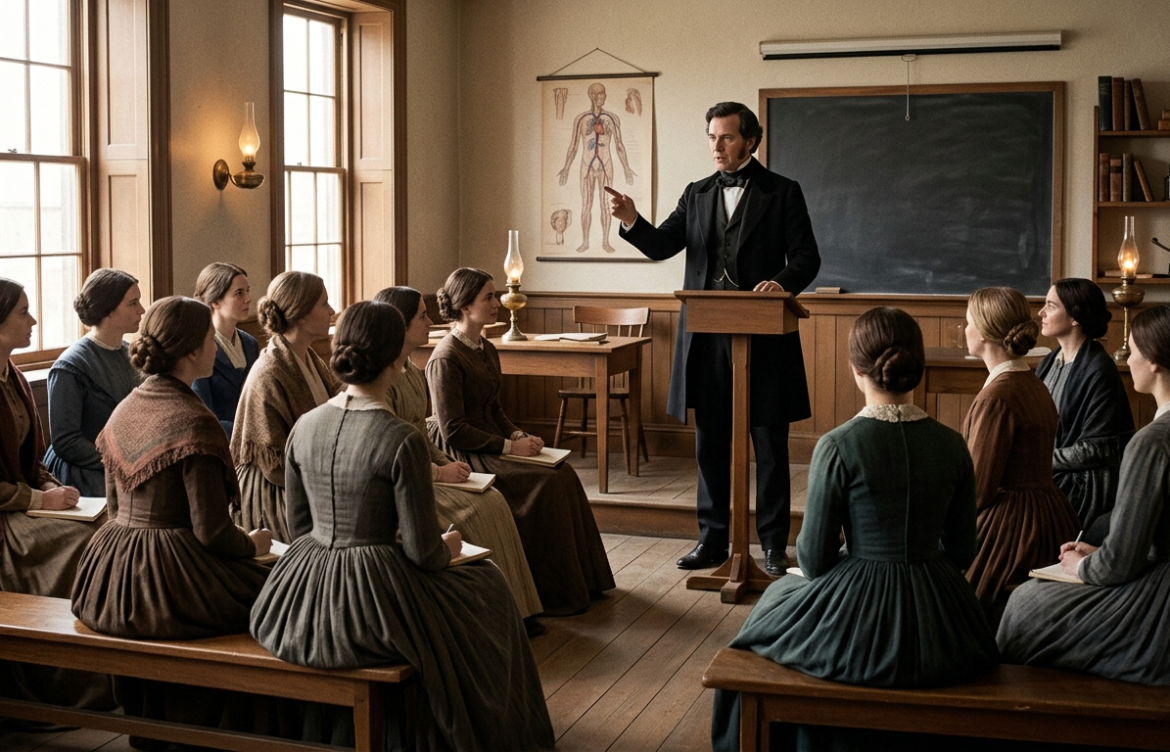
No person contributed more to the achievement of women’s suffrage in New Zealand than Kate Sheppard, and her story is inseparable from the history of the Electoral Act 1893. Sheppard was born Katherine Wilson Malcolm in Liverpool, England, probably on March 10, 1847, to Scottish parents. She emigrated to New Zealand with her family in 1868 and settled in Christchurch, where she became an active member of the Trinity Congregational Church and eventually a founding member of the New Zealand Women’s Christian Temperance Union in 1885.
The Women’s Christian Temperance Union, or WCTU, was the organizational base of New Zealand’s suffrage movement, as it had been in the United States, where it had been founded by Frances Willard. The connection between temperance and women’s suffrage was not coincidental. Alcohol abuse was devastating to women and families in the nineteenth century, and many women experienced firsthand the consequences of having no political voice in laws that affected them profoundly. The temperance movement argued that women needed the vote to be able to advocate effectively for legislation protecting women and children from the consequences of alcohol-related violence, poverty, and family breakdown.
In 1887, Sheppard was appointed national superintendent of the franchise and legislation department of the WCTU. From this position, she transformed the women’s suffrage campaign from a diffuse collection of sympathies and aspirations into a coordinated political movement with a clear strategy and a formidable organizational apparatus. She wrote extensively in the WCTU’s publications, toured the country giving lectures, built networks between the WCTU and other women’s organizations and trade unions, and persuaded male politicians of the justice and political feasibility of women’s suffrage.
The Wikipedia article on women’s suffrage in New Zealand provides the comprehensive account of the suffrage movement’s organizational history, the key figures alongside Sheppard, and the parliamentary battles that produced the Electoral Act 1893.
The Petition Campaign: 9,000, 20,000, and 32,000 Signatures
Sheppard’s most tactically brilliant contribution to the suffrage campaign was the series of massive petitions to Parliament that she organized between 1891 and 1893. The petitions were a form of direct democracy in which women who could not vote demonstrated their political consciousness and their desire to participate by signing their names to a formal demand. The scale of the petitions was designed to make the political cost of continued inaction too high for Parliament to sustain.
In 1891, the first major petition was presented to Parliament bearing more than 9,000 signatures gathered from across New Zealand. It was an impressive demonstration of organized women’s political will, but Parliament’s opposition remained firm. In 1892, a second petition was presented with nearly 20,000 signatures, almost double the previous year’s total. Again Parliament failed to pass a suffrage bill through both chambers.
In 1893, Sheppard and her colleagues organized the most ambitious petition campaign yet. Petition sheets were circulated throughout New Zealand and returned to Christchurch, where Sheppard personally pasted each sheet end to end and rolled it around a section of a broom handle, creating what she described as “a monster petition.” In total, thirteen petitions were submitted to the House of Representatives in 1893 bearing the signatures of 31,872 women, representing almost a quarter of the entire adult European female population of New Zealand. The combined petition roll was 270 meters long.
The presentation of the petition to Parliament became one of the most dramatic moments in New Zealand political history. John Hall, a Member of Parliament and long-time supporter of women’s suffrage, carried the enormous roll into the House and unrolled it down the central aisle of the debating chamber until it hit the end wall with a thud that echoed through the room. The spectacle was deliberate. Sheppard had designed the petition not merely as a record of signatures but as an unmistakable physical demonstration of women’s collective political will.
Alongside Sheppard, other women made essential contributions to the petition campaigns and to the suffrage movement. Mary Ann Muller, writing under the pseudonym Femina, had been one of the earliest advocates for women’s suffrage in New Zealand, publishing arguments for the cause in the 1860s. Harriet Morison, a leader of the Tailoresses’ Union in Dunedin, brought the organized labor movement into partnership with the suffrage cause, providing working-class women’s voices alongside the more middle-class WCTU networks. Marion Hatton, Rachel Reynolds, Ada Wells, writer Edith Grossmann, and Christina and Stella Henderson were among the women whose signatures and organizing work helped compile the 1893 petition. Meri Te Tai Mangakahia was a significant Maori leader who ensured that Maori women’s voices were incorporated into the movement and that the eventual legislation would extend voting rights to Maori women as well as Pakeha women.
The Parliamentary Battle: Supporters, Opponents, and the Liquor Industry
The parliamentary battle for women’s suffrage in New Zealand was shaped by the alignment of competing interests as much as by competing principles. The suffrage cause had genuine supporters among male politicians, including some of the most eminent figures of the era. John Hall, Julius Vogel who had been the eighth Premier of New Zealand, Robert Stout, William Fox, and John Ballance all supported women’s suffrage at various points, and their advocacy was essential to the series of bills that came close to passing in the 1878, 1879, and 1887 parliamentary sessions.
The opposition was equally formidable and considerably less principled. The most powerful organized opposition came from the liquor industry, whose commercial interests were directly threatened by women’s suffrage. The WCTU’s explicit goal of using women’s votes to restrict alcohol sales made the hotel and brewing industries implacable opponents of enfranchisement. They lobbied actively against every suffrage bill and funded anti-suffrage campaigns to the extent their resources allowed.
Premier Richard Seddon, who took office after John Ballance’s death in April 1893, was a particular obstacle. Seddon was a close ally of the liquor industry and a personal friend of the hotel trade. He was not merely skeptical about women’s suffrage; he was actively hostile to it. When Seddon was asked in 1892 why he opposed the bill, he made no pretense of principled argument. His opposition was a matter of political calculation and commercial loyalty.
The anti-suffrage forces used procedural tactics to defeat the bills of 1891 and 1892. In the Legislative Council, the conservative upper house that had to pass any bill before it became law, opponents added devious amendments designed to make the bills unacceptable to the lower house. Walter Carncross moved an amendment in 1891 that was intended to make the bill fail by adding a provision that women should also be eligible to stand for the House of Representatives, knowing that the conservative Council would reject this more radical step. The tactic worked, defeating the 1891 bill.
By 1893, however, the political environment had shifted decisively. The 1893 petition’s 31,872 signatures were impossible to dismiss as unrepresentative. The suffrage bill passed the House of Representatives with a large majority. The question was whether the Legislative Council would once again sabotage it.
On September 8, 1893, the bill was passed by the Legislative Council by a vote of 20 to 18. The margin was razor-thin. Eighteen anti-suffrage councillors subsequently petitioned Governor Lord Glasgow to withhold his consent to the bill. In a symbolic expression of the political battle that had been fought, anti-suffragists gave their parliamentary supporters red camellias to wear as a signal of their opposition. Suffragists responded by distributing white camellias to their supporters, turning the flower into a lasting symbol of the New Zealand suffrage movement.
On September 19, 1893, Lord Glasgow signed the Electoral Act 1893 into law. Kate Sheppard received a telegram from Premier Seddon himself, conceding victory to the women. Governor Glasgow, recognizing her central role in the campaign, presented Sheppard with the pen with which the bill had been signed.
The NZ History website’s comprehensive account of women’s suffrage in New Zealand documents the full parliamentary struggle, the key votes, and the decisive moments that produced the Electoral Act 1893.
November 28, 1893: The First National Election in Which Women Could Vote
The period between the signing of the Electoral Act on September 19 and the general election on November 28, 1893, was just ten weeks. In that time, 109,461 New Zealand women enrolled to vote, a response that demonstrated the movement’s claims about women’s political consciousness had not been rhetorical.
When election day arrived, the women of New Zealand turned out in large numbers and cast their ballots without incident. The predicted disorder did not occur. Women were not jostled or harassed by “boorish and half-drunken men” as opponents had warned. They walked to polling booths, voted, and returned home. The process was ordinary in the best possible sense.
The election’s outcome was shaped in part by the newly enfranchised women’s votes. Both the Liberal government and the Conservative opposition subsequently claimed credit for women’s enfranchisement and competed for women’s support, a revealing demonstration that once women had the vote, male politicians immediately recognized the practical necessity of taking their interests seriously.
Approximately 65 percent of eligible women voted in the 1893 election, a turnout rate that compared favorably to the turnout rates of men. The women who had organized, petitioned, lobbied, and argued for nearly a decade to win this right used it in enormous numbers on the first opportunity they were given.
The Wider Context: Maori Women, Class, and the Limits of 1893
The Electoral Act 1893 was genuinely groundbreaking in its inclusiveness compared to women’s suffrage legislation that would subsequently be passed elsewhere in the world. It extended voting rights to all women who were British subjects and aged 21 and over, explicitly including Maori women. This was a significant distinction from the women’s suffrage legislation that would pass in Australia in 1902, which initially excluded Aboriginal women, and from the American women’s suffrage amendment of 1920, which was followed by decades of systematic disenfranchisement of Black women in the South.
The inclusion of Maori women in the Electoral Act 1893 was not accidental. Wāhine Māori were active participants in the suffrage movement and had been organizing within their own communities for political rights simultaneously with Pakeha women. Meri Te Tai Mangakahia addressed the Maori Parliament, Te Kotahitanga, in 1893, arguing for Maori women’s right to vote and to stand as members of that body. Her advocacy helped ensure that Maori women’s rights were explicitly included in the legislation.
There were limits to the 1893 Act’s inclusiveness. The requirement that voters be British subjects excluded Chinese women, who had been subject to discriminatory immigration legislation since the 1880s. The Act enfranchised women to vote but not to stand for Parliament; that right would not come until 1919. The first woman to be elected to the New Zealand Parliament, Elizabeth McCombs, was not elected until 1933, forty years after the right to vote was won.
The Britannica account of New Zealand women’s suffrage places the 1893 Electoral Act in the global context of women’s suffrage movements, showing how New Zealand’s achievement preceded the comparable victories in Australia (1902), Finland (1906), Norway (1913), Denmark (1915), Russia (1917), Canada (1918), Germany (1918), the United Kingdom (1918), and the United States (1920).
The Legacy of 1893: New Zealand’s Suffrage and Its Global Influence
The achievement of women’s suffrage in New Zealand in 1893 had an immediate and significant impact on suffrage campaigns around the world. Congratulations poured in from suffrage organizations in Britain, Australia, the United States, and elsewhere in the immediate aftermath of the signing. One correspondent wrote that New Zealand’s achievement had given “new hope and life to all women struggling for emancipation.” Kate Sheppard subsequently traveled to England and the United States to lend her experience and advocacy to the campaigns for women’s suffrage there.
New Zealand’s self-image as a trail-blazing “social laboratory” was deeply shaped by the 1893 achievement. The country had demonstrated that enfranchising women was practically workable, that women would vote in large numbers and with political seriousness, that the predictions of social disorder were unfounded, and that democracy was strengthened rather than weakened by extending the franchise to all adults.
Kate Sheppard continued her advocacy throughout her life, founding the National Council of Women of New Zealand in 1896, editing The White Ribbon newspaper, the first in New Zealand to be owned, managed, and published solely by women, and campaigning on causes ranging from reproductive rights to prison reform to women’s access to cycling. She died in 1934, having lived long enough to see New Zealand women gain the right to stand for Parliament in 1919 and to see the first woman elected to Parliament in 1933. A line from the Christchurch Times upon her death captured her place in the national memory: “A great woman has gone, whose name will remain an inspiration to the daughters of New Zealand while our history endures.”
The New Zealand Ministry for Women’s account of women’s suffrage in Aotearoa New Zealand covers the full history of the movement from the 1852 Constitution Act through the 1893 Electoral Act and the subsequent milestones in women’s political representation.
Today, September 19 is observed annually in New Zealand as Suffrage Day, a national day of commemoration recognizing the achievement of 1893 and acknowledging the contributions of the women who made it possible. When women MPs are sworn in to New Zealand’s Parliament, each receives a camellia brooch engraved with the number that indicates their place in the lineage of women MPs, connecting each new parliamentarian back to the moment in 1893 when the white camellia first became a symbol of the right to vote. Following the 2023 election, 57 of 123 Members of Parliament, approximately 46 percent, are women. The twelve women who received their first ballots on November 28, 1893, and the 109,449 who followed them, set something in motion that has not stopped.