
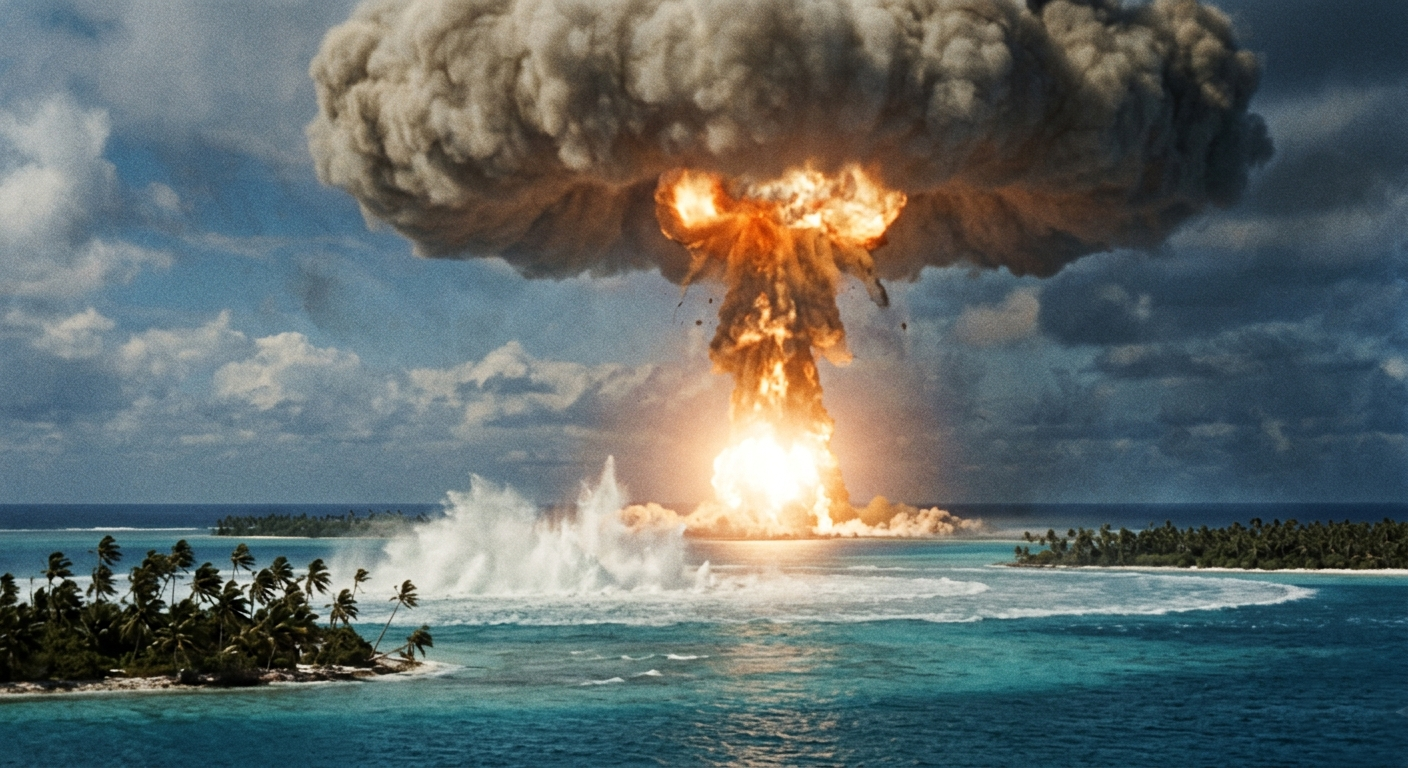
At 7:15 in the morning on November 1, 1952, local time, a device the size of a small factory building detonated on the tiny Pacific island of Elugelab in Enewetak Atoll in the Marshall Islands. The fireball that followed stretched three miles across within seconds, roughly thirty times larger than the fireball that had destroyed Hiroshima seven years earlier. The mushroom cloud climbed to 57,000 feet in ninety seconds, reached 108,000 feet within minutes, and ultimately soared to 120,000 feet. Radioactive coral debris rained down on ships stationed thirty-five miles away. When the mushroom cloud finally cleared, the island of Elugelab no longer existed. In its place was a crater 6,300 feet wide and 164 feet deep, carved into the floor of the Pacific Ocean.
The device that accomplished this was the first thermonuclear weapon, or hydrogen bomb, ever detonated. Its codename was Mike. The test was called Operation Ivy, the eighth series of American nuclear weapons tests. The explosion yielded 10.4 megatons of energy, equivalent to 10.4 million tons of TNT. It was approximately 1,000 times more powerful than the atomic bomb that had destroyed Hiroshima in 1945, and approximately twice the total explosive power of all the bombs dropped by all sides during the entire Second World War. Humanity had entered a new era of destructive capability, one whose implications would take decades to fully absorb.
The Road to the Hydrogen Bomb: From Fission to Fusion
To understand why the United States built and tested the Mike device, it is necessary to understand the fundamental difference between atomic bombs and hydrogen bombs, and the political and military pressures that drove the development of the latter.
The atomic bombs used against Japan in 1945 were fission weapons: they released energy by splitting the nuclei of heavy atoms, specifically uranium-235 or plutonium-239. Fission weapons were enormously destructive, but they had a theoretical upper limit on their yield determined by the physics of the chain reaction process. Thermonuclear weapons, by contrast, released energy by fusing light atomic nuclei together, the same process that powers the sun. Fusion reactions release far more energy per unit of fuel than fission reactions, and in principle there was no upper limit on the yield of a fusion bomb.
Scientists had understood the theoretical basis of thermonuclear reactions since before the Manhattan Project. Edward Teller, the Hungarian-born physicist who became the most prominent advocate for hydrogen bomb development, had been interested in the possibility of a fusion weapon since his conversations with Enrico Fermi in 1941, before the Manhattan Project had even begun. Robert Oppenheimer, who directed the Manhattan Project at Los Alamos, New Mexico, was skeptical of Teller’s focus on what he called the “Super,” believing it diverted resources from the immediate fission weapon program. Teller and Oppenheimer’s relationship deteriorated badly over this disagreement, with consequences that would reverberate through American nuclear policy for years.
Truman’s Decision: The Soviet Test of 1949 and the Push for the Super
The event that transformed the hydrogen bomb from an abstract scientific possibility into a presidential priority was the Soviet Union’s first successful atomic bomb test, codenamed Joe-1 by American intelligence, on August 29, 1949. The test shocked American officials who had predicted, based on assessments of Soviet scientific capacity and industrial reconstruction, that the Soviets would not achieve nuclear capability until the mid-1950s. The CIA had actually predicted 1953 as the earliest possible Soviet atomic test. The Soviets had achieved it four years early, at least in part through espionage by agents including Klaus Fuchs, the German-born British physicist who had worked on the Manhattan Project and who confessed to passing atomic secrets to Soviet intelligence in January 1950.
The discovery of Soviet atomic capability triggered a fierce debate within the American scientific and policy community about whether the United States should proceed immediately with developing a thermonuclear weapon. The General Advisory Committee of the Atomic Energy Commission, chaired by Robert Oppenheimer, issued a report in October 1949 concluding that the United States should not pursue the hydrogen bomb on both practical and moral grounds. The report argued that the existing fission weapon program was adequate for American security needs and that building a weapon capable of mass destruction on a genocidal scale would cross a moral threshold that the United States should not cross.
Teller, Fermi, Ernest Lawrence of the University of California, and other scientists argued the opposite: that if a hydrogen bomb was physically possible, the Soviet Union would inevitably develop one, and that American security required developing it first. This was the argument that ultimately prevailed. On January 31, 1950, President Harry S. Truman announced his decision: the United States would proceed with the development of thermonuclear weapons. The Atomic Energy Commission was directed to accelerate its thermonuclear research program. The Korean War, which began in June 1950 and pitted American forces directly against Soviet-backed North Korean and Chinese forces, added further urgency.
The Wikipedia article on Operation Ivy provides the comprehensive technical and political history of the first hydrogen bomb test series, including the Mike and King shots and the full scientific and military planning that produced them.
Edward Teller, Stanislaw Ulam, and the Breakthrough Design
Despite Truman’s January 1950 directive to pursue thermonuclear weapons, the technical path to a working hydrogen bomb was far from clear. The early concept of the “Super,” in which a fission bomb would simply be placed adjacent to fusion fuel and would ignite a self-sustaining thermonuclear reaction, was not working. Preliminary calculations by Ulam and Fermi in early 1950 suggested that the classical Super concept might not be achievable at all. The field of thermonuclear weapon design was at an impasse.
The breakthrough came in early March 1951, when Stanislaw Ulam and Edward Teller developed a radical new approach that became known as the Teller-Ulam design. The details of the Teller-Ulam configuration remain classified to this day, but the general principle is understood: rather than relying on direct heating of fusion fuel by a fission bomb, the design uses the radiation from the fission explosion to compress and heat the fusion fuel before ignition, a process known as radiation implosion. This staged design was far more efficient than the classical approach and, crucially, was scalable to essentially unlimited yields.
Teller and Ulam had been in a difficult professional relationship for years, with tensions over credit and priority that would later become one of the defining controversies in the history of nuclear physics. The question of which man deserved primary credit for the breakthrough has been disputed ever since. What is not disputed is that the Teller-Ulam design made hydrogen bombs possible as practical weapons rather than theoretical concepts, and that the Mike device at Enewetak in November 1952 was the proof of concept for that design.
The breakthrough was presented to a wider group of scientists at a meeting in June 1951 at the Institute for Advanced Study in Princeton, New Jersey. The assembled experts, including those who had previously been skeptical, concluded that the new design was sound. Work at Los Alamos shifted immediately to developing a test device based on the new concept.
Joint Task Force 132 and the Preparations at Enewetak
The decision to test the hydrogen bomb required choosing a location remote enough to contain the fallout and the devastation, but accessible enough for the massive logistical operation that a test of this scale required. The Enewetak Atoll in the Marshall Islands had already been used for American nuclear testing in the late 1940s, displacing the indigenous Marshallese population who had been promised they would eventually be able to return to their home islands. It was designated the site for Operation Ivy.
President Truman designated Joint Task Force 132 as responsible for the operation. General Percy Clarkson commanded Joint Task Force 132. The task force included Army, Navy, and Air Force components alongside numerous scientists from Los Alamos and other national laboratories. Beginning in March 1952, more than nine thousand military personnel and two thousand civilians moved into the Enewetak area, living on board ships or on surrounding islands. An aircraft carrier and four destroyers were positioned in the waters adjacent to the atoll. At least five hundred scientific stations were spread across thirty islands to measure and analyze the explosion.
The Mike device was assembled on Elugelab, a small uninhabited coral island that was the greatest distance from the larger inhabited atoll islands. The device itself was housed in a corrugated aluminum building called the “shot cab,” accompanied by a signal tower three hundred feet high for communication with the control ship USS Estes, positioned thirty miles from ground zero. Because the Mike device used liquid deuterium as its fusion fuel, a large cryogenics plant had to be built on Elugelab to maintain the deuterium at temperatures near absolute zero, minus 250 degrees Celsius. A 3,000-kilowatt power plant was constructed solely to run the cryogenics facility.
The Mike device was massive beyond anything previously attempted in nuclear weapons development. The cylindrical insulated steel container holding the liquid deuterium was approximately seven feet across and more than twenty feet high, with walls almost a foot thick. It held approximately 1,000 liters of liquid deuterium. The complete device weighed approximately 82 tons, with an additional 24,000 pounds of refrigeration equipment. It resembled a factory building more than a weapon. It could not have been delivered by any existing or foreseeable aircraft. It was, as its designers acknowledged, a proof-of-concept experiment rather than a deployable weapon.
The Test: November 1, 1952, and the Vaporization of Elugelab
The detonation of the Mike device was planned for October 31, 1952, but minor technical issues and weather conditions pushed it back by one day to November 1. Truman had been quietly informed that he could accept a delay for “technical reasons” if he wanted to keep the test away from the presidential election scheduled for November 4, just three days away. He indicated he was open to this possibility, but a review at the test site found no sufficient technical justification, and the test proceeded as planned.
At 7:15 a.m. local time on November 1, 1952, the Mike device was detonated remotely from the control ship USS Estes, thirty miles from ground zero. The fission trigger, a device similar in design to the Hiroshima bomb, fired first. The radiation from that fission explosion compressed and ignited the liquid deuterium in the secondary stage. The results exceeded the test’s designers’ expectations.
The fireball reached approximately three and a quarter miles in diameter, dwarfing anything previously seen in a nuclear test. The mushroom cloud climbed to 57,000 feet in ninety seconds and ultimately reached 120,000 feet in altitude, spreading one hundred miles across at its maximum extent. Sailors on ships thirty-five miles away felt a wave of heat wash over them. Radioactive coral debris fell on ships fifty-six kilometers from the detonation site. Pilots flying through the mushroom cloud to collect scientific samples watched their radiation counters spin “like the sweep second hand on a watch,” as one observer wrote. The yield of 10.4 megatons was the first true megaton-yield explosion ever achieved.
Elugelab, the island on which the device had been built, ceased to exist. Where it had stood there was now a crater 6,300 feet wide and 164 feet deep cut into the Pacific seafloor. The destruction of an entire island by a single explosion had no precedent in human history.
The Britannica account of Operation Mike and the First Thermonuclear Bomb Test covers the technical principles behind the Teller-Ulam design, the scale of the Mike explosion, and the photographs taken from aircraft at 12,000 feet that documented the fireball’s development.
Scientific Discoveries: Einsteinium, Fermium, and the Elements Born in the Explosion
The unprecedented conditions created by the Mike explosion included neutron flux of an intensity never before produced artificially, and scientists suspected that the intensely bombarded material from the explosion might contain previously undiscovered heavy elements. Filter papers from aircraft that had flown through the mushroom cloud were sealed in lead containers and sent to the University of California, Berkeley for analysis.
Albert Ghiorso, a nuclear scientist at Berkeley, suspected that the filters might contain atoms that had undergone radioactive decay into predicted but undiscovered elements with atomic numbers 99 and 100. He and fellow scientists Stanley Gerald Thompson and Glenn Seaborg obtained half a filter paper from the Ivy Mike test and were able to detect the existence of both elements, which had been created by the intense neutron bombardment of uranium-238 atoms during the explosion. In 1955, the two new elements were officially named einsteinium and fermium, in honor of Albert Einstein and Enrico Fermi respectively. The hydrogen bomb test had produced two new elements of the periodic table as a byproduct.
Samples from the explosion also contained traces of plutonium-246 and plutonium-244, isotopes that had not been previously produced. The Mike explosion was thus both a weapons test and an involuntary physics experiment of unique productive power.
Secrecy, Leaks, and the Public Announcement
The Truman administration attempted to maintain complete secrecy about the Mike test. Despite the thousands of people who had participated in or observed the operation, Truman wanted the test kept away from public knowledge at least until after the November 4 presidential election. News of it was not released officially.
The secrecy was immediately compromised. Within three hours of the detonation, a reporter from Time magazine called the Atomic Energy Commission and a reporter from Life magazine called the Department of Defense. Both reporters asked for confirmation of a hydrogen bomb test and both gave the correct time of detonation, which was among the most highly classified information associated with the test. The AEC and the Defense Department denied confirmation, but the leaks had occurred.
By late November, sixteen letters written by participants in the test who had been overwhelmed by what they had seen had made their way to newspapers across the country. A week after the detonation, an article appeared in the Los Angeles Examiner based on an eyewitness account from someone aboard the USS Estes. The story was out in substance if not in official confirmation.
On January 7, 1953, with the evidence of the test widely if unofficially known, Truman announced to the world that the United States had developed the hydrogen bomb. The announcement came just days before Truman left office, with Dwight D. Eisenhower inaugurated as president on January 20, 1953.
The Smithsonian Magazine account of the first hydrogen bomb test at Eniwetok covers the eyewitness accounts of sailors aboard the task force ships, the scale of the explosion as described by observers, and the political history of keeping the test secret during the 1952 presidential election.
The Soviet Response, the Arms Race, and the Path to Castle Bravo
The Mike device, despite its 10.4-megaton yield, was not a usable weapon. The next step for American thermonuclear development was building a hydrogen bomb that could actually be delivered by aircraft. The Mike’s reliance on cryogenic liquid deuterium made it impractical: maintaining the fuel at temperatures near absolute zero required a building-sized refrigeration apparatus that would obviously never fit inside any aircraft.
The solution was to use lithium deuteride, a solid compound, as the fusion fuel instead of liquid deuterium. Lithium deuteride was stable at room temperature, far more compact, and far lighter than the liquid deuterium system. The Castle Bravo test on March 1, 1954, at Bikini Atoll, used this solid-fuel approach and produced the first test of a truly deliverable thermonuclear weapon. Castle Bravo yielded 15 megatons, exceeding the designers’ expectations by a factor of approximately 2.5. The fallout from Castle Bravo contaminated inhabited Marshall Islands atolls and a Japanese fishing vessel, the Daigo Fukuryu Maru, whose crew suffered radiation sickness, triggering an international incident and helping generate the global anti-nuclear testing movement.
Meanwhile, the Soviet Union was not far behind. Less than a year after Mike, on August 12, 1953, the Soviets tested their first thermonuclear device, RDS-6s, codenamed Joe-4 by American intelligence. The Soviet device used a different design approach from the Teller-Ulam configuration, but it demonstrated Soviet thermonuclear capability and accelerated the nuclear arms race. By 1955, both superpowers had deliverable hydrogen bombs, and the strategic landscape of the Cold War had been permanently transformed.
The History.com account of the Troubled Asset Relief Program and its context in American history provides comparative perspective on the kinds of national decisions that have shaped modern America, but the full historical weight of the hydrogen bomb’s development is covered in the Nuclear Museum’s account of hydrogen bomb development and the 1952 tests.
The Legacy of November 1, 1952: Mutually Assured Destruction and the Nuclear Age
The Mike test of November 1, 1952, inaugurated the era of thermonuclear warfare and established the strategic reality of mutually assured destruction that governed the Cold War and continues to underlie nuclear deterrence to the present day. A weapon capable of destroying an entire city in a single detonation, with a radius of destruction ten times that of the atomic bombs used against Japan, fundamentally transformed the strategic calculus of great power conflict.
The Marshall Islands paid an enormous price for hosting American nuclear testing. Between 1946 and 1958, the United States conducted sixty-seven nuclear tests across the Enewetak and Bikini atolls and surrounding areas, displacing the indigenous Marshallese population and contaminating the land and water with radioactive fallout. The cleanup effort at Enewetak, begun in 1977 and continuing for decades, involved removing contaminated topsoil and consolidating it beneath a concrete dome on Runit Island. Scientists believed the atoll might be habitable again by the mid-2020s.
The crater where Elugelab once stood remains on the floor of the Pacific Ocean. It is the permanent physical record of the moment on November 1, 1952, when human beings first achieved a thermonuclear explosion and demonstrated that the destruction of nations, not merely cities, was now within their technical reach.