
At his home in Palo Alto, California, on October 5, 2011, Steven Paul Jobs took a last long look at the faces of his family gathered around him and spoke his final words. His sister Mona Simpson, who was present, later described the moment in a eulogy that moved millions of people who read it: he had looked at his sister Patty, then for a long time at his children, then at his wife Laurene, and then past them all, his gaze rising over their shoulders to something none of them could see. His last words, spoken three times in succession, were the same three syllables: “Oh wow. Oh wow. Oh wow.” He then lost consciousness and died a few hours later.
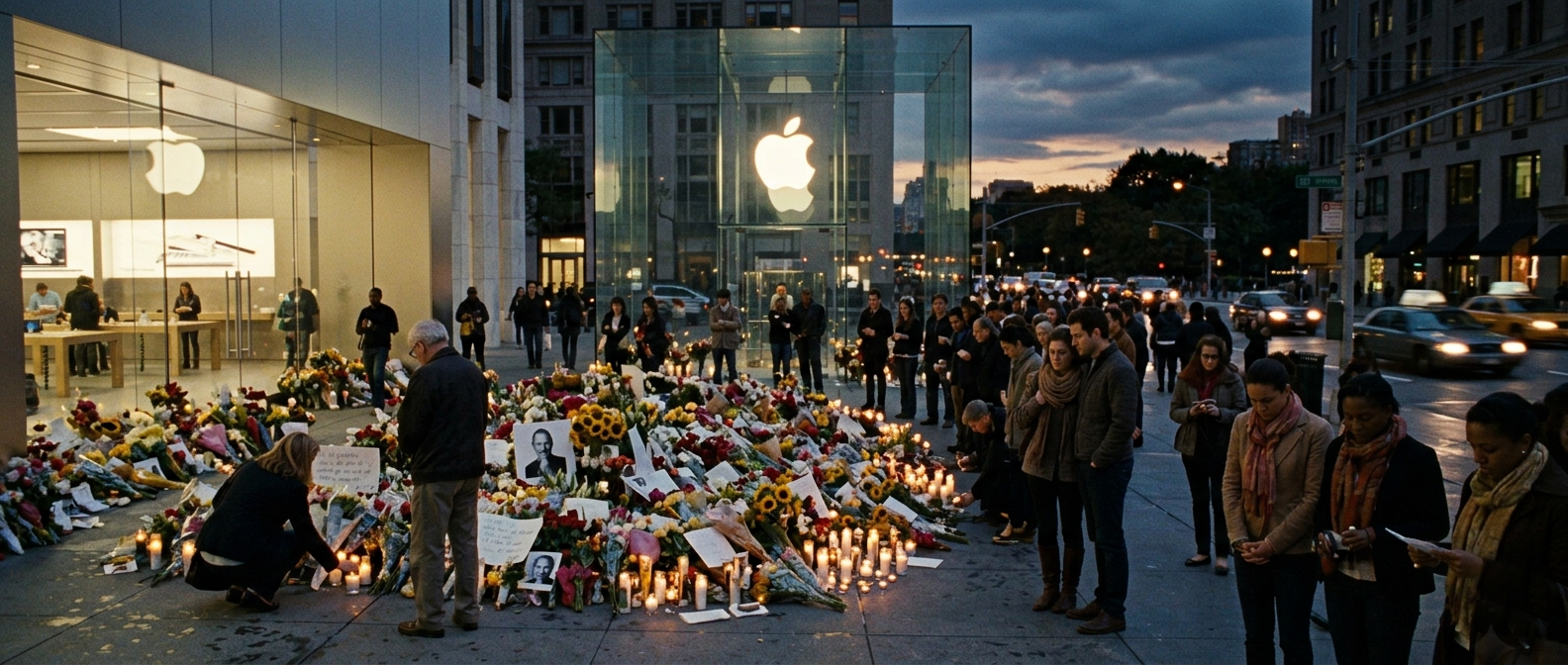
Steve Jobs was fifty-six years old. The official cause of death was respiratory arrest resulting from complications of a relapse of his pancreatic neuroendocrine tumor, a rare form of pancreatic cancer he had been fighting for eight years. Apple Inc. announced his death the same evening with a statement that reflected the scale of what his company believed it had lost: “Steve’s brilliance, passion and energy were the source of countless innovations that enrich and improve all of our lives. The world is immeasurably better because of Steve.” Within hours, memorial tributes had appeared outside Apple stores in cities around the world. Flowers, handwritten notes, lit candles, and half-eaten apples accumulated outside the glass facades of the same stores that had been the temples of the consumer revolution Jobs had created.
Who Was Steve Jobs: From Adoption to the Garage Where Apple Was Born
Steven Paul Jobs was born on February 24, 1955, in San Francisco, California. His biological parents were Abdulfattah “John” Jandali, a Syrian graduate student, and Joanne Schieble, an American of Swiss and German descent. Unwilling to marry and unable to raise the child under the circumstances of 1955, they placed the baby for adoption. He was adopted by Paul Jobs, a machinist and tinkerer in the tradition of working-class American self-improvement, and Clara Jobs, a bookkeeper. The family settled in Mountain View, California, in the heart of what would become Silicon Valley.
Paul Jobs nurtured in his adopted son a love of mechanics, electronics, and the satisfaction of understanding how things worked and making them work better. The neighborhood where Jobs grew up was full of engineers from companies like Hewlett-Packard, and the cultural atmosphere of inventive practicality surrounded him from childhood. At thirteen, he cold-called Bill Hewlett, the co-founder of Hewlett-Packard, to ask for spare parts for an electronics project, and Hewlett gave him both the parts and a summer job.
Jobs enrolled at Reed College in Portland, Oregon in 1972 but dropped out after one semester, unable to justify the cost to his adoptive parents of a formal education he found largely irrelevant. He stayed in Portland for eighteen months, sleeping on floors, auditing courses that interested him, and attending a calligraphy class that he later credited with giving him his deep understanding of typography and proportion that would shape Apple’s visual design philosophy. In 1974, he returned to California and took a job at Atari before traveling to India in search of spiritual enlightenment. He returned a Buddhist, a perspective that shaped his approach to aesthetics, simplicity, and the relationship between technology and human experience for the rest of his life.
Steve Wozniak, the Apple Garage, and the Birth of the Personal Computer Industry
The partnership that changed the technology industry began between two Steves who had known each other since the early 1970s through the informal networks of engineering enthusiasts in the Bay Area. Steve Wozniak, known universally as Woz, was a gifted electronics engineer with a rare ability to design elegant, efficient circuits. Jobs was not primarily a technical designer but possessed something that in some ways was rarer: an absolute clarity about what technology should do for people, and a relentless perfectionism about how it should be presented to them.
Together they founded Apple Computer Company on April 1, 1976, in the garage of Paul and Clara Jobs’s home in Los Cupertino, California. Wozniak designed the Apple I, the original machine that demonstrated the concept of a personal computer with a keyboard and a display interface. Jobs persuaded local electronics retailer Paul Terrell to stock fifty units. The Apple II, released in 1977, was the machine that established the personal computer as a mass market product. It was sleek, it was complete, it worked out of the box, and it came in colors rather than institutional gray. It was Jobs’s vision of what a personal computer should be, and it sold millions of units.
The introduction of the Macintosh on January 24, 1984, marked perhaps the most significant single product announcement in the history of personal computing. The Macintosh introduced the graphical user interface and the mouse to mainstream consumers in a product that was practical, affordable, and beautiful. The famous television advertisement, directed by Ridley Scott and broadcast during the Super Bowl, depicted a world of Orwellian conformity being shattered by a single figure with a hammer, the implicit message being that the Macintosh would liberate individuals from the drabness of convention.
The Wikipedia biography of Steve Jobs provides the comprehensive account of his personal history, the founding of Apple, his decade in exile at NeXT and Pixar, and the extraordinary second act of his career at Apple from 1997 to 2011.
The Firing, the Exile, and the Unlikely Road Back to Apple
The years immediately following the Macintosh’s success contained the most humiliating reversal of Jobs’s career. His management style, which combined visionary inspiration with a domineering perfectionism that could be cruel, had generated intense conflict within Apple. The board of directors, led by Chairman John Sculley, the Pepsi executive whom Jobs had famously recruited by asking him whether he wanted to “sell sugared water for the rest of your life, or come with me and change the world,” ultimately decided in May 1985 that the company could not function with Jobs’s disruptive presence. Jobs was removed from his operational role and effectively stripped of authority. He resigned from Apple in September 1985, selling nearly all his Apple shares.
He immediately founded a new computer company called NeXT, aimed at the higher education and scientific research markets. NeXT produced technically admirable computers that were ahead of their time but too expensive for mass adoption. The company spent a decade making machines that were primarily valuable as platforms for its innovative operating system software. NeXT never became the commercial success Jobs had hoped, but it produced the software architecture that would ultimately save Apple.
In 1986, Jobs purchased the computer graphics division of Lucasfilm for $10 million, turning it into Pixar Animation Studios. Under Jobs’s ownership and the creative direction of John Lasseter, Ed Catmull, and others, Pixar developed the technology and storytelling ambition to create the first feature-length computer-animated film. Toy Story, released on November 22, 1995, was a triumph. It was followed by A Bug’s Life, Monsters Inc., Finding Nemo, The Incredibles, and a succession of other films that collectively dominated animated cinema for fifteen years. Disney acquired Pixar for $7.4 billion in 2006, making Jobs the largest individual shareholder of The Walt Disney Company.
By the mid-1990s, Apple was in serious trouble. Its market share had collapsed, its product line was confused and unfocused, and the company had burned through several chief executives without finding direction. In December 1996, Apple purchased NeXT for $377 million, acquiring the operating system software it needed for a new generation of Macintosh computers. Jobs returned to Apple as a “special advisor” and within a year had orchestrated the removal of most of the existing board and had himself named interim CEO. The i prefix attached to the iMac, iPod, iPhone, and iPad began as an “interim” prefix for the CEO title he held. He became permanent CEO in 2000.
The Second Act: iMac, iPod, iPhone, and the Reinvention of Apple
The decade between Jobs’s return to Apple in 1997 and the release of the iPhone in 2007 was one of the most remarkable creative and commercial runs in the history of American business. Jobs began by eliminating most of Apple’s product line, focusing the company on a small number of products executed with total commitment to design, user experience, and manufacturing quality.
The iMac, released in August 1998, was the first product of the reinvented Apple, a personal computer in a translucent, colorful case that looked unlike any computer previously sold. It was an immediate commercial success and a statement of intent about the kind of company Apple intended to be. The iPod, released in October 2001, transformed the music industry by making a thousand songs truly pocketable and by connecting the hardware seamlessly to iTunes, the software through which music was managed and purchased. The combination of device, software, and a complete commercial ecosystem was the template that Apple applied to everything that followed.
The iPhone, introduced at the Macworld Conference on January 9, 2007, in what many technology observers regard as the greatest product announcement in corporate history, combined a phone, an internet browser, and a music player in a device controlled entirely by a multitouch glass screen. Jobs stood on the stage at the Moscone Center in San Francisco and told the audience he was introducing three revolutionary products: a widescreen iPod with touch controls, a revolutionary mobile phone, and a breakthrough internet communications device. Then he revealed that they were all the same device. The reaction in the room was audible astonishment, and the iPhone’s subsequent commercial success transformed the mobile phone industry, the mobile internet, the music industry, the photography industry, and eventually aspects of virtually every commercial sector.
The iPad, released in April 2010, extended the iPhone’s touchscreen interface to a larger device and created the tablet computer category as a mass market product. The App Store, which had launched in July 2008, made software distribution a directly consumer-facing market for the first time, creating an entirely new category of economic activity, the app economy, that by the time of Jobs’s death was generating billions of dollars annually for developers around the world.
The Britannica biography of Steve Jobs covers the full scope of his business career, his management philosophy, the products that defined his legacy, and his complex personal life including his initial denial of paternity of his first daughter Lisa and his later relationship with her.
The Cancer Diagnosis, the Delayed Surgery, and Eight Years of Fighting
In October 2003, Steve Jobs was diagnosed with a pancreatic neuroendocrine tumor, a form of cancer significantly different from the more common and far more lethal adenocarcinoma of the pancreas. Neuroendocrine tumors of the pancreas are typically slow-growing and, when caught early, are potentially curable with surgery. Jobs’s surgeons advised him to operate immediately.
Jobs refused. For nine months after his diagnosis, he declined conventional medical intervention and attempted to treat his cancer through alternative approaches including diet, acupuncture, herbal remedies, and consultations with spiritual advisers. It was only in July 2004 that he agreed to surgery, announcing to his Apple employees afterward that he had had a cancerous tumor in his pancreas that had been removed. His biographer Walter Isaacson, who spent years interviewing Jobs for the authorized biography published immediately after his death, wrote that Jobs himself came to believe this nine-month delay was the worst mistake he ever made, giving the cancer additional time to potentially spread beyond the pancreas before it was treated.
In 2008, Jobs’s health began visibly declining. His appearance at Apple events showed dramatic weight loss, and speculation about his health dominated technology media. He underwent a liver transplant in April 2009, performed at Methodist University Hospital in Memphis, Tennessee, where he had been placed on the transplant waiting list because Tennessee’s donor pool was available to patients from other states. He received the transplant after waiting approximately two months on the list, an experience that put him in competition with thousands of other patients for an organ that could save his life. The transplant gave him additional years but did not cure the underlying cancer.
Jobs took a medical leave of absence in January 2011, his third since his cancer diagnosis. He continued to be involved with Apple’s most significant product decisions during this period, attending at least one critical planning session from his home. But by the summer of 2011, it was clear that the cancer had advanced beyond what any treatment could control. On August 24, 2011, Jobs sent an email to Apple’s board: “I have always said if there ever came a day when I could no longer meet my duties and expectations as Apple’s CEO, I would be the first to let you know. Unfortunately, that day has come.” He resigned as CEO and named Tim Cook, Apple’s chief operating officer who had been running the company’s day-to-day operations during Jobs’s absences, as his successor. Jobs became chairman of the Apple board.
He continued to work for Apple for approximately six weeks after his resignation. His last day of substantive involvement was October 4, 2011. He lost consciousness the following day. He died on October 5, surrounded by his wife Laurene Powell Jobs, their children Reed Paul, Erin Sienna, and Eve, his daughter Lisa Brennan-Jobs from his earlier relationship with Chrisann Brennan, and his sisters, including Mona Simpson, the novelist who had discovered she was Jobs’s biological sister in the early 1980s.
The History.com account of Steve Jobs’s life and death covers the trajectory of his illness, the controversial choices he made about treatment, and the medical history that brought him to the last months of his life.
The World’s Reaction and the Outpouring of Grief
The global reaction to Steve Jobs’s death on October 5, 2011, demonstrated the extent to which he had become not merely a technology executive but a figure of genuine cultural significance. Outside Apple stores in San Francisco, New York, Paris, London, Tokyo, and Sydney, spontaneous memorials accumulated within hours. People brought flowers, handwritten notes, drawings, photographs, and, repeatedly, apples with a bite taken from them, the visual echo of the Apple logo itself becoming the symbol of collective mourning.
Tim Cook sent a message to Apple employees that evening which ended: “Apple has lost a visionary and creative genius, and the world has lost an amazing human being.” Microsoft co-founder Bill Gates, who had been Jobs’s great rival throughout the personal computer era and whose own company had benefited from and been battered by Apple’s rise, issued a statement saying he had been “fortunate to share our office adventures and eye-opening talks about what the future holds. I will miss Steve immensely.” President Barack Obama said: “Steve was among the greatest of American innovators, brave enough to think differently, bold enough to believe he could change the world, and talented enough to do it.”
A small private funeral was held on October 7, 2011, at Stanford Memorial Church, with details kept confidential out of respect for the family. Apple and Microsoft flew their flags at half-staff. Bob Iger ordered all Disney properties, including Walt Disney World and Disneyland, to fly flags at half-staff from October 6 to 12. The authorized biography by Walter Isaacson, which Jobs had commissioned and for which he had granted extensive access over several years of interviews, was published on October 24, 2011, becoming one of the fastest-selling biographies in publishing history.
The Legacy Steve Jobs Left Behind: Devices, Design, and a Philosophy of Creation
The legacy Steve Jobs left behind was measured not only in products but in a way of thinking about the relationship between technology and human beings that had not existed before him and that became ubiquitous because of him. He had insisted, against the conventional wisdom of his industry throughout his career, that the user experience of technology was as important as its technical capabilities, perhaps more important. He had argued that design was not a surface coating applied to finished engineering but a fundamental component of the engineering process itself, inseparable from function. He had demonstrated through product after product that the consumer’s emotional relationship with a device mattered, and that it could be shaped and cultivated with the same care that any artist would bring to a work intended to affect its audience.
He had also built Apple into the most valuable company on earth. At the time of his death, Apple’s market capitalization exceeded $350 billion, having briefly surpassed ExxonMobil to become the most valuable company in the world. Under Tim Cook’s stewardship, Apple continued to grow, eventually becoming the first company in history to reach a market capitalization of $1 trillion in 2018 and subsequently to reach $2 trillion and then $3 trillion.
Jobs had been explicit about not wanting Apple to become a company that asked itself what Steve would do. He had watched how Disney stagnated after Walt Disney’s death as the company tried to preserve rather than extend the founder’s vision, and he was determined not to leave that kind of dependent legacy. He wanted Apple to be able to innovate without him, and the evidence of the decade following his death suggests that the company he built has, at least commercially, been able to do exactly that. The Steve Jobs Theater at Apple Park in Cupertino, the amphitheater where Apple introduces its major new products to the world, bears his name. The campus itself, Apple Park, does not, in keeping with his stated wishes.
The Wikipedia article on Steve Jobs’s legacy and influence covers the cultural, commercial, and technological impact of his career, including the assessments of rivals, collaborators, and historians who have evaluated his place in the history of American business and technology.
Steve Jobs died at fifty-six, younger than he should have been given what medical science might have offered him with earlier intervention. The tumor that killed him was one of the more survivable forms of pancreatic cancer, and the nine-month delay before surgery is a fact he came to regret with the same intensity he brought to everything he cared about. “Oh wow. Oh wow. Oh wow.” His last words left everything unfinished and everything essential said. The world he had helped make, in which a small rectangle of glass in every pocket connected every person to every other, was already real and already irreversible. Whatever he saw in those final seconds that made him say what he said, his work was done.