
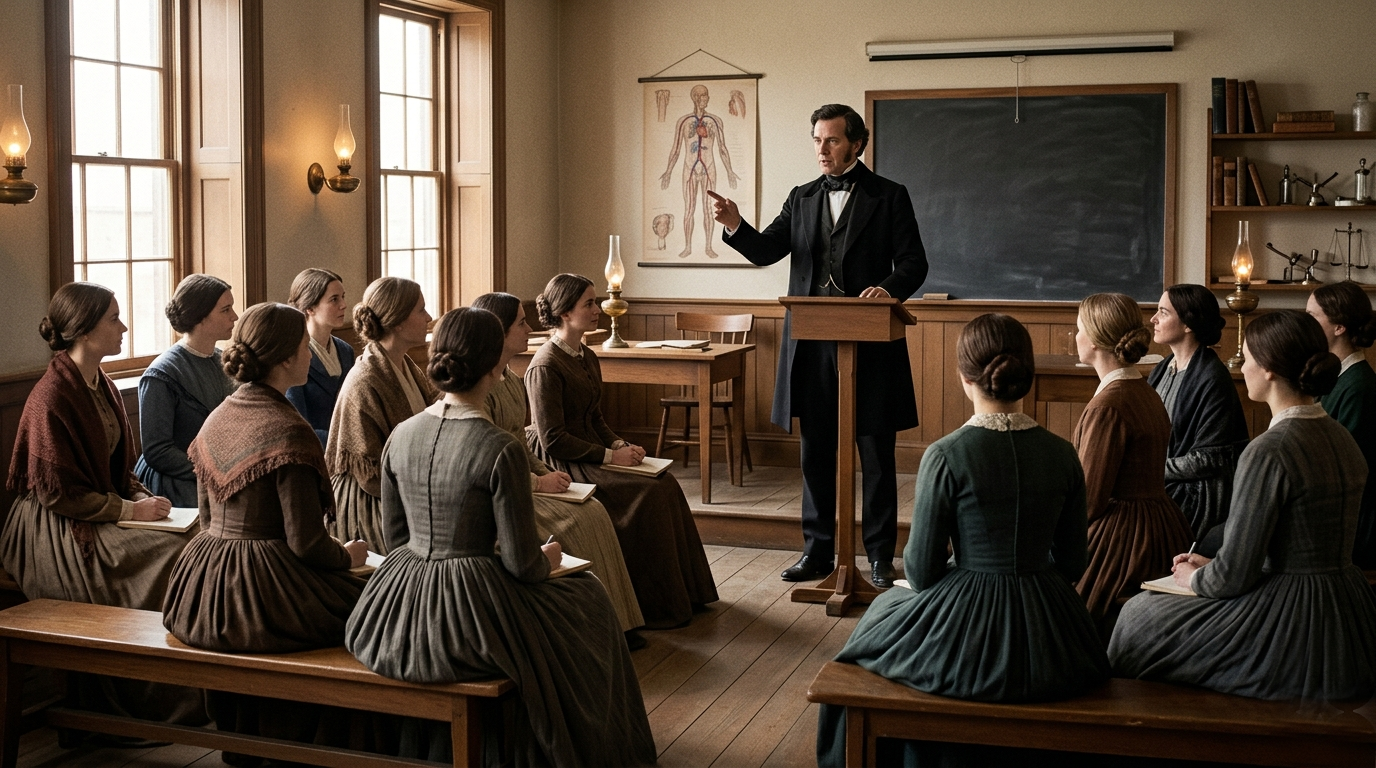
On November 1, 1848, twelve women walked into a classroom in Boston, Massachusetts, and took their seats as medical students. This was not merely an unusual occurrence. It was an event without precedent in the history of Western medicine. No institution had ever before opened its doors to train women as physicians. These twelve students, drawn from across New England, New York, and Ohio, paid $25 in tuition for the privilege of attending the Boston Female Medical College, the first medical school for women in the United States and in the world. The room in which they sat was located in the home of Dr. Winslow Lewis, president of the Boylston Medical School, who had agreed to host the new institution’s first classes. The school had two faculty members. It had no hospital affiliation. It had, in all the world, no comparable model. Everything it attempted was being done for the first time.
The Boston Female Medical College had been founded by Samuel Gregory, a Yale-educated lecturer, writer, and reformer from Guilford, Vermont, who had arrived at the cause of female medical education from a direction that said as much about the social conventions of 1848 as about any progressive vision of women’s professional equality. Gregory was not a feminist. He would later openly oppose women’s suffrage. What he did believe, with a conviction that led him to publish pamphlets, give lectures, and eventually build an institution, was that it was indecent for male physicians to attend women during childbirth. His motivating argument, as he expressed it in his widely circulated 1848 pamphlet, was that male attendance at childbirth was “unnecessary, unnatural, and injurious to the physical welfare of the community,” and that the solution was to educate women as physicians who could treat women and children without the impropriety of male presence.
Whatever the limitations of Gregory’s founding motivation, the institution his advocacy created was genuinely transformative. The Boston Female Medical College, later renamed the New England Female Medical College, became the crucible in which the American tradition of women in medicine was forged.
The World That Barred Women from Medicine in 1848
To understand what the founding of the Boston Female Medical College meant, it is necessary to understand how completely the medical profession excluded women in the mid-nineteenth century. In 1848, every established medical school in the United States admitted only men. The dominant view among physicians and in mainstream culture was that women were constitutionally unsuited to the demands of medical practice. Critics argued that women lacked the stamina required by the profession, that their presence in clinical settings would be unseemly, and that medical training would somehow damage their capacity for the domestic roles society had assigned them.
The medical establishment’s objections were not merely conventional. They were active and aggressive. When a physician published a response to the new school in the Boston Medical and Surgical Journal in February 1849, just three months after the first class had enrolled, he expressed what many of his colleagues believed: that “all civilized nations regard the professions of law, medicine and divinity as masculine duties” and that “woman was obviously designed to move in another sphere.” This was not a fringe view. It was mainstream professional opinion, and it shaped the obstacles that the students of Boston Female Medical College would face for decades.
Women could train as midwives in 1848, a practice that had been accepted for centuries. In some communities, women had served informally as healers, nurses, and botanical medicine practitioners. But formal medical education, the systematic clinical and scientific training that qualified a person to practice as a physician under the authority of a medical degree, was entirely closed to them. The few women who managed to obtain any medical training in the years before 1848 did so through exceptional individual circumstances that depended entirely on the sympathy of specific institutions or instructors, not on any formal policy of inclusion.
Elizabeth Blackwell, who became the first woman to earn a medical degree in the United States when she graduated from Geneva Medical College in New York in January 1849, had been accepted to Geneva Medical College only because the dean, unwilling to take personal responsibility for either admitting or rejecting her, put the decision to the student body, which voted yes as what they thought was a prank. Blackwell’s acceptance was a fluke of institutional democracy, not a policy. The Boston Female Medical College was something entirely different: an institution built specifically to provide women with the systematic medical education that no existing institution would offer them.
Samuel Gregory and the Female Medical Education Society
The Boston Female Medical College was the institutional product of a campaign that Gregory had been conducting for several years before 1848. Beginning in 1847, he delivered a series of lectures in Boston on the subject of female medical education, arguing that training women as physicians and midwives was a matter of public health as well as propriety. His lectures attracted attention and support, particularly from prominent Boston women who agreed that the care of women and children should be in the hands of women physicians rather than male doctors.
Gregory’s campaign led to the establishment of the Female Medical Education Society, a voluntary association of supporters who provided the organizational and financial foundation for the new school. The Society’s stated goals were straightforward: to establish a medical school in Boston complete with its own teaching hospital, to teach women midwifery and nursing, and to train female physicians who would specialize in the treatment of women and children. The expectation was not initially that the school would produce physicians in the full modern sense but rather that it would train women in the medical knowledge needed to serve their own sex.
The first classes of the Boston Female Medical College were held in November 1848 in the home of Dr. Winslow Lewis, who provided the space while also serving as one of the original two faculty members. The other early faculty member was Dr. Israel Tilsdale Talbot, who would later become one of the school’s most committed supporters and instructors. Students paid $25 in tuition and could find room and board for $2 to $3 per week in the neighborhoods surrounding the school. The twelve students of the first class graduated in 1850, receiving the first medical certificates ever formally awarded by an institution to women in the United States.
The Wikipedia article on the New England Female Medical College provides the complete institutional history of the school from its founding as the Boston Female Medical College through its expansion, its name changes, and its eventual merger with Boston University in 1874.
What the School Taught and How It Grew
The earliest curriculum at the Boston Female Medical College reflected Gregory’s original vision, which was oriented primarily toward midwifery and the medical care of women in childbirth. The first two faculty members focused their instruction predominantly on obstetrics and the physiological processes of pregnancy and childbirth. But as the school expanded through the early 1850s, its curriculum broadened considerably, and by the mid-decade it offered a full medical education comparable in scope to that of other medical schools of the period.
By 1852, the number of students had grown from the original twelve to over fifty, drawn from New England and other states across the country. The school’s growing reputation attracted women who sought a complete medical education, not merely obstetrical training, and the faculty expanded to between five and seven instructors by the mid-1850s to meet this demand. In 1852, the institution changed its name to the New England Female Medical College to reflect the wider scope of its geographic reach and its educational ambitions.
One of the most influential faculty members of the school’s later years was Dr. Marie Zakrzewska, a German-born physician who had emigrated to the United States and trained at the Cleveland Medical College. Zakrzewska brought to the New England Female Medical College a commitment to full professional equality for women in medicine and a conviction that women should pursue medical careers because of, in her words, “an innate interest and talent for practicing medicine as well as the love for the science of it.” She was a demanding educator who pushed the school toward the highest academic standards possible and who would later found the New England Hospital for Women and Children, providing clinical training for the school’s graduates that the mainstream hospital system refused to offer them.
The Massachusetts Legislature provided tangible support for the school’s mission. In 1854, it granted funding that provided tuition support for forty students. In 1855, it authorized a ten-thousand-dollar grant for college buildings. In May 1857, by an act of the Commonwealth of Massachusetts, the Female Medical Education Society was formally reorganized as the New England Female Medical College, with the Society’s board members becoming the Trustees of the College. On November 9, 1859, the school established the Ladies’ Medical Academy with a free clinic on Summer Street in Boston, expanding its educational mission to include community health services alongside its degree programs.
Discrimination, Clinical Denial, and the Battle for Equal Training
The students and graduates of the New England Female Medical College did not achieve their qualifications without enduring systematic discrimination from the medical establishment that surrounded and outnumbered them. The most damaging obstacle was the consistent denial of access to the clinical training that was essential to a complete medical education.
While Harvard Medical School’s male students trained in the wards of Boston’s hospitals, the female students of the New England Female Medical College were barred from those same wards, even the wards serving female patients. The Boston City Hospital denied the college’s students access to its facilities in 1864, a decision that directly impaired the quality of clinical preparation the school could offer. Without hospital access, the school could not provide its students with the range of clinical experience that qualified physicians needed, creating a persistent quality gap between the training it could offer and what was available to male students at better-resourced institutions.
This systemic exclusion was the reason that women’s medical schools throughout the country felt compelled to establish their own hospitals. The New England Hospital for Women and Children, founded by Dr. Zakrzewska in Boston, was a direct institutional response to the denial of training opportunities at public hospitals. It provided the clinical venue where graduates of the New England Female Medical College could complete their education, and where subsequent generations of women physicians would train.
Graduates of the school also faced barriers after graduation. They were frequently denied positions at established hospitals and could not count on the professional networks through which male physicians built practices and obtained institutional appointments. The isolation of women physicians from the mainstream of the profession was not merely social; it had direct consequences for the kinds of practices they could build and the patients they could serve. Many graduates built practices focused on women and children, partly out of genuine commitment to those patient populations and partly because those were the patients most willing to see a woman physician.
The Britannica resource on women in medicine in the nineteenth century covers the broader struggle for female medical education across the United States and Europe, including the specific obstacles faced by the graduates of the first women’s medical schools and the institutional strategies they developed to overcome them.
Rebecca Lee Crumpler and the First Black Woman Physician in America
The New England Female Medical College made history not only as the first medical school for women but as an institution whose commitment to inclusion extended beyond gender to race at a moment when racial exclusion was the overwhelming norm in American higher education. In 1860, the school admitted its first African American student, becoming the first medical school in the nation to do so. That student, Rebecca Lee Crumpler, graduated in March 1864, becoming the first African American woman to earn a medical degree in the United States.
Crumpler had been born in 1833 and had worked as a nurse in Massachusetts for eight years before entering medical school, bringing practical clinical experience to her studies. After graduating from the New England Female Medical College, she practiced medicine in Boston for a time before traveling to Richmond, Virginia, in the immediate aftermath of the Civil War to provide medical care to freed enslaved people who were living in desperate conditions. She cared for an estimated ten thousand freed people who had no other access to medical attention, working with virtually no resources and under conditions of intense racial hostility.
In 1883, Crumpler published “A Book of Medical Discourses,” a medical text focused on the health of women and children that drew on her years of practice. It was one of the earliest medical texts written by an African American physician and one of the few surviving records of her remarkable career. Crumpler’s graduation from the New England Female Medical College was a direct expression of the school’s founding commitment to serving populations that the medical establishment had excluded, a commitment that reflected, whatever Gregory’s personal limitations, the genuine progressive spirit of the institution he had created.
The Merger with Boston University and the End of an Era
By the early 1870s, the New England Female Medical College was facing serious financial difficulties. The costs of maintaining a full medical school without access to public hospital facilities, combined with the ongoing challenge of building an endowment sufficient to fund the institution’s ambitions, had pushed the school toward insolvency. The question of the school’s future became pressing.
Harvard University was unwilling to absorb the college. As the associate dean at Boston University’s medical school later described the Harvard position: Harvard was willing to take the school over but would not assume its debt and would not allow women or minorities to enroll. This was, in practical terms, not an offer that any institution committed to the women’s medical education mission could accept.
Boston University offered better terms. The newly established Boston University was a Methodist-affiliated institution with a constitutional commitment to admitting students regardless of sex or race. It offered to absorb the New England Female Medical College, assume its debt, continue admitting women and minorities, and add men to the student body, creating a coeducational medical school. The merger took effect in 1873, and the Boston University School of Medicine was formally established, becoming the third coeducational medical school in the United States.
The merger was not a defeat for the women’s medical education movement. It was a transformation. The institution that had opened with twelve students in a borrowed classroom in 1848 became, through its merger with Boston University, the foundation of a coeducational medical school that continued to embody the progressive commitments of its predecessor. In the late 1880s, the school trained one of the first Native American physicians in the country, Charles Eastman, a Santee Dakota man who would later become famous as the author of accounts of Sioux life. The school continued to push the boundaries of inclusion that the New England Female Medical College had first established.
The Boston University Chobanian and Avedisian School of Medicine’s account of its own history traces the institutional lineage from the 1848 founding of the New England Female Medical College through the Boston University merger and the school’s continuing tradition of firsts in American medical education.
The Legacy of the First Women’s Medical School in American History
The twelve women who sat down in a Boston classroom on November 1, 1848, paying twenty-five dollars each for the privilege of being told what no medical establishment in the world had previously been willing to tell women, that they were capable of studying and practicing medicine, set in motion a transformation of the American medical profession whose consequences extended across generations. When they graduated in 1850, there was a genuine uncertainty about what to call them. The school’s administrators, having no precedent to draw on, initially issued diplomas designating them “Doctresses of Medicine.” The women resented the title. They had studied the same subject, passed the same examinations, and demonstrated the same competence as any Doctor of Medicine. After twelve years of advocacy, the school finally began awarding the Doctor of Medicine degree without qualification.
Today, women constitute the majority of students enrolled in American medical schools, having first surpassed men in enrollment in 2017. More than 350,000 women practice medicine in the United States. The journey from twelve students in a borrowed room to majority status in the profession took 170 years. It began on November 1, 1848, in Boston, because Samuel Gregory believed it was improper for men to deliver babies, and twelve women believed it was entirely proper for them to become physicians.