
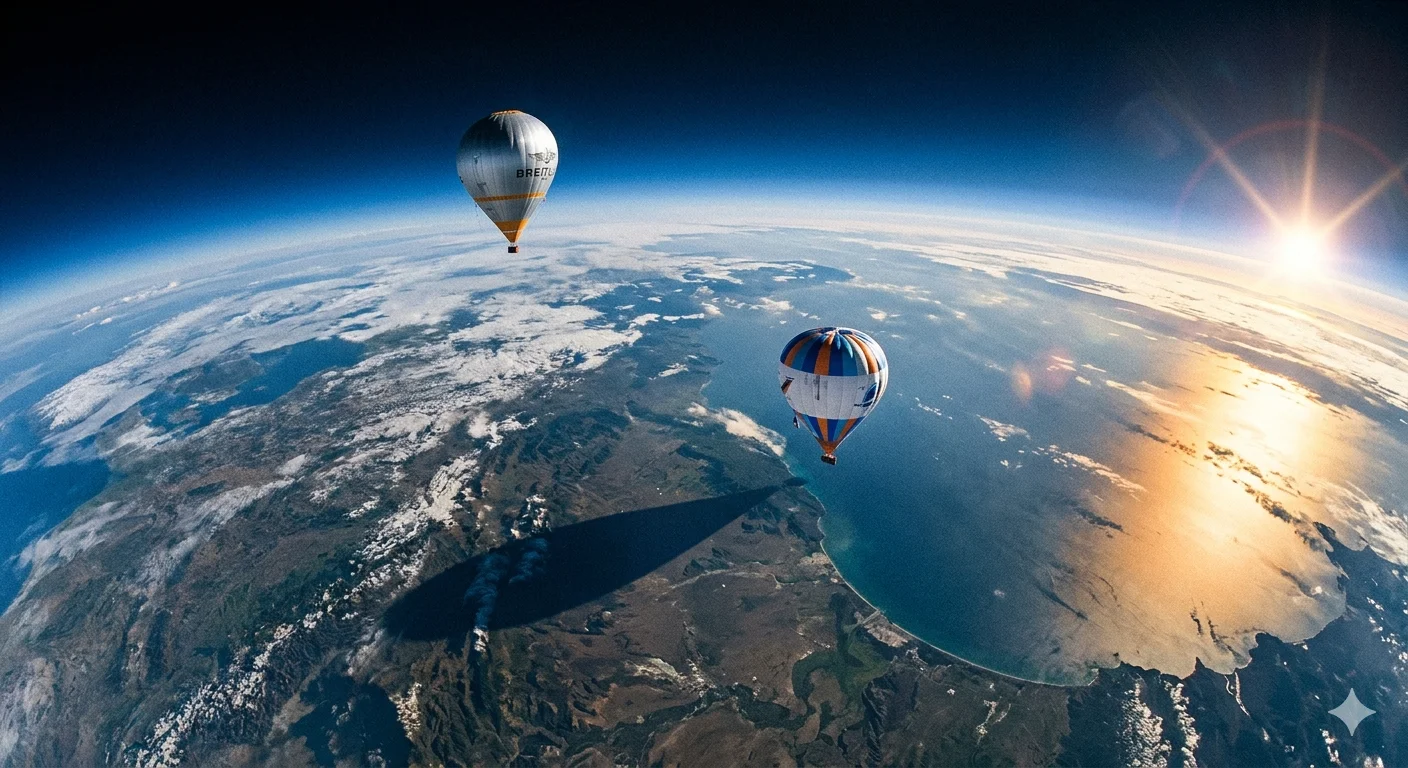
On the morning of July 2, 2002, a red, white, and silver balloon the height of a ten-story building drifted down from the sky above Queensland, Australia, and landed on the flat farmland of the continent’s northeast coast. Its lone occupant, fifty-eight-year-old American businessman and adventurer Steve Fossett, had been aloft for thirteen days, eight hours, and thirty-three minutes, covering 20,626 miles across the vast emptiness of the Southern Hemisphere’s oceans without another human being beside him, without a refueling stop, and without an engine. It was his sixth attempt at a feat he had first tried in 1996. He had nearly drowned in the Coral Sea on a previous attempt. He had been forced down in Canada, India, and Europe. He had spent in total years of his life pursuing this single objective. On July 2, 2002, Steve Fossett became the first person in the entire history of aviation to circumnavigate the globe solo, nonstop, and unrefueled — not merely the first to do it in a balloon, but the first to do it in any aerial vehicle of any kind.
The story of balloon circumnavigation is one of the great adventure narratives of modern times, a story about human beings doing what they have always done when confronted with an apparently impossible challenge: refusing to be stopped. From the moment the Montgolfier brothers first demonstrated that a fire and a bag of hot air could lift a human being off the surface of the earth in 1783, the logic of the balloon as an instrument of exploration was clear. If you could go up, you could eventually go around. If you could catch the wind, you could be carried to the ends of the earth. The practical gap between that vision and its realization took two hundred and sixteen years to close, and when it finally closed in 1999 with Bertrand Piccard and Brian Jones’s historic Breitling Orbiter 3 flight, and again in 2002 with Fossett’s solo achievement, it closed in circumstances of such drama, technical complexity, and human determination that the story deserves to be told in full.
The Montgolfier Brothers and the Dawn of Human Flight: 1783 and the Invention That Changed Everything
The history of balloon circumnavigation begins on a June morning in 1782, when Joseph-Michel Montgolfier, sitting by a fire in his house in Avignon, France, noticed that the flames caused a paper bag above them to rise and fill with the heated air produced by the combustion. Joseph was the older of two brothers who ran the family paper mill in Annonay, in the Ardèche region of southern France. He wrote to his brother Jacques-Étienne describing the phenomenon and proposing an experiment. The brothers began testing their hypothesis with cloth and paper bags over open fires in their mill, and within months they had demonstrated that a lightweight container filled with heated air would rise with sufficient buoyancy to carry a significant payload.
The public demonstrations of 1783 came in rapid, extraordinary succession. On June 4, 1783, the Montgolfier brothers launched an unmanned balloon at Annonay before a gathering of local dignitaries, sending an enormous linen bag treated with alum to prevent fire about 1,000 metres into the air over a flight of approximately ten minutes. The demonstration caused a sensation, and the brothers were summoned to Paris to perform before King Louis XVI. On September 19, 1783, at the Palace of Versailles in the presence of the royal court, they launched a balloon carrying the first living air passengers: a sheep named Montauciel, a duck, and a rooster. The animals survived their eight-minute flight of approximately three kilometres and were recovered intact, demonstrating that living creatures could survive at altitude. Then, on November 21, 1783, at the Château de la Muette in Paris, Jean-François Pilâtre de Rozier and François Laurent, the Marquis d’Arlandes, made the first free, untethered manned balloon flight in human history, rising to approximately 500 feet and travelling about five miles in twenty-five minutes over the rooftops of Paris. The straw fire heating their envelope set the fabric alight twice during the flight, and both men spent considerable effort dousing the flames with wet sponges they had carried for exactly that contingency. The age of human flight had begun.
Less than three weeks later, on December 1, 1783, the physicist Jacques Alexandre César Charles and his assistant Nicolas-Louis Robert flew a hydrogen-filled balloon from the Tuileries gardens in Paris, staying aloft for two hours and travelling twenty-seven miles to the village of Nesles-la-Vallée, where Charles continued alone for a further altitude record of approximately ten thousand feet. Charles’s balloon introduced the hydrogen gas balloon, which differed fundamentally from the Montgolfier hot-air design by using a lighter-than-air gas rather than heated air for its lift, and which would prove more practical for long-distance flight. The two types of balloon — hot-air and gas — would develop in parallel through the following century and a half, until a third type, the Rozière balloon combining features of both, was developed and ultimately made circumnavigation possible.
Two Centuries of Expanding Ambition: From Channel Crossings to the Stratosphere
The century and a half following the Montgolfier brothers‘ invention was a period of steady expansion in the ambitions of balloonists, as each generation pushed the technology further in pursuit of longer distances, greater altitudes, and more challenging crossings. On January 7, 1785, just over a year after the first manned flight, the French aeronaut Jean-Pierre Blanchard and the American physician John Jeffries flew a hydrogen balloon from Dover to Calais, crossing the English Channel for the first time by air in a journey of approximately two and a half hours. The crossing was not without drama: the balloon lost altitude over the middle of the Channel, and Blanchard and Jeffries were forced to jettison their anchor, their food, their ballast, and eventually most of their clothing to maintain enough height to reach the French coast. They arrived over Calais almost naked but triumphant.
The nineteenth century saw balloons deployed for military observation, scientific research, and the first tentative attempts at long-distance travel. During the American Civil War, the Union Army Balloon Corps, under the direction of Thaddeus Lowe, used hydrogen balloons to observe Confederate positions from heights up to a thousand feet. The first serious attempt at a transatlantic balloon crossing was made in August 1859 by John Wise of Lancaster, Pennsylvania, who aimed to ride the prevailing westerly jet stream from St. Louis to Europe. He managed only 809 miles before coming down in Henderson, New York, setting a distance record at the time. The dream of crossing the Atlantic by balloon would consume numerous aeronauts over the following decades before it was finally achieved.
One of the most haunting episodes in the history of exploration by balloon was the Arctic expedition of 1897, when Swedish engineer Salomon August Andrée attempted to reach the North Pole by hydrogen balloon from Svalbard, accompanied by Nils Strindberg and Knut Frænkel. Their balloon, the Eagle, disappeared in the Arctic after launch and was not heard from again. For thirty-three years the fate of the expedition was one of the great unsolved mysteries of polar exploration, until 1930, when a scientific expedition to White Island discovered the remains of all three men and their equipment, including exposed photographic film that could still be developed. The men had crashed on pack ice on their third day aloft and died attempting to walk to civilization, a tragic testament to the gap between the ambition of balloon exploration and the state of the technology in 1897.
The twentieth century brought the first truly systematic attempts to push balloon flight to its physical limits. On May 27, 1931, the Swiss physicist Auguste Piccard and his assistant Paul Kipfer ascended from Augsburg, Germany, in a sealed pressurized aluminum gondola of Piccard’s own design, reaching an altitude of 15,781 metres (51,775 feet) — the first human beings to reach the stratosphere. Piccard’s innovation of the pressurized gondola, which allowed occupants to breathe normal air at altitudes where the atmosphere was too thin for survival, was a fundamental technological contribution to aviation history. It was a concept that would be carried forward by his grandson Bertrand Piccard in the Breitling Orbiter 3 sixty-eight years later. In 1935, the American military balloon Explorer II, crewed by Captain Albert Stevens and Orvil Anderson, set an altitude record of 22,066 metres (72,395 feet) that would stand for twenty years and provided critical data about the upper atmosphere that contributed to the development of manned spaceflight.
The Race to Circle the Earth: Why Balloon Circumnavigation Was Aviation’s Last Great Prize
By the second half of the twentieth century, every major conquest of distance and altitude in aviation had been achieved by powered aircraft. Charles Lindbergh had crossed the Atlantic solo in 1927. The English Channel had been crossed by air in 1909. The poles had been reached. The sound barrier had been broken in 1947. The first orbital spaceflight had been achieved in 1961. And yet the balloon, humanity’s oldest flying machine, had never once circled the globe. The longest balloon flight in history, as late as 1981 when serious circumnavigation attempts began, was measured in days rather than the weeks that a circumnavigation would require.
The technical challenge of balloon circumnavigation was formidable and specific. A balloon cannot fly in a straight line: it moves entirely at the will of the wind, carried wherever the air masses surrounding it choose to go. To circle the globe, a balloon crew needed to find and ride a series of wind systems — principally the jet streams, fast-moving bands of wind at high altitude — that would carry them generally eastward around the planet without depositing them in hostile airspace or over terrain where landing would be dangerous or impossible. The meteorological precision required was extraordinary: not merely predicting the wind at one location at one time, but modeling the wind patterns at altitudes of up to 35,000 feet across entire continents and oceans over periods of weeks, adjusting predictions as the balloon moved and conditions changed. Ground-based meteorological teams became as important to the attempt as the pilots themselves.
The geopolitical dimension added another layer of complexity. The balloon could not choose its route: it went where the wind took it, and the wind took it over whatever nations happened to lie in its path. China’s airspace restrictions, in particular, created enormous problems for circumnavigation attempts: the most favourable jet stream routes for an eastward circumnavigation passed directly over Chinese territory, and China initially refused to grant overflight permission. Iraq’s airspace was periodically off-limits due to international tensions. Libya and other nations had their own restrictions. Every circumnavigation attempt required years of diplomatic preparation alongside the technical preparation, with teams of diplomats negotiating overflight agreements with dozens of sovereign governments for a flight that could not guarantee its precise path any more than a sailing ship can guarantee its route in variable winds.
The financial dimension was equally formidable. A serious circumnavigation attempt required a custom-built balloon large enough to carry sufficient fuel, food, water, and equipment for a three-week flight, together with the support infrastructure of a ground team of meteorologists, communications specialists, and logistics coordinators, often based in Geneva or some other central hub, monitoring the flight around the clock. The balloons cost hundreds of thousands of dollars to build; the support operations cost millions more; and the cost of failed attempts, which consumed an entire balloon and all its equipment in a single landing, meant that participants needed either personal fortunes or major corporate sponsors to keep trying. The race for balloon circumnavigation was accordingly dominated by a small number of wealthy adventurers and their corporate backers, competing in a high-stakes game of technology, meteorology, diplomacy, and physical endurance that played out across nearly two decades.
The Piccard Dynasty: From the Stratosphere to the Globe Across Four Generations
No family in the history of exploration has contributed more to the story of balloon flight than the Piccard family of Switzerland, a dynasty of scientists and explorers spanning four generations whose achievements bracket the entire arc of serious high-altitude ballooning. Auguste Piccard, born January 28, 1884, in Basel, Switzerland, was the brilliant physicist who designed and flew the first pressurized balloon gondola to the stratosphere in 1931. His twin brother Jean Félix Piccard, who immigrated to the United States, and Jean Félix’s wife Jeannette Piccard were also pioneering balloonists; their son Donald Piccard made the first balloon crossing of the English Channel. Jacques Piccard, Auguste’s son and Bertrand’s father, built on the family tradition of extreme environments in the opposite direction, descending to the deepest point in the world’s oceans, the Challenger Deep in the Mariana Trench, in January 1960 aboard the bathyscaphe Trieste — reaching 10,916 metres below sea level, the deepest any human being has ever gone.
Bertrand Piccard was born in Lausanne, Switzerland, on March 1, 1958, the same date on which, forty-one years later, he would take off on the flight that completed his family’s extraordinary contribution to the history of exploration. Growing up in the shadow of a grandfather who had flown to the stratosphere and a father who had descended to the ocean floor, Piccard was profoundly aware of the exploratory tradition he had inherited. Initially afraid of heights as a child, he took up hang gliding at sixteen and proceeded through ultralights, aerobatic aircraft, and hot-air balloons to become an accomplished and experienced aviator. He qualified as a psychiatrist and established a practice in Lausanne, but aviation and exploration remained central to his life. In 1992, he and Wim Verstraeten won the Chrysler Transatlantic Balloon Race across the Atlantic Ocean, demonstrating the long-distance balloon navigation skills he would need for the circumnavigation.
Piccard had been thinking about circumnavigation for years before he made his first attempt. The symbolic resonance of a Piccard completing the balloon’s conquest of the globe was obvious to him and to his supporters, but the practical achievement required a balloon and a support infrastructure beyond anything the family had previously attempted. He found his corporate backer in Breitling SA, the Swiss watchmakers, whose sponsorship funded the construction of three successive Breitling Orbiter balloons. The first attempt, the Breitling Orbiter, took off from Château-d’Oex in January 1997 with Piccard, Verstraeten, and Andy Elson aboard, but ended just hours after launch when a loose clip caused kerosene fuel to leak into the gondola, forcing an emergency landing. The second attempt, the Breitling Orbiter 2, launched in January 1998 and flew from Switzerland across Africa and the Middle East to Myanmar, where Chinese airspace restrictions forced it down. The lessons from each failure were incorporated into the design and planning of the third attempt.
Breitling Orbiter 3: The Design and Technology of the First Balloon to Circle the World
The Breitling Orbiter 3 was a Rozière balloon, a hybrid type that combined the features of both a gas balloon and a hot-air balloon. The Rozière design, named after Jean-François Pilâtre de Rozier (the very man who had made the first free manned balloon flight in 1783, and who died in 1785 attempting to cross the English Channel in a combined hydrogen and hot-air balloon), used an inner cell of helium for its primary lift, surrounded by an outer envelope of hot air that could be heated by propane burners to fine-tune the balloon’s altitude. The advantage of the Rozière design for long-distance flight was the stability it offered across the extreme temperature swings of day and night at high altitude: the hot-air envelope could compensate for the cooling of the helium cell at night, preventing the potentially dangerous loss of altitude that would otherwise occur as the helium contracted in the cold.
When fully inflated, the Breitling Orbiter 3 stood 55 metres tall — approximately the height of an eighteen-story building. Its outer hot-air envelope contained approximately 18,000 cubic metres of air. The inner helium cell held approximately 6,300 cubic metres of helium at sea level, expanding as the balloon rose and the atmospheric pressure decreased around it. The propane gas that fueled the six burners heating the outer envelope was stored in twenty-eight titanium cylinders mounted in two rows along the sides of the gondola; so concerned was the team about fuel consumption that four additional propane containers were added just before launch, a decision that proved essential to the completion of the flight. The gondola itself was constructed of Kevlar and carbon fibre, materials that combined exceptional strength with minimum weight. After launching, the cabin was sealed at approximately 6,000 feet to maintain a pressurized atmosphere during flight at altitudes where the outside air was too thin to breathe unaided.
The interior of the gondola was approximately four metres long and two metres in diameter — roughly the size of a large recreational vehicle, as the National Air and Space Museum later described it — and contained everything that two people would need to survive for three weeks in the stratosphere. Navigation instruments occupied a significant portion of the available space, including GPS receivers, altimeters, and the communication systems that connected Piccard and Jones to their ground control team in Geneva around the clock. A single bunk accommodated one crew member at a time, with the daily routine calling for each man to spend eight hours alone at the controls, eight hours working alongside his crewmate, and eight hours sleeping. The cabin was equipped with heaters designed to maintain a temperature of approximately 15 degrees Celsius, but temperatures occasionally fell low enough during the flight that drinking water froze and ice had to be carefully removed from the delicate electronic circuitry. Life support was maintained through supplemental oxygen and nitrogen, with carbon dioxide removed by lithium hydroxide filters.
March 1, 1999: Launch from Château-d’Oex and the Long Wait for the Wind
The launch of the Breitling Orbiter 3 from the Swiss Alpine village of Château-d’Oex on March 1, 1999, had been delayed for months by a combination of diplomatic and meteorological obstacles. Iraq was under NATO air bombardment in late 1998, periodically closing the Middle Eastern airspace that the balloon might need to cross. More critically, a British balloon had recently drifted over unauthorized portions of Chinese territory, and the Chinese government had halted all overflight permissions for the Breitling team until diplomatic negotiations conducted by Swiss officials could produce a new agreement. The wait stretched through the winter months, consuming what was normally the best season for high-altitude westerly winds. When Chinese permission finally arrived, the team took off with barely adequate wind conditions rather than wait any longer.
At 8:05 Greenwich Mean Time on the morning of March 1, 1999 — Bertrand Piccard’s forty-first birthday — the Breitling Orbiter 3 lifted away from Château-d’Oex amid the cheers of thousands of spectators who had gathered in the alpine village. Brian Jones, Piccard’s British copilot, was the product of a very different background from the famous Piccard dynasty. Born on March 27, 1947, in Bristol, England, Jones had left school early to spend thirteen years in the Royal Air Force, becoming a skilled aviator before getting involved in ballooning in 1986 and acquiring a balloon-flying instructor’s license by 1989. He had served as project manager for several Breitling balloon missions, overseeing the construction of the craft, and had originally been designated as a third copilot for the Orbiter 3 before the withdrawal of Wim Verstraeten and another pilot elevated him to Piccard’s sole copilot. He brought to the flight a methodical professional competence that complemented Piccard’s more visionary character.
In the first hours of flight, Piccard and Jones climbed through the cold Alpine air with views of Mont Blanc and the Matterhorn spread below them, the landscape of Switzerland giving way to Italy and then the Mediterranean. The ground control team in Geneva, headed by meteorologists Luc Trullemans and Pierre Eckert, tracked their progress and provided guidance on the wind patterns that would determine the balloon’s route. The first major challenge came early: the team needed to fly south to below the 26th parallel to respect the Chinese airspace restrictions, a maneuver that required threading a meteorological needle thousands of kilometres away. As Trullemans later described it, threading a needle fifteen thousand kilometres distant while the balloon moves at the wind’s speed and direction is the closest analogy to their task.
The Pacific Crisis and the Six Days That Nearly Ended Everything
The most terrifying episode of the Breitling Orbiter 3’s flight occurred over the Pacific Ocean, the vast empty expanse that covers a third of the planet’s surface and offered no possibility of rescue or refuge for a crew in trouble at altitude. Approaching the Pacific from the Asian landmass, Piccard and Jones encountered wind conditions that were far weaker than their meteorologists had predicted, leaving them drifting through the ocean at speeds too slow to complete the circumnavigation before their fuel supply ran out. For six days they hung suspended over the immense ocean, cut off at times from their Geneva control centre by satellite antenna problems, watching their propane reserves dwindle as they struggled to maintain altitude and forward motion. The situation was genuinely desperate: without a powerful jet stream to carry them eastward across the Pacific at the speeds of 100 miles per hour or more that the circumnavigation required, they would run out of fuel and be forced to ditch at sea.
The meteorological team in Geneva worked around the clock, analyzing pressure systems, wind charts, and satellite data in search of a route that would bring the balloon into contact with a usable jet stream. After six agonizing days during which success appeared increasingly unlikely, a high-pressure system shifted in a way that the meteorologists had been watching and hoping for, creating a corridor of fast-moving air that swept down toward the balloon’s position. At 180 kilometres per hour, the jet stream caught the Breitling Orbiter 3 and drove it eastward toward Mexico at a speed that transformed the prognosis from doubtful to confident almost overnight. The balloon crossed Central America and the Atlantic Ocean at speed, reaching Africa and crossing the continent toward the designated finish line. On March 19, 1999, at 9:54 Greenwich Mean Time, the Breitling Orbiter 3 crossed the longitude of 9 degrees 27 minutes west over Mauritania in North Africa — the same meridian that Piccard and Jones had crossed on their way south shortly after departing Switzerland. They had circumnavigated the globe.
The balloon continued south and east toward Egypt, where Piccard had hoped to land near the Great Pyramids of Giza. High winds in the desert prevented the planned landing, and on March 21, 1999, at 6:00 Greenwich Mean Time, the Breitling Orbiter 3 landed approximately 80 kilometres north of Mut in the Egyptian desert. The total flight had lasted 19 days, 21 hours, and 47 minutes. The total distance covered was approximately 45,755 kilometres, or 28,431 miles. Piccard and Jones had set seven new world records, including absolute records for both distance and duration across all balloon categories, four of which still stand today. The gondola was recovered and is now on permanent display at the Smithsonian Institution’s National Air and Space Museum in Washington, D.C., across from the Apollo 11 command module. Bertrand Piccard later reflected that we took off as pilots, flew as friends and landed as brothers. Brian Jones said his first act on landing would be to phone his wife, and then, like the good Englishman he was, have a cup of tea.
The Other Challengers: Richard Branson, Steve Fossett, and the Race That Defined an Era
The race to be first to complete a nonstop balloon circumnavigation of the globe attracted some of the most prominent and determined adventurers of the late twentieth century, and the stories of the failed attempts that preceded Piccard and Jones’s success are as important to the full history of balloon circumnavigation as the success itself. Richard Branson, the British billionaire founder of the Virgin Group, was among the most persistent competitors. Branson had already established himself as a record-breaking balloonist, having crossed the Atlantic with Per Lindstrand in 1987 in the Virgin Atlantic Flyer — the first hot-air balloon to cross the Atlantic — and crossed the Pacific with Lindstrand in 1991 in the Virgin Otsuka Flyer, setting a world distance record of 6,700 miles. His three circumnavigation attempts, in 1997, 1998, and December 1998, all ended in failure. The December 1998 attempt with Steve Fossett ended when their balloon, launched from Morocco, had to ditch in the Pacific near Hawaii after bad weather forced them to bail out of the craft and wait for rescue.
Steve Fossett’s involvement in the circumnavigation race was, if anything, even more intense than Branson’s. James Stephen Fossett was born on April 22, 1944, in Jackson, Tennessee, and grew up in Garden Grove, California. He made his fortune as a commodities trader in Chicago, founding Lakota Trading and accumulating sufficient wealth to pursue an extraordinary range of athletic and adventuring ambitions. He was a marathon runner, a long-distance swimmer, a solo sailor, and above all an aviator and balloonist of exceptional skill and determination. In February 1995, he completed the first solo balloon crossing of the Pacific Ocean, flying from Seoul, South Korea to Leader, Saskatchewan, Canada, setting a new milestone in solo balloon distance. His circumnavigation attempts began in January 1996 and continued for six years, through setbacks that would have ended any less determined person’s campaign.
Fossett’s six attempts at solo balloon circumnavigation included some of the most dramatic near-misses in the history of aviation adventure. His first attempt, launched from the Black Hills of South Dakota in January 1996 aboard the Solo Challenger, ended after three days and approximately 1,800 miles in eastern Canada when technical problems forced him down. He rebuilt the balloon, renamed it Solo Spirit, and launched again from Busch Stadium in St. Louis in February 1997, this time flying more than 9,600 miles before landing in a tree in India. The third attempt, launched from Mendoza, Argentina, in December 1997 with a larger Rozière envelope, ended in southeastern Europe due to bad weather. A fourth attempt in August 1998, launched from Mendoza, flew farther than any previous attempt, reaching the waters off the Australian coast before the balloon ruptured in a thunderstorm, sending Fossett into a terrifying five-mile fall into the Coral Sea. He survived, floating in survival gear for seventy-two hours before rescue at a cost of $500,000. His fifth attempt, in December 1998 with Branson as co-pilot, ended in the Pacific. None of these setbacks persuaded Fossett to stop.
July 2, 2002: Steve Fossett’s Solo Victory and the Spirit of Freedom
After Piccard and Jones’s success in 1999 established that circumnavigation by balloon was achievable, Fossett turned his focus to a specific remaining record: the first solo balloon circumnavigation, which would also constitute the first solo nonstop unrefueled circumnavigation of the Earth by any aerial vehicle. No pilot, in any aircraft with any number of engines, had ever circled the globe alone without stopping or taking on fuel. The logistical and physical demands of doing so in a balloon, rather than a powered aircraft, were particularly severe: the pilot would be alone in a gondola roughly the size of a large closet for potentially two or three weeks, navigating by the wind rather than by throttle and rudder, with no mechanical means of reaching land if the balloon drifted into unfavorable conditions.
Fossett’s sixth attempt, launched from Northam, Western Australia, on June 19, 2002, was significantly different in strategy from his previous attempts. Rather than attempting a Northern Hemisphere route, which required complex diplomatic negotiations for overflight rights through multiple nations and risked interception over hostile airspace, Fossett and his meteorological team designed a Southern Hemisphere route that would take the balloon over the vast expanse of the Southern Ocean and Pacific, spending most of its time above water where airspace restrictions were minimal. Washington University in St. Louis served as his mission control center, as it had for several previous attempts. The balloon, named Spirit of Freedom, was a The Rozière design is similar in principle to the Breitling Orbiter 3, though smaller given that it needed to carry only one person rather than two.
The Spirit of Freedom lifted off from Northam on June 19, 2002, and sailed eastward across the Southern Ocean, driven by the powerful westerly winds of the roaring forties and fifties latitudes south of the equator. The Southern Hemisphere route exposed Fossett to extreme weather and the possibility of being swept into Antarctic airspace, but it had the enormous advantage of requiring negotiations with far fewer sovereign nations. At times the balloon exceeded 200 miles per hour in the strongest jet streams, hurtling eastward across the featureless ocean at speeds that consumed the circumference of the earth faster than any balloon had previously flown. Fossett subsisted on dehydrated survival rations, used a bucket as a toilet, breathed from oxygen canisters at altitude, and managed the balloon’s systems alone for thirteen days.
On July 2, 2002, Steve Fossett brought the Spirit of Freedom down in Queensland, Australia, completing the circuit he had begun in Western Australia thirteen days earlier. He had covered 20,626 miles in 13 days, 8 hours, and 33 minutes, at an average speed that set new records for a solo balloon flight. He had not merely become the first person to make a solo balloon circumnavigation: he had become the first person in history to make any aerial circumnavigation alone, without stopping or taking on fuel, in any kind of flying machine. The record was recognized by the Fédération Aéronautique Internationale, the governing body of world aviation records, and Fossett received the Harmon Trophy, the Gold Medal of the Royal Aero Club of the United Kingdom, and the Grande Médaille of the Aéro-Club de France. He was inducted into the National Aviation Hall of Fame in 2007, the same year he died when a light aircraft he was flying went missing over the Nevada desert.
The Technology That Made It Possible: Rozière Balloons, Jet Streams, and the Science of Navigation
The balloon circumnavigation achievements of 1999 and 2002 were products of specific technological developments that distinguished the Rozière balloon from all previous balloon designs and made flights of the required duration and distance physically possible. The Rozière design’s combination of a helium gas cell and a hot-air envelope addressed the fundamental problem of long-duration balloon flight: the thermal cycle. A pure gas balloon rises at night as the ambient temperature drops, because the denser cold air around it increases its relative buoyancy, and sinks during the day as the sun heats both the gas and the surrounding air. A pure hot-air balloon requires constant burning of fuel to maintain altitude. The Rozière balloon manages both problems simultaneously by using the fixed helium cell for stable baseline lift and the variable hot-air envelope to compensate for the thermal cycle, burning burners at night to maintain altitude and venting hot air during the day to prevent excessive climbing. The result is a balloon that can fly for weeks with a manageable fuel consumption, making transcontinental and intercontinental flight practical in a way that neither pure design could achieve.
The science of jet stream navigation was equally critical. Jet streams are fast-moving, narrow bands of wind found at high altitudes, typically between 25,000 and 35,000 feet, flowing generally from west to east around the planet. They are products of the temperature difference between cold polar air and warm tropical air, and their positions, speeds, and directions shift constantly with the global weather patterns. Speeds in the core of a jet stream can exceed 200 miles per hour, providing the eastward propulsion that makes rapid circumnavigation possible. But jet streams meander, split, and dissolve unpredictably, and the art of balloon circumnavigation was largely the art of predicting where the jet streams would be days and weeks in advance, navigating the balloon into their cores by adjusting altitude, and riding them across oceans and continents.
The ground meteorological teams supporting the Breitling Orbiter 3 and the Spirit of Freedom were genuinely central to the achievements, not merely supportive of the pilots. Luc Trullemans and Pierre Eckert, for Piccard and Jones, and the Washington University team for Fossett, processed satellite data, atmospheric pressure models, and real-time weather information around the clock, producing the route recommendations and altitude guidance that kept the balloons in favorable winds. The communication systems that connected the balloon to the ground team depended on satellite links, since the balloons flew at altitudes and over oceanic regions where conventional radio was unavailable. GPS navigation systems provided continuous positional data. The entire technological infrastructure of late twentieth-century telecommunications and meteorology was deployed in support of what appeared, in the romantic image of a balloon sailing through the clouds, to be the most primitive of flying machines.
The Piccard Legacy Continues: Solar Impulse and the Next Frontier
Bertrand Piccard’s achievement in 1999 did not exhaust his exploratory ambitions or his commitment to the intersection of adventure and environmental purpose. In the years following the Breitling Orbiter 3 flight, he used the prize money from the Budweiser Cup, which had been offered to the first balloon crew to complete a circumnavigation, to found the Winds of Hope humanitarian foundation, dedicated to promoting respect for humanity and the natural world. He had been moved, during the three weeks of flying high above the earth, by the sight of millions of people suffering below while he traveled in a technological cocoon, and by the beauty of the planet viewed from altitude. The experience, he said, changed his understanding of his responsibilities.
In 2003, Piccard announced a project that extended the philosophy of circumnavigation into new technological territory: a solar-powered aircraft that could fly around the world without any fuel whatsoever, using only the energy of sunlight captured by solar cells on its enormous wings. The project, Solar Impulse, was developed in partnership with the École Polytechnique Fédérale de Lausanne and co-piloted with André Borschberg, a Swiss pilot and engineer. Solar Impulse 1 made its first overnight flight in 2010 and its first intercontinental flight from Switzerland to Morocco in 2012. Solar Impulse 2, a larger and more capable aircraft, began its circumnavigation from Abu Dhabi on March 9, 2015, completing the journey and landing back in Abu Dhabi on July 26, 2016, the first solar-powered aircraft to circle the globe. The circumnavigation took seventeen legs and more than twenty-three days of actual flight time, spread over sixteen months of stops for maintenance and weather. Piccard piloted the final leg back to Abu Dhabi, completing a personal aviation arc that ran from the stratosphere balloon of his grandfather to the solar aircraft of the twenty-first century.
The Meaning of Balloon Circumnavigation: Adventure, Science, and the Human Condition
The balloon circumnavigation achievements of 1999 and 2002 were, in a narrow technical sense, the filling of the last remaining gap in the map of aerial achievement. Every other fundamental challenge of distance and direction had been accomplished by powered aircraft: the first Atlantic crossing by air was in 1919 (John Alcock and Arthur Whitten Brown in a Vickers Vimy biplane), the first solo Atlantic crossing in 1927 (Charles Lindbergh in the Spirit of St. Louis), the first circumnavigation by powered aircraft in 1924 (the U.S. Army Air Service World Cruiser flight, completed in 175 days). The balloon had been left behind, the original flying machine made irrelevant to the record books by the superior capability of the internal combustion engine. Piccard and Jones’s flight in 1999 and Fossett’s flight in 2002 retrieved the balloon from that historical marginalization and demonstrated that the oldest form of aviation still had original achievements to offer.
But the significance of balloon circumnavigation was always more than technical. The balloon, unlike the powered aircraft, does not impose itself on the atmosphere: it works with the atmosphere, being carried where the wind chooses, negotiating with the planet’s weather systems rather than overcoming them with thrust. Bertrand Piccard articulated this dimension of his experience repeatedly in the years after the Breitling Orbiter 3 flight: for him, the circumnavigation was a metaphor for life, a demonstration that the greatest achievements come not from fighting against circumstances but from harmonizing with them, from finding the jet stream of opportunity rather than burning fuel to fight the headwinds. Human beings always want to control nature, he said, but flying around the world by balloon required him to harmonize with nature, following the rhythm of the wind. The insight found its eventual practical expression in the Solar Impulse project, which applied the same principle of working with natural energy rather than against it to the challenge of aviation’s carbon footprint.
Conclusion: From Annonay to the Egyptian Desert to Queensland — 216 Years in the Making
On June 4, 1783, in the town of Annonay in southern France, Joseph and Jacques Montgolfier demonstrated that a fire and a bag of hot air could lift a mass of linen off the ground and carry it into the sky. The dream that was born in that moment — of traveling by air, of being carried above the earth on the invisible medium of the atmosphere — has driven human beings for more than two centuries to attempt feats that their contemporaries consistently described as impossible. The sheep, duck, and rooster who were the first living creatures to travel by balloon had no idea what they were participating in. Pilâtre de Rozier and the Marquis d’Arlandes, who flew over Paris twenty minutes in 1783, could not have imagined that the technology they pioneered would eventually carry human beings around the circumference of the globe.
Bertrand Piccard and Brian Jones, sitting in a sealed capsule of Kevlar and carbon fibre at 38,000 feet above the Egyptian desert on March 21, 1999, after nineteen days and twenty-one hours aloft, were the heirs of that 216-year tradition. Steve Fossett, landing his Spirit of Freedom in Queensland, Australia, on July 2, 2002, after thirteen days alone above the Southern Ocean, was its most recent expression. Together, these two achievements closed the circle that the Montgolfier brothers had opened in 1783, demonstrated that the oldest and most elemental form of human flight still had original frontiers to cross, and added to the long human story of exploration two chapters that will be told for as long as the history of aviation is told.
The gondola of the Breitling Orbiter 3 hangs today in the National Air and Space Museum in Washington, D.C., across the room from the Wright Brothers’ Flyer and near the Apollo 11 command module. The Spirit of Freedom, Steve Fossett’s red, white, and silver balloon, is gone — consumed by the various tribulations of storage after its Queensland landing. But the records stand, ratified in the archives of the Fédération Aéronautique Internationale, and the stories of the men who achieved them, and of the hundreds of other adventurers, engineers, meteorologists, and diplomats who contributed to their achievement, remain one of the most extraordinary testaments to human aspiration and persistence that the history of flight has to offer.