
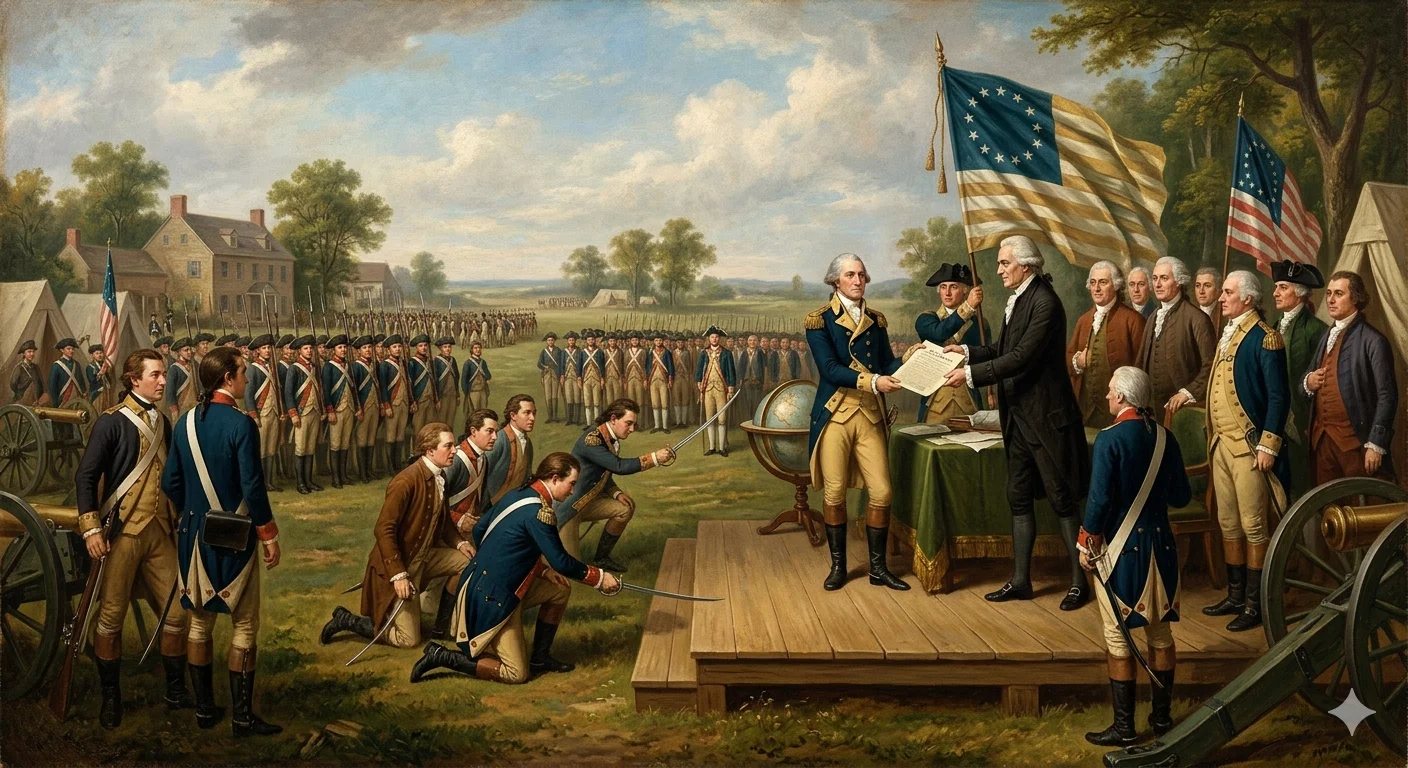
On July 3, 324 AD, on the flat plains near the city of Hadrianopolis in the Roman province of Thrace — the city that would later be known as Adrianople, and that is today the Turkish city of Edirne — the armies of two Roman emperors met in decisive battle for the second and final time. Constantine I, the Western emperor who had converted to Christianity, crossed the Hebrus River with an army that was smaller in number than the force arrayed against him, using a tactical deception that stands as one of the most skillful maneuvers in late Roman military history. His opponent was Licinius, the Eastern emperor, a man who had once been his ally, his brother-in-law by marriage, and his co-author of the Edict of Milan, but who had in the intervening years become both a personal rival for sole imperial power and, in the eyes of history, a representative of the pagan past that Constantine’s Christianity was displacing.
The Battle of Adrianople on July 3, 324 AD was not the final engagement of the war between Constantine and Licinius — that distinction belongs to the Battle of Chrysopolis on September 18, 324, where the last remnants of Licinius’s power were destroyed — but it was the decisive turning point, the engagement that shattered Licinius’s army, stripped him of his territorial base, and set in motion the chain of events that ended with Constantine ruling the entire Roman Empire as its sole master for the first time since Diocletian had created the Tetrarchy system in 285 AD. More than a military victory, the Battle of Adrianople was the event that ensured the future of the Christian religion within the Roman Empire, the future of the Roman state as a unified rather than divided entity, and the future of the city that Constantine would found as his new capital on the shores of the Bosphorus: Constantinople, the city that would carry his name and the civilization he shaped for a thousand years after his death.
Diocletian’s Tetrarchy: The System of Divided Power That Constantine Was Born Into and Determined to Destroy
To understand the Battle of Adrianople and its significance, it is necessary to understand the political system of the late Roman Empire into which Constantine was born and which the battle helped bring to an end. The Roman Empire of the late third century AD had been in serious trouble for decades. The fifty years between 235 and 284 AD, sometimes called the Crisis of the Third Century, had seen the empire convulsed by continuous civil war, military usurpations, plague, economic disruption, and external pressure from Germanic tribes on the Rhine and Danube frontiers and from the resurgent Persian Empire in the east. More than twenty emperors claimed the title during this period, most of them dying violently. The empire came close to dissolving entirely into competing regional states.
The emperor Diocletian, who came to power in 284 AD, responded to this crisis with an administrative and military reform of extraordinary ambition: the Tetrarchy, meaning rule of four. Diocletian’s system divided the Roman Empire into four administrative regions, each governed by a senior emperor (Augustus) or junior emperor (Caesar). There were two Augusti and two Caesares, each responsible for defending and administering their portion of the empire. The system was intended to provide succession stability—the were understood to be heirs in waiting who would succeed to the rank of Augustus when the senior emperors retired or died — and to ensure that the entire frontier could be defended by competent military commanders simultaneously rather than relying on a single emperor to be everywhere at once. It was a rational solution to a real problem, and it worked, after a fashion, for as long as Diocletian’s personal authority and prestige held the arrangement together.
When Diocletian abdicated on May 1, 305 AD, the Tetrarchic system began to unravel almost immediately. The abdication he forced on his colleague Maximian created a vacancy for new Augusti, and the men who were appointed — Severus and Maximinus Daia — lacked the authority to command the loyalty of the armies. The deaths and depositions that followed created a situation in which multiple men claimed imperial title simultaneously, fighting civil wars for supremacy. At the peak of the chaos, there were as many as six men claiming to be emperor. It was out of this chaos of the crumbling Tetrarchy that both Constantine and Licinius emerged, and their eventual confrontation at Adrianople in 324 was the culmination of nearly twenty years of civil war among the inheritors of Diocletian’s system.
Constantine the Great: From the Legions of Britain to the Master of the Western Empire
Flavius Valerius Constantinus, who would become known to history as Constantine the Great, was born around February 27, 272 AD in Naissus, in the Roman province of Moesia Superior, the city that is today Niš in Serbia. His father was Constantius Chlorus, a career soldier who rose through the ranks to become one of Diocletian’s Caesares, governing the western provinces of Gaul and Britain. His mother was Helena, a woman of low birth — possibly an innkeeper’s daughter or a stable girl, though the exact circumstances of her origins are debated — who was either Constantius’s concubine or a common-law wife. The couple’s relationship ended when Constantius was required to marry a woman of higher status to consolidate his political position, but Helena would remain a figure of profound importance in her son’s life. She is venerated today as a saint in the Eastern Orthodox Church, credited with discovering the True Cross in Jerusalem.
The young Constantine spent years at the court of Diocletian in Nicomedia, in what is now northwestern Turkey, effectively as a high-status hostage ensuring his father’s loyalty to the imperial system. He received an education in Latin literature, Greek philosophy, and the administrative and military skills necessary for imperial service. He was tall, physically imposing, and reportedly handsome, with a direct and commanding personal presence that made him a natural leader of soldiers. When his father Constantius died of illness on July 25, 306 AD while campaigning against the Picts in northern Britain at Eboracum, the city that is now York in England, the troops of the Western army immediately proclaimed Constantine as the new Augustus. The appointment was technically irregular — Tetrarchic succession was not supposed to work by hereditary principle — but the army’s will was difficult to argue with.
Constantine’s path from his proclamation at York to the sole mastership of the Roman Empire was a journey of eighteen years through almost continuous civil conflict. He first secured his position in Gaul and Britain, then turned south to confront the most powerful of his rivals, Maxentius, who held Rome and Italy. On October 28, 312 AD, the two emperors met at the Battle of the Milvian Bridge, a few miles north of Rome at a crossing of the Tiber River. According to the Christian chroniclers Eusebius of Caesarea and Lactantius, Constantine experienced on the eve of the battle a vision or dream in which he was instructed to fight under the sign of Christ — the Greek letters Chi and Rho, the first two letters of the word Christos, forming the symbol known as the labarum. Whether or not the account is literally true, Constantine’s victory at the Milvian Bridge was complete and decisive. Maxentius drowned in the Tiber when the pontoon bridge he was retreating across collapsed under the press of his own routing army. His body was recovered, decapitated, and his head paraded through Rome. Constantine entered the city as the undisputed master of the Western Roman Empire.
Licinius: The Eastern Emperor, the Brother-in-Law, and the Final Rival
Valerius Licinianus Licinius, known to history simply as Licinius, was a very different kind of man from Constantine. Born around 263 AD, of humble origin from the Danubian provinces, he had served in the army with Galerius, the Eastern Augustus, and had gained the older emperor’s trust and friendship through decades of loyal military service. When Galerius was assembling the Tetrarchy for the second generation of rulers in 308 AD, he named his old friend Licinius as the new Western Augustus despite Licinius’s having never served as a Caesar — bypassing the normal succession hierarchy and angering Maximinus Daia, who had expected the promotion. Licinius received the Balkans and Lower Danube region as his initial territory, a geographically significant province that would later serve as the battlefield on which his fate was decided.
Licinius defeated Maximinus Daia at the Battle of Adrianople in April 313 AD — a different battle from the 324 engagement, fought at the same location eleven years earlier — and became the master of the entire Eastern Roman Empire. This earlier victory at Adrianople was thus a prelude to the 324 battle: the same city witnessed both the establishment of Licinius’s Eastern power in 313 and its destruction in 324. With Maxentius dead and Licinius in control of the East, the two surviving claimants to Roman imperial authority were now Licinius and Constantine. To formalize the peace and their arrangement for governing the divided empire, the two men met in Milan in early 313 AD. There they concluded the alliance that historians remember as the Edict of Milan: a formal agreement guaranteeing religious toleration for all peoples of the Roman Empire, with specific provisions restoring to Christians the property that had been confiscated during the Great Persecution under Diocletian. Constantine married his half-sister Constantia to Licinius as the personal bond cementing the political alliance.
The marriage of Constantia to Licinius created a family connection between the two emperors that would, in a later and different empire, have been expected to produce lasting peace. But in the late Roman world, where family bonds were all too frequently dissolved by the solvent of political ambition, the arrangement produced only a temporary stability. The seeds of conflict were present from the beginning: two men who each believed they had a legitimate claim to supreme imperial authority, sharing an empire that both regarded as ideally unified under a single ruler, could never be truly at peace with each other. The only question was when and on whose terms the final confrontation would come.
The Breakdown of the Alliance: Religious Persecution, the First War, and the Years of Tension
The alliance between Constantine and Licinius began to deteriorate within a few years of the Milan agreement. The causes were both personal and ideological. Personally, Constantine’s extraordinary success in consolidating the Western provinces and his growing reputation as a ruler of exceptional ability and divine favor made him increasingly confident in his position and increasingly unwilling to share authority in perpetuity with an equal. Ideologically, the two men represented genuinely different orientations toward the empire’s religious life. Constantine was moving steadily, if not yet completely, toward an identification with Christianity that was transforming the character of imperial patronage, public worship, and state policy in his territories. Licinius, while he had initially tolerated Christianity as required by the Milan agreement, remained oriented toward the traditional pagan religious culture of the Roman state.
The first open military conflict between the two emperors came in 316 AD, triggered by a dispute over the appointment of a new Augustus in the Balkans — Licinius had appointed Aurelius Valerius Valens without Constantine’s agreement. Constantine invaded Licinius’s Balkan territories and defeated him decisively at the Battle of Cibalae on October 8, 316 AD, in the territory of modern Croatia. A second battle, the Battle of the Campus Ardiensis, was inconclusive, and the two emperors negotiated a peace settlement in which Licinius ceded most of the Balkan Peninsula to Constantine, retaining only Thrace. The peace was an unstable one: Constantine had demonstrated that he could defeat Licinius in open battle, and Licinius had learned that his hold on even the territory that remained to him was precarious. The eight years between the first war and the second were years of increasing mutual suspicion and preparation for the inevitable rematch.
By 320 AD, Licinius had begun reversing his earlier policy of religious tolerance. He renewed the persecution of Christians in his Eastern territories, dismissing Christians from positions in his administration and army, shutting down church councils, and ordering the destruction of churches. The New World Encyclopedia records that Licinius reneged on the religious freedom promised in the Edict of Milan, and that this became a direct challenge to Constantine in the west. The precise motivations behind Licinius’s persecution are debated by historians: it may have reflected genuine pagan religious convictions, or a calculated attempt to deprive Constantine of the political advantage that Christian loyalty gave him, or both. But its effect was to give Constantine a moral and religious justification for renewed war that added to his existing political and military reasons. By 324, both emperors were preparing for the final confrontation that both knew was coming.
The Casus Belli: Visigoths, Sarmatians, and the Manufactured Excuse for Invasion
The formal pretext for Constantine’s invasion of Licinius’s territories in 324 was provided by a raid of Visigoths — or possibly Sarmatians, sources differ — into the Danube frontier region. In pursuing the raiders, Constantine’s troops crossed from his territory into the province of Thrace, which had been Licinius’s since the settlement of 317 AD. Licinius declared this incursion a violation of the peace agreement and responded with open hostility, mobilizing his forces for war. Constantine needed no further invitation. He was in any case ready for the conflict: according to the ancient sources, he had been constructing a large fleet in the harbor of Athens, its purpose unmistakable even to contemporaries. The Visigothic raid and the resulting border violation were the casus belli that gave legal color to what both men understood to be an inevitable confrontation for sole mastery of the Roman world.
Constantine’s strategic position as he invaded Thrace in the summer of 324 had several significant advantages and one significant disadvantage. The disadvantage was numbers: Licinius had assembled an army reportedly of approximately 150,000 infantry and 15,000 cavalry, drawn from the vast resources of the Eastern provinces, together with Goth mercenaries. Constantine’s army, though composed of many battle-hardened veterans from his campaigns in the West and the finest new recruits from the Illyrian provinces, was smaller. Ancient sources’ exact figures are unreliable — late Roman military chronicles regularly inflated casualty and force figures — but the consensus of modern historians is that Constantine was significantly outnumbered at Adrianople. His compensating advantages were the quality of his troops and, most critically, the quality of his own generalship, which was about to produce one of the most effective tactical deceptions of the late Roman era.
The Armies at Adrianople: Deployments, Terrain, and the Two Emperors’ Preparations
Licinius encamped his army near the city of Hadrianopolis — the city founded by the Emperor Hadrian in approximately 125 AD, built on a peninsula formed by the confluence of the Hebrus River (today the Maritsa) and its tributary the Tonoseius (today the Tunca). The location was well chosen from a defensive perspective. Hadrianopolis was the principal city of inland Thrace, a significant administrative center and a natural strongpoint. Licinius deployed his forces along a defensive line approximately 200 stades in length — a stade being roughly 600 feet, making the total line approximately 22 miles — anchored at one end on high ground overlooking the city and at the other on the confluence of the two rivers. The Hebrus River itself provided the primary obstacle separating the two armies, its banks offering a natural defensive barrier that any attacker would have to cross under fire.
Constantine advanced eastward from his base at Thessalonica, the major Macedonian city, until he came to the Hebrus River and set up his camp on the opposite bank from Licinius. The two armies then remained in their positions for several days, each waiting for the other to commit to the disadvantageous act of crossing the river against a prepared opponent. The situation favored Licinius: his army was larger and already deployed in a prepared defensive position, while Constantine would have to organize a river crossing under observation. A conventional crossing would have required bringing troops across on boats or pontoon bridges under enemy fire, with Licinius’s army free to concentrate against each successive wave of attackers while they were still at their most vulnerable. It was precisely the kind of frontal assault that could neutralize the quality advantage of Constantine’s veterans against Licinius’s superior numbers. Constantine’s solution was one of tactical genius.
Constantine’s River Crossing: The Feint, the Hidden Force, and the Surprise Attack on July 3, 324
Having surveyed the terrain carefully, Constantine identified two critical features that would form the basis of his tactical plan. The first was a point where the Hebrus River narrowed and was overlooked by a wooded hillside on Licinius’s side of the water. The second was a location well away from this crossing point where the river was visible and open — a location where any construction activity would be clearly observed by Licinius’s scouts and pickets. Constantine ordered bridging materials, ropes, and engineering equipment to be assembled conspicuously at the open location, working in plain sight of Licinius’s army, creating the clear impression that he intended to build a conventional bridge and cross the river at that point. Licinius deployed his forces to respond to this expected crossing.
While the bridging decoy occupied Licinius’s attention, Constantine executed the real plan. On the wooded hillside overlooking the natural ford at the river’s narrows, he secretly assembled a force of 5,000 foot archers and 800 cavalry, moving them into position under cover of the trees and the darkness before the battle. Then, at the moment of his choosing on July 3, 324 AD, he personally led his cavalry force across the river at the narrow ford. The surprise attack was complete. Licinius’s troops, deployed against the expected bridge crossing at the decoy site, were caught unprepared by the cavalry that crashed into their flank from an unexpected direction. The archers on the hillside provided covering fire. The remainder of Constantine’s army began crossing the river at the narrow ford as the cavalry created the breach, and what had been an orderly defensive position dissolved into the chaos of a force suddenly attacked from an unexpected quarter.
The ancient historian Zosimus, whose account in the Historia Nova provides one of the most detailed descriptions of the battle, describes what followed as a great massacre. With his position on the river outflanked, Licinius withdrew his forces and attempted to take up a new defensive position on higher ground near the city. But the momentum of Constantine’s success was unstoppable. Constantine attacked again and broke through the second defensive line as well. The battle continued throughout the day, with fierce fighting that wounded Constantine himself in the thigh — the only recorded wound he personally received in his military career. By the time sunset ended the fighting, Licinius’s army had suffered catastrophic losses. Zosimus records approximately 34,000 killed, a figure that modern historians regard as exaggerated in the manner typical of ancient military chronicles, but which points to a defeat of devastating proportions. The survivors scattered across the surrounding countryside and the immediate vicinity of the battle.
The Labarum and the Religious Dimension of the Battle: Christianity Against Paganism
The Battle of Adrianople was fought not merely as a military and political contest for imperial supremacy but as a confrontation that both sides and their contemporaries understood in explicitly religious terms. Constantine’s army fought under the labarum, the Christian military standard bearing the Chi-Rho monogram that he had first adopted before the Battle of the Milvian Bridge in 312. According to the ancient sources, Constantine maintained a guard unit whose sole duty was to carry and protect the labarum, and during the fighting at Adrianople he directed this guard to move the standard to any part of the battlefield where his troops seemed to be faltering. The effect was described in religious terms by Christian chroniclers: the appearance of the labarum encouraged Constantine’s soldiers and struck his enemies with a kind of superstitious dread.
Licinius, for his part, responded to the religious dimension of the conflict in kind. At the Battle of Chrysopolis in September 324, where the final destruction of his power occurred, Licinius drew up his battle lines with images of the traditional pagan gods of Rome prominently displayed, making explicit the theological stakes of the confrontation. Licinius had, according to Christian sources, developed a particular superstitious fear of the labarum itself, reportedly forbidding his troops from attacking it directly or even looking at it. Whether this represents historical fact or Christian propaganda, the religious framing of the final civil war between Constantine and Licinius was real and significant. The conflict was experienced and remembered as a war between the Christian God who protected Constantine and the pagan gods who had failed to protect Licinius — a narrative that would shape the subsequent history of the Roman Empire and of Christianity for centuries.
Constantine’s military use of Christian symbolism was not merely propagandistic. He genuinely appears to have believed that his military successes were products of divine protection, and his progressive identification with Christianity deepened with each victory. The Edict of Milan had been a policy of general religious toleration; Constantine’s post-Adrianople posture was increasingly that of an active promoter of Christianity. Within a year of his final victory at Chrysopolis, he would convene the First Council of Nicaea in 325 AD, bringing together bishops from across the empire to settle the doctrinal disputes dividing the Christian church, most importantly the Arian controversy about the nature of Christ. The Battle of Adrianople, by ensuring Constantine’s ultimate victory, thus had direct consequences not only for the Roman Empire’s political structure but for the development of Christian theology.
The Siege of Byzantium and the Naval Battle of the Hellespont: Crispus Destroys Licinius’s Fleet
The Battle of Adrianople did not immediately end the war. Licinius escaped from the battlefield as darkness fell, withdrawing the remnants of his force to the coast and the safety of his fleet. He retreated to Byzantium, the ancient Greek city on the Golden Horn at the entrance to the Bosphorus, and organized its defenses for a siege. Byzantium’s position was extraordinary: situated on a triangular peninsula where Europe and Asia almost touched, with the Golden Horn providing a natural harbor on the north and the Bosphorus on the east, it was one of the most defensible positions in the Mediterranean world. Constantine moved to besiege it, but the city’s walls and its position made a direct assault prohibitively costly.
Control of the narrow waters separating Thrace from Asia Minor now became critical to the outcome of the war. Licinius had a larger fleet than Constantine — ancient sources suggest approximately 200 warships to Constantine’s 80 — and as long as he controlled the Bosphorus and the Hellespont, he could supply and reinforce Byzantium from Asia Minor and potentially threaten Constantine’s lines of communication. Constantine’s response was to entrust his fleet to his son Crispus, the Caesar who had been appointed to manage the naval dimension of the campaign. Crispus was, by all accounts, an able and courageous officer; his role in 324 was the most brilliant of his short life. He sailed his fleet of 80 warships into the Hellespont and engaged Licinius’s admiral Abantus with a force that was more than doubled in the enemy’s favor.
The naval battle of the Hellespont lasted two days. On the first day Crispus made significant progress against the larger fleet, outmaneuvering and outfighting Abantus despite the disparity in numbers. On the second day, as fresh enemy vessels appeared and Abantus seemed to be gaining a second chance, the wind changed. A powerful southerly gale struck the Eastern fleet with devastating force, destroying the majority of Abantus’s ships and leaving him to escape to Asia with only four vessels. The combination of Crispus’s skill and what Constantine and his supporters interpreted as divine intervention had effectively eliminated Licinius’s naval power in a single engagement. Without his fleet, Licinius could neither supply nor evacuate Byzantium. He abandoned the city, crossing the Bosphorus to Chalcedon on the Asiatic shore, and Byzantium surrendered to Constantine.
The Battle of Chrysopolis, September 18, 324: The Final Destruction of Licinius
With naval supremacy established and Byzantium in his hands, Constantine moved to complete the conquest. He constructed a flotilla of light transport vessels on the Bosphorus, avoiding the army of Licinius’s newly appointed co-emperor Martinian that was guarding the Hellespont crossing at Lampsacus, and crossed into Bithynia in Asia Minor. Licinius, who had gathered around 30,000 surviving troops at Chalcedon, supplemented by Visigothic auxiliaries under their leader Aliquaca, marched out to meet him at Chrysopolis — the city on the Asiatic shore of the Bosphorus, across the water from Byzantium, that is today the Üsküdar district of Istanbul.
The Battle of Chrysopolis on September 18, 324 AD was the last act of the civil wars that had convulsed the Roman Empire since Diocletian’s abdication in 305. Constantine attacked directly and with overwhelming force, breaking Licinius’s line almost immediately. Zosimus, whose tendency toward dramatic numbers we have noted, claims Licinius lost 25,000 to 30,000 men at Chrysopolis — more conservative modern estimates suggest similar or somewhat lower figures but agree on the completeness of the rout. Thousands more broke and fled. Licinius himself escaped and retreated to his capital Nicomedia, the city in modern Turkey where he had been based as Eastern Emperor, where he gathered around 30,000 surviving troops. But he recognized that further resistance was impossible.
Constantia, Constantine’s half-sister and Licinius’s wife, served as intermediary in the surrender negotiations. She persuaded her brother to spare Licinius’s life and accept his abdication, a rare act of mercy in the brutal political culture of late Roman imperial politics. Constantine agreed, and Licinius was allowed to live in what was described as comfortable exile at Thessalonica, the major city of Macedonia. The agreement did not last. Within months, according to the Christian historian Socrates Scholasticus, Licinius was suspected of treasonable actions, alleged to have been conspiring with the Gothic tribes across the Danube frontier. The army command pressed for his execution. Constantine, setting aside the oath he had sworn to his sister, had Licinius executed, probably in 325 AD. A year later, the younger Licinius, Constantine’s nephew by Constantia, was also put to death and his name erased from official inscriptions — the Roman practice of damnatio memoriae applied to the last survivor of the rival dynasty.
Constantine: Sole Emperor of a Reunified Roman Empire and the Consequences for History
With the death of Licinius, Constantine became the sole emperor of the entire Roman Empire — the first man to hold that position since Diocletian had created the Tetrarchy in 285 AD, nearly four decades earlier. The eighteen years of civil war that had followed Diocletian’s abdication were over. The system of shared imperial power that Diocletian had designed to solve the empire’s strategic vulnerabilities had been replaced by the very form of concentrated monarchic authority that Diocletian had judged unsustainable. Constantine’s replacement of the Tetrarchic system with dynastic succession — planning to divide the empire among his three sons after his death — proved, as subsequent events would demonstrate, to be no more stable than Diocletian’s arrangement, but it expressed a fundamentally different political philosophy: one in which imperial authority was not a pragmatic office held by capable administrators but a divinely sanctioned personal inheritance.
The consequences of Constantine’s victory at Adrianople and the subsequent campaign that ended at Chrysopolis were immediate and profound. He began planning almost immediately for the construction of a new imperial capital at Byzantium, which he renamed Constantinople — Constantine’s city — and which was formally inaugurated on May 11, 330 AD. The choice of location was both strategic and symbolic: positioned at the juncture of Europe and Asia, controlling the narrow waters connecting the Black Sea and the Mediterranean, Constantinople was almost unassailable by land and could be supplied and defended by sea indefinitely. It was also a new city, without the deep roots in pagan tradition that made Rome politically and culturally inconvenient for a Christian emperor. Constantinople would be from its founding a Christian city, adorned with churches rather than temples, governed by a court that was explicitly and programmatically Christian in its ceremonial and cultural identity.
Constantine also convened the First Council of Nicaea in 325 AD, less than a year after his final victory. The council brought together approximately 300 bishops from across the empire — the exact number varies in different sources — to address the Arian controversy, which had been dividing the Eastern church since the early 320s. Arius, a priest from Alexandria, had argued that Christ the Son was a created being, subordinate to God the Father and not co-eternal with him. His position had attracted substantial support, particularly in the Eastern provinces, and was creating serious divisions in the church. The Council of Nicaea rejected Arianism and produced the Nicene Creed, the foundational statement of Christian doctrine that affirmed the Son as of the same substance as the Father. Constantine’s convening of the council and his personal interest in its outcome established a precedent for imperial involvement in church governance that would define the relationship between Christian emperors and the church for centuries.
Why Adrianople 324 Was Different From All Other Battles of Adrianople
The city of Hadrianopolis, later known as Adrianople and now called Edirne, was one of the most frequently contested military sites in the long history of Rome and its successors. At least sixteen different military engagements are associated with its name in ancient and medieval records, making it one of the most historically significant battlefields in European history. The 313 AD battle at Adrianople, in which Licinius destroyed the army of Maximinus Daia and secured his mastery of the Eastern Empire, has already been mentioned. The 324 AD battle that is the subject of this article destroyed Licinius’s power and gave Constantine mastery of the entire empire. The most famous battle of Adrianople in modern historical memory, however, is neither of these Roman civil war engagements but the catastrophe of 378 AD, when the Gothic forces of King Fritigern destroyed the Roman army of Emperor Valens, killing Valens himself and effectively beginning the process of Germanic settlement within the empire that would eventually produce the fall of the Western Roman Empire in 476 AD.
The 324 AD battle that concerned Constantine and Licinius was fundamentally different in character and consequence from the 378 catastrophe that has overshadowed it in popular historical consciousness. Where the 378 battle represented the Roman military machine losing control of its own frontiers to external barbarian pressure, the 324 battle was an internal Roman affair — a civil war between two Roman emperors, fought with Roman armies, decided by Roman military genius, and consequential primarily for the internal political and religious character of the Roman state rather than for its external security. The 324 battle was also, unlike the 378 disaster, a Roman victory: it demonstrated the Roman army at something close to its peak capability, executing a complex tactical plan with precision and defeating a significantly larger force. Constantine at Adrianople in 324 was the Roman Empire at its most capable; Valens at Adrianople in 378 was the same empire beginning its terminal decline.
The Legacy of July 3, 324: What the Battle of Adrianople Made Possible
The Battle of Adrianople on July 3, 324 AD set in motion consequences that extended through the entire subsequent history of Western civilization. Most immediately, it ended eighteen years of Roman civil war and reunited the empire under a single ruler for the first time in a generation. This reunification, however temporary it proved — Constantine’s three sons resumed the civil wars almost immediately after his death in 337 AD — gave the empire a decade and a half of relative stability in which significant institutional transformations could occur. The founding of Constantinople, the Council of Nicaea, the construction of the Church of the Holy Sepulchre in Jerusalem and Saint Peter’s Basilica in Rome, the development of the imperial patronage of the church and Christian clergy, and the gradual but unmistakable reorientation of the Roman state toward Christian identity: all of these were products of the decade and a half between Adrianople and Constantine’s death.
More profoundly, Adrianople and Chrysopolis together ensured that the Christianity that Constantine championed would be the dominant religious tradition of the Roman Empire and, through its successor states, of European civilization. Had Licinius won at Adrianople, or had he been able to fight Constantine to a second inconclusive draw as he had done in 317, the history of Christianity within the Roman Empire might have been very different. Licinius’s Eastern Empire, with its large Christian population, would likely have maintained the Edict of Milan’s nominal toleration, but without the active imperial patronage that Constantine was providing in the West and that he extended to the East after 324. The Council of Nicaea would not have been called by an emperor sympathetic to the Nicene position. The institutional development of the church in the fourth century would have proceeded differently, and the subsequent history of both Christianity and European civilization would have been shaped by that different trajectory in ways that are impossible to specify but impossible to dismiss.
Constantine himself died on May 22, 337 AD at Nicomedia, the same city where Licinius had made his last stand. He was baptized on his deathbed — the delayed baptism was not unusual in an era when baptism was understood to wash away all accumulated sin, and many Christians chose to receive the sacrament as death approached for exactly that reason. He was buried in the Church of the Holy Apostles in Constantinople, which he had built for this purpose, in a sarcophagus positioned symbolically among twelve cenotaphs for the twelve apostles of Christ, presenting himself in death as the thirteenth apostle: equal to the apostles, as the Eastern Orthodox Church still titles him. He had been born a pagan in a pagan empire, had converted to Christianity on a battlefield outside Rome, and had, through decades of civil war and military genius, made the Roman Empire his and made that empire Christian. The chain of events that led to all of this passed through the banks of the Hebrus River on the morning of July 3, 324 AD, when he sent 800 cavalry across a narrow ford and destroyed the army of the last man standing between him and absolute power.
Conclusion: The Hebrus Crossing and the Morning That Changed the Roman World
Constantine’s crossing of the Hebrus River on July 3, 324 AD was a tactical operation of remarkable elegance: a decoy construction project at one location, 5,000 archers and 800 cavalry secretly assembled on a wooded hillside at another, a cavalry charge that caught Licinius’s army facing the wrong direction, and a day of fighting that left 34,000 dead by Zosimus’s reckoning — however much we should discount the specific number — and Licinius’s army shattered beyond recovery. It was the kind of victory that generals dream of: decided not by superior numbers but by superior intelligence, by the ability to understand the terrain, to deceive the opponent, and to act decisively at the moment of maximum advantage.
But the Battle of Adrianople on July 3, 324 AD was more than a military achievement. It was the battle that ended the Tetrarchy, reunited the Roman Empire, and ensured that the greatest empire of the ancient world would be a Christian empire. The city that Constantine founded at Byzantium on the Bosphorus, the creed that the council he convened at Nicaea formulated, the institutional shape of the church that his patronage produced — all of these were downstream consequences of the morning when he sent his cavalry across a narrow ford in Thrace and fell on Licinius’s army from an unexpected direction. The great religions, the great nations, and the great civilizations of human history have often been shaped by single days of battle. July 3, 324 AD was one of those days.