
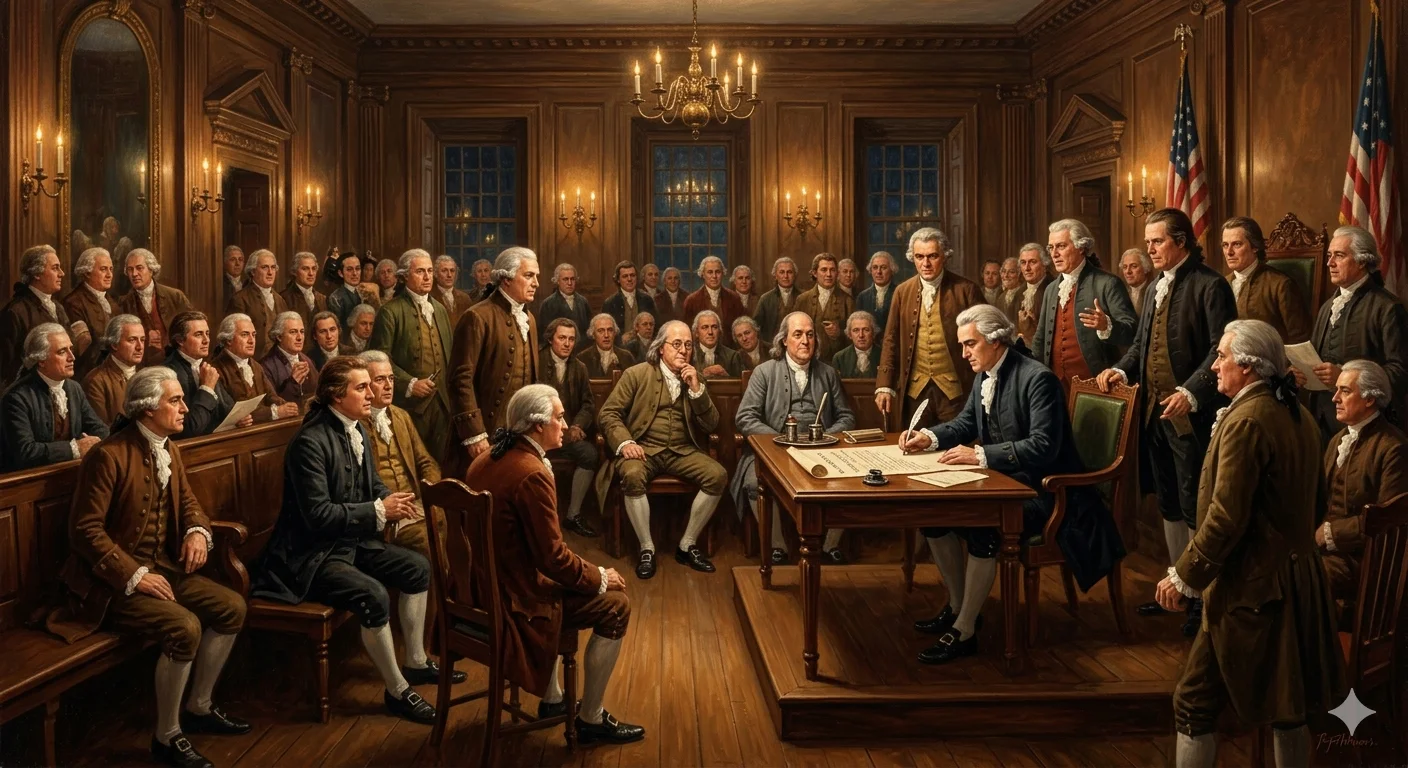
On the afternoon of July 4, 1776, in the stifling summer heat of the Pennsylvania State House in Philadelphia, the delegates of the Second Continental Congress completed two days of intensive debate and revision and formally adopted a document that would change the course of world history. The Declaration of Independence, as it came to be universally known, was the founding act of the United States of America — the formal announcement to the world that thirteen British colonies on the eastern seaboard of North America had severed their political bonds with the Kingdom of Great Britain and established themselves as free, sovereign, and independent states. In approximately 1,320 words, the document proclaimed that all men are created equal and endowed with unalienable rights to life, liberty, and the pursuit of happiness; that governments derive their just powers from the consent of the governed; and that when any government becomes destructive of those ends, the people have not only the right but the duty to alter or abolish it and institute new government.
The adoption of the Declaration on July 4, 1776 — the date celebrated ever since as the Fourth of July, America’s Independence Day — was the culmination of more than a decade of escalating conflict between the American colonies and the British imperial government, and of months of intense debate within the Continental Congress about whether independence was desirable, achievable, and morally justified. It was not, as popular myth sometimes suggests, a sudden or unanimous decision. It was the product of a long revolution in political thought, a protracted military conflict that had already been underway for fifteen months, a committee of five men tasked with putting into eloquent prose the arguments that most of their colleagues already held in their minds, and a primary author of genius who worked in a Philadelphia boarding house for seventeen days to produce a draft that the full Congress then debated, edited, and ultimately adopted as the formal expression of what they called the American mind. The story of the Declaration of Independence is one of the most important stories in the history of democracy, and its importance has only grown in the nearly two and a half centuries since that July afternoon in Philadelphia.
The Road to Revolution: Colonial Grievances Against British Rule from the Stamp Act to Lexington and Concord
The American colonies did not arrive at independence quickly or easily. For most of their history, the relationship between the colonies and Britain had been one of mutual benefit and genuine attachment: Britain provided trade, protection, legal tradition, and cultural identity; the colonies provided raw materials, markets, and the human energy of a rapidly growing frontier society. Most American colonists in the middle of the eighteenth century thought of themselves as British subjects and were proud of it. The crisis that ultimately produced the Declaration of Independence grew from a series of British parliamentary actions beginning in 1765 that the colonists experienced as fundamental violations of their rights as freeborn Englishmen.
The Stamp Act of 1765 was the first major flashpoint. Passed by the British Parliament to raise revenue to pay for the defense of the American frontier following the Seven Years’ War, the act imposed direct taxes on all printed materials in the colonies — newspapers, legal documents, almanacs, pamphlets — requiring them to carry a revenue stamp purchased from British agents. The colonial reaction was immediate and furious. Under the rallying cry of no taxation without representation, colonists organized the Stamp Act Congress in October 1765, the first unified political action of the thirteen colonies, and coordinated a boycott of British goods that proved sufficiently damaging to British merchants that Parliament repealed the Stamp Act in 1766. But in the same legislation that repealed it — the Declaratory Act — Parliament asserted its right to bind the American colonies in all cases whatsoever, a claim that colonists rejected as incompatible with the English constitutional tradition of representative government.
The pattern repeated over the following decade. Parliament imposed new taxes — the Townshend Acts of 1767, taxing paint, paper, glass, and tea — and the colonies protested, boycotted, and eventually forced partial repeal. British troops were stationed in Boston, generating friction with the civilian population that culminated in the Boston Massacre of March 5, 1770, when soldiers fired on a crowd and killed five colonists. The Tea Act of 1773, designed to save the financially troubled East India Company by giving it a monopoly on tea sales in the colonies, provoked the Boston Tea Party of December 16, 1773, in which militant Patriots — the Sons of Liberty, led by Samuel Adams — dumped 342 chests of British tea worth approximately eighteen thousand pounds into Boston Harbor. Parliament responded with the Coercive Acts of 1774, which the colonists called the Intolerable Acts: closing Boston Harbor until the tea was paid for, effectively subjecting Massachusetts to military government, and authorizing the quartering of troops in colonial homes. The colonial response was the First Continental Congress of September-October 1774, which coordinated a comprehensive boycott of British goods and prepared petitions of grievance to King George III that went unanswered.
The armed conflict that transformed political grievance into revolution began at Lexington and Concord in Massachusetts on April 19, 1775. On that morning, British General Thomas Gage dispatched 700 Redcoats to seize colonial military supplies stored at Concord. They were met first at Lexington by a company of Minutemen — colonial militia — commanded by Captain John Parker. The brief engagement that followed left eight Americans dead and launched the American Revolutionary War. By the time the Second Continental Congress convened in Philadelphia on May 10, 1775, the colonies and Britain were at war, though most delegates still hoped for reconciliation and did not yet contemplate independence.
The Second Continental Congress: From War to Independence, 1775 to June 1776
The Second Continental Congress that met in Philadelphia from May 1775 onward was a body operating under enormous and escalating pressure. It was not a legitimate government in any conventional sense — it had no formal constitutional authority, no power to tax, no standing army of its own, and represented colonies that were legally still part of the British Empire. Yet it found itself compelled to perform the functions of a government: organizing a military force, seeking foreign allies, managing supply chains, and ultimately deciding the political fate of three million colonists. Its delegates represented a wide range of opinion, from ardent independence advocates to men who continued to believe that reconciliation with Britain was both possible and desirable.
The Congress’s first major military act was to appoint George Washington of Virginia as Commander-in-Chief of the Continental Army on June 15, 1775, a choice that was both militarily and politically significant — by selecting a Virginian rather than a New Englander, Congress signaled that the conflict was not merely a Massachusetts quarrel but a continental cause. Washington assumed command of the ragged militia besieging Boston in July 1775 and would spend the following six years fighting a war that seemed at times entirely unwinnable. In the meantime, Congress made one final attempt at conciliation with the Olive Branch Petition of July 5, 1775, addressed to King George III and expressing loyalty to the crown while asking for a redress of grievances. George III refused to receive the petition. In August 1775 he issued a Royal Proclamation declaring the colonies to be in open and avowed rebellion and ordering loyal subjects to report all treason to the proper authorities. The door to reconciliation was closing.
The transformation of colonial opinion in the winter of 1775-1776 was accelerated by two events of great importance. The first was the news of King George III’s speech to Parliament in October 1775, in which he declared his intention to suppress the rebellion with overwhelming force and announced that he was hiring Hessian mercenaries — German soldiers — to assist British forces in America. To many colonists, the hiring of foreign mercenaries to kill fellow British subjects seemed the final proof that the King had abandoned any pretense of paternal concern for his American people. The second and perhaps more immediately influential event was the publication in January 1776 of Thomas Paine’s pamphlet Common Sense, written by a recent British immigrant to Philadelphia who had absorbed both the radical traditions of English dissent and the colonial experience of British misrule. In plain, direct, passionate prose aimed at ordinary readers rather than educated elites, Paine demolished the mystique of monarchy and the argument for continued British connection. More than 150,000 copies circulated in a matter of weeks — an extraordinary print run for the era — and the pamphlet reached virtually every politically active household in the colonies. Common Sense turned the intellectual tide decisively toward independence.
By the spring of 1776, the political landscape had shifted dramatically. Colony after colony was instructing its delegates to the Continental Congress to support independence. In April 1776, North Carolina’s revolutionary convention became the first colony to explicitly authorize its delegates to vote for independence. Seven more had followed by mid-May. On May 15, 1776, Congress passed a resolution authored by John Adams advising the colonies to form their own governments — an act that was in practice a declaration of the end of British authority, even if it fell short of a formal independence declaration. Congress also opened colonial ports to all foreign trade except British trade, a practical step toward economic independence. Then on June 7, 1776, Richard Henry Lee of Virginia rose on the floor of Congress and introduced the motion that precipitated everything that followed.
Richard Henry Lee’s Resolution and the Appointment of the Committee of Five
Richard Henry Lee was born January 20, 1732, at Stratford Hall in Westmoreland County, Virginia, into one of the great planter dynasties of the Old Dominion. Educated in England but deeply committed to colonial rights, he had been one of the most forceful voices in the Virginia delegation and in Congress for resistance to British imperial overreach. On June 7, 1776, acting on explicit instructions from the Virginia Convention, he stood before the full Congress and read a resolution of three parts: that the United Colonies are, and of right ought to be, free and independent States; that foreign alliances should be formed; and that a plan for confederation among the colonies should be prepared. John Adams of Massachusetts immediately seconded the motion.
The debate that followed ran for two days and was among the most consequential in the history of any legislative body anywhere. The arguments for and against independence reflected genuine divisions of principle, pragmatism, and political calculation. John Dickinson of Pennsylvania, one of the most respected legal and political minds of the era, argued passionately against a hasty declaration, warning that the colonies were not yet sufficiently united, that foreign alliances had not been secured, and that declaring independence prematurely would expose the colonies to destruction. He famously warned his colleagues that they were about to brave the storm in a skiff made of paper. Edward Rutledge of South Carolina and James Wilson of Pennsylvania also expressed reservations, partly on the grounds that their constituents had not yet authorized them to vote for independence.
On June 10, Congress voted seven to five to postpone a final decision on the Lee Resolution for three weeks, to allow delegates to return to their colonies and obtain instructions. But recognizing that independence might ultimately be adopted, Congress simultaneously voted to appoint a committee of five to draft a formal declaration that would explain and justify independence to the world. The Committee of Five, as it came to be called, comprised John Adams of Massachusetts, Benjamin Franklin of Pennsylvania, Thomas Jefferson of Virginia, Robert R. Livingston of New York, and Roger Sherman of Connecticut — a geographical and intellectual cross-section of the colonial leadership. The committee’s first decision was to choose its primary drafter, and that choice proved decisive for the character of the document that resulted. The task fell to Thomas Jefferson, and the reasons given by John Adams have become among the most-quoted in the history of American political folklore.
Adams later recalled that he had told Jefferson: Reason first, you are a Virginian, and a Virginian ought to appear at the head of this business. Reason second, I am obnoxious, suspected, and unpopular. You are very much otherwise. Reason third, you can write ten times better than I can. Adams understood that a declaration of independence drafted primarily by a New Englander — particularly by Adams himself, who had been Massachusetts’s most vocal advocate of independence and whose aggressive personality had created enemies — would be seen as a narrow sectional document rather than the expression of a continent’s united conviction. Jefferson, at thirty-three one of the younger delegates, was a Virginia planter, a lawyer, and a writer of exceptional gifts who combined the classical learning of an eighteenth-century gentleman with the philosophical radicalism of the Enlightenment. He was also the elected chairman of the Committee of Five, which meant he would have gotten the drafting assignment regardless of Adams’s arguments.
Thomas Jefferson Drafts the Declaration: June 11-28, 1776
Thomas Jefferson was born on April 13, 1743, at Shadwell plantation in Goochland County, Virginia, the son of Peter Jefferson, a prosperous surveyor and planter, and Jane Randolph, of one of Virginia’s most distinguished families. He attended the College of William and Mary, studied law under George Wythe — one of the most distinguished legal minds in colonial America — and built at Monticello a private library of thousands of volumes that was the envy of his contemporaries. He was deeply read in the Enlightenment philosophy of John Locke, the natural law theory of the Swiss jurist Emmerich de Vattel, the republicanism of Algernon Sidney, and the political traditions of English constitutionalism from Magna Carta through the English Bill of Rights of 1689. He had articulated many of the ideas that would appear in the Declaration as early as 1774, in his Summary View of the Rights of British America, a pamphlet that had argued that the colonies owed allegiance to the King but not to Parliament, and that rights derive from natural law rather than royal grant.
Between June 11 and June 28, 1776, Jefferson worked on the draft of the Declaration in his lodgings on the second floor of a new brick house at the corner of Seventh and Market Streets in Philadelphia, rented from a bricklayer named Jacob Graff. He wrote, according to his own later account, not to find out or invent new principles, but to express the American mind — to give voice to the harmonizing sentiments of the day, whether expressed in conversations, in letters, in printed essays, or in the elementary books of public right. He drew on Virginia’s Declaration of Rights, drafted by George Mason and adopted just weeks earlier, which had declared that all men are by nature equally free and independent and possess certain inherent rights that no compact can divest. He drew on Locke’s Second Treatise of Government, with its theory that government is a compact between rulers and ruled, that its authority derives from the consent of the governed, and that the people retain the right to dissolve a government that betrays its trust. He wove these philosophical threads together with a specific enumeration of the actual grievances that the colonies held against King George III, creating a document that was simultaneously a philosophical treatise about the nature of legitimate government and a legal indictment of a specific monarch for specific violations of specific rights.
Jefferson’s most celebrated passage, the preamble’s second paragraph, became in the final revised version one of the most quoted and most influential statements in the history of political thought: We hold these truths to be self-evident, that all men are created equal, that they are endowed by their Creator with certain unalienable Rights, that among these are Life, Liberty and the pursuit of Happiness. That to secure these rights, Governments are instituted among Men, deriving their just powers from the consent of the governed. That whenever any Form of Government becomes destructive of these ends, it is the Right of the People to alter or to abolish it, and to institute new Government, laying its foundation on such principles and organizing its powers in such form, as to them shall seem most likely to effect their Safety and Happiness. Jefferson’s original rough draft had used the phrase sacred and undeniable rather than self-evident, a change attributed to Benjamin Franklin, who is generally credited with transforming the claim from a statement of faith into a claim of reason. The draft also changed the Lockean phrase life, liberty, and property to life, liberty, and the pursuit of happiness — a shift that broadened the revolutionary promise and has reverberated through American political culture ever since.
The draft Jefferson submitted to Adams and Franklin contained twenty-seven specific charges against King George III, organized to demonstrate a pattern of deliberate tyranny rather than the random excesses of misgovernment. The charges ranged from specific legislative complaints — dissolving colonial assemblies, refusing to approve necessary laws, maintaining standing armies in peacetime without legislative consent — to more fundamental constitutional violations: denying trial by jury, imposing taxes without representation, blockading colonial ports, transporting Americans to Britain for trial on manufactured charges. Jefferson’s most passionate original charge — accusing the king of having waged cruel war against human nature itself by forcing the slave trade on the colonies — was struck from the final version during Congress’s editing process, removed to avoid alienating delegates from South Carolina and Georgia who were deeply invested in the slave trade, and to avoid the obvious hypocrisy of a slaveholder denouncing slavery as a royal imposition.
The Lee Resolution Passes: July 2, 1776 — The Actual Day America Declared Independence
The Continental Congress reconvened on July 1, 1776, and the first order of business was a final vote on Richard Henry Lee’s June 7 resolution. The debate that followed in the full Congress was among the most dramatic in American history. John Dickinson of Pennsylvania made one final, eloquent argument for delay, warning that independence without secured foreign alliances was premature and dangerous. John Adams, who had been the floor leader for the independence cause for months, gave what contemporaries described as a magnificent and exhausting response lasting several hours, laying out the case for immediate action. Nine hours of debate produced a preliminary result that showed four colonies still voting against: Pennsylvania, South Carolina, Delaware, and New York. The outcome was in doubt.
What followed became one of the legendary stories of the founding. Caesar Rodney, one of Delaware’s three delegates, was at his home in Dover, Delaware, seriously ill with what was likely an aggressive form of cancer that was disfiguring his face — he is described in contemporary accounts as wearing a green silk cloth over one side of his face in public. Delaware’s other two delegates were split, and without Rodney’s vote the delegation could not support independence. Through the night of July 1-2, Rodney mounted his horse and rode approximately seventy miles through a thunderstorm, arriving at the Pennsylvania State House in his muddy riding clothes just in time to cast Delaware’s decisive vote for independence on the morning of July 2. His ride is one of the great individual acts of commitment in the founding of the United States. By the morning of July 2, Pennsylvania and South Carolina had also switched their votes in favor. New York’s delegates had not received new instructions from their convention and abstained.
On July 2, 1776, the Continental Congress voted on the Lee Resolution for independence. The result was twelve colonies in favor, one — New York — abstaining. John Adams wrote to his wife Abigail on July 3 that he believed July 2 would go down in history as the most memorable Epocha in the History of America, and that it ought to be celebrated with Pomp and Parade, with Shews, Games, Sports, Guns, Bells, Bonfires and Illuminations from one End of this Continent to the other. He was right about the celebrations; he was wrong about the date. It is July 4 — the date on which the Declaration of Independence itself was formally adopted — not July 2, that became and remains the American national holiday. Adams never entirely reconciled himself to this historical irony.
Congress Debates and Adopts the Declaration: July 3-4, 1776
Having voted for independence on July 2, Congress turned its full attention to the language of the declaration that Jefferson’s committee had prepared. The revision process occupied all of July 3 and the morning and early afternoon of July 4. Congress sat as a Committee of the Whole — a procedure that allowed delegates to debate freely without the formalities required of official sessions — and worked through Jefferson’s draft with the systematic care of legislators who understood that every word would be read by enemies and allies alike around the world. Jefferson himself sat in painful silence as his colleagues revised his prose, and he privately circulated copies of his original draft to friends afterward so that posterity could compare his version to what Congress had done to it.
The revisions were both numerous and significant. Congress removed approximately one-fifth of Jefferson’s original text — not only the passage condemning the slave trade, but also a lengthy passage blaming the British people for failing to restrain their government, and several other sections that were considered too inflammatory, legally questionable, or likely to offend potential allies. The most significant philosophical change was relatively minor in words but enormous in implication: Jefferson had written that truths were sacred and undeniable; Congress’s version made them self-evident. The shift from sacred (a claim of religious authority) to self-evident (a claim of rational demonstration) moved the Declaration from the idiom of theology into the idiom of Enlightenment philosophy, aligning it with the empirical rationalism of Locke rather than the revealed religion of a particular tradition. The resulting document was crisper, more universal in its claims, and more resistant to philosophical challenge than Jefferson’s original.
The final text of the Declaration of Independence was approved by the Continental Congress on the afternoon of July 4, 1776. The document was organized in four broad sections. The preamble established the philosophical foundation: the self-evident truths about equality, unalienable rights, and the basis of legitimate government in popular consent. The second section catalogued the twenty-seven specific grievances against King George III that justified the dissolution of the colonial relationship with Britain. The third, brief section addressed failed attempts by the colonies to obtain redress from both the King and the British people. The fourth and final section was the declaration itself: a formal proclamation that the United Colonies are, and of Right ought to be, Free and Independent States, absolved from all Allegiance to the British Crown, with full power to levy War, conclude Peace, contract Alliances, establish Commerce, and to do all other Acts and Things which Independent States may of right do. The document concluded with the Founders’ mutual pledge of their Lives, their Fortunes and their sacred Honor.
Late in the afternoon of July 4, the manuscript was taken to the printing shop of John Dunlap, the official printer to the Congress, who worked through the night to produce printed broadside copies. On the morning of July 5, these printed copies — known as the Dunlap Broadsides, bearing only the names of John Hancock as President of Congress and Charles Thomson as Secretary — were dispatched to state assemblies, conventions, committees of safety, and the commanders of Continental troops. It was a printed broadside from Dunlap’s shop that General George Washington ordered read aloud to his troops at their encampment outside New York on July 9. An eyewitness account describes the soldiers’ reaction as jubilation so intense that a crowd afterward pulled down the gilt equestrian statue of King George III on the Bowling Green in lower Manhattan, and the lead was later melted into musket balls for the Continental Army.
The Signing: John Hancock, the 56 Delegates, and the Act of Courage
The popular image of the Declaration of Independence — fifty-six Founding Fathers gathered in the Pennsylvania State House on July 4, 1776, each solemnly placing their signature on the document in a single ceremonial event — is one of the most persistent and romantic myths in American history. The reality was more complex, more drawn-out, and in some ways more interesting. The Declaration was adopted on July 4 with a vote, not a signing ceremony. The physical document that was formally adopted was a manuscript copy, and John Hancock, as President of the Congress, authenticated it with his signature on that day. The other delegates did not sign on July 4.
On July 19, following New York’s convention formally approving the Declaration on July 9 (thus making the adoption unanimous), Congress ordered that the Declaration be engrossed on parchment — copied in a formal, large-letter script — and that the same, when engrossed, be signed by every member of Congress. The engrossing was performed by Timothy Matlack, an assistant to the Secretary Charles Thomson, on a large sheet of parchment. On August 2, 1776, most delegates present signed the engrossed parchment copy. John Hancock signed first, in the center of the document, with the bold, oversized signature that made his name synonymous with the word signature itself. According to legend, Hancock said that the King could now read his name without spectacles — a statement that acknowledged the reality that every signer was, from a British legal perspective, committing treason and risking execution.
In total, fifty-six delegates signed the Declaration across a period from August 2 through the following months. They represented all thirteen colonies, ranging in age from twenty-six-year-old Edward Rutledge of South Carolina, the youngest signer, to seventy-year-old Benjamin Franklin of Pennsylvania, the oldest. Among the signers were men who would become presidents of the United States — John Adams and Thomas Jefferson both signed, and both died on the same extraordinary date, July 4, 1826, the fiftieth anniversary of the Declaration’s adoption. Two delegates never signed: John Dickinson of Pennsylvania, who abstained from the vote and refused to sign because he continued to believe the timing was premature; and Robert R. Livingston of New York, who had served on the Committee of Five but was recalled to New York to help draft that state’s constitution before the August 2 signing. Eight new delegates signed who had not been present when the Declaration was adopted. George Wythe, Richard Henry Lee, Elbridge Gerry, Oliver Wolcott, Lewis Morris, Thomas McKean, and Matthew Thornton signed in the weeks and months following August 2. Nine delegates who had been present for the vote never signed, including George Clinton and Henry Wisner, who had voted for independence but were attending to other duties when the signing took place.
The Philosophical Foundations: John Locke, Natural Rights, and the Enlightenment Ideas Behind the Declaration
The Declaration of Independence was not merely a political manifesto for a specific colonial dispute. It was an application to a specific historical situation of a body of Enlightenment political philosophy that had been developing in Europe for more than a century. Understanding what Jefferson and his colleagues were drawing upon is essential to understanding what the document means and why it has exercised such extraordinary influence on subsequent history. The primary philosophical source was John Locke, the English philosopher whose Second Treatise of Government, published in 1689, had laid out the theory of natural rights and the social contract that became the foundation of Whig political thought on both sides of the Atlantic. Locke argued that human beings in a state of nature possess natural rights — to life, liberty, and property — that are prior to and independent of any government. Government is created by a compact among individuals to protect those rights more effectively than individuals can protect them alone. The authority of government thus derives from the consent of the governed, and if a government systematically violates rather than protects those rights, the people are not merely permitted but obligated to dissolve it and form a new one.
Jefferson also drew heavily on George Mason’s Virginia Declaration of Rights of June 1776, which had articulated many of the same principles in similar language just weeks before the Committee of Five was appointed. The Scottish Enlightenment, particularly the moral philosophy of Francis Hutcheson, provided another stream of influence, especially the idea that human beings have a natural sense of moral truth that is as reliable a guide to right action as logical demonstration — an idea that underlies the Declaration’s claim that the truths in its preamble are self-evident. The Swiss jurist Emmerich de Vattel’s Law of Nations, which historian David Armitage has identified as a key influence, provided the framework for understanding international relations among sovereign states and the legal basis for one nation’s right to declare independence from another. And the English common law tradition — Magna Carta, the Petition of Right of 1628, the English Bill of Rights of 1689 — gave the grievance sections of the Declaration their specific legal vocabulary and their form as an indictment of royal misconduct against established constitutional rights.
Jefferson’s genius was not originality in the philosophical sense — as he himself readily acknowledged, he had not invented these ideas. His genius was synthesis and expression: the ability to take ideas that were in wide circulation among educated colonists and to distill them into a prose of extraordinary clarity, elegance, and force. The famous opening of the preamble — When in the Course of human events, it becomes necessary for one people to dissolve the political bands which have connected them with another — established immediately the tone of measured, rational deliberation that runs through the entire document. The Declaration presents independence not as a passionate act of rebellion but as a solemn, carefully reasoned fulfillment of the obligations that all people have to themselves and to the principles of just government. Its authority rests on the demonstration of its arguments, not on the assertion of force.
The Twenty-Seven Grievances: The Legal Indictment of King George III
While the preamble of the Declaration contains the philosophical arguments that have made it universally famous, the body of the document — the twenty-seven specific charges against King George III — constituted the actual legal case for independence and was, in Jefferson’s own understanding, the primary purpose of the document. Jefferson was not drafting a philosophical tract; he was drafting what legal historian John Phillip Reid has called an indictment, following the established legal and political tradition of using enumerated grievances to justify political resistance, as had been done in the English Bill of Rights of 1689 against King James II. The grievances were organized to demonstrate a cumulative pattern of deliberate tyranny — not isolated mistakes or miscommunications but a design to reduce the colonists under absolute despotism.
The grievances fell into several broad categories. The first group attacked George III’s manipulation of colonial legislatures: refusing to assent to necessary and wholesome laws, forbidding governors to pass laws of immediate necessity, dissolving representative houses for opposing his invasions on the rights of the people, and refusing to allow new representative bodies to be elected. The second group targeted his control of the judiciary and legal system: making judges dependent on his will alone for their tenure and salaries, obstructing the administration of justice, and subjecting colonists to trial without jury and transportation to Britain for trial for offenses committed in America. The third group addressed military matters: keeping standing armies in peacetime without legislative consent, quartering soldiers in private homes without the consent of the owner, and protecting soldiers from punishment for murders committed against the inhabitants.
Further grievances targeted economic oppression: cutting off colonial trade with all parts of the world, imposing taxes without colonial consent — the foundational complaint that had driven the entire crisis since 1765 — and altering colonial charters and abolishing colonial laws by unilateral royal action. The military grievances at the end of the list addressed the war itself: hiring foreign mercenaries, inciting domestic insurrections and Native American attacks, and burning colonial towns. Jefferson’s deleted passage about the slave trade would have added another dimension: the charge that the King had refused to allow the colonies to ban the importation of enslaved Africans. Its removal from the final text was a compromise that demonstrated both the political realities of a coalition that included deep-South slave states and the profound contradiction between the Declaration’s universal language about human equality and the reality of chattel slavery in the very society that was proclaiming those principles.
The Immediate Impact: Public Readings, Celebrations, and Reactions Across the Colonies
The adoption of the Declaration of Independence on July 4, 1776, was followed within days by public readings and celebrations across the thirteen colonies that were remarkable in their scale and intensity. The Dunlap Broadsides distributed on July 5 reached major cities within a week. The Pennsylvania Evening Post was the first newspaper to print the Declaration on July 6. Public readings took place in town squares, courthouse greens, and military camps. In Philadelphia on July 8, the Declaration was read publicly from the steps of the Pennsylvania State House to a large crowd, and the celebration that followed included the ringing of the State House bell — the bell now known as the Liberty Bell — and bonfires lit throughout the city. In New York, as previously noted, troops who heard the Declaration read aloud reacted by toppling the statue of King George III on the Bowling Green.
The reaction in Britain was predictably hostile. The British government dismissed the Declaration as a trivial document issued by disgruntled colonists and refused to engage with its arguments. King George III did not formally receive it or respond to it. The war continued and intensified: in the weeks following the Declaration’s adoption, British General William Howe arrived in New York with the largest expeditionary force Britain had ever assembled in North America — approximately 32,000 troops — and proceeded to defeat Washington’s army in the Battle of Long Island on August 27, 1776, driving the Continental Army out of New York. The Declaration had not won the war; it had transformed it from a quarrel about constitutional rights into a contest for national existence and self-determination.
The Declaration’s immediate diplomatic purpose was to enable the United States to seek formal alliances with European powers, most importantly France. France had been covertly supporting the American cause since early 1776, but formal recognition required that the United States be a legally constituted sovereign state rather than a collection of rebellious colonies. The Declaration provided that legal status. The Sultan of Morocco mentioned American ships in a consular document in 1777, an informal recognition. The crucial formal recognition came with the Treaty of Alliance of February 6, 1778, in which France recognized the United States as a sovereign nation and committed to the war against Britain. Without French military and financial support — which ultimately included the French fleet’s decisive intervention at Yorktown in October 1781 — it is difficult to imagine how the Continental Army could have sustained the war to a successful conclusion.
The Document’s Fate: From Independence Hall to the National Archives
The physical history of the Declaration of Independence is a story of remarkable journey through American history, marked by both careful preservation and some periods of surprising neglect. The engrossed parchment copy signed on and after August 2, 1776, followed the Continental Congress in its various relocations during the Revolutionary War — from Philadelphia to Baltimore when British troops threatened the city in December 1776, back to Philadelphia, then to York, Pennsylvania. After the war it was housed with government records in various locations, including the State Department and the Library of Congress.
For much of the nineteenth century, the Declaration was on public display, first in the Patent Office Building and then in other government facilities, where it was exposed to light and dampness that caused significant deterioration. By the late nineteenth century the document had faded considerably from its original clarity. In 1921 it was transferred to the Library of Congress, and in 1952 it was moved to its permanent home at the National Archives exhibition hall in Washington, D.C., where it has been on public display ever since, alongside the Constitution and the Bill of Rights. During a portion of World War II, the document was kept at the Bullion Depository at Fort Knox, Kentucky, for safekeeping. Today it rests in a bulletproof enclosure, lowered each night into a vault beneath the exhibition hall, where temperature, humidity, and light exposure are precisely controlled to prevent further deterioration. It is among the most carefully protected objects in the United States.
The Declaration’s Global Influence: Inspiration for Revolutions, Independence Movements, and Democratic Constitutions
The Declaration of Independence’s influence extended far beyond the borders of the new United States and far beyond the eighteenth century. Its assertion of the principle of popular sovereignty — that governments derive their just powers from the consent of the governed — and its articulation of universal human rights that governments are bound to protect rather than violate became reference points for democratic and independence movements around the world for the following two and a half centuries.
The most immediate and dramatic international impact was on France. The American Revolution and the Declaration of Independence were a direct inspiration for the French Revolution of 1789, which produced its own Declaration of the Rights of Man and Citizen in August of that year. The Marquis de Lafayette, who had served as a general in Washington’s Continental Army, was a key figure in the early French Revolutionary government and explicitly modeled the French declaration on its American predecessor. The Haitian Revolution of 1791-1804, which produced the first republic established by formerly enslaved people in world history, was also directly inspired by the American Declaration, even as the Haitian revolutionaries pointed out the contradiction between its universal language and the continuation of slavery in the United States.
Throughout the nineteenth and twentieth centuries, independence movements and democratic reformers invoked the Declaration’s language and arguments. Ho Chi Minh quoted its opening preamble in the Vietnamese Declaration of Independence of September 2, 1945. The Indian independence movement under Mahatma Gandhi, the African National Congress in South Africa, and countless other liberation movements drew explicitly on its principles. The United Nations Universal Declaration of Human Rights of 1948, which established a global framework of human rights law, drew directly on the Declaration of Independence’s language and philosophy. Abraham Lincoln repeatedly invoked the Declaration’s promise that all men are created equal as the fundamental aspiration of American democracy that the Civil War was being fought to preserve and fulfill — arguing that the Declaration’s promise, not the Constitution alone, was the true foundation of American national identity.
The Declaration’s Contradictions: Slavery, Equality, and the Unfinished Promise
The Declaration of Independence’s proclamation that all men are created equal and endowed with unalienable rights was, from the moment of its adoption, in obvious and profound tension with the reality of chattel slavery in American society. Jefferson himself enslaved more than six hundred people over the course of his life at Monticello and elsewhere, never freeing more than a handful even upon his death. The men who signed the Declaration included numerous slaveholders. The document’s universal language about human equality and the right to liberty was drafted, adopted, and celebrated by a society that systematically denied both to approximately five hundred thousand enslaved people, nearly one-fifth of the entire population of the thirteen colonies at the time of independence.
This contradiction was not invisible to contemporaries. John Adams, who did not own enslaved people and had strong personal reservations about slavery, was aware that the institution undermined the moral coherence of the American cause. Samuel Johnson, the English writer and lexicographer, dismissed the American claims to liberty with devastating irony: How is it that we hear the loudest yelps for liberty among the drivers of Negroes? The deletion of Jefferson’s passage condemning the slave trade from the final text of the Declaration made the contradiction slightly less glaring but did nothing to resolve it. The Declaration’s promise of equality was explicitly universal in its language — all men are created equal — and yet the men who adopted it had no intention of applying it universally in their own time.
The history of the United States in the centuries since 1776 can in large part be told as the story of the struggle to make the Declaration’s promise real — to extend the rights it proclaimed to those who were excluded from them at the founding. The abolitionist movement of the nineteenth century used the Declaration’s language as its primary moral argument against slavery. Frederick Douglass, in his famous Fourth of July speech of 1852, argued simultaneously that the Declaration’s ideals were the most magnificent expression of human equality ever written and that Independence Day was a day of bitter mockery for enslaved Americans to whom those ideals had never been applied. The Thirteenth, Fourteenth, and Fifteenth Amendments to the Constitution, adopted after the Civil War, attempted to close the gap between the Declaration’s promise and American reality by abolishing slavery, establishing birthright citizenship, and prohibiting racial discrimination in voting. The Civil Rights Movement of the 1950s and 1960s invoked the Declaration at every turn, with Martin Luther King Jr.’s I Have a Dream speech of August 28, 1963 — delivered a century after the Emancipation Proclamation — citing the Declaration’s promissory note of equality as a check not yet cashed but still owed to Black Americans.
Conclusion: July 4, 1776 and the Enduring Promise of Self-Evident Truths
On July 4, 1776, the Continental Congress adopted a document that was, in the immediate term, a practical instrument of revolution and diplomacy — a formal announcement of independence that would allow the United States to seek foreign allies, organize a government, and prosecute a war. In the longer term, it was something much more: a statement of political philosophy that planted principles whose implications its authors could not fully anticipate and whose fulfillment required generations of struggle, sacrifice, and continuing moral argument.
The fifty-six men who signed the Declaration were not abstract idealists operating outside history. They were property-owning men of the eighteenth century, shaped by the assumptions and limitations of their era, capable of breathtaking inconsistency between their stated principles and their personal practice. John Hancock’s large signature was an act of courage that risked his fortune and his life; it was also the signature of a wealthy merchant whose understanding of liberty was shaped by his experience as a member of the colonial elite. Thomas Jefferson’s soaring prose about unalienable rights was written by a man who enslaved more than a hundred people in the very house where he drafted those words. The gap between the Declaration’s ideals and the realities of the society that produced it was real, large, and morally troubling.
And yet the Declaration’s power as a statement of human aspiration has outlasted and transcended those limitations. The self-evident truths that Jefferson articulated — that all human beings possess equal dignity, that the purpose of government is to protect rather than oppress those it governs, that people have both the right and the responsibility to hold their governments accountable to the principles of justice — these ideas have proved genuinely revolutionary in ways that even their authors did not fully anticipate. They provided the language and the moral framework for abolitionists, suffragists, civil rights leaders, and democratic reformers not only in the United States but around the world. They gave to the aspiration for human freedom a declaration — a public, formal, reasoned statement addressed to the opinions of mankind — that has served as a reference point for every subsequent generation that has struggled to make the promise of equality real.
The original parchment, faded now and carefully protected behind bulletproof glass in Washington, is still the founding document of the United States of America, still the most powerful statement ever made of the American political creed. When in the Course of human events, Jefferson wrote, it becomes necessary for one people to dissolve the political bands which have connected them with another. On July 4, 1776, the Continental Congress dissolved those bands. What it built in their place — a nation dedicated to the proposition that all men are created equal, however imperfectly that proposition has been honored in practice — remains the central and unfinished project of American democracy, and the Declaration of Independence remains its founding promise.