
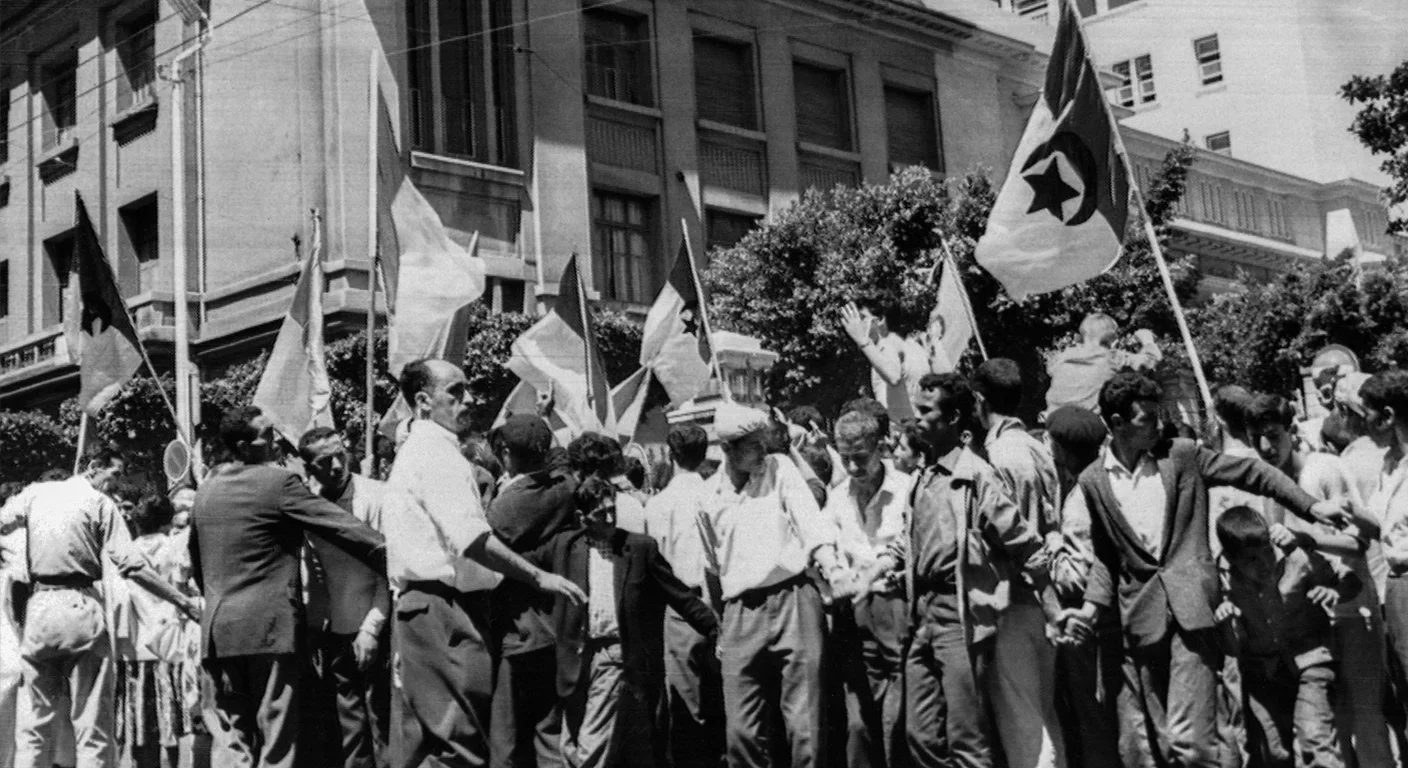
On July 5, 1962, in cities and towns across Algeria, people poured into the streets in waves of joy that the world’s cameras recorded with astonishment. Children rode on their fathers’ shoulders. Women ululated from windows. Men who had survived years of warfare wept openly. The date was not chosen by accident: it was July 5, 1830, that a French expeditionary force had entered Algiers and begun the long occupation that would last 132 years. By choosing July 5 as the official independence day, the Algerian Provisional Executive was inscribing into the national calendar the precise arc of the colonial experience — its beginning and its end, separated by a century and a third of foreign domination, a war of extraordinary brutality, and a diplomatic process that had pushed both the French Republic and the Algerian nationalist movement to their limits. The formal declaration of independence came two days after French President Charles de Gaulle had officially recognized Algerian sovereignty on July 3, following a referendum in which 5,975,581 Algerians voted for independence against only 16,534 who voted against. The margin was not merely overwhelming: it was among the most decisive expressions of popular will in the history of decolonization.
The independence that was celebrated on July 5, 1962 had been purchased at a cost that remains one of the most debated and contested of the entire colonial era. The Algerian War of Independence, fought from November 1, 1954 to March 19, 1962, had consumed an estimated 300,000 to 1.5 million Algerian lives, depending on whose counting is accepted — the disparity in figures reflecting both the genuine uncertainty about casualties in a complex conflict and the political stakes that attached to the numbers on both sides. Nearly half a million French soldiers had served in Algeria at its peak. The conflict had destroyed the French Fourth Republic, brought Charles de Gaulle back to power, produced two attempted coups by French military officers determined to keep Algeria French, generated a campaign of terrorism by the settler extremist group the OAS that had shocked France and the world, and left in its wake the tragic figures of the Harkis — Algerians who had fought on the French side and who were abandoned to reprisals and massacre by the terms of the peace. Algeria was free. The price had been almost incomprehensible.
France Invades and Algeria Becomes a Colony: 1830 to the Eve of Nationalism
The French invasion of Algeria in 1830 was justified by its architects on the basis of a diplomatic incident of almost comical insufficiency as a pretext for conquest. In 1827, Hussein Dey, the Ottoman-appointed ruler of Algiers, struck the French consul Pierre Duval with a flyswatter — or possibly a fan — during a dispute over unpaid debts owed by France to Algerian merchants from grain deals conducted during the Napoleonic Wars. The insult to French diplomatic dignity became the public justification for a military expedition that had been contemplated for years on the basis of strategic and political interests that had nothing to do with flyswatters. The French government of Charles X, facing domestic political difficulties and looking for a popular military success, dispatched an expeditionary force of approximately 34,000 men under the Count of Bourmont, which landed near Algiers on June 14, 1830, and captured the city within three weeks.
What followed was not a swift and easily administered occupation but a prolonged colonial conquest that required decades of warfare against Algerian resistance. The most significant figure of that resistance was Emir Abdelkader ibn Muhieddine, who led a military campaign against the French from 1832 to 1847 that at its height controlled much of the interior of Algeria and commanded the loyalty of a substantial portion of the Muslim population. Abdelkader created a proto-state in the areas under his control, negotiating treaties with the French that were repeatedly violated, and fighting a campaign that mixed conventional battles with guerrilla tactics. The French response, under the direction of Marshal Thomas-Robert Bugeaud, who became Governor-General of Algeria in 1840, involved the systematic destruction of villages, the burning of crops, and the use of enfumades — sealing people into caves and lighting fires at the entrance to suffocate those inside. These methods, which Bugeaud defended openly in the French parliament, established the pattern of colonial violence that would characterize French rule in Algeria for the next century. Abdelkader surrendered in 1847 and was exiled, but he became an enduring symbol of Algerian resistance, his memory invoked by the nationalists who would eventually succeed where he had not.
In 1834 Algeria was declared a French military colony, and in 1848, the constitution of the French Second Republic declared Algeria to be an integral part of France — not a colony but three French departments, as constitutionally French as Normandy or Provence. This legal fiction would prove to be both the ideological foundation of French resistance to Algerian independence and one of the primary sources of the conflict’s ultimate intractability. If Algeria was France, then Algerian independence was not decolonization but the amputation of French territory. The reality on the ground, however, was nothing like a French department. The European settler community, the pieds-noirs, poured into Algeria throughout the nineteenth and early twentieth centuries, eventually numbering approximately one million people out of a total Algerian population of approximately nine million by the mid-twentieth century. They occupied the best agricultural land, controlled the commercial and professional life of the cities, dominated the civil service and the police, and enjoyed the full rights of French citizenship. The Muslim Algerian majority, by contrast, was subject to a separate legal code — the code de l’indigénat — that imposed collective punishments, restricted freedom of movement and assembly, and denied most of the civil and political rights available to European Algerians.
The Road to November 1954: Nationalism, the Sétif Massacre, and the Decision for Armed Struggle
Algerian nationalism did not begin with the FLN in 1954. It had been building for decades through a variety of political and cultural movements that expressed, in different ways and at different levels of militancy, the aspiration of Muslim Algerians for dignity, equality, and self-determination. In the early twentieth century, a generation of educated Algerians known as the Young Algerians pushed for political reforms and greater participation within the French system, hoping to achieve full French citizenship without renouncing their Muslim identity. Their ambitions were systematically frustrated by the pieds-noir establishment and by a French government that had no interest in extending genuine equality to the Muslim majority. A more radical tendency emerged in the 1930s, when Messali Hadj, a communist-influenced labor organizer who had moved to France for work, founded the Étoile nord-africaine and then in 1937 the Parti du Peuple Algérien, which openly called for independence and built a substantial working-class base among Algerian immigrants in France and among workers in Algeria itself.
The most important figure in the evolution of middle-ground Algerian nationalism was Ferhat Abbas, born in 1899 in Taher in the Jijel region, an educated pharmacist and politician who had spent decades arguing that Algerian Muslims should seek integration and equality within the French Republic rather than independence. In 1943, during the Second World War, Abbas wrote the Manifeste du peuple algérien — the Manifesto of the Algerian People — which argued that the Algerian people’s service to France in the war deserved recognition in the form of genuine political equality, equal rights, and an end to the discriminatory system of colonial administration. The French government’s response was dismissive. The gap between what the Muslim Algerian majority expected as reward for wartime service and what French policy was prepared to offer proved to be unbridgeable, and the failure of Abbas’s moderate approach to produce meaningful change accelerated the radicalization of Algerian nationalist opinion.
The event that radicalized an entire generation and made the war of 1954 inevitable in the eyes of those who experienced it was the Sétif massacre of May 8, 1945. On the very day that France was celebrating victory in Europe — VE Day, marking the end of the war against Nazi Germany — Algerian Muslims in the town of Sétif in the eastern Constantine region began a demonstration that was planned as a peaceful procession calling for Algerian rights and acknowledging Algerian wartime sacrifice. In the violence that followed, triggered by a confrontation between the demonstrators and French police, approximately one hundred European settlers were killed. The French response was catastrophic in its disproportionality. French army units, the Foreign Legion, and armed pieds-noir militia conducted reprisals across the region for weeks. Aircraft strafed villages. Naval vessels bombarded coastal towns. Estimates of the Algerian dead range from 6,000 to 30,000, with the precise figure — like so many figures in the Algerian story — disputed and politically contested. For the generation that experienced Sétif, the massacre demonstrated something fundamental: that France would respond to demands for equality with overwhelming violence, and that the path to meaningful change did not pass through petition and politics but through armed resistance.
The FLN — Front de Libération Nationale, National Liberation Front — was founded in October 1954 by a core group of militants who had absorbed the lessons of Sétif and of the French defeat in Indochina, where the Viet Minh had just beaten the French at Dien Bien Phu. The founding leadership included Mostefa Ben Boulaïd, Larbi Ben M’hidi, Rabah Bitat, Mohamed Boudiaf, and Mourad Didouche, joined by Krim Belkacem and, slightly later, Hocine Aït Ahmed, Ahmed Ben Bella, and Mohamed Khider. Ben Bella, born in 1918 in Maghnia near the Moroccan border, was a former corporal in the French army who had been decorated for bravery in the Italian campaign of the Second World War; he would become the first president of independent Algeria. Krim Belkacem, from Kabylie, was already a veteran guerrilla leader who had been conducting armed operations against the French since 1947. Together, these men and those who joined them in the months that followed created the organization that would fight the French army to a negotiated settlement and transform Algeria forever.
Toussaint Rouge: November 1, 1954 and the Beginning of the War
In the early morning hours of November 1, 1954 — All Saints’ Day in the Catholic calendar — the FLN launched a coordinated series of attacks throughout Algeria. Approximately seventy simultaneous strikes hit military installations, police posts, communications infrastructure, and colonial administrative buildings across the country. The attacks were not uniformly successful in military terms, but they achieved their fundamental purpose: they announced to France, to Algeria, and to the world that a new force had entered the conflict for Algerian self-determination, and that it intended to fight. The FLN’s Declaration of November 1, 1954, broadcast over radio from Cairo, called on all Algerians to join the national struggle for the restoration of the sovereign Algerian state and announced the creation of the Armée de Libération Nationale (ALN), the National Liberation Army, as the FLN’s military wing. The French government’s initial response was dismissive: Interior Minister François Mitterrand — the same François Mitterrand who would later serve as president of France — declared that Algeria was France and that there could be no compromise with rebellion.
The French response to the FLN’s campaign in the first two years was a massive escalation of military force. The number of French troops in Algeria grew from approximately 50,000 in 1954 to approximately 400,000 by 1956. The army pursued a counterinsurgency strategy that included the resettlement of approximately 3.5 million Algerians — nearly half the rural Muslim population — into secured regroupement centers designed to deny the FLN its rural base of support. The FLN, meanwhile, expanded its organizational structure, its international contacts, and its military capabilities, obtaining weapons through smuggling operations across the Tunisian and Moroccan borders. The conflict was brutal on both sides from its beginning: the FLN targeted not only French military personnel and pieds-noir settlers but also Algerian Muslims who collaborated with the French or who belonged to rival nationalist organizations, while the French army employed torture, summary execution, and collective punishment as standard counterinsurgency tools. France never officially acknowledged that the conflict was a war — it was termed a matter of public order, and French soldiers were not subject to the Geneva Conventions as their government understood the situation — a legal fiction that facilitated the use of methods that would otherwise have been classified as war crimes.
The Battle of Algiers, 1956-1957: Torture, Terror, and the Hollow Victory
The most internationally visible episode of the Algerian War, and the one that most decisively shaped global opinion about the conflict, was the Battle of Algiers, fought between 1956 and 1957 in the capital city. The FLN’s urban network in Algiers, operating from the ancient labyrinthine alleyways of the Casbah, conducted a sustained campaign of bombings, assassinations, and attacks on European civilian targets in the European quarters of the city. The FLN leaders of the Algiers network included Saadi Yacef, who directed the urban campaign, and Ali Ammar, known as Ali La Pointe, who was one of the most effective operatives. The attacks on European civilians — including the bombing of the Milk Bar café in September 1956 — provoked both outrage and a French military escalation that ultimately produced a victory whose methods destroyed France’s moral claim to be fighting for civilization.
The French army’s response to the Battle of Algiers was entrusted primarily to the 10th Parachute Division under General Jacques Massu, who was given full powers in January 1957 to suppress the FLN in Algiers by whatever means he judged necessary. Massu and his subordinates, most notably Lieutenant Colonel Roger Trinquier and Colonel Marcel Bigeard, developed a systematic approach to counterinsurgency that relied heavily on the arrest, interrogation under torture, and often the disappearance of suspected FLN members and sympathizers. Approximately 24,000 Muslims were arrested during the Battle of Algiers, and approximately 3,000 of them were never seen again. The torture methods employed — electric shock, water torture, beatings — became widely known in France and abroad, generating protests by French intellectuals including Simone de Beauvoir and Jean-Paul Sartre, and deeply dividing French public opinion. By September 1957, the FLN network in Algiers had been effectively destroyed. Saadi Yacef was captured, Ali La Pointe was killed. The French had won the battle. But as subsequent history demonstrated, they lost the war in Algiers even as they won the battle: the worldwide publicity given to the torture and the disappearances did more to undermine the French position internationally than a dozen FLN military victories could have achieved.
The Algerian War simultaneously drew on and intensified the intellectual output of one of the most important political thinkers of the decolonization era. Frantz Fanon, a Martinique-born psychiatrist of African descent who had come to Algeria to work at the Blida-Joinville psychiatric hospital and had joined the FLN, became in his writings the foremost theorist of anti-colonial violence and the psychology of colonialism. His books, most notably Les Damnés de la Terre — The Wretched of the Earth, published in 1961 with a preface by Jean-Paul Sartre — argued that colonial violence had degraded both the colonized and the colonizer, and that the violence of the independence struggle was not merely a tactical necessity but a psychological necessity for the oppressed, a means of reclaiming their humanity from the dehumanization of the colonial system. Fanon died of leukemia in December 1961, just months before the independence whose arrival he had devoted the last years of his life to hastening. The Wretched of the Earth became one of the foundational texts of Third World political thought, influencing revolutionary movements from Vietnam to Cuba to South Africa.
De Gaulle Returns to Power: The Fifth Republic and the Shift Toward Negotiation
By 1958, the Algerian War had become the dominant fact of French political life, and it was consuming the Fourth Republic. The Fourth Republic, established in 1946, was a parliamentary system characterized by governmental instability: between 1946 and 1958, France had twenty-five governments in twelve years, each coalition collapsing under the weight of the Algerian question and the tensions between those who were willing to consider negotiation and those who insisted that l’Algérie française was non-negotiable. The military in Algeria had grown increasingly autonomous, believing that civilian politicians were betraying their efforts by contemplating any compromise. In May 1958, a political crisis in Paris over the appointment of a premier considered sympathetic to negotiations triggered a revolt among European settlers and military officers in Algiers, who established a Committee of Public Safety and made clear that they were prepared to intervene militarily in metropolitan France if the politicians did not find a solution that preserved French Algeria.
In this crisis, the only figure commanding sufficient authority in both civilian and military circles to manage the situation was Charles de Gaulle, the general who had led the Free French during the Second World War, founded the French Fourth Republic, and then retired from politics in 1946 in frustration at what he regarded as the incompetence of the parliamentary system. De Gaulle returned to power on June 1, 1958, as premier with emergency powers, and rapidly engineered the replacement of the Fourth Republic with a new Fifth Republic built around strong executive authority — a constitution explicitly designed around his own requirements. The pieds-noirs and the military officers who had facilitated his return to power believed they had secured a champion for French Algeria. They had made a profound miscalculation. De Gaulle’s priority was France, not the pieds-noirs, and he concluded relatively quickly that the continuation of the war was damaging France’s international reputation, exhausting its military, and consuming resources that were needed for the modernization of the French economy and for France’s role in European integration.
On September 16, 1959, de Gaulle made the decisive public announcement: in a nationally televised address, he declared his support for Algerian self-determination. The right of Algerians to determine their own political future through a referendum was now stated French policy. The announcement was a political earthquake. The pieds-noirs felt betrayed. The military felt deceived. In January 1960, a group of European settlers erected barricades in Algiers in what became known as Barricades Week, confronting French police and calling for a popular uprising against de Gaulle’s policy. The revolt collapsed, but it was followed by a far more serious challenge: in April 1961, four senior French generals — Raoul Salan, Maurice Challe, Edmond Jouhaud, and André Zeller — launched a military putsch in Algiers, seizing control of the city and announcing that they were assuming power to prevent the abandonment of French Algeria. De Gaulle responded with a television and radio address of extraordinary force, wearing his military uniform and calling on Frenchmen and Frenchwomen across France and Algeria to help him. The conscript soldiers in Algeria largely refused to follow the putschist generals, and the coup collapsed within four days. The generals who escaped arrest went underground and founded the Organisation de l’Armée Secrète, the OAS, which would conduct a savage campaign of terrorism against both the FLN and de Gaulle’s government in the months that followed.
Negotiating Independence: The Évian Accords of March 18, 1962
The negotiations that produced the Évian Accords were long, tortuous, and repeatedly interrupted by violence on both sides. The first serious direct talks between French government representatives and the FLN’s Provisional Government of the Algerian Republic (GPRA) began in 1960, but broke down repeatedly over the fundamental issues of the Sahara’s status — the desert region rich in oil and gas that France wanted to retain or at least control, and which the FLN insisted was an integral part of Algerian territory — and over the status of the European settler community. The talks moved between various locations: Évian-les-Bains on the French shore of Lake Geneva, Lugrin nearby, the Les Rousses ski resort in the Jura mountains. The French delegation was led by Louis Joxe, Secretary of State for Algerian Affairs, a career diplomat and administrator of considerable skill. The Algerian delegation was led by Krim Belkacem, one of the founding members of the FLN and a veteran of the armed struggle in Kabylie, accompanied by officials of the GPRA that had been formed in September 1958 under its first premier Ferhat Abbas.
The decisive breakthrough came in early 1962, after years of failed talks. Both sides had concluded by December 1961 that an agreement had to be reached — the French were exhausted by the cost of the war and by its domestic and international political consequences, and the FLN recognized that the military stalemate that would persist indefinitely was not the path to the independent Algeria they sought. Secret preliminary talks in January and February 1962 worked through the principal areas of disagreement. France agreed to recognize Algeria’s sovereignty over the Sahara, in exchange for maintained access to Saharan petroleum resources. Agreement was reached on a three-year transition period during which European settlers could choose Algerian citizenship or leave, and during which their property rights would be protected. France was permitted to maintain the Mers El Kébir naval base for fifteen years and to use certain military facilities including those used for nuclear testing in the Sahara.
The Évian Accords were signed on March 18, 1962, at the Hôtel du Parc in Évian-les-Bains. The 93-page document covered the ceasefire, the self-determination referendum, transitional arrangements, the rights of all communities, and the framework for post-independence cooperation. A ceasefire took effect on March 19, 1962. The signing was followed by a referendum in metropolitan France on April 8, 1962, in which 90.99 percent of French voters approved the accords. The OAS, which had been conducting a campaign of bombings averaging 120 per day in March 1962 — targeting hospitals, schools, and the University of Algiers library — rejected the ceasefire and escalated its terror campaign in a desperate last attempt to prevent independence by provoking a retaliatory massacre of pieds-noirs by the FLN that would force the French army to intervene. The FLN refused to be provoked. Eventually, after extended negotiations, the OAS agreed to a ceasefire with the FLN in June 1962.
The Referendum, De Gaulle’s Recognition, and July 5, 1962
On July 1, 1962, the referendum on Algerian self-determination was held. The question asked of voters was direct: Do you want Algeria to become an independent state, cooperating with France under the conditions defined in the declarations of March 19, 1962? Of the approximately 6.5 million eligible voters, approximately 6 million participated. The result was overwhelming: 5,975,581 voted yes; only 16,534 voted no. The abstentions came primarily from pieds-noirs who either had already left Algeria or who refused to participate in a process they considered illegitimate. The turnout and the margin expressed something far beyond a procedural ratification of the Évian Accords: they expressed the depth and unanimity of Algerian desire for independence, a desire forged across 132 years of colonial subjugation, eight years of war, and millions of individual acts of resistance and sacrifice.
On July 3, 1962, French President Charles de Gaulle issued the official French recognition of Algerian independence, announcing it at 10:30 in the morning. He had arrived at this point through a path that, whatever its twists and its periods of ambivalence, had followed a consistent logic: France’s national interest required the end of the Algerian war, and the end of the war required Algerian independence. The man who had once been brought to power by those determined to keep Algeria French had presided over its becoming Algerian. Two days later, on July 5, 1962, the Algerian Provisional Executive proclaimed the official independence day, choosing the 132nd anniversary of the French invasion to give the date its full symbolic weight. The celebrations that erupted across Algeria on July 5 were among the most intense expressions of national joy in the history of African independence movements. Ahmed Ben Bella, who had spent more than five years in French imprisonment after his plane was intercepted and forced to land in October 1956, would become the first president of independent Algeria in September 1962.
The Leaders Who Made Independence: FLN, GPRA, and the Men of the Revolution
The independence of Algeria was achieved through the combined efforts of a generation of leaders whose backgrounds, methods, and ultimate fates were as varied as the movement itself. Ahmed Ben Bella, born on December 25, 1918, in Maghnia in western Algeria, was the most internationally visible of the founding generation. He had served in the French army in World War II as a corporal, winning the Médaille Militaire for his bravery during the Italian campaign, before returning to an Algeria unchanged in its inequality and dedicating himself to independence. His dramatic kidnapping by France in October 1956 — when French intelligence forced the aircraft carrying Ben Bella and four other FLN leaders (Mohamed Khider, Hocine Aït Ahmed, Mohamed Boudiaf, and Mostefa Lacheraf) to land in Algiers rather than continue from Rabat to Tunis — made him an international figure and a rallying point for Algerian nationalism even from his prison cell.
Ferhat Abbas served as the first president of the GPRA, the Provisional Government of the Algerian Republic formed in September 1958 in Cairo, Egypt, with the support of President Gamal Abdel Nasser. Abbas, born in 1899, represented the moderate strand of Algerian nationalism that had spent decades seeking equality within the French system before concluding that armed independence was the only path. His evolution from the assimilationist of the 1930s to the revolutionary of 1958 embodied the transformation of Algerian political consciousness that the Sétif massacre and its aftermath had accelerated. He was succeeded as GPRA president in 1961 by Benyoucef Benkhedda, under whose leadership the final negotiations at Évian were concluded.
Houari Boumédiène — born in 1927 as Mohamed Ben Brahim Boukharouba in Guelma — served as the military commander of the FLN’s external army during the war and would prove to be the most enduring political figure of the independence era. He commanded the ALN forces based in Tunisia, training and organizing the external army that, while it never launched a decisive offensive into Algeria, provided the FLN with a conventional military force as a strategic reserve and a symbol of state-building capacity. It was Boumédiène’s alliance with Ben Bella that determined the outcome of the internal power struggle that erupted within the Algerian nationalist movement in the summer of 1962, in the weeks between the ceasefire and independence. When Ben Bella’s Political Bureau, backed by Boumédiène’s ALN units, moved against the GPRA and its allies, a brief civil conflict between Algerian factions threatened to turn the country’s liberation into another form of disorder. By September 1962, Ben Bella had prevailed, installed as Algeria’s first prime minister and then first president with Boumédiène’s support. Three years later, in June 1965, Boumédiène overthrew Ben Bella in a bloodless military coup and ruled Algeria until his death in 1978.
The Pieds-Noirs, the Harkis, and the Human Catastrophe of Departure
The independence of Algeria was accompanied by two massive human displacements that left permanent marks on both countries. The more visible and politically significant departure was that of the pieds-noirs — the approximately one million European settlers who had built their lives in Algeria over five generations and who now faced a choice between remaining in an independent Algeria and repatriating to a France that many of them had never seen. In the weeks and months following the ceasefire of March 19 and accelerating through the spring and summer of 1962, the vast majority chose to leave. By the end of 1962, approximately 900,000 pieds-noirs had repatriated to metropolitan France, arriving at the ports of Marseille, Toulon, and Sète in a stream that overwhelmed the French government’s capacity to receive and house them. The French government had expected perhaps 300,000 departures over a period of years; what it received was a mass exodus of an entire community within months. The pieds-noirs brought with them their anger, their sense of abandonment, their memories of a country they would grieve for the rest of their lives, and their deep bitterness against the de Gaulle government that they believed had sacrificed them for political convenience.
The tragedy of the Harkis was far greater and far less visible. The Harkis were approximately 200,000 Algerian Muslims who had served as auxiliary soldiers with the French army during the war, recruited for a variety of reasons ranging from genuine attachment to France to economic desperation to coercion by local commanders. The Évian Accords included provisions guaranteeing amnesty for members of auxiliary forces and prohibiting reprisals. These provisions were essentially worthless in practice. Once French forces withdrew, the FLN and armed civilian mobs targeted Harkis with savage reprisals. Estimates of the number of Harkis killed in the months following independence range from 30,000 to 150,000, with many killed in circumstances of particular cruelty — mutilated, tortured, and publicly executed. Some French officers, acting in defiance of official orders, helped Harki families escape to France: approximately 90,000 Harki families, or around 90,000 people, eventually reached France. But the French government, afraid of alienating the new Algerian state and overwhelmed by the pieds-noirs exodus, largely failed to protect the people who had served alongside French soldiers and who had been promised French protection. The Harkis and their descendants constitute one of the most painful unresolved legacies of the Algerian War, a community marked by a history of service, abandonment, and massacre that neither France nor Algeria has ever fully confronted.
The Costs of Freedom: Human, Economic, and Social Consequences of 132 Years of Colonialism and Eight Years of War
The independent Algeria that was proclaimed on July 5, 1962 inherited a country devastated by both the long colonial period and the eight years of war. The human cost of the conflict itself remains disputed in its precise scale, but not in its enormity. French official records acknowledged approximately 17,456 French military dead and 65,000 wounded. The FLN claimed approximately one million Algerian dead, a figure that many subsequent historians have accepted as plausible in its order of magnitude, while other estimates have been lower. The war had displaced more than two million Algerians from their homes, creating internal refugees who had been concentrated in French-controlled camps where malnutrition, disease, and exposure had killed many thousands. The pieds-noirs’ departure stripped Algeria almost overnight of most of its doctors, lawyers, engineers, teachers, and technical specialists. The University of Algiers had been burned by the OAS in June 1962. The infrastructure of the country — roads, railways, communications, administrative systems — had all been damaged by eight years of warfare and by the OAS’s scorched-earth campaign in its final phase.
The colonial legacy extended far deeper than the immediate consequences of the war. One hundred and thirty-two years of French rule had fundamentally distorted the Algerian economy and society. The land most suitable for commercial agriculture had been systematically transferred from Algerian to European ownership throughout the colonial period. The educational system had been designed to serve the European population, leaving the majority of Muslim Algerians with limited literacy in either Arabic or French. Most professional and managerial positions had been occupied by Europeans, creating a vacuum of technical expertise that could not be filled immediately. The political culture of the new state was shaped by the FLN’s experience as a clandestine organization at war, which sat uneasily with the requirements of democratic governance, transparency, and respect for civil rights. Algeria’s constitution of 1963 declared a one-party state, with the FLN as the sole legal political organization, a structure that reflected the movement’s wartime organizational culture and that set the pattern for the authoritarian governance that would characterize Algerian politics for decades.
Algeria in the World: Non-Alignment, Arab Nationalism, and the New State’s Place in the Cold War
Independent Algeria’s entry into the international system was shaped by the experience of the independence struggle and by the global context of the Cold War in which decolonization was taking place. The FLN had received crucial support from Egypt’s President Gamal Abdel Nasser, who had provided the GPRA with a base in Cairo and who represented the pan-Arab nationalist movement that gave the Algerian struggle its regional and civilizational dimensions. The Algerian War had been debated at the United Nations General Assembly, where the newly decolonized states of Africa and Asia had used their growing numbers to express solidarity with the FLN and to put pressure on France. The 1955 Bandung Conference had recognized the FLN as the legitimate representative of the Algerian people. Radio Yugoslavia had broadcast support for the Algerian cause from the first weeks of the war. The new Algerian state was born already embedded in the Non-Aligned Movement, the grouping of states that sought to define a Third World path between the American and Soviet blocs.
The new Algeria actively cultivated its role as a symbol of Third World liberation and anti-colonial solidarity. Algiers became a meeting point and safe haven for revolutionary movements from around the world: the Black Panther Party’s Eldridge Cleaver was given asylum there; the Palestinian Liberation Organization established offices; African liberation movements from Angola to South Africa found support and training facilities. The Algerian government nationalized French oil and gas interests in 1971, completing the formal economic decolonization that the Évian Accords had left incomplete, and invested the revenues in a program of state-led industrialization intended to transform Algeria from a dependent colonial economy into a modern industrial state. The results were mixed: the hydrocarbon revenues created genuine development in some sectors while also generating the patronage networks and authoritarian dependencies that have characterized Algerian political economy ever since.
The Long Shadow: Memory, Reconciliation, and the Legacy of the Algerian War in France and Algeria
The Algerian War cast a long shadow over both the country that fought to be free of it and the country that had fought to hold it. In France, the war was officially described not as a war but as operations for the maintenance of order for more than thirty years: it was not until October 18, 1999 that the French National Assembly formally passed legislation recognizing the events of 1954 to 1962 as a war. This official suppression of the war’s name was symptomatic of a broader cultural and political difficulty in confronting what France had done in Algeria — the torture, the disappearances, the systematic brutality of a state that was simultaneously the home of the Declaration of the Rights of Man and that was conducting systematic human rights abuses on an enormous scale. The French generals and officers who had ordered and practiced torture were never put on trial. The official recognition of the systematic use of torture by the French army came only slowly and incompletely, driven by the testimonies of survivors and the persistence of historians.
In Algeria, the war became the founding myth of the nation and the primary source of the FLN’s legitimacy to govern. The memory of the million martyrs — a million dead, however contested the exact figure — was invoked constantly in political discourse, education, and public commemoration. The war veterans, the mujahideen as they were known, occupied a privileged position in the social and political hierarchy of independent Algeria. The National Liberation Front maintained its monopoly on political power until 1988, when popular protests against economic mismanagement and political corruption produced a brief democratic opening that included the legalization of opposition parties and the elections of 1991. Those elections were cancelled by the military after the first round produced a likely victory for the Islamic Salvation Front — an outcome that triggered the bloody civil conflict of the 1990s known as the Black Decade, in which tens of thousands more Algerians died in a conflict between the military and Islamist groups that scarred the country as deeply as any episode since the independence war itself.
Conclusion: July 5, 1962 and What Independence Meant
When the celebrations of July 5, 1962 filled the streets of Algiers, Constantine, Oran, and a hundred other Algerian cities and towns, the people who celebrated had earned their joy at a cost that few independence movements anywhere in the world had paid. They had fought for eight years against a European military power that deployed 400,000 soldiers and the full resources of an industrial state. They had endured torture, imprisonment, and massacre. They had survived the systematic destruction of their rural communities in the regroupement camps. They had watched the OAS burn their libraries and bomb their hospitals in the final weeks of a colonial occupation that was already legally over. And they had prevailed.
The independence they celebrated was not uncomplicated. The Évian Accords contained within them the seeds of subsequent contradictions: the oil and gas arrangements that would sustain French commercial interests in the Saharan resources that Algeria had bled to claim; the military base provisions that kept France present in the nominally sovereign Algerian territory; the pieds-noir departure that would generate decades of nostalgia, resentment, and difficult migration politics on both sides of the Mediterranean; and the Harki abandonment that left a moral wound on both France and Algeria that has never fully healed. The Algeria that Ben Bella’s government inherited was not the democratic, pluralist republic that the more idealistic FLN declarations had promised, and the one-party state that replaced it would evolve through military coup, authoritarian consolidation, oil-funded development, political violence, and incomplete democratization in ways that the independence celebrations of July 1962 could not have anticipated.
But the fundamental fact remained, and remains: Algeria is an independent nation. The people who spoke Arabic and Berber and French, who prayed in mosques and celebrated Ramadan and recited their own poetry and told their own stories and felt their own history as something distinct and precious, those people govern themselves in their own name. On July 5, 1962, 132 years after the first French soldiers landed near Algiers and began a process of dispossession, violence, and cultural suppression that had seemed, to those who enforced it, to be both eternal and inevitable, Algeria was free. The price had been paid in blood by those who are today called the Shuhada, the martyrs. Their names are recorded on the walls of the Maqam Echahid — the Martyrs’ Memorial — that stands on a hilltop overlooking Algiers, three concrete palm fronds rising 92 metres into the sky, sheltering beneath them the eternal flame of a nation that refused to be extinguished.