
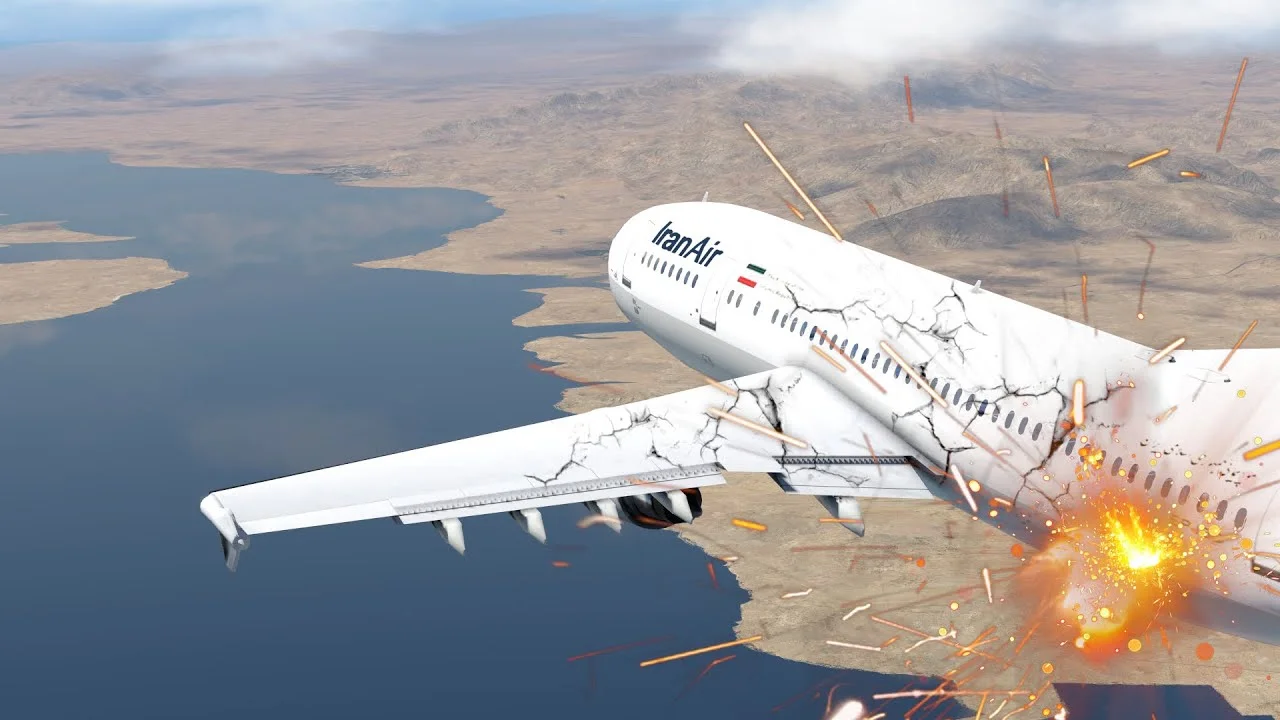
At 9:54 in the morning of July 3, 1988, two SM-2MR surface-to-air missiles launched from the guided-missile cruiser USS Vincennes tore through the fuselage of an Airbus A300 climbing through the skies above the Strait of Hormuz. The aircraft — Iran Air Flight 655, registration EP-IBU, a six-year-old wide-body jet that had been airborne for exactly seven minutes and five seconds — disintegrated almost instantly. The wreckage fell into the waters of the Persian Gulf approximately eight miles from the ship that had destroyed it, near the Iranian island of Hengham. Of the 290 people on board, not one survived. The dead included 66 children, 16 crew members, and passengers from six nations, the majority of them Iranians flying the twice-weekly scheduled service from Tehran to Dubai for reasons of commerce, family, and ordinary life. It was the deadliest shootdown of a commercial airliner in history at the time, and it remains among the most devastating aviation disasters ever caused by military action.
The USS Vincennes had not fired on an enemy warplane. It had fired on a scheduled civilian airliner operating on a published route, squawking the correct civilian transponder code, climbing normally on its assigned airway, in communication with air traffic control at Bandar Abbas and Dubai. The aircraft’s crew — Captain Mohsen Rezaian, First Officer Kamran Teymouri, Flight Engineer Mohammad Reza Amini, and thirteen cabin crew members — had done everything correctly. They had filed a flight plan. They had departed on the correct heading. They had transmitted the correct identification codes. They died because of a catastrophic accumulation of human errors, technological failures, software design flaws, institutional overaggressiveness, and the fog of a naval combat situation in which the commanding officer of a state-of-the-art warship managed to mistake a rising civilian airliner for a diving military fighter jet. The tragedy of Flight 655 is not simply a story about one terrible mistake made in the chaos of war. It is a story about how systems — technological, institutional, human, and political — can fail simultaneously with lethal consequences, and about how those failures were subsequently managed, obscured, and never fully acknowledged by the government whose warship caused them.
The Iran-Iraq War and the Persian Gulf in 1988: The Context That Made the Tragedy Possible
The shootdown of Iran Air Flight 655 cannot be understood in isolation from the broader conflict that had turned the Persian Gulf into one of the world’s most dangerous bodies of water in the 1980s. The Iran-Iraq War, which had begun in September 1980 when Iraqi President Saddam Hussein invaded Iran, had by 1988 been grinding on for nearly eight years, claiming hundreds of thousands of lives and consuming the economies of both nations. The war had acquired a maritime dimension known as the Tanker War, in which both sides attacked each other’s oil shipping and the shipping of third-party nations doing business with the enemy. Between 1984 and 1988, approximately 450 ships were attacked in the Persian Gulf, with oil tankers from Kuwait, Saudi Arabia, and other Gulf states repeatedly struck by Iranian gunboats and Iraqi aircraft.
The United States, though nominally neutral, had in practice aligned itself significantly with Iraq throughout the war. The Reagan administration provided Iraq with intelligence, credits, agricultural assistance, and dual-use technology even as evidence mounted that Iraq was using chemical weapons against both Iranian forces and its own Kurdish population. By 1987, the US was directly engaged in the Gulf in a major naval operation. In May 1987, the Iraqi Air Force had mistakenly attacked the US frigate USS Stark with Exocet missiles, killing 37 American sailors in an incident that Iraq apologized for but that had the effect of tightening US rules of engagement — US Navy ships were now given greater latitude to fire in self-defense. Then in October 1987, the US struck Iranian oil platforms in retaliation for Iranian attacks on Kuwaiti tankers. In April 1988, the frigate USS Samuel B. Roberts struck an Iranian mine and was severely damaged, triggering the largest US naval surface engagement since World War II: Operation Praying Mantis on April 18, 1988, in which the US Navy attacked Iranian naval targets, sank one Iranian frigate, damaged another, and destroyed two oil platforms. By the summer of 1988, the US and Iran were engaged in what amounted to an undeclared naval war.
It was against this backdrop of escalating confrontation, recent combat losses, and a rules-of-engagement framework designed to err on the side of protecting American ships and lives that the USS Vincennes arrived in the Persian Gulf. The Vincennes was a Ticonderoga-class guided-missile cruiser, hull number CG-49, commissioned in July 1985. It was among the most technologically advanced warships in the world, equipped with the Aegis Combat System — a billion-dollar integrated battle management platform built around the AN/SPY-1 phased array radar, capable of tracking more than 100 targets simultaneously at ranges exceeding 100 nautical miles. It was designed to be the shield of the US fleet against Soviet air attacks, capable of processing and engaging multiple incoming threats simultaneously. The Chief of Naval Operations, Admiral Carlisle Trost, had in fact objected to deploying such a high-value asset into the confined and complex waters of the Persian Gulf, where its sophisticated anti-aircraft capabilities were at risk of being misapplied in exactly the kind of ambiguous, high-intensity coastal environment that the system had not been designed to handle. His objections were overruled.
USS Vincennes and Captain William C. Rogers III: The Ship and Its Commanding Officer
William Chapel Rogers III was born on December 13, 1938, in Fort Worth, Texas, and grew up in San Antonio. He had studied psychology at Baylor University and earned a master’s degree in history from Trinity University before entering the Navy as an officer through Officer Candidate School, receiving his commission in December 1965. His first tour was in the engineering department of the aircraft carrier USS Independence, and his career progressed through various naval assignments until, in April 1987, he assumed command of USS Vincennes as its second commanding officer, at a time when Vincennes was one of only five Aegis cruisers in the Pacific Fleet. It was a prestigious posting: the Vincennes was among the most capable ships in the Navy, and Rogers was proud of his command.
From the beginning of his tenure, Rogers cultivated an aggressive command style that distinguished Vincennes in a way that impressed some of his superiors but alarmed his peers. The ship earned the nickname RoboCruiser from both its own crew members and the personnel of other US Navy ships in the region — the name referring both to the Aegis system and to what was perceived as Rogers’s readiness to engage. Commander David Carlson, the commanding officer of USS Sides, a frigate operating in the same patrol area and the ship nearest to Vincennes on the day of the shootdown, later described Rogers’s aggressiveness as a pattern he had been observing for weeks before July 3. Carlson specifically documented an incident on June 2, 1988, in which Rogers had sailed Vincennes too close to an Iranian frigate that was conducting a lawful, if unusual, search of a bulk carrier for war materiel bound for Iraq; had launched a LAMPS III Seahawk helicopter within two to three miles of a small Iranian craft when the rules of engagement required a minimum four-mile separation; and had opened fire on small Iranian military gunboats — an act that Carlson later questioned, asking why one would want to use an Aegis cruiser shooting up boats. Carlson’s description of the shootdown of Flight 655 as the horrifying climax to Captain Rogers’s aggressiveness, first seen four weeks ago, would become one of the most damning assessments in the subsequent investigations.
The Morning of July 3, 1988: Combat Engagement and the Departure of Flight 655
The events of July 3, 1988, began early in the morning when Vincennes’s LAMPS III helicopter, operating ahead of the ship, was fired upon by a small Iranian gunboat. Whether the gunboat fired in warning or in aggression was disputed — the gunboat was operating within Iranian territorial waters and may have been responding to the helicopter’s proximity in the standard way for vessels that perceived themselves to be under surveillance. Rogers treated the incident as hostile fire and turned Vincennes to pursue the gunboats, entering Iranian territorial waters in the process. USS Sides and USS Elmer Montgomery were also in the area as part of the escort operation for the Strait of Hormuz transit. The Vincennes began exchanging fire with the Iranian gunboats — small, fast Islamic Revolutionary Guard Navy (IRGCN) speedboats — in a fast-moving, disorienting action that had the ship maneuvering at high speed, its guns blazing at low-value targets far below the capabilities its designers had envisioned. In the Combat Information Center (CIC) belowdecks, where the Aegis operators worked in a darkened compartment filled with glowing screens, the lights were flickering on and off as the ship’s guns fired, and the vessel was rolling and turning as Rogers pursued the gunboats.
At 9:46 AM local time, as the surface engagement was ongoing, Iran Air Flight 655 pushed back from its gate at Bandar Abbas International Airport. The flight was operating under the command of Captain Mohsen Rezaian, a veteran pilot with approximately 7,000 hours of flight experience. His first officer was 31-year-old Kamran Teymouri; his flight engineer was 33-year-old Mohammad Reza Amini. The aircraft was an Airbus A300B2-203 that had been in service for six years, technically sound and properly maintained. The flight was thirty minutes behind its scheduled departure time, a minor delay with no operational significance. Bandar Abbas International Airport was, and is, a joint military-civilian facility — both commercial airliners and military aircraft use the same runways and the same airspace. The airport served Iran Air’s commercial routes and also housed Iranian military F-14 Tomcat fighters, some of which had been warning off US ships that approached Iranian territory. The dual-use nature of the airport was significant to what was about to happen.
Flight 655 was assigned to commercial air corridor Amber 59, a 20-mile-wide lane on a direct path from Bandar Abbas to Dubai. The flight would climb to approximately 14,000 feet, cruise briefly, and then begin its descent to Dubai — a route of just 28 minutes’ total duration, barely enough time for a full beverage service. As the aircraft climbed normally through the skies above the strait, its transponder was broadcasting Mode III — the standard civilian identification code that signals commercial air traffic to both military and civilian radar systems worldwide. The transponder was squawking 6760, the correct code for civilian flight. The aircraft was on its assigned route. Captain Rezaian was in communication in English with air traffic control at Bandar Abbas on his departure and would shortly have been in contact with Dubai. He was not monitoring the military distress frequencies on which the Vincennes was broadcasting its warnings, because those frequencies were not the ones he was required to monitor — his communications protocols required him to stay in contact with civilian air traffic control.
The Fatal Seven Minutes: Misidentification, Bad Data, and the Order to Fire
The Aegis Combat System aboard Vincennes detected the aircraft taking off from Bandar Abbas almost immediately after departure. Petty Officer Andrew Anderson, whose station in Air Alley was responsible for identifying air contacts within range, queried the Aegis identification friend-or-foe (IFF) system for the new contact. What happened next illustrates the compound nature of the disaster. The Aegis system detected the aircraft’s Mode III civilian transponder signal correctly, but it also detected, separately, a Mode II military IFF reading from a different source — almost certainly from an F-14 Tomcat sitting on the ground at Bandar Abbas, which was transmitting its military identification code. The Aegis operator mistakenly correlated the Mode II military signal with the aircraft taking off, rather than with the stationary aircraft on the ground. The anti-air warfare coordinator accepted this correlation as valid because Iranian military aircraft were known to transmit both Mode II and Mode III codes simultaneously. The result was that the ascending commercial airliner was tagged in the Vincennes’s system as a potentially military contact.
The confusion deepened through a remarkable software failure that Scientific American would later rate as one of the worst user interface disasters in the history of computing. The Aegis software at the time reused tracking numbers on its display, recycling identifier numbers when it ran out and reassigning them to new contacts. The Aegis system had initially assigned the on-screen tracking number TN4474 to Flight 655. Before Rogers gave the order to fire, the Aegis software switched the Flight 655 tracking number to TN4131 and recycled the old identifier TN4474, assigning it to an entirely different aircraft — a US Navy jet flying 110 miles away, over the Gulf of Oman, that happened to be descending toward a carrier. When Captain Rogers, deep in the surface engagement with the Iranian gunboats, asked for a status update on TN4474, the operator gave him information about the wrong aircraft: descending, speed 450 knots. The data was accurate — for the Navy jet 110 miles away. For Flight 655, the Aegis’s own data showed a steady, normal ascent the entire time. The aircraft was climbing, not descending. It was getting further away from the Vincennes, not closer.
The chain of errors continued. A check of the commercial airliner schedule to verify whether a civilian flight had departed from Bandar Abbas at this time found nothing — partly because the CIC was poorly lit, partly because of confusion over which of the four time zones then in use in the operational area applied, and partly because Flight 655 had departed thirty minutes behind schedule. The ship was pitching and rolling in its pursuit of the gunboats. The operators were under combat stress, monitoring multiple threats simultaneously. Lieutenant Commander Victor G. Guillory, the surface tactical warfare officer, was reportedly so unfamiliar with the Aegis system that he used Post-it notes stuck to his radar screen as a substitute for using the computer properly. One officer, Lieutenant William Montford, who was standing directly behind Rogers, later testified that he warned the captain that the contact was a possible commercial airliner and that he never saw any indication on the displays that the aircraft was descending. His warning went unheeded.
Rogers had a window of approximately four minutes between the moment he was aware of the contact and the moment he gave the order to fire. During that time, he was told — incorrectly — that the aircraft was an Iranian F-14 descending in what looked like an attack profile. He was also told — correctly — that the contact was not responding to the radio challenges Vincennes was broadcasting, but those challenges were being transmitted on the military distress frequency, not on the civilian air traffic control frequencies that Captain Rezaian was monitoring. The asymmetry of frequencies meant that the Iranian pilot simply could not hear the warnings that were supposedly being directed at him. At 9:54 AM, Captain Rogers authorized the release of two SM-2MR surface-to-air missiles. The aircraft was at approximately 13,500 feet, eight miles from the Vincennes. Seven minutes and five seconds after takeoff, Iran Air Flight 655 was destroyed. The Airbus A300 disintegrated into three pieces and fell into the Persian Gulf. Neither the cockpit voice recorder nor the flight data recorder was ever recovered.
The 290 Dead: Who Was on Flight 655 and What Was Lost
The 290 people who died in the destruction of Iran Air Flight 655 were overwhelmingly civilians going about the ordinary business of their lives. The passenger manifest included 248 Iranian nationals, 13 passengers from the United Arab Emirates, 10 from India, 6 from Pakistan, 6 from Yugoslavia, and 1 each from Italy and the Philippines. Among the dead were 66 children — infants and young children traveling with their families, many of them going to Dubai for weekend shopping, a common practice for Iranian families who used the relatively liberal emirate as a source for electronics, clothing, and luxury goods unavailable or expensive in post-revolution Iran. The 16 crew members, under Captain Rezaian’s command, had done nothing wrong. The flight had been properly operated in every respect.
In Iran, the news of the shootdown fell like a catastrophe upon a country already exhausted by eight years of war. July 4 — the American Independence Day, the day after the shootdown — was declared a day of national mourning. Mass funeral processions took place in Tehran and other cities. Ayatollah Ruhollah Khomeini, the Supreme Leader of the Islamic Republic, condemned the attack in the strongest terms, calling it a barbaric massacre and citing it as evidence of American hostility toward Iran and the Islamic world. The government’s official position, then and subsequently, was that the attack had not been an accident — that it had been a deliberate act of aggression by the United States, either as a direct military strike against Iran or as a signal that the US was about to formally enter the war on Iraq’s side. This interpretation, shaped by the accumulation of US actions in the Gulf over the preceding years and by a deep distrust of American intentions that was foundational to the Islamic Republic’s political identity, was never fully shaken even as the evidence for accident rather than intent became overwhelming.
The US Government’s Response: Misinformation, Deflection, and Political Damage Control
The initial public response of the US government to the destruction of Flight 655 was a masterclass in the management of damaging information. Within hours of the incident, Admiral William J. Crowe, Chairman of the Joint Chiefs of Staff, held a press conference in which he stated that Iran Air Flight 655 had been descending toward the Vincennes, that it had been outside the commercial air corridor, that it had been traveling at a speed consistent with a military aircraft, and that it had been transmitting on a military IFF frequency. Every one of these statements was false. The aircraft had been ascending. It had been inside its assigned commercial corridor. Its speed had been consistent with a commercial aircraft climbing out of a short-field airport. And it had been squawking the civilian Mode III code, not a military one. The Vincennes’s own Aegis data tapes, examined afterward, confirmed all of these facts unambiguously.
The political response was equally striking in its refusal to acknowledge responsibility. Vice President George H. W. Bush, then campaigning for the presidency, declared at the United Nations Security Council that the United States expressed regret over the loss of lives but simultaneously blamed Iran for a series of provocative actions and defended the Vincennes’s conduct. At a campaign appearance on August 2, 1988, Bush made one of the most remarkable statements in the history of American diplomatic relations: I will never apologize for the United States — I don’t care what the facts are. I’m not an apologize-for-America kind of guy. The statement captured the political calculus of the Reagan administration’s response: in an election year, with American public sympathy firmly on the side of the Navy personnel who had been operating in a genuinely dangerous environment, there was no political incentive to acknowledge error and significant political cost in doing so. President Ronald Reagan issued a written diplomatic note to Iran expressing deep regret for the loss of human lives — a statement that Reagan’s administration considered an apology but that fell well short of the formal acknowledgment of error and responsibility that Iran demanded.
The Fogarty Report: An Official Investigation and Its Silences
The official investigation into the shootdown was conducted by Rear Admiral William M. Fogarty, who submitted his findings on July 28, 1988 in a document formally titled Formal Investigation into the Circumstances Surrounding the Downing of Iran Air Flight 655 on 3 July 1988. The Fogarty report, released to the public in redacted form on August 19, 1988, concluded that the Vincennes had acted in good faith and that the crew’s decisions were understandable given the stress of combat and the confusion of the information environment. It attributed the misidentification primarily to what Fogarty called scenario fulfillment — an unconscious attempt by crew members to make available evidence fit a preconceived scenario in which they were under attack by a military aircraft. The report acknowledged that the aircraft had been on a normal commercial air flight plan profile, in the assigned airway, squawking Mode III 6760, on a continuous ascent in altitude from takeoff. In other words, the Fogarty report confirmed that every public statement Crowe had made at the initial press conference was wrong.
But the Fogarty report’s critics — and they were numerous — argued that it was as notable for what it omitted as for what it acknowledged. The report did not include the navigational data that would have shown precisely where the Vincennes was at the moment of the shootdown. The map that Fogarty displayed when briefing Congress showed Vincennes operating in international waters, well clear of Iranian territorial limits. In 1992, Newsweek obtained a full copy of the internal DoD report, including the navigational charts that had been withheld from the public version. Those charts showed that Vincennes was approximately four kilometres inside Iranian territorial waters at the moment it fired the missiles. This was subsequently admitted by Admiral Crowe himself on the ABC News television program Nightline in 1991 — three years after the incident — in a direct contradiction of the Navy’s public position. The International Civil Aviation Organization’s investigation of December 1988 independently placed Vincennes well inside Iranian territorial waters.
The Fogarty report also failed to adequately address the question of Rogers’s aggressive command style and the series of decisions that had put Vincennes inside Iranian territorial waters while engaged in combat with gunboats. It did not interview the commanders on the aircraft carrier Forrestal. It did not examine Rogers’s decision to pursue the Iranian gunboats into Iranian waters against the advice of his surface warfare commander. The Newsweek investigation, conducted jointly with ABC News Nightline in 1992, characterized the report as a pastiche of omissions, half-truths and outright deceptions, approved at the top by Admiral Crowe. The Proceedings of the US Naval Institute published a detailed critical analysis in August 1993 calling for the declassification of the full geographic track files and noting that the secrecy surrounding the incident only served to conceal ethical and operational weaknesses from the Navy itself.
The Medals Controversy: Honors for the Vincennes Crew
Perhaps no aspect of the Flight 655 incident generated more sustained outrage — internationally and among critics within the military itself — than the decision to award military decorations to officers of the USS Vincennes for their service during the period that included the shootdown. In 1990, Captain Rogers was awarded the Legion of Merit, one of the highest non-combat decorations available to US military officers, citing exceptionally meritorious conduct in the performance of outstanding service as commanding officer of USS Vincennes from April 1987 to May 1989. The citation made no mention of the downing of Flight 655. The air warfare coordinator on duty during the shootdown received the Navy Commendation Medal. The crew was awarded Combat Action Ribbons for completion of their tours in a combat zone.
The Navy’s explanation — that the awards were for the totality of service over the officers’ tours, not for any specific action — was technically accurate but profoundly tone-deaf in its execution. From the perspective of Iran and of international observers who had followed the case, the United States government was rewarding the officers responsible for killing 290 civilians. The Navy’s position was that the Vincennes’s crew had done their duty under genuinely dangerous circumstances and that the tragedy resulted from honest error under stress rather than negligence or malice. But the award of the Legion of Merit to Rogers, with its language of outstanding service for the same period during which 290 civilians were killed, was experienced in Iran as an affirmation that the United States regarded the destruction of a civilian airliner as a praiseworthy act. The awards became a recurring reference point in Iranian political discourse about American arrogance and the asymmetry of how civilian deaths were treated depending on which nation’s forces caused them.
Iran’s Response and the Ceasefire: How the Shootdown Accelerated the End of the Iran-Iraq War
The destruction of Iran Air Flight 655 had a profound and largely unacknowledged strategic consequence: it played a significant role in Iran’s decision to accept a ceasefire in the Iran-Iraq War just weeks after the incident. By the summer of 1988, Iran’s military position had already been deteriorating. The coordinated US-Iraqi actions of early 1988, particularly the recapture of the Faw Peninsula by Iraqi forces — which US intelligence and helicopter support had assisted, according to Iranian accounts — had reversed some of Iran’s most significant territorial gains. Operation Praying Mantis in April had demonstrated the devastating capability of the US Navy against Iranian naval assets. Iran’s economy was in severe distress. The human cost of eight years of war had been catastrophic.
Against this background, the shootdown of Flight 655 was interpreted in Tehran not merely as a tragic accident but as a signal: that the United States was prepared to engage Iran directly and comprehensively, not merely defensively. Former CIA analyst Kenneth M. Pollack wrote that the shoot-down of Iran Air Flight 655 was an accident, but that is not how it was seen in Tehran. Iranian authorities concluded that the US was on the verge of entering the war on Iraq’s side with the full weight of American military power — a war Iran could not possibly win. Less than three weeks after the shootdown, on July 20, 1988, Ayatollah Khomeini announced Iran’s acceptance of UN Security Council Resolution 598, the ceasefire resolution that had been on the table for a year. His statement was among the most remarkable admissions in the history of modern statecraft: Making this decision was deadlier than swallowing poison. The man who had declared the war a sacred defense, who had rejected ceasefire after ceasefire for eight years, was accepting terms that fell short of the comprehensive victory he had promised. The downing of Flight 655 had not caused the ceasefire — the military and economic situation was already forcing Iran toward it — but it had powerfully accelerated the calculus.
The International Court of Justice, the 1996 Settlement, and the Question of Accountability
In May 1989, Iran filed a formal lawsuit against the United States at the International Court of Justice in The Hague, styled as Case Concerning the Aerial Incident of 3 July 1988 (Islamic Republic of Iran v. United States of America). The case raised questions about the legality of the Vincennes’s presence in Iranian territorial waters, the lawfulness of the attack on a civilian aircraft under international law, and the US obligation to provide compensation for the deaths of Iranian nationals. The case proceeded slowly through the ICJ’s procedures over the following years, with both sides submitting extensive written pleadings and supporting evidence.
In February 1996, the United States and Iran reached a settlement that ended the ICJ case. Under the settlement, the US agreed to pay a total of $131.8 million to Iran: $61.8 million in compensation for the 248 Iranian nationals killed in the shootdown, calculated at $300,000 per wage-earning victim and $150,000 per non-wage-earner, and approximately $70 million for other claims, understood to be an approximation of the value of the destroyed aircraft. An average of approximately $213,000 was paid per victim. The US also agreed, as part of a broader normalization of commercial relations, to supply Iran with two Airbus A300-600 aircraft — the first Western aircraft delivered to Iran since 1980, following the Islamic Revolution. The settlement was explicitly characterized by the United States as ex gratia — a voluntary humanitarian payment made without any admission of legal liability. The United States never apologized for the shootdown. It never admitted wrongdoing. It expressed deep regret for the loss of human lives, a formulation carefully chosen to convey sympathy without conceding responsibility.
Technological Lessons: The Aegis System, Human-Machine Interface Failures, and the Fog of War
The destruction of Flight 655 became a landmark case study in the failure of human-machine systems under combat stress, and it generated decades of analysis in naval, technological, and psychological literature. The central technical failure — the recycling of tracking numbers that caused Rogers to receive data about the wrong aircraft — was identified as one of the worst user interface disasters in the history of military computing. The Aegis system had been designed for a different kind of war: a large-scale open-ocean engagement against Soviet forces, where the threats would be clearly identified and the decision-making environment, while fast, would be less ambiguous than the cluttered, multi-use airspace above a busy commercial port and military base in a regional conflict. Deployed in the Persian Gulf, where civilian and military air traffic shared the same runways and the same initial flight paths, the system’s assumption that any aircraft departing from Bandar Abbas should be tagged as presumed hostile was a fundamental category error.
The psychological dimension was equally significant. Fogarty’s concept of scenario fulfillment — the tendency of operators under stress to interpret ambiguous data in ways that confirm a preconceived belief about what is happening — was validated by subsequent research in military psychology. The crew of the Vincennes had been in active combat for minutes before Flight 655 departed. Their arousal levels were high, their cognitive bandwidth was consumed by the surface engagement, and they were operating in a dark, flickering, noise-filled environment that was physically degrading their ability to process information carefully. When data was presented to them that could be read as consistent with an F-14 attack, they read it that way, discarding or ignoring the data that would have told a different story — including the Aegis’s own display, which showed the aircraft ascending throughout. The Fogarty report’s conclusion that stress and inexperience of the crew in warfare resulted in misjudgment and unconscious distortion of data was an accurate description of what had happened, even if it fell short of the full accountability that critics demanded.
In 2004, Marita Turpin and Niek du Plooy of the Centre for Logistics and Decision Support identified an expectancy bias introduced by the Aegis Combat System itself as a contributing factor — arguing that the system’s design encouraged operators to act quickly on incomplete information in ways that were appropriate for the massive Soviet air attacks it had been designed to counter but deeply inappropriate for the ambiguous coastal engagement environment of the Persian Gulf. The case became a touchstone in debates about autonomous weapon systems and the appropriate role of human judgment in automated warfare — debates that have only intensified as artificial intelligence has been applied to military targeting systems. If a human crew in a state-of-the-art combat information center could make these mistakes, the question of what autonomous systems might do without human oversight in similarly ambiguous conditions became deeply pressing.
The Long Shadow: Pan Am 103, the Iran Nuclear Deal, and the Unhealed Wound in US-Iran Relations
The destruction of Flight 655 cast a long shadow over US-Iran relations that extended far beyond the 1996 settlement. In the immediate aftermath, the US government briefly theorized that Iran might seek revenge for the incident, and when Pan Am Flight 103 was destroyed by a bomb over Lockerbie, Scotland, on December 21, 1988 — killing 270 people in the deadliest terrorist attack in UK history — American investigators initially suspected Iranian involvement as retaliation for Flight 655. The theory credited Iran with having financed or organized the attack through a Palestinian militant group backed by Syria. The investigation ultimately concluded that Libyan intelligence was responsible for the Lockerbie bombing, but the early suspicion of Iranian retaliation illustrates how deeply Flight 655 had poisoned the relationship and how readily the incident was interpreted as a motive for violence.
The incident continued to resonate in the diplomatic relationship decades later. Former CIA analyst Pollack’s observation that the incident was not seen as an accident in Tehran proved persistently accurate: the shooting down of Flight 655 became a permanent element of Iranian political culture’s account of American hostility, cited in official speeches, taught in schools, and referenced in diplomatic contexts as evidence of the United States’ willingness to kill Iranian civilians with impunity and then honor the killers with medals. When nuclear negotiations between Iran and the major powers produced the Joint Comprehensive Plan of Action in July 2015, analysts noted that the distrust generated by the Flight 655 incident was among the deep structural impediments to the diplomatic relationship — a grievance that, like the 1953 CIA-backed coup that overthrew Prime Minister Mohammad Mosaddegh, had become embedded in Iranian national memory as a defining moment of American bad faith.
In January 2020, after the US drone strike that killed Iranian General Qasem Soleimani, Iranian President Hassan Rouhani posted a tweet that referenced the number 290, the death toll of Flight 655, alongside the number 52, the figure of Iranian cultural sites that President Trump had threatened to target. The tweet was a reminder that in Iranian political consciousness, Flight 655 had never been resolved, never apologized for, and never adequately accounted for. When Iran’s Revolutionary Guard accidentally shot down Ukraine International Airlines Flight 752 shortly afterward on January 8, 2020, killing 176 people — a tragic parallel to the 1988 disaster — the comparison was immediately and widely drawn, with some observers noting that Iran was now experiencing what it had long argued the US had done and refused to take responsibility for.
The Vincennes Crew, Rogers’s Later Life, and the Human Aftermath
The men and women of USS Vincennes returned to San Diego in October 1988, completing their deployment after the shootdown. Rogers remained in command until May 27, 1989. The human cost of the incident on the crew was real and significant: multiple crew members were still in therapy years afterward, according to the Newsweek investigation, wrestling with the weight of what had happened. The cognitive dissonance between the Navy’s official position — that they had acted correctly given the information available — and the undeniable reality that they had killed 290 innocent people was a burden that many bore in silence. Rogers himself maintained until the end of his life that he had made the proper decision given what he had been told, and he consistently defended his actions in public appearances and in the book he wrote with his wife, Storm Center: The USS Vincennes and Iran Air Flight 655, published in 1992.
Captain Rogers lived until June 30, 2025, dying the day before the thirty-seventh anniversary of the shootdown. He had spent the decades after the incident largely out of the public eye, but the case never left him. The attacks on him and his family — his wife’s car was pipe-bombed in 1989 in an incident that investigators connected to Iranian-linked individuals — illustrated the personal danger that the incident had created. He was never criminally charged. He was never subjected to formal military discipline. He received his Legion of Merit and retired from the Navy. Whether justice was done — and for whom — depends entirely on which of the many competing truths about the incident one prioritizes.
Conclusion: July 3, 1988 and What It Means to Take Responsibility
Iran Air Flight 655 departed Bandar Abbas at 9:46 AM on July 3, 1988, and was destroyed eight minutes later by missiles fired from a US Navy warship operating inside Iranian territorial waters. Two hundred and ninety people died: 66 of them children, all of them civilians, none of them combatants in any war. The aircraft was on its correct route, transmitting its correct identification codes, climbing normally, doing precisely what a commercial airliner is supposed to do. The crew that destroyed it was not acting with malice. They were acting in fear and confusion, in the middle of a real combat engagement, with a technological system that was producing wrong information, under a commanding officer whose aggressiveness had already alarmed his colleagues, in a strategic environment that their government had created through a decade of covert and overt military involvement in a regional war.
The question of what those facts mean — whether they constitute an accident, a tragedy, a war crime, an example of institutional failure, or some combination of all of these — has been debated for nearly four decades and has not been resolved. The United States has paid compensation but admitted no liability. It has expressed regret but not apologized. It decorated the commanding officer but never prosecuted him. Iran has never accepted the American characterization of the incident as accidental. The 290 dead have no memorial in the country that killed them. The number 290 remains, in Iran, a number that requires no explanation — a figure as charged with meaning and grief as any in the history of the Islamic Republic.
The lessons of Flight 655 — about the dangers of deploying advanced weaponry in ambiguous environments without adequate training and institutional safeguards, about the way that aggressive command cultures can create conditions for catastrophic errors, about the political dynamics that prevent governments from acknowledging the full truth of their mistakes, and about the human cost of the distrust that unacknowledged grievances generate — remain as relevant today as they were in 1988. In a world where automated weapons systems, artificial intelligence targeting, and naval operations in contested waters are features of military reality for many nations, the seven minutes between takeoff and destruction of Iran Air Flight 655 stand as a permanent warning about the gap between technological capability and human wisdom, and about the terrible consequences that gap can produce.