
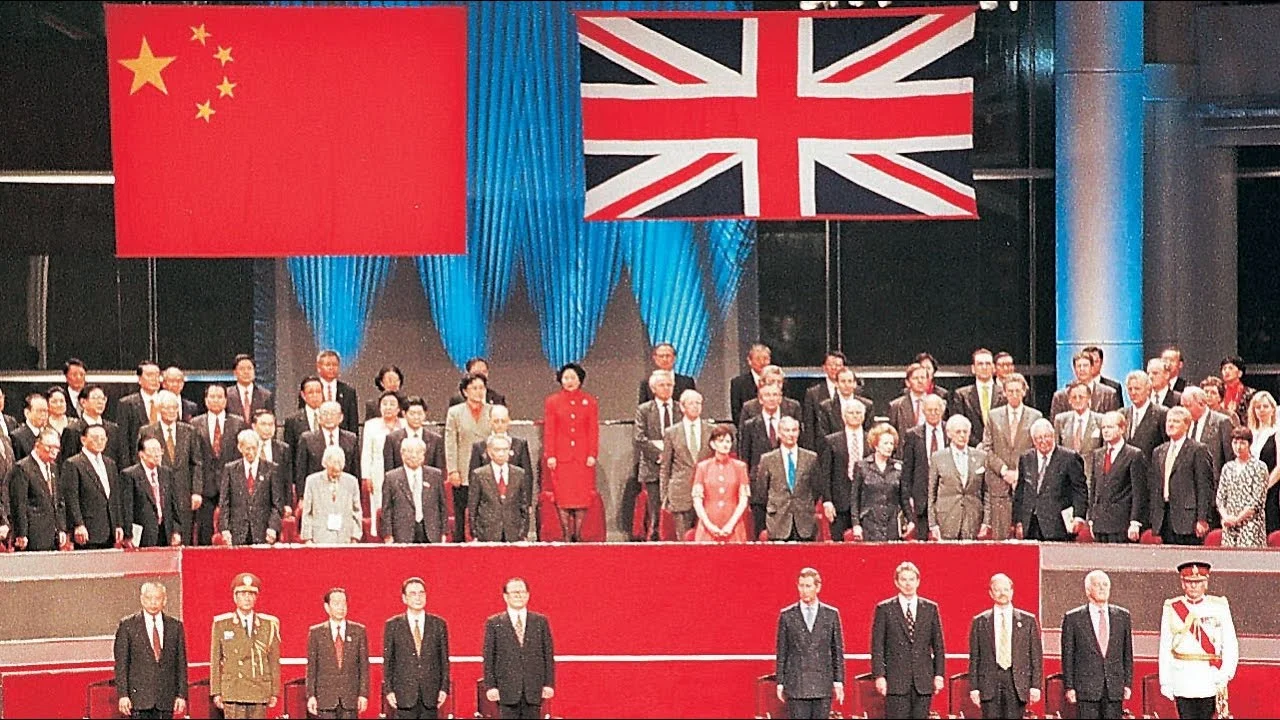
At the stroke of midnight between June 30 and July 1, 1997, in the cavernous new wing of the Hong Kong Convention and Exhibition Centre in Wan Chai, the last notes of God Save the Queen faded into the humid air of a subtropical night, and the Union Jack was lowered for the last time over what had been one of the jewels of the British Empire. In its place rose the five-starred red flag of the People’s Republic of China and the new purple bauhinia flag of the Hong Kong Special Administrative Region. Prince Charles, representing Queen Elizabeth II, looked on. President Jiang Zemin of China watched as his nation reclaimed a territory lost more than a century and a half earlier in the humiliation of the Opium Wars. Governor Chris Patten, the last of twenty-eight British governors of Hong Kong, had already boarded the Royal Yacht Britannia, which would carry him and the Prince into international waters as the clock struck midnight. Britain’s 156 years of colonial rule over Hong Kong were over.
The handover of Hong Kong on July 1, 1997 was among the most consequential diplomatic events of the late twentieth century, a moment at which the remaining architecture of the British Empire was formally dismantled and at which the People’s Republic of China recovered, in Beijing’s formulation, a piece of its national territory that had been torn away by foreign aggression. For Hong Kong’s 6.5 million residents, who had not been consulted about their own fate in any meaningful democratic sense, it was a moment of profound and complex emotion: pride, anxiety, hope, grief, and uncertainty about what the promise of one country, two systems would actually mean in practice. For the watching world, it was the end of an era: the last major colony of the British Empire returning to the country from which it had been taken, in a choreographed ceremony that was simultaneously a diplomatic triumph, a historical reckoning, and the beginning of an experiment in governance that remains contested to this day.
The Opium Wars and the Origins of British Hong Kong: How a Colony Was Born from Conflict
The story of Hong Kong’s handover begins not in 1997 but in the late eighteenth century, when Britain’s East India Company was generating enormous profits from the triangular trade in which Indian opium was sold to Chinese consumers, the proceeds used to buy Chinese silk, porcelain, and tea for the British market. The Chinese imperial government under the Qing dynasty attempted to restrict and then ban the opium trade, which was inflicting severe social and economic damage on China: by the 1830s, millions of Chinese people were addicted to opium, silver was draining out of the country to pay for it, and the Qing administration saw its authority undermined by a trade conducted at the barrel of the British commercial interest. When Commissioner Lin Zexu confiscated and destroyed approximately 20,000 chests of British-owned opium in Canton in 1839, acting on the Emperor’s orders, the British government in London took the position that Chinese interference with British commerce required a military response.
The First Opium War, fought between 1839 and 1842, was a nakedly commercial conflict in which British naval and military superiority overwhelmed the outdated Qing defenses with devastating efficiency. The war ended with the Treaty of Nanking, signed on August 29, 1842, which compelled China to cede the island of Hong Kong in perpetuity to the British Crown, open five treaty ports to British trade, pay an indemnity of 21 million silver dollars, and grant British subjects the right of extraterritoriality in China. The Convention of Chuenpi, signed on January 20, 1841, had already given Britain provisional possession of Hong Kong Island, and the island was formally occupied by British forces on January 26, 1841. Sir Henry Pottinger became Hong Kong’s first governor, serving from 1843 to 1844, establishing the administrative foundation for what would become one of the most remarkable economic transformations in colonial history.
The Second Opium War, fought between 1856 and 1860 after further Chinese resistance to British and French commercial demands, extended British territorial control further. The Convention of Peking, signed in October 1860, ceded the southern portion of the Kowloon Peninsula and Stonecutters Island to Britain in perpetuity, giving the colony the mainland foothold that its island geography had previously lacked. The territory of British Hong Kong was completed with the Convention for the Extension of Hong Kong Territory, signed on June 9, 1898, which granted Britain a ninety-nine-year lease over the New Territories, an area of mainland China north of Kowloon comprising approximately 365 square miles and more than 200 outlying islands. The lease was set to expire on June 30, 1997 — the date that would become the inescapable deadline around which the entire subsequent history of the colony would ultimately be organized. From the Chinese perspective, all three agreements were unequal treaties, imposed on a weakened China by superior military force, and none of them was legally or morally binding on a sovereign nation. That position would shape every aspect of the eventual negotiations over Hong Kong’s future.
The Transformation of Hong Kong Under British Rule: From Fishing Village to Global Financial Powerhouse
When the British first arrived, Hong Kong Island was a largely uninhabited collection of fishing communities with a natural deep-water harbor that the Royal Navy had identified as strategically valuable. British officials had mixed initial views of their acquisition: the British Foreign Secretary Lord Palmerston, who had supported the First Opium War, famously described Hong Kong as a barren island with hardly a house upon it, dismissing its prospects as a trading post. He proved spectacularly wrong. The combination of Hong Kong’s magnificent natural harbor, its strategic position at the mouth of the Pearl River Delta — the gateway to southern China’s vast interior — and the institutional framework of British colonial governance, including the common law legal system, property rights, and relatively free trade, created conditions for extraordinary commercial development.
Through the second half of the nineteenth century and the first half of the twentieth, Hong Kong established itself as the premier entrepot of East Asia, the intermediary through which vast quantities of goods flowed between China and the world. The great trading houses, known as Hongs, including Jardine Matheson and Swire, built commercial empires that spanned Asia and beyond. The Bank of Hong Kong, later the Hongkong and Shanghai Banking Corporation, was founded in 1865 and grew into one of the world’s major financial institutions. The harbour, one of the deepest natural harbours in the world, became a hub for shipping routes that connected the Pacific and Indian Oceans. The colony grew and diversified, absorbing waves of migrants from mainland China, particularly during periods of instability and conflict: the Taiping Rebellion of the 1850s and 1860s, the Sino-Japanese War of 1937 to 1945, and most dramatically the Communist Revolution of 1949, which drove more than a million refugees across the border into the colony.
The Japanese occupation of Hong Kong, which lasted from December 25, 1941, when Governor Mark Young surrendered to Japanese forces, to August 15, 1945, when Japan’s defeat ended the occupation, represented a traumatic interruption of colonial life and a permanent blow to the myth of British imperial invincibility in Asia. The Fall of Singapore and the Fall of Hong Kong had demonstrated to Asian populations and to the British themselves that the empire could not protect its subjects against a determined modern military power. When British rule was restored in 1945, it was in a context in which the broader project of the British Empire was already in terminal decline, though the pace of decolonization in Asia and Africa would take decades to work through. Hong Kong, uniquely among Britain’s major colonies, was not offered independence when British rule was restored: it was too valuable commercially, too strategically complex given the proximity of Communist China, and too small to be viable as an independent state. It remained a colony while the rest of the empire decolonized around it.
The economic miracle of postwar Hong Kong was one of the most remarkable development stories of the twentieth century. Transformed from an entrepot trader into a manufacturing center by the 1950s and 1960s, as millions of mainland Chinese refugees provided both labor and entrepreneurial energy, Hong Kong then transitioned in the 1970s and 1980s into one of the world’s premier financial centers, a destination for international banking, stock exchange activity, and the management of capital flows into and out of the rapidly developing economies of East Asia. By the time the handover negotiations began in earnest in the 1980s, Hong Kong was one of the four Asian Tiger economies, with a per capita income that had surpassed that of its colonial master in some measures, and a commercial infrastructure of extraordinary sophistication. The colony’s population had grown to 6.5 million people, generating a GDP that made it one of the world’s most significant economic entities. What had begun as a barren island was, by the late twentieth century, one of the most prosperous and dynamic urban environments on earth.
Murray MacLehose, Deng Xiaoping, and the First Confrontation with 1997
The question of what would happen to Hong Kong when the New Territories lease expired in 1997 had been largely suppressed in British colonial consciousness through most of the postwar period. The lease expiry was decades away, Communist China showed no particular urgency about the question, and the practical business of governing and developing the colony consumed the attention of successive governors and the Colonial Office. It was the necessities of infrastructure finance, rather than any grand diplomatic initiative, that forced the issue into the open. By the 1970s, Hong Kong’s Mass Transit Railway project and other major infrastructure developments required long-term financial planning, and financiers were reluctant to commit capital to projects whose legal framework might expire before the investments matured. The clock was running.
In March 1979, Governor Sir Murray MacLehose visited Beijing, the first official visit by a Hong Kong Governor to the mainland since 1949. MacLehose met with Vice Premier Deng Xiaoping and raised the issue of the lease, hoping to negotiate an extension of British administration over the whole of Hong Kong beyond 1997, perhaps while conceding nominal Chinese sovereignty over the New Territories. Deng’s response was unequivocal and fundamentally altered the diplomatic landscape. China, Deng told MacLehose, would recover sovereignty over the entirety of Hong Kong, including not just the leased New Territories but also the ceded territories of Hong Kong Island and Kowloon, which Britain claimed to hold in perpetuity. The unequal treaties were not recognized by the People’s Republic. But Deng also suggested that Hong Kong’s investors could set their minds at peace, that China understood the economic value of the colony and intended to preserve it. The formula that would eventually become one country, two systems was already, in embryonic form, in Deng’s mind.
MacLehose’s visit marks the moment when the Hong Kong question moved from the theoretical future to the urgent present. Britain was now aware that its position in Hong Kong after 1997 had no diplomatic future: China would not accept an extension of British administration on any terms. The question was no longer whether Britain would leave but under what conditions, and what framework could be devised to protect Hong Kong’s commercial and legal character after sovereignty passed to the People’s Republic. Margaret Thatcher, who became Prime Minister in May 1979, was initially determined to press Britain’s case for continued administration if not sovereignty, approaching the negotiations from a position of legal principle regarding the binding nature of the 1842 and 1860 treaties. She would soon discover that the legal argument, however compelling in Western international law, carried no weight in Beijing.
Margaret Thatcher, Zhao Ziyang, and the Two-Year Negotiation: The Road to the Joint Declaration
In September 1982, Margaret Thatcher visited Beijing for the formal opening of negotiations on Hong Kong’s future, the first visit by a serving British Prime Minister to the People’s Republic. The meeting was a collision of two formidable political personalities: Thatcher, fresh from her triumph in the Falklands War and accustomed to prevailing through sheer force of will, and Deng Xiaoping, the paramount leader who had rebuilt China from the chaos of the Cultural Revolution and who regarded the return of Hong Kong as a matter of non-negotiable national sovereignty. Thatcher arrived arguing the validity of the nineteenth-century treaties. Deng told her directly, in language that she quoted in her memoirs, that China could walk in and take the whole lot this afternoon. She replied, I know there is nothing I could do to stop you, but the eyes of the world would know what China is like. The exchange captured perfectly the power asymmetry of the negotiating situation: Britain had the better legal argument and China had the better leverage.
The formal negotiations between British Ambassador to Beijing Richard Evans and Chinese Deputy Foreign Minister Zhou Nan, who led the respective delegating teams, lasted two years and proceeded through twenty-two rounds of talks. The British negotiating position evolved from a bid for continued administration under Chinese sovereignty, through a proposal for a joint administration arrangement, to the eventual acceptance that sovereignty and administration would both pass entirely to China. The concessions were largely on the British side, driven by the inescapable fact that without an agreement Britain faced the prospect of 1997 arriving without any legal framework to protect Hong Kong’s institutions. China’s position was clear from the beginning and did not change: full sovereignty would be recovered, and the institutional preservation of Hong Kong’s capitalist system would be guaranteed by China’s own commitment rather than by any continued British role.
The breakthrough that made the Joint Declaration possible was Deng Xiaoping’s formulation of one country, two systems. Originally conceived as a formula to entice Taiwan into reunification with the mainland, the concept proposed that a socialist China could contain within itself a capitalist region governed by its own laws under a high degree of autonomy. For Hong Kong, the formula meant that after the handover the territory would become a Special Administrative Region in which the existing capitalist economic system, the common law legal tradition, the independent judiciary, the freedoms of speech, press, assembly, and religion, and the existing way of life would be preserved unchanged for fifty years, until 2047. China would handle defence and foreign affairs; Hong Kong would handle everything else. The Basic Law, a mini-constitution to be drafted and enacted by China’s National People’s Congress, would give these commitments legal form.
The Sino-British Joint Declaration was signed in the Great Hall of the People in Beijing on December 19, 1984, by Premier Zhao Ziyang and Prime Minister Margaret Thatcher, on behalf of their respective governments. The Declaration entered into force on May 27, 1985, when instruments of ratification were exchanged, and was registered at the United Nations on June 12, 1985. In the Declaration, Britain confirmed that it would restore Hong Kong to China on July 1, 1997, and China confirmed its basic policies for governing Hong Kong as a Special Administrative Region, including the preservation of the capitalist system and the rights and freedoms of Hong Kong residents for fifty years after the handover. The agreement was a diplomatic achievement of considerable complexity, and both sides presented it as a triumph. For the people of Hong Kong, who had not been represented in the negotiations and had not been consulted about their own future, it was a fait accompli that they absorbed with a mixture of relief at having a framework and anxiety about whether it would be honoured.
The Tiananmen Effect: How June 4, 1989 Transformed Hong Kong’s Relationship with China
The single event that most profoundly shaped Hong Kong’s experience of the transition period between the Joint Declaration and the 1997 handover was the massacre in Beijing’s Tiananmen Square on June 4, 1989, when the Chinese People’s Liberation Army crushed the student-led democracy movement that had occupied the square for weeks. The crackdown, watched live on television by Hong Kong’s population, shattered whatever confidence the Joint Declaration had generated about China’s intentions toward political freedom and civil rights. Approximately one million people marched in Hong Kong on the night of May 21, 1989, in support of the Beijing students, the largest demonstration in the colony’s history. When the tanks moved in and the bodies were counted, Hong Kong’s political consciousness was transformed overnight.
The implications of Tiananmen for Hong Kong were immediate and concrete. Emigration, already rising as 1997 approached, accelerated dramatically: tens of thousands of Hong Kong residents sought right of abode in Canada, Australia, Britain, and the United States, transferring capital, skills, and families to destinations where their rights and freedoms would not be contingent on the promises of a government that had just demonstrated its willingness to use lethal force against unarmed demonstrators. The emigration wave created an ongoing brain drain that Hong Kong struggled to manage for the remainder of the colonial period. The memory of Tiananmen became the prism through which Hong Kong people assessed every subsequent development in the transition process, and the annual June 4 candlelight vigil in Victoria Park became one of the largest events in the democratic calendar, a ritual of remembrance that, in a haunting irony, would eventually be banned after the National Security Law of 2020.
The Tiananmen massacre also transformed the political atmosphere in which the transition was managed, affecting both the British government’s approach to the question of democratic reform in Hong Kong and the Chinese government’s sensitivity to any attempt to expand Hong Kong’s political freedoms before the handover. The British government, which had previously been cautious about democratizing Hong Kong’s colonial institutions, partly from its own antidemocratic instincts as a colonial power and partly from a desire not to irritate Beijing, now faced intense domestic and international pressure to give Hong Kong people greater protection before the handover occurred. The response was partly substantive, including the expansion of the Bill of Rights in 1991, and partly symbolic, as the British government began to reckon publicly with the anomaly of having governed Hong Kong for 150 years without democracy and now discovering the virtues of democratic reform as departure became imminent.
Chris Patten: The Last Governor and the Battle for Democratic Reform
The appointment of Christopher Francis Patten as Hong Kong’s twenty-eighth and last governor in July 1992 represented a significant departure from colonial tradition and set the stage for the final, turbulent chapter of British rule. Patten was a career politician rather than a diplomat or colonial administrator: he had served as Chairman of the Conservative Party and had just lost his own parliamentary seat at Bath in the 1992 general election, despite managing John Major’s successful campaign. He arrived in Hong Kong without the Foreign Office pedigree of his predecessors and without a personal relationship with Beijing, and he brought with him a combative democratic conviction that immediately put him on a collision course with the Chinese government.
In October 1992, Patten announced a package of democratic reforms that proposed to expand the electorate for the 1995 Legislative Council elections, lowering the voting age from twenty-one to eighteen, creating new functional constituencies that would enfranchise large numbers of workers, and reforming existing constituencies to make them more broadly representative. The reforms did not introduce full democracy, but they significantly increased the democratic character of Hong Kong’s legislature and were explicitly designed to entrench a more representative system before the handover. Beijing was furious. Chinese officials denounced Patten as a criminal who would be judged by history, accused him of violating the Joint Declaration and previous bilateral agreements, and made clear that any legislature elected under his reforms would be dissolved on July 1, 1997. China’s Foreign Ministry described Patten’s proposals as deceitful, insinuating and shameful.
Seventeen rounds of talks between Britain and China on the electoral arrangements failed to produce agreement. The 1995 Legislative Council elections, conducted under Patten’s reforms, produced a decisive victory for the Democratic Party of Hong Kong, led by the barrister and democracy advocate Martin Lee. The pro-Beijing parties were routed. The result reinforced Chinese determination to replace the elected legislature: in March 1996, China’s 150-member Preparatory Committee voted to dissolve the Legislative Council and replace it with a Provisional Legislature after the handover. In December 1996, a Beijing-backed Selection Committee chose Tung Chee-hwa, a 59-year-old Shanghai-born shipping magnate whose financially troubled business empire had been rescued by a large injection of mainland Chinese capital in the 1980s, as Hong Kong’s first Chief Executive under Chinese rule. Tung was inaugurated at the stroke of midnight alongside the handover ceremony. Days before the handover, he announced plans to restrict political gatherings and parties after July 1, drawing protest from democrats who argued that the promises of the Joint Declaration were being abandoned before they had formally come into effect.
Chris Patten’s final act as governor was both ceremonially moving and personally painful. He had arrived in Hong Kong determined to do something for the people he was leaving behind, and had antagonized Beijing in the attempt. Whether his democratic reforms represented genuine principle or an eleven-hour scramble by a departing colonial power to dress its exit in democratic clothing after 150 years of colonial autocracy is a question that historians and commentators continue to debate. What is not in doubt is that his personal relationship with Hong Kong, his evident affection for the territory and its people, and his willingness to fight openly with Beijing on their behalf made him genuinely popular with Hong Kongers in a way that few colonial governors had been. In his final address before leaving Government House, Patten spoke of his love for Hong Kong and his belief that its people would prevail. He wept openly. The images of Patten’s departure, and the moment when he handed the folded Union Jack to Prince Charles aboard the Britannia, became some of the most widely reproduced photographs of the handover period.
Midnight, June 30 to July 1, 1997: The Ceremony That Ended an Empire
The handover ceremony took place at the new wing of the Hong Kong Convention and Exhibition Centre in Wan Chai, on Hong Kong Island, an extraordinary piece of architecture that had been specifically built for the occasion and that extended out into Victoria Harbour like the prow of a ship. The ceremony was internationally televised, watched by approximately a billion people around the world. Both the British and Chinese sides had spent months negotiating the choreography of the event, including the precise timing and staging of the flag exchanges, the order of speeches, and the seating arrangements. The stage had been designed by the American set designer Donato Moreno, with a large red and gold backdrop.
Prince Charles represented the Queen and delivered a gracious speech congratulating Hong Kong on its political, economic, and social successes and telling its people: We shall not forget you, and we shall watch with the closest interest as you embark on this new era of your remarkable history. He was accompanied by Prime Minister Tony Blair, who had won the landslide general election of May 1997 just weeks before the handover and who attended the ceremony in a role that was partly symbolic of Britain’s new political leadership and partly a gesture of historical reckoning. Secretary of State for Foreign Affairs Robin Cook was also present.
On the Chinese side, President Jiang Zemin attended as head of state, the first mainland Chinese leader to visit Hong Kong since the Qing dynasty. He was accompanied by Premier Li Peng. Jiang’s presence was both symbolically and practically significant: by attending in person, he was asserting the weight that China attached to the occasion and reassuring Hong Kong residents that Beijing took the handover seriously. Deng Xiaoping, the paramount leader who had conceived the one country, two systems formula and who had driven the negotiations from the Chinese side, did not live to see the moment he had engineered: he died on February 19, 1997, just four and a half months before the handover. His absence was widely noted as one of the poignant ironies of the occasion.
As midnight approached, the British and Hong Kong flags were lowered and folded in a ceremony of military precision. The Chinese national anthem, March of the Volunteers, struck up, and the five-starred red flag of the People’s Republic of China and the new purple and white bauhinia flag of the Hong Kong Special Administrative Region were raised. Tung Chee-hwa was sworn in as Chief Executive, repeating an oath in Chinese. The new Provisional Legislature, which replaced the elected Legislative Council that China had refused to recognize, was sworn in simultaneously in the early hours of July 1. Several thousand soldiers of the Chinese People’s Liberation Army, who had crossed the border from Shenzhen into Hong Kong at midnight, were deployed in the territory as the symbolic garrison of the new sovereign power. In Beijing, fireworks exploded over Tiananmen Square.
A Territory Without a Voice: What Hong Kong’s People Were Never Asked
One of the most striking aspects of the entire handover process, from the initial negotiations of the early 1980s through the Joint Declaration and the Basic Law drafting process to the ceremony of July 1, 1997, was the near-total exclusion of Hong Kong’s own population from the decisions that determined their fate. The 6.5 million people who lived in Hong Kong were not given a referendum on their preferred future. They were not formally represented at the negotiating table: the British government explicitly rejected any suggestion that Hong Kong should be a party to the talks, and China denounced the idea of consulting Hong Kong people as a violation of Chinese sovereignty. The colony’s residents were, in effect, treated as a prize to be negotiated over rather than as people with their own political agency.
The exclusion reflected the structural realities of colonial governance: Hong Kong had been ruled without democracy for 156 years, and neither Britain nor China had any incentive to introduce the democratic element at the very moment when it might have produced outcomes inconsistent with the handover. The British government’s belated conversion to democratic reform under Patten came too late to create genuinely entrenched democratic institutions that China would have been bound to respect, and Patten’s reforms were in any case swept away when China installed its Provisional Legislature at midnight on July 1. The Basic Law, which served as Hong Kong’s constitutional framework after the handover, promised eventual universal suffrage for the election of the Chief Executive and the Legislative Council but left the timetable entirely vague, providing the Beijing government with indefinite flexibility in determining when, if ever, genuinely democratic governance would be introduced.
Many Hong Kong residents chose to express their views by leaving. The emigration waves of the late 1980s and 1990s took hundreds of thousands of people, disproportionately educated and skilled, to other destinations. Those who remained did so partly from attachment to Hong Kong, partly from economic calculation, partly from a belief that the promised autonomy might indeed be honoured, and partly from a pragmatic acceptance that the handover was going to happen regardless of anyone’s preferences. The mood at midnight on July 1, 1997, among Hong Kong residents who watched the ceremony on television, ranged from genuine celebration among those who saw the occasion as an act of national liberation from colonial rule, through resigned acceptance among those who had made their peace with the inevitability of the transition, to deep apprehension among those who feared what Chinese sovereignty would eventually mean for the freedoms they had taken for granted.
One Country, Two Systems: The Promise, the Practice, and the Erosion
In the years following the 1997 handover, the one country, two systems framework showed both its strengths and its limits. Hong Kong’s common law legal system continued to function, with its traditions of judicial independence, due process, and protection of civil liberties largely maintained. The territory continued to operate as one of the world’s premier financial centers, with its free currency, open capital markets, and transparent regulatory environment intact. Freedom of the press, while subject to increasingly self-conscious self-censorship, remained far greater than on the mainland. Democratic opposition parties, including Martin Lee’s Democratic Party, continued to contest and win elections. The Chief Executive selection process, though controlled by Beijing through a nominating committee, was at least notionally open to candidates with different views.
Yet the signs of erosion were visible from the earliest years. Tung Chee-hwa’s attempt in 2003 to introduce a national security law under Article 23 of the Basic Law, which would have criminalized subversion, sedition, and theft of state secrets in terms that critics argued would have been used to suppress political dissent, provoked the largest demonstrations in Hong Kong since Tiananmen: approximately 500,000 people marched on July 1, 2003, the sixth anniversary of the handover, and the legislation was shelved. The 2014 Umbrella Movement, in which tens of thousands of protesters occupied central Hong Kong for 79 days demanding genuine universal suffrage for the election of the Chief Executive, demonstrated the depth of popular commitment to the democratic promises that the Basic Law had left frustratingly vague. China’s decision in 2014 to allow popular election of the Chief Executive only from candidates pre-screened by a nominating committee controlled by Beijing was widely interpreted as a fundamental betrayal of the Joint Declaration’s promises.
The decisive turning point came with the protest movement of 2019, triggered initially by a proposed extradition bill that would have allowed suspects to be transferred to mainland Chinese jurisdiction. The protests, which at their peak drew approximately two million people into the streets of a city of seven million, evolved into a broader pro-democracy movement demanding the five demands, including direct elections, an independent inquiry into police conduct, and amnesty for arrested protesters. The scale and sustained intensity of the protests alarmed Beijing profoundly. The response came in June 2020 with the imposition of the National Security Law, drafted in Beijing and enacted without the participation of Hong Kong’s legislature, which criminalized secession, subversion, terrorism, and collusion with foreign forces in terms broad enough to encompass a wide range of political speech and activity. The law effectively ended the political opposition in Hong Kong: dozens of democratic politicians and activists were arrested, the Democratic Party and other opposition groups were dismantled or forced to dissolve, and the June 4 Tiananmen vigil that had been held annually since 1990 was banned.
The Significance of 1997: The End of the British Empire and the Rise of Chinese Power
The handover of Hong Kong on July 1, 1997 is widely regarded as marking the definitive end of the British Empire. With a population of approximately 6.5 million, Hong Kong in 1997 accounted for 97 percent of the total population of all British Dependent Territories combined, and was by far the most economically significant colonial possession remaining to Britain. The transfer of sovereignty removed the last major colony, the last substantial remnant of an imperial project that had at its height encompassed a quarter of the world’s land surface and governed a quarter of its population. The ceremony in Wan Chai that midnight was not merely a bilateral diplomatic event but the closing of a historical chapter that had shaped the modern world.
For China, the handover was an event of entirely different significance: the redemption of a national humiliation that had begun with the Opium Wars and that had defined China’s self-image as a nation for 150 years. The century of humiliation, as Chinese historical consciousness labels the period from the First Opium War to the Communist Revolution, had involved the forced cession of territory, the imposition of unequal treaties, the subjugation of Chinese sovereignty to foreign commercial and military power, and the systematic diminishment of China’s standing among the great powers of the world. The return of Hong Kong was, for Beijing and for many Chinese people everywhere, the reversal of that humiliation, the moment when China demonstrated that it had regained the strength to recover what had been taken from it. Jiang Zemin’s declaration at midnight that Hong Kong had come home resonated with a national meaning that transcended the diplomatic formalities of the handover ceremony.
The handover also reflected and reinforced the broader geopolitical shift that was underway in 1997: the emergence of China as a major power in the international system, the relative decline of British global influence, and the transformation of the Asia-Pacific region into the most economically dynamic area of the world. The new Hong Kong that passed to Chinese sovereignty was a financial center of extraordinary sophistication, a gateway between China and the world economy, and a living demonstration of what Chinese commercial culture could achieve under conditions of legal stability and institutional freedom. What the subsequent decades revealed, as Beijing’s influence over Hong Kong’s governance steadily expanded, was that China’s leadership ultimately placed a higher priority on political control than on the model of autonomous capitalism that had made Hong Kong so valuable in the first place.
The Thiepval Memorial and the Legacy of Hong Kong: What 1997 Means in the Twenty-First Century
Looking back from the vantage point of the twenty-first century, the Hong Kong handover of July 1, 1997 carries a meaning that has continued to evolve with the subsequent history of the territory and of China’s relationship with the international community. The Sino-British Joint Declaration, which Britain and China signed as an internationally registered treaty, has been the subject of intense dispute: China has declared it a historical document with no binding force in the present, while Britain and other Western governments maintain that it represents ongoing legal obligations that China continues to breach. The introduction of the National Security Law in 2020 and the restructuring of Hong Kong’s electoral system in 2021 to ensure that only patriots acceptable to Beijing could hold office have been widely condemned as violations of the one country, two systems commitments that were the entire basis of the 1997 handover.
For the people of Hong Kong, the history of the handover is inseparable from the question of what Hong Kong is and what it might become. A city that developed a distinct identity under colonial rule, absorbing Chinese cultural heritage and British institutional traditions to create something genuinely unique, found itself caught between two competing narratives of its own history after 1997: the Chinese narrative of return and national belonging, and the Hong Kong narrative of autonomy, civic identity, and the freedoms that distinguished the territory from the mainland. The protests of 2019 and the repression that followed them demonstrated that this tension had not been resolved by the handover but had merely been deferred, and that the democratic aspirations of Hong Kong’s civil society were in fundamental conflict with Beijing’s determination to maintain political control.
Conclusion: Midnight, July 1, 1997 and the Weight of 156 Years
When the Union Jack was lowered at midnight on July 1, 1997, it marked the end of 156 years of British colonial rule over a territory that Britain had taken by force, transformed into one of the world’s great cities, and ultimately returned to the nation from which it had been seized. The Opium Wars that had given Britain Hong Kong were among the more indefensible episodes in the long history of British imperialism: a war fought to protect the profits of the drug trade, whose human cost fell overwhelmingly on the Chinese people who were its victims. The colony that grew from those origins eventually transcended them, becoming something that its original architects could not have imagined: a city of 6.5 million people, one of the world’s great financial centers, a place where Chinese culture, British law, and global commerce had created a unique human achievement.
The people of Hong Kong were not meaningfully consulted about either the colonial relationship or its ending. They were governed without democracy for 156 years, negotiated about without representation in the early 1980s, and handed over to Chinese sovereignty on the basis of a treaty that has been increasingly hollowed out in the decades since 1997. The promise that their way of life would be preserved unchanged for fifty years, enshrined in the Joint Declaration and the Basic Law, has been partially kept and partially broken, in ways that continue to be contested by the governments of Britain and China and by the people of Hong Kong themselves. The handover was simultaneously an act of historical reckoning, an act of diplomatic necessity, and an act of colonial abandonment, and the weight of all three of these interpretations presses on the midnight of June 30, 1997.
Deng Xiaoping’s formula of one country, two systems was an ingenious political invention that may ultimately prove to have been too ingenious for its own sustainability: it required of China’s government a degree of tolerance for political pluralism within its borders that proved, as the decades advanced, to be incompatible with the political culture of the Chinese Communist Party. Whether the experiment that began at midnight on July 1, 1997 ultimately succeeds or fails in its most fundamental objective, the preservation of Hong Kong’s distinct character and freedoms within Chinese sovereignty, is a question that will not be fully answered until 2047, when the fifty-year commitment expires. What the history of the handover and its aftermath demonstrates is that the transfer of sovereignty is not merely a diplomatic transaction between governments but a transformation of human lives, and that the promises made in the Great Hall of the People in December 1984 and repeated at the Convention and Exhibition Centre in Wan Chai at midnight on July 1, 1997, belong as much to the people of Hong Kong as they do to the governments that made them.