Before the sun had fully risen over the rolling farmlands of Adams County, Pennsylvania, on the morning of July 1, 1863, the course of the American Civil War began to shift. Confederate infantry advancing toward the small crossroads town of Gettysburg in search of supplies ran into dismounted Union cavalrymen who had arrived the previous night and taken up defensive positions on the ridges west of town. The shots exchanged in those early morning hours on McPherson Ridge were the opening sounds of the Battle of Gettysburg, the bloodiest engagement ever fought on American soil and, by the consensus of historians, the most consequential three days of battle in the nation’s history. What began as an accidental collision between advance units would escalate, within hours, into a struggle that consumed nearly 170,000 men and left somewhere between 46,000 and 51,000 of them killed, wounded, captured, or missing.
The Battle of Gettysburg, fought from July 1 through July 3, 1863, was the defining confrontation of General Robert E. Lee’s second and final invasion of the North. It pitted Lee’s Army of Northern Virginia, approximately 71,000 to 75,000 strong, against Major General George Gordon Meade’s Army of the Potomac, numbering roughly 94,000 to 100,000 men. It resulted in a decisive Union victory, the repulse of Lee’s invasion, and the effective destruction of the Confederate army’s offensive capacity for the remainder of the war. Combined with Ulysses S. Grant’s capture of Vicksburg, Mississippi on July 4, 1863, the victory at Gettysburg marked the moment at which the military balance of the Civil War tilted irrevocably against the Confederacy. And four months after the battle ended, President Abraham Lincoln would travel to Gettysburg to dedicate a cemetery for the Union dead and deliver a speech of 272 words that redefined the purpose of the war and the meaning of American democracy.
The Civil War in 1863: Strategic Context and the Road to Pennsylvania
To understand how the Battle of Gettysburg came to be, it is necessary to understand the military situation of the Civil War in the spring of 1863. The conflict had been raging since April 1861, when Confederate forces attacked Fort Sumter in South Carolina and President Lincoln called for 75,000 volunteers to suppress the rebellion. Two years of fighting had produced enormous casualties and no decisive result in the Eastern Theater, where the two main armies had been locked in a deadly back-and-forth struggle across Virginia and Maryland. The Union Army of the Potomac had repeatedly attempted to capture Richmond, Virginia, the Confederate capital, and had repeatedly been repulsed by the Army of Northern Virginia under General Robert E. Lee and his brilliant subordinates. The Confederate victories at the First and Second Battles of Bull Run, at Fredericksburg in December 1862, and most recently at Chancellorsville in May 1863 had given Lee’s army an almost mythic aura of invincibility and had deeply demoralized Northern public opinion.
Chancellorsville, fought from April 30 to May 6, 1863, was Lee’s tactical masterpiece. Facing a Union army nearly twice the size of his own under General Joseph Hooker, Lee audaciously divided his force and sent Lieutenant General Thomas ‘Stonewall’ Jackson on a sweeping flanking march that routed the Union right flank at dusk on May 2. Though Jackson himself was accidentally shot by his own troops during the battle and died of pneumonia on May 10 from wounds sustained in the engagement, his loss being a devastating blow to Lee and the Confederacy, Chancellorsville was a crushing Confederate victory that sent Hooker’s humiliated army retreating across the Rappahannock River. The victory set the stage for Lee’s most ambitious plan yet: a second invasion of the North.
Lee’s strategic objectives for the Pennsylvania campaign were multiple and mutually reinforcing. After two years of devastating fighting on Virginia soil, the state’s agricultural regions had been stripped bare. His army’s men and horses needed food and forage that could only be found in the untouched farms of Pennsylvania. A successful invasion of the North would relieve Virginia, allow his army to resupply itself at the enemy’s expense, and potentially threaten major Northern cities including Baltimore, Philadelphia, and even Washington D.C. itself. Beyond logistics, Lee believed that a decisive Confederate victory on Northern soil might break the political will of the Northern peace movement, strengthen the Copperhead Democrats who opposed the war, and possibly induce Britain and France to recognize the Confederacy. In the Western Theater, the Confederate garrison at Vicksburg, Mississippi was under siege by Grant’s forces; a Northern invasion might force the Union to divert troops from Vicksburg to meet the threat in Pennsylvania, relieving some pressure on that crucial Mississippi River fortress.
Lee’s Army Moves North: The Gettysburg Campaign, June 1863
On June 3, 1863, the Army of Northern Virginia began moving north from its positions along the Rappahannock River in Virginia. Lee’s army of approximately 75,000 men was organized into three infantry corps. The First Corps was commanded by Lieutenant General James Longstreet, Lee’s most experienced and trusted corps commander, with divisions under Major Generals Lafayette McLaws, John Bell Hood, and George Pickett. The Second Corps, reorganized after Stonewall Jackson’s death, was commanded by Lieutenant General Richard Stoddert Ewell, with divisions under Major Generals Jubal Early, Robert Rodes, and Edward ‘Allegheny’ Johnson. The Third Corps, newly created from the reorganization following Chancellorsville, was commanded by Lieutenant General Ambrose Powell Hill, with divisions under Major Generals Richard H. Anderson, Henry Heth, and W. Dorsey Pender. The army’s cavalry was led by the dashing and controversial Major General J.E.B. Stuart, whose brigades were commanded by Brigadier Generals Wade Hampton, Fitzhugh Lee, Beverly Robertson, Albert Jenkins, William ‘Grumble’ Jones, and Colonel John Chambliss.
The Confederate army moved up the Shenandoah Valley, screened by Stuart’s cavalry, and crossed the Potomac River on June 15, entering Maryland and then Pennsylvania. Elements of Ewell’s Second Corps advanced rapidly to the north and east, reaching the Susquehanna River and threatening Harrisburg, Pennsylvania’s capital, by late June. Confederate forces occupied Chambersburg, York, and other Pennsylvania towns, demanding supplies under threat of destruction. During this advance, Confederate soldiers committed one of the most disturbing aspects of the invasion: the seizure of free Black residents of Pennsylvania and their transportation south into slavery. The Confederates captured approximately 40 Black northerners, most of them free men and women who had never been enslaved, and sent them south under guard. It was a stark demonstration of what Southern victory would mean for African Americans throughout the country.
The Union Army of the Potomac, still under the command of Major General Joseph Hooker, had been shadowing Lee’s movement, keeping itself between Lee’s army and Washington D.C. as Lincoln’s administration insisted. On June 28, in a moment of crucial drama that would shape the battle to come, Major General George Gordon Meade received word at midnight that he was replacing Hooker in command of the Army of the Potomac. Meade, a 47-year-old Pennsylvania native known for his meticulous professionalism and notoriously difficult personality, was given command just three days before the decisive battle. He immediately began moving his seven infantry corps aggressively northward, determined to find Lee’s army and bring it to battle on ground of his choosing. Meade planned a defensive fight near Pipe Creek in Maryland if Lee gave him the opportunity, but events would not allow him that luxury.
One of the most consequential failures of the Gettysburg campaign was J.E.B. Stuart’s absence from Lee’s army at the crucial moment. Stuart had embarked on a daring cavalry ride completely around the Union army, a maneuver intended to gather intelligence and demonstrate Confederate boldness. But the operation took far longer than anticipated, and by the time the two armies were converging on Gettysburg, Lee was effectively blind. Without Stuart’s cavalry acting as the army’s eyes, Lee had no reliable information about the location, strength, or movements of Meade’s forces. It was through a spy, not his cavalry, that Lee learned on June 28 that Meade had taken command and that the Army of the Potomac was at Frederick, Maryland, much closer than Lee had believed. This intelligence shock caused Lee to immediately order his scattered corps to concentrate around the crossroads at Gettysburg or nearby Cashtown.
The Convergence: July 1, 1863 Begins with an Accidental Collision
The town of Gettysburg, Pennsylvania, a community of approximately 2,400 residents in 1863, was not chosen as a battlefield by anyone. It was a modest crossroads town in Adams County where ten roads converged from all directions, making it the natural hub of the surrounding region and, in the summer of 1863, the inevitable concentration point for two armies groping toward each other in a fog of strategic uncertainty. Its significance was geographical: any army moving through south-central Pennsylvania would naturally pass through or near Gettysburg. As Lee’s scattered corps converged from the west and north and Meade’s corps moved up from the south, the town lay directly in the path of collision.
The collision was initiated not by the generals but by the needs of infantry soldiers. On June 30, Brigadier General J. Johnston Pettigrew’s brigade of Henry Heth’s division approached Gettysburg from the northwest, following the Chambersburg Pike, in search of shoes and other supplies that were rumored to be stored in the town. Pettigrew’s men encountered Union cavalry entering the town from the south and, following Lee’s standing order to avoid a general engagement until the army was concentrated, turned back to Cashtown without fighting. Pettigrew reported to Heth and his corps commander A.P. Hill that he had seen Union cavalry in force. Both Hill and Heth were skeptical, believing the force was merely Pennsylvania militia of little consequence. The following morning, Hill dispatched Heth’s division, reinforced, to conduct a reconnaissance in force.
The Union cavalry that had halted Pettigrew was the division of Brigadier General John Buford, one of the finest cavalry commanders in the Union army. Buford recognized immediately the tactical significance of the high ground south of Gettysburg, particularly the ridges and hills that ran from Culp’s Hill on the northeast, through Cemetery Hill just south of town, down along Cemetery Ridge to the Round Tops two miles to the south. If the Confederates could seize these heights, the Union Army would have an extremely difficult time dislodging them. Buford understood that his mission was to hold the ground long enough for Union infantry to arrive and occupy the commanding heights. He disposed his two brigades, under Colonels William Gamble and Thomas Devin, along three ridges west of Gettysburg: Herr Ridge, McPherson Ridge, and Seminary Ridge. His troopers were armed with breech-loading carbines that could be fired faster than the muzzle-loading rifles of the infantry, giving them the ability to simulate the firepower of a much larger force during a delaying action.
First Blood: The Opening Hours of the Battle, July 1, 1863
At approximately 5:30 in the morning on July 1, 1863, Heth’s Confederate infantry began their advance from Cashtown toward Gettysburg along the Chambersburg Pike. As the lead elements approached Marsh Creek, about three miles west of town, they encountered Buford’s cavalry pickets. The first shots of the Battle of Gettysburg were fired in the early morning darkness and mist, and for years afterward, veterans and historians argued about the precise time and location of the opening volley. The pickets fell back, and the main Confederate advance encountered Buford’s dismounted troopers holding McPherson Ridge in a fighting withdrawal designed to slow the Confederate advance and buy time.
Buford’s troopers fought with extraordinary tenacity, making use of their faster-firing carbines and their training in dismounted combat to delay Heth’s much larger infantry force. The fighting was severe, and as the morning progressed it became clear that Buford could not hold his positions indefinitely against the weight of a full Confederate division. He sent word back to First Corps commander Major General John Fulton Reynolds, one of the most respected officers in the Union army, who was bringing his infantry forward along the Emmitsburg Road. Reynolds himself rode forward to assess the situation and made a critical decision: he would commit his infantry to hold the ridge and ordered his lead division to advance at the double-quick.
Reynolds arrived on McPherson Ridge in the late morning, personally directing the placement of his troops and the disposition of artillery. He was coordinating the defense when, at approximately 10:15 in the morning, he was struck in the head by a bullet fired from a Confederate sharpshooter in the trees along Willoughby Run and killed instantly. Reynolds’s death was a tremendous loss to the Union army; he had been one of Lincoln’s preferred choices to command the Army of the Potomac, and his personal authority and fighting qualities were irreplaceable on that morning. Command of the First Corps devolved to Major General Abner Doubleday, later immortalized in the mythology of baseball’s origins. The fighting continued even as Reynolds fell, with Union infantry pushing Heth’s Confederates back and capturing the brigade commander Brigadier General Archer along with several hundred of his men near Willoughby Run, the first general officer captured in the Army of Northern Virginia.
The Battle Escalates: The Arrival of Ewell, Hill, and the Union Collapse Through Gettysburg
The morning’s fighting had been a sharp Union success, with the First Corps infantry holding McPherson Ridge against Heth’s division and capturing Confederate prisoners. But the situation changed dramatically in the early afternoon as additional Confederate forces arrived on the field. Lieutenant General Richard Ewell’s Second Corps, marching south from the Carlisle area toward Gettysburg on the roads from the north, arrived on the Union right flank along Oak Ridge and Oak Hill. Major General Robert Rodes’s division struck the Union First Corps from the north while Heth renewed his assault from the west. Major General Jubal Early’s division swept in from the northeast and fell upon the Union Eleventh Corps, commanded by Major General Oliver Otis Howard, which had taken up positions north of town.
The Union Eleventh Corps, which had the misfortune of being the unit flanked by Jackson at Chancellorsville and bore the stigma of that disaster, found itself overwhelmed again. Early’s division, attacking from the northeast with four brigades, overlapped and enveloped the Union right flank north of town. The corps broke, and its soldiers streamed in disorder through the streets of Gettysburg toward Cemetery Hill to the south. Simultaneously, the Union First Corps, attacked from both the north and west by Rodes and Heth, was compressed and driven from McPherson Ridge and Seminary Ridge into the town. The Confederate assault, involving roughly 30,000 men against 20,000 Union defenders, had produced the breakthrough that Lee’s army needed. By 4:00 in the afternoon, Union forces were in full retreat through Gettysburg, fighting through the narrow streets as pursuing Confederates pressed them from behind and on both flanks.
General Lee had arrived on the battlefield at approximately 2:30 in the afternoon, riding his famous gray horse, Traveller, and observed the battle from Seminary Ridge as the Union forces broke. The victory developing before him was larger than he had anticipated when the day began. He made the decision to press the advantage and ordered his corps commanders to continue the attack. To Ewell, who held the commanding position north of town, Lee sent the discretionary instruction to take Cemetery Hill ‘if practicable.’ This critical qualifier would become one of the most debated phrases in Civil War historiography. Ewell, who had served his entire career under the decisively aggressive Stonewall Jackson and was unaccustomed to exercising independent judgment on such matters, surveyed Cemetery Hill and determined that the assault was not practicable with his tired troops, the approach of darkness, and uncertainty about reinforcements. He did not attack.
This decision by Ewell not to attack Cemetery Hill on the evening of July 1 is one of the great what-ifs of the Battle of Gettysburg and of the Civil War itself. Cemetery Hill was, at that moment, defended by the broken and disorganized remnants of two Union corps. A vigorous assault by Ewell’s fresh troops might well have taken the position before Union reinforcements could arrive. Had Cemetery Hill fallen on the evening of July 1, the entire Union defensive line on Cemetery Ridge would have been untenable, and the course of the subsequent two days’ fighting would have been entirely different. Historians have speculated endlessly that if Stonewall Jackson had survived Chancellorsville and been present at Gettysburg, he would not have hesitated.
The Union Rallies on the High Ground: The Fishhook Line Takes Shape
As darkness fell on the evening of July 1, the battered Union forces that had retreated through Gettysburg gathered themselves on Cemetery Hill, just south of town, and on adjacent Culp’s Hill to the east. The officer who did the most to rally the shattered troops and restore order was Major General Winfield Scott Hancock, commander of the Second Corps, whom Meade had sent forward to assess the situation. Hancock’s personal presence and force of command steadied the retreating soldiers and organized the defense of the high ground. His decision to hold Cemetery Hill would prove to be one of the most consequential tactical judgments of the battle. Meade arrived at the battlefield after midnight and, after consulting with his corps commanders, decided to stay and fight from the defensive position his army now occupied.
Through the night of July 1 and the morning of July 2, the remaining Union infantry corps arrived on the field and took their positions in what became one of the most formidable defensive lines of the Civil War. The Army of the Potomac occupied a roughly fishhook-shaped position running approximately three miles in length. From Culp’s Hill on the east, the line curved through Cemetery Hill, ran south along Cemetery Ridge for two miles, and terminated at the rocky elevation of Little Round Top in the south, with the larger but less strategic Big Round Top beyond it. This interior-line position gave Meade’s commanders the critical advantage of being able to shift reinforcements rapidly along the shorter internal distances to wherever the Confederate attack struck hardest.
The Confederate army held a longer exterior arc wrapping around the Union position, running approximately six miles from the Confederate right at the Round Tops area through Seminary Ridge to the north. The Army of Northern Virginia’s length of line was a tactical disadvantage: coordinating simultaneous attacks on both flanks over such distances would prove exceptionally difficult, and the gap between a blow on one end of the Confederate line and its effect on the other end allowed the Union to respond to each crisis in turn.
July 2, 1863: Longstreet’s Assault, Little Round Top, and the Defense of the Union Left
The second day of the Battle of Gettysburg was the largest and most complex of the three days’ fighting. Lee’s plan was to attack both flanks of the Union line simultaneously: Longstreet would strike the Union left with two divisions while Ewell attacked the Union right at Culp’s Hill and Cemetery Hill. Lee wanted the attack launched early, ideally at dawn, but delays in the movement of Longstreet’s corps and disagreements between Lee and Longstreet about the wisdom of the plan pushed the assault back to the mid-afternoon. Longstreet, Lee’s most senior and trusted corps commander, believed the entire Second Invasion was a strategic mistake. He argued that Lee should maneuver south of Gettysburg, place the Confederate army between Meade and Washington, and let the Union army attack the Confederates on ground of their choosing. Lee heard his objections and overruled them. The resulting tension between the two men would color the rest of the battle and the decades of controversy that followed.
Complicating matters further, the Union situation on the left flank changed in the hours before Longstreet attacked. Major General Daniel Sickles, commanding the Third Corps at the southern end of Cemetery Ridge, grew dissatisfied with the ground assigned to him. Without orders from Meade, he advanced his entire corps forward to higher ground along the Emmitsburg Road and the Peach Orchard, creating a large salient that was far too extended for his corps to defend effectively. Sickles’s unauthorized move left Little Round Top entirely unoccupied by Union infantry at the moment Longstreet’s attack began. Meade’s chief engineer, Brigadier General Gouverneur Kemble Warren, climbed Little Round Top to assess its condition and was alarmed to find it defended only by a Signal Corps detachment. Scanning the landscape to the southwest, he saw the glint of bayonets in the sun indicating Confederate forces moving toward the hill. He sent urgent messages to every available commander for infantry to occupy the position immediately.
The race for Little Round Top was one of the defining episodes of the battle. Colonel Strong Vincent’s brigade arrived just minutes before Confederate forces from John Bell Hood’s division began their assault up the hill’s southern and western slopes. Vincent placed his four regiments along the crest, with the 20th Maine Volunteer Infantry Regiment under Colonel Joshua Lawrence Chamberlain at the extreme left end of the entire Union army line. Chamberlain, a thirty-four-year-old college professor from Bowdoin College who had been teaching rhetoric when the war began and who would go on to become one of the most celebrated soldiers of the Civil War, understood that if his regiment was turned or broken, the Confederate attack would roll up the entire Union line from the flank. He held his position through repeated Confederate assaults by the 15th Alabama Regiment under Colonel William Oates, extending his line and refusing his left flank to prevent being outflanked.
By late afternoon, the 20th Maine’s ammunition was nearly exhausted, and Chamberlain’s men were fighting with the last rounds in their cartridge boxes. Confederates were pressing around his left flank and threatening to envelop his position entirely. In a moment that has been debated and celebrated ever since, Chamberlain ordered a bayonet charge down the slope. The 20th Maine swept down the hill in what accounts describe as a swinging gate movement, the right of the line pivoting while the left swung outward in an arc. The Confederate attackers, who had believed the Union line was nearly broken, were stunned by the sudden offensive action and broke and ran. Chamberlain’s charge preserved Little Round Top. Strong Vincent was mortally wounded during the defense and died five days later. Colonel Patrick O’Rourke of the 140th New York was killed leading his regiment into the fight. Lieutenant Charles Hazlett was killed by a sharpshooter while manning an artillery battery on the summit. These men’s sacrifices, along with Chamberlain’s charge, are among the most celebrated acts of heroism in American military history.
While the drama on Little Round Top unfolded, ferocious fighting raged across the entire southern portion of the battlefield. At the Devil’s Den, a boulder-strewn area west of Little Round Top, Confederate sharpshooters and infantry battled Union defenders in one of the most photographed and legendary settings of the battle. In the Wheatfield, a rectangular field owned by farmer John Rose, nearly 11,000 Union and Confederate soldiers fought in a series of back-and-forth assaults that left the grain soaked with blood and changed hands six times. At the Peach Orchard, Confederate artillery devastated Sickles’s advanced position and Sickles himself lost his leg to a cannonball, becoming the highest-ranking Union officer wounded at Gettysburg. Longstreet’s divisions drove through Sickles’s corps, effectively destroying it as a combat organization, and Confederate forces pressed toward Cemetery Ridge.
Major General Winfield Scott Hancock, commanding the Union Second Corps from his position on Cemetery Ridge, demonstrated extraordinary tactical skill in this crisis, galloping along the line to identify threatened points and dispatching reinforcements with remarkable speed and judgment. He sent units from his own corps and others to plug gaps, shore up the line, and stop the Confederate advance before it could break through to Cemetery Hill. His efforts, along with those of dozens of other officers and thousands of soldiers, succeeded in holding Cemetery Ridge, albeit at tremendous cost. By nightfall, Longstreet’s assault had achieved significant local successes, including the capture of the Peach Orchard and portions of Devil’s Den, but had failed in its primary objective of breaking the Union line. On the Union right, Ewell’s Second Corps launched attacks on Culp’s Hill and East Cemetery Hill after dark, fighting in the twilight and into the night. Some Confederate units briefly reached the crest of East Cemetery Hill but were driven back when reinforcements failed to arrive. Culp’s Hill, defended by a single brigade under Brigadier General George S. Greene, held against Johnson’s division.
July 3, 1863: Pickett’s Charge and the High Water Mark of the Confederacy
On the morning of July 3, Confederate forces renewed the battle on Culp’s Hill, where Johnson’s division had captured a portion of the Union breastworks the previous night. The fighting on Culp’s Hill lasted approximately seven hours, from dawn until mid-morning, as Union Twelfth Corps troops systematically recaptured their lost positions. By about 11:00 in the morning, the fighting on Culp’s Hill ended with the Union line completely restored and Confederate casualties mounting. Ewell’s assault had been repulsed.
Lee had planned to renew Longstreet’s assault on the Union left on July 3 while Ewell attacked on the right, but the early morning fighting on Culp’s Hill disrupted this plan. With his flanking attacks exhausted, Lee made the most controversial decision of the battle: a massive frontal assault on the center of the Union line on Cemetery Ridge. The attack would be commanded by Longstreet, who opposed it strenuously. He later wrote that he told Lee the assault was doomed, that no 15,000 men ever arrayed for battle could take the position. Lee was convinced that the Union center had been weakened by troops shifted to the flanks during the previous day’s fighting, and he believed that a strong enough blow at the center could crack the Union line and decide the battle. The assault would be spearheaded by the division of Major General George Edward Pickett, a Virginia officer known for his long ringletted hair and his extravagant personal style, whose division had arrived from Chambersburg during the previous night and was fresh for action. Supporting brigades from A.P. Hill’s corps, commanded by officers including Brigadier General James Johnston Pettigrew and Major General Isaac Trimble, would participate alongside Pickett’s Virginians. The assault force totaled approximately 12,500 men.
At approximately 1:00 in the afternoon, the Confederates opened the largest artillery barrage in the history of the Western Hemisphere up to that time, with approximately 150 Confederate guns opening fire on Cemetery Ridge in an effort to silence the Union artillery and demoralize the defenders before the infantry assault. Union artillery chief Brigadier General Henry Hunt ordered his batteries to reduce their fire and eventually to cease firing entirely, partly to conserve ammunition for the infantry assault and partly to deceive the Confederates into believing their bombardment had been more effective than it actually was. The roar of the cannon could reportedly be heard as far away as Pittsburgh. The Confederate shells, however, largely overshot Cemetery Ridge, falling behind the Union lines and causing casualties among reserves and headquarters personnel but leaving the infantry along the ridge relatively unharmed.
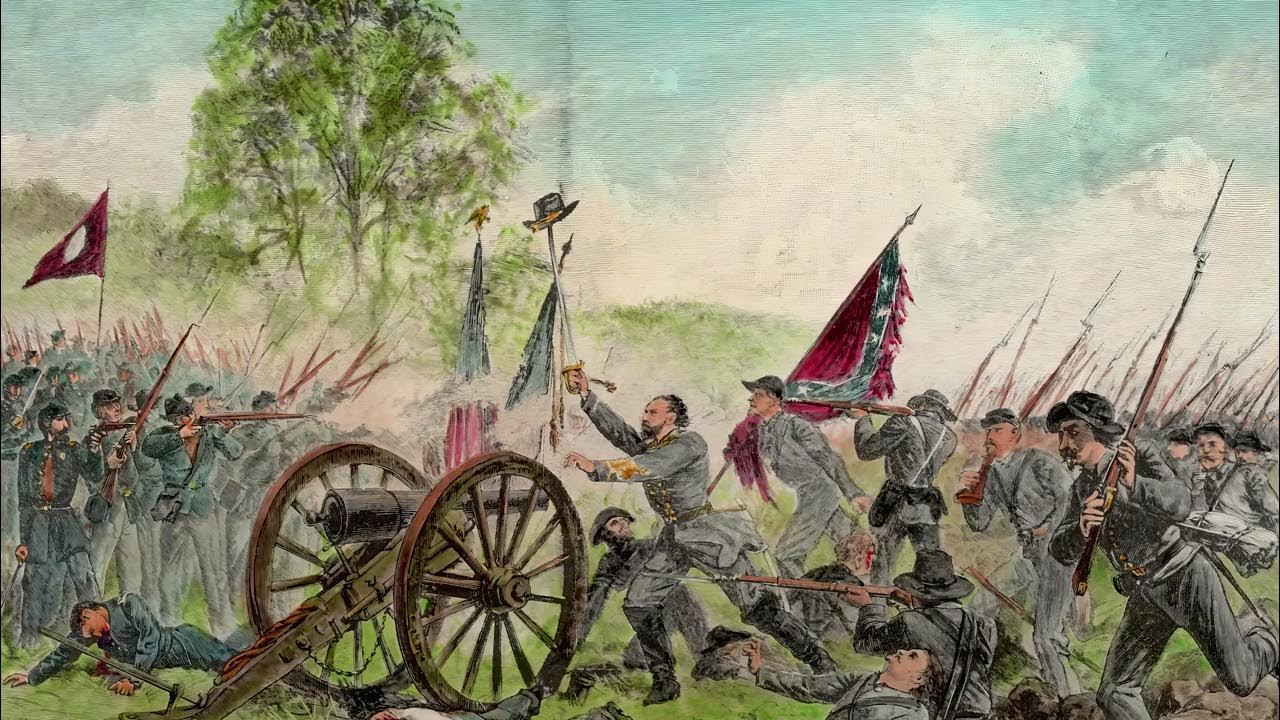
At approximately 3:00 in the afternoon, after nearly two hours of artillery fire, the Confederate infantry stepped off from Seminary Ridge and began the assault that would become forever known as Pickett’s Charge. The sight described by every observer who recorded it: nearly 12,500 men in parade-ground order, with regimental flags flying and officers on horseback, marching in a single massive formation across almost a mile of open ground under the July sun. The Union troops watching from Cemetery Ridge felt a complex mixture of awe, terror, and grim determination. As the Confederate line crossed the Emmitsburg Road about halfway across the open ground, Union artillery opened a devastating fire with canister, solid shot, and shell. The Confederate formation began to disintegrate under the killing fire. Brigades on the flanks were cut up by artillery and infantry fire from positions angled to pour flanking volleys into the advancing columns.
The survivors pressed on toward the angle in the stone wall on Cemetery Ridge, the focal point of the assault and the position held by Hancock’s Second Corps infantry under Brigadier General Alexander Webb’s Philadelphia Brigade. As the Confederates approached the wall, Union rifles opened at close range, pouring volley after volley into the charging mass. Brigadier General Lewis Addison Armistead, one of Pickett’s brigade commanders and a personal friend of Hancock’s who had held his black hat on his upraised sword as he led his men forward, crossed the stone wall with approximately 200 men, placed his hand on a Union cannon in a gesture of capture, and was immediately mortally wounded. The small Confederate penetration was surrounded and crushed within minutes. The survivors of Pickett’s Charge streamed back across the fields toward Seminary Ridge in defeat. When Pickett was ordered by Lee to reform his division for a possible second assault, Pickett reportedly replied that he had no division. The Confederacy had reached what historians would call the High Water Mark, the farthest penetration of Confederate power into Union territory, and it had been driven back.
The Aftermath: Casualties, Retreat, and Lincoln’s Missed Opportunity
The human cost of the three days of fighting at Gettysburg was staggering. Combined casualties for both armies, including killed, wounded, captured, and missing, totaled somewhere between 46,000 and 51,000 men. The Union Army of the Potomac suffered approximately 23,049 casualties, including 3,155 killed, 14,529 wounded, and 5,365 captured or missing. The Confederate Army of Northern Virginia suffered approximately 28,063 casualties, including roughly 3,903 killed, 18,735 wounded, and 5,425 captured or missing. On the Confederate side, Pickett’s division alone had approximately 60 percent casualties from the charge on July 3. The Army of Northern Virginia lost many of its finest officers: Brigadier Generals Richard B. Garnett and Armistead died in Pickett’s Charge, Brigadier General William Barksdale was mortally wounded in the fighting on July 2, and Major General Dorsey Pender, who commanded a Third Corps division, was also mortally wounded. The medical facilities in and around Gettysburg were overwhelmed; farmhouses, barns, churches, and the town itself were converted into hospitals, and the suffering in those improvised facilities was indescribable.
On July 4, 1863, while Meade’s army occupied the battlefield and the rain fell, Lee began withdrawing his battered army southward. His retreat was a painful, torturous affair: a wagon train of wounded soldiers seventeen miles long moved along the rain-soaked roads toward the Potomac River, escorted by whatever troops Lee could spare. The Confederates reached the Potomac at Williamsport, Maryland, on July 7, only to find the river swollen by heavy rains and impassable. For several days, Lee’s army was trapped north of the river with Meade’s army pressing from behind. President Lincoln watched with mounting excitement, believing that Meade could trap and destroy Lee’s army before it crossed the Potomac and end the war at a stroke. But Meade moved cautiously. By July 12, when Lincoln telegraphed his frustration to General-in-Chief Henry Halleck, lamenting that they had only to stretch forth their hands and the enemy was theirs, Lee had already repaired the pontoon bridges and crossed the Potomac on July 13 and 14. The war would continue for nearly two more years.
The fall of Vicksburg to Grant on July 4 and the Confederate defeat at Gettysburg on July 3 represented the strategic fulcrum of the Civil War. The Confederate loss at Gettysburg ended all realistic hope of European intervention in the conflict; Britain and France had been watching for a Confederate military success that might justify diplomatic recognition, and the defeat at Gettysburg made clear that the Confederacy could not win the war by military force. Combined with the loss of Vicksburg and Union control of the Mississippi River, which effectively split the Confederacy in two, the events of July 1863 doomed the Confederate cause in a strategic sense, even if the fighting would grind on through two more years of bloodshed.
The Gettysburg Address: Lincoln Redefines America on November 19, 1863
Four months after the battle, on November 19, 1863, President Abraham Lincoln traveled to Gettysburg to attend the dedication ceremony of the Soldiers’ National Cemetery, where the Union dead from the battle were being reinterred in a proper military burial ground. The principal speaker for the ceremony was Edward Everett, the most celebrated orator in America, who delivered a two-hour address of extraordinary rhetorical polish covering the military history of the battle in detail. Lincoln, who had been invited almost as an afterthought to make ‘a few appropriate remarks,’ spoke for approximately two minutes. He delivered a speech of 272 words that has endured as one of the most powerful and consequential pieces of political oratory in human history.
The Gettysburg Address accomplished several things simultaneously. It honored the Union dead with language of genuine feeling and beauty. It redefined the purpose of the Civil War, framing it not merely as a struggle to preserve the Union but as a test of whether democratic government could survive on earth, and specifically connecting the war to the principles of equality declared in the Declaration of Independence. Lincoln invoked the Declaration’s assertion that all men are created equal and argued that the war was a struggle to give that founding promise a new birth of freedom. He transformed the soldiers’ sacrifice from a military necessity into a quasi-sacred act of national consecration, arguing that it was not possible for the living to add or subtract from the honor the dead had already given the ground. And he ended with his famous statement of democratic purpose: that government of the people, by the people, for the people, shall not perish from the earth. Everett wrote to Lincoln the next day that Lincoln had captured in two minutes what he had failed to convey in two hours.
The Battle of Gettysburg’s Legacy: National Memory, the National Park, and Enduring Historical Significance
The Battle of Gettysburg has occupied a unique place in American memory since the guns fell silent. It has been studied, analyzed, debated, and commemorated more intensively than any other battle in American history. In 1895, Congress established the Gettysburg National Military Park, which preserved the battlefield terrain and the monuments erected by veterans’ organizations from both sides. The park became one of the most visited historic sites in the United States, drawing millions of visitors annually to walk the ground where Buford’s cavalrymen delayed Heth’s infantry on McPherson Ridge, where Reynolds died, where Chamberlain’s 20th Maine charged down Little Round Top, where Armistead crossed the stone wall and fell at the High Water Mark. In 1913, on the battle’s fiftieth anniversary, approximately 54,000 veterans, both Union and Confederate, gathered at Gettysburg for a reunion. Veterans of Pickett’s Charge reenacted the assault on July 3 but stopped when they reached the stone wall, where former enemies shook hands across it in one of the most moving demonstrations of national reconciliation in American history.
The battle’s outcome, the people who fought it, and the decisions that determined its results have generated a library of historical analysis that continues to grow more than 160 years after the fighting ended. The debates about Ewell’s decision not to attack Cemetery Hill on the evening of July 1, about Longstreet’s alleged slowness in executing Lee’s orders on July 2, about whether Stuart’s cavalry absence was the decisive factor, about whether Meade was too cautious in pursuing Lee after the battle, and about the enduring question of whether a Confederate victory at Gettysburg would have ended the war will never be definitively resolved. Michael Shaara’s 1974 novel The Killer Angels, which told the story of the battle from the perspectives of officers on both sides and won the Pulitzer Prize, introduced the battle’s human drama to a new generation of readers. The 1993 film Gettysburg, based on Shaara’s novel, brought the visual spectacle of the battle to mass audiences.
The Battle of Gettysburg began on the morning of July 1, 1863, as an accident of geography and military necessity. What neither Lee nor Meade had intended to be their decisive engagement became precisely that: the battle that determined the fate of the American republic. In three days of fighting across the hills and fields of a small Pennsylvania town, approximately 170,000 men fought and 50,000 of them became casualties. The Union was preserved, the Confederate invasion was repulsed, and the course of the Civil War was set toward its eventual Union conclusion in April 1865. On the ground where they fell, Lincoln spoke four months later of a new birth of freedom, and the words he chose have defined America’s understanding of itself ever since.