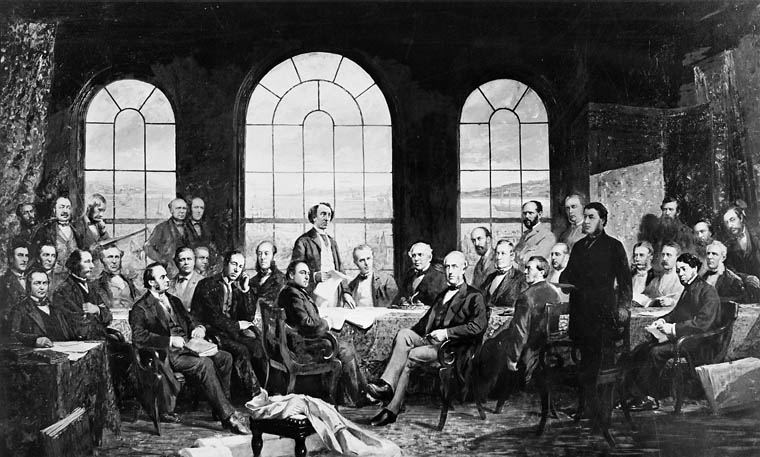
On July 1, 1867, the Dominion of Canada came into existence, not through revolution or war, but through a decade of political negotiation, constitutional compromise, and diplomatic persuasion that produced one of the most unusual national births in modern history. When Queen Victoria’s Royal Assent brought the British North America Act, 1867 into force, three British North American colonies, the Province of Canada, Nova Scotia, and New Brunswick, ceased to exist as separate entities and became four provinces of a new self-governing federation: Ontario, Quebec, Nova Scotia, and New Brunswick. The new country’s first Prime Minister, Sir John Alexander Macdonald, was sworn into office. Canada became the first dominion in the British Empire, establishing a template for how vast colonial territories could transition toward self-governance without severing their ties with the Crown.
The creation of the Dominion of Canada was the culmination of an extraordinary process. Three major conferences over three years, thousands of miles of travel, hundreds of speeches, countless negotiations over constitutional details, and the sustained application of political will by a remarkable group of men from profoundly different backgrounds had produced a federation that balanced French and English cultural identities, Protestant and Catholic religious communities, the interests of large and small provinces, and the rights of localities with the demands of central authority. Canada was, as the Irish-born Father of Confederation Thomas D’Arcy McGee declared in the new Dominion’s first Parliament, the first constitution ever given to a mixed people in which the conscientious rights of the minority were made a subject of formal guarantee. It was an imperfect achievement, one that excluded Indigenous peoples entirely from its foundations, left women without political recognition, and still remained subject to ultimate British authority. But it was also genuine: a nation created by its own people, through argument and compromise, in an act of deliberate political imagination.
British North America Before Confederation: The Colonial World That Needed to Change
The story of Canadian Confederation begins with the political geography of British North America in the mid-nineteenth century. By the 1860s, the territories that would become Canada were divided among a collection of British colonies that were separately governed, economically unintegrated, and geographically separated in ways that made coordinated defence or economic development extremely difficult. The largest of these was the Province of Canada, created by the Act of Union in 1840 by merging Upper Canada, which was predominantly English-speaking and Protestant and had its centre of gravity in what is now southwestern Ontario, and Lower Canada, which was predominantly French-speaking and Catholic and centred on the St. Lawrence Valley and present-day Quebec. The Act of Union had given equal representation in the legislature to both sections of the united province despite their significantly different populations, a formula that worked relatively smoothly when Canada East’s population was larger but became deeply problematic as Canada West’s population grew rapidly and surpassed that of Canada East.
To the east, the Maritime colonies of Nova Scotia, New Brunswick, Prince Edward Island, and the island of Newfoundland had their own separate legislatures, their own economies oriented primarily toward the sea, and their own distinct political cultures. Nova Scotia, with its tradition of responsible government dating to 1848, was the most self-confident of the Maritime provinces; its economy rested on fisheries, shipbuilding, and timber. New Brunswick was somewhat more agricultural and more oriented toward trade with the United States. Prince Edward Island was the smallest and most agricultural of the Maritime colonies, intensely focused on its land question, the ownership of the island’s farms, which remained in the hands of absentee British proprietors. Newfoundland stood apart from all the others, an island colony whose fishing economy had sustained a distinct and isolated culture for centuries and whose interests often seemed to have little in common with those of the continental colonies.
The responsible government movement, which had given the British North American colonies the right to be governed by ministries accountable to elected legislatures rather than to appointed governors, had been achieved in most colonies by the late 1840s. This was an enormously important achievement: it meant that colonial politicians, not imperial officials, controlled domestic policy. But responsible government within individual colonies had not resolved the deeper structural problems of British North America: the threat of American expansionism, the difficulty of building transcontinental infrastructure, the political deadlock that had paralyzed the Province of Canada, the need for a common defence policy, and the opportunity to create a common market large enough to sustain industrial development.
The Great Coalition and Political Deadlock: Why the Province of Canada Had to Act
The immediate political context for Confederation was the persistent deadlock in the legislature of the Province of Canada. The system of equal representation for Canada East and Canada West, originally designed to protect the interests of the English-speaking minority in what had been Lower Canada, had produced a legislature in which stable government was nearly impossible. No government could retain the confidence of the legislature for long, because any measure acceptable to the English-speaking majority in Canada West was liable to be opposed by the French-speaking majority in Canada East, and vice versa. Between 1854 and 1864, the Province of Canada experienced no fewer than ten different governments, with the legislature frequently deadlocked and unable to act on pressing issues.
The solution to this political crisis came from an unexpected political alliance. In June 1864, George Brown, the leader of the Clear Grits, or Reformers, of Canada West and the powerful editor of the Toronto Globe newspaper, made a remarkable proposal. Brown had been one of the most vigorous opponents of Conservative leader John Alexander Macdonald for nearly two decades. He was an idealistic Scottish-born journalist who had championed representation by population as the solution to the province’s political inequality, arguing that Canada West’s larger population entitled it to greater representation than Canada East. Yet Brown now proposed to Macdonald and to George-Etienne Cartier, the leader of the Quebec Bleus who were Macdonald’s Conservative ally, a grand coalition. The three parties would set aside their fierce political rivalry and work together toward a single overriding objective: a new constitutional arrangement for British North America that would end the deadlock and create a federation in which each section could manage its own local affairs while sharing a common central government.
This Great Coalition of June 1864 was the political foundation of Confederation. It brought together three men who embodied the principal constituencies that the new Canada would need to hold together: Macdonald, the English Protestant pragmatist from Canada West; Cartier, the French Catholic nationalist from Canada East; and Brown, the English Protestant reformer also from Canada West whose support was essential to carry the Protestant majority in Upper Canada. Their willingness to cooperate across the deepest divisions in Canadian politics made what followed possible. Cartier’s participation was particularly crucial: without French-Canadian support, any federation scheme would fail, and Cartier’s argument that a federal system with strong provincial governments could protect French-Canadian identity, language, religion, and civil law was the key that opened the door to Quebec’s participation.
The Charlottetown Conference, September 1864: The Meeting That Started a Country
The immediate occasion for the first conference was a Maritime initiative. The governments of Nova Scotia, New Brunswick, and Prince Edward Island had arranged a meeting in Charlottetown, Prince Edward Island, beginning September 1, 1864, to discuss the possibility of a union among the three Maritime provinces. Britain had been encouraging Maritime Union as a way to reduce the imperial burden of governing three small, separate colonies. When the Great Coalition government in Canada learned of the planned Maritime conference, it moved quickly to send a delegation of eight politicians, including Macdonald, Brown, and Cartier, to Charlottetown with the intention of expanding the agenda from Maritime Union to a union of all British North American colonies.
The Charlottetown Conference was, by any measure, an unusual diplomatic gathering. The arrival of the Canadian delegation complicated matters from the start: they had not been invited, their ship had to serve as overflow accommodation because a circus arriving simultaneously on Prince Edward Island had occupied most of the available hotel rooms, and their proposal to replace the Maritime Union agenda with a discussion of a broader federation was initially unexpected. Yet the conference, which lasted until September 9 and was followed by additional discussions in Halifax and Saint John, proved remarkably productive. Macdonald’s eloquence about strong central government, Cartier’s reassurances about French-Canadian cultural protection, Alexander Tilloch Galt’s financial presentation demonstrating how the provinces would be funded, and George Brown’s advocacy for representation by population all found receptive audiences.
The delegates at Charlottetown included some of the most significant political figures in Canadian history. From Nova Scotia came Charles Tupper, the province’s premier, a physician and forceful advocate of Confederation who would later become Canada’s sixth Prime Minister. From New Brunswick came Samuel Leonard Tilley, the premier, a former pharmacist known for his deep religious convictions, who would later suggest the word ‘dominion’ for the new country’s official designation, inspired by a Biblical verse from Psalms: ‘He shall have dominion also from sea to sea, and from the river unto the ends of the earth.’ Thomas D’Arcy McGee, the Irish-born poet, journalist, and passionate orator from Canada East whose eloquence did more than perhaps any other single voice to articulate the vision of a transcontinental Canadian nationality, was also present. John Hamilton Gray, the premier of Prince Edward Island, chaired the conference. After four days of substantive discussion, the delegates reached broad agreement on the principles of confederation and arranged to continue the talks the following month in Quebec City.
The Quebec Conference, October 1864: The Seventy-Two Resolutions That Shaped a Constitution
The Quebec Conference, which opened on October 10, 1864, and ran for seventeen days at the site of present-day Montmorency Park in Quebec City, was the most substantive of the three Confederation conferences. It was attended by thirty-three delegates from all the colonies, including two observers from Newfoundland, and its purpose was to translate the broad principles agreed at Charlottetown into specific constitutional provisions. Etienne-Paschal Tache, the elderly and respected politician from Canada East, was elected chairman of the conference, but the dominant figure was Macdonald, who had thought more systematically about constitutional design than any other delegate and who came prepared with detailed proposals on almost every question.
The Quebec Conference produced the Seventy-Two Resolutions, a document that laid out the constitutional framework of the proposed federation in remarkable detail. The resolutions addressed the structure of the federal Parliament, with a Senate whose seats would be allocated on the principle of regional equality, giving Ontario, Quebec, and the Maritime provinces twenty-four seats each in the upper chamber, and a House of Commons whose membership would be proportional to population, giving the larger provinces more seats. They addressed the division of powers between the federal and provincial governments, with the critical principle that the federal government would hold residual powers, those not explicitly assigned to provinces, ensuring that the central government would be paramount. Section 91 of the eventual British North America Act would enumerate twenty-nine exclusive federal powers, including trade and commerce, banking, criminal law, defence, and most significantly, the responsibility for ‘Indians, and Lands reserved for the Indians.’ Section 92 would list the exclusive provincial powers, including education, property and civil rights, hospitals, and local matters generally.
The critical question of how to protect French-Canadian identity in the federation was resolved through the combination of provincial control over education and civil law in Quebec, the guarantee of French as an official language in the federal Parliament and in Quebec’s legislature, and the general principle that what Cartier called the diversity of races and religions within a confederation need not be a source of weakness but could be a source of strength if the constitutional architecture provided adequate protection for each community. Cartier told the conference that there was room for a great nationality, composed of different elements and sympathies, and that in the creation of that nationality, Confederation was the goal. Prince Edward Island and Newfoundland ultimately rejected the Seventy-Two Resolutions, finding the terms, particularly regarding financial arrangements and representation, unsatisfactory. The conference concluded with the three mainland colonies committed to the project but with substantial popular opposition, particularly in Nova Scotia and New Brunswick, still to be overcome.
Opposition, Persuasion, and the Maritime Problem: Selling Confederation in the Colonies
The path from the Quebec Conference to actual Confederation was far from smooth. In both Nova Scotia and New Brunswick, significant popular opposition to the terms agreed at Quebec had to be overcome through political strategy, argument, and in some cases a fortuitous combination of external events and changed circumstances. In New Brunswick, the situation was initially so unpromising that the anti-Confederation forces won the provincial election of March 1865, defeating Samuel Tilley and his pro-Confederation government. The issue seemed potentially fatal. Without New Brunswick, geographic continuity between Nova Scotia and the Province of Canada would be impossible, and the entire Confederation project might unravel.
The Fenian raids of 1866 proved to be an unexpected and decisive catalyst for the Maritime provinces. The Fenian Brotherhood, an Irish-American organization dedicated to Irish independence from Britain, launched raids across the United States border into New Brunswick and across the border from Vermont into Quebec in April and June of 1866. While these raids were militarily negligible, they demonstrated with alarming vividness the vulnerability of British North America to American-based aggression, reinforced the argument that no single colony could defend itself effectively, and galvanized public opinion in New Brunswick in favour of Confederation as the only viable defence arrangement. In the subsequent New Brunswick election of June 1866, the pro-Confederation forces won decisively, returning Tilley to power. The Fenian scare had done what argument alone had failed to accomplish.
In Nova Scotia, opposition to Confederation was led by Joseph Howe, the province’s most celebrated politician and orator, a man who had done more than almost anyone else to achieve responsible government in British North America. Howe was a Nova Scotian patriot who believed that Confederation would subordinate his province to the interests of the Province of Canada, drain the Maritime economy for the benefit of central Canadian manufacturers, and reduce a proud people to a subject community paying taxes to a distant government in Ottawa. His opposition was principled, eloquent, and widely shared. Yet Charles Tupper, Nova Scotia’s premier, managed the province’s legislative endorsement of Confederation through adroit parliamentary maneuvering, passing the resolution in favour of Confederation before Howe and his allies could organize effective resistance. After Confederation, Howe would lead a vigorous but ultimately unsuccessful campaign to have Nova Scotia released from the union, his opposition to Confederation becoming one of the most dramatic and historically significant losing causes in Canadian political history.
The London Conference, December 1866 to March 1867: Drafting the Constitution with the Empire
The final conference on Confederation took place in London, England, beginning December 4, 1866. Sixteen delegates from Nova Scotia, New Brunswick, and the Province of Canada met with representatives of the British government to translate the Quebec Resolutions into formal legislative language that could be enacted by the British Parliament as the British North America Act. The conference worked closely with the British Colonial Secretary, Henry Howard Molyneux Herbert, the fourth Earl of Carnarvon, who proved to be a sympathetic and constructive interlocutor. Carnarvon’s role in shaping the final text was substantial, and the conference sessions included working meetings at his estate, Highclere Castle, where Macdonald, Cartier, and Alexander Tilloch Galt joined him to review and refine the draft legislation.
The naming of the new country was one of the surprisingly contentious issues at the London Conference. Various names had been proposed: ‘Kingdom of Canada’ had been Macdonald’s preference, a designation that would have given the new country a monarchical dignity explicitly equal to that of the United Kingdom. The British government, however, rejected ‘kingdom’ on the grounds that it might offend the United States by appearing to assert a monarchical challenge to the republican principles of American democracy. Other suggestions included ‘Confederation of Canada,’ ‘Laurentia,’ ‘Cabotia,’ ‘Franklin,’ and even the peculiar ‘Guelfenland.’ The delegates agreed on ‘Dominion of Canada,’ with the title ‘dominion’ reportedly suggested by Samuel Tilley, who had been struck by the verse from Psalm 72 speaking of dominion from sea to sea. The word ‘dominion’ was chosen to indicate self-governing status within the empire without explicitly claiming the full dignity of kingdom or the full independence of a republic. It would become the model for the British Commonwealth that would evolve from the Empire in the following century.
The London Conference delegates completed the draft of the British North America Act in February 1867. The text was presented to the British Parliament, where it passed through both the House of Commons and the House of Lords with relatively little debate, reflecting the British government’s eagerness to transfer the costs and responsibilities of North American defence to the colonists themselves. On March 29, 1867, Queen Victoria gave the act Royal Assent. A royal proclamation was issued declaring that on and after the first day of July, one thousand eight hundred and sixty-seven, the Provinces of Canada, Nova Scotia, and New Brunswick shall form and be One Dominion, under the name of Canada.
July 1, 1867: The Birth of the Dominion of Canada
On July 1, 1867, the Dominion of Canada formally came into existence. The Province of Canada was divided into two separate provinces, Ontario and Quebec, restoring the separate identity that each had possessed before the Act of Union of 1840. Combined with Nova Scotia and New Brunswick, the new Dominion comprised four provinces stretching from the Atlantic coast to the western edge of the Province of Canada along the Great Lakes and the St. Lawrence River. To the west lay the vast territories of the Hudson’s Bay Company and the empty prairies; to the far west, the separate colony of British Columbia. The new Dominion was geographically incomplete, but it contained the institutional and constitutional framework into which the rest of the country could eventually be built.
Sir John Alexander Macdonald, born January 11, 1815, in Glasgow, Scotland, was sworn in as Canada’s first Prime Minister. Macdonald, who had emigrated to Canada as a child and had practised law in Kingston, Ontario, before entering politics, had been the dominant intellectual force behind Confederation from its earliest stages. His vision was of a federated country with a strong central government that would build a transcontinental economy, settle the western prairies, and create a national identity robust enough to resist American expansionism and French-Canadian secessionism simultaneously. On Confederation Day itself, Macdonald was exhausted from the years of political effort that had brought the moment about; he was known to celebrate its arrival with characteristic excess, since his struggle with alcohol was one of the open secrets of Canadian political life. But he understood, better than almost anyone, what had been accomplished.
The first Governor General of the Dominion of Canada was Charles Stanley Monck, the fourth Viscount Monck, an Irish-born peer who had served as Governor General of British North America since 1861 and who had played an important role in facilitating the Confederation process by encouraging cooperation among the colonial governments and maintaining constructive relations with the British government. Monck represented the Crown in the new Dominion and presided over the formal proceedings of July 1. He was succeeded in 1868 by Lord Lisgar. The first meeting of the Dominion Parliament took place in November 1867, establishing the institutional machinery of the new federal government in Ottawa, the capital city that had been selected in 1857 partly for its central location between Ontario and Quebec and partly because of its distance from the American border, which gave it a degree of defensibility that cities like Toronto or Montreal lacked.
The British North America Act: What the Constitution of 1867 Actually Established
The British North America Act, 1867, which serves today under its renamed title the Constitution Act, 1867, as the foundational document of Canada’s constitutional order, was a document of extraordinary practical and legal sophistication. Its preamble declared that the provinces had expressed their desire to be federally united into one Dominion with a constitution similar in principle to that of the United Kingdom, a phrase that at once linked the new country to the British parliamentary tradition while implicitly acknowledging that the federal structure it established was a significant departure from the unitary British model.
The division of powers between the federal Parliament and the provincial legislatures was the Act’s most consequential provision. Section 91 enumerated twenty-nine exclusive federal powers and reserved to the federal government the residual authority to legislate for the peace, order, and good government of Canada, a phrase that became one of the most litigated in Canadian constitutional history. Federal powers included defence, criminal law, trade and commerce, banking, copyright, patents, navigation and shipping, postal service, and the census. Section 92 listed the exclusive provincial powers, including education, property and civil rights, local works and undertakings, hospitals, and municipal institutions. The Act also gave the federal government the power to disallow any provincial legislation within two years of its passage, a power that established federal supremacy in cases of conflict but which the courts and political practice would significantly constrain over the following century.
The Act established Canada’s bicameral federal Parliament, with a Senate appointed by the Governor General on the advice of the Prime Minister and a House of Commons elected by voters in each province. The Senate was designed as the chamber of regional representation, with twenty-four senators each from Ontario, Quebec, and the combined Maritime provinces, ensuring that no single province or section could dominate the upper chamber. The House of Commons was based on population, giving Ontario and Quebec the largest representations. The Act also guaranteed the use of French and English in the federal Parliament and its courts, and in the Quebec legislature and its courts, establishing the bilingual character that would become one of Canada’s most distinctive and contested constitutional features. Education was placed firmly under provincial jurisdiction, with specific protections for denominational schools that had existed before Confederation.
Indigenous Peoples and the Silences of Confederation: What 1867 Left Out
The creation of the Dominion of Canada in 1867 was built on a profound and deliberate silence about the peoples who had inhabited the land for thousands of years before European arrival. Indigenous nations, the hundreds of distinct peoples with their own languages, governance systems, spiritual traditions, and territorial claims across the land now being constituted as Canada, were not consulted in the Confederation process. They were not represented at Charlottetown, Quebec City, or London. Their interests, title, and rights were addressed in the British North America Act only through a single line in Section 91, which assigned responsibility for Indians, and Lands reserved for the Indians to the federal Parliament, making Indigenous peoples the subject of legislation rather than participants in the political process that would govern them.
The implications of this silence would be catastrophic. The federal Indian Act of 1876, enabled by the BNA Act’s grant of power over Indian affairs, created a system of reserves, prohibited Indigenous ceremonies and spiritual practices, restricted movement off reserves, and subjected Indigenous peoples to a form of colonial management that explicitly aimed at assimilation and cultural destruction. Residential schools, which separated Indigenous children from their families and communities for generations in a system that imposed enormous suffering and cultural damage, were one of the most devastating instruments of this assimilationist policy. The Confederation of 1867, which its architects celebrated as an act of nation-building and self-determination, was simultaneously an act of colonial displacement of the peoples who had occupied the land from time immemorial. The reconciliation between Canada’s national story and this colonial foundation remains one of the central unresolved questions of Canadian political and cultural life in the twenty-first century.
Expanding the Dominion: How Canada Grew from Four Provinces to Ten
The framers of Confederation had designed the British North America Act to accommodate expansion, and expansion came rapidly. In 1869, the Dominion acquired Rupert’s Land and the Northwestern Territory from the Hudson’s Bay Company for 300,000 pounds sterling, an enormous transfer of territory that gave Canada formal jurisdiction over the prairie west. This acquisition, however, did not come without conflict. The Metis people of the Red River Settlement, the mixed-heritage descendants of French and Scottish fur traders and Indigenous women who had built a distinct culture and society in what is now Manitoba, found themselves facing the prospect of an influx of English Protestant settlers from Ontario who would overwhelm their community. Under their leader Louis Riel, the Metis organized resistance, established a provisional government, and executed a man named Thomas Scott, triggering a political crisis that roiled the new Dominion. The Red River Resistance of 1869 to 1870 eventually resulted in the Manitoba Act of 1870, which brought Manitoba into Confederation as a new province with specific protections for French language rights and Catholic education, though these protections were subsequently undermined.
The subsequent admission of provinces and territories completed the outline of modern Canada. British Columbia joined Confederation in 1871, persuaded by Macdonald’s promise of a transcontinental railway to be completed within ten years, which ultimately became the Canadian Pacific Railway, completed in November 1885. Prince Edward Island, which had declined to join in 1867, finding the terms unsatisfactory, joined in 1873 after the federal government agreed to assume the province’s railway debts and provide ferry service to the mainland. The North-West Territories were administered federally until the provinces of Alberta and Saskatchewan were carved out of them in 1905, completing the continental prairie provinces. Newfoundland and Labrador, the most reluctant of the original British North American colonies, did not join Confederation until 1949, when Premier Joey Smallwood campaigned for union with Canada in a referendum decided by the narrowest of margins. Smallwood called himself the last Father of Confederation.
From Dominion to Nation: The Path to Full Canadian Sovereignty After 1867
The Confederation of 1867 established Canada as a self-governing dominion but not as a fully sovereign nation. The British Parliament retained ultimate authority over Canadian constitutional matters; the British government retained control over Canadian foreign policy and the right to sign treaties on Canada’s behalf; and the Judicial Committee of the British Privy Council served as Canada’s final court of appeal. These residual elements of imperial authority would be progressively removed over the following decades as Canada’s own national consciousness and international standing grew.
Canada’s participation in the First World War, in which more than 600,000 Canadians served and over 60,000 died, dramatically accelerated the country’s demand for full recognition as an independent nation. The Borden government’s insistence on separate Canadian representation at the Paris Peace Conference of 1919 and Canada’s independent signature of the Treaty of Versailles were significant milestones. The Balfour Declaration of 1926, which emerged from the Imperial Conference of that year, recognized that Britain and the Dominions including Canada were equal in status, in no way subordinate to one another in any aspect of their domestic or external affairs. The Statute of Westminster, enacted by the British Parliament on December 11, 1931, gave legal form to this equality, granting the Dominions full legislative sovereignty. Canada could now pass laws in contradiction to British law, and Britain could no longer legislate for Canada without Canadian consent.
The final act of Canada’s constitutional evolution came with the Constitution Act of 1982, also known as the patriation of the Constitution. Prime Minister Pierre Elliott Trudeau negotiated with the provincial governments, over the fierce opposition of Quebec’s Premier Rene Levesque, to bring the Canadian constitution fully under Canadian control. The Constitution Act of 1982 ended the formal role of the British Parliament in amending Canada’s constitution and added the Canadian Charter of Rights and Freedoms as an entrenched bill of rights. What Queen Victoria had signed in 1867 as the British North America Act was renamed the Constitution Act, 1867, and became the cornerstone of a fully independent constitutional order. July 1, which had been celebrated as Dominion Day since Confederation, was officially renamed Canada Day in 1982 in a reflection of the country’s full national sovereignty.
The Fathers of Confederation: The Thirty-Six Men Who Built a Country
The thirty-six men recognized as the Fathers of Confederation, those who attended at least one of the three Confederation conferences at Charlottetown, Quebec City, or London, represented a remarkably diverse cross-section of British North American political life. They were lawyers, merchants, newspaper editors, physicians, and landowners. They were English and French, Protestant and Catholic, Conservative and Liberal. They came from every British North American colony except Newfoundland, which sent observers to Quebec but ultimately declined to join the union. What they shared was the conviction that the existing political arrangements were inadequate, that the American threat was real, that economic opportunity lay in transcontinental development, and that federation offered the framework within which each community’s distinct character could be preserved while sharing the benefits of a common national project.
Macdonald was preeminent among them but could not have succeeded without others. George-Etienne Cartier, born September 6, 1814, in Saint-Antoine, Quebec, was in many ways the co-architect of Confederation alongside Macdonald; without his ability to carry French Canada, the project would have been impossible. Alexander Tilloch Galt, the financial architect whose proposals on federal subsidies and provincial debt allocation made the economic case for federation compelling, was essential. George Brown, without whose participation in the Great Coalition the political coalition necessary for Confederation could not have been assembled, played a role that his later estrangement from Macdonald has sometimes caused to be underestimated. Samuel Leonard Tilley of New Brunswick and Charles Tupper of Nova Scotia brought their provinces into Confederation against significant popular opposition, demonstrating political courage that the historical record has sometimes undervalued. Thomas D’Arcy McGee, whose oratory gave Confederation its most idealistic voice, was assassinated by a Fenian in Ottawa on April 7, 1868, just months after Confederation, becoming the only Canadian politician to be assassinated.
Conclusion: July 1, 1867 and the Meaning of Canada
The Dominion of Canada that came into existence on July 1, 1867 was a genuinely new kind of political entity: a self-governing federation within the British Empire that had been created not through violence or revolution but through negotiation and constitutional argument. It was the product of a decade of political effort by people who understood that no single colony could address alone the challenges of defence, economic development, and territorial integrity that faced British North America. It was also, in important ways, incomplete: it excluded Indigenous peoples from its foundations, left women without political recognition, and still required British legislative authority to change its own constitution.
Yet what was accomplished was remarkable. A federation of French and English, Catholic and Protestant, Maritime and continental, populated by immigrants from dozens of countries, had been assembled into a constitutional order that could hold together long enough to grow into something larger and more complete. The transcontinental railway that Macdonald promised and eventually built made possible the settlement of the prairies and the development of a genuinely national economy. The expansion from four provinces in 1867 to ten provinces and three territories in the twenty-first century, with a population from around 3.5 million at Confederation to over 40 million today, represents one of the most successful nation-building projects in modern history.
Canada Day, celebrated on July 1 each year, commemorates the proclamation that brought the Dominion into being. It honours the men who negotiated Confederation, the compromises they made to hold together profoundly different communities, and the constitutional framework they built that has proven durable enough to survive a century and a half of social, economic, and political change. But it also invites reflection on what the creation of Canada in 1867 meant for those who were excluded from its founding, whose lands it occupied, and whose sovereignty it displaced. The full story of Canadian Confederation, like the full story of Canada itself, is one that continues to unfold.