As a summer thunderstorm broke over the flat expanse of Marston Moor, seven miles west of York, on the evening of July 2, 1644, the fate of the English Civil War in the north was decided in less than two hours of savage fighting. Approximately 28,000 Parliamentarian and Scottish Covenanter soldiers launched a surprise attack at around seven in the evening against a Royalist force of approximately 18,000 men commanded by Prince Rupert of the Rhine and the Marquess of Newcastle. The Royalists, who had believed that no battle would be fought that day, were in the midst of standing down when the allied assault began. By nightfall, approximately 4,000 Royalist soldiers were dead, 1,500 more had been taken prisoner, and the combined Parliamentarian and Scottish force had suffered fewer than 300 casualties. The Battle of Marston Moor was the largest battle ever fought on English soil during the Civil War, the largest pitched battle fought in England since Towton in 1461, and the most decisive military event in the first four years of the conflict.
The consequences of Marston Moor were immediate and lasting. The Royalists effectively abandoned Northern England, surrendering York just two weeks later. They lost access to the ports of the North Sea coast, cutting their lines of communication with the European continent. They lost the manpower and resources of the strongly Royalist northern counties, a reserve of men, horses, and supply from which the King’s armies had drawn throughout the war. And they lost, for the first time and permanently, the myth of invincibility that had surrounded Prince Rupert’s cavalry and given the Royalist cause its most potent psychological advantage. Most consequentially of all, the battle made the name of one particular cavalry commander — a forty-four-year-old East Anglian gentleman farmer turned soldier named Oliver Cromwell — as a military leader of the first order, setting him on the path toward the political and military dominance that would ultimately see the King tried and executed, the monarchy abolished, and England governed as a republic.
King Against Parliament: The Origins and Context of the English Civil War
The English Civil War that produced the Battle of Marston Moor was the culmination of decades of accumulating tension between King Charles I and the English Parliament over questions of royal authority, religious practice, taxation, and the constitutional limits of monarchy. Charles I, who had come to the throne on March 27, 1625, was a man of genuine personal dignity, deep religious conviction, and profound political stubbornness, who believed with absolute sincerity in the divine right of kings and in his duty to God to defend the prerogatives of the Crown against what he regarded as Parliamentary encroachment. He married Henrietta Maria of France, a Catholic princess, in 1625, stoking Protestant anxieties about the direction of English religious policy. He favoured a high church Anglicanism associated with his Archbishop of Canterbury, William Laud, which Puritan Protestants regarded as dangerously close to Roman Catholicism in its ceremonial forms.
The constitutional crisis that led to war had been building since Charles had dismissed Parliament in 1629 and attempted to govern without it for eleven years, the period of Personal Rule, during which he raised revenue through controversial devices including Ship Money, a tax that Parliament had not authorized. When a Scottish rebellion against Charles’s attempt to impose an English-style prayer book on Scotland’s Presbyterian church forced him to recall Parliament in 1640, the resulting Long Parliament proved unwilling to simply grant the King the money he needed without extracting fundamental concessions on the limits of royal authority. The execution of Charles’s chief minister, the Earl of Strafford, in May 1641, the impeachment of Archbishop Laud, and Parliament’s determination to control the appointment of royal ministers represented a challenge to royal prerogative that Charles could not accept. In January 1642, Charles entered Parliament with soldiers in an attempt to arrest five prominent members of the House of Commons, including the leading Parliamentary opponent John Pym. The five members had been warned and had escaped. Charles had failed, and the symbolic rupture between King and Parliament was complete.
War broke out in earnest in August 1642, when Charles raised his standard at Nottingham, formally declaring war on his opponents in Parliament. The geographical division was roughly as follows: the King controlled the north and west of England, including the important northern strongholds of York, Newcastle, and much of Yorkshire, and the agricultural west and southwest. Parliament controlled London, the economically vital southeast and East Anglia, and commanded the Royal Navy, which was crucial for supply and communication. The armies of both sides were initially composed of volunteers, gentry levies, and professional soldiers who had served in the continental wars, with neither side having a clear advantage in numbers or organization. The first major battle, at Edgehill on October 23, 1642, was indecisive, though Prince Rupert’s cavalry swept the Parliamentary horse from the field in a characteristic display of aggressive dash that would become both his greatest strength and, ultimately, his fatal weakness.
The Solemn League and Covenant: Scotland Enters the War and Changes Everything
The year 1643 appeared to favour the Royalists. Charles’s forces won significant victories in several parts of England, and the King’s position seemed to be strengthening. Parliament, increasingly desperate, took a step that would prove decisive for the entire course of the war: it sought a military alliance with the Scottish Covenanters. The Covenanter movement, which had already defeated Charles’s attempts to impose an English prayer book on Scotland in the Bishops’ Wars of 1639 and 1640, was controlled by a Presbyterian nobility and clergy who were deeply suspicious of the King’s religious policies and who had their own reasons to want Parliament to prevail in England. The Solemn League and Covenant, signed by the English Parliament in September 1643, formalized the alliance. In exchange for Scottish military assistance, Parliament agreed to reform the English Church along Presbyterian lines, bringing it into conformity with the Scottish Kirk. It was a commitment that Parliament’s more radical Protestant wing, the Independents, had little intention of honouring in full, and one that would eventually fracture the alliance when the war was won, but for the immediate purposes of the conflict it was transformative.
Under the terms of the Covenant, a Scottish army under Alexander Leslie, Earl of Leven, crossed the River Tweed into England in January 1644. Leven was a veteran soldier who had served in the Swedish army of Gustavus Adolphus during the Thirty Years War and who commanded an experienced and disciplined force of approximately 21,000 infantry and cavalry. The entry of the Scottish army into the war on Parliament’s side transformed the balance of power in northern England. The Marquess of Newcastle, William Cavendish, who had been the dominant Royalist commander in the north and who had previously succeeded in controlling most of Yorkshire, now found himself unable to meet the combined threat of the Scottish army pressing from the north and Parliamentarian forces operating in Yorkshire. He fell back on York, England’s second city and the most important Royalist stronghold in the north, and concentrated his forces for the defence of the city.
The Siege of York, 1644: The Pressure That Forced the Battle
The siege of York, which began in the spring of 1644 and drew together the three Allied armies that would fight at Marston Moor, was one of the most significant strategic operations of the First English Civil War. By April 1644, Lord Ferdinando Fairfax, the Parliamentarian commander in Yorkshire, had positioned his forces before the city. Leven’s Scottish army joined him, and on June 3, the Army of the Eastern Association, commanded by Edward Montagu, Earl of Manchester, arrived with approximately 7,000 additional men, bringing the total besieging force to approximately 28,000. Manchester’s lieutenant general of cavalry was Oliver Cromwell, who had spent the previous months building and training the disciplined cavalry force that would prove decisive at Marston Moor.
York was defended by the Marquess of Newcastle and his deputy, the Scottish-born professional soldier James King, recently elevated as Lord Eythin, with a garrison of approximately 4,500 infantry and 300 cavalry drawn from the city’s population and the surviving Royalist forces of the north. Newcastle was a man of great wealth, personal honour, and considerable military incompetence: he had raised much of the money that had financed the Royalist cause in the north from his own fortune, but his military judgment was frequently poor and his relationship with his subordinates was troubled. The besieging armies launched major assaults on June 16 that were repulsed with significant Allied casualties. The siege settled into a more methodical pattern, with the Allies establishing batteries against the city’s walls and conducting the formal siege operations that eighteenth-century military doctrine prescribed. The city was suffering, its food supplies dwindling and its civilian population enduring the miseries of siege warfare, but it was not yet on the point of surrender.
The solution to the siege dilemma came from King Charles I himself, who wrote to his nephew Prince Rupert of the Rhine on June 14, ordering him to march to the relief of York and then, as the critical phrase in the letter read, to fight and beat the enemy’s army. The letter has been the subject of intense historical analysis because of the argument it generated between Rupert and Newcastle about whether the instruction to fight and beat the enemy was a definite command or a conditional one. Charles’s advisor Lord Culpeper, when he heard of the content of the letter, reportedly told the King: Why, then, before God you are undone, for upon this peremptory order he will fight, whatever comes on’t. Culpeper’s alarm was justified. Rupert, who needed little encouragement to seek battle under any circumstances, read the letter as an unambiguous command to engage the enemy in the field and was determined to obey it.
Prince Rupert’s Relief March: The Manoeuvre That Changed the Battle
Prince Rupert of the Rhine was one of the most colorful and militarily gifted figures of the Civil War era. Born in Prague on December 17, 1619, the third son of Frederick V, Elector Palatine, and Elizabeth Stuart, daughter of King James I of England, Rupert had grown up in exile after his father’s brief and disastrous kingship of Bohemia was overthrown by the Habsburg forces of the Counter-Reformation in 1620. He had been a soldier from his teens, serving in the Dutch army and being captured by Imperial forces at the Battle of Lemgo in 1638, spending three years as a prisoner before being released. He arrived in England in 1642 and immediately became the King’s most effective military commander, leading the Royalist cavalry with a combination of personal bravery, aggressive tactical instinct, and charismatic command presence that earned him a reputation for near-invincibility.
In mid-May 1644, Rupert set out from Shropshire with a force of approximately 5,000 cavalry and dragoons and 9,000 infantry, with orders to relieve York. He took a deliberate roundabout route through Lancashire, a strongly Royalist region, recruiting additional men and gathering supplies along the way. He crossed the Pennines, arriving at Skipton Castle on June 26 and then at Knaresborough on June 30, now only thirteen miles west of York. The news of his approach caused immediate consternation among the three Allied army commanders, who abandoned the siege of York and moved to intercept him on the road to the city. The Allied commanders positioned their forces at Long Marston, expecting Rupert to advance directly along the main road from Knaresborough to York.
Rupert, however, had no intention of advancing directly into the Allied position. With characteristic military daring, he executed a crossing of the River Ure at Boroughbridge during the night of June 30 to July 1, circumventing the Allied forces entirely and approaching York from the north. The manoeuvre outflanked all three Allied armies simultaneously and allowed Rupert to enter York unopposed on July 1, relieving the siege without fighting a battle. It was a demonstration of tactical skill that his opponents found deeply alarming and that reinforced his reputation as a commander of exceptional ability. Newcastle and Lord Eythin greeted him in the city. Newcastle urged Rupert to wait, arguing that the three Allied armies, with separate garrisons, recruiting areas, and lines of communication to protect, would inevitably separate. He also suggested waiting for reinforcements under Colonel Clavering, approximately 3,000 men, who were some distance away. Rupert, interpreting the King’s letter as requiring immediate action, refused to wait and ordered his forces to march out and seek battle the following morning.
The Armies Deploy on Marston Moor: Forces, Numbers, and Commanders
On the morning of July 2, 1644, both armies took up their positions on Marston Moor, a large expanse of wild meadow and open farmland in the Vale of York. The terrain was relatively flat, punctuated by drainage ditches, hedges, and the particular feature that would dominate the opening phase of the battle: a long ditch with a hedge running along much of the Royalist front, behind which Rupert positioned his army in a defensive formation while he waited for his forces to complete their deployment. The moor itself, lying between the villages of Long Marston and Tockwith, was bounded to the south by the ridge on which the Allied forces deployed, looking down across what is now enclosed agricultural land toward the Royalist position.
The combined Allied army numbered approximately 27,000 to 28,000 men, organized under the three commanders in chief. Alexander Leslie, Earl of Leven, commanded the Scottish Covenanter contingent of approximately 16,000 men. Lord Ferdinando Fairfax, who commanded the Yorkshire Parliamentarian army, was accompanied by his son Sir Thomas Fairfax, who served as an active cavalry commander. Edward Montagu, Earl of Manchester, commanded the Army of the Eastern Association, with Oliver Cromwell as his lieutenant general of cavalry. The Allied deployment followed the conventional pattern of the era: infantry in the centre, cavalry on the flanks. Oliver Cromwell commanded the cavalry on the Allied left flank. Sir Thomas Fairfax commanded the cavalry on the Allied right flank. The Scots infantry under the Earl of Leven occupied the centre alongside the English foot regiments.
The Royalist force numbered approximately 17,000 to 18,000 men, organized under the joint command of Rupert and Newcastle. Rupert commanded the field army he had brought from the southwest: approximately 5,000 cavalry and dragoons and 9,000 infantry. Newcastle contributed approximately 4,500 foot from the York garrison and his cavalry, including a mounted troop of gentleman volunteers who accompanied Newcastle personally. Lord Eythin, Newcastle’s professional deputy, commanded the infantry in the centre. Lord George Goring commanded the Royalist cavalry on the left wing, opposite Sir Thomas Fairfax. Lord John Byron commanded the Royalist cavalry on the right wing, opposite Oliver Cromwell. Prince Rupert himself, with an elite cavalry reserve, was positioned in the rear centre. The total Royalist force was outnumbered by approximately 10,000 men.
The Fatal Afternoon Pause and the Thunderstorm: How the Battle Began
Throughout the long afternoon of July 2, both sides maintained their positions without attacking. Around two o’clock in the afternoon, an exchange of artillery fire took place that, as one participant, Major Lionel Watson, recorded, produced small success to either side. The day wore on. Newcastle himself remained in his coach for much of the afternoon, and accounts suggest he was smoking tobacco, a detail that has attracted historical comment as emblematic of the relaxed Royalist confidence that no battle would be fought that day. By early evening, Rupert had concluded that the hour was too late for battle and that the action would be resumed the following morning. He gave orders for his cavalry to dismount and sent his men to eat and rest. Newcastle retired to his coach. The Royalist army, in its defensive position behind the ditch and hedge, began to stand down.
The Allied commanders, watching from the ridge to the south, came to an entirely different conclusion. Lord Leven, who as the most senior officer present held overall command, called a council of war. The Allies, who were aware that they needed to prevent Rupert’s force from combining with other Royalist contingents then on the march toward the north, decided that the moment to attack had arrived. As a thunderstorm broke over the moor, the Scots chaplains began to sing psalms and pray, and at approximately seven in the evening the entire Allied line began its advance. The speed and determination of the Allied attack surprised the Royalists completely. The thunderstorm that accompanied the assault had one crucial tactical effect: it extinguished the slow-burning matches that the Royalist musketeers used to ignite their charges, hampering their ability to fire their weapons at the advancing Allied infantry and cavalry.
Oliver Cromwell, the Ironsides, and the Battle for the Royalist Right Wing
The action that determined the outcome of Marston Moor began on the Allied left flank, where Oliver Cromwell led his Eastern Association cavalry against the Royalist right wing commanded by Lord Byron. Cromwell’s troopers, who had been trained and disciplined over two years of campaigning in eastern England to a standard of order and cohesion that set them apart from most cavalry of the era, moved forward at the trot down the slope from the ridge toward the Royalist position. The ground was broken and uneven, hindering the advance. Byron, rather than waiting for the Allied cavalry to come to him behind the defensive advantage of the ditch and hedge, made the fatal decision to advance to meet Cromwell, moving his cavalry forward from their protected position and losing the defensive advantage of the terrain.
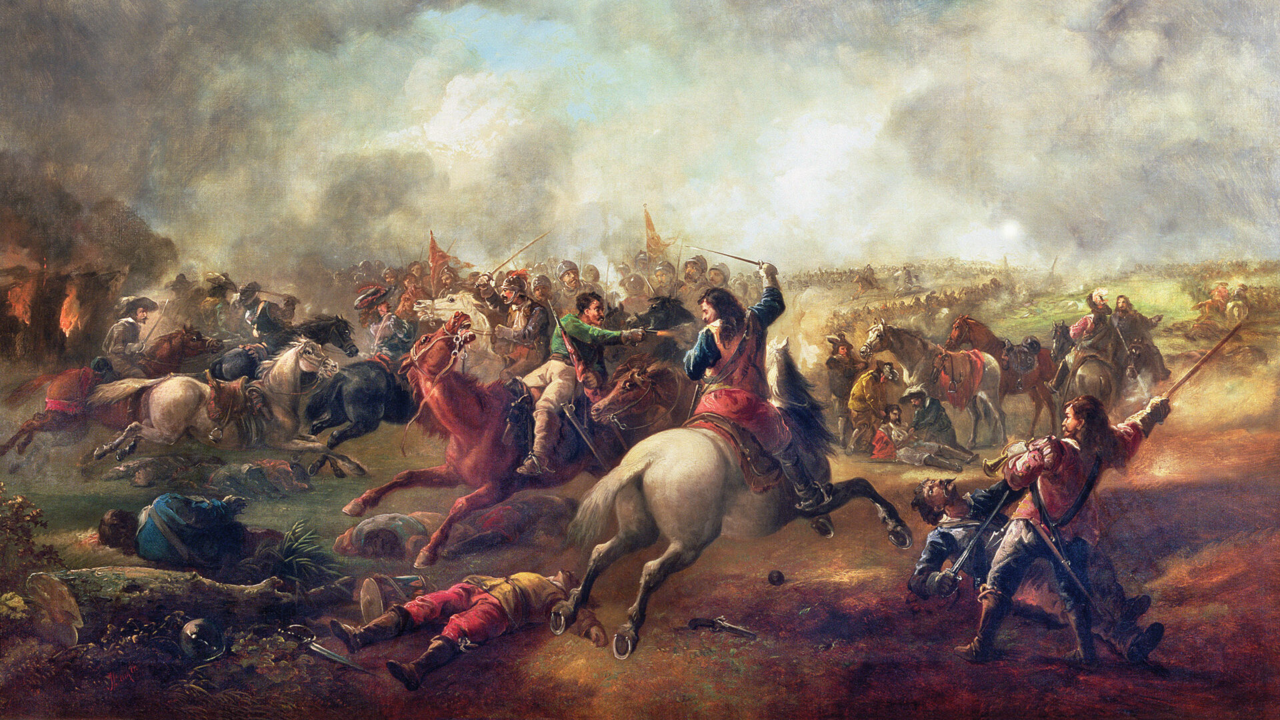
The clash between Cromwell’s cavalry and Byron’s was immediately ferocious. Major Lionel Watson, an eyewitness, recorded that Cromwell’s own division had a hard pull of it and that they stood at the sword’s point a pretty while, hacking one another. Cromwell himself was struck in the neck by a pistol ball or sword cut, a wound serious enough to force him to temporarily leave the field while it was dressed. At this critical moment, Prince Rupert himself intervened, rallying the retreating Royalist cavalry and leading a counter-charge that temporarily checked the Allied advance. Cromwell’s troopers wavered. Then David Leslie, commanding a brigade of Scottish cavalry in reserve behind Cromwell’s regiments, seized the moment: he launched a flank attack against Byron’s rallied horsemen that struck them from an unexpected direction and threw them into disorder from which they could not recover. Byron’s cavalry broke and fled, many of them toward York.
What distinguished Cromwell’s cavalry from virtually all other cavalry of the Civil War era, and what made their achievement at Marston Moor genuinely revolutionary in military terms, was what they did after winning their fight against Byron: they stopped. Where the cavalry of the era, including Prince Rupert’s famous troopers, habitually chased defeated enemy horsemen from the battlefield in a pursuit that took them entirely out of the action and made them unavailable for any further role in the battle, Cromwell’s Ironsides, having routed Byron’s wing, held their formation, rallied under their officers, and remained on the battlefield. This discipline, which Cromwell had spent two years instilling through the insistence on biblical discipline and Puritan military virtue that made his regiment unique, was now about to prove decisive for the wider battle.
Goring’s Success and Fairfax’s Desperate Crossing of the Battlefield
While Cromwell’s victory was unfolding on the Allied left, the right wing of the Allied army, under Sir Thomas Fairfax, experienced a very different fate. The ground on the Allied right was broken by hedges and the sunken lane of Atterwith Lane, which severely disrupted the cavalry’s formation as it advanced. Lord George Goring, commanding the Royalist left wing cavalry, was a more experienced and flexible cavalry commander than Byron. He held his position as the Parliamentary cavalry struggled toward him through the difficult terrain, then launched his counter-attack at the moment of maximum confusion. Goring’s horsemen swept away Fairfax’s cavalry with devastating effect, driving them from the field in a rout that carried many of them far to the rear. Goring then attacked the Allied infantry in the flank, creating a crisis in the Allied right and centre that threatened to unravel the entire Allied position.
In the centre of the battlefield, the opposing infantry were engaged in a brutal melee. Lord Eythin’s Royalist foot initially showed considerable fighting quality, and the Allied infantry, pressed from the flank by Goring’s victorious cavalry, began to give ground. The Earl of Leven himself, surveying the confused and threatening scene, apparently concluded that the battle was lost and rode from the field, escaping toward Leeds. He was not alone: Lord Fairfax the elder also left the battlefield. A portion of the Allied infantry in the centre broke entirely, and for a time it appeared that Goring’s success on the left might reverse the outcome that Cromwell was achieving on the right.
At this moment of crisis, Sir Thomas Fairfax demonstrated extraordinary personal courage and quick thinking. Having been separated from his cavalry by the rout of his wing, and moving alone through the confused fighting in the centre, Fairfax removed the white handkerchief from his hat that the Allied troops wore as a field sign to distinguish themselves from the Royalists, and worked his way around or through the Royalist formations until he reached Cromwell’s victorious cavalry on the opposite wing. With a sword cut across his face, Fairfax found Cromwell and warned him of the crisis on the right flank and in the centre. It was Fairfax’s desperate crossing of the battlefield under fire, as much as Cromwell’s cavalry victory, that made the decisive Allied counter-stroke possible.
The Decisive Moment: Cromwell Turns the Battle and the Royalist Army Is Destroyed
Oliver Cromwell, having received Fairfax’s warning about the state of the battle, now executed the manoeuvre that turned a partial victory into a comprehensive and annihilating defeat of the Royalist army. With his cavalry still cohesive and disciplined after their victory over Byron’s wing, Cromwell wheeled his regiments to the left and charged into the rear and flanks of Goring’s cavalry, who were still engaged with the Allied infantry in the centre and who had not maintained their own order after their initial triumph. Caught between Cromwell’s fresh and organized cavalry attacking from behind and the reformed Allied infantry to their front, Goring’s horsemen broke. Simultaneously, the Scottish cavalry of Leslie, having already contributed to the destruction of Byron’s wing, joined the attack on the Royalist centre.
The result was the annihilation of the Royalist infantry. Trapped in the centre of the moor, unable to retreat or to form the defensive squares that might have protected them against cavalry attack, Newcastle’s foot regiments were ridden down in the gathering darkness. The White Coats, Newcastle’s own regiment of foot soldiers dressed in undyed white woollen coats, are said to have refused to surrender, making a last stand in a field ditch and fighting until almost all of them were killed. One account suggests that approximately 2,500 of them were killed in this final stand, though the precise numbers are disputed. Rupert himself, having been driven from the field, reportedly hid in a beanfield as the darkness deepened, his famous poodle Boy killed in the chaos, before escaping with approximately 6,000 surviving cavalry northward toward Richmond. Newcastle and Lord Eythin, having witnessed the complete destruction of their army, argued bitterly in the aftermath about responsibility for the disaster, then both left England for the Continent, Newcastle remarking that he could not endure the laughter of the court.
The casualty figures testified to the completeness of the Allied victory. Approximately 4,000 Royalists were killed, 1,500 more were taken prisoner, and thousands of weapons, standards, and supplies were captured. The Allied forces lost fewer than 300 men killed in the entire engagement. The disparity between the two sides’ losses was among the most extreme of any major battle of the English Civil War, reflecting both the discipline of Cromwell’s cavalry and the effectiveness of Leven’s infantry in finishing the Royalist foot once the flanking threat of Goring’s cavalry had been removed. Lord Eythin later attributed much of the Royalist failure to the late arrival of Newcastle’s garrison troops, which disrupted Rupert’s deployment and deprived the army of the opportunity to take the offensive before the Allied assault.
The Commanders: Rupert, Newcastle, Cromwell, Fairfax, and Leven
The Battle of Marston Moor was shaped by the characters and decisions of a remarkable collection of commanders on both sides, and its outcome was determined as much by individual judgment in the chaos of battle as by the structural factors of numbers and terrain. Prince Rupert, twenty-four years old at the time of Marston Moor, had been the dominant military personality of the Royalist cause since 1642. His aggressive cavalry tactics had repeatedly swept Parliamentary horsemen from the field, and his personal bravery was beyond question. At Marston Moor, however, his characteristic aggression led him into two fatal errors: the decision to seek battle when outnumbered and when his forces were not fully concentrated, and his instruction to Byron that may have encouraged Byron’s premature advance against Cromwell rather than the defensive stand that the terrain would have favoured. After Marston Moor, Rupert was appointed general of the whole royal army in November 1644, but his military reputation never fully recovered. He surrendered Bristol to Parliament in September 1645 and was dismissed by the King in bitter circumstances.
The Marquess of Newcastle’s role in the disaster at Marston Moor was substantial, though the nature of his responsibility is contested. His delay in bringing his garrison troops out of York on the morning of July 2 disrupted Rupert’s deployment schedule and contributed to the Royalists’ unreadiness when the Allied attack came in the evening. His decision to spend the afternoon in his coach, apparently convinced that no battle would be fought that day, symbolized the Royalist commanders’ catastrophic failure to maintain their defensive alertness. His subsequent departure to the Continent, abandoning his command and his responsibility to the King whose cause he had financed so generously, was seen by contemporaries as a desertion, however understandable the personal humiliation that drove it. Newcastle himself attributed the defeat primarily to Lord Eythin’s lateness and to Rupert’s insistence on fighting against his own advice.
For the Allied commanders, Marston Moor was a defining moment of very different character. Oliver Cromwell, born April 25, 1599, in Huntingdon, had spent the first forty-three years of his life as a minor East Anglian gentleman, farmer, and obscure Member of Parliament before finding his vocation as a soldier in 1642. His cavalry regiment, formed in his home county of Cambridgeshire and built on his personal conviction that God-fearing men of principle would fight better than professional mercenaries, had demonstrated their quality in engagements at Gainsborough in July 1643 and Winceby in October 1643. Marston Moor was his first engagement at the scale of a major pitched battle, and the discipline his Ironsides displayed in stopping after their victory against Byron, rather than pursuing the fleeing Royalists, was a direct product of the training and conviction he had instilled in them. After Marston Moor, no one doubted that Cromwell was one of the most formidable military commanders in England.
Sir Thomas Fairfax, born January 17, 1612, in Denton, Yorkshire, was thirty-two years old at Marston Moor and had already established a reputation as one of Parliament’s most capable field commanders through his conduct of the Yorkshire campaign. His crossing of the battlefield at personal risk to warn Cromwell about the crisis on the right wing was one of the most significant individual acts of the entire engagement. It was Fairfax, not Cromwell, who made possible the decisive turn in the battle by providing the intelligence that allowed Cromwell to wheel and attack Goring’s cavalry from behind. The partnership between Cromwell and Fairfax that would prove decisive at the Battle of Naseby in June 1645 was forged in the confused darkness of Marston Moor.
York Surrenders and the North Is Lost: The Immediate Aftermath of Marston Moor
The military and political consequences of the Allied victory at Marston Moor unfolded rapidly. Rupert retreated northward with his surviving cavalry of approximately 6,000 men, then turned westward to regroup his forces at Chester, abandoning the north to its fate. York, deprived of any prospect of relief and now isolated in a region where the entire Royalist field army had been destroyed, sent negotiators to the besieging forces. On July 16, 1644, just two weeks after the battle, Lord Fairfax accepted the surrender of York on relatively generous terms to the garrison, including guarantees to protect York Minster and the city’s other historic religious buildings from the potential iconoclasm of Puritan soldiers. The surrender of England’s second city was a profound symbolic and practical blow to the Royalist cause.
The strategic consequences of losing the north were enormous and ultimately fatal to the King’s cause. Northern England had been not only the largest geographically coherent Royalist-controlled region in England but also one of the most important in terms of manpower and economic resources. The northern counties were strongly Royalist in sympathy, providing a reservoir of recruits that the King’s armies had drawn upon throughout the war. The ports of the North Sea coast had been the most accessible points of contact with the European continent, through which the King could potentially have imported men, money, and weapons to sustain his forces. The loss of York and the collapse of Royalist control in the north cut off both the manpower reservoir and the continental connections simultaneously. Although the King retrieved some of his fortunes with victories in southern England later in 1644, including the drawn Battle of Newbury, the northern disaster meant that the Royalist position was now strategically compromised in ways that could not be repaired.
Marston Moor, the New Model Army, and the Path to Royalist Defeat
The Battle of Marston Moor had a profound effect on Parliamentary politics as well as on military strategy. The controversy over the conduct of the battle, and more broadly over the management of the Parliamentary war effort, intensified the debates within Parliament and the Army about how to fight the war more effectively. Cromwell and others in the army and Parliament pressed for radical reform of the Parliamentary military command, arguing that gentlemen and aristocrats were being given military commands based on social status rather than military merit, and that this had produced inconsistent and often indecisive leadership. The critique was aimed in particular at the three commanders in chief of the Marston Moor campaign: Leven, Manchester, and Lord Fairfax. Leven was a Scot whose primary loyalty was to the Covenanting interest rather than to Parliament’s political goals. Manchester, who had performed capably enough at Marston Moor, was later accused by Cromwell of unwillingness to press the war to a decisive conclusion, preferring a negotiated settlement that would preserve the social and political order.
The result of these debates was the Self-Denying Ordinance, which Parliament passed in the winter of 1644, requiring all Members of Parliament to resign their military commissions. This was followed by the creation of the New Model Army in April 1645, a single, unified, professional standing army of approximately 22,000 men, paid regularly and recruited on merit rather than county connection or social status. Sir Thomas Fairfax was appointed commander in chief. Cromwell, granted an exemption from the Self-Denying Ordinance, became lieutenant general of cavalry. The New Model Army that emerged from the organizational revolution inspired partly by the lessons of Marston Moor was a fundamentally different kind of force from anything the Civil War had previously seen: disciplined, motivated by religious conviction, professionally led, and capable of sustained operations across the entire country.
The New Model Army’s decisive engagement came at the Battle of Naseby in Northamptonshire on June 14, 1645, where Fairfax and Cromwell together destroyed the main Royalist field army in a battle whose tactical dynamics bore strong resemblances to Marston Moor. Once again, Prince Rupert’s cavalry swept the Parliamentary horse from one wing of the battlefield, then rode far in pursuit while Cromwell’s disciplined Ironsides on the other wing defeated the Royalist cavalry opposite them, then wheeled to destroy the Royalist centre. The lesson that Cromwell’s cavalry had first applied at Marston Moor, disciplined cohesion and the willingness to turn from a local success to the decisive opportunity, was applied again at Naseby with even greater effect. After Naseby, Charles’s cause collapsed: stronghold after stronghold surrendered, and on May 5, 1646, the King surrendered himself to the Scottish army at Newark, preferring to place himself in Scottish hands rather than those of Parliament.
The Legacy of Marston Moor: Battlefield, Memory, and Historical Significance
The Battle of Marston Moor left a permanent mark on the landscape of the Vale of York, on the memory of the communities whose sons had fought and died there, and on the course of English history. The battlefield today lies between the villages of Long Marston and Tockwith in the North Yorkshire plain, a landscape of enclosed agricultural fields that retains something of the open character of the seventeenth-century moor on which the battle was fought. A monument erected near the centre of the battlefield, accessible by a lane running north from the Long Marston to Tockwith road, commemorates the engagement and the approximately 4,000 men who died there. Marston Moor is recognized by Historic England as one of the principal registered battlefields in England, its significance acknowledged in the national heritage framework.
The historical significance of Marston Moor extends far beyond the immediate military consequences of the battle. It was the engagement at which Oliver Cromwell first demonstrated, on the largest scale and under the most testing conditions, the combination of military skill, tactical insight, and religious conviction that would make him the dominant figure in English public life for the next fifteen years. The nickname Ironsides, which Prince Rupert reportedly applied to Cromwell after Marston Moor in grudging tribute to the cavalry that had defeated him, became the name applied to Cromwell’s entire cavalry force and eventually a byword for the disciplined military virtue that the Parliamentary cause at its best embodied. From Marston Moor through Naseby, Preston, Dunbar, and Worcester, the trajectory of Cromwell’s rise to power as Lord Protector of the Commonwealth was direct, and it began on the evening of July 2, 1644.
The battle also demonstrated, for the first time in the Civil War, what a well-trained, ideologically motivated, and tactically disciplined Parliamentarian army could achieve against Royalist forces that relied more on individual courage and cavalry dash than on organized collective fighting power. The Parliamentarians and Scots at Marston Moor did not win because they had braver soldiers: the Royalist infantry, particularly Newcastle’s White Coats, showed extraordinary courage in their final stand. They won because Cromwell’s cavalry had been trained to hold their discipline after victory, because Fairfax’s personal bravery in crossing the battlefield provided the tactical intelligence that made the decisive stroke possible, and because the Allied army as a whole maintained its cohesion and command structure through the crisis on the right wing in a way that the Royalist command did not.
Conclusion: July 2, 1644 and the Day the North Was Lost
The Battle of Marston Moor was fought on July 2, 1644, across two hours of a summer evening on a flat expanse of Yorkshire moorland. When it was over, the Royalist cause in northern England had been destroyed, and the man who would prove to be the decisive figure of the entire Civil War and of the English Revolution that followed it had made his name. The battle was the largest ever fought on English soil during the Wars of the Three Kingdoms, the most decisive single engagement of the First Civil War, and the turning point from which the Royalist cause never recovered in the north.
The consequences of Marston Moor ran through the entire subsequent history of the Civil War: through the fall of York and the loss of the north; through the creation of the New Model Army and the Self-Denying Ordinance; through Naseby and the collapse of the Royalist cause; through the King’s surrender and his eventual execution on January 30, 1649; through Cromwell’s rise to Lord Protector and the decade of republican government that followed. The thunderstorm that accompanied the Allied assault at seven in the evening on July 2, 1644, extinguishing the Royalist matchlocks and heralding the most complete Parliamentarian victory of the war, was in a real sense the storm that changed England. The world on the other side of Marston Moor was not the world of divine right monarchy that Charles I had believed was his by God’s will and hereditary right: it was a world in which Parliament had demonstrated, decisively and irreversibly, that it could make war effectively enough to hold the King to account for his actions. The consequences of that demonstration would reshape the English constitution for generations.