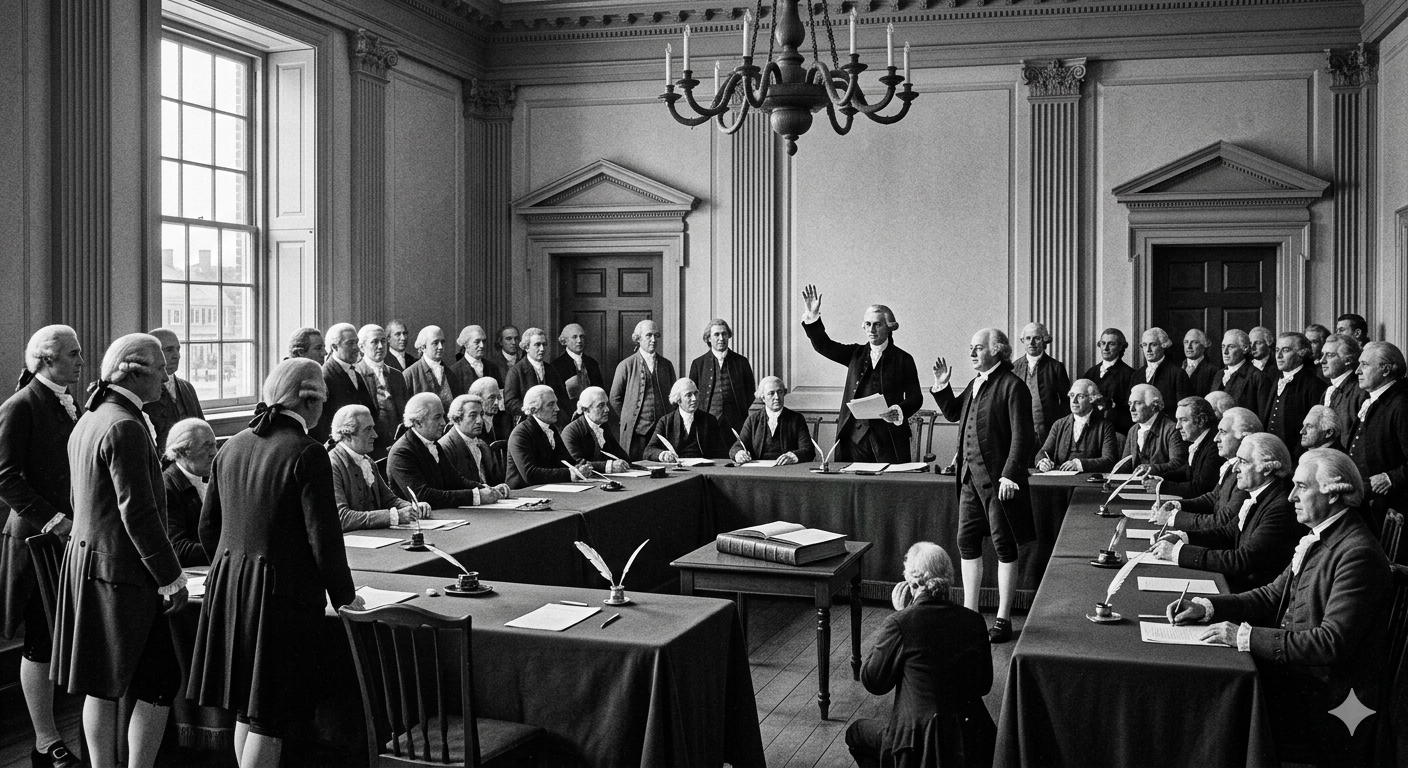
On the afternoon of July 2, 1776, in the assembly room of the Pennsylvania State House in Philadelphia, twelve of the thirteen colonial delegations to the Second Continental Congress voted in favor of a resolution declaring that the United Colonies of North America were, and of right ought to be, free and independent States, absolved from all allegiance to the British Crown, and entirely severed in political connection from the State of Great Britain. The resolution had been proposed by Virginia delegate Richard Henry Lee on June 7, debated and postponed over three weeks of extraordinary political maneuvering, and now, at last, carried with only the New York delegation abstaining rather than voting against. In a single afternoon’s vote, the thirteen American colonies formally ceased to exist as part of the British Empire and became something entirely new in the history of the world: a self-governing republic declaring itself sovereign by the consent of its own people.
John Adams, who had seconded Lee’s resolution on June 7 and had been among the most passionate advocates of independence throughout the months of debate, wrote to his wife Abigail the following day in a letter of extraordinary prescience: The second day of July 1776 will be the most memorable epoch in the history of America. I am apt to believe that it will be celebrated by succeeding generations as the great anniversary festival. It ought to be commemorated as the day of deliverance, by solemn acts of devotion to God Almighty. It ought to be solemnized with pomp and parade, with shows, games, sports, guns, bells, bonfires, and illuminations, from one end of this continent to the other. Adams was wrong about the date that would be celebrated: the United States would ultimately choose July 4, when the formal text of the Declaration of Independence was approved, rather than July 2, when the actual vote for independence was cast. But his sense of the magnitude of what had happened was completely accurate. The vote of July 2, 1776 was the founding act of the United States of America.
The Colonial World Before Revolution: What Drove Thirteen Colonies to Break with Britain
The vote for independence on July 2, 1776 was the culmination of more than a decade of mounting conflict between the thirteen American colonies and the British government in London, a conflict rooted in fundamentally incompatible views of what the relationship between the colonies and the mother country meant, and of what rights the colonists possessed as British subjects. To understand why fifty-six men in Philadelphia were prepared to commit treason against the Crown in the summer of 1776, it is necessary to understand the world that had produced them and the specific chain of events that had transformed loyal British subjects into revolutionary republicans.
The immediate financial context was the aftermath of the French and Indian War, which Britain and its American colonies had fought from 1754 to 1763. The war had been expensive beyond measure, and the British government, facing enormous debt, concluded that the American colonies ought to bear more of the cost of their own defence. Parliament passed the Stamp Act in 1765, imposing for the first time a direct tax on printed materials in the colonies, including newspapers, legal documents, pamphlets, and playing cards. The tax was imposed without the agreement of the colonial assemblies, which had always claimed the exclusive right to tax their own populations. The colonial response was electrifying. Nine colonial assemblies sent delegates to the Stamp Act Congress, an unofficial gathering that coordinated resistance and issued a Declaration of Rights and Grievances asserting that Parliament had no right to tax the colonies without their consent. The rallying cry that would echo through a decade of resistance was already being articulated: no taxation without representation.
Parliament eventually repealed the Stamp Act in 1766 under the pressure of colonial non-importation agreements and the lobbying of British merchants who were losing trade, but it simultaneously passed the Declaratory Act, asserting that Parliament had the right to legislate for the colonies in all cases whatsoever. The fundamental constitutional question had not been resolved: it had merely been deferred. The Townshend Acts of 1767, which imposed duties on imported glass, lead, oil, paint, and tea, revived the conflict immediately. Resistance grew. In Boston in March 1770, British soldiers fired into a crowd of colonists who were throwing snowballs and ice chunks at them, killing five men, including Crispus Attucks, a mixed-race dockworker who became the first martyr of the independence movement. The Boston Massacre, as Patriots immediately labelled it, inflamed colonial opinion across thirteen colonies.
The decisive rupture came in December 1773, when members of the Sons of Liberty, many of them disguised as Mohawk Indians, boarded three ships in Boston Harbor and dumped 342 chests of East India Company tea, approximately 46 tons worth, into the water in protest against the Tea Act, which they regarded as an attempt to impose a monopoly and circumvent colonial resistance to parliamentary taxation. The Boston Tea Party sent shock waves through the British political establishment. Parliament responded in 1774 with the Coercive Acts, known in America as the Intolerable Acts: the Boston Port Act closed Boston Harbor to all trade until the destroyed tea was paid for; the Massachusetts Government Act suspended elected government in Massachusetts; the Administration of Justice Act allowed royal officials to be tried in Britain rather than the colonies; and the Quartering Act required colonists to house British troops. The Intolerable Acts united the colonies in a way that previous disputes had not: if Parliament could suspend representative government in Massachusetts, it could do the same anywhere.
The First Continental Congress and the Second: Building the Infrastructure of Revolution
The First Continental Congress met in Carpenters’ Hall in Philadelphia on September 5, 1774, with delegates from twelve of the thirteen colonies — Georgia, fighting a Native American uprising and dependent on British military supplies, was the sole absentee. The gathering included men who would become the most celebrated figures of the American founding: John Adams and Samuel Adams of Massachusetts; George Washington and Patrick Henry of Virginia; John Jay of New York; and Roger Sherman of Connecticut. The Congress’s purpose was to coordinate a response to the Intolerable Acts, and it settled on a comprehensive non-importation, non-exportation, and non-consumption agreement with Britain, pledging to cease importing British goods and eventually to stop exporting American produce if Parliament did not repeal its offensive legislation. The Congress issued a Declaration of Rights and Grievances and sent petitions to the King and Parliament, still professing loyalty to the Crown while insisting on the constitutional limits of Parliamentary authority.
The British government’s response was to declare Massachusetts in a state of rebellion and to order the seizure of colonial weapons and the arrest of rebel leaders. On the night of April 18 to 19, 1775, British General Thomas Gage sent 700 soldiers from Boston to Concord, Massachusetts, to seize a cache of colonial military supplies. Paul Revere and William Dawes rode through the night to warn the Patriots. At Lexington, the British force encountered a small company of colonial militiamen drawn up on the village green. A shot was fired, triggering a brief skirmish that left eight colonists dead, and the Revolution had begun. The British continued to Concord, where they were met by hundreds of colonial militia at the North Bridge; the colonists fired the shot heard round the world and drove the British back toward Boston in a running fight that cost the regulars significant casualties. The thirteen colonies were at war.
The Second Continental Congress convened on May 10, 1775, at Independence Hall in Philadelphia, now with all thirteen colonies represented. It became the de facto governing body of a revolution already underway. On June 14, 1775, Congress established the Continental Army. The following day, it named George Washington of Virginia as its Commander in Chief, a choice that reflected both Washington’s military experience in the French and Indian War, his commanding physical presence, and the strategic necessity of giving the war effort a southern face at a moment when New England militiamen were doing most of the fighting. Washington was not present when he was named: he was sitting in the hall in his Virginia militia uniform when the vote was taken, apparently to signal his willingness to serve, and he quietly left the room when the motion was introduced. The Congress continued to profess loyalty to King George III even as it organized and directed a military campaign against his armies. In August 1775, George III declared the colonies to be in open and avowed rebellion, closing the door to any reconciliation that did not involve unconditional colonial surrender.
Thomas Paine and Common Sense: The Pamphlet That Made Independence Thinkable
As late as the autumn of 1775, most delegates to the Continental Congress were not seeking independence. They were seeking the redress of specific grievances: the repeal of the Intolerable Acts, the acknowledgment of their constitutional rights as British subjects, a negotiated settlement that would restore the relationship with Britain on terms that the colonies could accept. Independence was the demand of a radical minority; the majority still hoped and believed that the dispute could be resolved short of a permanent break. The document that did more than any other single event to shift this balance was a pamphlet published in Philadelphia on January 10, 1776, by a recently arrived English immigrant named Thomas Paine.
Paine had come to America in 1774 carrying a letter of recommendation from Benjamin Franklin. He was a former English corsetmaker and tax collector with a gift for political prose of unusual clarity and force. His pamphlet Common Sense was addressed directly to the common people of America, written in a style deliberately stripped of the classical allusions and legal arguments that characterized most political writing of the era. Paine attacked not merely the specific policies of the British government but the entire institution of monarchy and hereditary rule, arguing that kings were an absurd anachronism, that Britain’s vaunted constitution was a corrupt mockery of genuine self-government, and that the only logical outcome of the American situation was complete independence and the creation of a republic governed by the consent of the people. Common Sense sold approximately 100,000 copies in the first three months after its publication, in a country with a total free population of approximately two and a half million. Adjusted for population, it remains the best-selling book in American history. Its effect on public opinion was electric.
Paine’s argument went beyond the specific constitutional disputes about taxation and representation that had occupied the debate since 1765. He asked why a great continent should be dependent on a small island three thousand miles away. He argued that the mere fact of being subject to a distant king was incompatible with the self-governing dignity to which Americans had a natural right. He invoked the political philosophy of John Locke, who had argued in the seventeenth century that governments derive their just powers from the consent of the governed, and that when a government becomes destructive of the ends for which it was created, the people have the right to alter or abolish it. These ideas, already embedded in colonial political consciousness through decades of constitutional argument, were given direct and unambiguous practical application: if George III and the British Parliament had broken their compact with the American people, as Paine argued they had, then independence was not merely permissible but obligatory.
Richard Henry Lee and the Resolution That Started It All: June 7, 1776
The political preparation for the independence vote intensified through the spring of 1776, as the provisional colonial governments began sending new instructions to their congressional delegates. North Carolina, on April 12, 1776, became the first colony to explicitly authorize its delegates to vote for independence; the Halifax Resolves gave North Carolina’s delegates blanket authority to concur in any measures which Congress might deem necessary to promote colonial safety, honour and happiness. Massachusetts, Connecticut, New Hampshire, Delaware, and other colonies followed with their own authorizations through May and June. The decisive instruction came from Virginia, whose Convention meeting in Williamsburg on May 15, 1776, voted unanimously to instruct its Congressional delegation to propose to the Continental Congress that it declare the United Colonies free and independent States, absolved from all allegiance to, or dependence upon, the Crown or Parliament of Great Britain.
Richard Henry Lee, one of Virginia’s delegates to the Continental Congress, rose in the assembly room of the Pennsylvania State House on June 7, 1776, to introduce the motion that his home convention had directed him to bring. Lee was fifty-four years old, a member of one of Virginia’s most distinguished families, a fluent orator who had been arguing the case for colonial rights in Congress since 1774. The resolution he read to the assembled delegates was elegant in its brevity: Resolved, That these United Colonies are, and of right ought to be, free and independent States, that they are absolved from all allegiance to the British Crown, and that all political connection between them and the State of Great Britain is, and ought to be, totally dissolved. The resolution also called for Congress to take steps toward forming foreign alliances and to prepare a plan of confederation binding the newly independent states together. John Adams of Massachusetts seconded the motion.
The reaction in the Congress was not unanimous enthusiasm. A significant bloc of delegates, representing colonies including Pennsylvania, New York, South Carolina, New Jersey, Delaware, and Maryland, were either personally opposed to independence or had not received instructions from their home governments authorizing them to vote for it. Edward Rutledge of South Carolina argued that the resolution was premature and that the colonies needed more time to consolidate opinion and prepare their domestic governments for independence. James Wilson of Pennsylvania, whose colony’s powerful conservative establishment was deeply reluctant to break with Britain, was also opposed. John Dickinson of Pennsylvania, the author of the widely influential Letters from a Farmer in Pennsylvania, which had argued the constitutional case against Parliamentary taxation, remained opposed to independence itself, believing that the dispute could and should be resolved short of permanent separation. Congress voted on June 10 to postpone a final vote for three weeks, to give delegates time to seek instructions from their home governments, and simultaneously appointed a Committee of Five to prepare a formal Declaration of Independence that could be issued if and when the resolution passed.
The Committee of Five: Jefferson, Adams, Franklin, Livingston, and Sherman Write the Declaration
The Committee of Five appointed on June 11, 1776 to draft the Declaration of Independence was perhaps the most consequential committee in the history of representative government. Its members were John Adams of Massachusetts, Benjamin Franklin of Pennsylvania, Thomas Jefferson of Virginia, Robert R. Livingston of New York, and Roger Sherman of Connecticut. The committee’s assignment was to produce a document that would explain and justify to the world, and to the American people themselves, the decision to declare independence that Congress was expected to make when it reconvened after the three-week postponement.
Benjamin Franklin, at seventy years of age, was the oldest and most internationally celebrated of the five, a scientist, inventor, printer, and diplomat whose reputation spanned the Atlantic and whose wisdom in the committee’s deliberations would be crucial. John Adams was the most passionate advocate of independence on the committee, the man who had done more than anyone else in Congress to build the coalition that made the vote possible, and who remained the leading parliamentary force for the independence cause. Robert R. Livingston of New York, though he would eventually not sign the Declaration because he was recalled to New York before August 2, was a respected figure in the committee’s work. Roger Sherman of Connecticut, a self-made man who had begun his working life as a cobbler and became one of the most respected constitutional thinkers in New England, provided a steadying common-sense voice.
But the declaration itself was primarily the work of Thomas Jefferson of Virginia, the committee’s youngest member at thirty-three years of age, who wrote the initial draft between June 11 and June 28, 1776, in rented rooms on the second floor of a house on Market Street in Philadelphia. Jefferson later described his intent as simply to be an expression of the American mind, to give to that expression the proper tone and spirit called for by the occasion. He drew on the political philosophy of John Locke and other Enlightenment thinkers, on the constitutional arguments of the previous decade of colonial resistance, and on his own extraordinary gift for phrase. The famous second paragraph of the Declaration, We hold these truths to be self-evident, that all men are created equal, that they are endowed by their Creator with certain unalienable Rights, that among these are Life, Liberty and the pursuit of Happiness, compressed into a single sentence the entire philosophical foundation of the American revolutionary enterprise. The committee made minor revisions to Jefferson’s draft, and Adams and Franklin suggested a few additional changes, before the document was submitted to Congress on June 28.
July 1, 1776: The Debate Begins and the First Vote Fails
On July 1, 1776, with the three-week postponement ended, the Continental Congress convened in a committee of the whole to consider Lee’s Resolution. The debate was open, extended, and passionate. John Dickinson of Pennsylvania delivered the most eloquent speech against immediate independence, arguing that the colonies were not yet prepared, that their governments were insufficiently organized, that the military situation was dangerous, and that a French alliance had not yet been secured. Dickinson was a man of genuine conviction, and his arguments were not easily dismissed: independence before the colonies were ready, he contended, would be like burning down a house before one had another to move into. John Adams replied on behalf of the independence party in what witnesses described as one of the most brilliant speeches of his career, systematically demolishing each of Dickinson’s objections and making the case that delay was itself dangerous.
When the committee of the whole took its informal vote at the end of the day, the result was troubling: nine colonies voted for independence, Pennsylvania and South Carolina voted against, the Delaware delegation was split two to one against independence because the third delegate, Caesar Rodney, was absent in Delaware attending to his duties as speaker of the colonial assembly, and the New York delegation abstained, their instructions prohibiting them from voting without further authorization from the New York Provincial Congress. Congress was not prepared to declare independence with anything less than a unanimous vote, or as close to unanimous as possible. The appearance of a divided house would weaken the declaration’s authority both domestically and internationally, conveying to the world that the American cause was fractured. The vote was postponed until the following morning to allow time for the situation to change.
Caesar Rodney’s Midnight Ride and the Delaware Decision: July 2, 1776
The night of July 1 to 2, 1776 saw one of the most famous acts of individual commitment in the history of the American founding. Caesar Rodney, Delaware’s third delegate, was in Dover, Delaware, attending to colonial business, when word reached him that Delaware’s vote on independence was split and that his presence was needed immediately in Philadelphia. Rodney was not a well man: he suffered from severe asthma and from a facial cancer that had disfigured him badly enough that he habitually wore a green cloth mask over the affected side of his face. Despite his health and despite the distance and the weather, he mounted his horse and rode through the night of July 1 to 2, covering approximately eighty miles of rough roads in heat and thunderstorm, arriving in Philadelphia with his boots covered in mud, just in time for the July 2 vote. His arrival gave Delaware’s delegation a pro-independence majority, and Delaware voted for independence.
Simultaneously, overnight persuasion among the Pennsylvania and South Carolina delegations produced the crucial shifts. In Pennsylvania, John Dickinson and Robert Morris, both opponents of immediate independence, absented themselves from the Congress rather than voting against the rest of the delegation, allowing the remaining Pennsylvania delegates to vote for independence. In South Carolina, Edward Rutledge, who had spoken against the resolution on July 1, concluded that South Carolina should not stand alone against the tide, and he and his fellow South Carolinians voted for independence rather than be isolated dissenters. When the formal vote was taken on the afternoon of July 2, twelve colonial delegations voted in favor of the Lee Resolution. New York, which had not yet received new instructions from its Provincial Congress authorizing a yes vote, abstained rather than voting against. On July 9, 1776, the New York Provincial Convention officially endorsed the Declaration, making the vote effectively unanimous. For the practical purposes of the founding of the United States, July 2, 1776 was the day the Continental Congress voted that the colonies were free.
The Vote of July 2, 1776: What Happened in the Assembly Room
The vote itself, taken in the assembly room of the Pennsylvania State House on the afternoon of July 2, 1776, was a formal and deliberate act. Each colonial delegation voted as a unit, with the majority within each delegation determining how that colony cast its single vote. The atmosphere in the room combined the solemn awareness of historical moment with the practical political relief of finally concluding a debate that had consumed Congress for weeks. John Hancock, the President of the Congress, presided. The names of the twelve colonies that voted affirmatively were recorded in the official journals of the Congress: New Hampshire, Massachusetts, Rhode Island, Connecticut, New Jersey, Pennsylvania, Delaware, Virginia, North Carolina, South Carolina, Georgia, and Maryland. New York did not vote. The resolution that had been proposed by Richard Henry Lee twenty-five days earlier was formally adopted.
News of the vote spread rapidly. The Pennsylvania Evening Post published an account that very evening of July 2: Yesterday, the CONTINENTAL CONGRESS declared the UNITED COLONIES FREE and INDEPENDENT STATES. The Pennsylvania Gazette reported it the following morning. These were among the first public announcements of what had happened, and they captured the historic nature of the event with simple declarative directness. The vote had been taken. The colonies were now independent states, at least in their own declaration. The question of whether they could actually make that declaration stick against the most powerful military empire in the world was a different matter, and one that would not be resolved for seven more years of war.
Congress then turned to the text of the Declaration itself. Over July 3 and 4, the delegates went through Jefferson’s draft with the systematic care of a legislative committee, making changes that Jefferson himself found painful — he sat silent and suffering, Adams later wrote, during the debates over his text, which Congress revised, abbreviated, and in some cases fundamentally altered. The most significant deletion was an entire passage in which Jefferson had condemned King George for allowing the slave trade, which Congress removed entirely, partly at the insistence of South Carolina and Georgia delegates and partly because many other delegates felt it was hypocritical for slaveholders to condemn the trade while continuing to hold enslaved people. It was one of the founding compromises of American democracy, and its consequences would haunt the nation for nearly a century until the Civil War. On July 4, 1776, the final text was approved and forwarded to John Dunlap, a Philadelphia printer, who produced the first printed copies during the night of July 4 to 5.
The Declaration of Independence: Jefferson’s Words and the Philosophy of American Freedom
The Declaration of Independence that was approved on July 4, 1776 and that announced to the world the independence that Congress had voted on July 2, is one of the most consequential documents in the history of political philosophy. Its opening declaration of universal human equality, its assertion of unalienable rights to life, liberty, and the pursuit of happiness, and its statement that governments derive their just powers from the consent of the governed have resonated across two and a half centuries and across the world with a power that its authors, brilliant as they were, could not entirely have anticipated.
The Declaration served multiple purposes simultaneously. It was a legal act, formally announcing to the international community that a new sovereign state had come into existence. It was a political manifesto, explaining to the American people why independence was necessary and just. It was a diplomatic instrument, making the case to France and other potential allies that the American cause deserved support. And it was a philosophical statement of the principles on which the new republic would be founded. Jefferson’s long list of grievances against King George III, the bulk of the document’s text, served the legal and political purposes, making the case that the King had violated the social contract with his subjects in ways that justified revolution. The immortal preamble served the philosophical purpose, providing the ideological foundation for a new political order.
The Declaration’s assertion that all men are created equal was a revolutionary claim that the signers themselves largely failed to honour in their own lives, many of them being slaveholders, and that the new nation they created would take nearly a century and a catastrophic civil war to begin seriously addressing. But the claim itself, once made in this publicly and solemnly enacted form, had consequences its authors could not fully control. Enslaved people, women, and subsequent generations of the excluded and marginalized would use the Declaration’s own language to demand the equality it promised. As Abraham Lincoln would argue in 1858, the Declaration had set up a standard maxim for free society, which could be familiar to all, and revered by all; constantly looked to, constantly labored for, and even though never perfectly attained, constantly approximated, and thereby constantly spreading and deepening its influence, and augmenting the happiness and value of life to all people of all colors everywhere.
The Fifty-Six Signers: Who They Were and What They Risked
The Declaration of Independence was signed not on July 2, when the vote was taken, nor on July 4, when the text was approved, but on August 2, 1776, when a fair engrossed parchment copy was ready for formal signing by the delegates. In all, fifty-six men signed the Declaration on various dates through the summer and autumn of 1776 and into 1777. The signatories represented the full range of colonial society in a way that the mythology of the founding sometimes obscures: they were lawyers, merchants, farmers, physicians, and landowners; they were Congregationalists, Presbyterians, Quakers, Anglicans, and Catholics; they came from the sparsely populated farms of New Hampshire and the prosperous plantations of South Carolina; they ranged in age from twenty-six-year-old Edward Rutledge of South Carolina to seventy-year-old Benjamin Franklin of Pennsylvania.
John Hancock, the President of Congress, was the first to sign. His famously oversized signature, placed prominently in the centre of the document, became one of the most recognizable images in American history and gave the English language a new synonym for a signature. Hancock reportedly said that he wrote it large enough that King George could read it without his spectacles. The other delegates signed by state delegation, beginning with New Hampshire in the upper right and proceeding through five columns to Georgia at the lower right. Seven members of the July 4 meeting never signed at all, and the last delegates to sign did not do so until January 1777.
The signers understood that they were committing what the British government regarded as treason, and that if the Revolution failed, they faced hanging. The preamble to the Declaration had framed the action in terms of the laws of nature and of nature’s God, appealing to the supreme judge of the world for the rectitude of their intentions. The closing words pledged to the support of this declaration, with a firm reliance on the protection of divine Providence, the mutual pledge of their lives, their fortunes, and their sacred honor. The phrase was not merely rhetorical. Several signers lost their fortunes in the war. Several lost their homes to British armies. Several died before the Revolution ended. None was executed, because the Revolution succeeded, but the risk had been genuine and the courage required to accept it should not be underestimated by those who benefit, two and a half centuries later, from the world their willingness to commit created.
The Revolutionary War and the World Made by the Vote: From July 2, 1776 to the Treaty of Paris
The vote for independence on July 2, 1776 was a declaration of intent, not yet a reality. Making the declaration stick required winning a war against the most powerful military empire in the world, and in the summer of 1776, that outcome was far from guaranteed. Even as Congress was voting and debating, the largest British expeditionary force ever assembled was arriving off New York: 32,000 soldiers, including 8,000 German Hessian mercenaries hired by King George, under the command of General William Howe. George Washington’s Continental Army of approximately 20,000 was outnumbered, outgunned, and outclassed in conventional military terms. The British took New York in the late summer and autumn of 1776, chasing Washington’s army across New Jersey in a retreat that seemed to many observers to presage the Revolution’s rapid collapse.
What saved the Revolution in its darkest hours was a combination of Washington’s tactical stubbornness, the adaptability of the Continental Army, the intervention of France following the American victory at the Battle of Saratoga in October 1777, and the fundamental impossibility of the British military task of subduing a continent. The Franco-American alliance of 1778, secured largely through Benjamin Franklin’s brilliant diplomacy in Paris, brought French money, ships, and eventually soldiers into the conflict, transforming a colonial rebellion into a global war that Britain could not sustain indefinitely. In 1781, French and American forces combined to trap the British army under General Charles Cornwallis at Yorktown, Virginia, and Cornwallis surrendered on October 19. The Revolutionary War effectively ended at Yorktown, though the formal peace was not concluded until the Treaty of Paris, signed on September 3, 1783. Britain recognized the independence of the United States and ceded the territory east of the Mississippi River to the new nation.
The Legacy of July 2, 1776: The Vote That Created a Nation and Inspired the World
The vote of July 2, 1776 and the Declaration that followed it on July 4 were acts whose consequences have continued to unfold for two and a half centuries. The immediate consequence was the creation of the United States of America, a republic that would grow from thirteen struggling Atlantic seaboard states into a continental nation of fifty states and the world’s dominant economic and military power. The government established by the Constitution of 1787, drafted by many of the same men who had voted for independence, has proved the most durable written constitutional republic in world history, surviving civil war, economic catastrophe, global conflicts, and the strains of an increasingly diverse and complex society.
The philosophical legacy of the Declaration was in some ways even more significant than its immediate political consequences. The assertion that all men are created equal, that governments derive their legitimate authority from the consent of the governed, and that the people have the right to alter or abolish any government destructive of their ends, provided a vocabulary and a set of principles that successive generations in America and around the world have invoked in their own struggles for freedom and justice. The French Revolution, though it took a far more violent and turbulent course, drew explicitly on American revolutionary principles. The Haitian Revolution of 1791, in which enslaved people claimed for themselves the freedom that American slaveholders had declared in 1776 without applying it to them, was one of the most powerful demonstrations of the Declaration’s radical implications. Nineteenth-century independence movements in Latin America, Ireland, and elsewhere drew on the American example.
The incompleteness of the American founding is part of its legacy too. The men who voted for independence on July 2, 1776 and signed the Declaration on August 2 did not create a perfect union. They created a union founded on ideals that they themselves often failed to live up to, containing compromises and contradictions, most fundamentally around the institution of slavery, that would require generations of struggle to begin addressing. The long arc of American history since 1776 has been in significant part the story of the effort to make the Declaration’s promises real for the people it excluded at its founding: enslaved people, women, Indigenous peoples, immigrants, and all those who found the gap between the Declaration’s ideals and the country’s practice too wide to ignore.
Conclusion: July 2, 1776 and the Words That Changed the World
The Continental Congress voted for independence from Britain on July 2, 1776. The resolution was sixty-five words long. It had been proposed by Richard Henry Lee on June 7 and seconded by John Adams. It had been debated, postponed, and reconsidered across three weeks of extraordinary political deliberation. It had required Caesar Rodney to ride eighty miles through the night to cast his vote. It had required John Dickinson and Robert Morris to absent themselves from the Congress so that Pennsylvania could vote yes. It had required the persistent, passionate advocacy of Adams, Lee, Franklin, Jefferson, and the Adams-Lee Junto over months and years to bring the reluctant colonies to the point of commitment.
When the vote was taken, twelve colonial delegations cast their affirmative votes. New York abstained, and would ratify the Declaration one week later. The United Colonies were free and independent States. The British Empire’s authority over the people of North America was dissolved. A new nation was in the process of being born. John Adams knew it was the most memorable epoch in the history of America. He predicted it would be celebrated with illuminations from one end of the continent to the other. He was right about everything except the date.
The Declaration of Independence that was approved two days later, on July 4, and that would be celebrated as the birthday of the nation, gave voice and philosophy to the act. But the act itself was the vote of July 2, 1776, when fifty-six representatives of thirteen colonies, meeting in a room in Philadelphia in the summer heat, voted to declare their freedom, pledged their lives, their fortunes, and their sacred honor to the enterprise, and set in motion a chain of events that would ultimately produce the most powerful democratic republic in the history of the world.