
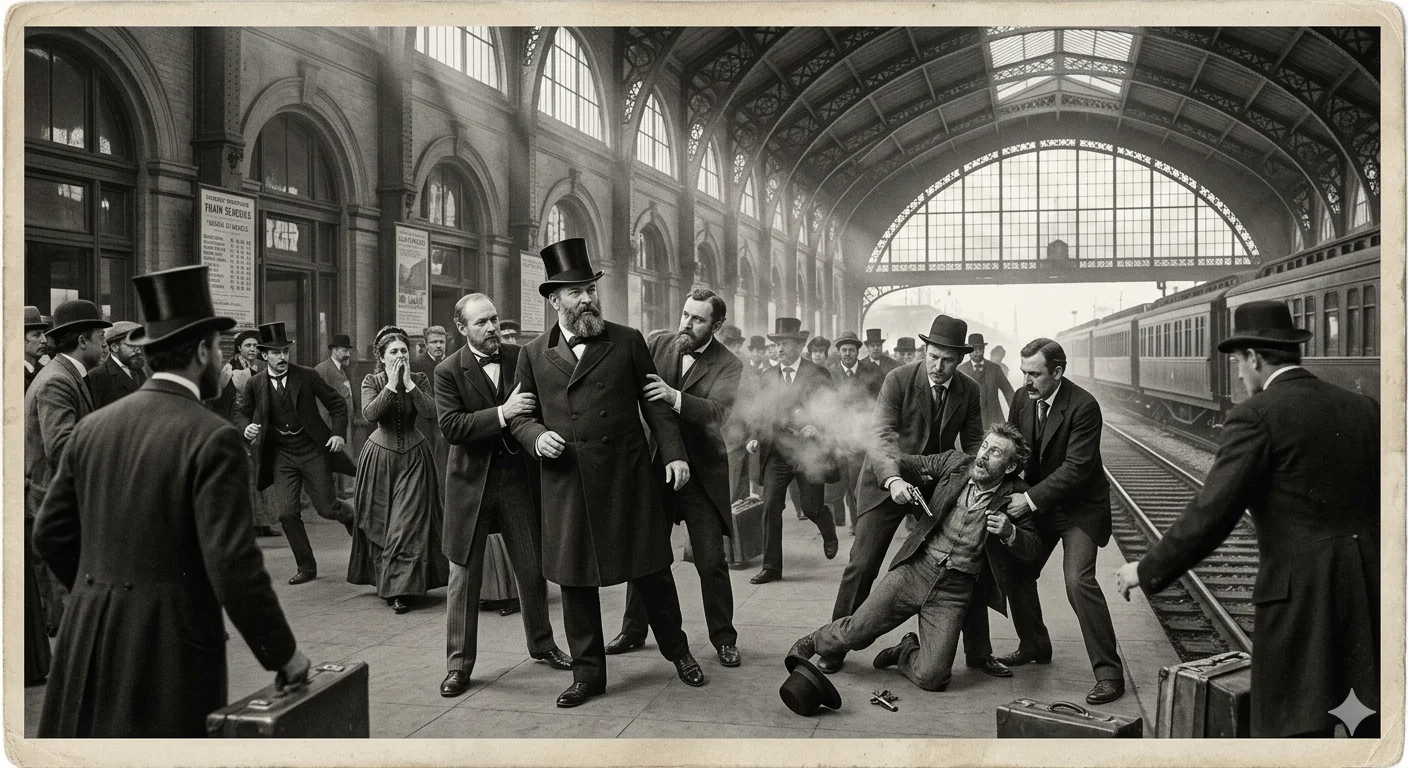
At 9:30 in the morning on Saturday, July 2, 1881, President James A. Garfield walked through the ladies’ waiting room of the Baltimore and Potomac Railroad Station in Washington, D.C., accompanied by Secretary of State James G. Blaine, his two teenage sons James and Harry, and Secretary of War Robert Todd Lincoln, the eldest son of the martyred sixteenth president. Garfield was in high spirits. He was heading north to Williams College in Massachusetts for his twenty-fifth class reunion, and from there he planned to join his wife Lucretia at the seaside resort of Long Branch, New Jersey, where she was convalescing from malaria. The summer heat of Washington had oppressed him for weeks, and the prospect of relief was welcome. He had no reason to suspect that the visit would never happen.
From behind a pillar in the station’s waiting room, a slight, dark-bearded man in a dark suit stepped forward and fired two shots at the President from a distance of a few feet. One bullet grazed Garfield’s right arm. The second entered his back, piercing the first lumbar vertebra but — as would become crucial to the subsequent medical drama — missing the spinal cord. The shooter, Charles Julius Guiteau, a forty-year-old failed lawyer, failed evangelist, and failed office seeker from Freeport, Illinois, did not attempt to flee immediately. He had already arranged for a cab to take him to the District of Columbia jail after the shooting, and as he walked toward the exit he was apprehended by Officer Patrick Kearney, who had heard the screams. As he was arrested, Guiteau announced with evident satisfaction: I am a Stalwart of Stalwarts. I did it and I want to be arrested. Arthur is President now. The second assassination of an American president had begun — and in its medical aftermath, its legal proceeding, and its political consequences, it would reshape the United States in ways that neither Guiteau nor Garfield could have imagined.
The Rise of James A. Garfield: From Log Cabin to the White House
James Abram Garfield was born on November 19, 1831, in a log cabin in Orange Township, Cuyahoga County, Ohio, the youngest of five children of Abram Garfield and Eliza Ballou Garfield. His father died less than two years after his birth, leaving his mother to raise the family alone on their small farm near Cleveland. Garfield’s poverty was genuine and formative. He worked as a canal boat driver in his youth, hauling cargo on the Ohio and Erie Canal, a job whose physical dangers he survived through luck — he fell into the water fourteen times by his own account — and whose hardships he would later invoke in his campaign biography, literally written by Horatio Alger, under the slogan From the tow path to the White House. He is regarded by many historians as perhaps the poorest man ever to become President of the United States.
Education was Garfield’s path out of poverty. He attended Geauga Seminary in Chester Township, Ohio, worked his way through the Eclectic Institute, now Hiram College, as a janitor and teacher, and then transferred to Williams College in Williamstown, Massachusetts, from which he graduated in 1856 with high academic honors. He returned to Ohio to teach at his alma mater, was appointed its president at the age of twenty-six, and simultaneously studied law, passing the Ohio bar examination in 1861. His intellectual abilities were exceptional: he was reputedly ambidextrous and could write Greek with one hand and Latin with the other simultaneously, and he was fluent in both classical languages. He married Lucretia Rudolph, known as Crete, on November 11, 1858; she would prove a devoted partner and a perceptive political adviser throughout his career, and her illness at the time of the shooting would become one of the factors in the story of the assassination.
When the Civil War broke out in 1861, Garfield threw himself into the Union cause with the conviction of a man for whom the antislavery principles of the new Republican Party were genuinely held moral commitments rather than political positions. He was appointed colonel of the 42nd Ohio Infantry and led his regiment in the eastern Kentucky campaign, winning the Battle of Middle Creek against Confederate General Humphrey Marshall on January 10, 1862, in one of the Union’s early western victories. He served at the Battle of Shiloh in April 1862 and later at the Battle of Chickamauga in September 1863, where he delivered a crucial message under fire that earned him promotion to major general. His military reputation, combined with the Republican Party’s appetite for candidates who could wave the bloody shirt of Union service, sent him to the United States House of Representatives in December 1863 without his having campaigned for the seat. He would serve nine consecutive terms in Congress, becoming a skilled parliamentary tactician and eventually the Republican minority leader of the House.
The Gilded Age Spoils System: The Political Poison That Produced Charles Guiteau
To understand the assassination of President Garfield, it is necessary to understand the political culture of the Gilded Age and in particular the system of patronage and spoils that dominated American government in the decades after the Civil War. The spoils system, whose operating principle was summarized in Senator William Marcy’s famous declaration that to the victor belong the spoils of the enemy, held that the winning political party was entitled to distribute federal government jobs to its supporters as rewards for their service and loyalty. The federal civil service, from customs house collectors to postmasters to diplomatic appointees, was not a professional meritocracy but a patronage machine: positions were awarded for political service, not for competence, and were expected to be vacated and reassigned when administrations changed. The result was an enormous appetite for government jobs among political supporters of every administration, and an equally enormous amount of time consumed by every president and cabinet member in dealing with the endless streams of office seekers who besieged them.
By 1880, this system had generated two bitter factions within the Republican Party itself. The Stalwarts, led by the powerful and imperious New York Senator Roscoe Conkling, were the defenders of the spoils system in its most unapologetic form. Conkling was a physically imposing man of theatrical political presence, known for the elaborate curls of his trademark hairstyle and for his equally elaborate political vindictiveness. His machine dominated New York Republican politics and derived much of its power from control of federal patronage appointments in the state, most crucially the Collector of the Port of New York, which oversaw the busiest port in the country and provided the richest patronage plum in the nation. The Stalwarts viewed civil service reform as a direct attack on the machinery that sustained their political power and resisted it with every tool available to them.
The opposing faction, derisively labelled Half-Breeds by Conkling and his allies, was led by Senator James G. Blaine of Maine and represented a more moderate wing of the party that was beginning to embrace civil service reform, a merit-based system for government appointments, as both good policy and good politics. The division between Stalwarts and Half-Breeds was not purely or even primarily ideological: both factions sought the spoils of political power, and the distinction between them was more about which faction would control the patronage than about whether the patronage system should continue to exist. But the rhetoric of reform gave the Half-Breeds a moral high ground that the Stalwarts found maddening, and the political struggle between the two factions would be the central drama of the Republican Party in the early 1880s.
The 1880 Republican Convention and Garfield’s Dark-Horse Nomination
The Republican National Convention of 1880, held in Chicago, was one of the most dramatic in the party’s history. Three major candidates sought the nomination: former President Ulysses S. Grant, backed by Conkling’s Stalwart machine and seeking an unprecedented third term; Senator James G. Blaine of Maine, the Half-Breed champion; and Secretary of the Treasury John Sherman of Ohio, who had the support of his state’s Republican establishment, including Garfield, who had come to Chicago specifically to manage Sherman’s campaign. The convention deadlocked across thirty-five ballots, with neither Grant, Blaine, nor Sherman able to secure the required majority.
On the thirty-sixth ballot, delegates from Wisconsin and Indiana began shifting their votes to Garfield as a compromise dark horse. Garfield, who had delivered a widely admired nominating speech for Sherman early in the convention and who had spent the week impressing delegates with his intelligence, affability, and political skill, protested to the Ohio delegation that he did not seek the nomination and did not want to betray Sherman. The delegation overruled him, and the stampede began. By the end of the thirty-sixth ballot, Garfield had received 399 votes and the nomination. To satisfy the disgruntled Stalwart faction, whose support was essential for victory in November, Chester A. Arthur — a former New York customs house collector who was one of Conkling’s closest political associates and whose career had been built entirely on patronage — was nominated as vice president. It was a ticket that papered over the fundamental Stalwart-Half-Breed divide with political necessity, and that division would be one of the factors that brought Charles Guiteau to the Baltimore and Potomac Railroad Station.
In the November 1880 general election, Garfield defeated the Democratic candidate, General Winfield Scott Hancock, by fewer than 10,000 popular votes out of more than nine million cast — one of the narrowest popular vote margins in presidential election history. The Electoral College gave Garfield 214 votes to Hancock’s 155, a more comfortable margin. Garfield ran a front porch campaign from his farm at Lawnfield in Mentor, Ohio, receiving delegations of supporters and conducting himself with a dignity that contrasted with the undignified scrambling of party bosses in the background. He was inaugurated as the twentieth President of the United States on March 4, 1881, delivering an inaugural address that touched on civil service reform, civil rights for African Americans in the post-Reconstruction South, and the assertion of presidential authority over patronage appointments. His presidency would last barely four months.
Charles Julius Guiteau: The Making of an Assassin
Charles Julius Guiteau was born on September 8, 1841, in Freeport, Illinois, the fourth of six children of Jane August (née Howe) and Luther Wilson Guiteau, whose family was of French Huguenot ancestry. His mother Jane suffered from psychosis for much of her life, a condition involving loss of contact with reality, and she died in 1848 when Charles was six, leaving his father to raise the children. Luther Guiteau was a deeply religious man of harsh temperament who beat young Charles for stammering when he could not properly recite his prayers or pronounce a word without stuttering. The father later declared his own son a fit subject for a lunatic asylum, a judgment that would become grimly relevant three decades later.
Guiteau’s adult life was a catalogue of failure and delusion of remarkable consistency. He spent two years at the Oneida Community, a utopian free-love commune in New York founded by John Humphrey Noyes, leaving after a dispute that led to his fellow community members nicknaming him Charles Get-out. He attempted to study law in Chicago and was eventually admitted to the Illinois bar, though his legal career was characterized by dishonesty and incompetence: he defrauded clients, skipped town without paying rent, and was described by those who knew him as mentally unstable. He worked briefly as an insurance agent and then as an itinerant evangelical preacher, touring the country delivering sermons and distributing pamphlets on theological subjects that showed the grandiosity of a man who had entirely lost contact with any accurate assessment of his own abilities and standing. He married a woman named Annie Bunn, who eventually fled their marriage after years of physical and verbal abuse.
During the 1880 presidential campaign, Guiteau discovered politics. He composed a speech titled Garfield vs. Hancock, had it printed by the Republican National Committee, and attempted to deliver it to audiences around New York and New England. By his own account, he delivered the speech in the summer of 1880, though on at least one occasion nobody came to listen and on another he was reportedly too nervous to finish. His actual contribution to Garfield’s campaign was negligible, peripheral, and essentially invisible to anyone who had any real role in managing it. But Guiteau’s mind did not work on accurate assessments. He convinced himself, with the complete certainty of a man untethered from reality, that his speech had been decisive in securing Garfield’s election victory, and that he was therefore owed a significant reward by the incoming administration. He wrote to Garfield directly, expressing his belief that he would be appointed as consul general to Paris, despite speaking no French and having no relevant qualifications of any kind.
The Long Season of Rejection: Guiteau in Washington, March to July 1881
Guiteau arrived in Washington, D.C., on March 5, 1881, the day after Garfield’s inauguration, fully expecting to collect his diplomatic appointment. He was forty years old, destitute, and wearing the same threadbare clothes every day. He had no overcoat, no hat, no gloves, and no boots in the cold Washington winter. He survived by sneaking between rooming houses without paying, eating at charity, and using the complimentary stationery of hotel lobbies to write letter after letter to Garfield, to Secretary of State James Blaine, and to every prominent Republican he could identify, pressing his claim for the Paris consulship. He loitered in hotel lobbies to read discarded newspapers and keep track of Garfield’s schedule. He obtained entry to the White House on at least fourteen documented occasions, waiting in the crowded public receiving rooms where the President met office seekers, and at least once on March 8 he briefly spoke to Garfield directly, leaving a copy of his speech as a reminder of the debt he believed was owed.
Through March, April, and May, the rejections accumulated without penetrating Guiteau’s conviction. Every letter went unanswered or brought a negative response. Every appearance at the State Department produced a polite dismissal. On May 13, 1881, he was formally banned from the White House waiting room. The following day, he encountered Secretary Blaine on the street and raised the Paris consulship again. Blaine, who had been dealing with Guiteau’s harassment for months and whose patience was exhausted, snapped at him: Never speak to me again on the Paris consulship as long as you live. It was the decisive break. Guiteau, who had been sustaining himself on the fantasy of imminent appointment, now had to confront that the appointment would never come.
His mind, already disordered, now underwent a further deterioration. He began to interpret his situation not as the consequence of his own delusions and unsuitability but as evidence that Garfield was deliberately destroying the Republican Party by pursuing civil service reform and antagonizing the Stalwart faction. He had been following the political battle between Garfield and Senator Conkling over the appointment of William H. Robertson as Collector of the Port of New York — Garfield had defied Stalwart senatorial courtesy by appointing a Half-Breed man to the most coveted patronage position in the country, and Conkling had eventually resigned from the Senate in protest. In Guiteau’s disordered reasoning, this conflict was destroying the party. He decided, and recorded this decision in writing, that the only solution was to remove Garfield from office and elevate Vice President Chester Arthur, a Stalwart, to the presidency. He convinced himself that this was not merely a practical political calculation but a divine command: he later stated that the Divine pressure on me to remove the president was so enormous that it destroyed my free agency.
The Stalking of President Garfield and the Purchase of the British Bulldog
Having decided to assassinate the President, Guiteau prepared with a methodical care that his previous failures had never permitted. On May 18, 1881, he visited a gunsmith and purchased a .44-caliber British Bulldog revolver, selecting it specifically, he later explained, because he thought it would look impressive in a museum after the assassination. He spent six dollars on the weapon — money he did not actually have and borrowed for the purpose — and practised with it in the woods along the Potomac River. He then spent the entire month of June following Garfield around Washington, identifying opportunities to shoot him.
On at least one occasion, Guiteau trailed Garfield to the Baltimore and Potomac Railroad Station when the President was seeing his wife Lucretia off to her convalescence in New Jersey. He had his revolver with him and was positioned to fire, but he held back because, as he later explained, Lucretia was known to be in poor health and he did not want to upset her. This extraordinary detail, Guiteau declining to murder the President in order to spare the feelings of the President’s ill wife, has been cited by medical and legal historians as among the clearest evidence of his profound mental derangement: a man capable of the consideration he showed in that moment, and incapable simultaneously of perceiving that shooting the President’s wife’s husband would upset her considerably more. He also visited the District of Columbia jail during this period to request a tour of the facility, explaining that he expected to be incarcerated there after the shooting. He was told to come back later.
He wrote letters in advance of the shooting to General William Tecumseh Sherman, the Commanding General of the Army, requesting protection from the mob he anticipated would gather after he killed the President. He wrote a letter to the White House explaining his reasoning — that he was a Stalwart and that Arthur’s presidency would unite the Republican Party — and another to the American people. He arranged for a cab to be waiting at the station on the morning of July 2 to take him to the police station to turn himself in. On the evening of July 1, having read in the Washington newspapers that the President was scheduled to depart from the Baltimore and Potomac Station the following morning, Guiteau finalized his plan. He had his shoes shined before going to the station, reportedly because he wanted to look presentable for the scene that would follow.
July 2, 1881: The Shooting at the Baltimore and Potomac Railroad Station
The morning of July 2, 1881, was a summer Saturday in Washington. President Garfield had been looking forward to his departure for weeks. He planned to travel first to Williams College in Massachusetts, where he would attend his twenty-fifth reunion and deliver a speech to the graduating class. His two teenage sons, James Rudolph Garfield and Harry Augustus Garfield, were traveling with him. Secretary of State James Blaine, who was accompanying the President to the station, walked beside Garfield as they entered the ladies’ waiting room. Robert Todd Lincoln, the Secretary of War who had been present at his own father’s assassination sixteen years earlier at Ford’s Theatre in April 1865, was also with the party. Lincoln would later be present at a third presidential assassination when he was with President William McKinley in Buffalo, New York in September 1901 — making him the only person in American history to have been in proximity to three presidential assassinations.
Guiteau had arrived at the station early, pacing the waiting room, getting his shoes shined one final time, and positioning himself behind a pillar. As Garfield and Blaine walked through the ladies’ waiting room together, Guiteau stepped forward from behind the pillar and fired two shots from his British Bulldog revolver at the President’s back. The first bullet grazed Garfield’s right arm, doing little damage. The second struck Garfield in the lower right back, lodging near the first lumbar vertebra. Garfield fell to the floor, crying out in pain. He said to one of the first physicians who reached him, I thank you, doctor, but I am a dead man. He was wrong in the immediate term — the wound was serious but not necessarily fatal — but right in the tragic outcome that followed.
Guiteau moved toward the station’s Sixth Street exit and was immediately apprehended by Officer Patrick Kearney, who had entered the station upon hearing the shots and the cries of the crowd. As he was arrested, Guiteau handed Kearney a letter addressed to the White House and declared himself a Stalwart of Stalwarts, announcing that Arthur was now president. The prisoner was taken to police headquarters, where he was calm, cooperative, and apparently satisfied with himself. He was formally charged with attempted murder, later upgraded to murder when Garfield died. News of the shooting spread by telegraph across the country within hours; in New York and other major cities, telegraph offices and newspaper offices posted bulletins on chalkboards outside their doors, and crowds gathered to read the latest reports. The nation was in shock.
Eighty Days of Agony: The Medical Treatment That Killed the President
The most bitter irony of the Garfield assassination is that the bullet Guiteau fired did not, by itself, kill the president. The wound, though serious, was survivable. The bullet had lodged in Garfield’s back near the spine, missing the spinal cord itself, and had come to rest in a position that, while uncomfortable, was not life-threatening—the human body can tolerate bullets lodged in muscle tissue for years without serious consequences. Modern surgical understanding makes clear that if Garfield had received appropriate medical care in 1881, he would very likely have survived. What killed him was the medical treatment he received, delivered by well-intentioned physicians who had not adopted the antiseptic methods pioneered by the British surgeon Joseph Lister, which would have prevented the infections that ultimately destroyed him.
Dr. Willard Bliss, the physician who assumed primary charge of Garfield’s care, inserted unwashed fingers and unsterilized metal probes into the wound repeatedly in his attempts to locate the bullet. Other physicians did the same. In 1881, the germ theory of disease was still contested in the American medical establishment, and Listerian antiseptic practice, though widely accepted in Britain and Europe, had not yet been universally adopted in American hospitals. The repeated probing of the wound track with contaminated instruments introduced bacteria deep into Garfield’s body, creating infections that spread and generated abscesses throughout his chest and abdomen over the following weeks. What had been a wound of perhaps three inches in depth became, through the probing of his doctors, a contaminated channel of twenty inches. The President lost weight catastrophically, dropping from approximately 210 pounds at the time of the shooting to 130 pounds by September.
Alexander Graham Bell, the inventor of the telephone, was enlisted to help locate the bullet using a metal detector of his own design. Bell came to Garfield’s bedside at the White House on July 26, 1881, and again on August 1, using his induction balance device to search for the metallic bullet. The device produced ambiguous readings: it appeared to detect metal consistently in the area of the President’s right side, but the readings were never definitive enough to pinpoint the bullet’s exact location. It was later determined that the signals may have been confounded by the metal coil springs in the President’s mattress, which Bell had not been informed about. The bullet was never found by Bell’s device. In desperation, the physicians made a surgical incision on July 24 to attempt to drain an abscess near the wound track, which temporarily relieved some of Garfield’s suffering but did not address the fundamental problem of the spreading infection.
On September 6, 1881, with Garfield’s condition deteriorating despite everything that his physicians could do, the President was moved from the White House to a cottage at Elberon, on the New Jersey shore, in the hope that the ocean air and cooler temperatures would improve his condition. A special railroad spur was laid overnight by two hundred workers to bring the train directly to the cottage, a remarkable feat of engineering accomplished in the space of a few hours by volunteers who wanted to help their stricken President. The sea air did not save him. On September 19, 1881, seventy-nine days after Guiteau’s bullet entered his back, James A. Garfield died at his cottage at Elberon of blood poisoning, massive hemorrhaging, and septic complications. Some later medical historians have proposed that the rupture of a gallbladder that had developed secondary to the wound’s infection may have been the immediate cause of death. He was forty-nine years old. Chester A. Arthur was sworn in as President in the early morning hours of September 20, 1881.
The Trial of Charles J. Guiteau: Insanity, Spectacle, and the Question of Responsibility
The trial of Charles J. Guiteau, formally styled United States v. Charles J. Guiteau, began on November 14, 1881, in Washington, D.C., before Judge Walter Cox. It was the first presidential murder case to go to trial in American history, and it became one of the most extraordinary courtroom spectacles the Gilded Age press had ever witnessed. Guiteau was represented nominally by his brother-in-law George Scoville, a Chicago attorney, though the defendant’s determination to represent himself and his constant interruption of the proceedings made the concept of legal representation largely theoretical. The prosecution was led by District Attorney George Corkhill.
Guiteau’s primary defense was insanity. He argued, through Scoville and in his own extensive courtroom speeches, that the Divine pressure on him to remove the President had been so overwhelming that it had destroyed his free agency, and that he therefore could not be held legally responsible for his actions. He described the shooting as an act of God and a political necessity, insisting that God had commanded him to kill Garfield and that his obedience to divine command exempted him from human law. The defense also argued that Garfield had actually been killed by the malpractice of his physicians — a claim that was not entirely without medical merit, as later analysis would confirm — rather than by Guiteau’s bullet directly. Guiteau himself famously stated from the dock: I did not kill the President. The doctors did that. I merely shot him.
The insanity defense raised genuinely difficult legal and medical questions that would resonate through American jurisprudence for decades. American courts in 1881 applied the M’Naghten rule, a British legal standard from 1843, which held that defendants bore no criminal guilt if they could prove they were unaware of the nature of their actions or were incapable of understanding right from wrong. Defense experts testified that Guiteau’s behavior, his lifetime of failure and delusion, his religious mania, his family history of mental illness in his mother, and the character of his stated motivations all indicated a profoundly disordered mind incapable of normal moral reasoning. Prosecution experts countered that Guiteau knew perfectly well that what he was doing was illegal and wrong, had prepared for the shooting and its aftermath with methodical care, and had demonstrated a capacity for deliberate planning inconsistent with legal insanity as the courts defined it.
The trial became a media sensation precisely because Guiteau made it one. He interrupted proceedings constantly, insulted his own lawyers, shouted objections to prosecution questions, attempted to deliver extended speeches, critiqued the witnesses, sent letters to newspapers, and generally conducted himself with a chaotic energy that was simultaneously alarming, pathetic, and, to the audiences that packed the gallery and followed the coverage in the press, compellingly strange. Judge Cox, seeking to avoid any grounds for a mistrial that might result from restricting the defendant, allowed Guiteau’s outbursts to continue with remarkable patience. The jury deliberated for less than an hour before returning a verdict of guilty. The insanity defense had failed. On January 25, 1882, Guiteau was sentenced to death by hanging.
The Execution of Charles Guiteau and the Circus of His Final Hours
Charles Guiteau was hanged at the District of Columbia jail on June 30, 1882, two days shy of the first anniversary of his attack on the President. In the weeks before his execution, he continued to behave with the grandiosity and disconnection from reality that had characterized his entire adult life, giving interviews to journalists, writing letters to newspapers and to President Arthur, and composing poetry that he intended to be recognized as literary masterpieces. He sent a letter to Arthur arguing that Arthur should set him free because by killing Garfield, Guiteau had elevated Arthur to the presidency and increased Arthur’s value to the country, and that a grateful President ought to acknowledge this service.
On the morning of his execution, Guiteau was permitted to recite a poem he had written, titled I Am Going to the Lordy. He delivered it with apparent pleasure, addressing a crowd of witnesses in the execution yard at the jail. The poem expressed his conviction that he had saved the Republican Party by killing Garfield, that he had acted under divine command, and that he was ascending to heaven as a martyr to his cause. After reciting the poem, he was hanged. He was forty years old. His body was subsequently dissected for medical examination at the Army Medical Museum, and his brain was preserved for study; physicians examining him posthumously generally concluded that he had been severely mentally ill, probably suffering from a condition that would today be identified as narcissistic personality disorder combined with paranoid schizophrenia or delusional disorder, though the diagnosis remains a matter of historical interpretation.
The Pendleton Civil Service Reform Act: Garfield’s Death and the Reform It Inspired
The most consequential and lasting consequence of the assassination of James A. Garfield was not the elevation of Chester A. Arthur to the presidency, though that had its own significance, but the transformation of American political will on the question of civil service reform. Before the assassination, the Pendleton Civil Service Reform Act, which would establish a merit-based system for federal government employment, had been a cause championed by reformers but lacking the political momentum to overcome the resistance of the patronage machines in both parties. The assassination of a President by a disappointed office seeker who had been driven to murder by the frustrations of the spoils system shocked the American public into a recognition that the patronage culture was not merely corrupt and inefficient but actively dangerous.
The irony that made the Pendleton Act possible was Chester A. Arthur. The man who had been Roscoe Conkling’s protege, the former Collector of the Port of New York whose entire career had been built on the patronage system that Garfield’s assassination had discredited, became unexpectedly the instrument of that system’s reform. Chastened by the manner in which he had come to power, aware that his administration’s legitimacy depended on demonstrating that he was something more than the Stalwart machine politician the nation feared, and politically astute enough to read the overwhelming public demand for reform, Arthur surprised almost everyone by supporting and signing the Pendleton Civil Service Reform Act into law on January 16, 1883. The Act established the United States Civil Service Commission, created a system of competitive examinations for federal appointments, prohibited political assessments on federal employees, and protected civil servants from being fired for political reasons. It was the foundation of the modern American civil service.
The Pendleton Act did not eliminate political patronage overnight — it initially covered only about ten percent of the federal workforce, and the full professionalization of the civil service would take decades. But it established the principle, backed by law, that federal employment should be earned through merit rather than dispensed as political reward, and it created the institutional framework through which that principle could be extended. Subsequent presidents extended the competitive service to cover more and more of the federal workforce, until by the early twentieth century the spoils system that had produced Charles Guiteau was largely, though never entirely, a thing of the past. The man whose bullet failed to kill James Garfield had, through the long agonized months of the President’s dying, managed to kill the political system that had produced him.
Chester A. Arthur’s Unexpected Presidency and Garfield’s Legacy
Chester A. Arthur’s transformation from Conkling machine politician to reform president was one of the more surprising character evolutions in American presidential history. Arthur, born in Fairfield, Vermont, on October 5, 1829, had spent his career as a loyal soldier of the New York Republican organization, serving as Collector of the Port of New York from 1871 to 1878, a position he administered with reasonable efficiency but obvious political partisanship. President Rutherford B. Hayes had removed him from the collectorship in 1878 as part of his own civil service reform efforts, over the bitter opposition of Conkling. Arthur had been put on the 1880 Republican ticket as vice president specifically to placate the Stalwart faction. Nothing in his career suggested that he would become a reformer. Yet the presidency, and the manner in which he had obtained it, seems to have elevated him in ways that his critics had not expected.
Arthur signed the Pendleton Act, supported an independent investigation into post office corruption, and generally administered the federal government with more concern for competence than his Stalwart past would have suggested. He did not pursue Garfield’s unfinished agenda in full — he was politically cautious, personally isolated by the circumstances of his accession, and never fully trusted by either the reform wing or the Stalwart wing of his party. He was not renominated in 1884, the Republican convention turning instead to James G. Blaine. But his presidency demonstrated that the assassination had changed something fundamental in American politics: even the beneficiary of the spoils system’s most extreme failure was willing to reform it when the political cost of defending it became too high.
James A. Garfield’s legacy is necessarily shadowed by the brevity of his presidency. He served for just 199 days, of which 79 were spent dying. Historians can only speculate about what his full term might have achieved. He had demonstrated in his brief months in office a willingness to assert presidential authority against senatorial courtesy in executive appointments — the battle over the New York collectorship that he won against Conkling — and had initiated investigations into corruption in the Post Office Department. He had advocated for civil rights for African Americans and for an educated electorate in terms that were unusually direct for a president of the Gilded Age. He had proposed civil service reform. He was a man of genuine intellectual distinction, genuine personal integrity, and genuine commitment to a vision of American public life that was more principled than most of his contemporaries. The nation mourned him sincerely, and the outpouring of grief that accompanied his long illness and death was a measure of what the country recognized it had lost.
The Historical Significance of Garfield’s Assassination: Medicine, Politics, and Memory
The assassination of James A. Garfield resonates across multiple domains of American history in ways that continue to attract scholarly attention. In the history of medicine, the case raises the uncomfortable question of how much the incompetence of Garfield’s physicians contributed to his death — a question that has been answered by subsequent medical analysis with uncomfortable directness. Robert Todd Lincoln’s unlucky proximity to three presidential assassinations made him so superstitious about public events that he eventually refused all presidential invitations, reportedly saying that fate seemed to have some particular connection between himself and the death of presidents.
The case also has a secure place in the history of American law and forensic psychiatry. The Guiteau trial was among the first major American cases to explore the insanity defense in depth, and it raised questions about the legal standard for criminal responsibility that remain alive in American jurisprudence today. The M’Naghten rule that the jury applied to convict Guiteau has been the subject of persistent debate ever since: many psychiatrists and legal scholars who have examined the historical record believe that Guiteau was genuinely unable to distinguish right from wrong in the legally relevant sense, and that his execution was a miscarriage of justice driven by public emotion rather than dispassionate legal analysis. The alternative view holds that his methodical preparation for the shooting, his awareness of its legal consequences, and his rational calculation that Arthur would reward him demonstrate a capacity for criminal responsibility that the jury correctly identified. The debate has never been definitively settled.
Garfield’s body lay in state in the Capitol Rotunda after his death, where tens of thousands of Americans filed past his coffin. His funeral was held on September 26, 1881, and he was buried at Lake View Cemetery in Cleveland, Ohio. The Garfield National Memorial, a distinctive round structure containing his tomb and a museum dedicated to his life and presidency, was opened in 1890 and remains one of the most architecturally distinctive presidential memorials in the United States. The site of the Baltimore and Potomac Railroad Station where he was shot no longer exists: the station was demolished in 1908 and its footprint is now occupied by the West Building of the National Gallery of Art on the National Mall.
Conclusion: July 2, 1881 and the Day That Changed American Government
The shooting of President James A. Garfield on July 2, 1881, was an event whose significance extended far beyond the immediate tragedy of a promising president cut down in his prime. It was the product of the specific pathology of Gilded Age American politics, in which the spoils system had created a culture of expectation so pervasive that a delusional man with no qualifications and no legitimate claim to any government position could convince himself that the President of the United States owed him a diplomatic appointment, and could translate the frustration of that delusion into an act of murderous violence. It was in this sense both a personal catastrophe and a systemic indictment.
Charles Guiteau was hanged on June 30, 1882, having spent his last months composing poetry about his martyrdom and writing letters to newspapers. He died as he had lived: convinced of his own importance, disconnected from any accurate understanding of how the world regarded him, and apparently unbothered by the reality that confronted him. The man he shot survived eighty days of what his wife Lucretia, who had rushed to his side from her New Jersey convalescence, described as an agony endured with magnificent patience and courage, before dying at the age of forty-nine on the New Jersey shore he had been heading toward when the bullet struck.
James A. Garfield’s greatest achievement as president was arguably one he never intended and could not have foreseen: his death, and the manner of it, gave the American civil service reform movement the moral weight it had previously lacked. The Pendleton Civil Service Reform Act of 1883, signed by the man who had risen to the presidency on the back of Garfield’s assassination, was the direct legacy of the shooting on July 2, 1881. In a government of, by, and for the people, the spoils system had made government employment a currency of political reward rather than an instrument of public service. The bullet that killed James Garfield did not end that system, but it ended the era in which that system could be defended without shame. That, in the end, is the meaning of the morning when Charles Guiteau stepped out from behind a pillar in the ladies’ waiting room of the Baltimore and Potomac Railroad Station and fired two shots at a president who was on his way to see his wife.