
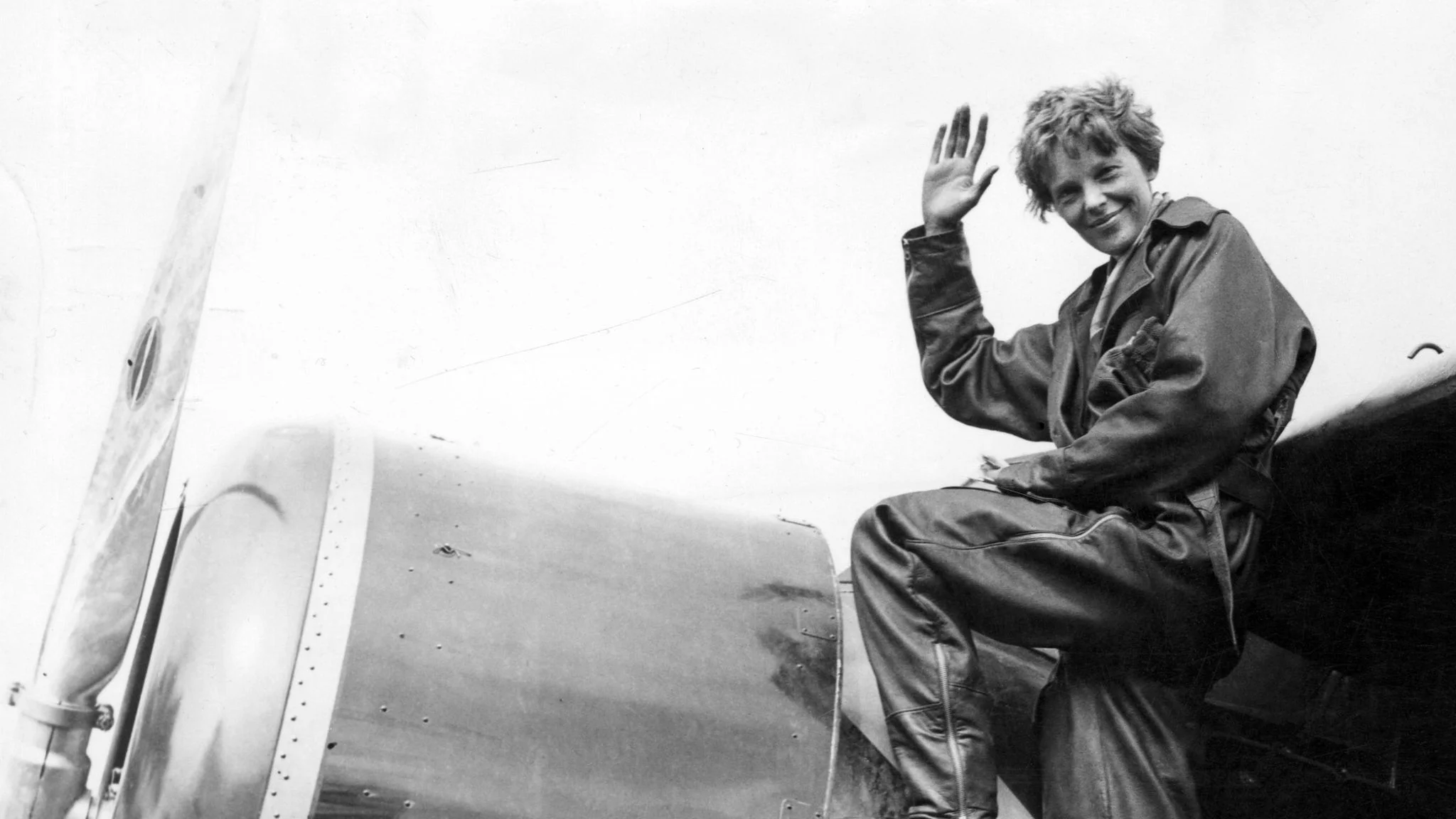
At 8:43 in the morning on July 2, 1937, the United States Coast Guard cutter Itasca, stationed near the tiny coral atoll of Howland Island in the central Pacific Ocean, received the last confirmed radio transmission from Amelia Earhart’s twin-engine Lockheed Electra. The words have reverberated through history for almost ninety years: We are on the line of position 157 337. Will repeat the message. We will repeat this message on 6210 kilocycles. Wait. Listening on 6210 kilocycles. We are running north and south. Then silence. Amelia Mary Earhart, the most celebrated female aviator in the history of aviation, was thirty-nine years old. Her navigator, Frederick Joseph Noonan, was forty-four. They had departed Lae, New Guinea, approximately twenty hours earlier, bound for Howland Island on what was to be the thirty-first of thirty-four legs in their attempt to circumnavigate the globe near the equator. They were never seen or heard from again.
The disappearance of Amelia Earhart has occupied the imagination of the United States, and of the world, for nearly nine decades. It has generated more theories, more expeditions, more documentary films, more books, and more declassified government records than almost any other disappearance in American history. As recently as September 2025, President Donald Trump ordered the declassification and release of all government records related to Earhart’s final flight, producing thousands of pages of previously restricted documents that aviation experts acknowledged were unlikely to resolve the fundamental mystery. The search continues, in satellite imagery of remote Pacific atolls, in underwater expeditions to the ocean floor near Howland Island, and in the inexhaustible human fascination with a woman whose life was a declaration that women could do anything and whose death remains as open a question as any in twentieth-century history.
A Child of the American Heartland: Amelia Earhart’s Early Life and the Spark That Ignited a Legend
Amelia Mary Earhart was born on July 24, 1897, at her maternal grandparents’ house on the banks of the Missouri River in Atchison, Kansas, to Edwin Stanton Earhart, a railroad lawyer, and Amy Otis Earhart, whose family was among Atchison’s most established. Her younger sister Muriel was born two years later. The Atchison of Earhart’s early childhood was a prosperous, conventional Victorian-era town, and her maternal grandparents’ house, where she spent school years while her parents lived in Kansas City, was the kind of respectable establishment where the expectations for young women were thoroughly conventional. Earhart was not. From her earliest years she climbed trees, hunted rats with a rifle, belly-flopped on her sled down icy hills while boys watched, and kept a scrapbook of newspaper clippings about women who succeeded in what were considered men’s professions, as an engineer, a lawyer, a bank manager, and a film producer.
Her family life became turbulent as her father’s alcoholism deepened. Edwin Earhart moved the family repeatedly — from Atchison to Des Moines to St. Paul to Chicago — as he sought and lost positions on various railroads. Amelia attended six different high schools in four years. Despite the disruption, she graduated from Chicago’s Hyde Park High School in June 1915 with an academic distinction that belied the chaos of her home life. She entered the Ogontz School near Philadelphia in 1916, then interrupted her studies when she visited her sister Muriel in Toronto at Christmas 1917 and encountered the human wreckage of the First World War: soldiers who had lost limbs in the trenches, blinded by gas, their youth expended in the mud of the Western Front. She left school and became a volunteer nurse’s aide at the Spadina Military Convalescent Hospital, spending months tending to injured soldiers. She also spent hours watching the Royal Flying Corps training pilots at a nearby airfield, and she was transfixed.
After the war, Earhart completed a semester at Columbia University studying medicine before finances forced her to join her parents in California. It was in California, at a stunt-flying exhibition on December 28, 1920, that everything changed. A pilot named Frank Hawks took her up for a ten-minute flight over Los Angeles. As she later described it, by the time I had got two or three hundred feet off the ground, I knew I had to fly. She began taking lessons from Neta Snook, one of the first women to receive a pilot’s license in the United States, at the rate of one dollar per minute. When her finances ran out she worked a series of jobs — truck driver, photographer’s assistant, stenographer — to fund her flying. On her twenty-fifth birthday, July 24, 1922, she purchased a bright yellow Kinner Airster biplane that she named The Canary, and before the year was out she had set the women’s altitude record of 14,000 feet. She received her pilot’s license in 1923. The legend was beginning.
Record by Record: How Earhart Became the Face of American Aviation and Women’s Possibility
The path from obscure Massachusetts social worker — she had moved east with her mother after her parents finally divorced in 1924 and worked at Denison House, a Boston settlement house — to global aviation celebrity began with a phone call in April 1928. A man named Captain Hilton Railey called Earhart and asked whether she would be interested in doing something for aviation. The answer was yes. The something turned out to be an invitation to become the first woman to cross the Atlantic Ocean by airplane, as a passenger. The Friendship, a Fokker trimotor seaplane piloted by Wilmer Stultz and carrying co-pilot and mechanic Louis Gordon, departed Newfoundland on June 17, 1928, and landed in Burry Port, Wales, on June 18, after a crossing of twenty hours and forty minutes. Earhart was technically a passenger who kept the log, and she was characteristically honest about this: she told interviewers that the pilot did all the work and that she had been merely a sack of potatoes along for the ride.
But the crossing made her famous. Publicist George Palmer Putnam, who had organized the Atlantic flight, became her manager, then her husband — she refused his proposals six times before finally accepting on February 7, 1931, only after he agreed to her terms, which she laid out in a letter stating that she would not be held to medieval code of faithfulness and that she expected a dual-control marriage between equal partners. She retained her own surname. They made an extraordinary team: Putnam as the tireless promoter and organizer, Earhart as the genuine pilot who was determined to prove that her celebrity was deserved on her own terms. In 1929 she participated in the Women’s Air Derby — the first women-only air race in American history, dismissed by press wags as the Powder Puff Derby — placing third and establishing herself as a serious competitive aviator. That November, she helped found the Ninety-Nines, an organization for women pilots whose founding meeting was attended by ninety-nine of the 117 women pilots in America who were invited. She became its first elected president in 1931.
The achievement that made her a figure of permanent historical importance came on May 20 to 21, 1932, when she flew solo across the Atlantic Ocean in her bright red single-engine Lockheed Vega, departing from Harbour Grace, Newfoundland, on the fifth anniversary of Charles Lindbergh’s famous crossing and landing in a field in Northern Ireland fourteen hours and fifty-six minutes later. She had planned to reach Paris, as Lindbergh had done, but deteriorating weather and instrument failure forced her down in Derry. She was the first woman, and only the second person ever, to fly solo across the Atlantic. She was awarded the Distinguished Flying Cross by Congress, the first woman to receive it, and the Cross of the French Legion of Honor. President Herbert Hoover received her at the White House. She was thirty-four years old and at the absolute pinnacle of popular celebrity.
The records accumulated with extraordinary speed. In 1932 she became the first woman to fly solo nonstop across the continental United States. In January 1935, she made the first solo flight from Honolulu, Hawaii to Oakland, California, a distance of 2,408 miles over open ocean — more than 500 miles longer than the Atlantic crossing — becoming the first person of any gender to complete that route. Later in 1935 she was the first person to fly solo from Los Angeles to Mexico City. Between 1930 and 1935 she set seven women’s speed and distance records. In 1935 Purdue University appointed her as a consultant in careers for women and an adviser in aeronautics, and the university’s Purdue Research Foundation purchased her a new twin-engine Lockheed Electra 10E, a state-of-the-art aircraft that she called her flying laboratory. By the time she announced her intention to fly around the world in 1936, Earhart had become not merely a famous pilot but a cultural institution — a symbol of what women could achieve and a living rebuke to the conventional limitations that American society continued to impose on female ambition.
Fred Noonan: The Expert Navigator Who Flew into History Alongside Earhart
Frederick Joseph Noonan was born on April 4, 1893, in Chicago, Illinois, the son of Irish-American parents. He went to sea as a young man and eventually qualified as a licensed ship’s captain and master mariner, accumulating experience in celestial navigation and oceanic route-finding that was exceptional even by the standards of professional aviators. He joined Pan American Airways in the 1920s and became one of the most respected navigators in the company, responsible for establishing many of Pan American’s China Clipper seaplane routes across the Pacific — the same oceanic routes that would later be the arena of his disappearance. He trained Pan American’s navigators in the techniques of Pacific navigation and was considered the company’s leading expert on the challenges of finding tiny island destinations in the vast, featureless expanse of the central Pacific.
Noonan had left Pan American in late 1936 after a series of incidents related to his heavy drinking, which colleagues described as episodic rather than constant: he had a reputation for arriving for flights looking hung over but performing his navigation duties with complete professionalism once airborne. He was forty-three years old when Earhart recruited him for the world flight attempt. Under the original plans, Earhart had intended two navigators: Noonan and Captain Harry Manning, a skilled radio operator who would handle communications. Manning participated in the first, aborted attempt in March 1937. By the time of the second attempt, Earhart had become dissatisfied with Manning and cut him from the crew, leaving the flight with Noonan as the sole navigator and Earhart as the sole radio operator — a decision that would have significant consequences for the final leg of the journey.
The First Attempt and the Hawaii Crash: How the World Flight Plan Changed
Earhart’s first attempt at circumnavigating the globe began on March 17, 1937, when she and her crew — including Noonan, Manning, and stunt pilot Paul Mantz, who served as technical adviser — took off from Oakland, California, in the Lockheed Electra, flying the first leg to Honolulu, Hawaii, in fifteen hours and forty-seven minutes. Three days later, when Earhart attempted to take off from Luke Field in Pearl Harbor for the next leg to Howland Island, disaster struck. The Electra suffered a ground loop during takeoff — most likely the result of a tire failure or differential braking — and crashed on the runway, the undercarriage collapsing, the right wingtip and both propellers striking the pavement, and the plane catching fire. Earhart and her crew escaped without serious injury, but the Lockheed Electra required approximately $50,000 and five weeks of repair at the Lockheed factory in Burbank, California.
The crash forced a fundamental change in the flight plan. The original route had been east to west, taking advantage of the prevailing westerly winds across the Pacific. By the time the Electra was repaired, the weather patterns had shifted, and Putnam and Earhart concluded that the route should be reversed: they would fly west to east, departing from Miami and crossing the Atlantic, Africa, Asia, and the Pacific before returning to California. The reversal meant that the most technically challenging segment — the long overwater flight from New Guinea to Howland Island in the central Pacific — would come near the end of the journey rather than near the beginning, when the crew was freshest. It also meant, crucially, that Earhart would approach that critical leg from a westward direction with the sun rising in her eyes, a factor that would affect her visual navigation on the final morning.
The second attempt also involved significant changes to the aircraft’s equipment that have attracted critical attention from aviation historians. George Putnam pressed for the removal of various items to reduce weight, including some navigational and communication equipment. Most significantly, the trailing wire antenna — a long copper wire deployed from the plane’s underside to improve radio reception at lower frequencies — was removed, reportedly because Earhart found it cumbersome to deploy and retrieve. This removal restricted Earhart’s radio to higher frequencies that were less reliable at long distances, and it meant she could not receive the radio direction-finding bearings from the Itasca at the lower frequency that would have been most useful for locating Howland Island. Manning, the skilled radio operator, was also off the crew. Earhart, who by her own admission was not an expert radio operator, would be handling communications alone.
From Miami to Lae: Twenty-Two Thousand Miles and Twenty-Nine Days Across the World
Earhart and Noonan departed Miami on June 1, 1937, heading east-southeast into the Caribbean and South America. Their route took them through Puerto Rico, Venezuela, Suriname, and Brazil, then across the South Atlantic to Dakar in Senegal, and eastward across Africa through Khartoum in Sudan and Massawa in Eritrea. From Africa they flew to Karachi in what was then British India, across the Indian subcontinent to Calcutta and Rangoon, and through Southeast Asia via Bangkok and Singapore to Bandoeng in the Dutch East Indies — today Bandung in Indonesia. They pushed on through Darwin in Australia’s Northern Territory and Port Darwin, finally arriving at Lae, in the Territory of New Guinea administered by Australia, on June 29, 1937. Twenty-two thousand miles had been completed. Seven thousand remained, and all of them would be over the Pacific Ocean.
The journey to Lae had been arduous but not catastrophic. Earhart reported various mechanical concerns with the Electra along the way, and she was visibly tired by the time she reached New Guinea. Her dispatches to her husband and to newspapers, which were later compiled by Putnam into the posthumous book Last Flight, documented the heat, the exhaustion, the mechanical anxieties, and the cumulative strain of nearly a month of arduous long-distance flying. She was honest about these difficulties in a way that reads, with hindsight, as both courageous and valedictory. I have a feeling that there is just one more good flight in my system, she had written before departing. At Lae, mechanics worked on the Electra for two days, checking the engines, the instruments, and the fuel system. The crew rested, studied charts, calculated fuel loads, and prepared for what everyone involved recognized as the most difficult leg of the entire journey.
The Final Leg: Lae to Howland Island and the Navigation Challenge of the Century
The task facing Earhart and Noonan on the morning of July 2, 1937, was navigational in character and oceanic in scale. Howland Island, their destination, was a flat coral atoll approximately 2,500 feet long and 1,600 feet wide at its widest point, rising barely three metres above sea level, with no landmarks visible from altitude and no distinctive features on radar — a world without radar, in 1937 — to distinguish it from the surrounding expanse of the central Pacific. It lay approximately 2,556 miles east of Lae, near the equator just north of the international dateline, in a zone of ocean so remote that it was accessible only by ship and had been deemed significant enough for a landing strip only because it lay precisely on the route that trans-Pacific aviation was beginning to explore. An error of just one degree in bearing over a distance of 2,500 miles would put the aircraft 44 miles off course, and in the vast Pacific, 44 miles meant the difference between finding Howland and searching empty ocean.
To assist Earhart and Noonan in finding the island, the United States government had deployed several vessels in the area. Most importantly, the Coast Guard cutter Itasca, under Commander Warner K. Thompson, was stationed directly off Howland Island with specific orders to maintain radio contact with the Electra throughout the approach, provide radio direction-finding bearings when requested, and generate a column of black smoke from its boilers as a visible landmark on the day of the arrival. On Howland itself, a small crew maintained the Department of the Interior’s weather observation station and an amateur radio operator named Yau Fai Lum monitored communications. Two additional ships, the USS Ontario and the USS Swan, were positioned at intervals along the route to provide radio navigation assistance.
Earhart and Noonan departed Lae at 10:00 a.m. local time on July 2, 1937, fully fueled with approximately 1,100 gallons of aviation fuel, enough for approximately twenty to twenty-two hours of flight. The plan was to navigate by celestial methods — sun shots and star sights taken by Noonan using his drift sight and sextant, combined with dead reckoning based on speed and heading — supplemented by radio contact with the Itasca as they neared the island. Noonan was widely considered one of the most accomplished ocean navigators in the world, the man who had plotted the Pan American Clippers across this same ocean for years. The plan was sound in conception. What went wrong in execution has been the subject of debate for eighty-seven years.
The Last Radio Transmissions: What Earhart Said and What Went Unanswered
The radio contact between Earhart and the Itasca during the final approach to Howland Island was intermittent, incomplete, and, for both parties, profoundly frustrating. Earhart had been assigned specific radio frequencies and scheduled times for transmission. She was to transmit on 3105 kilocycles at certain times and to listen for the Itasca’s response on the same frequency. The Itasca was also prepared to transmit a continuous radio direction-finding signal on 7500 kilocycles — a signal that would have given Noonan a precise bearing to home in on — but Earhart’s equipment could not receive on that frequency. Crucially, Earhart’s transmissions were consistently too short for the Itasca’s direction-finding equipment to obtain a bearing on her position: a direction fix required approximately two minutes of continuous transmission, and Earhart’s messages typically lasted only seconds.
The Itasca’s radio logs, released in November 2025 as part of the Trump administration’s declassification order, document the agonizing one-sidedness of the communication in the final hours. The Itasca heard Earhart clearly and with growing strength as the Electra approached from the west, indicating that she was coming closer to the island. At 7:42 a.m. Howland Island time, she transmitted: We must be on you but cannot see you. But gas is running low. Have been unable to reach you by radio. We are flying at altitude 1,000 feet. The signal strength was strong, suggesting she was close. The Itasca transmitted repeatedly on multiple frequencies in response — voice calls, Morse code, direction-finding signals — and Earhart apparently heard none of it, or heard it only in fragments she could not interpret. The phrase EARHART UNHEARD appears repeatedly in the Itasca’s log entries for outgoing transmissions during this period.
At 7:58 a.m., Earhart transmitted: We are circling but cannot hear you. Go ahead on 7500 either now or on the schedule time on half hour. The Itasca attempted to comply but the frequency mismatch meant no useful contact was established. At 8:43 a.m. came the final transmission: We are on the line of position 157 337. Will repeat message. We will repeat this message on 6210 kilocycles. Wait. Listening on 6210 kilocycles. We are running north and south. Then silence. The line of position 157-337 was a sun line — a navigational line derived from a sun sight that Noonan had taken, running roughly northwest to southeast through the Howland Island area. If Earhart and Noonan were running north and south along that line, they were searching for Howland by flying its length in both directions, unable to locate the tiny atoll visually. The fuel gauges were showing critical levels. The silence that followed 8:43 a.m. was permanent.
The Search: President Roosevelt’s Navy, George Putnam’s Ships, and the Ocean That Gave Nothing Back
The United States government response to Earhart’s disappearance was the most extensive naval search operation in American history to that date. President Franklin D. Roosevelt, who had received a personal letter from Earhart in November 1936 informing him of her world flight plans and whose administration had provided the logistics support for the attempt, immediately authorized a massive search. The Itasca began searching within minutes of losing contact, broadcasting requests for Earhart to respond and sweeping the ocean near Howland. The battleship USS Colorado, which happened to be in Hawaiian waters, was dispatched to the search area on July 3. The aircraft carrier USS Lexington, one of the most powerful ships in the Pacific Fleet, sailed from Santa Barbara, California, on July 13 with sixty-two aircraft aboard and conducted an intensive aerial and surface search of more than 250,000 square miles of ocean.
The search lasted officially from July 2 to July 19, 1937, seventeen days. Naval aircraft flew 102 missions. Surface ships covered 250,000 square miles of ocean. Nothing was found: no wreckage, no oil slick, no life raft, no bodies, no personal effects, nothing whatsoever that could be identified as coming from Amelia Earhart, Frederick Noonan, or their Lockheed Electra. On July 18 the government officially abandoned the search and declared the pair lost at sea. George Putnam, who had been in anguish since the morning of July 2, privately financed his own continuing search through October 1937, hiring civilian vessels to comb additional areas of the Pacific. He too found nothing. On January 5, 1939, in Superior Court in Los Angeles, Amelia Earhart was declared legally dead. She was forty years old at the time of her disappearance.
Three Theories and Eight Decades of Investigation: What Happened to Earhart and Noonan
The most widely accepted explanation for Earhart’s disappearance among aviation experts, government investigators, and many researchers is the simplest: the Electra ran out of fuel in the vicinity of Howland Island and went into the ocean. This crash-and-sink theory is supported by the testimony of Itasca crew members, who heard Earhart’s transmissions growing stronger as she approached and then cutting off abruptly, suggesting the aircraft was near Howland when contact was lost. Retired U.S. Navy Rear Admiral Richard R. Black, who was in administrative charge of the Howland Island airstrip and was present in the radio room on the Itasca, stated in 1982 that the Electra went into the sea about 10 a.m. on July 2, 1937, not far from Howland. The ocean floor in the vicinity of Howland reaches a depth of approximately 17,000 feet, which would explain why no wreckage was ever found: at that depth, the Electra would have been effectively unrecoverable with the technology available in 1937 or for decades afterward.
The second major theory, championed by the International Group for Historic Aircraft Recovery, known as TIGHAR, proposes that Earhart and Noonan did not crash into the ocean near Howland but instead followed the 157-337 line of position southward to Gardner Island, now known as Nikumaroro, an uninhabited coral atoll approximately 350 nautical miles south-southeast of Howland. TIGHAR has conducted multiple expeditions to Nikumaroro since the 1980s and has assembled a body of circumstantial evidence that its researchers regard as compelling. A week after Earhart’s disappearance, Navy search planes spotted what they described as signs of recent habitation on the island, unaware that it had been uninhabited for approximately forty-five years. In 1940, a British colonial officer discovered a partial human skeleton on Nikumaroro; later forensic analysis, published in 2018, concluded with a high statistical likelihood that the bones were consistent with Earhart’s physical characteristics, though the original bones were subsequently lost before DNA testing became available.
TIGHAR expeditions have recovered various artifacts from Nikumaroro that may or may not be associated with Earhart and Noonan: fragments of a 1930s American cosmetics jar that could have been Earhart’s freckle cream; partial remains of what may have been a woman’s shoe from the 1930s; the riveted aluminum panel with unusual characteristics; and most recently, a visual anomaly visible in satellite and underwater imagery of the island’s lagoon that researchers have called the Taraia Object and believe may be the Electra’s fuselage. As recently as November 2025, a planned expedition to investigate the Taraia Object was delayed pending permit approvals, with the team unable to complete the visit before cyclone season. The castaway theory proposes that Earhart and Noonan survived for days or weeks on Nikumaroro before dying of exposure and injury, a conclusion supported by what TIGHAR argues are post-loss radio transmissions picked up by multiple receivers between July 2 and July 13, 1937, on Earhart’s frequencies.
The third major theory — that Earhart and Noonan were captured by the Japanese — has been the most dramatic and the least substantiated. Japan controlled the Marshall Islands under a League of Nations mandate in 1937 and had been fortifying many of the islands against potential American interference, activities it was eager to conceal. Proponents of the capture theory argue that Earhart’s flight may have been a cover for a deliberate intelligence mission to photograph Japanese fortifications, and that when the Electra came down in or near the Marshall Islands, Japanese naval forces apprehended the aviators. Stories circulated for decades from residents of Saipan claiming they had seen two American captives — a woman and a man — held by the Japanese in the late 1930s, and a 2017 photograph believed at first to show Earhart and Noonan alive on a dock in the Marshall Islands generated enormous media attention before a Japanese historian identified the same photograph in a 1935 Japanese travel book, predating the disappearance. The official U.S. government position has always been that Earhart ran out of fuel and crashed into the Pacific, and no verified evidence of Japanese capture has ever been produced.
The 2025 Declassification: What Trump’s Documents Revealed — and What They Did Not
In September 2025, President Trump signed an executive order directing the declassification and release of all U.S. government records related to Amelia Earhart, her final trip, and everything else about her. Director of National Intelligence Tulsi Gabbard announced in November 2025 that the newly declassified materials included files from the National Security Agency, information on Earhart’s last known communications, weather and plane conditions at the time, potential search locations, and subsequent inquiries and theories regarding her disappearance. Thousands of documents were published on the National Archives website, including the complete July 1937 radio log from the Itasca.
Aviation experts, upon reviewing the newly released materials, generally concluded that while the documents provided important primary source documentation of the last hours of the flight and of the search that followed, they were unlikely to resolve the fundamental question of what happened. Many of the documents had been available previously to researchers, and the genuinely new materials added detail and context without providing the decisive evidence that would settle the debate. The radio logs confirmed the one-sided nature of the Itasca’s attempts to make contact with Earhart. The weather records documented the overcast conditions that may have obscured celestial navigation. The search reports confirmed the exhaustive nature of the Navy’s effort and the complete absence of findings. The mystery endured.
What Made Earhart More Than a Pilot: Her Legacy as a Cultural Icon and Women’s Champion
Amelia Earhart’s significance to American and world culture extends far beyond the aviation records she set and the mystery of her disappearance. She was, throughout her decade of celebrity, one of the most effective and articulate advocates for women’s equality and women’s possibility that early twentieth-century America produced. She argued constantly and from her own experience that women could do anything men could do, that the barriers placed before women in aviation, in business, in education, and in public life were the products of convention rather than capacity, and that the only way to demonstrate this was to break through those barriers personally and repeatedly.
Her approach to her own celebrity was distinctive and calculated. She used the commercial opportunities that fame provided — endorsements, lecture tours, book deals, the Amelia Earhart line of sportswear and luggage — to fund her flying, to remain financially independent, and to maintain the public platform from which she could advocate for women’s advancement. She lobbied for birth control rights, supported women in politics and business, and advocated for equal pay. She wrote two bestselling books about her flying experiences, 20 Hours 40 Minutes (1928) and The Fun of It (1932), both of which were also arguments for women’s aviation and for the viability of commercial air travel. Her appointment as a professor at Purdue University, where she counselled women students on careers in aviation and engineering, reflected her belief that institutional access was as important as individual achievement.
The Ninety-Nines, the organization she helped found in 1929, now has more than 7,000 members in forty-four countries, and remains the world’s largest organization for women pilots. Her 1932 solo Atlantic crossing inspired a generation of women to take up flying and to challenge the physical and institutional barriers that kept them from every category of professional life. The phrase Women must try to do things as men have tried. When they fail, their failure must be but a challenge to others captures the essential Earhart philosophy: the attempt, however it ends, is what matters; what is owed to those who come after is not an easy path but an example of courage.
The Enduring Mystery: Why We Cannot Let Earhart Go
The question of what happened to Amelia Earhart on the morning of July 2, 1937, has proven uniquely resistant to resolution, and the cultural reasons for that resistance are as interesting as the technical ones. Earhart disappeared at the height of her fame, in the middle of an adventure that the entire world was following, on a journey that had a clear symbolic purpose: to prove that a woman could circumnavigate the globe. The incompleteness of the story, its abrupt and total cessation at the moment of what should have been triumph, creates an almost unbearable narrative tension that has been driving investigation and speculation for nearly ninety years.
The physical circumstances of the disappearance have also made resolution exceptionally difficult. The central Pacific Ocean is the most remote and least-accessible place on earth. At the depths where the Electra likely rests, if the crash-and-sink theory is correct, the wreckage would require sophisticated deep-water equipment to locate and recover. The area of ocean around Howland Island that the Navy searched in 1937 was vast, but modern bathymetric surveys suggest that even the most thorough searches of that era covered only a fraction of the relevant ocean floor. If the Nikumaroro castaway theory is correct, the evidence would be limited to bone fragments, small artifacts, and the corrosion-damaged remains of aluminum aircraft components in a tropical environment that destroys organic and metallic materials alike over decades. Neither scenario lends itself to easy resolution.
The mystery has also been amplified by the very features of Earhart’s character that made her famous. She was a woman who challenged convention, who flew alone across oceans, who married on her own terms, who refused to be a passenger in her own life. The idea that such a person simply ran out of fuel and went into the ocean — the prosaic, mechanical explanation that most experts favor — feels somehow inadequate to the scale of her personality and her story. The theories that have her surviving on a desert island for weeks, or being captured by Japanese forces and held as a prisoner, or returning to the United States under a false identity, all represent attempts to construct a story worthy of the woman who lived one of the most dramatic lives of the twentieth century.
Conclusion: The Pacific Silence and the Story Without an Ending
Amelia Earhart disappeared over the Pacific Ocean on July 2, 1937. She was thirty-nine years old and had spent the better part of two decades proving, record by record and flight by flight, that the barriers placed before women by convention and prejudice were not the barriers of nature. Her final radio transmission was a navigational description, a line of position and a direction of search — the kind of language she had used throughout her career to locate herself in space and time. Then silence.
Frederick Noonan, the navigator who flew beside her and whose fate has been largely subsumed by the immensity of her fame, was forty-four years old, a man of exceptional navigational skill whose professional career had been built on finding tiny specks of land in exactly the kind of vast ocean in which he disappeared. That he could not find Howland Island on the morning of July 2, 1937, is a measure of how perfectly the conditions had aligned against them: the radio failures, the overcast sky that may have prevented celestial navigation, the fuel exhaustion after twenty hours of flight, the needle-in-a-haystack challenge of a 2,500-foot island in millions of square miles of featureless Pacific.
The Lockheed Electra that Purdue University bought Earhart as a gift on her thirty-ninth birthday, and that she called her flying laboratory, has never been found. The official search lasted seventeen days and covered 250,000 square miles. Expeditions have continued for nearly ninety years. The ocean has given nothing back. Earhart was declared legally dead on January 5, 1939. In 2025, the United States government released the last of its classified records about the disappearance, and the mystery remained what it has been since 8:43 on the morning of July 2, 1937: unanswered, and likely to remain so.
What has not remained unanswered is the question of what Earhart meant and what she achieved. She was the first woman to cross the Atlantic as a passenger, and then, because being a passenger was insufficient, the first to cross it as a pilot. She was the first to fly from Hawaii to the continental United States. She was the first woman to receive the Distinguished Flying Cross. She was the first president of the Ninety-Nines. She was, in the judgment of the culture that made her famous and that has not been able to forget her, the most consequential figure in the history of women’s aviation and one of the most important advocates for women’s equality that American public life has produced. The Pacific Ocean has her remains. The world has everything else.