
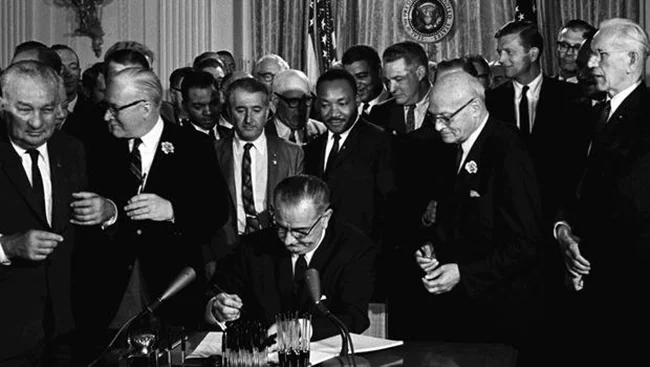
On the evening of July 2, 1964, President Lyndon Baines Johnson walked into the East Room of the White House dressed in a black suit and tie and sat down at a wooden desk in the center of the room, its walls paneled with fluted pilasters and hung with heavy gold drapes. Before him, in a ceremony that was broadcast live to a watching nation, stood the men and women who had made the moment possible: senators and representatives of both parties, cabinet members, and civil rights leaders whose lifetimes of struggle had brought this evening into being. The Reverend Martin Luther King Jr., who had called it nothing less than a second emancipation, was in the room. Roy Wilkins and Clarence Maurice Mitchell Jr. of the NAACP, Whitney M. Young of the Urban League, and Representative John Lewis were present. Using an estimated seventy-five pens, one after another, Johnson signed his name to the Civil Rights Act of 1964, the most sweeping civil rights legislation in the United States since the Reconstruction era that had followed the Civil War nearly a century earlier.
The Act that Johnson signed on July 2, 1964, was eleven titles of federal law that transformed the legal landscape of American life. It outlawed discrimination on the basis of race, color, religion, sex, or national origin in places of public accommodation — restaurants, theaters, hotels, swimming pools, libraries, and parks. It prohibited racial discrimination in employment by businesses and labor unions. It required the desegregation of public schools. It cut off federal funding to programs and institutions that practiced discrimination. And it created enforcement mechanisms, including the Equal Employment Opportunity Commission, to give the law teeth. In signing the Act, Johnson said: We believe that all men are created equal. Yet many Americans do not enjoy those rights. Today, the United States takes a new step forward. The journey to that step had been long, torturous, and paid for at an incalculable human cost.
The World the Civil Rights Act Was Meant to Destroy: Jim Crow America and the Architecture of Legal Segregation
To understand the magnitude of what was signed in the East Room on July 2, 1964, it is necessary to understand the world that the Civil Rights Act was designed to end. Following the Civil War and the brief democratic experiment of Reconstruction, in which African Americans in the South voted, held office, and exercised the rights of citizenship, the withdrawal of federal troops from the South in 1877 opened the way for a systematic reimposition of racial subordination across the former Confederate states. Through a combination of legal statutes, extralegal violence, and economic coercion, the white political establishments of the southern states constructed a comprehensive system of racial apartheid that denied African Americans access to the ballot box, imposed mandatory separation in all areas of public life, and enforced both structures through the constant threat and frequent reality of violence.
The legal foundation of this system was laid in the Supreme Court’s 1896 decision in Plessy v. Ferguson, which upheld Louisiana’s Separate Car Act by ruling that state laws requiring racial segregation were constitutional as long as the separate facilities provided were equal. The separate-but-equal doctrine gave constitutional blessing to an entire architecture of racial subordination. Across the eleven states of the former Confederacy and in significant portions of the border states and the North, the law required Black Americans to use separate entrances, sit in separate sections, attend separate schools, drink from separate water fountains, eat at separate lunch counters, stay in separate hotels, receive care in separate hospital wards, and be buried in separate cemeteries. The facilities provided were almost never equal: Black schools received a fraction of the funding that white schools received; Black hospitals were underfunded and understaffed; Black neighborhoods received inferior municipal services of every kind.
Beyond the legal structure of Jim Crow lay a broader reality of economic subordination and terror. The Ku Klux Klan, revived in the early twentieth century and at its peak membership of between three and six million in the 1920s, enforced racial hierarchy through intimidation, economic pressure, and violence. Between the end of Reconstruction and 1950, approximately 4,000 documented lynchings of African Americans occurred in the southern states alone, with many more cases unreported. African Americans who registered to vote in the South faced poll taxes, literacy tests administered with openly discriminatory intent, economic retaliation from white employers and landlords, and physical danger. By the middle of the twentieth century, despite the constitutional guarantees of the Fourteenth and Fifteenth Amendments, the percentage of Black voters registered in the states of the Deep South was in many places below ten percent.
The Seeds of Change: World War II, Brown v. Board of Education, and the Birth of the Modern Civil Rights Movement
The forces that would eventually produce the Civil Rights Act of 1964 began gathering strength in the 1940s. The Second World War created a profound ideological contradiction for a nation that asked Black Americans to fight and die for democracy abroad while maintaining racial apartheid at home. More than one million African Americans served in the segregated armed forces during the war, and many returned home having fought against fascism and racial ideology in Europe with a determination that they would not return to second-class citizenship at home. A. Philip Randolph, the labor leader and civil rights activist who had organized the Brotherhood of Sleeping Car Porters in the 1920s, threatened in 1941 to organize a March on Washington of one hundred thousand Black citizens unless President Roosevelt issued an executive order banning discriminatory hiring by federal contractors. Roosevelt issued Executive Order 8802 on June 25, 1941, the first federal action against employment discrimination since Reconstruction.
In July 1948, President Harry S. Truman signed Executive Order 9981, desegregating the United States armed forces, after a committee he had established concluded that the treatment of Black veterans in the post-war South was unconscionable. The order desegregated the military but left the broader structures of civilian Jim Crow intact. The decisive legal blow against the separate-but-equal doctrine came on May 17, 1954, when the Supreme Court of the United States, in its unanimous decision in Brown v. Board of Education of Topeka, Kansas, ruled that racially segregated public schools were inherently unequal and constituted a violation of the Equal Protection Clause of the Fourteenth Amendment. Chief Justice Earl Warren, writing for a court that included both liberal and conservative justices, declared that separate educational facilities are inherently unequal. The Brown decision overturned Plessy v. Ferguson in the educational context and established the constitutional principle that would eventually undergird the Civil Rights Act of 1964.
The decade following Brown saw an explosion of civil rights activism and organized resistance to segregation across the South, and a corresponding backlash from the white power structure that was determined to maintain racial hierarchy at any cost. In December 1955, Rosa Parks, a forty-two-year-old seamstress and NAACP activist in Montgomery, Alabama, refused to give up her seat on a city bus to a white passenger, and was arrested for violating the city’s bus segregation ordinance. The Montgomery Bus Boycott that followed, organized in significant part by the twenty-six-year-old Reverend Martin Luther King Jr., lasted 381 days and ended with a Supreme Court ruling that Alabama’s bus segregation laws were unconstitutional. King, born January 15, 1929, in Atlanta, Georgia, the son of a Baptist minister, emerged from Montgomery as the most visible leader of the nonviolent resistance movement and the moral voice that would guide the civil rights struggle through the decade of its greatest achievement.
Through the late 1950s and early 1960s, the movement deployed a strategy of nonviolent direct action, inspired by the teachings of Mahatma Gandhi and shaped by the specific theology of the African American church, to expose the violence and inhumanity of segregation to a watching national and international audience. In February 1960, four Black college students at North Carolina Agricultural and Technical College in Greensboro sat down at the whites-only lunch counter at a Woolworth’s store and requested service. They were refused but refused to leave. The sit-in movement spread within weeks to dozens of cities across the South, drawing in thousands of student participants and leading to the formation in April 1960 of the Student Nonviolent Coordinating Committee, known as SNCC. In 1961, the Congress of Racial Equality, known as CORE, organized the Freedom Riders, interracial groups of activists who boarded interstate buses to challenge segregation in southern bus terminals, and whose buses were burned and whose riders were brutally beaten by white mobs in Anniston and Birmingham, Alabama, with local law enforcement conspiring with the attackers.
Birmingham 1963: The Photographs That Moved a President and a Nation
The single most important catalyst for the legislative action that produced the Civil Rights Act of 1964 was the Birmingham Campaign of spring 1963, organized by the Southern Christian Leadership Conference under the leadership of Martin Luther King Jr. and the strategic direction of Reverend Fred Shuttlesworth, the founder of the Alabama Christian Movement for Human Rights. Birmingham, Alabama, was the most thoroughly segregated major city in the United States, a place where Bull Connor, the city’s Commissioner of Public Safety, was a committed and openly contemptuous enforcer of white supremacy. King and Shuttlesworth chose Birmingham precisely for this reason: they understood that Connor’s response to nonviolent protest would expose the violence at the heart of segregation to a national and international audience.
Beginning in early April 1963 and continuing through May, thousands of Black Birminghamians marched, sat in at segregated lunch counters, and knelt in prayer in the streets and public spaces of their city. Connor’s response was everything they had anticipated and worse. Fire hoses powerful enough to strip bark from trees were turned on women, children, and elderly marchers. Police dogs were set on peaceful demonstrators. Hundreds of protesters, including many children, were arrested and jailed. The photographs and television footage of these scenes, transmitted around the country and around the world, produced a wave of revulsion and outrage that reached into the White House. On May 12, a bomb exploded at the Gaston Motel, where King had been staying. On September 15, 1963, a bomb planted by Ku Klux Klan members exploded at the Sixteenth Street Baptist Church in Birmingham, killing four young girls: Addie Mae Collins, Cynthia Wesley, Carole Robertson, and Carol Denise McNair.
The Birmingham Campaign also brought to a head another confrontation that forced President Kennedy’s hand. Governor George Wallace of Alabama, who had proclaimed in his January 1963 inaugural address: Segregation now, segregation tomorrow, segregation forever, refused to allow the enrollment of two Black students, Vivian Malone and James Hood, at the University of Alabama. On June 11, 1963, Kennedy was forced to federalize the Alabama National Guard to ensure that the students could register, confronting the spectacle of the governor of a state personally blocking the entrance to a public university against a federal court order. That evening, Kennedy addressed the nation in a televised speech, the first time a sitting President had framed the civil rights struggle in explicitly moral terms. The United States, he said, will not be fully free until all of its citizens are free. And then, on June 19, 1963, he sent to Congress the most comprehensive civil rights bill that any president had ever proposed.
Kennedy’s Proposal and the March on Washington: Building the Political Foundation for the Civil Rights Act
President John Fitzgerald Kennedy‘s civil rights bill of June 1963 was the product of a political calculation that had been building for more than two years. Kennedy had entered the White House in January 1961 with a genuine personal commitment to civil rights, but also with the political caution of a man who had won the 1960 election with a narrow margin and who understood that his legislative program depended on the support of Southern Democrats whose chairmanships of key Senate and House committees gave them disproportionate power. He was wary of antagonizing southern Democrats whose support he needed for the rest of his agenda: the tax cut, the foreign aid bill, the nuclear test ban treaty, the education bill. The events of Birmingham, and the global attention they attracted, left him with no alternative. Supporting civil rights was now, Kennedy told his advisers, both the right thing to do and the politically necessary thing to do.
Kennedy’s bill went to the House Judiciary Committee, chaired by Emanuel Celler of New York, a liberal Democrat from Brooklyn who had served in the House since 1923 and who was among the most committed advocates of civil rights legislation in Congress. Celler’s committee strengthened the bill beyond Kennedy’s original proposal, adding an employment discrimination prohibition (Title VII) and other protections. The ranking Republican on the Judiciary Committee, William Moore McCulloch of Piqua, Ohio, was a quietly powerful figure whose support was essential for any Republican votes in the House. On July 2, 1963 — exactly one year before Johnson signed the final act — Assistant Attorney General Burke Marshall flew to Ohio to meet with McCulloch and secure his commitment to support the bill. McCulloch agreed, on the condition that the bill would not be watered down in the Senate, that he would be able to approve any amendments, and that Republicans would receive credit for their role in passage.
On August 28, 1963, the March on Washington for Jobs and Freedom gathered more than 250,000 people on the National Mall in Washington, D.C., in the largest political demonstration in American history to that date. The march was organized by A. Philip Randolph, who had first proposed a March on Washington in 1941, and directed by Bayard Rustin, a brilliant strategist and organizer. Its speakers included the leaders of virtually every major civil rights organization: John Lewis of SNCC, Whitney Young of the Urban League, Roy Wilkins of the NAACP, and James Farmer of CORE. It was at the Lincoln Memorial that afternoon, before a crowd that stretched from the Washington Monument to the Memorial steps, that Martin Luther King Jr. delivered the speech that would define the aspirations of the movement for generations: I have a dream that one day this nation will rise up and live out the true meaning of its creed — that all men are created equal. Kennedy met with civil rights leaders at the White House later that day and was moved by what he had witnessed.
Kennedy’s Assassination and Johnson’s Inheritance: November 22, 1963 Changes Everything
On November 22, 1963, President John F. Kennedy was shot and killed in Dealey Plaza in Dallas, Texas, while riding in a presidential motorcade. The assassination transformed the political landscape for the civil rights bill in ways that were simultaneously tragic and decisive. Kennedy had been unable to move the bill through Congress: the House Rules Committee, chaired by Howard W. Smith of Virginia, a dedicated segregationist, had bottled up the bill and shown no intention of allowing it to reach the floor. In the Senate, Majority Leader Mike Mansfield of Montana and the liberal advocates of the bill knew they lacked the votes to break a certain filibuster by the southern Democratic bloc. The bill appeared to be headed for the same fate that had befallen previous civil rights legislation: stalled in committee, talked to death in the Senate, ultimately gutted or abandoned.
Lyndon Baines Johnson, who had been sworn in as the thirty-sixth President of the United States aboard Air Force One at Love Field in Dallas on the afternoon of November 22, 1963, with Jacqueline Kennedy standing beside him, was a very different kind of politician from Kennedy. Johnson had grown up in the Texas Hill Country, the son of a state legislator, and had spent his career mastering the machinery of congressional power with an intensity and ruthlessness that had made him one of the most formidable legislative operators in Senate history. As Senate majority leader from 1955 to 1961, he had secured the passage of the Civil Rights Acts of 1957 and 1960, the first such legislation in eighty-two years, though both had been significantly weakened through the same kinds of compromises he would now have to manage. Johnson understood Congress the way a surgeon understands anatomy, and he understood that the moment of national grief following Kennedy’s assassination was a window of political opportunity that would not remain open indefinitely.
In his first address to a joint session of Congress, on November 27, 1963, five days after the assassination, Johnson framed the civil rights bill in terms that were both political masterstroke and genuine conviction: No memorial oration or eulogy could more eloquently honor President Kennedy’s memory than the earliest possible passage of the civil rights bill for which he fought so long. He told the nation: We have talked long enough in this country about equal rights. We have talked for one hundred years or more. It is time now to write the next chapter, and to write it in the books of law. And in his first State of the Union address in January 1964, he added: Let this session of Congress be known as the session which did more for civil rights than the last hundred sessions combined. Johnson had not merely inherited Kennedy’s bill: he had adopted it as his own defining mission.
The Battle in Congress: Discharge Petitions, Filibusters, and the Long Road to Passage
The legislative journey of what became the Civil Rights Act of 1964 was one of the most complex, dramatic, and historically significant episodes in the history of American democracy. In the House of Representatives, the bill HR 7152 was referred after Kennedy’s assassination to the Rules Committee, still chaired by Howard W. Smith of Virginia, who had stated his intention to keep the bill bottled up indefinitely. Chairman Emanuel Celler of the Judiciary Committee filed a discharge petition, which required the signatures of a majority of House members to bypass the Rules Committee and bring the bill directly to the floor. The threat of a successful discharge petition, combined with the overwhelming public pressure following Kennedy’s death and the moral weight of the civil rights movement, eventually forced Smith to relent. He allowed the bill to pass through the Rules Committee in January 1964.
The House debate on the bill lasted nine days, during which nearly one hundred amendments designed to weaken or kill the legislation were proposed and rejected. The bill passed the House of Representatives on February 10, 1964, by a vote of 290 to 130, a substantial bipartisan majority. Republicans voted 136 in favor and 35 against; Democrats voted 153 in favor and 91 against. The bill was stronger than Kennedy’s original proposal, having been enhanced by Celler’s committee to include the employment discrimination provisions of Title VII and other reinforcements. The legislation that passed the House prohibited discrimination in public accommodations, forbade discrimination by employers and labor unions, created the Equal Employment Opportunity Commission, prohibited discrimination in federally funded programs, and authorized the federal government to bring lawsuits to desegregate public schools. An amendment added by Howard Smith himself — apparently intended to reduce the bill’s chances of passage by adding sex to the list of protected characteristics — instead permanently expanded the Act’s scope. Title VII’s prohibition of employment discrimination covered race, color, religion, national origin, and sex.
The real battle was in the Senate. When the House-passed bill arrived in the Senate on February 26, 1964, Majority Leader Mike Mansfield of Montana made a critical procedural decision: rather than referring the bill to the Senate Judiciary Committee, which was chaired by James O. Eastland of Mississippi, a committed opponent who would have buried it, Mansfield placed it directly on the Senate calendar. On March 9, when Mansfield moved to take up the measure as the Senate’s pending business, the southern Democratic bloc launched its filibuster. The Senate filibuster of the Civil Rights Act of 1964 became the longest filibuster in Senate history: eighty-three days of continuous debate that filled more than 3,000 pages in the Congressional Record. Richard B. Russell Jr. of Georgia, the leader of the Southern bloc and one of the most powerful figures in the Senate, declared that the South would resist to the bitter end any measure that would tend to bring about social equality. Senator Strom Thurmond of South Carolina called the bill unconstitutional, unnecessary, and unwise. Senator Robert Byrd of West Virginia delivered the longest individual speech against the bill, speaking for fourteen hours and thirteen minutes on June 9 and 10.
Humphrey, Dirksen, and the Cloture Vote That Made History: Breaking the Filibuster
The key to breaking the Senate filibuster lay in the arithmetic of the Senate. In 1964, a two-thirds vote — sixty-seven of one hundred senators — was required to invoke cloture and cut off debate. The southern Democrats had thirty-three reliable votes against cloture, making it mathematically impossible to end the filibuster without the votes of a substantial number of Senate Republicans. The man who could deliver those Republican votes was Everett McKinley Dirksen of Illinois, the Republican minority leader. Dirksen was a theatrical politician of considerable personal charm and oratorical skill, known for the elaborate rhetoric and Churchillian cadences of his floor speeches. He had opposed some provisions of the original bill, primarily on constitutional grounds about federal power in the private sector, but he had a genuine personal commitment to civil rights that was rooted in his reading of the Constitution and the principles of his party.
Hubert Horatio Humphrey of Minnesota, the Democratic whip who managed the bill on the Senate floor for the majority, spent weeks in careful negotiation with Dirksen, working through Dirksen’s objections section by section and drafting compromise language that preserved the bill’s essential substance while addressing Dirksen’s specific constitutional concerns. The result was the Dirksen-Mansfield-Kuchel-Humphrey substitute bill, introduced by Dirksen on May 26, 1964. Once the compromise had been reached, Dirksen rose to deliver one of the most consequential speeches in Senate history, urging his Republican colleagues to support the bill as an idea whose time has come, quoting Victor Hugo. He declared that no army is stronger than an idea whose time has come, and made the case that the principles of the Republican Party — the party of Lincoln, the party that had fought to end slavery — required its members to vote for civil rights.
On June 10, 1964, in a dramatic roll call vote with all one hundred senators present, the Senate voted 71 to 29 to invoke cloture — the first time in the entire history of the Senate that a filibuster against a civil rights bill had been successfully ended. The historical significance of the cloture vote cannot be overstated: not once in the preceding century, through all the civil rights bills proposed since Reconstruction, had the Senate been able to overcome southern obstruction. Nine days later, on June 19, 1964, exactly one year after Kennedy had sent his bill to Congress, the Senate passed the Civil Rights Act by a vote of 73 to 27. Ralph Yarborough of Texas was the only Southern senator to vote in favor. Of the twenty-seven senators voting against, twenty-one were Southern Democrats and six were conservative Republicans.
July 2, 1964: The Signing Ceremony in the East Room and What It Meant
The House of Representatives voted to accept the Senate’s version of the bill on July 2, 1964, by a vote of 289 to 126. A few hours later, in a historically fraught parallel — July 2, 1964 was what would have been the thirty-ninth birthday of Medgar Evers, the NAACP field secretary who had been assassinated in his own driveway in Jackson, Mississippi, on June 12, 1963 — President Johnson convened the signing ceremony in the East Room. The room was packed with members of Congress from both parties, cabinet members, and civil rights leaders who had waited for this moment through decades of struggle.
Johnson’s remarks before the signing were carefully prepared, with six drafts having been written before the final version was set on the teleprompter. Johnson added extemporaneously one small but significant word — the word long in the phrase the United States takes a long step forward — that captured, as the Library of Congress later noted, the hard-fought, step-by-step efforts of countless Americans over the course of a century in the slow progression towards realizing civil rights. He told the nation: We believe that all men have certain unalienable rights. Yet many Americans do not enjoy those rights. He reminded the watching country that the bill had received the bipartisan support of more than two-thirds of the members of both the House and the Senate, an overwhelming majority of Republicans as well as Democrats. Then he signed the bill with the first of approximately seventy-five pens and began distributing them.
The distribution of signing pens was itself a statement about the coalition that had produced the Act. Senator Humphrey, the Democratic floor manager who had spent months cajoling and negotiating his way through the Senate, received one of the first pens. Senator Dirksen, whose Republican votes had broken the filibuster, received another. Attorney General Robert F. Kennedy, who had been deeply involved in the legislative effort as his brother’s chief advocate for the bill, received one. House Minority Leader Charles Halleck of Indiana, who had delivered Republican votes in the House, received one. And Martin Luther King Jr. received one, a pen that he later called one of his most cherished possessions. Johnson reportedly confided to an aide that evening a remarkably prescient political observation: I think we just delivered the South to the Republican Party for a long time to come. The political realignment that Johnson predicted — the long-term defection of white southern voters from the Democratic Party — would unfold over the following decades with the exactness he had foreseen.
The Eleven Titles: What the Civil Rights Act of 1964 Actually Said and Did
The Civil Rights Act of 1964 was divided into eleven titles, each addressing a specific area of discrimination. Title I strengthened existing prohibitions on discriminatory voting registration requirements, prohibiting the use of different standards for Black and white voter applicants. Title II was the public accommodations provision, prohibiting discrimination in hotels, motels, restaurants, cafeterias, lunch counters, gas stations, theaters, and other places serving the general public. Title III authorized the federal government to file lawsuits to desegregate publicly owned facilities including parks, stadiums, and swimming pools. Title IV addressed school desegregation, authorizing the federal government to file desegregation suits and directing the Office of Education to provide technical and financial assistance to schools undertaking desegregation.
Title VI was among the most powerful practical tools in the Act, prohibiting discrimination in any program or activity receiving federal financial assistance and authorizing the termination of federal funds to discriminating institutions. This provision gave the federal government an enormous lever: any hospital, school, university, or other institution that received federal money — which by 1964 included virtually every public institution in the country through the various programs established under the New Deal and post-war federal expansion — risked losing that funding if it practiced discrimination. Title VI would prove transformative in the desegregation of public schools across the South, as the threat of losing federal education funds forced school districts to comply with desegregation requirements that they had successfully resisted for a decade following Brown v. Board of Education. Title VII was the employment discrimination provision, prohibiting employers, labor organizations, and employment agencies from discriminating on the basis of race, color, religion, sex, or national origin. Title VII also created the Equal Employment Opportunity Commission, the EEOC, as the enforcement agency for employment discrimination claims.
The addition of sex as a protected category in Title VII — inserted through an amendment by Representative Howard Smith of Virginia, apparently intended to mock or undermine the bill — had consequences that Smith certainly did not intend. The prohibition on sex discrimination in employment became the legal foundation for decades of advances in women’s workplace rights, for the Supreme Court’s interpretation of sexual harassment as a form of sex discrimination, and eventually for legal protections against discrimination on the basis of sexual orientation and gender identity. The Act’s eleven titles, working together, created a comprehensive federal framework for combating discrimination that was fundamentally new in American law: for the first time, the federal government had asserted a general power to prohibit discrimination not only by governmental actors but by private businesses and institutions.
Resistance and Implementation: The South Defies the Law and the Federal Government Responds
The signing of the Civil Rights Act did not end discrimination or resistance to it. In the days immediately following the signing, many white business owners across the South defied the public accommodations provisions, posting signs that declared their continued intention to serve white customers only. In some communities, public swimming pools were drained and closed rather than integrated. Restaurant owners locked their doors. Others complied quietly, motivated by the threat of lawsuits and the loss of federal contracts. The early implementation of the Act was uneven, contested, and in many places violent, but its legal force was quickly confirmed by the federal courts.
The first major constitutional test came within months. In Heart of Atlanta Motel, Inc. v. United States, decided by the Supreme Court in December 1964, the Court unanimously upheld Title II’s public accommodations provision, ruling that Congress had the authority under the Commerce Clause of the Constitution to prohibit racial discrimination by private businesses that affected interstate commerce. The decision resolved the constitutional question that segregationists had raised about Congress’s power to regulate private conduct and cleared the way for vigorous enforcement of the public accommodations provisions. Simultaneously, the Civil Rights Act’s Title IV and Title VI desegregation provisions, backed by the threat of federal fund termination, began to produce significant progress in school desegregation across the South — though resistance, legal challenges, and the practical difficulties of dismantling a system built over generations meant that the process would continue for years and decades.
The Civil Rights Act’s Children: Voting Rights Act, Fair Housing Act, and the Legislative Revolution
The Civil Rights Act of 1964 was the first of three major civil rights laws passed in the mid-1960s that together constituted the most comprehensive legislative revolution in American law since the Constitutional amendments of the Reconstruction era. The Voting Rights Act of 1965, signed by Johnson on August 6, 1965, addressed the gap that the Civil Rights Act had left in voting rights protections by imposing direct federal control over election administration in states and counties with histories of racial discrimination. It prohibited literacy tests and other discriminatory voting prerequisites, required jurisdictions covered by its special provisions to obtain federal preclearance before changing any voting law or procedure, and authorized federal election observers. Within three years of its passage, Black voter registration in the covered states had roughly doubled. The Fair Housing Act of 1968, signed on April 11, 1968, one week after Martin Luther King Jr. was assassinated in Memphis, prohibited discrimination in the sale, rental, and financing of housing.
The Civil Rights Act’s Title VII employment provisions generated decades of litigation and interpretation that extended the Act’s protections far beyond what its drafters had anticipated. The EEOC became a major federal enforcement agency handling hundreds of thousands of discrimination complaints annually. Courts interpreted Title VII’s prohibition on sex discrimination to encompass sexual harassment, pregnancy discrimination, and eventually discrimination based on sexual orientation and gender identity — a development confirmed by the Supreme Court in Bostock v. Clayton County in 2020. The Act’s provisions were extended and supplemented by subsequent legislation: the Age Discrimination in Employment Act of 1967, the Americans with Disabilities Act of 1990, and the Civil Rights Act of 1991, which among other things reversed several Supreme Court decisions that had restricted the Act’s coverage.
The Key People: Johnson, King, Humphrey, Dirksen, and the Coalition That Changed America
The Civil Rights Act of 1964 was the product of an extraordinary coalition of individuals whose different roles, motivations, and constituencies combined to produce a legislative achievement that none of them could have accomplished alone. Lyndon Baines Johnson, born August 27, 1908, near Stonewall, Texas, the son of a state legislator and schoolteacher, brought to the fight for the Civil Rights Act the full weight of his legislative mastery and his genuine conviction, deepened by his own experience growing up in poverty in the Texas Hill Country, that the exclusion of any American from the mainstream of opportunity was a betrayal of the nation’s founding promise. His success in moving the bill through Congress depended on his willingness to use every tool of presidential power and personal persuasion available to him, from patronage appointments to late-night phone calls to the calculated deployment of political favors accumulated over decades.
Martin Luther King Jr., born January 15, 1929, in Atlanta, Georgia, provided the moral vision and the organizational leadership that created the conditions in which legislation became possible. His genius was the strategy of nonviolent direct action, which exposed the violence and injustice of segregation to a national audience in a way that made continued federal inaction politically untenable. His Birmingham Campaign of 1963, his March on Washington speech, and his constant testimony to the humanity and dignity of Black Americans created a moral climate in which the political operators in Washington were able to act. Without the movement King led, there would have been no political will to act; without the political will that Johnson orchestrated, the movement’s moral pressure would not have been translated into law.
Hubert Humphrey and Everett Dirksen were the legislative craftsmen who built the bipartisan bridge without which the Act could not have passed. Humphrey, born May 27, 1911, in Wallace, South Dakota, had been arguing for a federal civil rights plank since his electrifying speech at the 1948 Democratic National Convention, in which he urged the party to walk forthrightly into the bright sunshine of human rights. Dirksen, born January 4, 1896, in Pekin, Illinois, brought to the bill the Republican votes that made the Senate mathematics work, and his floor speech quoting Victor Hugo gave Republicans a noble framework for casting their votes. Emanuel Celler, born May 6, 1888, in Brooklyn, New York, and the chairman of the House Judiciary Committee for twenty-two years, was the House’s chief legislative architect. William McCulloch of Ohio, the quiet Republican whose commitment to the bill’s integrity was essential for bipartisan House support, demonstrated that principled opposition to discrimination crossed party lines. Roy Wilkins of the NAACP, born August 30, 1901, in St. Louis, Missouri, and the entire apparatus of the civil rights organizations whose pressure, lobbying, and organizing maintained the political momentum for the bill, were essential to its passage.
The Legacy of July 2, 1964: What the Civil Rights Act Changed and What It Left Unfinished
The Civil Rights Act of 1964, in the sixty years since its signing, has transformed American life in ways that are simultaneously profound and incomplete. It effectively ended the legal structure of Jim Crow segregation in the South. The signs designating separate water fountains and restaurant entrances came down. Hotels and motels were required to admit all customers regardless of race. Public schools were required to desegregate, and the threat of federal fund termination gave teeth to that requirement in ways that court orders alone had failed to provide. The EEOC created a mechanism through which individual victims of employment discrimination could seek redress. The systematic legal architecture of racial apartheid that had stood for nearly a century was dismantled.
At the same time, the Act’s limitations were apparent from the beginning and have remained apparent in the decades since. Legal equality did not produce economic equality: the structures of economic inequality built over centuries of slavery and segregation — unequal educational opportunity, segregated neighborhoods produced by discriminatory housing policies, exclusion from wealth-building through homeownership and business access, the legacy of unpaid labor — could not be undone by the stroke of a pen, however historic. The Voting Rights Act of 1965 made significant progress toward political equality, but its core enforcement mechanism was gutted by the Supreme Court’s decision in Shelby County v. Holder in 2013, which found the coverage formula unconstitutional and effectively suspended preclearance requirements for covered jurisdictions. The Fair Housing Act of 1968 prohibited housing discrimination but did not produce residential integration: American neighborhoods remain highly segregated by race sixty years after its passage.
The Civil Rights Act of 1964 also left incomplete the question of how to address the accumulated inequalities of the past, a debate that has continued under the labels of affirmative action, reparations, and racial equity through every decade since the Act’s passage. The Act’s fundamental approach was anti-discrimination: it prohibited specific acts of discriminatory treatment but did not mandate remediation of past wrongs. Courts and administrative agencies gradually extended affirmative action requirements as a remedy for past discrimination, but these measures have been subject to persistent legal challenge, and the Supreme Court in 2023, in Students for Fair Admissions v. Harvard and v. University of North Carolina, ruled that race-conscious admissions programs at colleges and universities violated the Equal Protection Clause, significantly restricting the tools available to institutions seeking to address racial inequality.
Conclusion: What Was Accomplished on July 2, 1964 and Why It Endures
When Lyndon Johnson signed the Civil Rights Act of 1964 in the East Room of the White House on the evening of July 2, he used seventy-five pens, one for each letter and portion of his signature, as was the tradition for historically significant legislation. He distributed them to the men and women who had made the moment possible: the senators and representatives, the civil rights leaders, the lawyers and organizers who had spent their careers building toward this evening. Martin Luther King Jr., who received one of those pens, called it a second emancipation. The comparison was not hyperbole. The Civil Rights Act of 1964 did what the Emancipation Proclamation of 1863 had not: it created a comprehensive federal legal framework that prohibited racial discrimination across the full range of American public life and gave the federal government the power and the obligation to enforce that prohibition.
The Act’s passage was not inevitable. It required the specific conjunction of moral pressure from below — the Montgomery Bus Boycott, the sit-ins, the Freedom Rides, the Birmingham Campaign, the March on Washington — and political will from above, in the form of Kennedy’s proposal and Johnson’s relentless legislative pressure. It required the breakdown of the barriers of partisanship, with Dirksen’s Republicans providing the margin that overcame the southern Democratic filibuster. It required the sacrifice of individuals who put themselves in the path of fire hoses and police dogs in Birmingham, who were beaten on Freedom Rides in Anniston, who were murdered in Mississippi, who organized in the face of terror across the Deep South. It required the courage of politicians who were willing to act in the knowledge that their action would cost their party dearly in the regions where segregation had its deepest roots — a cost that Johnson predicted and that came to pass exactly as he said it would.
The Civil Rights Act of 1964 remains, sixty years after its signing, one of the most consequential pieces of legislation in American history. It did not end racial inequality, and it did not resolve the deep disagreements about how inequality should be addressed that continue to define American politics. But it established, for the first time as a matter of unambiguous federal law, that discrimination on the basis of race, color, religion, sex, or national origin has no place in American public life, and it created the legal and institutional framework through which the ideal of equality can continue to be pursued. The seventy-five pens that Johnson distributed on the evening of July 2, 1964, were tools of law made into symbols of commitment — a commitment that the United States made to all of its citizens, and that all of its citizens continue to hold it to.