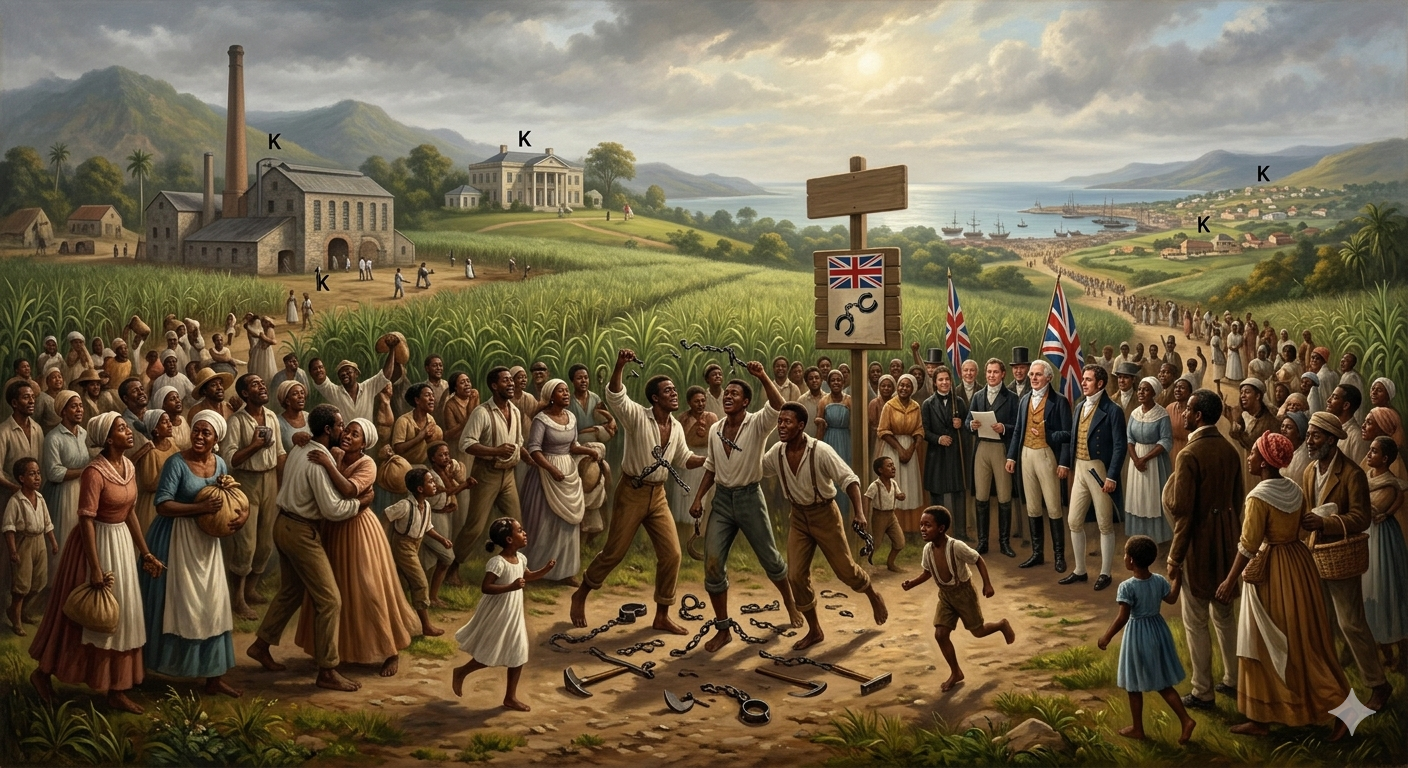
On August 28, 1833, the Slavery Abolition Act received Royal Assent in the Parliament of the United Kingdom, formally ending the institution of slavery across most of the British Empire. The Act freed more than 800,000 enslaved Africans and their descendants held in the Caribbean, South Africa, and Canada, making the purchase or ownership of enslaved people illegal throughout Britain’s colonial territories. It took effect on August 1, 1834, and represented the culmination of more than six decades of organized abolitionist campaigning, the sacrifices and resistance of enslaved people themselves, and a fundamental shift in both the moral conscience and the economic interests of British society.
The Slavery Abolition Act was not the end of the story. The law imposed a transitional system of forced apprenticeship on those it purported to free, and full emancipation for all formerly enslaved people did not come until August 1, 1838. But August 28, 1833 remains the date on which the British Parliament committed, however imperfectly, to the legal end of slavery in the empire that had done more than almost any other nation to spread the institution across the Atlantic world.
Britain and the Atlantic Slave Trade: The Scale of the Crime
To understand the significance of the 1833 Act, it is necessary to understand the scale of what Britain’s involvement in the Atlantic slave trade had been. From the late sixteenth century through the early nineteenth century, British merchants and the British state had been central participants in the transatlantic trade in human beings. British slave ships transported millions of enslaved Africans across the Atlantic Ocean in conditions of extreme brutality and mortality. By the time the trade was at its peak in the 1780s, Britain was the largest single national participant in the Atlantic slave trade, responsible for transporting more enslaved Africans than any other European power.
The economic foundation of Britain’s Caribbean colonies rested entirely on enslaved labor. Jamaica, Barbados, Antigua, Trinidad, and the other sugar-producing islands of the British Caribbean generated enormous wealth for their owners, for the British merchants who traded their products, and for the British government that taxed them. The triangular trade connecting Britain, West Africa, and the Caribbean was one of the most profitable commercial systems in the world. The sugar, tobacco, cotton, and rum that enslaved people were forced to produce flowed into British markets, making fortunes for plantation owners and generating revenues that funded British economic and imperial expansion.
The enslaved people at the center of this system suffered conditions of extraordinary violence. They were legally classified as property, not persons. They could be bought and sold, separated from their families, and subjected to physical punishment and death at the will of their owners. They resisted this system in every way available to them, from small acts of sabotage and slow working to organized revolts that terrified the planter class and contributed directly to the eventual decision to abolish the institution.
The Long Road to Abolition: From the Somerset Case to the 1807 Slave Trade Act
The movement to end slavery in Britain had its roots in the late eighteenth century and drew on several distinct streams of moral, religious, and legal argument. One of its earliest and most important catalysts was a legal case heard in 1772.
James Somerset was an enslaved man who had been brought to England from Boston in Massachusetts by his enslaver, Charles Stewart. While in England, Somerset escaped. He was recaptured and was being held on a ship in the Thames, about to be transported to Jamaica to be sold, when Granville Sharp, a dedicated abolitionist who had made it his personal mission to challenge the legal basis of slavery in England, brought a case before Lord Mansfield, Chief Justice of the King’s Bench. Lord Mansfield’s judgment in Somerset v Stewart, delivered in May 1772, ruled that slavery had no basis in English common law or statute, and that therefore Somerset could not be forcibly removed from England against his will. The judgment effectively meant that any enslaved person who set foot on English soil was legally free.
The Somerset case electrified the abolitionist movement. Granville Sharp took the position that the judgment meant slavery was unsupported by law throughout England and Scotland, and campaigners began to ask the obvious question: if enslaved people were free the moment they reached England, how could their enslavement in the British colonies continue to be legally and morally justified?
In 1787, a coalition of Quakers and Evangelical Protestants founded the Society for Effecting the Abolition of the Slave Trade, Britain’s first formally organized abolitionist society. Its founding members included Granville Sharp, Thomas Clarkson, and several Quakers including John Barton, William Dillwyn, George Harrison, Samuel Hoare Jr., and others. The society collected and published evidence of the conditions aboard slave ships, organized boycotts of slave-produced goods, circulated petitions, and worked to build public pressure on Parliament. The Wedgwood anti-slavery medallion, produced by the potter Josiah Wedgwood and depicting an enslaved African in chains with the words “Am I Not a Man and a Brother?”, became the most widely recognized icon of the abolitionist movement and was worn by women as jewelry and hair ornaments throughout British society.
The parliamentary face of the abolitionist movement was provided primarily by William Wilberforce, the Member of Parliament for Yorkshire who became the movement’s most prominent advocate in the House of Commons. Wilberforce first introduced a bill to abolish the slave trade in 1789. It was defeated. He introduced it again the following year, and again, and again. The West India Lobby, representing the plantation owners and merchants whose wealth depended on enslaved labor, was a powerful force in Parliament. Sugar planters from Jamaica and Barbados had purchased seats in the rotten boroughs, the constituencies with tiny electorates that could be controlled by wealthy patrons, and used their parliamentary presence to block abolition at every turn.
After nearly two decades of failed attempts, the Slave Trade Act was finally passed in March 1807, making it illegal for British subjects to participate in the transatlantic slave trade. The Royal Navy established the West Africa Squadron the following year to patrol the West African coast and intercept slave ships. Between 1808 and 1860, the Squadron captured approximately 1,600 slave ships and freed around 150,000 Africans. The Act of 1807 was a crucial step, but it was not the end. Slavery itself remained legal in the British colonies. The enslaved population in the Caribbean continued to be bought, sold, and worked under the same brutal conditions. What had changed was simply that the forced importation of new enslaved people from Africa had been restricted, not the enslavement of those already held or born into slavery.
The Baptist War and the Road to 1833: Resistance, Reform, and Political Change
The passage of the Slavery Abolition Act in 1833 was shaped by two converging forces: the intensifying resistance of enslaved people themselves, and a fundamental shift in the political landscape of Britain.
The most significant immediate catalyst for the 1833 Act was the Baptist War in Jamaica in December 1831, also known as the Christmas Rebellion or Sam Sharpe’s Rebellion, one of the largest slave revolts in British colonial history. The rebellion was led by Samuel “Sam” Sharpe, an enslaved Baptist deacon and charismatic organizer who had been following abolitionist debates in Britain closely. Sharpe originally planned a peaceful general strike during the Christmas holiday, intended to demand wages and better conditions. The strike escalated into a full revolt involving up to 60,000 enslaved people across Jamaica. British and colonial forces eventually suppressed the rebellion, and Sharpe was executed by hanging in May 1832. Before his execution, he reportedly told a fellow prisoner: “I would rather die upon yonder gallows than live in slavery.”
The Baptist War shocked British public opinion. It demonstrated that the enslaved population would not accept indefinite waiting and that suppressing slavery was becoming increasingly costly and violent. The rebellion reinforced the abolitionist argument that gradual amelioration was not working and that the only stable long-term solution was full emancipation.
The political transformation of British Parliament came from a different direction. The Reform Act of 1832, passed by the Whig government of Prime Minister Charles Grey, the second Earl Grey, swept away the rotten boroughs on which the West India Lobby had depended for its parliamentary power. With their purchased seats gone, plantation owners could no longer block reform as effectively as they had in the past. The Reform Act created the political conditions under which a majority in the Commons could support abolition for the first time.
The Wikipedia article on the Slavery Abolition Act 1833 provides a comprehensive scholarly account of the legislation, the compensation scheme, and the political context in which it was passed.
Also in 1823, a new abolitionist organization had been formed: the Anti-Slavery Society, whose members included Wilberforce and Henry Brougham, later Lord Chancellor. The Society organized systematic public campaigning and petition drives. In 1833 alone, several petitions calling for immediate abolition collectively gathered 1.3 million signatures, a remarkable demonstration of organized public opinion.
The Act Itself: What It Said and What It Did Not Say
The Slavery Abolition Act passed its second reading in the House of Commons on July 22, 1833, just one week before William Wilberforce died. Wilberforce, who had campaigned for abolition for nearly forty years, heard the news that the bill had passed its crucial vote and died three days later on July 29, 1833. The Act passed its third reading and moved to the House of Lords, where it completed its passage, receiving Royal Assent on August 28, 1833.
The Act’s full title was “An Act for the Abolition of Slavery throughout the British Colonies; for promoting the Industry of the manumitted Slaves; and for compensating the Persons hitherto entitled to the Service of such Slaves.” Its title encapsulated both what it accomplished and what was most troubling about it.
The Act explicitly excluded territories “in the Possession of the East India Company,” as well as the island of Ceylon (modern Sri Lanka) and the island of Saint Helena. These exceptions were removed in 1843, extending the Act’s provisions to the full British Empire. India was excluded throughout the period of the original Act.
For those who were freed by the Act, the transition was not immediate freedom but a system of compulsory “apprenticeship.” Only enslaved children under the age of six were freed outright when the Act came into force on August 1, 1834. All formerly enslaved people over the age of six were redesignated as “apprentices” and were required to continue working for their former owners without compensation for a transitional period. Field laborers were to serve six years of apprenticeship, domestic workers four years. The apprenticeship system was widely condemned as slavery by another name. In Port of Spain, Trinidad, on the day the Act came into force, a group of protesters chanted in French Creole: “Pas de six ans. Point de six ans,” meaning “Not six years. No six years.”
Peaceful protests by the apprentices themselves, combined with continuing abolitionist campaigning in Britain, eventually led to the early abolition of the apprenticeship system. Full legal emancipation for all formerly enslaved people across the British Empire was achieved on August 1, 1838, two years earlier than the Act had originally scheduled.
The £20 Million Compensation: Who Was Paid and Who Was Not
The most controversial provision of the Slavery Abolition Act was the compensation scheme. The Act directed the British government to raise £20 million to compensate the registered owners of enslaved people for the loss of their “property.” In 1833, £20 million represented approximately 40 percent of the British government’s total annual expenditure and roughly five percent of Britain’s entire GDP. It was one of the largest financial transactions the British government had ever undertaken.
To finance the payments, the government took out a £15 million loan arranged by banker Nathan Mayer Rothschild and his brother-in-law Moses Montefiore, finalized on August 3, 1835. The remaining £5 million was paid directly in government bonds. Over 40,000 separate awards were made to slave owners. The recipients included wealthy plantation families in the Caribbean and absentee owners living in Britain, including figures of high social standing. Henry Phillpotts, then the Bishop of Exeter, received £12,700 in compensation for the 665 enslaved people he and his business partners had held.
Roughly half of the £20 million went to slave-owning families in the Caribbean and South Africa, and half went to absentee owners in Britain. The men, women, and children who had actually been enslaved received nothing. The government loan was rolled over through successive refinancing arrangements for so long that the residual debt from the compensation payments was not fully cleared until February 2015, meaning that British taxpayers were effectively still paying for slave owners’ compensation into the twenty-first century.
The Britannica article on the Slavery Abolition Act covers the Act’s passage, its provisions, its territorial scope, and its effects on the enslaved populations of the British Caribbean and South Africa.
The Legacy of the Slavery Abolition Act: Emancipation, Apprenticeship, and Ongoing Injustice
The Slavery Abolition Act of 1833 and the full emancipation of 1838 were historic achievements, but they did not end the legacy of slavery in the British Empire or in the societies that had been shaped by it. The formerly enslaved people of the Caribbean received no land, no capital, and no compensation. They were expected to enter a free labor market after generations of forced servitude, in colonies where land ownership was concentrated entirely in the hands of the former planter class, and where the social, legal, and economic structures had been built to serve those owners.
The plantation economies of the Caribbean responded to emancipation partly by importing indentured laborers from India and other parts of the British Empire, a system that replicated many of slavery’s exploitative features under different legal terms. The social inequalities created by slavery took generations to begin to address and in many respects persist to the present day in the Caribbean, in Britain, and wherever descendants of the enslaved Atlantic trade live.
The Act itself was repealed in 1998 as part of a rationalization of English statute law, its provisions being incorporated into the Human Rights Act of 1998 and the European Convention on Human Rights, which prohibit the holding of any person as a slave.
The Historic UK article on the abolition of slavery in Britain traces the full arc of the abolitionist movement from the Somerset case through the 1807 Slave Trade Act to the 1833 Abolition Act and the full emancipation of 1838.
The date of August 1, when the Act came into force in 1834 and when full emancipation arrived in 1838, became known as Emancipation Day and has been celebrated annually in the Caribbean and in parts of the African diaspora in Canada and the United States ever since. It is a day of memory and of recognition: memory for those who were enslaved, and recognition that the freedom they finally received came not as a gift from Parliament but as the fruit of decades of resistance by enslaved people themselves, combined with the organized moral pressure of a movement that refused to accept that human beings could legally be someone else’s property.